
Nerves Reflexes The nervous system enables humans to
Nerves & Reflexes
The nervous system enables humans to react to their surroundings and coordinate their behaviour. 21/12/2021 2
Receptors detect stimuli which include light, sound, changes in position, chemicals, touch, pressure, pain and temperature. Where are your receptors? 21/12/2021 3

Stimulus Detected by Pressure Receptors under skin Pain Receptors under skin Pleasure Receptors under skin Temperature Receptors under skin Light/visual Receptors in the Eye Sound Receptors in the Ear Taste Receptors in the Mouth Smell Receptors in the Nose 21/12/2021 4
What are these receptors? How do they work? 21/12/2021 5
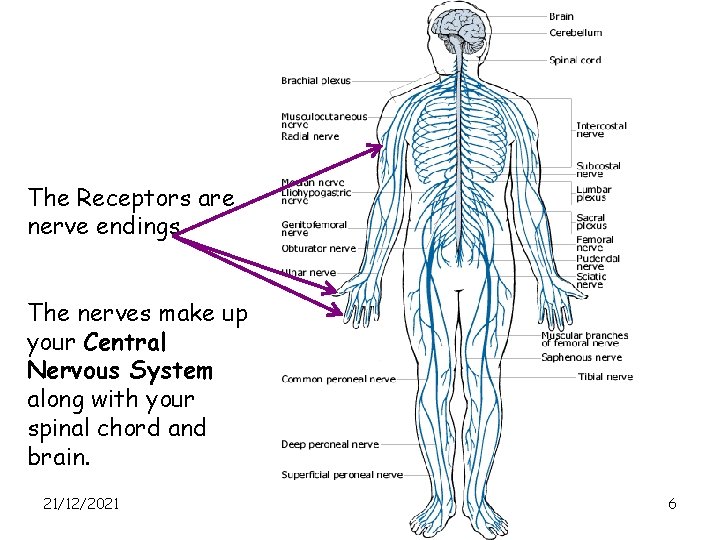
The Receptors are nerve endings. The nerves make up your Central Nervous System along with your spinal chord and brain. 21/12/2021 6

Retina – receives the image The Retina is at the back of your eye. It is full of light receptors which are sensitive to; Colour & Light levels 21/12/2021 Fovea Optic Nerve The Fovea is the main focal point and it has the greatest density of light receptors 7
Information from receptors passes along cells (neurones) in nerves to the brain. The brain coordinates the response. 21/12/2021 8
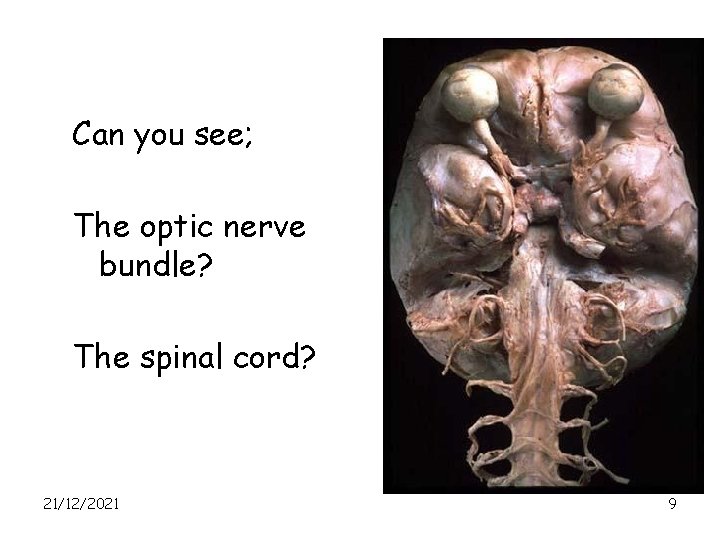
Can you see; The optic nerve bundle? The spinal cord? 21/12/2021 9
Nerve Cells Nerve cells are highly specialised. Their structure is directly linked to their function 21/12/2021 10
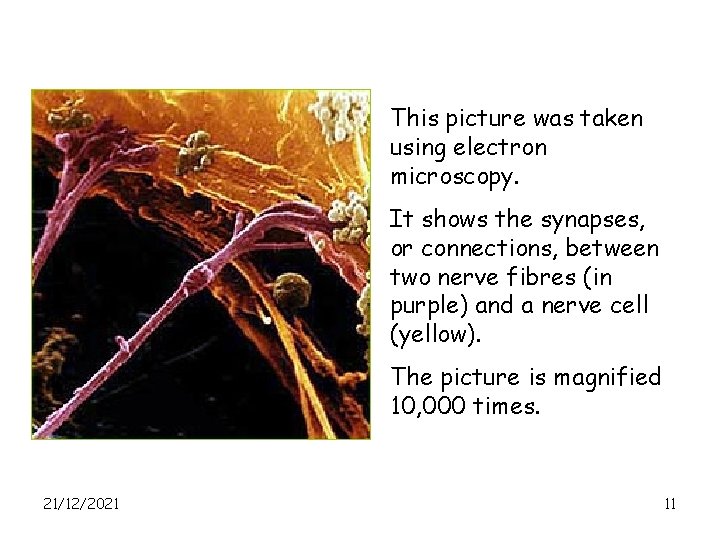
This picture was taken using electron microscopy. It shows the synapses, or connections, between two nerve fibres (in purple) and a nerve cell (yellow). The picture is magnified 10, 000 times. 21/12/2021 11
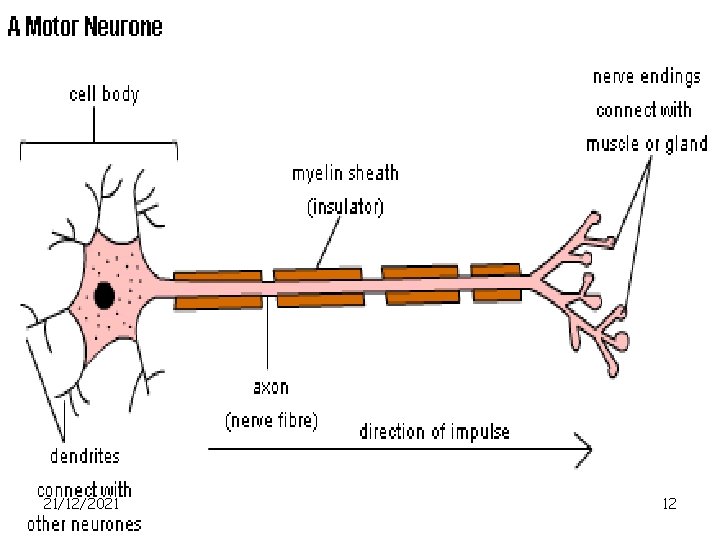
21/12/2021 12
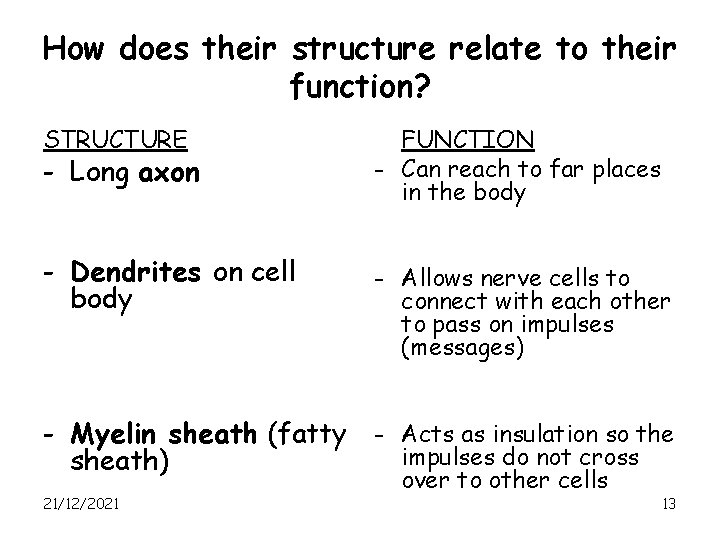
How does their structure relate to their function? STRUCTURE FUNCTION - Can reach to far places in the body - Dendrites on cell body - Allows nerve cells to connect with each other to pass on impulses (messages) - Long axon - Myelin sheath (fatty - Acts as insulation so the impulses do not cross sheath) 21/12/2021 over to other cells 13
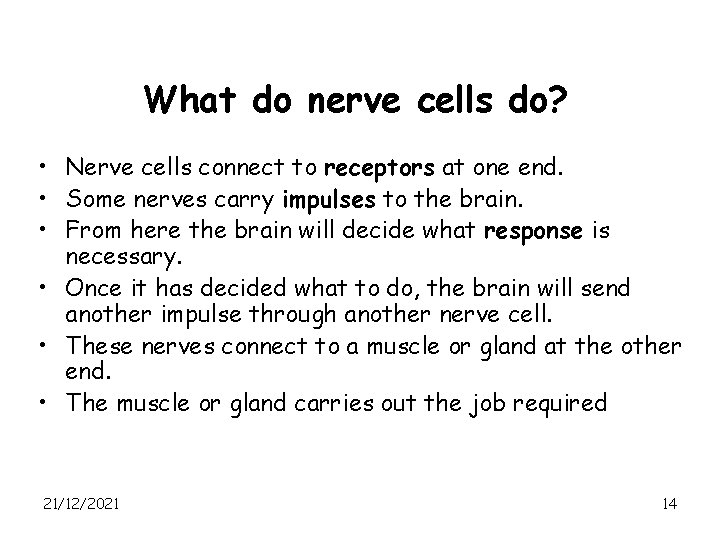
What do nerve cells do? • Nerve cells connect to receptors at one end. • Some nerves carry impulses to the brain. • From here the brain will decide what response is necessary. • Once it has decided what to do, the brain will send another impulse through another nerve cell. • These nerves connect to a muscle or gland at the other end. • The muscle or gland carries out the job required 21/12/2021 14
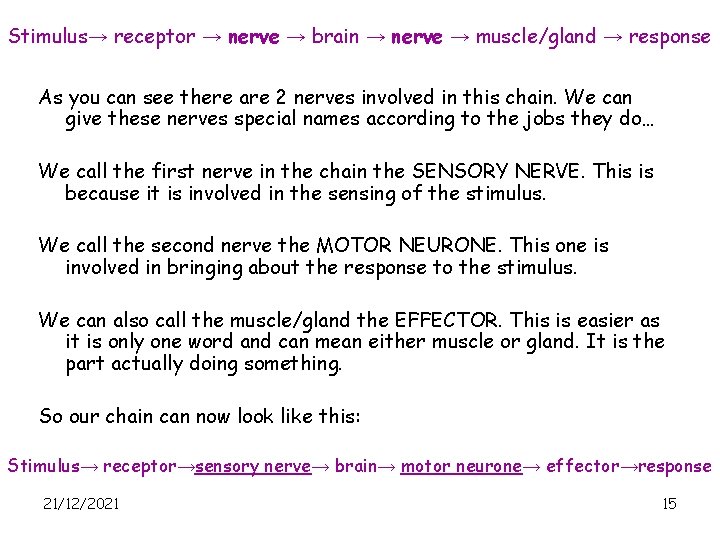
Stimulus→ receptor → nerve → brain → nerve → muscle/gland → response As you can see there are 2 nerves involved in this chain. We can give these nerves special names according to the jobs they do… We call the first nerve in the chain the SENSORY NERVE. This is because it is involved in the sensing of the stimulus. We call the second nerve the MOTOR NEURONE. This one is involved in bringing about the response to the stimulus. We can also call the muscle/gland the EFFECTOR. This is easier as it is only one word and can mean either muscle or gland. It is the part actually doing something. So our chain can now look like this: Stimulus→ receptor→sensory nerve→ brain→ motor neurone→ effector→response 21/12/2021 15
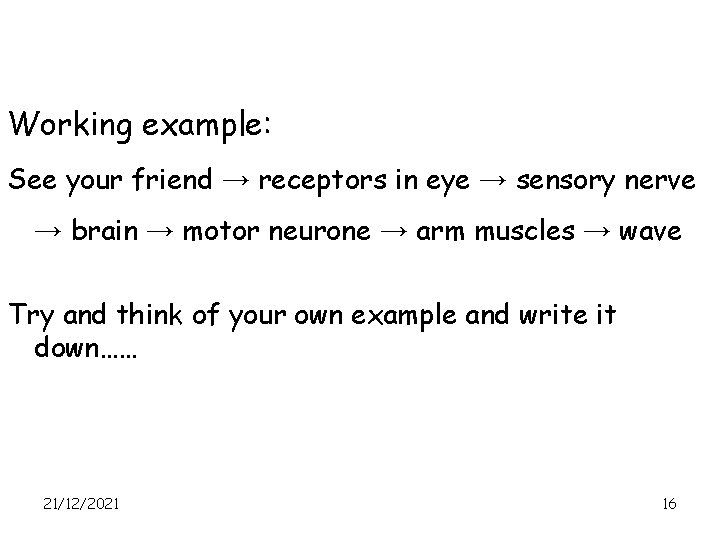
Working example: See your friend → receptors in eye → sensory nerve → brain → motor neurone → arm muscles → wave Try and think of your own example and write it down…… 21/12/2021 16
Reflex actions are automatic and rapid. They often involve sensory, relay and motor neurones. You need to know the role of receptors, sensory neurones, motor neurones, relay neurones, synapses and effectors in simple reflex actions. 21/12/2021 17
Reflexes • Some responses need to be really, really quick. We need to be able to do this without thinking. • If we are in danger of harming ourselves we would need to act without thinking about what to do. • We call this a reflex. It is like an action that is already programmed into our nervous systems: it happens automatically. • With reflexes the sensory nerves do not travel all the way to the brain. This would take too long if we were in danger. • Instead the impulses are taken to the spinal cord as it is closer. • Look at the next diagram and label your own. 21/12/2021 18
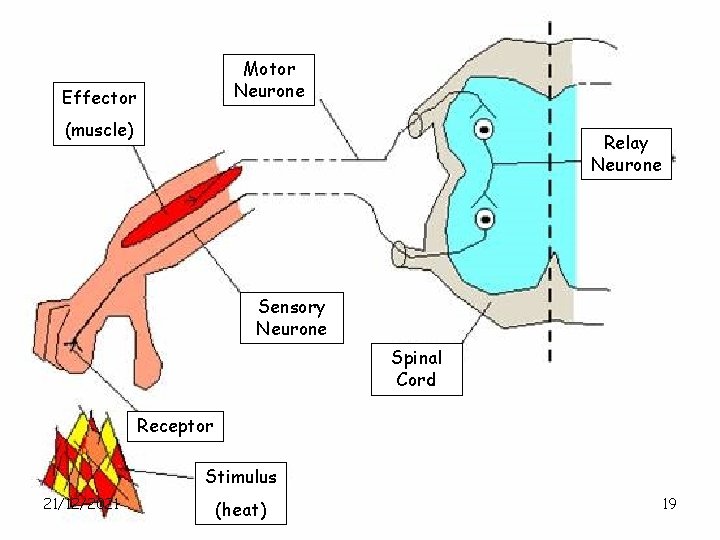
Motor Neurone Effector (muscle) Relay Neurone Sensory Neurone Spinal Cord Receptor Stimulus 21/12/2021 (heat) 19
Activity • Write down as many reflex actions as you can think of…. . • Write out the chain of events for a reflex like the chain we went through before. Pick a specific type of reflex from your list and write out the chain. 21/12/2021 20
Questions 1) What do these words mean: - stimulus - response - effector 2) What is the special name given to the nerve that carries the impulse from the receptor to the brain or spinal cord? 3) What is the special name given to the nerve that carries the impulse from the brain or spinal cord to the effector? 4) What is the name given to the brain and spinal cord together? 5) Write the chain of events for the following scenario: A silly year 11 boy has just thrown a pen towards a year 7 boys face. What does the year 7 boy do? 21/12/2021 21
Link to past paper questions Link to answers 21/12/2021 22
- Slides: 22