
Nerve physiology 4 rd lecture By Dr Mudassar
Nerve physiology 4 rd lecture By Dr. Mudassar Ali Roomi (MBBS, M. Phil) January 23, 2022 1

ORTHODROMIC & ANTIDROMIC CONDUCTION • An axon can conduct in either direction. • In vitro, when an action potential is initiated in the middle of nerve fiber, two impulses travel in opposite directions. • In the natural situation, impulses pass in one direction only, i. e. from synaptic junctions or receptors along axons to their termination. Such a conduction is called orthodromic conduction. • Conduction in the opposite direction is called antidromic conduction. • Because synapses, unlike axons, permit conduction in one direction only, an antidromic impulse will fail to pass the first synapse they encounter and die out at that point (law of forward conduction). January 23, 2022 2

Properties of nerve fibers Nerve fiber has many properties: 1. Excitability: The units of excitability are: • • Rheobase Chronaxie 2. Conductivity i. e. propagation of nerve impulse 3. Refractory period 4. All or none law (all or nothing principle) January 23, 2022 3

biphasic action potential • • • If both electrodes are placed on the surface of the axon, there is no potential difference between them at rest. When the nerve is stimulated an impulse is conducted past the two electrodes, a characteristic sequence of potential changes results. As the wave of depolarization reaches the electrode nearest the stimulator, this electrode becomes negative relative to the other electrode. When the impulse passes to the portion of the nerve between the two electrodes, the potential returns to zero, and then, as it passes the second electrode, the first electrode becomes positive relative to the second. This sequence is called a biphasic action potential. January 23, 2022 4
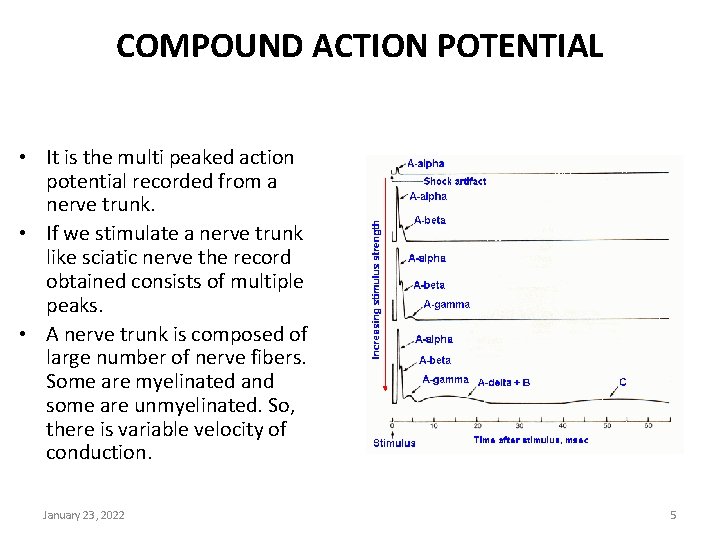
COMPOUND ACTION POTENTIAL • It is the multi peaked action potential recorded from a nerve trunk. • If we stimulate a nerve trunk like sciatic nerve the record obtained consists of multiple peaks. • A nerve trunk is composed of large number of nerve fibers. Some are myelinated and some are unmyelinated. So, there is variable velocity of conduction. January 23, 2022 5

COMPOUND ACTION POTENTIAL (cont…) • The recording electrode will record the action potential first from the fastest fiber and then from slow fibers leading to multipeaked record formation. • 3 main peaks: A, B, C. • A peak is further divided into alpha, beta, gamma, delta. • A & B types are myelinated & C type is unmyelinated. • Compound action potential is basis of physiological classification of nerve fibers. January 23, 2022 6

Electrophysiologic classification of nerve fibers January 23, 2022 7

Sensory classification of nerve fibers January 23, 2022 8
- Slides: 8