
Nerve Excitation Biophysics Neurons Motor neuron Sensory neuron
Nerve Excitation Biophysics
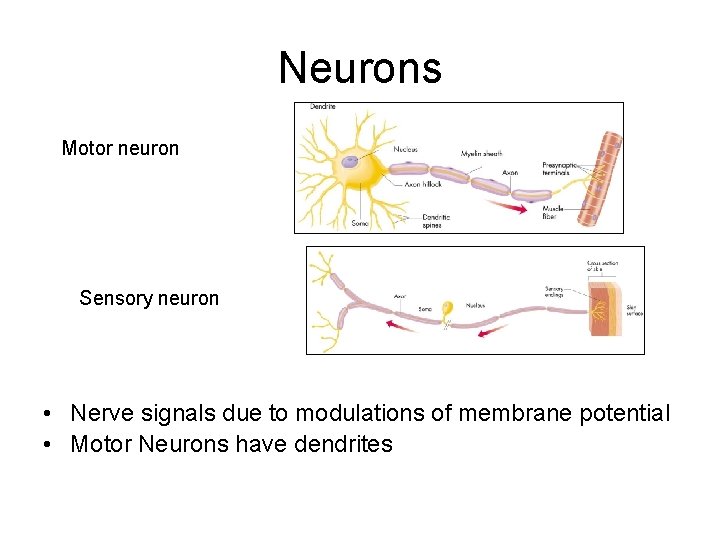
Neurons Motor neuron Sensory neuron • Nerve signals due to modulations of membrane potential • Motor Neurons have dendrites
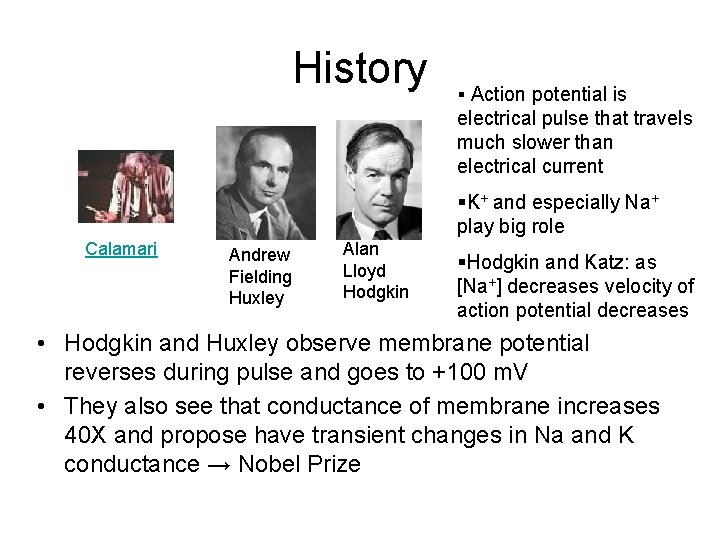
History § Action potential is electrical pulse that travels much slower than electrical current §K+ and especially Na+ play big role Calamari Andrew Fielding Huxley Alan Lloyd Hodgkin §Hodgkin and Katz: as [Na+] decreases velocity of action potential decreases • Hodgkin and Huxley observe membrane potential reverses during pulse and goes to +100 m. V • They also see that conductance of membrane increases 40 X and propose have transient changes in Na and K conductance → Nobel Prize
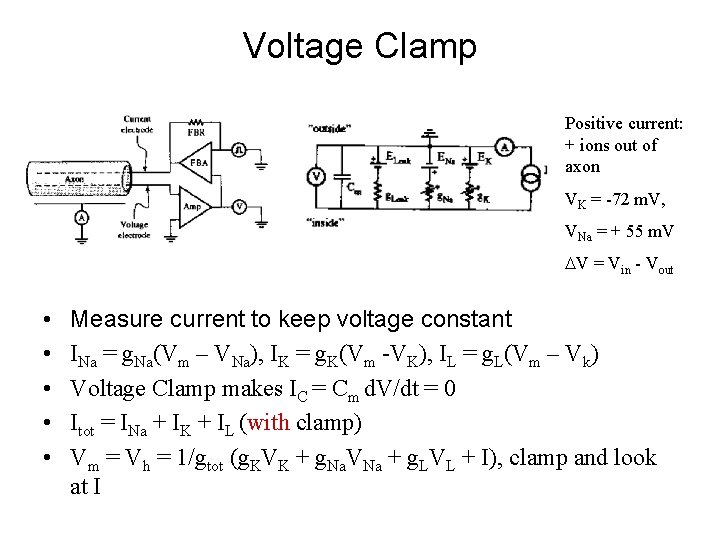
Voltage Clamp Positive current: + ions out of axon VK = -72 m. V, VNa = + 55 m. V DV = Vin - Vout • • • Measure current to keep voltage constant INa = g. Na(Vm – VNa), IK = g. K(Vm -VK), IL = g. L(Vm – Vk) Voltage Clamp makes IC = Cm d. V/dt = 0 Itot = INa + IK + IL (with clamp) Vm = Vh = 1/gtot (g. KVK + g. Na. VNa + g. LVL + I), clamp and look at I
Voltage Clamp experiments • Set concentrations of ions so can get Nernst potentials equal membrane potential and reduce variables • g. Na, g. K ~ 0 at resting potential and they are only activated when the axon is depolarized (becomes less negative). H&H get g. L when hyperpolarize • I = IL = g. L (Vm – VL), VL < Vresting (-60 m. V)
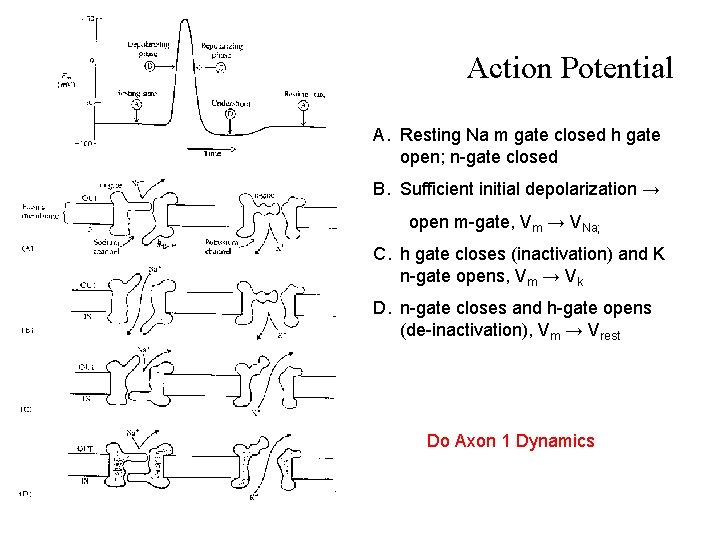
Action Potential A. Resting Na m gate closed h gate open; n-gate closed B. Sufficient initial depolarization → open m-gate, Vm → VNa; h C. h gate closes (inactivation) and K n-gate opens, Vm → Vk D. n-gate closes and h-gate opens (de-inactivation), Vm → Vrest Do Axon 1 Dynamics
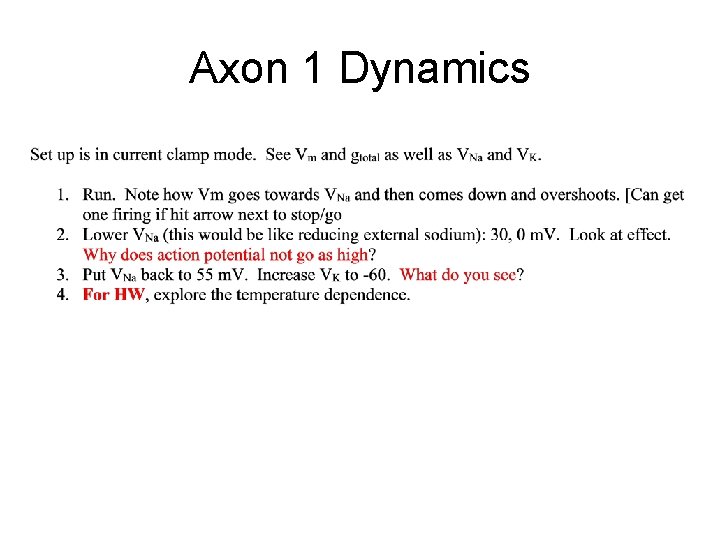
Axon 1 Dynamics
H&H Voltage Clamp experiments • When depolarize, get early negative current and later positive current • As DV increases • Amplitude of Ineg decreases; DV = 115 have Ineg = 0; DV > 115 have early positive current • Rate of current development increases (both + and -) • Switch from negative current to positive gets earlier • Note: VK = -72 m. V, VNa = +55 m. V, Vresting = -60 m. V; INa = g. Na(Vm – VNa), IK = g. K(Vm – VK) • So IK always positive; INa negative for small DV but becomes positive for DV>115 m. V • I reversal could be due to cessation of early I- or stronger/earlier I+ • H&H isolate currents by setting Vm = VNa so get voltage dependence of IK • Deduce voltage dependence of INa since Itot = INa + IK
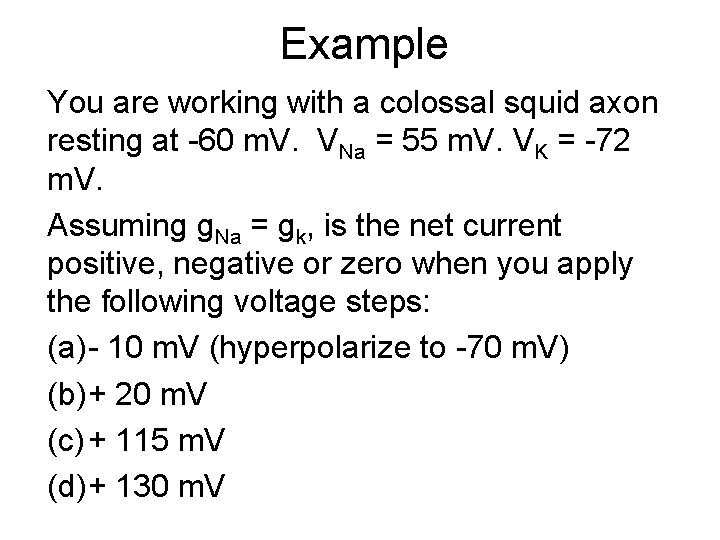
Example You are working with a colossal squid axon resting at -60 m. V. VNa = 55 m. V. VK = -72 m. V. Assuming g. Na = gk, is the net current positive, negative or zero when you apply the following voltage steps: (a)- 10 m. V (hyperpolarize to -70 m. V) (b)+ 20 m. V (c) + 115 m. V (d)+ 130 m. V
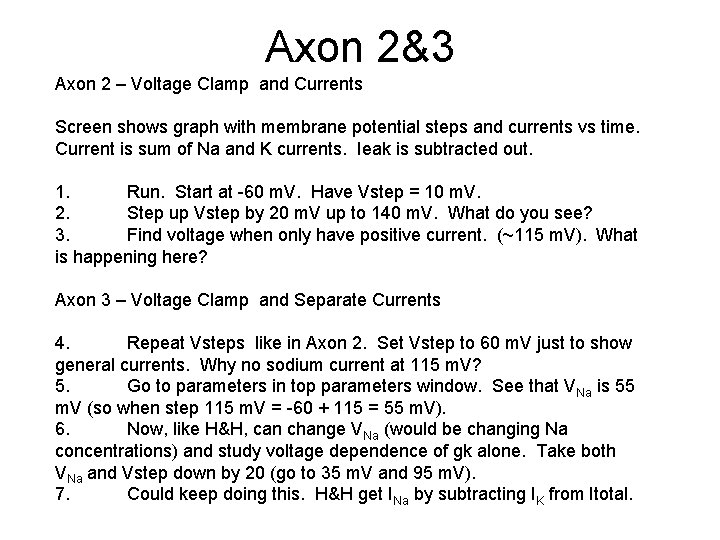
Axon 2&3 Axon 2 – Voltage Clamp and Currents Screen shows graph with membrane potential steps and currents vs time. Current is sum of Na and K currents. Ieak is subtracted out. 1. Run. Start at -60 m. V. Have Vstep = 10 m. V. 2. Step up Vstep by 20 m. V up to 140 m. V. What do you see? 3. Find voltage when only have positive current. (~115 m. V). What is happening here? Axon 3 – Voltage Clamp and Separate Currents 4. Repeat Vsteps like in Axon 2. Set Vstep to 60 m. V just to show general currents. Why no sodium current at 115 m. V? 5. Go to parameters in top parameters window. See that VNa is 55 m. V (so when step 115 m. V = -60 + 115 = 55 m. V). 6. Now, like H&H, can change VNa (would be changing Na concentrations) and study voltage dependence of gk alone. Take both VNa and Vstep down by 20 (go to 35 m. V and 95 m. V). 7. Could keep doing this. H&H get INa by subtracting IK from Itotal.
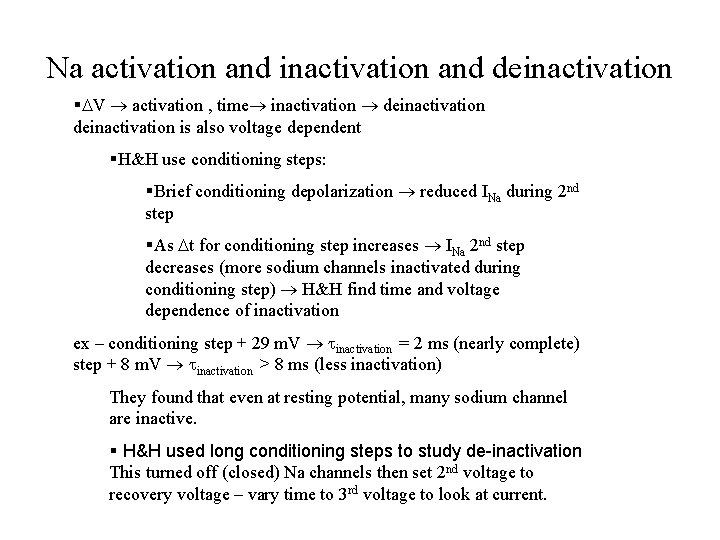
Na activation and inactivation and deinactivation §DV activation , time inactivation deinactivation is also voltage dependent §H&H use conditioning steps: §Brief conditioning depolarization reduced INa during 2 nd step §As Dt for conditioning step increases INa 2 nd step decreases (more sodium channels inactivated during conditioning step) H&H find time and voltage dependence of inactivation ex – conditioning step + 29 m. V tinactivation = 2 ms (nearly complete) step + 8 m. V tinactivation > 8 ms (less inactivation) They found that even at resting potential, many sodium channel are inactive. § H&H used long conditioning steps to study de-inactivation This turned off (closed) Na channels then set 2 nd voltage to recovery voltage – vary time to 3 rd voltage to look at current.
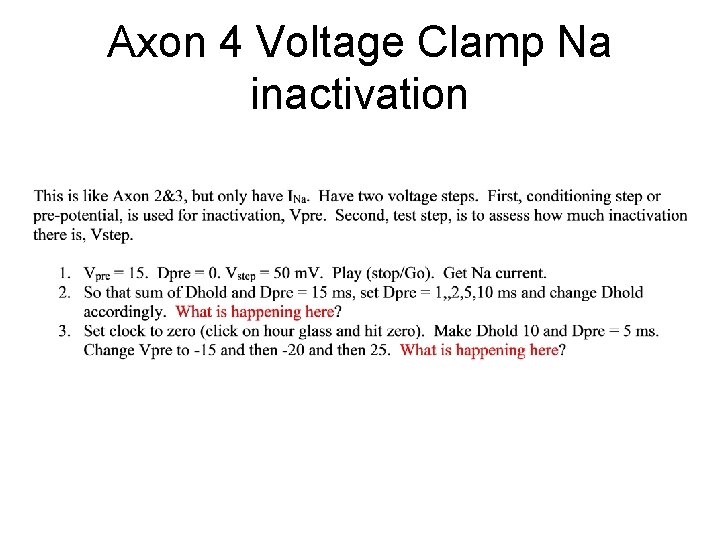
Axon 4 Voltage Clamp Na inactivation
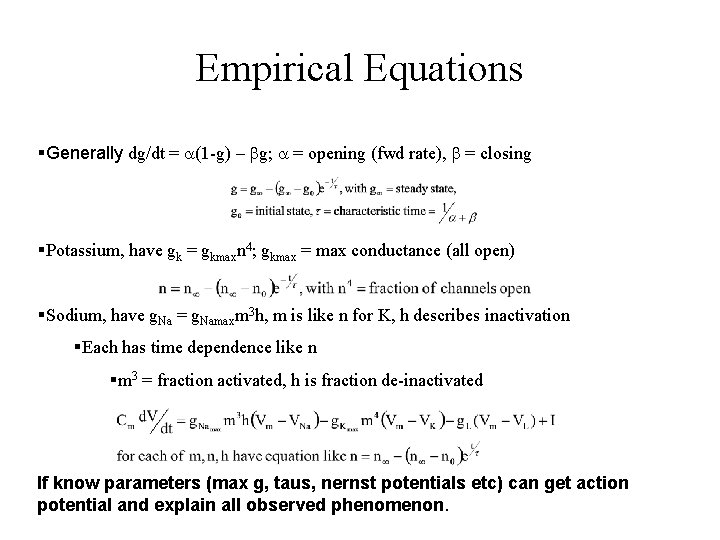
Empirical Equations §Generally dg/dt = a(1 -g) – bg; a = opening (fwd rate), b = closing §Potassium, have gk = gkmaxn 4; gkmax = max conductance (all open) §Sodium, have g. Na = g. Namaxm 3 h, m is like n for K, h describes inactivation §Each has time dependence like n §m 3 = fraction activated, h is fraction de-inactivated If know parameters (max g, taus, nernst potentials etc) can get action potential and explain all observed phenomenon.
Axon 5 Na K conductances This is like previous exercises except, now look at conductances which you would get from the currents divided by the potential. Remember can get g from I = g. V. 1. Play. Have 10 m. V Vstep. See nothing in g. Na and small effect on g. K. 2. Increase step 30, 50 , 70, 115 [Vstep in middle parameter – increase]. What is happening here? Why is g. NA so high when Vm = VNa (Vstep = 115 mv) even though we saw there is no current then?
Axon 6 Current clamp Summary Hit Stop/Go Explain what you see.
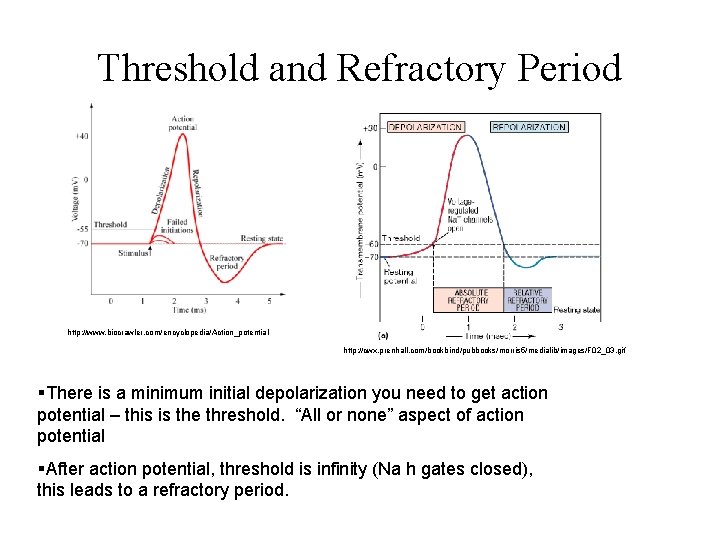
Threshold and Refractory Period http: //www. biocrawler. com/encyclopedia/Action_potential http: //cwx. prenhall. com/bookbind/pubbooks/morris 5/medialib/images/F 02_03. gif §There is a minimum initial depolarization you need to get action potential – this is the threshold. “All or none” aspect of action potential §After action potential, threshold is infinity (Na h gates closed), this leads to a refractory period.
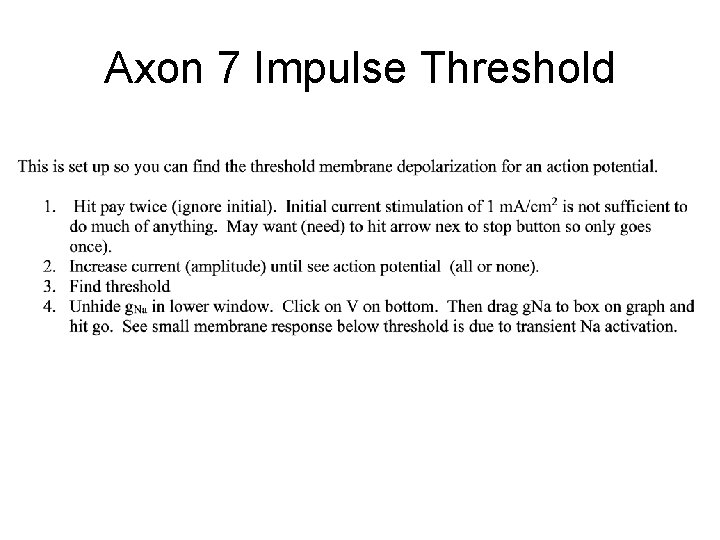
Axon 7 Impulse Threshold
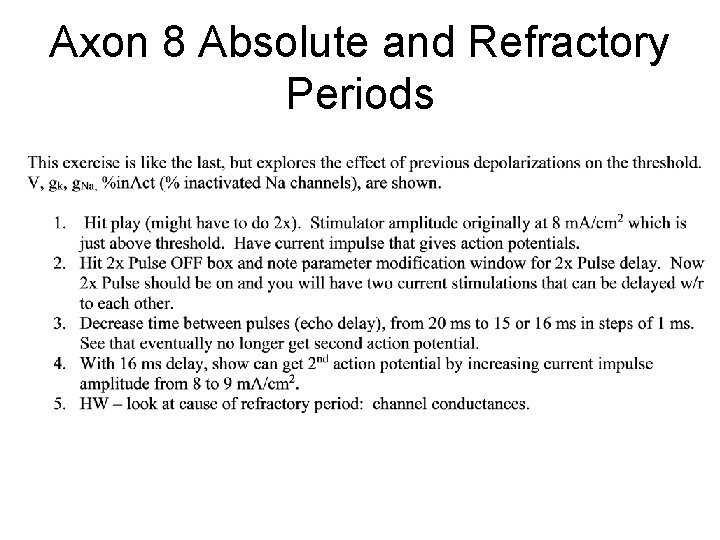
Axon 8 Absolute and Refractory Periods
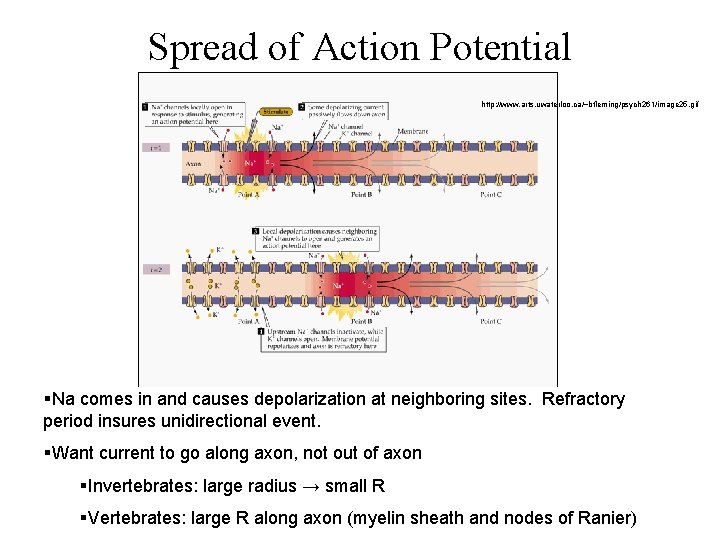
Spread of Action Potential http: //www. arts. uwaterloo. ca/~bfleming/psych 261/image 25. gif §Na comes in and causes depolarization at neighboring sites. Refractory period insures unidirectional event. §Want current to go along axon, not out of axon §Invertebrates: large radius → small R §Vertebrates: large R along axon (myelin sheath and nodes of Ranier)
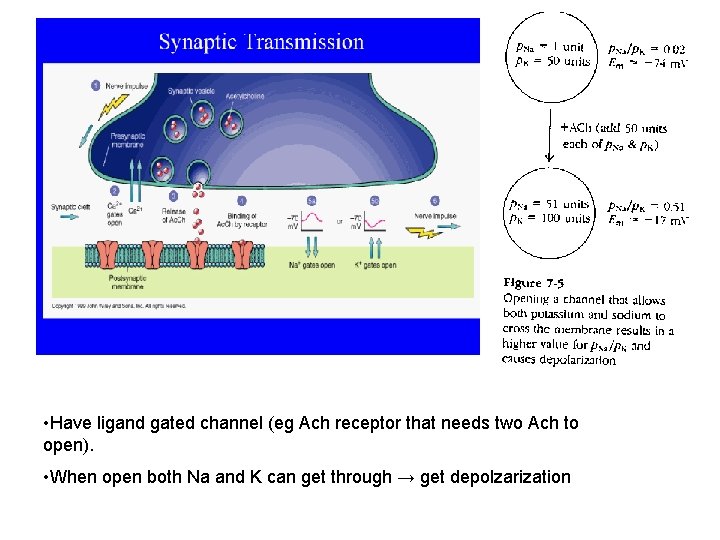
• Have ligand gated channel (eg Ach receptor that needs two Ach to open). • When open both Na and K can get through → get depolzarization
- Slides: 20