
Nerve Conduction Study NCS and Electromyography EMG Red
- Slides: 30
Nerve Conduction Study (NCS) and Electromyography ( EMG) Red: very important. Green: Doctor’s notes. Yellow: numbers. Gray: notes and explanation. Physiology Team 436 – Musculoskeletal Block Lecture 5 1 Lecture: If work is intended for initial studying. Review: If work is intended for revision.
Objectives o o 2 Define what is nerve conduction study (NCS) and electromyography (EMG). Explain the procedure of NCS using Abductor Pollicis Brevis muscle. Define the normal conduction velocity in upper limb and lower limb nerves. Define the motor unit potentials ( MUPs) and how they are changed in muscle and nerve diseases.
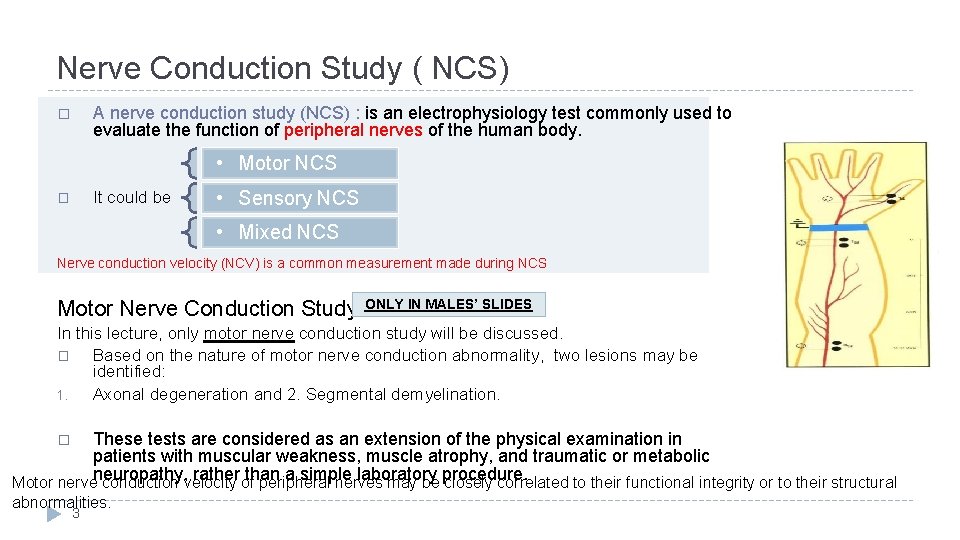
Nerve Conduction Study ( NCS) A nerve conduction study (NCS) : is an electrophysiology test commonly used to evaluate the function of peripheral nerves of the human body. � • Motor NCS It could be � • Sensory NCS • Mixed NCS Nerve conduction velocity (NCV) is a common measurement made during NCS Motor Nerve Conduction Study ONLY IN MALES’ SLIDES In this lecture, only motor nerve conduction study will be discussed. � Based on the nature of motor nerve conduction abnormality, two lesions may be identified: 1. Axonal degeneration and 2. Segmental demyelination. These tests are considered as an extension of the physical examination in patients with muscular weakness, muscle atrophy, and traumatic or metabolic neuropathy, rather than a simple laboratory procedure. Motor nerve conduction velocity of peripheral nerves may be closely correlated to their functional integrity or to their structural � abnormalities. 3
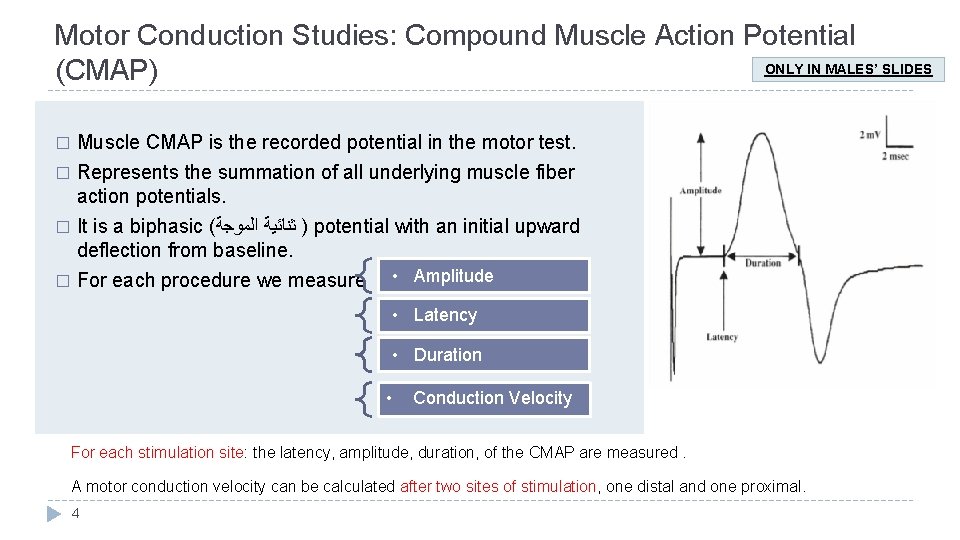
Motor Conduction Studies: Compound Muscle Action Potential ONLY IN MALES’ SLIDES (CMAP) � Muscle CMAP is the recorded potential in the motor test. Represents the summation of all underlying muscle fiber action potentials. � It is a biphasic ( ) ﺛﻨﺎﺋﻴﺔ ﺍﻟﻤﻮﺟﺔ potential with an initial upward deflection from baseline. • Amplitude � For each procedure we measure � • Latency • Duration • Conduction Velocity For each stimulation site: the latency, amplitude, duration, of the CMAP are measured. A motor conduction velocity can be calculated after two sites of stimulation, one distal and one proximal. 4
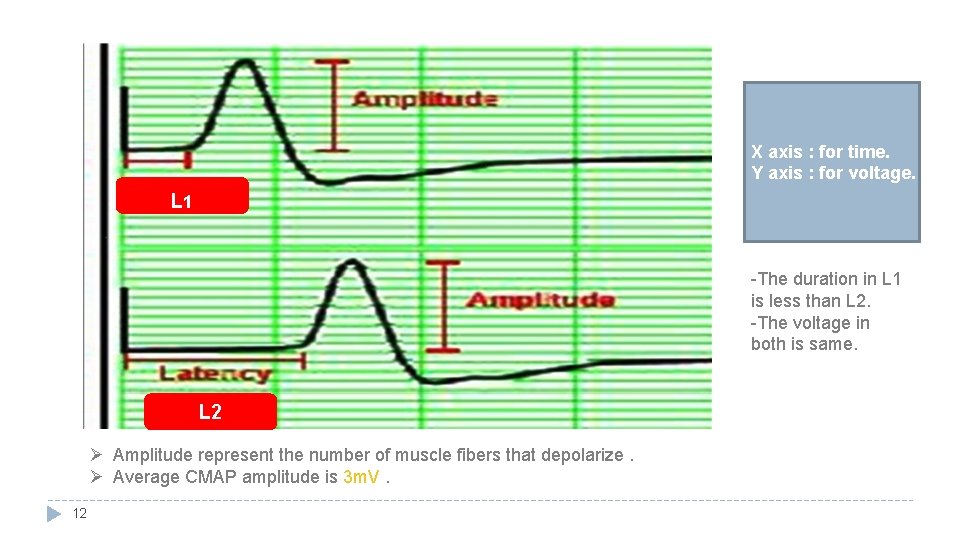
Important Notes: ONLY IN MALES’ SLIDES Amplitude Conduction Velocity • it is most commonly measured from baseline to the peak (baseline-to-peak) and less commonly from the first upward peak to the next downward peak (peak-to-peak). • It’s measurement of the speed of the fastest conducting nerve axons CMAP amplitude reflects the number of muscle fibers that depolarize. • low CMAP amplitudes most often result from loss of axons (as in a typical axonal neuropathy) • average CMAP amplitude 3 mv • It is calculated by dividing the change in distance (between proximal stimulation site & distal stimulation site in mm) by the change in time (proximal latency in milliseconds (ms) minus distal latency in ms) Latency Duration • The latency is the time from the stimulus to the initial deflection from baseline • Latency measurements usually are made in milliseconds (ms). • This is measured from the initial deflection from baseline to the final return • Duration characteristically increases in conditions that result in slowing of some motor fibers (e. g. , in a demyelinating lesion). 5
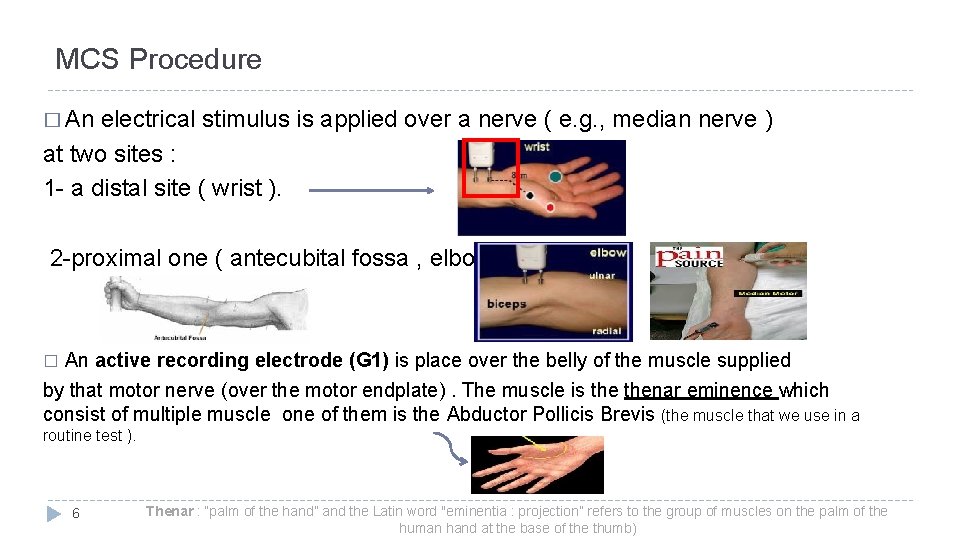
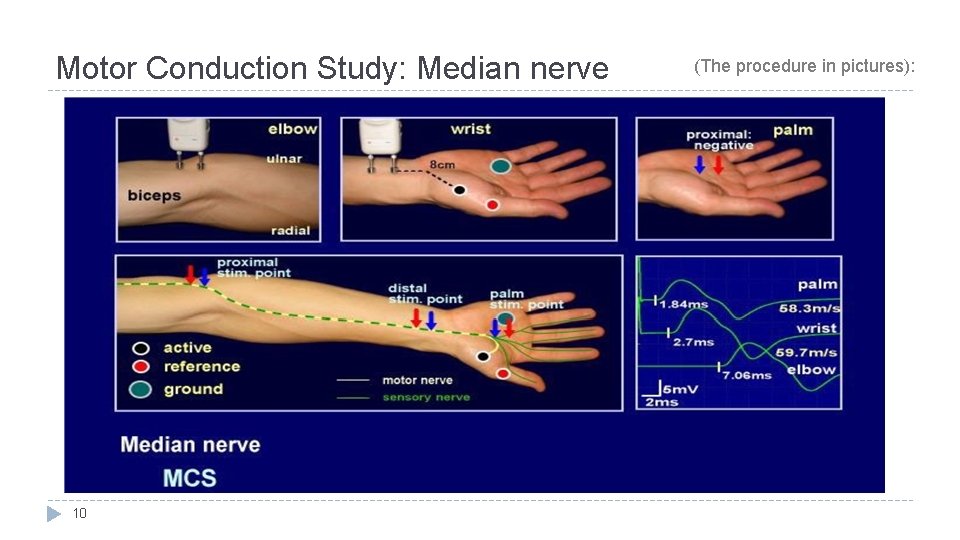
MCS Procedure � An electrical stimulus is applied over a nerve ( e. g. , median nerve ) at two sites : 1 - a distal site ( wrist ). 2 -proximal one ( antecubital fossa , elbow). An active recording electrode (G 1) is place over the belly of the muscle supplied by that motor nerve (over the motor endplate). The muscle is thenar eminence which consist of multiple muscle one of them is the Abductor Pollicis Brevis (the muscle that we use in a � routine test ). 6 Thenar : “palm of the hand” and the Latin word "eminentia : projection” refers to the group of muscles on the palm of the human hand at the base of the thumb)
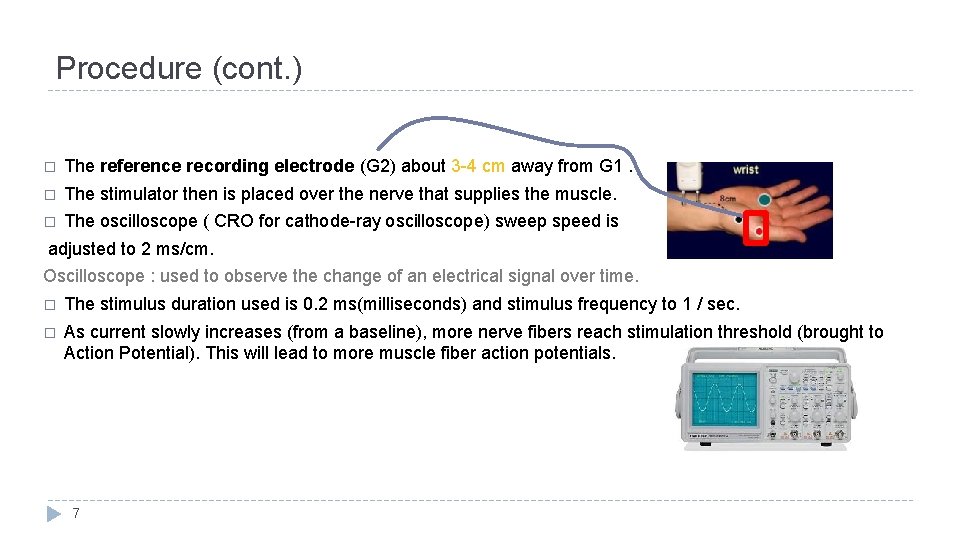
Procedure (cont. ) � The reference recording electrode (G 2) about 3 -4 cm away from G 1. � The stimulator then is placed over the nerve that supplies the muscle. � The oscilloscope ( CRO for cathode-ray oscilloscope) sweep speed is adjusted to 2 ms/cm. Oscilloscope : used to observe the change of an electrical signal over time. � The stimulus duration used is 0. 2 ms(milliseconds) and stimulus frequency to 1 / sec. � As current slowly increases (from a baseline), more nerve fibers reach stimulation threshold (brought to Action Potential). This will lead to more muscle fiber action potentials. 7
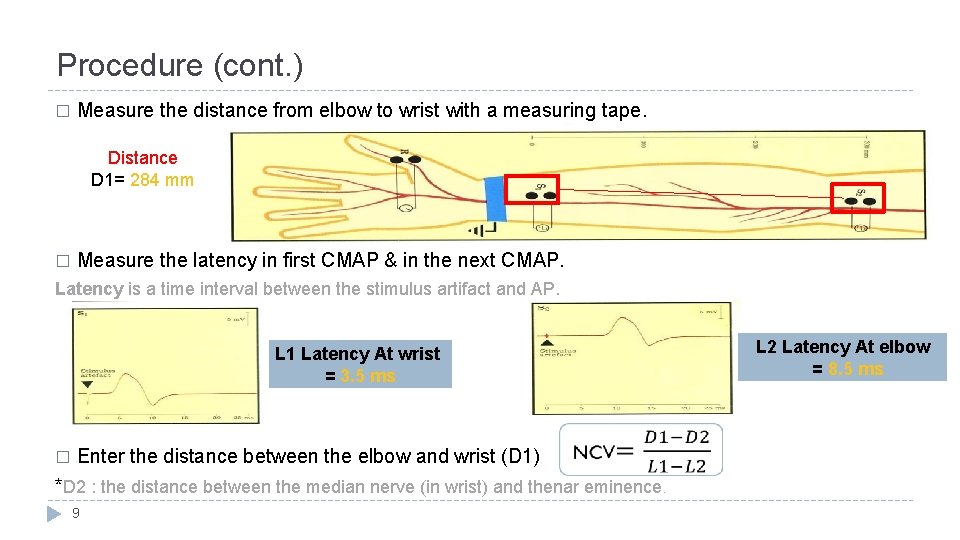
Procedure (cont. ) � Most nerves require a current in the range from 20 to 50 m. A to achieve supramaximal stimulation. � When the current reaches the point where CMAP no longer increases, we assume reaching the supramaximal stimulation. The current is increased by 20% to be sure. � 1 - Apply the stimulus and record the response from stimulation at the wrist. � Store the CMAP ( compound muscle action potential ) in the first channel of the oscilloscope. � 2 - Change the stimulating site from wrist to antecubital fossa ( elbow ). � Stimulate the nerve & record the CMAP for median nerve stimulation at the elbow. 8
Procedure (cont. ) � Measure the distance from elbow to wrist with a measuring tape. Distance D 1= 284 mm � Measure the latency in first CMAP & in the next CMAP. Latency is a time interval between the stimulus artifact and AP. L 1 Latency At wrist = 3. 5 ms � Enter the distance between the elbow and wrist (D 1) *D 2 : the distance between the median nerve (in wrist) and thenar eminence. 9 L 2 Latency At elbow = 8. 5 ms
Motor Conduction Study: Median nerve 10 (The procedure in pictures):
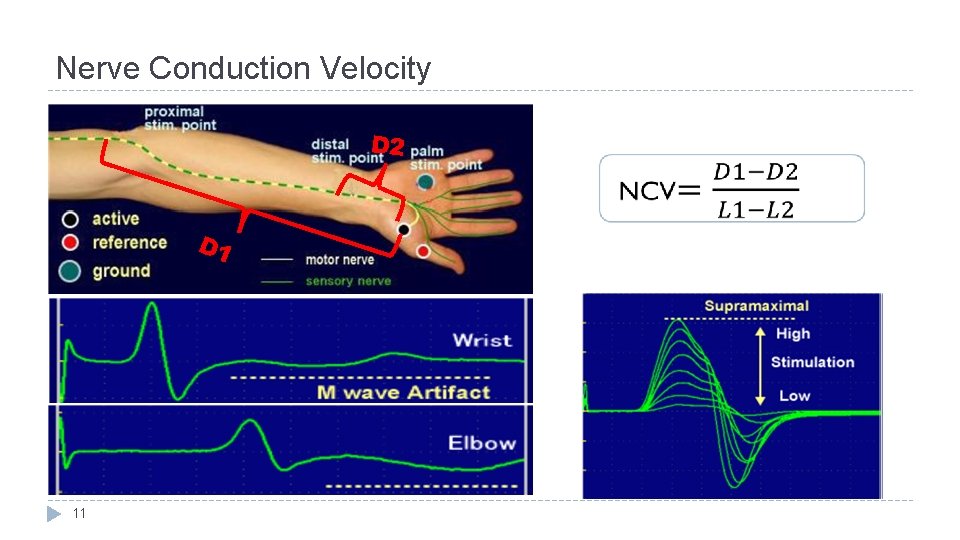
Nerve Conduction Velocity D 2 D 1 11
X axis : for time. Y axis : for voltage. L 1 -The duration in L 1 is less than L 2. -The voltage in both is same. L 2 Ø Amplitude represent the number of muscle fibers that depolarize. Ø Average CMAP amplitude is 3 m. V. 12
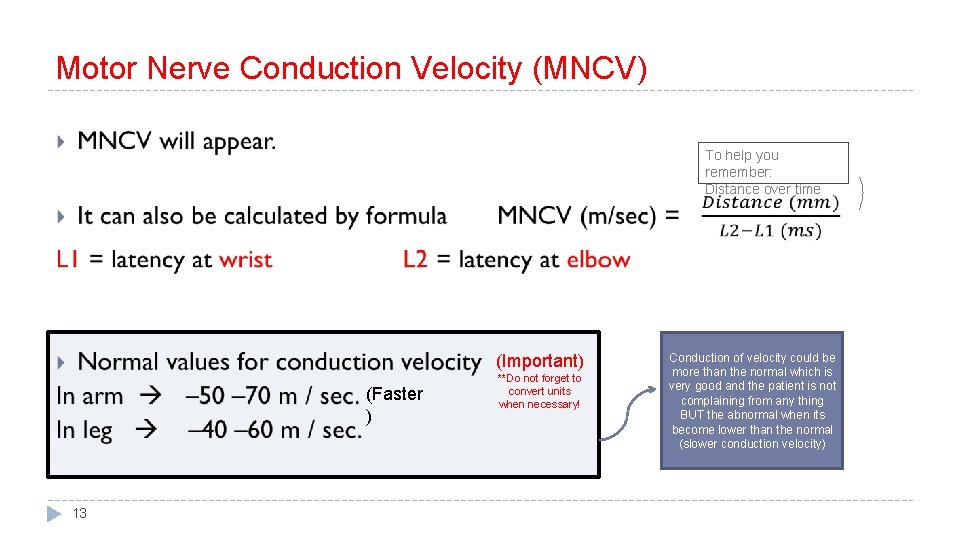
Motor Nerve Conduction Velocity (MNCV) To help you remember: Distance over time (Important) (Faster ) 13 **Do not forget to convert units when necessary! Conduction of velocity could be more than the normal which is very good and the patient is not complaining from any thing BUT the abnormal when its become lower than the normal (slower conduction velocity)
Female Doctor’s Notes on Slide 13 1. You might be asked to calculate the conduction velocity and determine whether or not it is within normal range. 2. The Doctor mentioned that: - Below average: abnormal. - Above average: still considered normal. 14
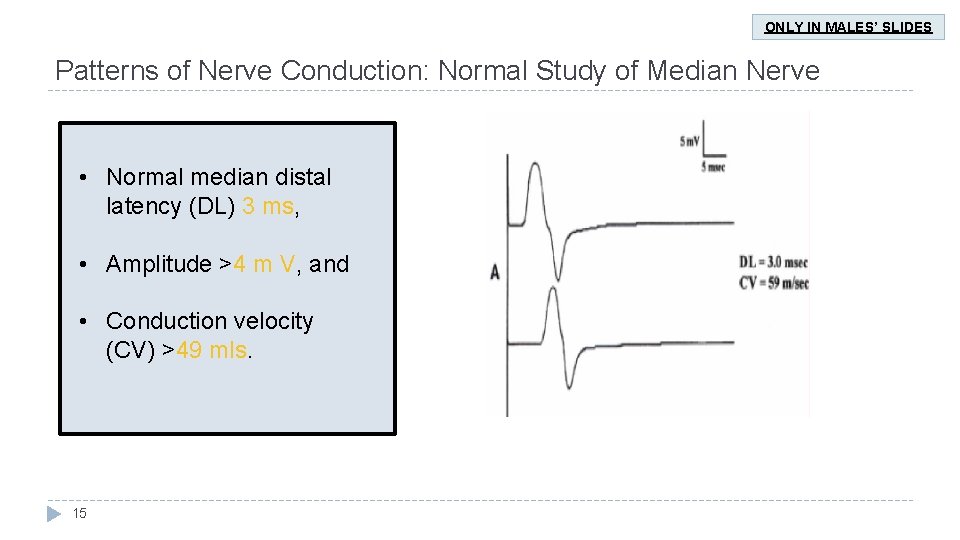
ONLY IN MALES’ SLIDES Patterns of Nerve Conduction: Normal Study of Median Nerve • Normal median distal latency (DL) 3 ms, • Amplitude >4 m V, and • Conduction velocity (CV) >49 mls. 15
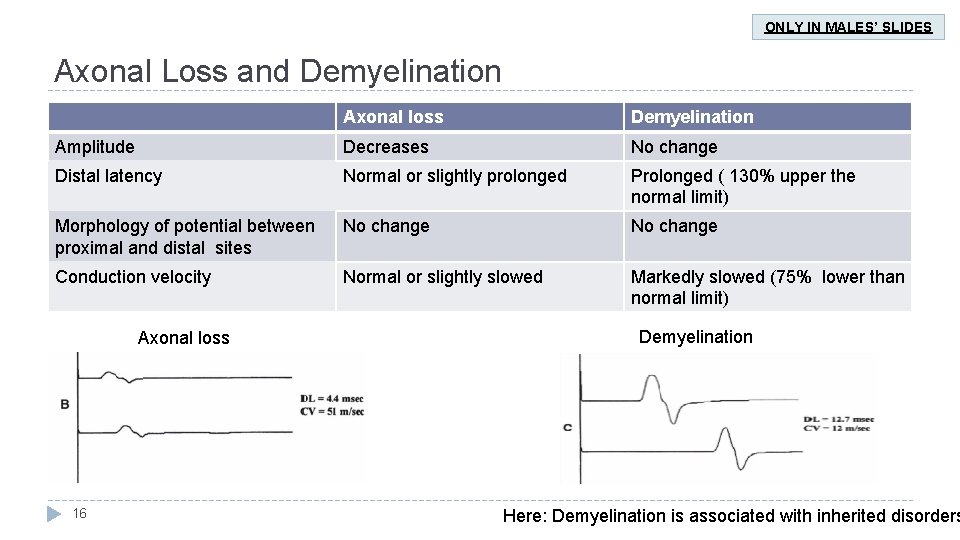
ONLY IN MALES’ SLIDES Axonal Loss and Demyelination Axonal loss Demyelination Amplitude Decreases No change Distal latency Normal or slightly prolonged Prolonged ( 130% upper the normal limit) Morphology of potential between proximal and distal sites No change Conduction velocity Normal or slightly slowed Markedly slowed (75% lower than normal limit) Axonal loss 16 Demyelination Here: Demyelination is associated with inherited disorders
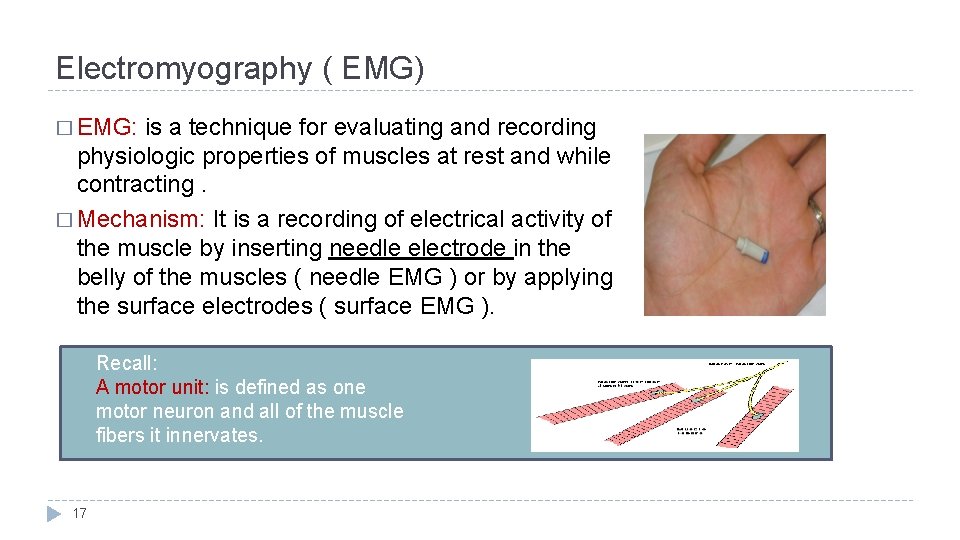
Electromyography ( EMG) � EMG: is a technique for evaluating and recording physiologic properties of muscles at rest and while contracting. � Mechanism: It is a recording of electrical activity of the muscle by inserting needle electrode in the belly of the muscles ( needle EMG ) or by applying the surface electrodes ( surface EMG ). Recall: A motor unit: is defined as one motor neuron and all of the muscle fibers it innervates. 17
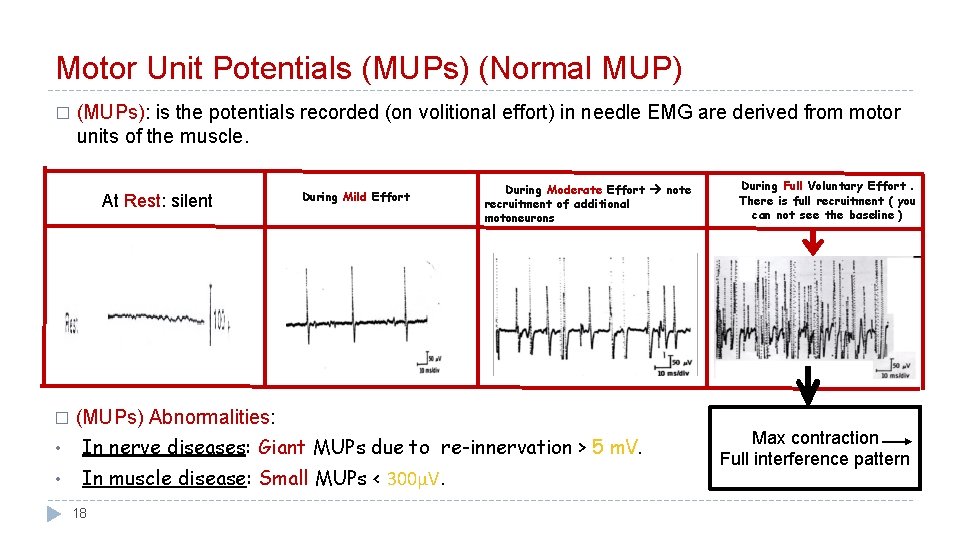
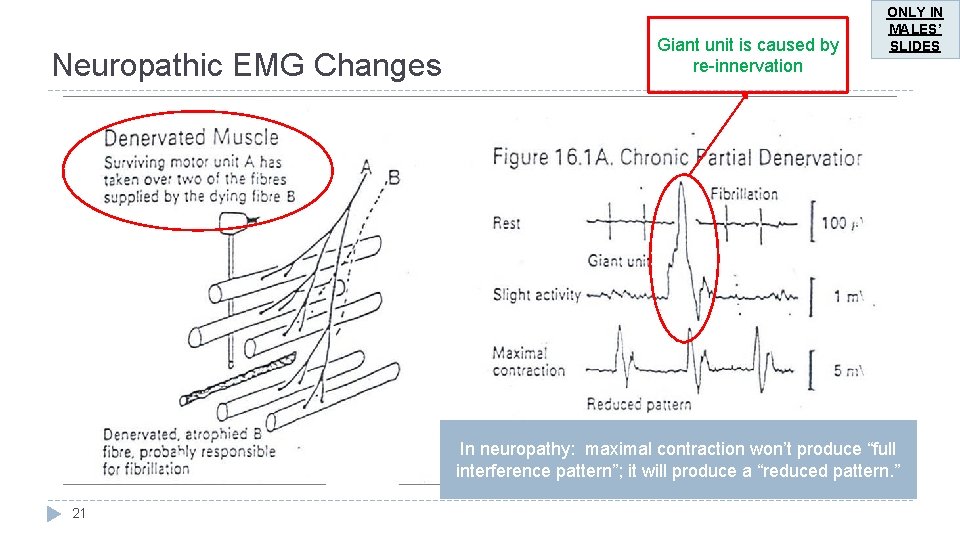
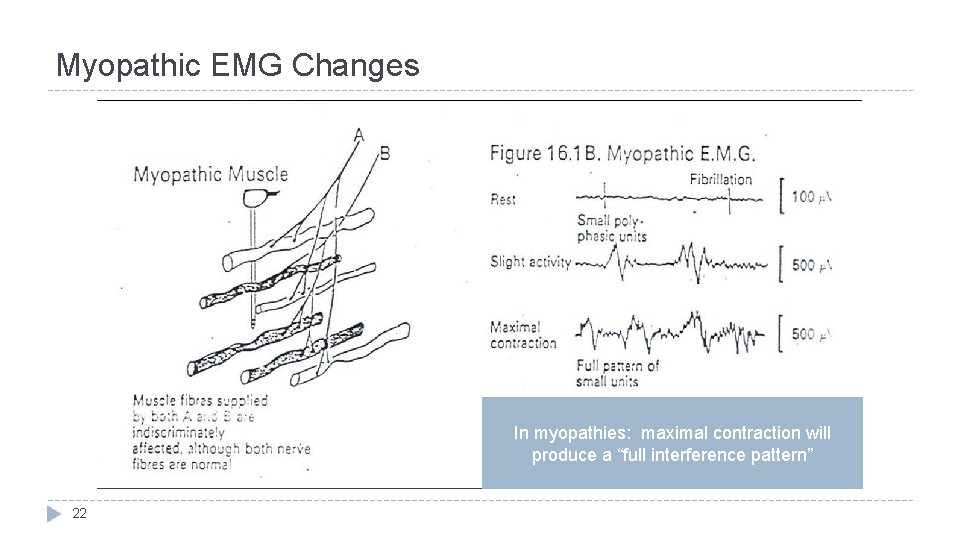
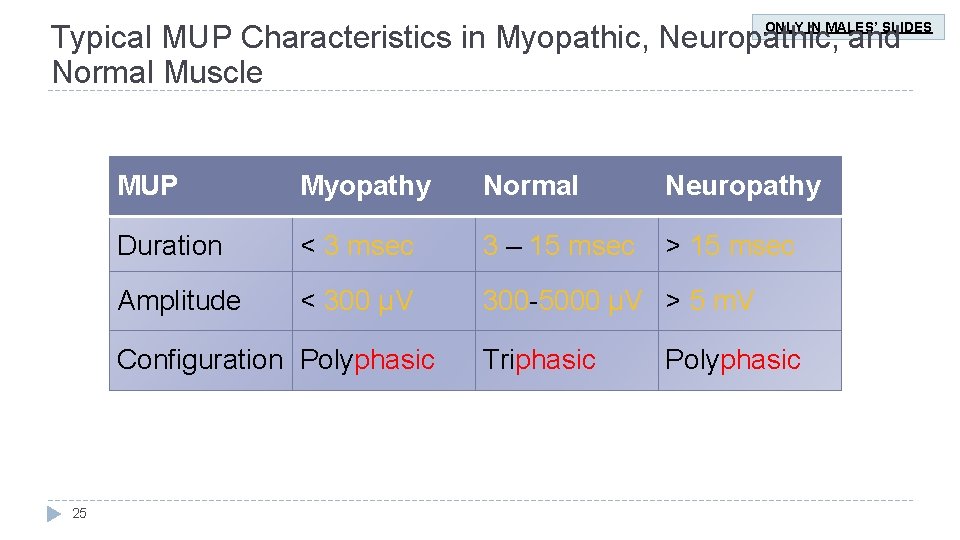
Motor Unit Potentials (MUPs) (Normal MUP) � (MUPs): is the potentials recorded (on volitional effort) in needle EMG are derived from motor units of the muscle. At Rest: silent � • • During Mild Effort During Moderate Effort note recruitment of additional motoneurons (MUPs) Abnormalities: In nerve diseases: Giant MUPs due to re-innervation > 5 m. V. In muscle disease: Small MUPs < 300μV. 18 During Full Voluntary Effort. There is full recruitment ( you can not see the baseline ) Max contraction Full interference pattern
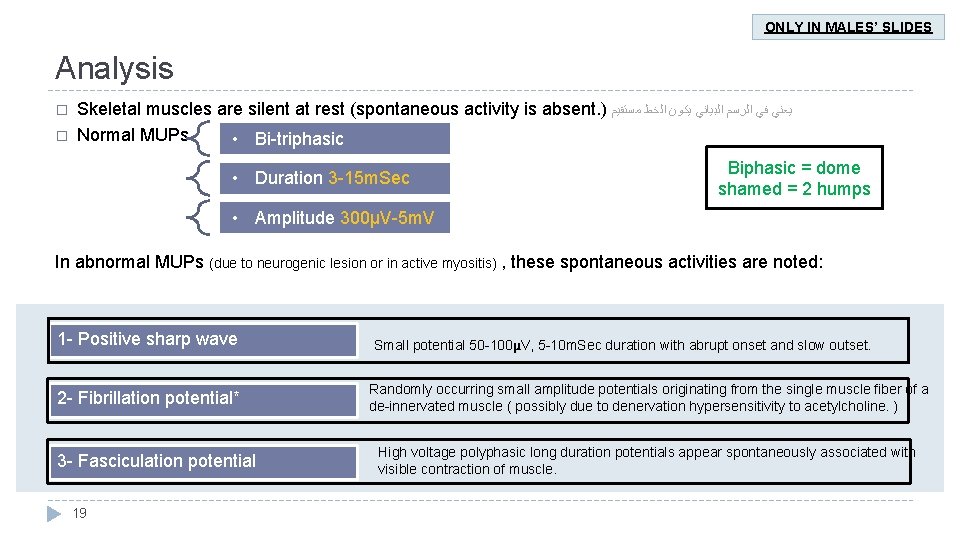
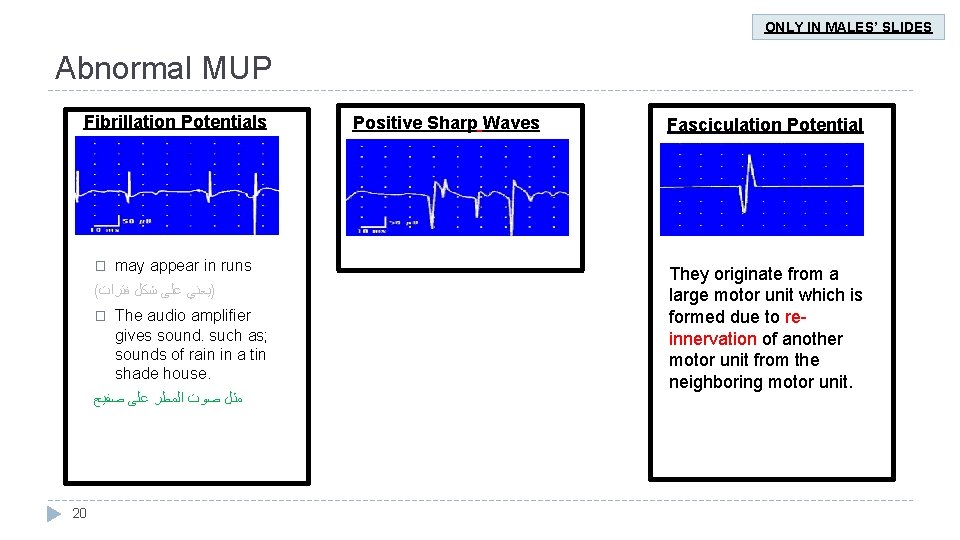
ONLY IN MALES’ SLIDES Analysis � � Skeletal muscles are silent at rest (spontaneous activity is absent. ) ﻳﻌﻨﻲ ﻓﻲ ﺍﻟﺮﺳﻢ ﺍﻟﺒﻴﺎﻧﻲ ﻳﻜﻮﻥ ﺍﻟﺨﻂ ﻣﺴﺘﻘﻴﻢ Normal MUPs • Bi-triphasic • Duration 3 -15 m. Sec Biphasic = dome shamed = 2 humps • Amplitude 300μV-5 m. V In abnormal MUPs (due to neurogenic lesion or in active myositis) , these spontaneous activities are noted: 1 - Positive sharp wave 2 - Fibrillation potential* 3 - Fasciculation potential 19 Small potential 50 -100μV, 5 -10 m. Sec duration with abrupt onset and slow outset. Randomly occurring small amplitude potentials originating from the single muscle fiber of a de-innervated muscle ( possibly due to denervation hypersensitivity to acetylcholine. ) High voltage polyphasic long duration potentials appear spontaneously associated with visible contraction of muscle.
ONLY IN MALES’ SLIDES Abnormal MUP Fibrillation Potentials � may appear in runs ( )ﻳﻌﻨﻲ ﻋﻠﻰ ﺷﻜﻞ ﻓﺘﺮﺍﺕ � The audio amplifier gives sound. such as; sounds of rain in a tin shade house. ﻣﺜﻞ ﺻﻮﺕ ﺍﻟﻤﻄﺮ ﻋﻠﻰ ﺻﻔﻴﺢ 20 Positive Sharp Waves Fasciculation Potential They originate from a large motor unit which is formed due to reinnervation of another motor unit from the neighboring motor unit.
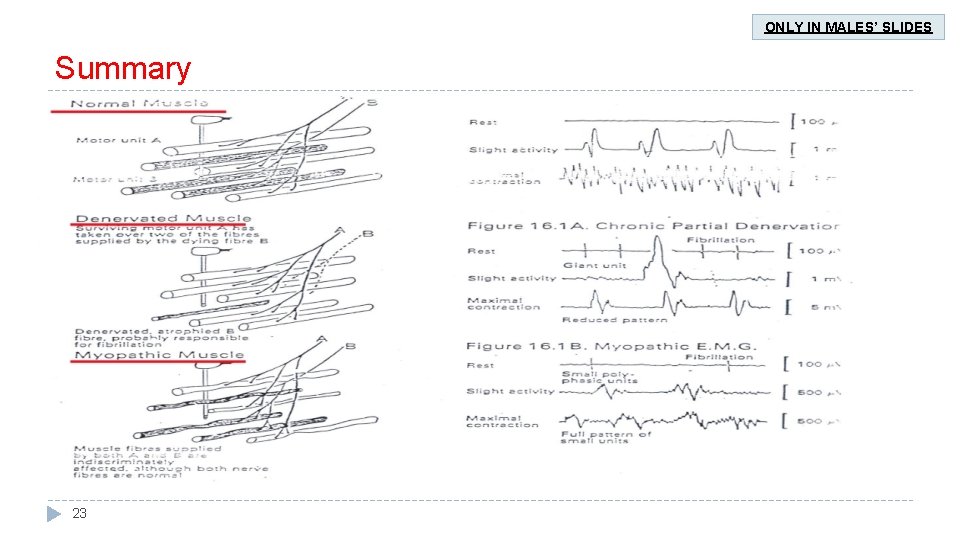
Neuropathic EMG Changes Giant unit is caused by re-innervation ONLY IN MALES’ SLIDES In neuropathy: maximal contraction won’t produce “full interference pattern”; it will produce a “reduced pattern. ” 21
Myopathic EMG Changes In myopathies: maximal contraction will produce a “full interference pattern” 22
ONLY IN MALES’ SLIDES Summary 23
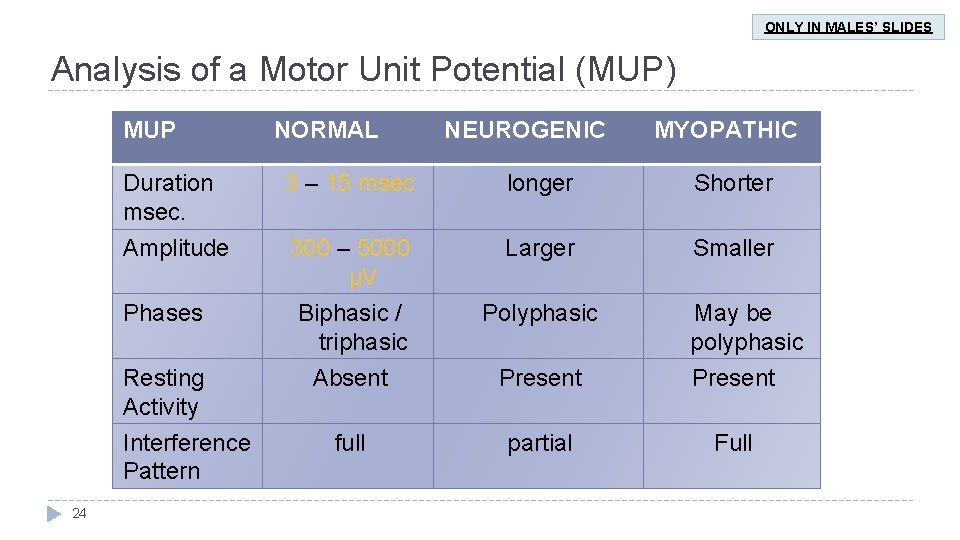
ONLY IN MALES’ SLIDES Analysis of a Motor Unit Potential (MUP) MUP NEUROGENIC MYOPATHIC Duration msec. 3 – 15 msec longer Shorter Amplitude 300 – 5000 µV Larger Smaller Phases Biphasic / triphasic Polyphasic Resting Activity Absent Present full partial Full Interference Pattern 24 NORMAL May be polyphasic
Typical MUP Characteristics in Myopathic, Neuropathic, and Normal Muscle ONLY IN MALES’ SLIDES MUP Myopathy Normal Neuropathy Duration < 3 msec 3 – 15 msec > 15 msec Amplitude < 300 µV 300 -5000 µV > 5 m. V Configuration Polyphasic 25 Triphasic Polyphasic
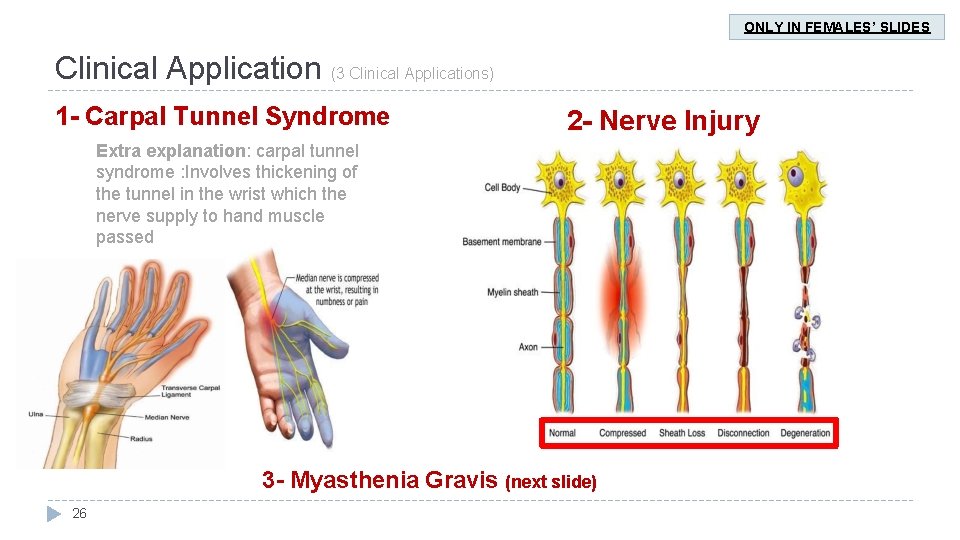
ONLY IN FEMALES’ SLIDES Clinical Application (3 Clinical Applications) 1 - Carpal Tunnel Syndrome 2 - Nerve Injury Extra explanation: carpal tunnel syndrome : Involves thickening of the tunnel in the wrist which the nerve supply to hand muscle passed 3 - Myasthenia Gravis (next slide) 26
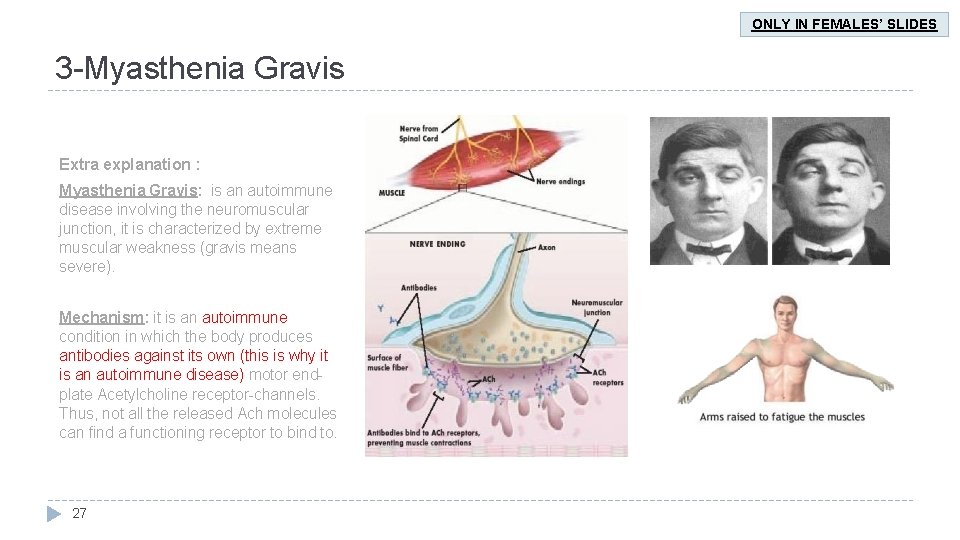
ONLY IN FEMALES’ SLIDES 3 -Myasthenia Gravis Extra explanation : Myasthenia Gravis: is an autoimmune disease involving the neuromuscular junction, it is characterized by extreme muscular weakness (gravis means severe). Mechanism: it is an autoimmune condition in which the body produces antibodies against its own (this is why it is an autoimmune disease) motor endplate Acetylcholine receptor-channels. Thus, not all the released Ach molecules can find a functioning receptor to bind to. 27
Videos o o What are NCS & EMG ? EMG/NCS testing Median motor nerve conduction study Nerve conduction test 28
Quiz � https: //www. onlineexambuilder. com/emp-mncv/exam-118896 Link to Editing File (Please be sure to check this file frequently for any edits or updates on all of our lectures. ) References: • Girls’ and boys’ slides. • (Lecture contents were not found in our reference textbook and therefore we could not add extra explanation from Guyton and Hall. ) 29
Thank you!. ﺍﻋﻤﻞ ﻭ ﺃﻨﺖ ﺗﻌﻠﻢ ﺃﻦ ﺍﻟﻠﻪ ﻻ ﻳﻀﻴﻊ ﺃﺠﺮ ﻣﻦ ﺃﺤﺴﻦ ﻋﻤﻼ ، ﺍﻋﻤﻞ ﻟﺘﻤﺴﺢ ﺩﻣﻌﺔ ، ﺍﻋﻤﻞ ﻟﺘﺮﺳﻢ ﺑﺴﻤﺔ The Physiology 436 Team: Nouf Alaqeel Ali Al-Subaie Leena Alwakeel Omar Albabtain Ruba Barnawi Muhammad Almutlaq Sondos Alhawamdeh Heba Alnasser Team Leaders: Qaiss Almuhaideb Lulwah Alshiha Contact us: Physiology 436@gmail. com @Physiology 436 30