
Nerve and Muscle By Dr Abdel Aziz M
Nerve and Muscle By Dr. Abdel Aziz M. Hussein Lecturer of Medical Physiology Member of American Society of Physiology

Smooth Muscle 3
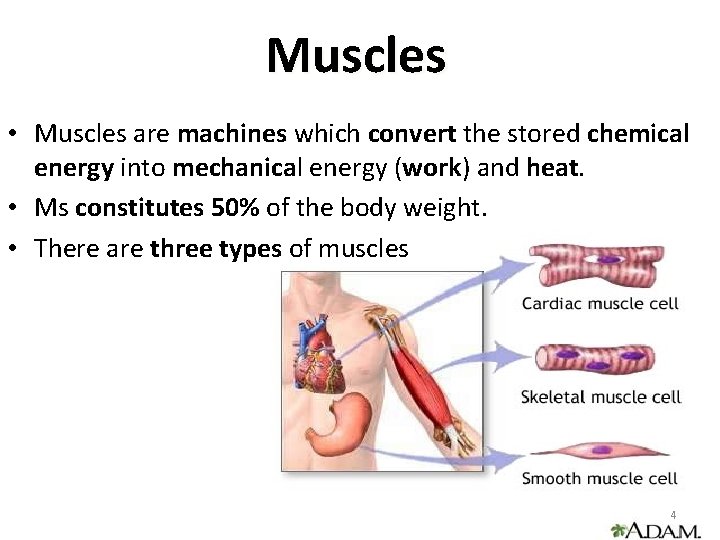
Muscles • Muscles are machines which convert the stored chemical energy into mechanical energy (work) and heat. • Ms constitutes 50% of the body weight. • There are three types of muscles 4
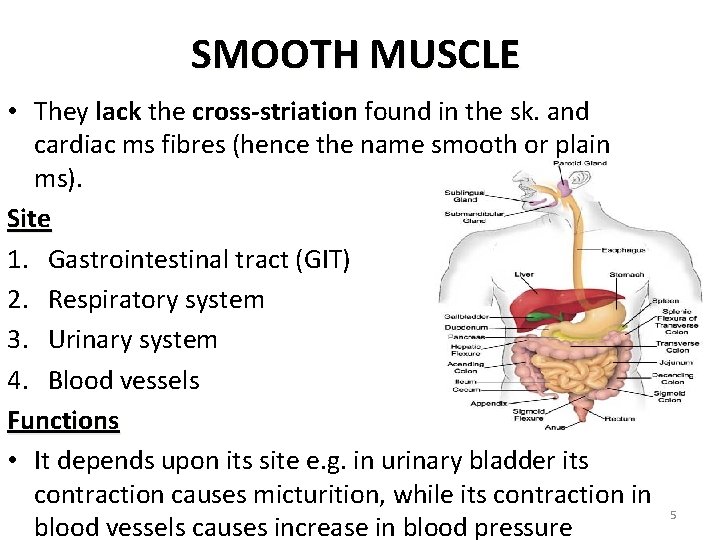
SMOOTH MUSCLE • They lack the cross-striation found in the sk. and cardiac ms fibres (hence the name smooth or plain ms). Site 1. Gastrointestinal tract (GIT) 2. Respiratory system 3. Urinary system 4. Blood vessels Functions • It depends upon its site e. g. in urinary bladder its contraction causes micturition, while its contraction in blood vessels causes increase in blood pressure 5
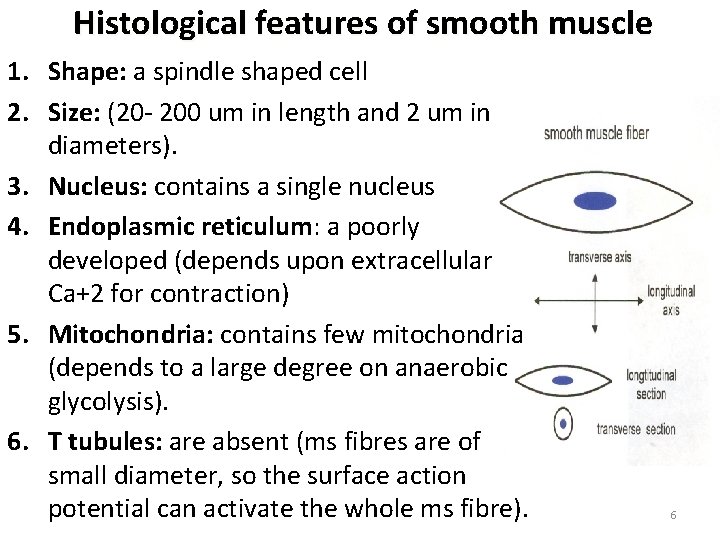
Histological features of smooth muscle 1. Shape: a spindle shaped cell 2. Size: (20 - 200 um in length and 2 um in diameters). 3. Nucleus: contains a single nucleus 4. Endoplasmic reticulum: a poorly developed (depends upon extracellular Ca+2 for contraction) 5. Mitochondria: contains few mitochondria (depends to a large degree on anaerobic glycolysis). 6. T tubules: are absent (ms fibres are of small diameter, so the surface action potential can activate the whole ms fibre). 6
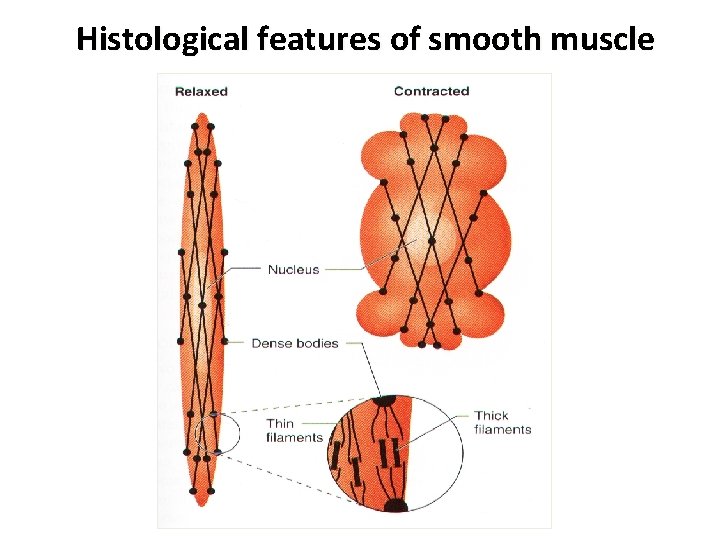
Histological features of smooth muscle
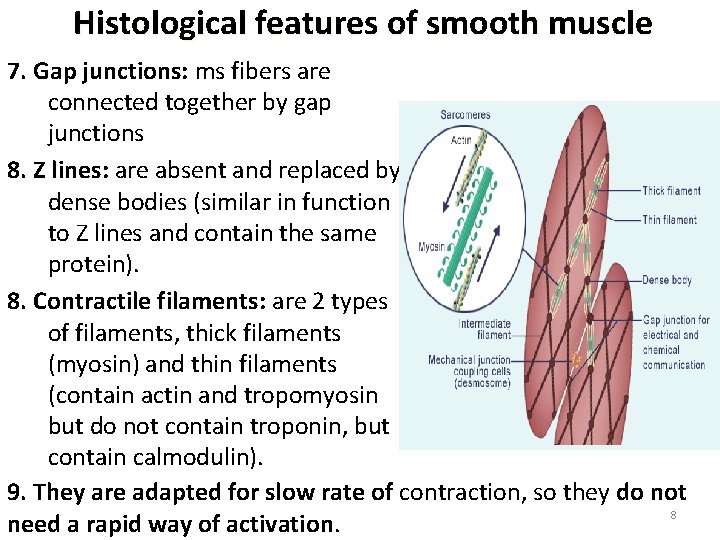
Histological features of smooth muscle 7. Gap junctions: ms fibers are connected together by gap junctions 8. Z lines: are absent and replaced by dense bodies (similar in function to Z lines and contain the same protein). 8. Contractile filaments: are 2 types of filaments, thick filaments (myosin) and thin filaments (contain actin and tropomyosin but do not contain troponin, but contain calmodulin). 9. They are adapted for slow rate of contraction, so they do not 8 need a rapid way of activation.
Excitation contraction coupling in smooth ms 9
Excitation contraction coupling in smooth ms
Excitation contraction coupling in smooth ms
Excitation contraction coupling in smooth ms
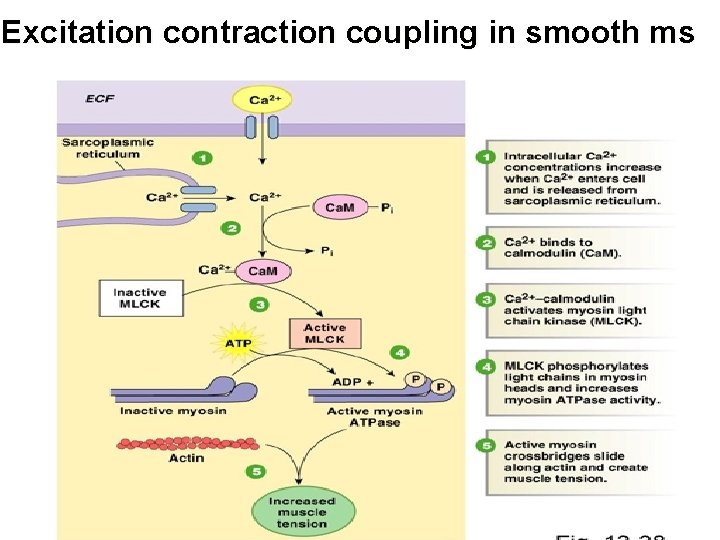
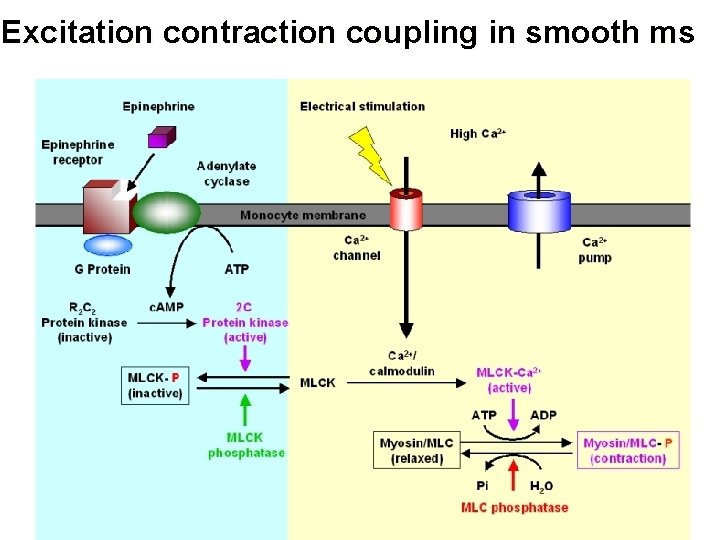
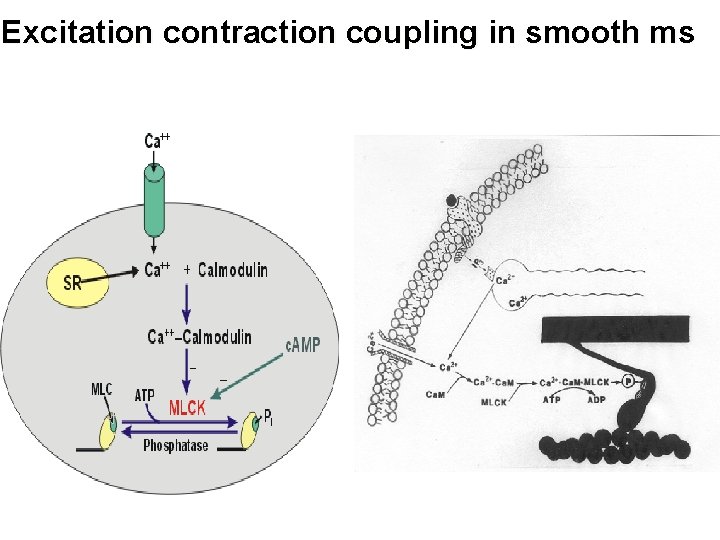
Excitation contraction coupling in smooth ms • It involves the following steps 1) Release of Ca ions; • Smooth ms contraction begins by ↑ in the concentration of Ca ions inside the ms fibre which comes from; i)Sarcoplasmic reticulum: • The spread of AP on the cell membrane or binding of a chemical transmitter with its specific receptor on the plasma membrane releases Ca ions from the SR. ii) Extracellular Ca: • The action potential as well as by chemical transmitter open voltage sensitive and chemically sensitive Ca channels → diffusion of Ca ions inside the cell from extracellular fluid 13
Excitation contraction coupling in smooth ms 2) Contraction: • Ca ions bind to calmodulin to form a Ca-calmodulin complex. • The Ca-calmodulin complex binds to and activates an enzyme known as myosin light chain kinase (MLCK). • The active enzyme (MLCK) then use ATP to phosphorylate myosin light chain (MLC). • The cross-bridges of the phosphorylated myosin are able to bind to actin and undergo cross bridge cycling i. e. sliding of filaments and shortening of ms fibres. 14
Excitation contraction coupling in smooth ms 3) Relaxation: • It occurs when the intracellular Ca concentration ↓es. • This occurs by an active transport of Ca ions back into the SR as well as out of the cell across the plasma membrane. • The rate of Ca removal in smooth ms is much slower than in skeletal ms which results in slow contraction and relaxation of smooth ms (lasts several seconds). • When the intracellular Ca ↓es, myosin light chain kinase (MLCK) enzyme becomes inactive while myosin phosphatase enzyme becomes active and remove phosphate from myosin light chain (MLC). • So, the cross -bridge cycle stops and relaxation occurs by sliding of filaments to their original position. 15
Types of smooth ms 16
Types of smooth ms 17
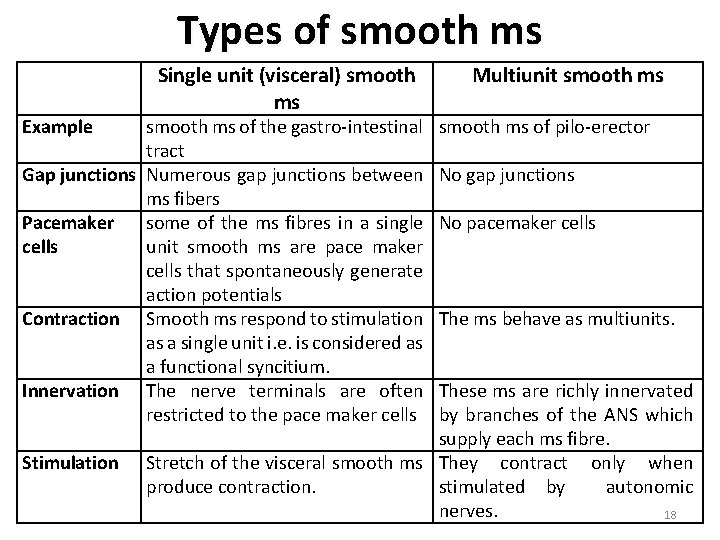
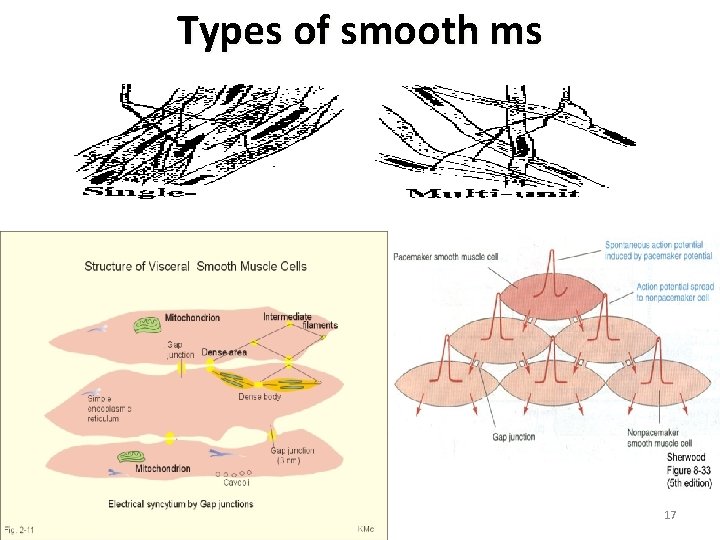
Types of smooth ms Example Single unit (visceral) smooth ms of the gastro-intestinal tract Gap junctions Numerous gap junctions between ms fibers Pacemaker some of the ms fibres in a single cells unit smooth ms are pace maker cells that spontaneously generate action potentials Contraction Smooth ms respond to stimulation as a single unit i. e. is considered as a functional syncitium. Innervation The nerve terminals are often restricted to the pace maker cells Stimulation Multiunit smooth ms of pilo-erector No gap junctions No pacemaker cells The ms behave as multiunits. These ms are richly innervated by branches of the ANS which supply each ms fibre. Stretch of the visceral smooth ms They contract only when produce contraction. stimulated by autonomic nerves. 18
Innervation of smooth muscle 19
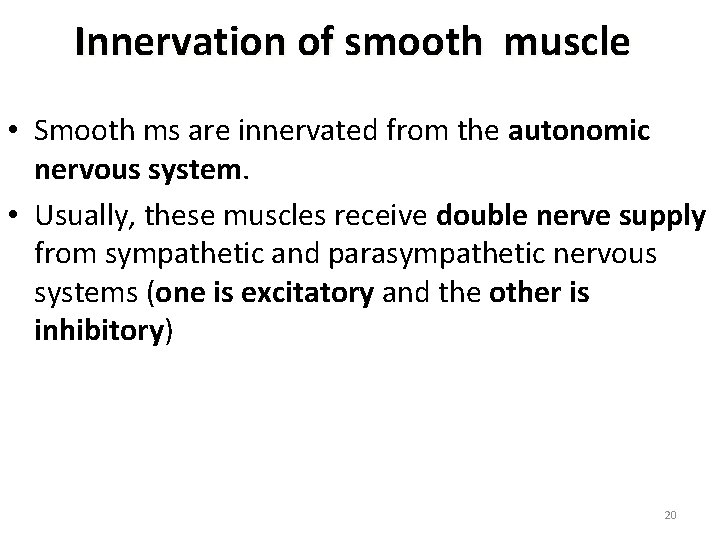
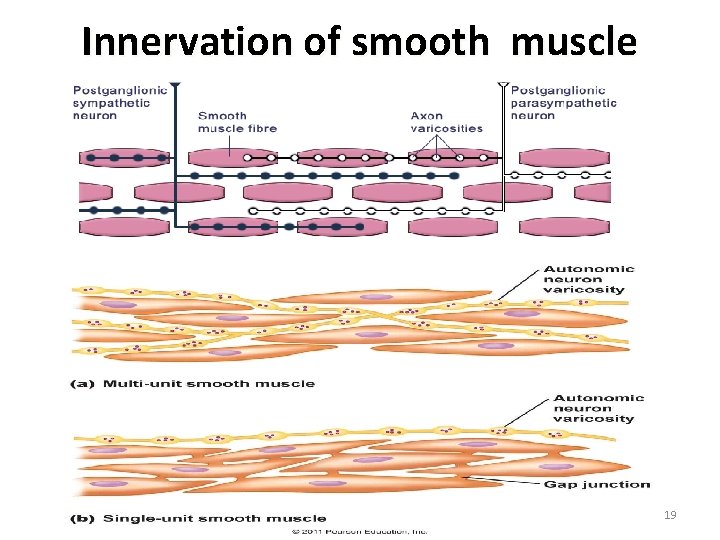
Innervation of smooth muscle • Smooth ms are innervated from the autonomic nervous system. • Usually, these muscles receive double nerve supply from sympathetic and parasympathetic nervous systems (one is excitatory and the other is inhibitory) 20
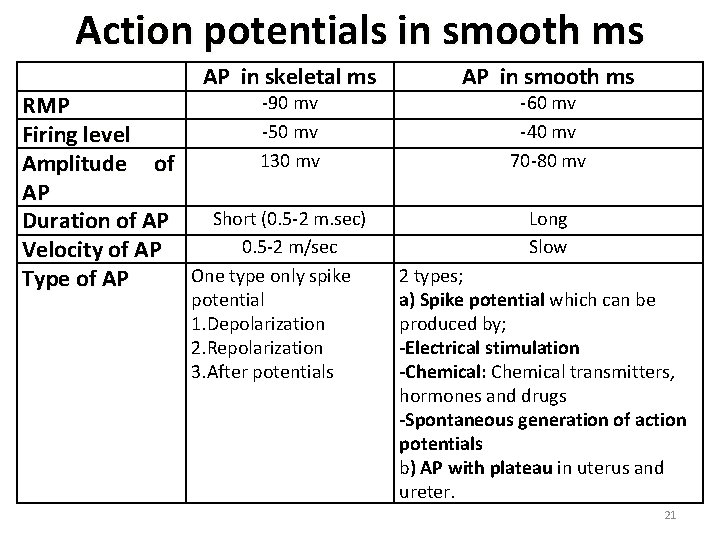
Action potentials in smooth ms AP in skeletal ms -90 mv RMP -50 mv Firing level 130 mv Amplitude of AP Short (0. 5 -2 m. sec) Duration of AP 0. 5 -2 m/sec Velocity of AP One type only spike Type of AP potential 1. Depolarization 2. Repolarization 3. After potentials AP in smooth ms -60 mv -40 mv 70 -80 mv Long Slow 2 types; a) Spike potential which can be produced by; -Electrical stimulation -Chemical: Chemical transmitters, hormones and drugs -Spontaneous generation of action potentials b) AP with plateau in uterus and ureter. 21
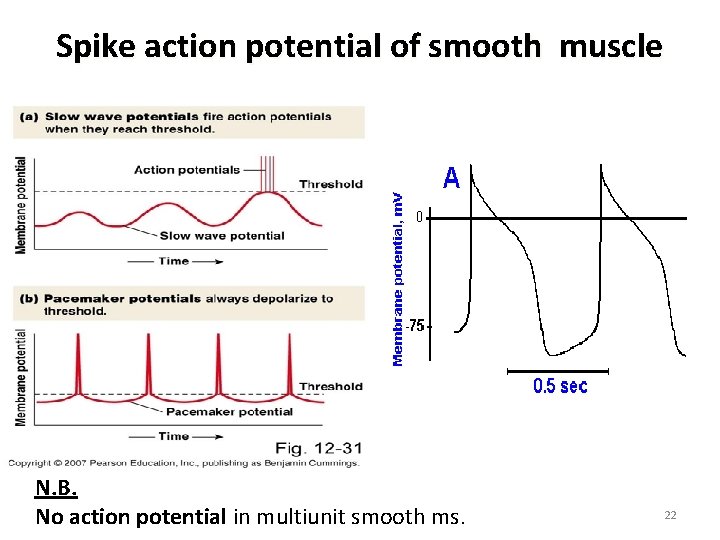
Spike action potential of smooth muscle N. B. No action potential in multiunit smooth ms. 22
Properties of smooth ms 23
1) Contractility 24
Contractility • Contraction of smooth ms is weaker and slow than skeletal ms contraction because smooth ms are adapted to perform slow physiological functions e. g. digestive function Types of contraction of smooth ms a) Tonus contraction: • A steady contraction and the smooth ms are never in state of complete relaxation e. g. smooth ms of blood vessels to maintain ABP. b) Tonic contraction: • Long sustained contraction in response to single or continuous stimulation by nerve, drugs or hormones. • They are found in sphincters that must remain contracted for 25 long period of time.
Contractility Types of contraction of smooth ms c) Phasic contraction: • Twitch like contractions in response to single stimuli. • These contractions are found in smooth ms that propel (move) materials e. g. peristalsis movement in intestine. d) Rhythmic contractions: • Means regular alternate contractions and relaxations as that occur in the wall small intestine. • These contractions results from the spontaneous generation of action potentials without any stimulus. 26
2) Excitability 27
Contractility • Smooth ms are less excitable than skeletal ms or cardiac ms (chronaxia is longer 5. 0 m. sec) cause these ms are usually specialized for long slow contractions 28
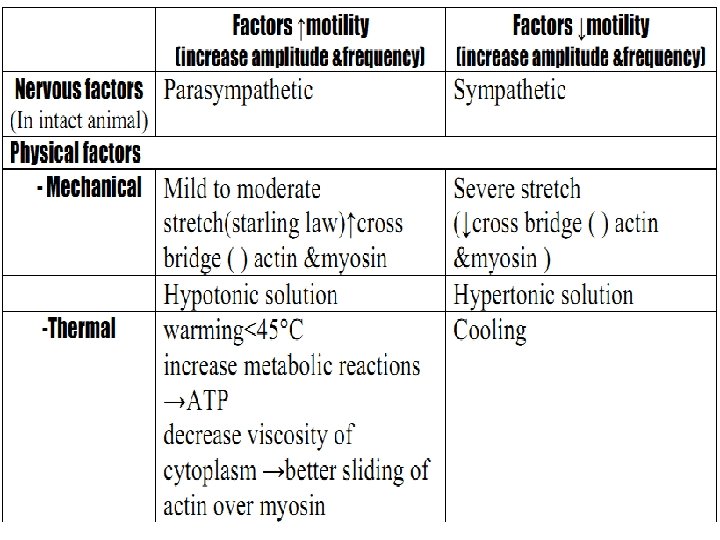
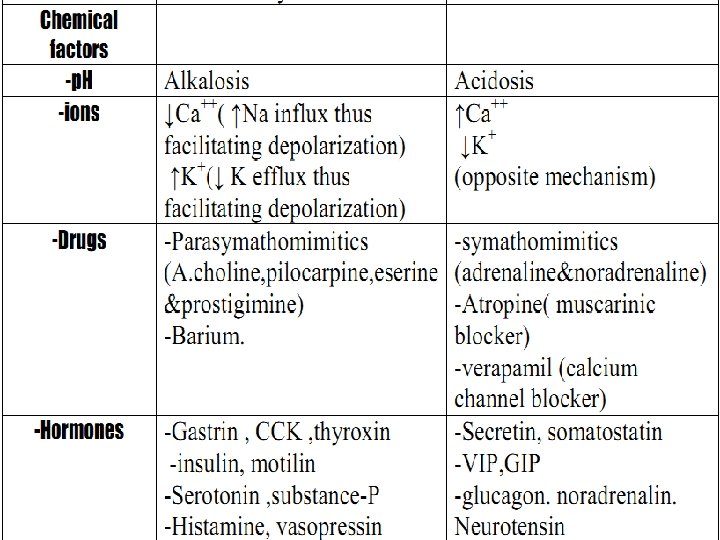
Factors affecting contractility and excitability of smooth ms 29
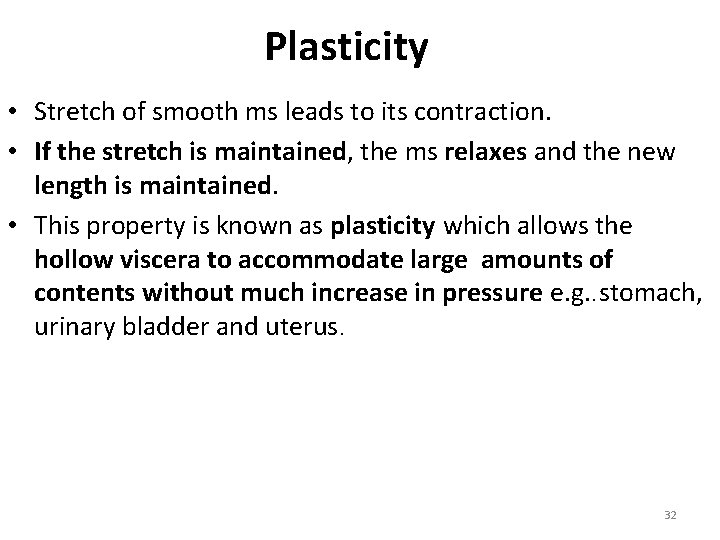
Plasticity • Stretch of smooth ms leads to its contraction. • If the stretch is maintained, the ms relaxes and the new length is maintained. • This property is known as plasticity which allows the hollow viscera to accommodate large amounts of contents without much increase in pressure e. g. . stomach, urinary bladder and uterus. 32

THANKS
- Slides: 33