
NERSC Site Update LTUG Kristy KallbackRose Senior HPC
NERSC Site Update @LTUG Kristy Kallback-Rose Senior HPC Storage Systems Analyst May 2, 2018 -1 -
Agenda • General Systems and Storage Overview • Current Storage Challenges -2 -
Systems & Storage Overview -3 -
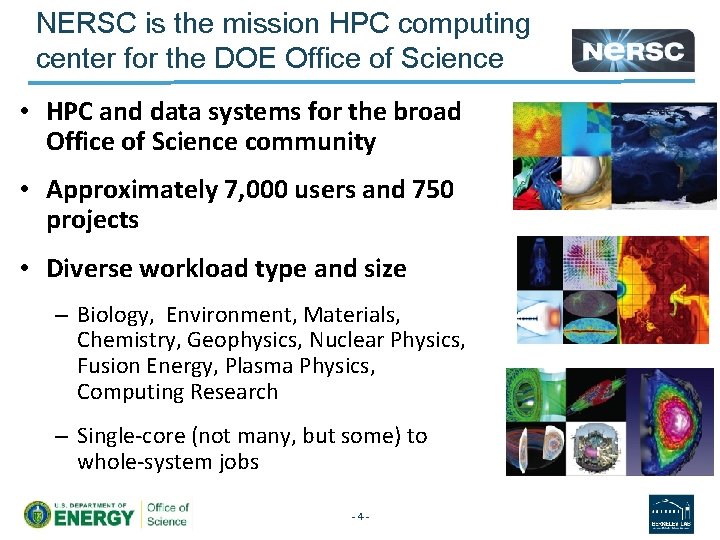
NERSC is the mission HPC computing center for the DOE Office of Science • HPC and data systems for the broad Office of Science community • Approximately 7, 000 users and 750 projects • Diverse workload type and size – Biology, Environment, Materials, Chemistry, Geophysics, Nuclear Physics, Fusion Energy, Plasma Physics, Computing Research – Single-core (not many, but some) to whole-system jobs -4 -
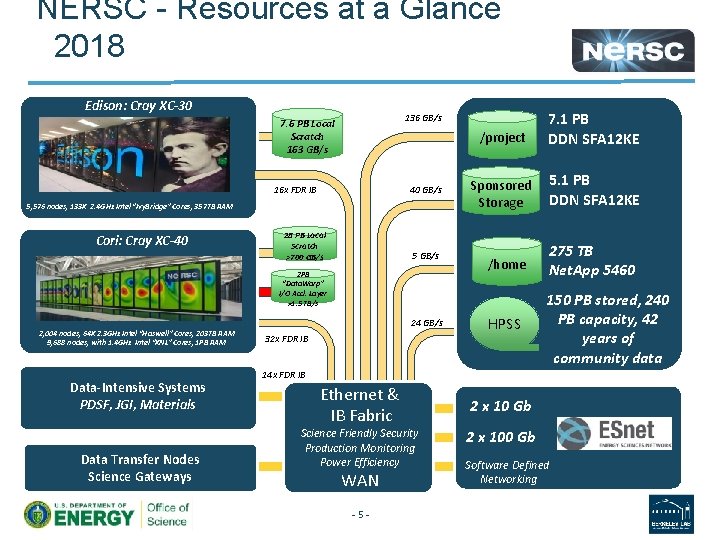
NERSC - Resources at a Glance 2018 Edison: Cray XC-30 16 x FDR IB 40 GB/s 5, 576 nodes, 133 K 2. 4 GHz Intel “Ivy. Bridge” Cores, 357 TB RAM Cori: Cray XC-40 28 PB Local Scratch >700 GB/s 5 GB/s 2 PB “Data. Warp” I/O Accl. Layer >1. 5 TB/s 2, 004 nodes, 64 K 2. 3 GHz Intel “Haswell” Cores, 203 TB RAM 9, 688 nodes, with 1. 4 GHz Intel “KNL” Cores, 1 PB RAM Data-Intensive Systems PDSF, JGI, Materials Data Transfer Nodes Science Gateways /project 7. 1 PB DDN SFA 12 KE Sponsored Storage 5. 1 PB DDN SFA 12 KE 136 GB/s 7. 6 PB Local Scratch 163 GB/s 24 GB/s 32 x FDR IB /home 275 TB Net. App 5460 HPSS 150 PB stored, 240 PB capacity, 42 years of community data 14 x FDR IB Ethernet & IB Fabric Science Friendly Security Production Monitoring Power Efficiency WAN -5 - 2 x 10 Gb 2 x 100 Gb Software Defined Networking
Tape Archive - HPSS • High Performance Storage System (HPSS) – Developed over >20 years of collaboration among five Department of Energy laboratories and IBM, with significant contributions by universities and other laboratories worldwide. – archival storage system for long term data retention since 1998 – Tiered storage system with a disk cache in front of a pool of tapes • On tape: ~150 PB • Disk Cache: 4 PB – Contains 42 years of data archived by the scientific community • Data Transfers via transfer client - there is no direct file system interface – We provide numerous clients: HSI/HTAR (proprietary tools), FTP, p. FTP, grid. FTP, Globus Online, etc. [VFS is an option which we don’t use]
Current Storage Challenges -8 -
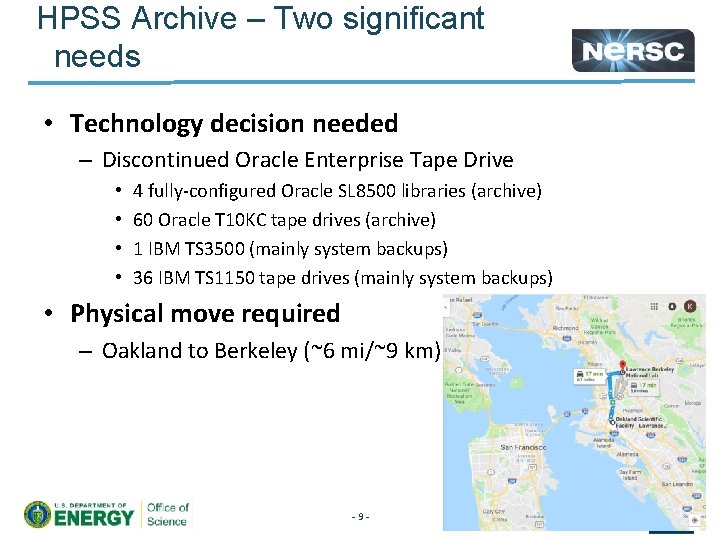
HPSS Archive – Two significant needs • Technology decision needed – Discontinued Oracle Enterprise Tape Drive • • 4 fully-configured Oracle SL 8500 libraries (archive) 60 Oracle T 10 KC tape drives (archive) 1 IBM TS 3500 (mainly system backups) 36 IBM TS 1150 tape drives (mainly system backups) • Physical move required – Oakland to Berkeley (~6 mi/~9 km) -9 -
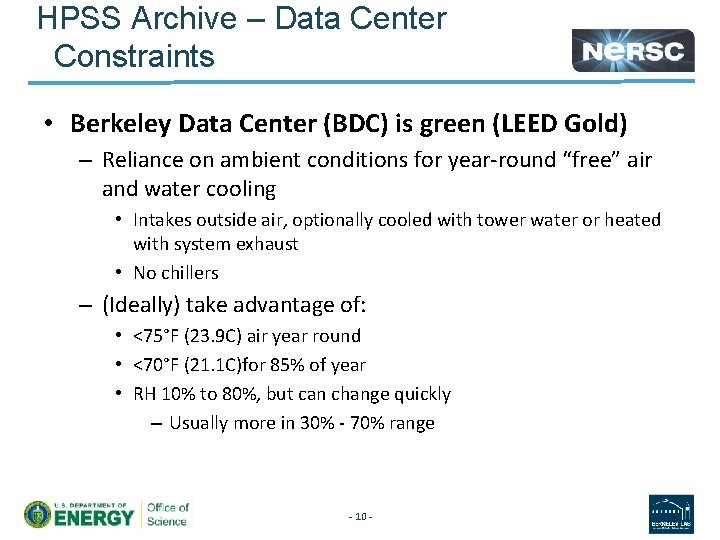
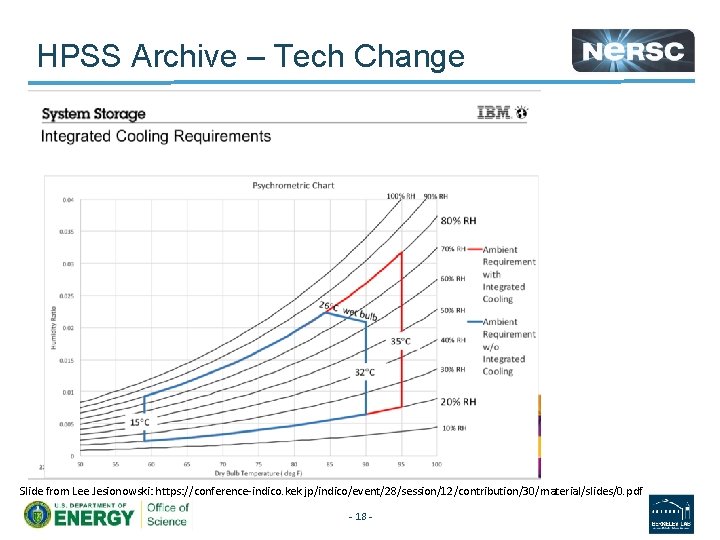
HPSS Archive – Data Center Constraints • Berkeley Data Center (BDC) is green (LEED Gold) – Reliance on ambient conditions for year-round “free” air and water cooling • Intakes outside air, optionally cooled with tower water or heated with system exhaust • No chillers – (Ideally) take advantage of: • <75°F (23. 9 C) air year round • <70°F (21. 1 C)for 85% of year • RH 10% to 80%, but can change quickly – Usually more in 30% - 70% range - 10 -
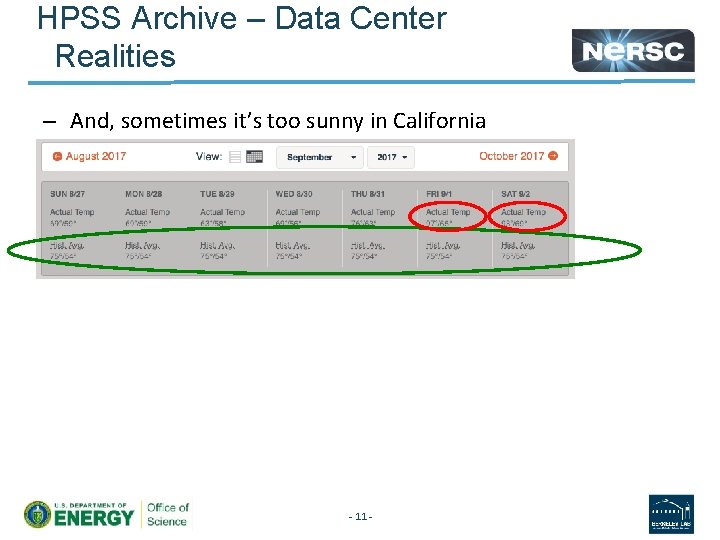
HPSS Archive – Data Center Realities – And, sometimes it’s too sunny in California - 11 -
Alternatives to Consider • Co-lo to a data center elsewhere – Costly – System management concerns • Cloud – not performant enough • queue issues – need my data now – too costly • General expectation that data retrieval is the cloud killer, – but just letting 150 PBs sit is more expensive » e. g. Amazon Glacier, gov’t option 2 -5 x more expensive » Pricing model of course different starting from 0 vs. starting with 150 PBs, YMMV • Room-within-a-room – Space utilization goals and budget constraints • Disk-only – Too costly – Increased power consumption - 12 -
HPSS Archive – Tape Tech Decision • Value in staying with Enterprise drives over LTO – Growth Rates: 2 PB/month (2016 -2017); 2018 so far is 3+ PB/month • Especially, gains from reformatting media at higher density – E. g. JC Media 4 TB capacity with TS 1140 drive 7 TB with reformat and TS 1150/TS 1155 drives – Time to first byte is important • Recommended Access Order (RAO) – NERSC read-back rate is high ~40% • High Resolution Tape Directory – 1/64 th of a tape wrap resolution per block versus 1⁄2 wrap for LTO » reach the target data block more efficiently • Higher search and rewind velocity about 30% faster then LTO – Data as old as 42 years, stewardship • Media Physical durability – Improved materials/construction over LTO. - 13 -
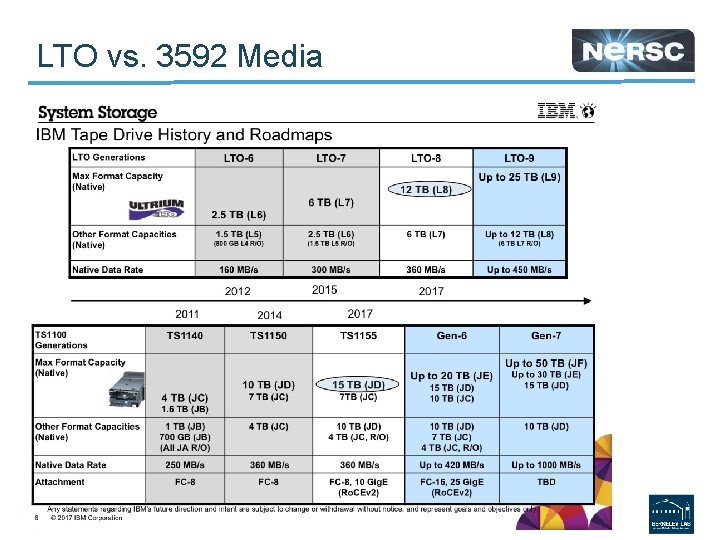
LTO vs. 3592 Media - 14 -
That being said… • We will have some LTO drives and media for second copies – Gain experience – Diversity of technology - 15 -
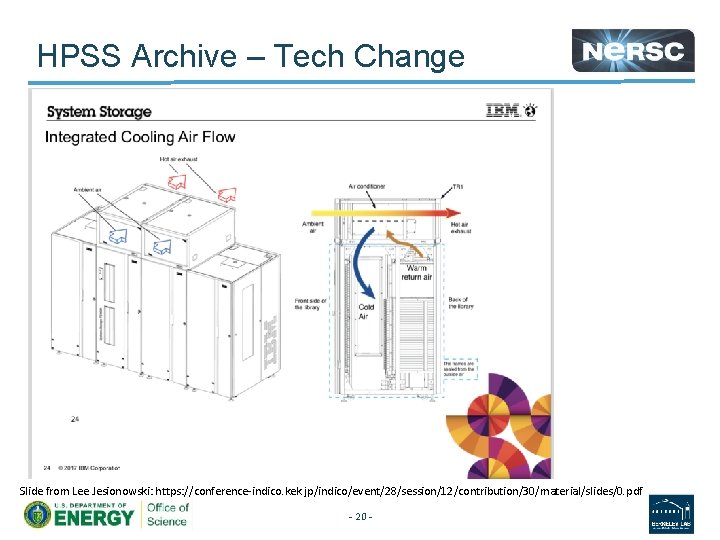
HPSS Archive – Green Data Center Solution • IBM TS 4500 Tape Library with Integrated Cooling – seals off the library from ambient temperature and humidity – built-in AC units (atop library) keeps tapes and drives within operating spec - 16 -
HPSS Archive – Tape Tech Decision • IBM had the library tech ready • We have experience with TS 3500/3592 drives for our backup system - 17 -
HPSS Archive – Tech Change Slide from Lee Jesionowski: https: //conference-indico. kek. jp/indico/event/28/session/12/contribution/30/material/slides/0. pdf - 18 -
![HPSS Archive – Tech Change • One “Storage Unit” (my term) [Cooling Zone] –](http://slidetodoc.com/presentation_image_h/28c10ac37397b7edd50cf56da8fc6928/image-18.jpg "HPSS Archive – Tech Change • One “Storage Unit” (my term) [Cooling Zone] –")
HPSS Archive – Tech Change • One “Storage Unit” (my term) [Cooling Zone] – Two S 25 frames sandwich, one L 25 and one D 25 frame • S 25: High-density frame, tape slots (798 -1000) • D 25: Expansion frame, drive (12 -16), tape slots (590 -740) • L 25: Base frame, drive (12 -16), tape slots (550 -660), I/O station and control electronics (for subsequent libraries no L 25) – Each one of these storage units considered it’s own cooling zone • AC units go atop L and D frames – Air recirculated, no special filters – Fire suppression a little trickier, but possible - 19 -
HPSS Archive – Tech Change Slide from Lee Jesionowski: https: //conference-indico. kek. jp/indico/event/28/session/12/contribution/30/material/slides/0. pdf - 20 -
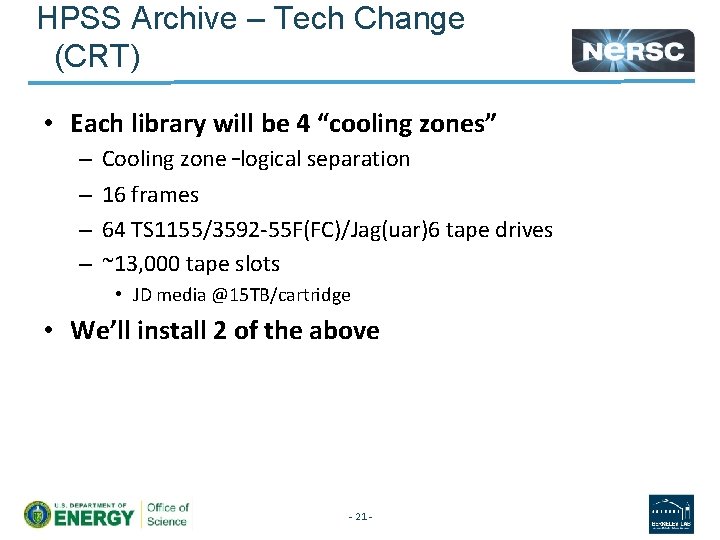
HPSS Archive – Tech Change (CRT) • Each library will be 4 “cooling zones” – – Cooling zone –logical separation 16 frames 64 TS 1155/3592 -55 F(FC)/Jag(uar)6 tape drives ~13, 000 tape slots • JD media @15 TB/cartridge • We’ll install 2 of the above - 21 -
HPSS Archive – Tech Change (CRT) • Some things to get used to/improve – No ACSLS – Can get some data out of IBM library, but – Need to re-do/build some tools – AFAIK, no pre-aggregated data like ACSLS – No Pass Through Port (PTP) • One Physical Volume Repository (PVR) per library – Since no shuttle option with IBM libraries – Could need more drives • But time to first byte should improve – PTP can fail, be slow - 22 -
HPSS Archive – Loose timeline April: • TS 4500 s w/integrated cooling were delivered at BDC May: • ½ Disk Cache + ½ of disk movers moved to Berkeley DC (BDC) – Not yet enabled, just in preparation • ½ Disk Cache + ½ of disk movers remain at Oakland June: • TS 4500 s w/integrated cooling installed at BDC July: • Move HPSS core server to BDC • Enable ½ Disk Cache, ½ disk movers at BDC • Enable Writes to new library at BDC • Oakland tapes now read-only [user access, repacks] • Remaining ½ disk cache made read-only, drained • Move remaining ½ disk cache, movers to BDC • Data migrated to BDC via HPSS “repack” functionality – – – >= 20 Oracle T 10 KC source drives at Oakland >= 20 TS 1155 destination drives at BDC 400 Gbps Oakland <-> BDC link 2020 (or earlier? ) data migration complete • We’re not in Oakland any more, Dorothy. - 23 -
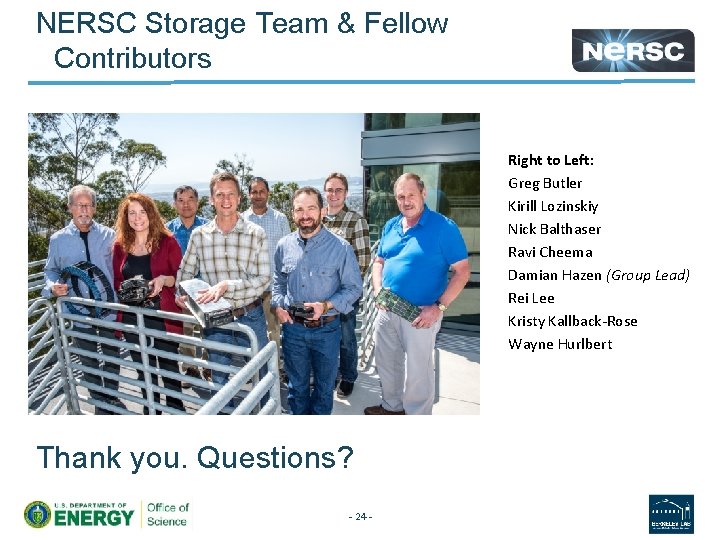
NERSC Storage Team & Fellow Contributors Right to Left: Greg Butler Kirill Lozinskiy Nick Balthaser Ravi Cheema Damian Hazen (Group Lead) Rei Lee Kristy Kallback-Rose Wayne Hurlbert Thank you. Questions? - 24 -
National Energy Research Scientific Computing Center - 25 -
Backup Slides - 26 -
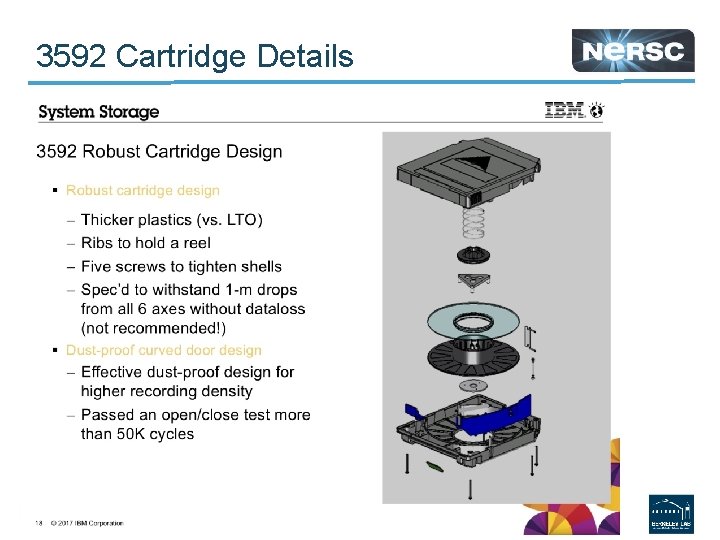
3592 Cartridge Details - 27 -
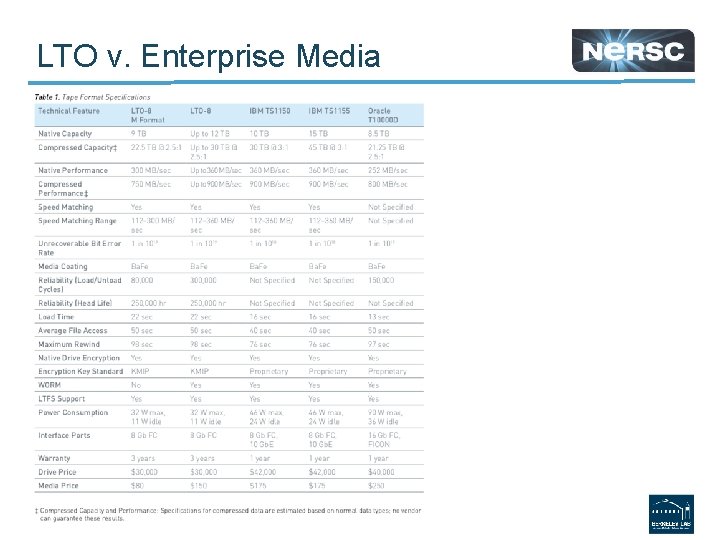
LTO v. Enterprise Media - 28 -
- Slides: 27