
Nepal Administrative Staff College Report Writing Skills Agenda
- Slides: 46
Nepal Administrative Staff College Report Writing Skills
Agenda Context Basic rules of report writing: Planning, techniques, and skills Preparing a report: Building on the work Presenting your report: Basic rules of presentation Share and feedback ©NASC 2018
Context Manisha is an newly appointed Class-III officer of Government of Nepal and taking Basic Administration Training (BAT) at Nepal Administrative Staff College. During her training program she has to prepare a report on the issue of governance, development and management. During her training programme, she has to prepare a report, present in plenary and submit for evaluation. She is planning to prepare a report. Suggest some tips for Sushila that draws attention of large number of 2018 audience and would be useful in ©NASC her later
Report Writing Skills. . Know the Rules Accuracy, brevity, clarity, well structured Avoid complex sentences/Language and clarity Short and specific Paragraph should convey a single idea Avoid jargons as well as metaphoric words Make it easily understandable by the readers Give visual impression (get-up, layout, font choice etc) ©NASC 2018
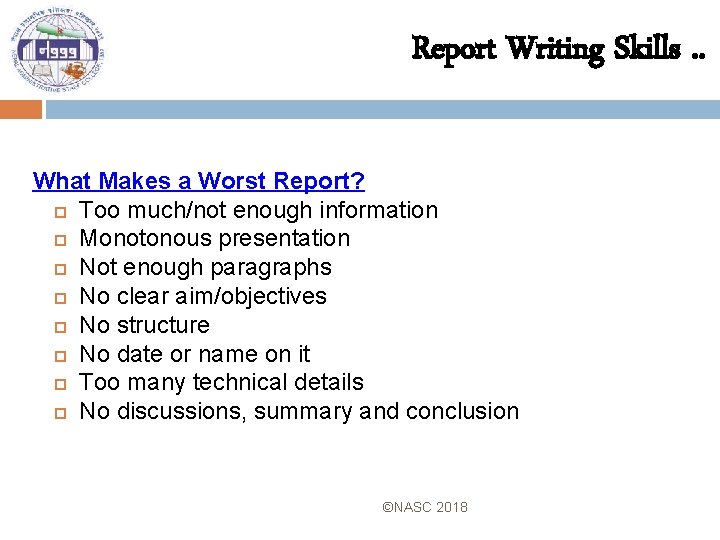
Report Writing Skills. . What Makes a Worst Report? Too much/not enough information Monotonous presentation Not enough paragraphs No clear aim/objectives No structure No date or name on it Too many technical details No discussions, summary and conclusion ©NASC 2018
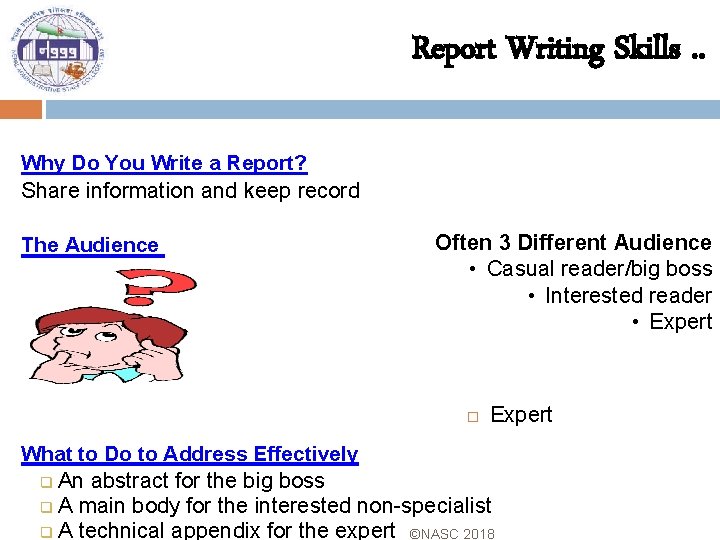
Report Writing Skills. . Why Do You Write a Report? Share information and keep record The Audience Often 3 Different Audience • Casual reader/big boss Often 3 Different Audiences • Interested reader Casual reader/big • Expert boss Interested reader Expert What to Do to Address Effectively q An abstract for the big boss q A main body for the interested non-specialist q A technical appendix for the expert ©NASC 2018
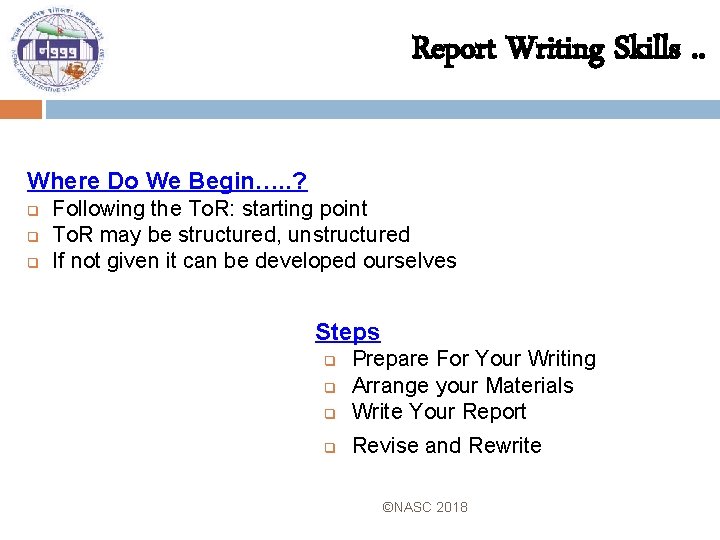
Report Writing Skills. . Where Do We Begin…. . ? q q q Following the To. R: starting point To. R may be structured, unstructured If not given it can be developed ourselves Steps q Prepare For Your Writing Arrange your Materials Write Your Report q Revise and Rewrite q q ©NASC 2018
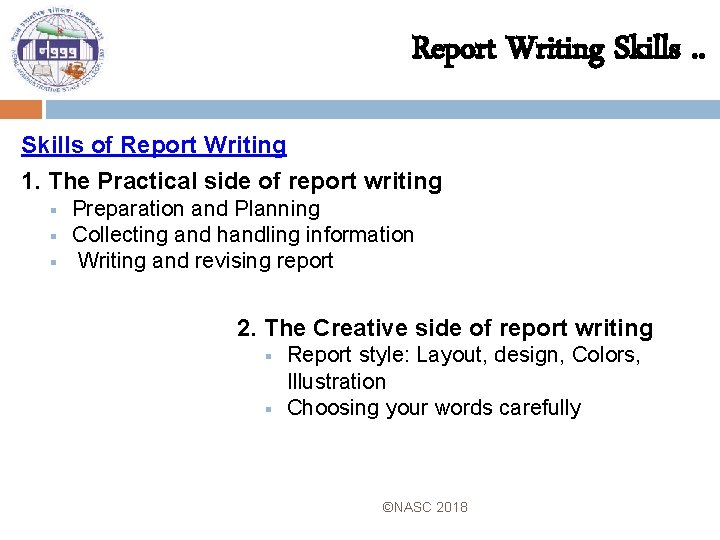
Report Writing Skills. . Skills of Report Writing 1. The Practical side of report writing Preparation and Planning Collecting and handling information Writing and revising report 2. The Creative side of report writing Report style: Layout, design, Colors, Illustration Choosing your words carefully ©NASC 2018
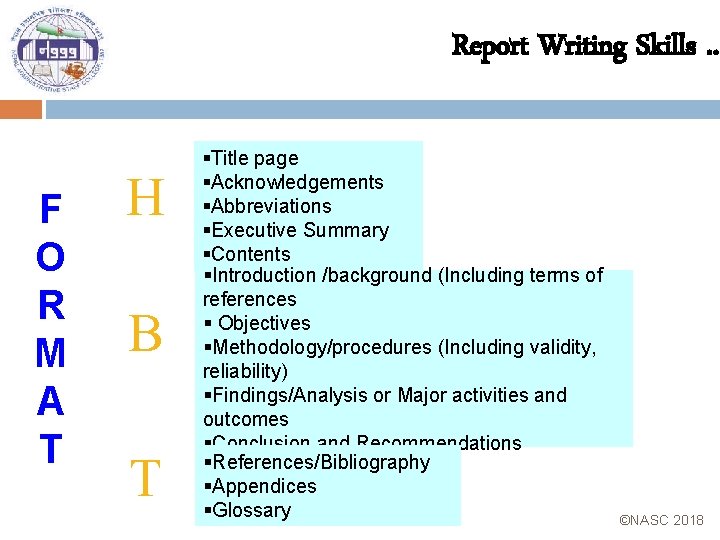
Report Writing Skills. . F O R M A T H B T Title page Acknowledgements Abbreviations Executive Summary Contents Introduction /background (Including terms of references Objectives Methodology/procedures (Including validity, reliability) Findings/Analysis or Major activities and outcomes Conclusion and Recommendations References/Bibliography Appendices Glossary ©NASC 2018
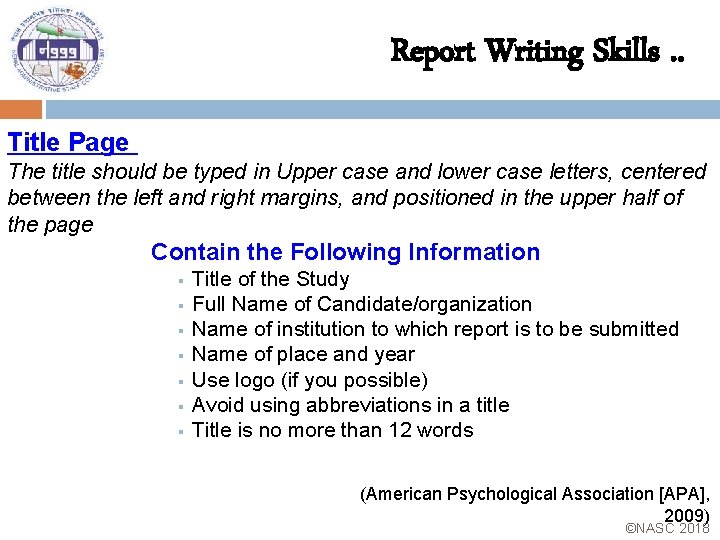
Report Writing Skills. . Title Page The title should be typed in Upper case and lower case letters, centered between the left and right margins, and positioned in the upper half of the page Contain the Following Information Title of the Study Full Name of Candidate/organization Name of institution to which report is to be submitted Name of place and year Use logo (if you possible) Avoid using abbreviations in a title Title is no more than 12 words (American Psychological Association [APA], 2009) ©NASC 2018
©NASC 2018
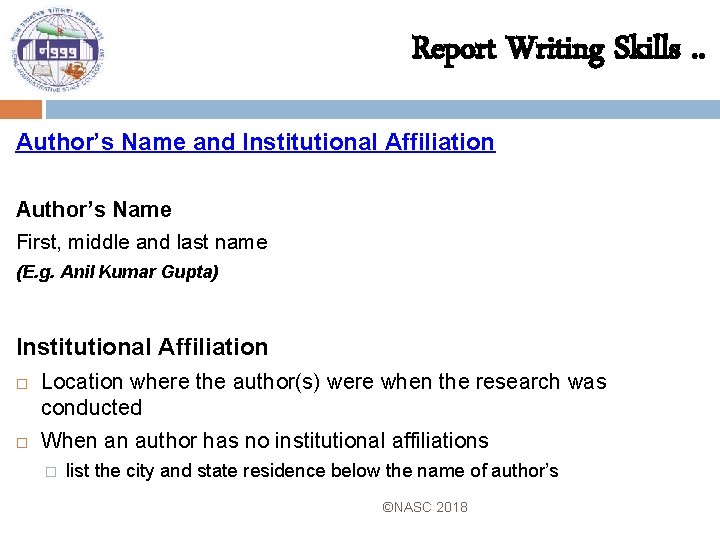
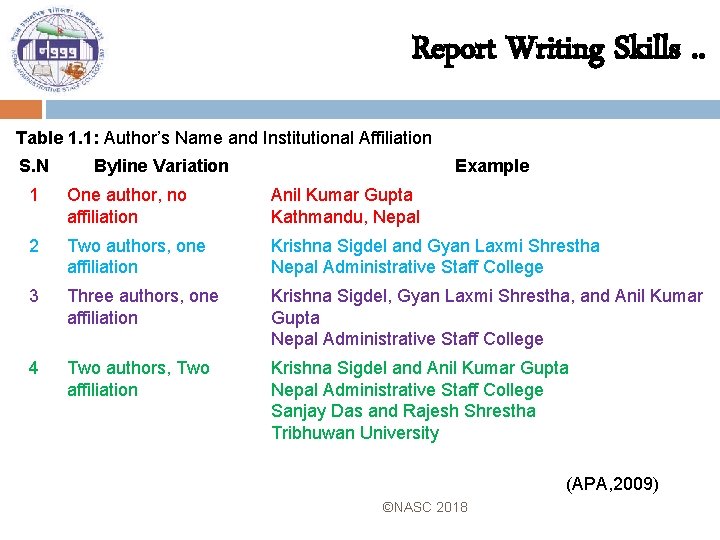
Report Writing Skills. . Author’s Name and Institutional Affiliation Author’s Name First, middle and last name (E. g. Anil Kumar Gupta) Institutional Affiliation Location where the author(s) were when the research was conducted When an author has no institutional affiliations � list the city and state residence below the name of author’s ©NASC 2018
Report Writing Skills. . Table 1. 1: Author’s Name and Institutional Affiliation S. N Byline Variation Example 1 One author, no affiliation Anil Kumar Gupta Kathmandu, Nepal 2 Two authors, one affiliation Krishna Sigdel and Gyan Laxmi Shrestha Nepal Administrative Staff College 3 Three authors, one affiliation Krishna Sigdel, Gyan Laxmi Shrestha, and Anil Kumar Gupta Nepal Administrative Staff College 4 Two authors, Two affiliation Krishna Sigdel and Anil Kumar Gupta Nepal Administrative Staff College Sanjay Das and Rajesh Shrestha Tribhuwan University (APA, 2009) ©NASC 2018
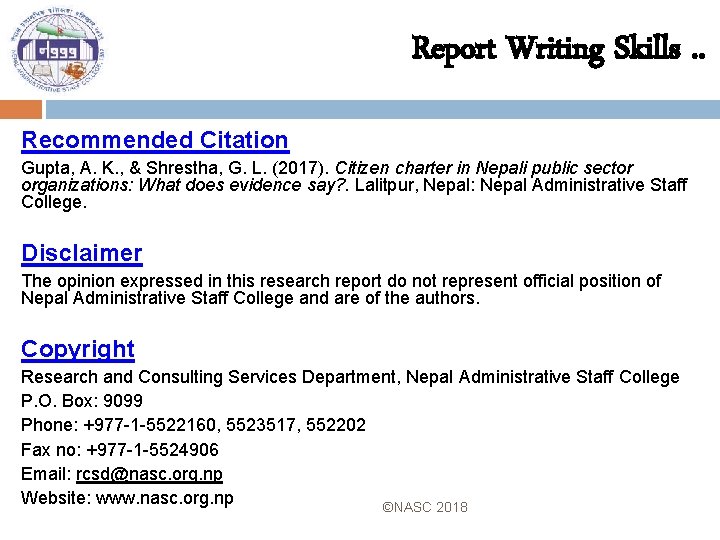
Report Writing Skills. . Recommended Citation Gupta, A. K. , & Shrestha, G. L. (2017). Citizen charter in Nepali public sector organizations: What does evidence say? . Lalitpur, Nepal: Nepal Administrative Staff College. Disclaimer The opinion expressed in this research report do not represent official position of Nepal Administrative Staff College and are of the authors. Copyright Research and Consulting Services Department, Nepal Administrative Staff College P. O. Box: 9099 Phone: +977 -1 -5522160, 5523517, 552202 Fax no: +977 -1 -5524906 Email: rcsd@nasc. org. np Website: www. nasc. org. np ©NASC 2018
Report Writing Skills. . All Rights Reserved No part of this book/report may be reproduced, or stored in a retrieval system, or transmitted in any form or by means, electronic, mechanical, photocopying, recording, or otherwise, without express written permission of the publisher/author. ©NASC 2018
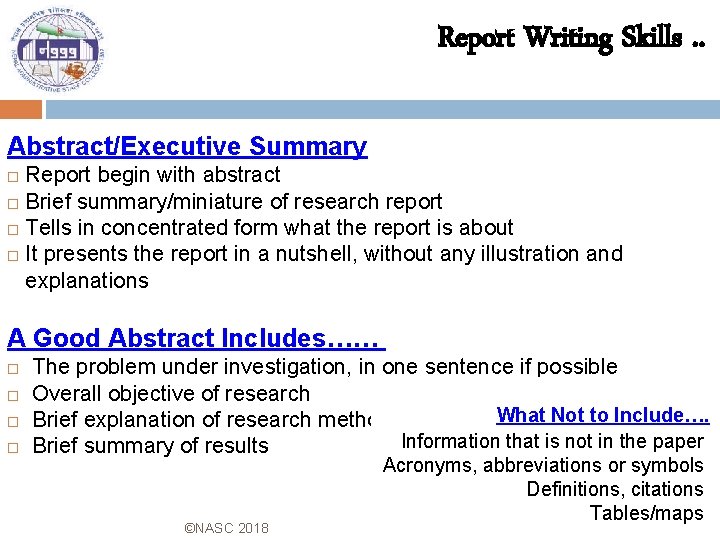
Report Writing Skills. . Abstract/Executive Summary Report begin with abstract Brief summary/miniature of research report Tells in concentrated form what the report is about It presents the report in a nutshell, without any illustration and explanations A Good Abstract Includes…… The problem under investigation, in one sentence if possible Overall objective of research What Not to Include…. Brief explanation of research method Information that is not in the paper Brief summary of results ©NASC 2018 Acronyms, abbreviations or symbols Definitions, citations Tables/maps
Report Writing Skills. . Abstract: Example Citizen Charter is an instrument of citizen centric governance that confirms quality in public service delivery by holding public sector organizations directly accountable, responsive, and transparent. Bearing this thing in mind, we disclose the current picture of Citizen Charter in Nepali public sector organizations from service receiver's perspectives. For this, we conducted surveys in key six public sector organizations (transport office, land revenue office, district administration office, inland revenue office, metropolitan city and court) of Lalitpur Metropolitan city by using client exist interview method with the help of semi-structured interview schedule in 2017. The result of the study shows that utilization of Citizen Charter is extensively low. Service receivers are not fully aware and well informed about its values. They prefer to receive services by asking from duty bearers, intermediate (agent) and previous service receivers than Citizen Charter. They believe there is no consistency in Shrestha, However, some promises of Citizen Charter and behavior of(Gupta duty &bearers. service receivers are demanding services as 2017) per Citizen Charter. ©NASC 2018
Report Writing Skills. . List of Content It gives the readers a bird eye view of the report Reader can identify a specific topic easily The chapter heading should be typed in capital letter Sub division with small latter with initial letter of the principal words capitalizes. Objective Road map Should be clear and specific (SMART) Use action verbs (to explore, to discuss, to evaluate, to recommend, to identify, to summarize, to explain, to compare, to analyze, and so on. ) E. g. The central purpose of this study is to reveal the current picture of Citizen Charter in Nepali©NASC public sector organizations. 2018
Report Writing Skills. . Methods Study area/organization Research design Sample size and selection criteria Nature and source of data Tools and procedures of data collection Data management, analysis, and meaning making Ethical standards Reliability and validity of the study Quality concerns ©NASC 2018
Report Writing Skills. . Data Management and Analysis Scrutinizing/processing Editing (field editing, central editing) � � � Completeness of data Accuracy of data Uniformity and consistency of data Data coding � � Pre coding Post coding Data entry (hand, computer) � � Excel (spreadsheet) SPSS (statistical software) and so on. Analysis of data (objective, nature of data, distribution of data) � � Quantitative data: Frequency, percentage, central tendency, correlation, regression etc. Qualitative data: Narration and contextualization ©NASC 2018
Quantitative: Example I started data cleaning process after receiving interview schedules. In this process, I manual scrutinized each interview schedule and I coded and recoded open response. After this, I entered into Statistical Package for the Social Sciences (SPSS) software program to get the required information. Based on the purpose and research questions I calculated frequency, percentages, crosstab, and mean. Finally, I tabulated to describe, interpret, compare, and generate meaning from them. ©NASC 2018
Qualitative: Example In order to make sense and meaning from the field data, I managed, analyzed and interpret of data as soon as collected. For this, I reviewed all my notes immediately after each interview. As soon as I returned from fieldwork, I transcribed the interviews in the same order that I conducted (Peräkylä, 1997). After this, I employed systematic process of coding, categorizing, and thematizing (In. Sites, 2007) to analyze the qualitative data. After this, I formed the anecdotes with the help of transcription. From these anecdotes, I reflected and generate meaning from them. ©NASC 2018
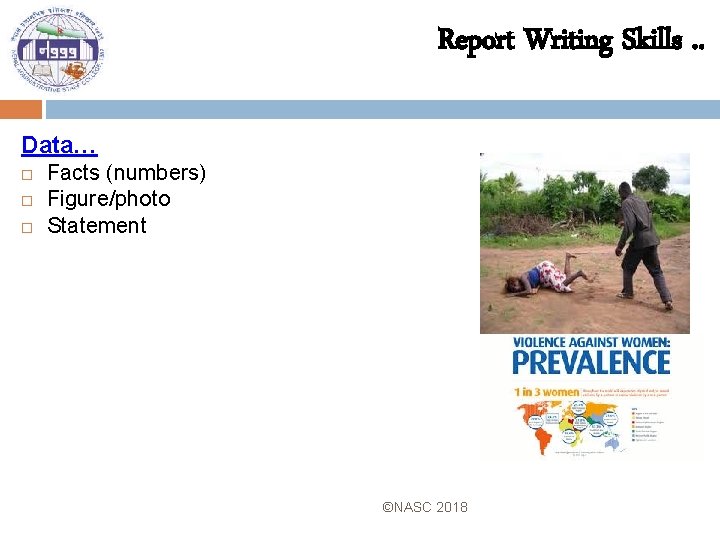
Report Writing Skills. . Data… Facts (numbers) Figure/photo Statement ©NASC 2018
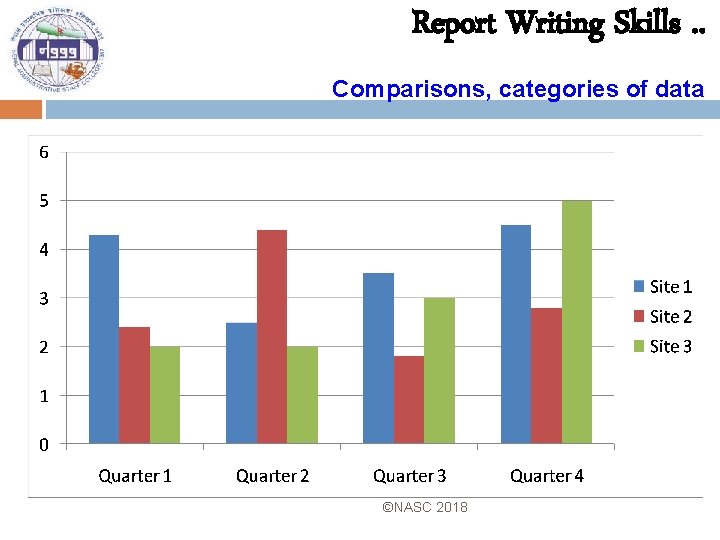
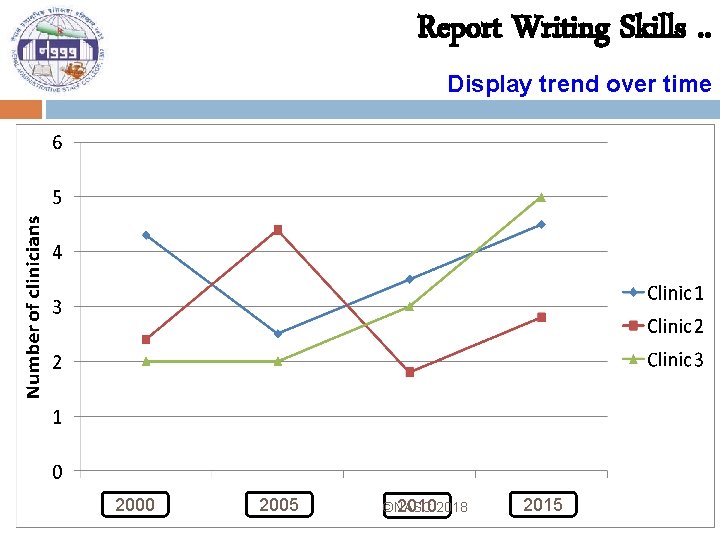
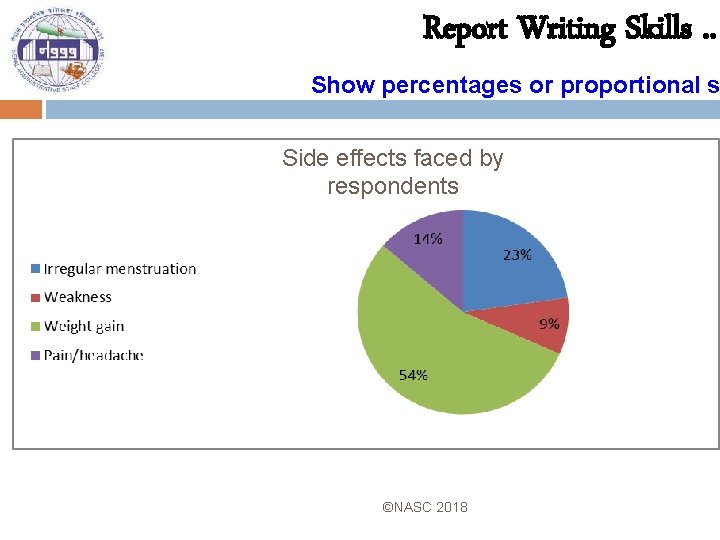
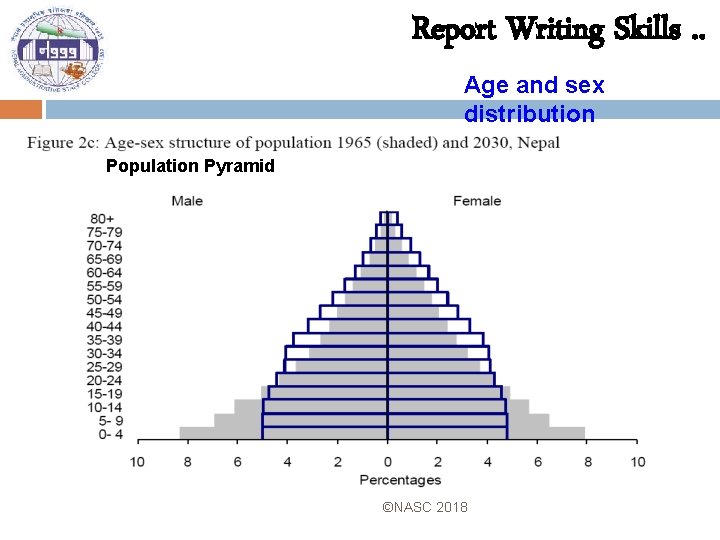
Report Writing Skills. . Data Display (visualization of Data) Table(frequency and cross table, comparative table) Charts, graphs, picture, symbol (informative, self-explanatory) Charts and graphs are used to show: Trends, relationships, and comparisons � � Bar chart: comparisons, categories of data Line graph: display trends over time Pie chart: show percentages or proportional share Pyramid: age and sex distribution of population Note � � � Do not use graph for too many details. Be careful with colour combination of graph and picture. Appropriate size of graph and picture If needed to keep, annex is the right place. Graph title, index and reference. ©NASC 2018
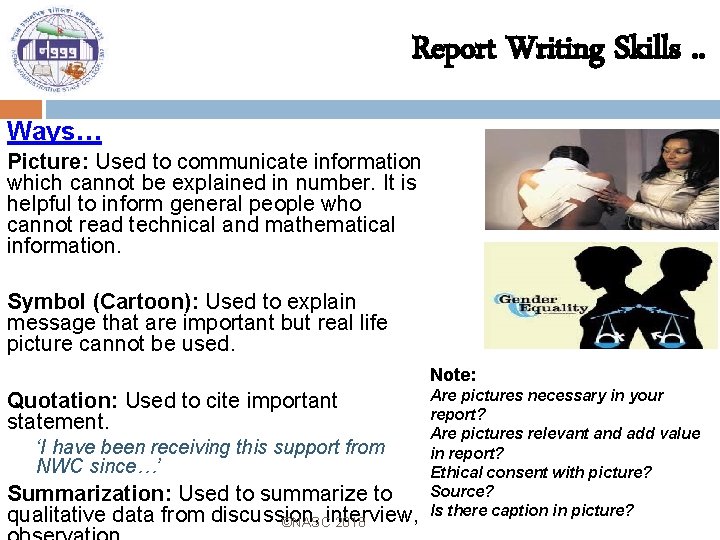
Report Writing Skills. . Ways… Picture: Used to communicate information which cannot be explained in number. It is helpful to inform general people who cannot read technical and mathematical information. Symbol (Cartoon): Used to explain message that are important but real life picture cannot be used. Note: Quotation: Used to cite important statement. ‘I have been receiving this support from NWC since…’ Summarization: Used to summarize to qualitative data from discussion, ©NASCinterview, 2018 Are pictures necessary in your report? Are pictures relevant and add value in report? Ethical consent with picture? Source? Is there caption in picture?
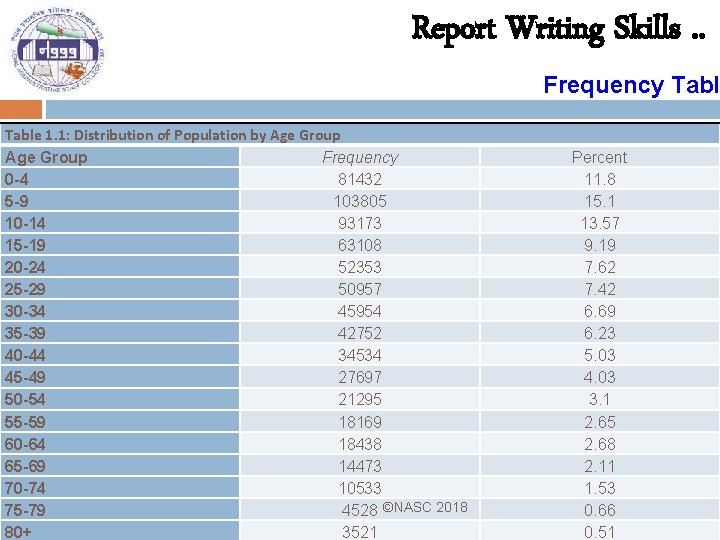
Report Writing Skills. . Frequency Table 1. 1: Distribution of Population by Age Group Frequency 0 -4 81432 5 -9 103805 10 -14 93173 15 -19 63108 20 -24 52353 25 -29 50957 30 -34 45954 35 -39 42752 40 -44 34534 45 -49 27697 50 -54 21295 55 -59 18169 60 -64 18438 65 -69 14473 70 -74 10533 75 -79 4528 ©NASC 2018 80+ 3521 Percent 11. 8 15. 1 13. 57 9. 19 7. 62 7. 42 6. 69 6. 23 5. 03 4. 03 3. 1 2. 65 2. 68 2. 11 1. 53 0. 66 0. 51
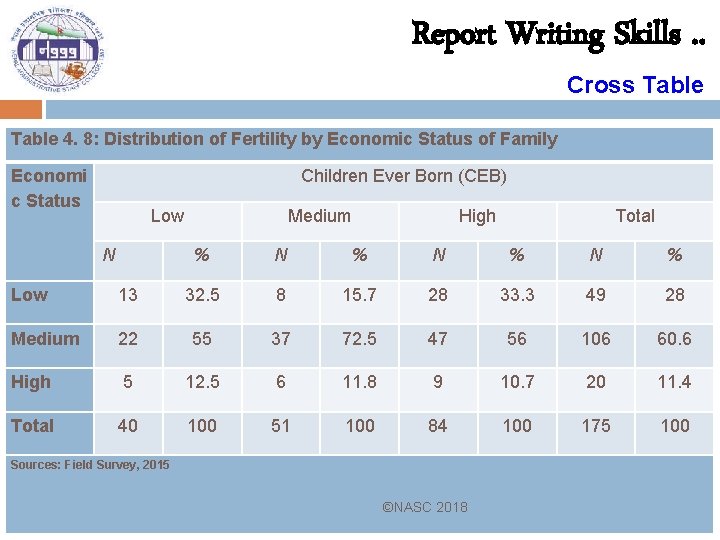
Report Writing Skills. . Cross Table 4. 8: Distribution of Fertility by Economic Status of Family Economi c Status Children Ever Born (CEB) Low N Medium High Total % N % N % Low 13 32. 5 8 15. 7 28 33. 3 49 28 Medium 22 55 37 72. 5 47 56 106 60. 6 High 5 12. 5 6 11. 8 9 10. 7 20 11. 4 Total 40 100 51 100 84 100 175 100 Sources: Field Survey, 2015 ©NASC 2018
Report Writing Skills. . Comparative Table ©NASC 2018
Report Writing Skills. . Comparisons, categories of data ©NASC 2018
Report Writing Skills. . Display trend over time 2000 2005 ©NASC 20102018 2015
Report Writing Skills. . Show percentages or proportional s Side effects faced by respondents ©NASC 2018
Report Writing Skills. . Age and sex distribution Population Pyramid ©NASC 2018
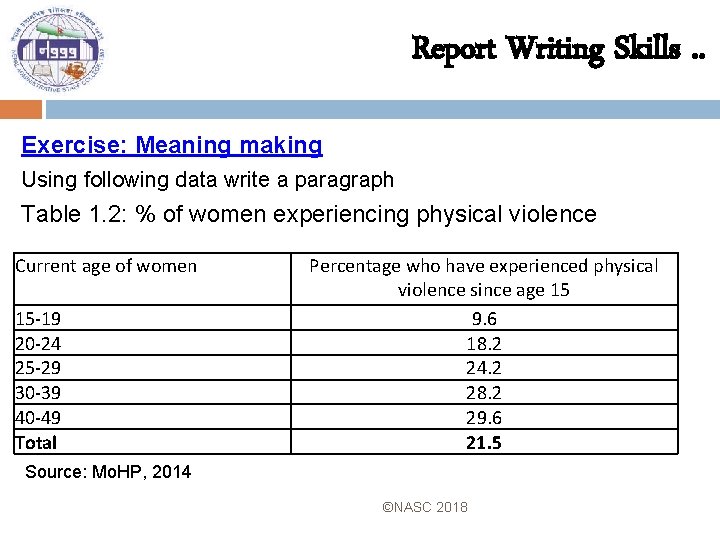
Report Writing Skills. . Exercise: Meaning making Using following data write a paragraph Table 1. 2: % of women experiencing physical violence Current age of women 15 -19 20 -24 25 -29 30 -39 40 -49 Total Percentage who have experienced physical violence since age 15 9. 6 18. 2 24. 2 28. 2 29. 6 21. 5 Source: Mo. HP, 2014 ©NASC 2018
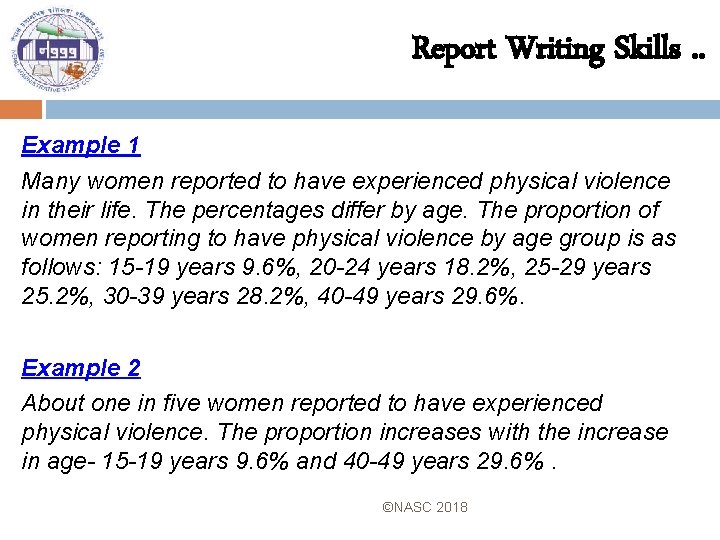
Report Writing Skills. . Example 1 Many women reported to have experienced physical violence in their life. The percentages differ by age. The proportion of women reporting to have physical violence by age group is as follows: 15 -19 years 9. 6%, 20 -24 years 18. 2%, 25 -29 years 25. 2%, 30 -39 years 28. 2%, 40 -49 years 29. 6%. Example 2 About one in five women reported to have experienced physical violence. The proportion increases with the increase in age- 15 -19 years 9. 6% and 40 -49 years 29. 6%. ©NASC 2018
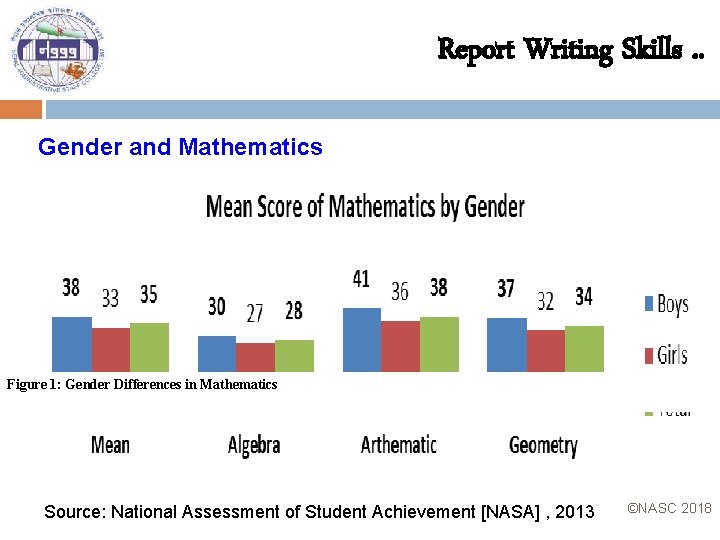
Report Writing Skills. . Gender and Mathematics Figure 1: Gender Differences in Mathematics Source: National Assessment of Student Achievement [NASA] , 2013 ©NASC 2018
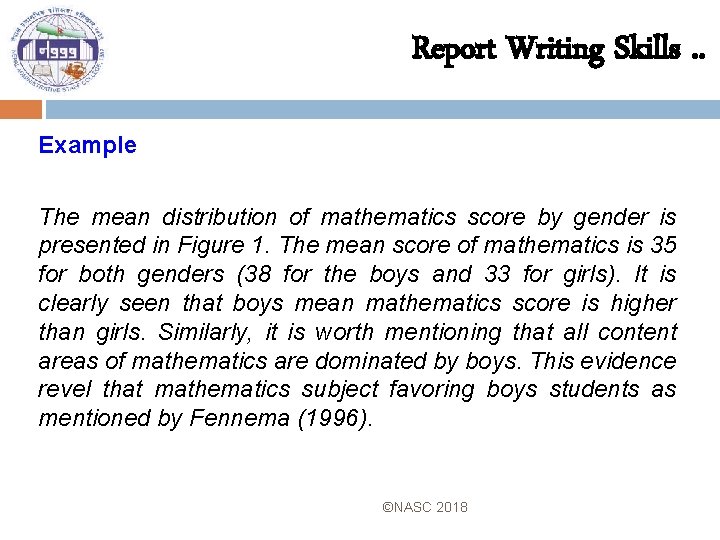
Report Writing Skills. . Example The mean distribution of mathematics score by gender is presented in Figure 1. The mean score of mathematics is 35 for both genders (38 for the boys and 33 for girls). It is clearly seen that boys mean mathematics score is higher than girls. Similarly, it is worth mentioning that all content areas of mathematics are dominated by boys. This evidence revel that mathematics subject favoring boys students as mentioned by Fennema (1996). ©NASC 2018
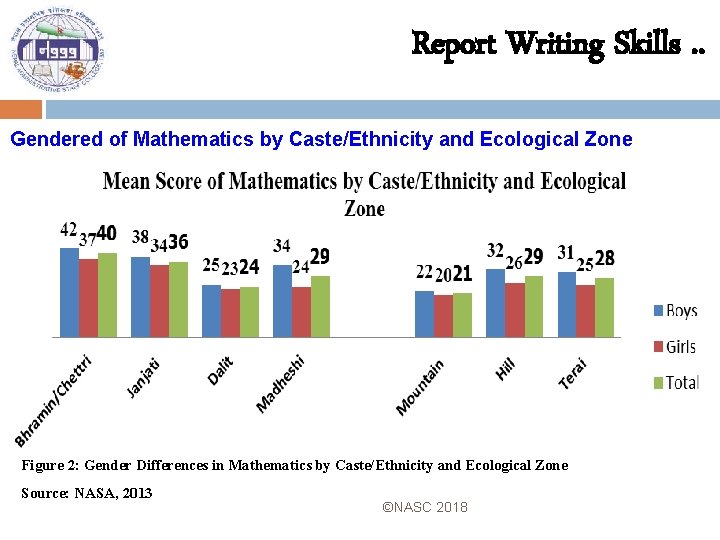
Report Writing Skills. . Gendered of Mathematics by Caste/Ethnicity and Ecological Zone Figure 2: Gender Differences in Mathematics by Caste/Ethnicity and Ecological Zone Source: NASA, 2013 ©NASC 2018
Report Writing Skills. . The role of caste/ethnicity and ecological zone in mathematics can't be ignored (NASA, 2013). Figure 2 shows gender difference of mathematics by caste/ethnicity and ecological zone. The mean score of mathematics for Bharamin/Cheetri is higher than Janjati, Madheshi, and Dalit respectively as shown in Figure 2. Similarly, mean score of mathematics is also differing by ecological zone. Hill and Terai ecological zone have more or less similar mean score in mathematics than mountain. By gender, it is remarkable that boys mean score in mathematics are higher as compared to girls in all caste/ethnicity and ecological zone. High gender gap in mathematics is observed in Madheshi caste (mean score 34 and 24 for boys and girls respectively) than others. Likewise, lower gender gap in 2018 mathematics is observed in mountain as ©NASC
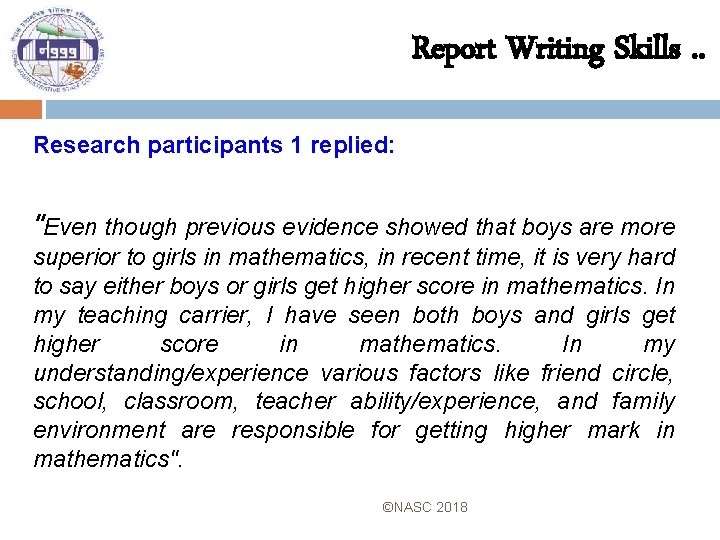
Report Writing Skills. . Research participants 1 replied: "Even though previous evidence showed that boys are more superior to girls in mathematics, in recent time, it is very hard to say either boys or girls get higher score in mathematics. In my teaching carrier, I have seen both boys and girls get higher score in mathematics. In my understanding/experience various factors like friend circle, school, classroom, teacher ability/experience, and family environment are responsible for getting higher mark in mathematics". ©NASC 2018
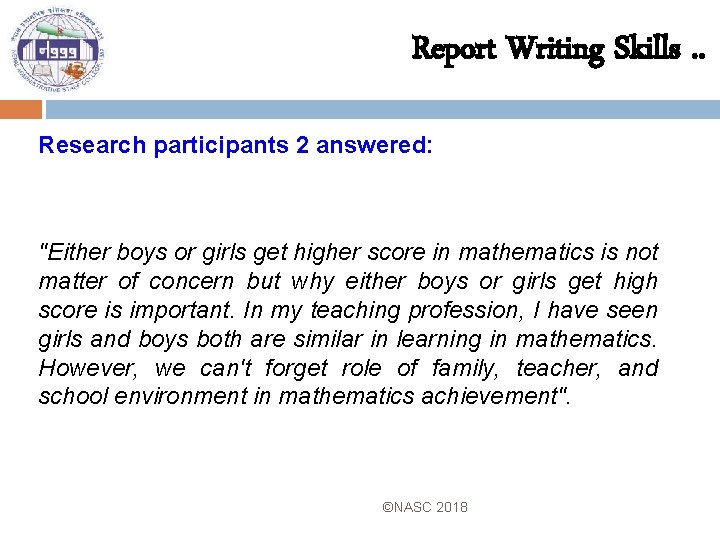
Report Writing Skills. . Research participants 2 answered: "Either boys or girls get higher score in mathematics is not matter of concern but why either boys or girls get high score is important. In my teaching profession, I have seen girls and boys both are similar in learning in mathematics. However, we can't forget role of family, teacher, and school environment in mathematics achievement". ©NASC 2018
Report Writing Skills. . Even though NASA (2013) clearly showed that boys mathematics score is higher than girls in all content areas of mathematics and caste/ethnicity and ecological zone, it is difficult to say boys or girls get high score in mathematics without analyzing their socio-demographic background as mentioned by research participants. Girls and boys are equal in mathematics. However, several socio-demographic factors such as spending less time in studying mathematics, working beyond school hour, access and opportunity for extra class, gender friendly facilities in school, absenteeism, support provided for the study, parental/teacher expectations and support, teaching skills, co-operation, homework, ©NASC 2018 and feedback are influences on their learning achievements.
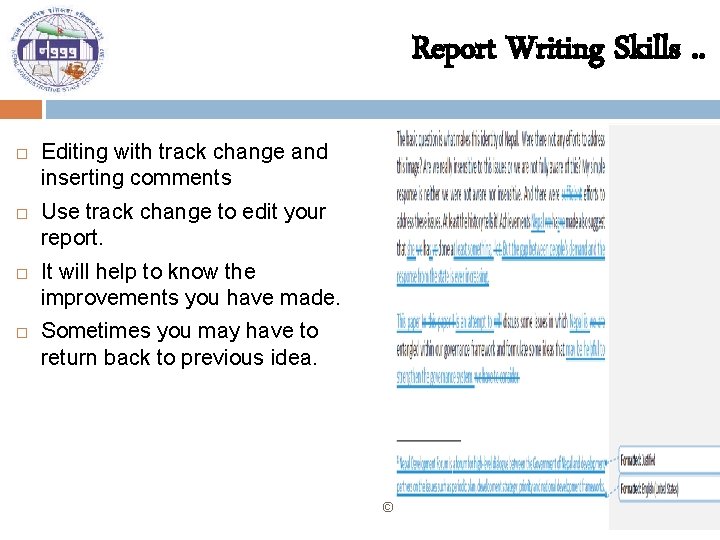
Report Writing Skills. . Editing with track change and inserting comments Use track change to edit your report. It will help to know the improvements you have made. Sometimes you may have to return back to previous idea. ©NASC 2018
Report Writing Skills. . Writing Conclusion Summarize the key findings/ideas Relate with objectives Follow logically from discussion Strictly based on facts No new in Information All conclusion must be supported by what has gone before Major conclusion comes first Recommendation Some times only this part of the report is read for taking decision Suggests future course of action Subjective opinion Cost, location, practicality and acceptability Related to discussion and conclusion Use bullet point (if possible) Ranked Recommend, when only asked ©NASC 2018
Report Writing Skills. . Plagiarism Act of presenting other’s work Or ideas as your own Self- plagiarism just as researcher do not present the work of others as their own, they don't present their own previously published work as new scholarship (APA, 2009) Ways I’ve just stolen other author’s work! Direct Quote: Put in quotation marks Summary: Condenses information and puts it in your own words Paraphrase: Roughly same length as original, but information is stated in your own words Cite all of your sources (Academic Integrity) Never represent the ideas or words of others as “Plagiarizer” ©NASC 2018
References American Psychological Association (1983). Publication manual. American Psychological Association. Education Review Office. (2015). National Assessment of Student Achievement (NASA) 2013 (Grade 8: Mathematics, Nepali and Science). Sanothimi: Author. Gupta, A. K. , & Shrestha, G. L. (2017). Citizen charter in Nepali public sector organizations: What does evidence say? . Lalitpur, Nepal: Nepal Administrative Staff College. Perakyla, A. (1997). Reliability and validity in research based on tapes and transcripts. Qualitative research: Theory, method and practice, 201 -220. ©NASC 2018
Thank You ©NASC 2018