
NeonatalPediatric Cardiopulmonary Care Assessment 2 Anatomic and Physiologic
- Slides: 56
Neonatal/Pediatric Cardiopulmonary Care Assessment
2 Anatomic and Physiologic Differences • Cardiopulmonary System • Metabolic System • Other
3 Cardiopulmonary Differences • Tongue proportionally larger • Large amt. lymphoid tissue in pharynx
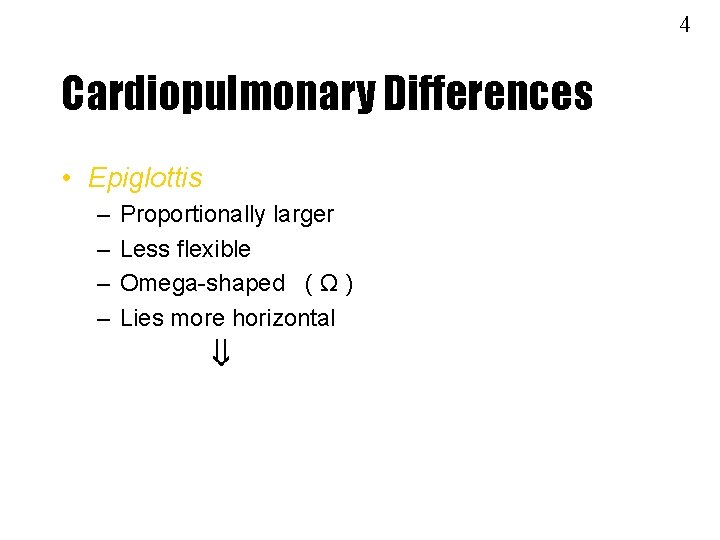
4 Cardiopulmonary Differences • Epiglottis – – Proportionally larger Less flexible Omega-shaped ( Ω ) Lies more horizontal
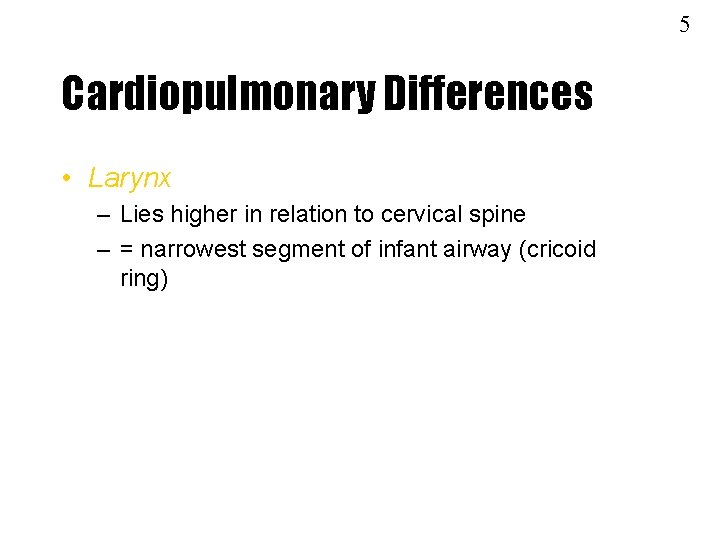
5 Cardiopulmonary Differences • Larynx – Lies higher in relation to cervical spine – = narrowest segment of infant airway (cricoid ring)
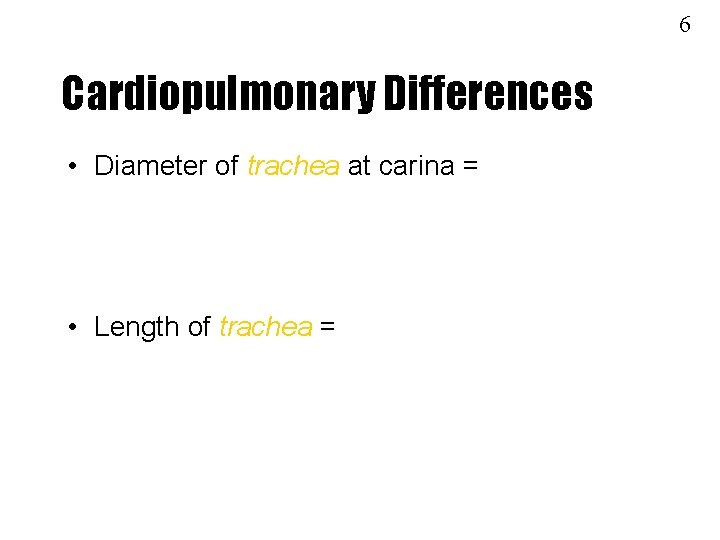
6 Cardiopulmonary Differences • Diameter of trachea at carina = • Length of trachea =
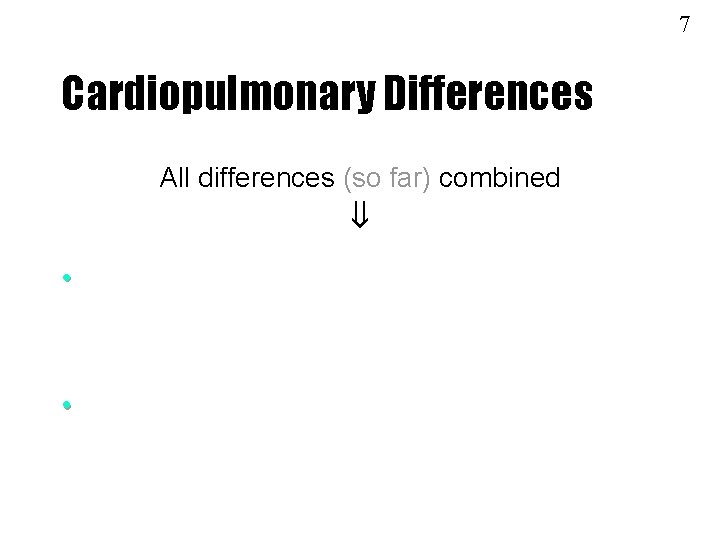
7 Cardiopulmonary Differences All differences (so far) combined • •
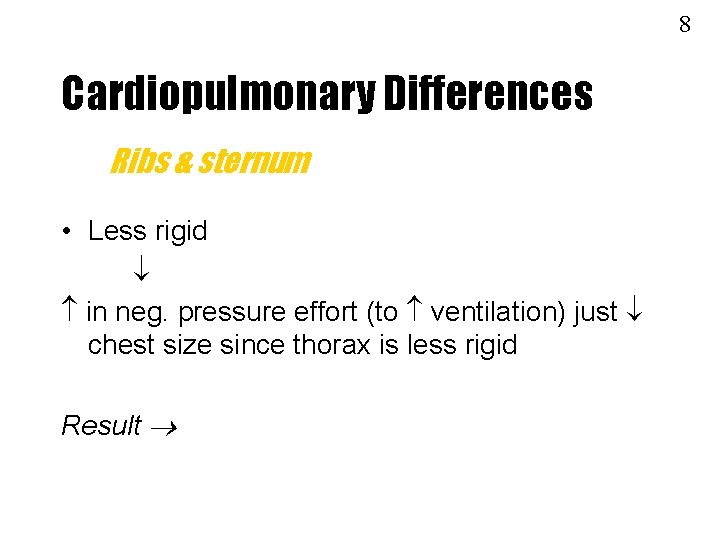
8 Cardiopulmonary Differences Ribs & sternum • Less rigid in neg. pressure effort (to ventilation) just chest size since thorax is less rigid Result
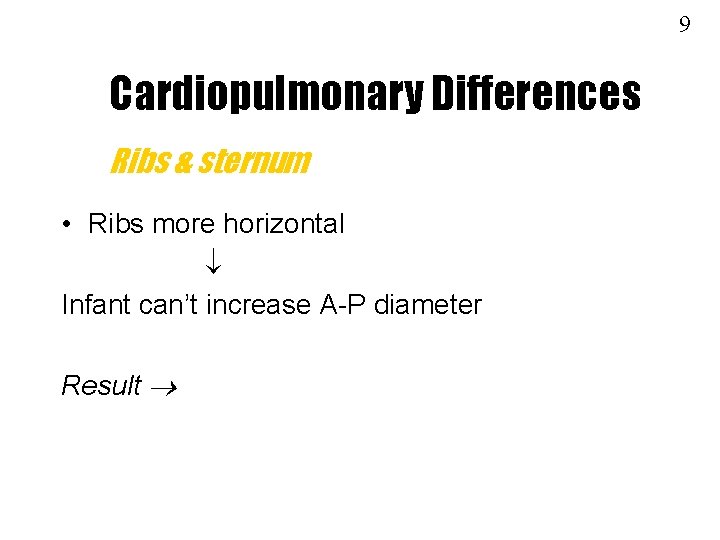
9 Cardiopulmonary Differences Ribs & sternum • Ribs more horizontal Infant can’t increase A-P diameter Result
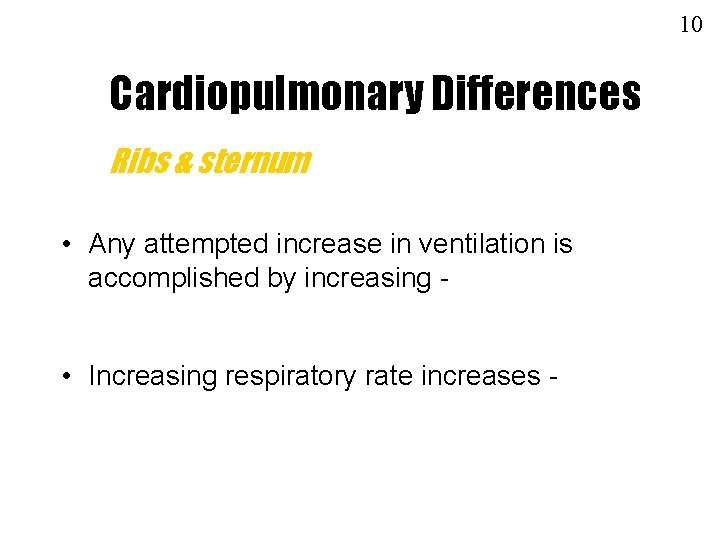
10 Cardiopulmonary Differences Ribs & sternum • Any attempted increase in ventilation is accomplished by increasing • Increasing respiratory rate increases -
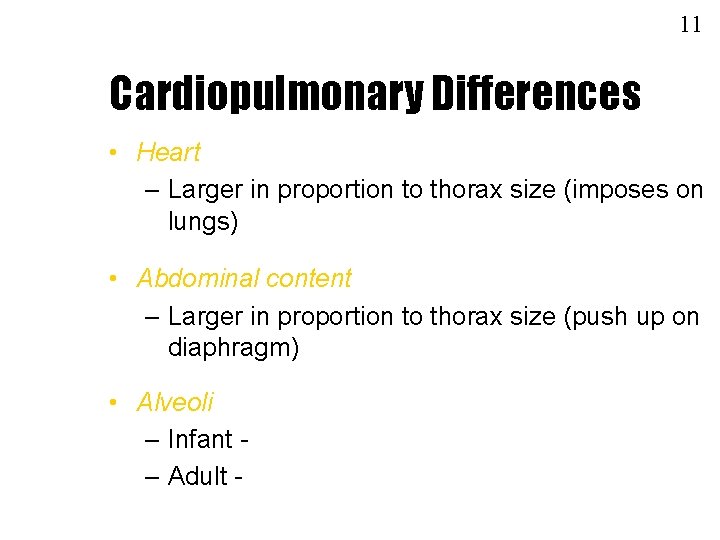
11 Cardiopulmonary Differences • Heart – Larger in proportion to thorax size (imposes on lungs) • Abdominal content – Larger in proportion to thorax size (push up on diaphragm) • Alveoli – Infant – Adult -
12 Cardiopulmonary Differences Ribs, sternal, heart, abdominal & alveolar differences
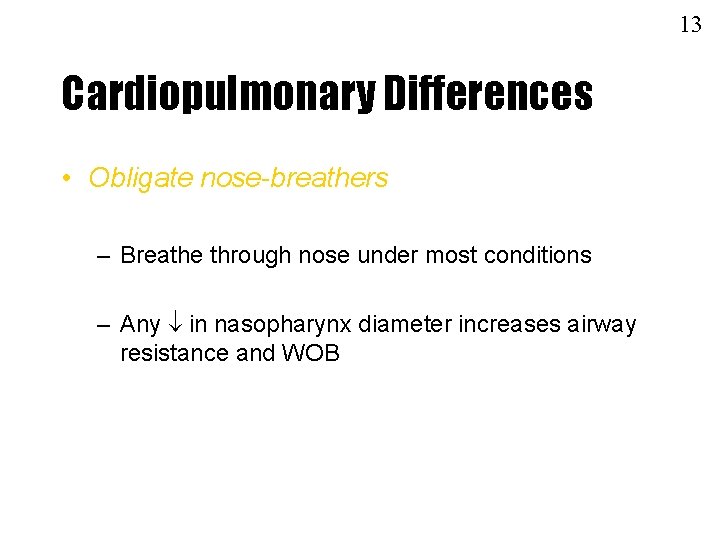
13 Cardiopulmonary Differences • Obligate nose-breathers – Breathe through nose under most conditions – Any in nasopharynx diameter increases airway resistance and WOB
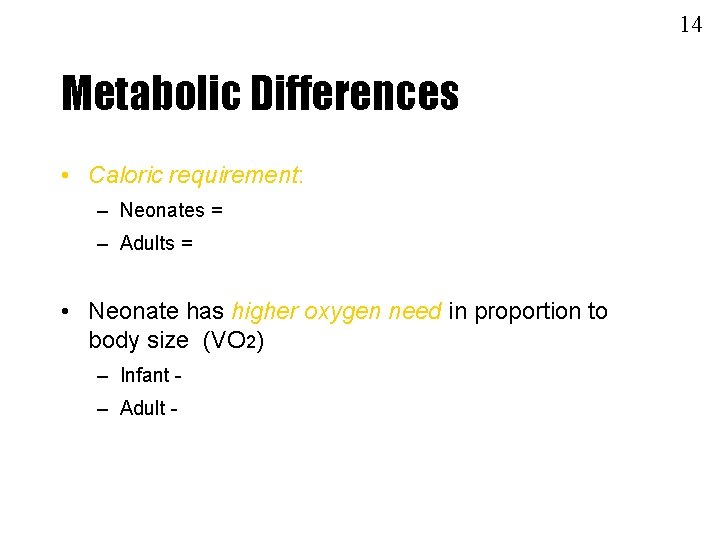
14 Metabolic Differences • Caloric requirement: – Neonates = – Adults = • Neonate has higher oxygen need in proportion to body size (VO 2) – Infant – Adult -
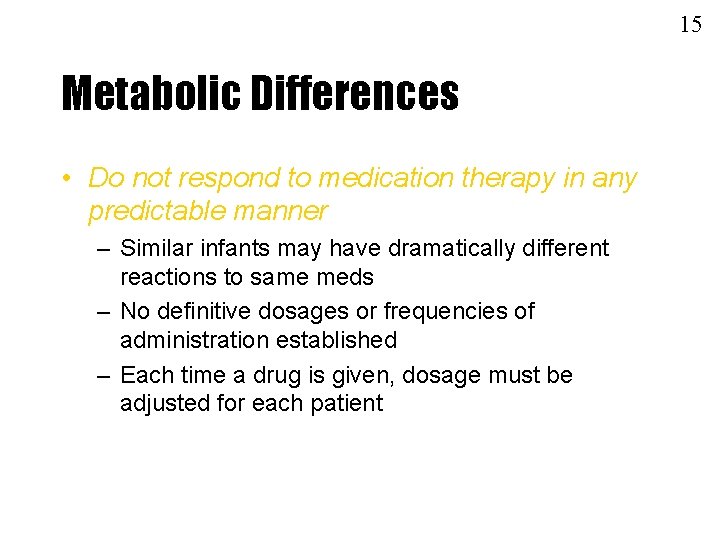
15 Metabolic Differences • Do not respond to medication therapy in any predictable manner – Similar infants may have dramatically different reactions to same meds – No definitive dosages or frequencies of administration established – Each time a drug is given, dosage must be adjusted for each patient
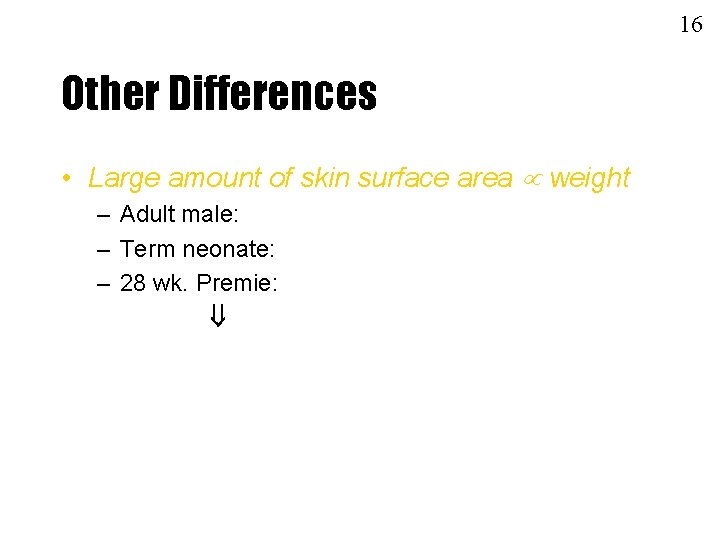
16 Other Differences • Large amount of skin surface area weight – Adult male: – Term neonate: – 28 wk. Premie:
17 Other Differences • 80% of body weight = water – Found in extracellular spaces
18 • Transition from uterine life to survival outside is critical time • Responsibility of HCG to determine how well infant is adapting • Vital to know – Obstetric history – Pregnancy history – L & D history
19 Gestational Age Assessment • Until 1960’s gestational age was based mostly on birth weight – <2500 g. – >4000 g. - • Assumed all fetuses grow at same rate • Important to determine age to anticipate potential problems to treat or avoid
20 Dubowitz Scale • Assesses gestational age with physical (11) & neurological (10) exam • Scored 0 -5 for each sign • Physical signs more accurate • When both evaluated = more accurate than either used alone • Accurate to within 2 weeks • Is a slow method, so …. …. . .
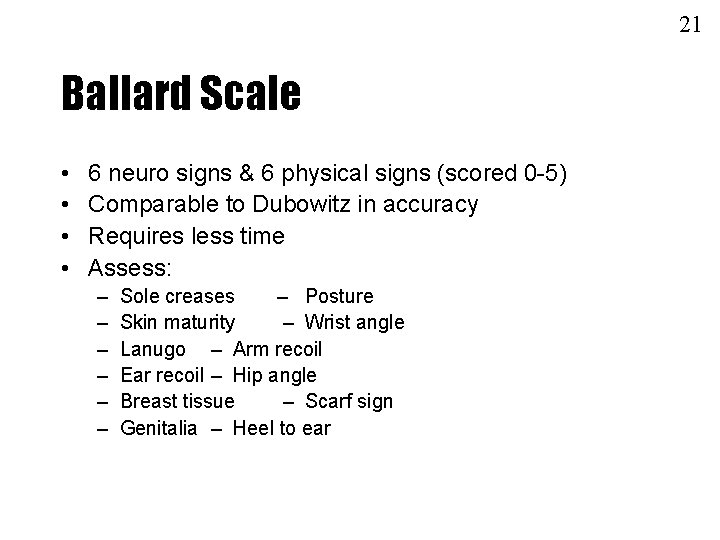
21 Ballard Scale • • 6 neuro signs & 6 physical signs (scored 0 -5) Comparable to Dubowitz in accuracy Requires less time Assess: – – – Sole creases – Posture Skin maturity – Wrist angle Lanugo – Arm recoil Ear recoil – Hip angle Breast tissue – Scarf sign Genitalia – Heel to ear
22 Classification of Neonate • Gestational age + weight – SGA (small for gestational age) – AGA (appropriate for gestational age) – LGA (large for gestational age)
23 Physical Assessment • Purposes – – – Discover physical defects Successful transition? Effect of L & D, anesthetics, analgesics Assess gestational age Signs of infection or metabolic disorder Baseline for further comparison
24 Physical Assessment • Done when infant is stabilized (keep warm) • 2 parts to exam – Quiet observation – Hands-on
25 Quiet Observation • Observe color – – – – Light-skinned -- skin color Dark-skinned -- mucous membranes Should be pink Blue or pale = hypoxemia Blue feet, hands OK for 1 st few hours Yellow hue to skin or eyes = jaundice Dark green = meconium (asphyxia may have been present in utero)
26 Quiet Observation • Look for presence of lanugo • Skin maturity • Activity – Symmetry of movement – Good muscle tone – Normal movement of all extremities • Overall appearance of patient – Malformations – Head size-to-body size – Cysts, tumors
27 Quiet Observation • Respirations – Normal = – Periodic breathing is normal (<5 -10 sec. without cyanosis or bradycardia) • True Apnea = – Tachypnea = • Could be respiratory distress, needs to be investigated – Symmetrical chest movement – Should be good abdominal movement • Sign of intact diaphragm
28 Quiet Observation • Watch for the 3 classic signs of respiratory distress 1. – Attempt to get more as volume to lungs 2. – High pitched noise made by glottis closing before end of expiration = PEEP to keep alveoli from collapsing
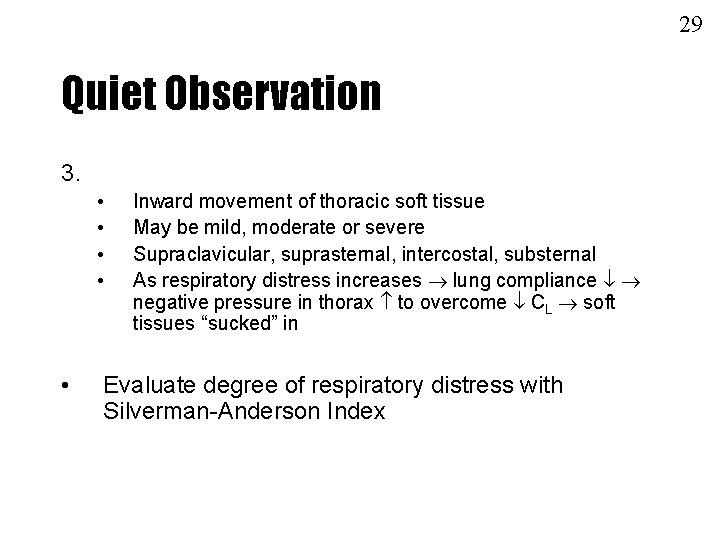
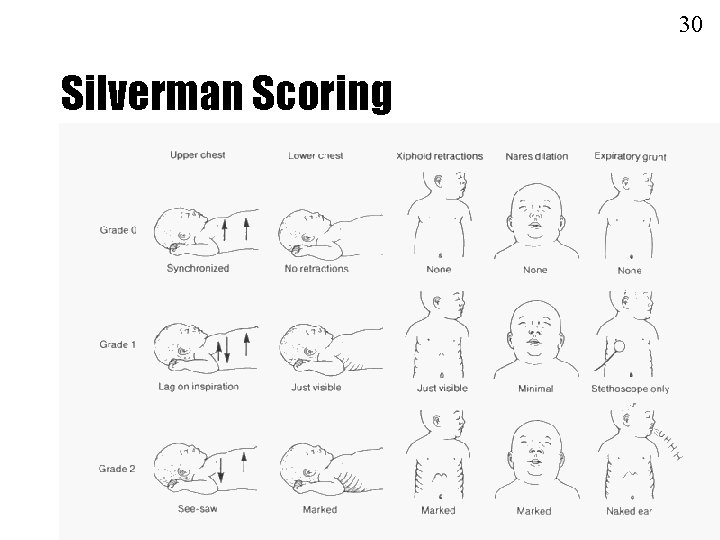
29 Quiet Observation 3. • • • Inward movement of thoracic soft tissue May be mild, moderate or severe Supraclavicular, suprasternal, intercostal, substernal As respiratory distress increases lung compliance negative pressure in thorax to overcome CL soft tissues “sucked” in Evaluate degree of respiratory distress with Silverman-Anderson Index
30 Silverman Scoring
31 Hands-On Exam • Warm hands, warm stethoscope • Start at head and work down • Head – Inspected for cuts, bruises, edema – Fontanelles (soft spots; anterior & posterior) • Should be firm but soft, not bulging ( ICP) or depressed (dehydrated)
32 Hands-On Exam • Mouth (clefts) • Ears (age) • Neck (cysts, tumors) • Breast tissue (age)
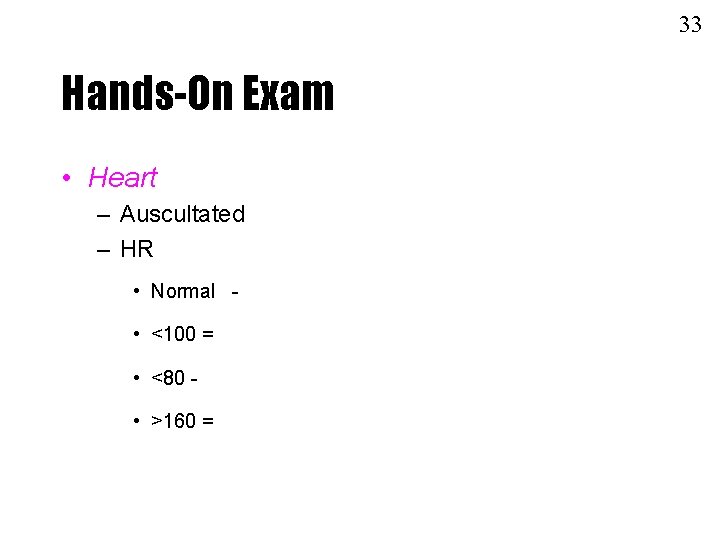
33 Hands-On Exam • Heart – Auscultated – HR • Normal • <100 = • <80 • >160 =
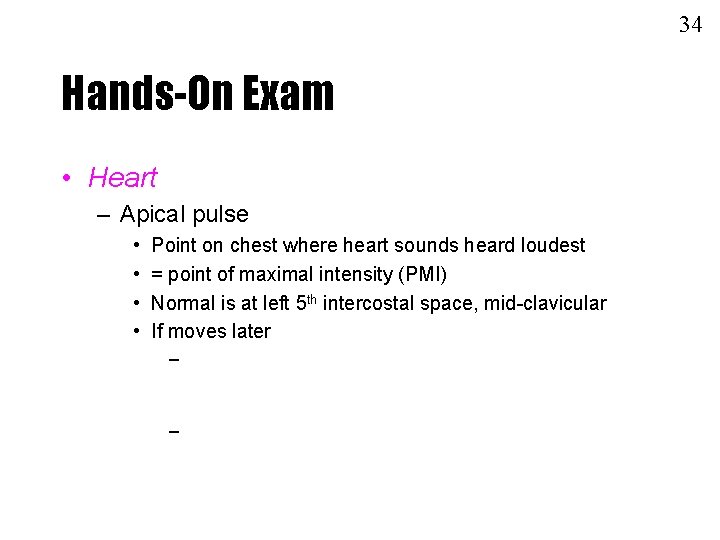
34 Hands-On Exam • Heart – Apical pulse • • Point on chest where heart sounds heard loudest = point of maximal intensity (PMI) Normal is at left 5 th intercostal space, mid-clavicular If moves later – –
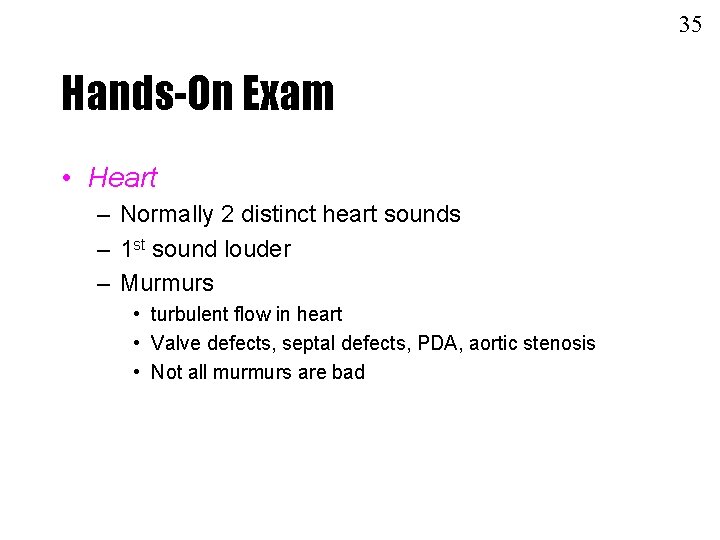
35 Hands-On Exam • Heart – Normally 2 distinct heart sounds – 1 st sound louder – Murmurs • turbulent flow in heart • Valve defects, septal defects, PDA, aortic stenosis • Not all murmurs are bad
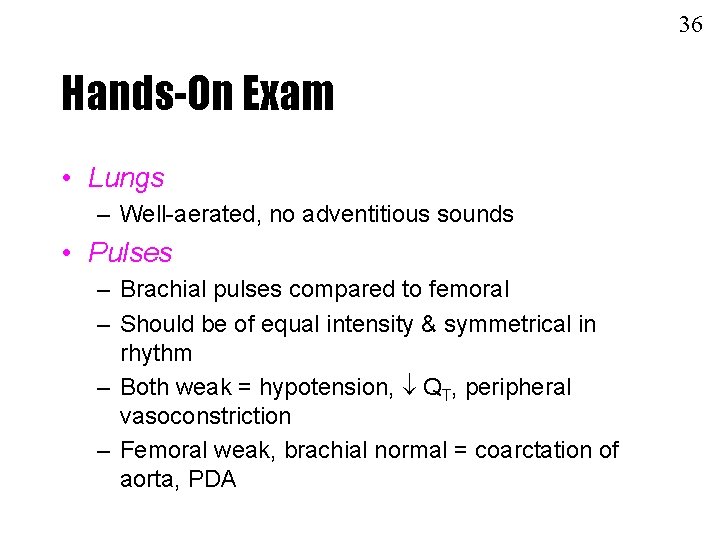
36 Hands-On Exam • Lungs – Well-aerated, no adventitious sounds • Pulses – Brachial pulses compared to femoral – Should be of equal intensity & symmetrical in rhythm – Both weak = hypotension, QT, peripheral vasoconstriction – Femoral weak, brachial normal = coarctation of aorta, PDA
37 Hands-On Exam • Blood pressure – Normally varies with gestational age, weight, cuff size, state of alertness – Taken with Doppler or electronic (cuff around thigh), UAC – Diastolic may be difficult to assess – Normal =
38 Hands-On Exam • Abdomen – – – Palpated for cysts, tumors Liver palpated & measured in cm Normally abdomen protrudes If scaphoid (sunken) = diaphragmatic hernia Check umbilical stump for 3 vessels Bowel sounds documented
39 Hands-On Exam • Genitalia - age • Feet - age • Temperature – Rectally or axillary or ear – 36. 2°C - 37. 3°C (97. 2°F - 99. 1°F)
40 Neurological Exam • Much of neuro exam can be done during physical exam – – Movement Crying Response to touch Body tone
41 Neurological Exam • Reflex exams – Rooting reflex • Gently stroke corner of mouth • Infant should turn head towards side stroked – Suck reflex • Place pacifier or clean finger into mouth • Infant should begin to suck
42 Neurological Exam • Reflex exams – Grasp reflex • • • Place index finger into infant’s palm Grasp finger & place your thumb over fingers Gently pull infant to sitting position Assess degree of head control Healthy infant can keep head upright
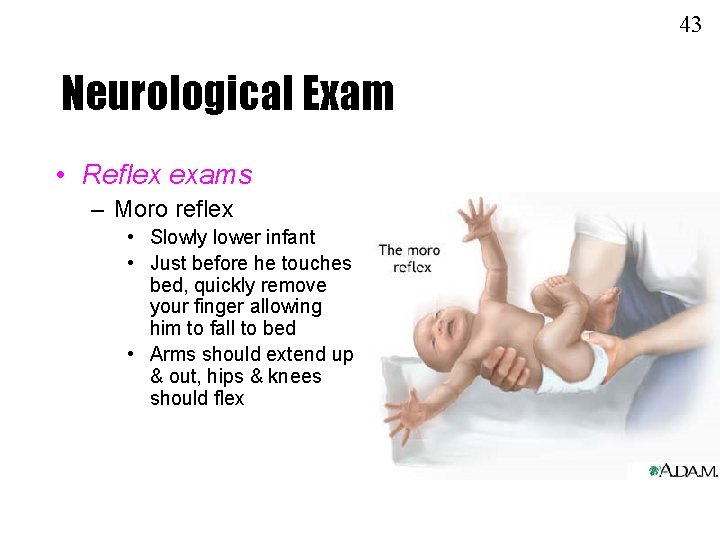
43 Neurological Exam • Reflex exams – Moro reflex • Slowly lower infant • Just before he touches bed, quickly remove your finger allowing him to fall to bed • Arms should extend up & out, hips & knees should flex
44 Neurological Exam • Dubowitz or Ballard Scale scoring – Aloan, Respiratory Care of the Newborn and Child, pg. 45
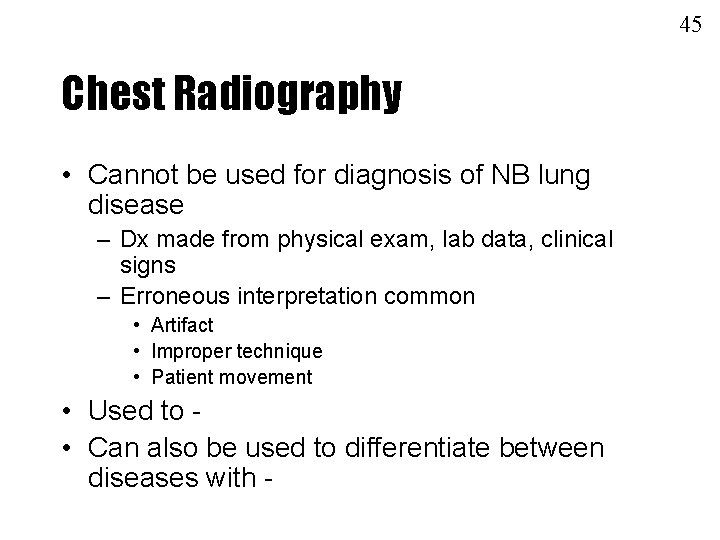
45 Chest Radiography • Cannot be used for diagnosis of NB lung disease – Dx made from physical exam, lab data, clinical signs – Erroneous interpretation common • Artifact • Improper technique • Patient movement • Used to • Can also be used to differentiate between diseases with -
46 Anatomic Considerations (on CXR) • Can cause confusion if not understood • Position of carina – Higher than adult • NB • adult -
47 Anatomic Considerations (on CXR) • Thymus gland – Extends in mediastinum from lower edge of thyroid gland to near 4 th rib – Less dense than heart, more dense than lung tissue – Often confused with heart border – Can appear as an upper lobe atelectasis or pneumonia – Often delta ( )-shaped - called
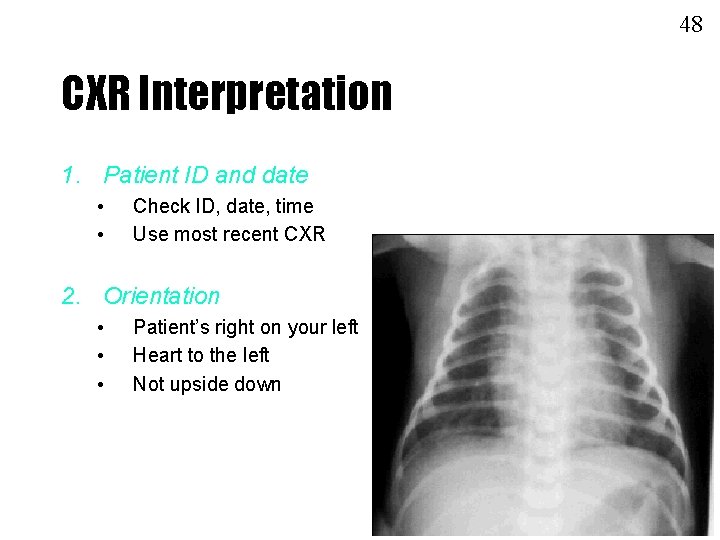
48 CXR Interpretation 1. Patient ID and date • • Check ID, date, time Use most recent CXR 2. Orientation • • • Patient’s right on your left Heart to the left Not upside down
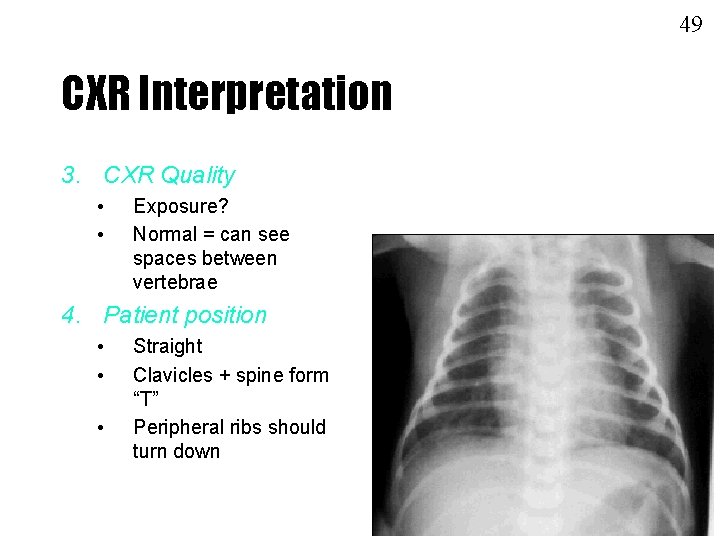
49 CXR Interpretation 3. CXR Quality • • Exposure? Normal = can see spaces between vertebrae 4. Patient position • • • Straight Clavicles + spine form “T” Peripheral ribs should turn down
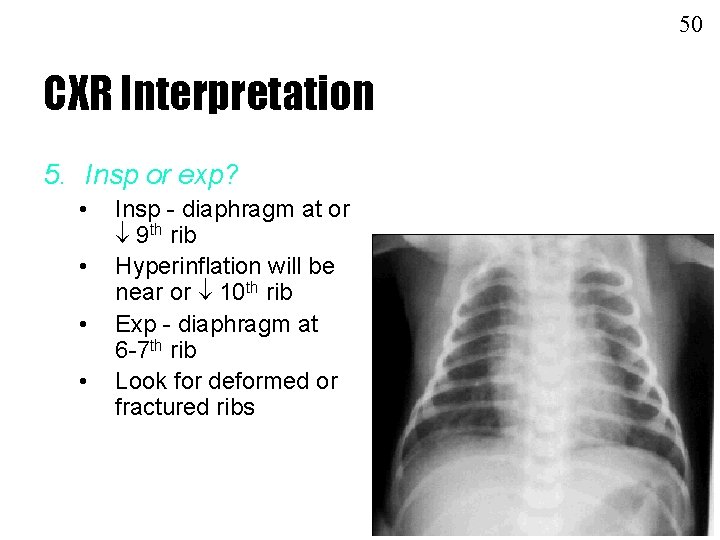
50 CXR Interpretation 5. Insp or exp? • • Insp - diaphragm at or 9 th rib Hyperinflation will be near or 10 th rib Exp - diaphragm at 6 -7 th rib Look for deformed or fractured ribs
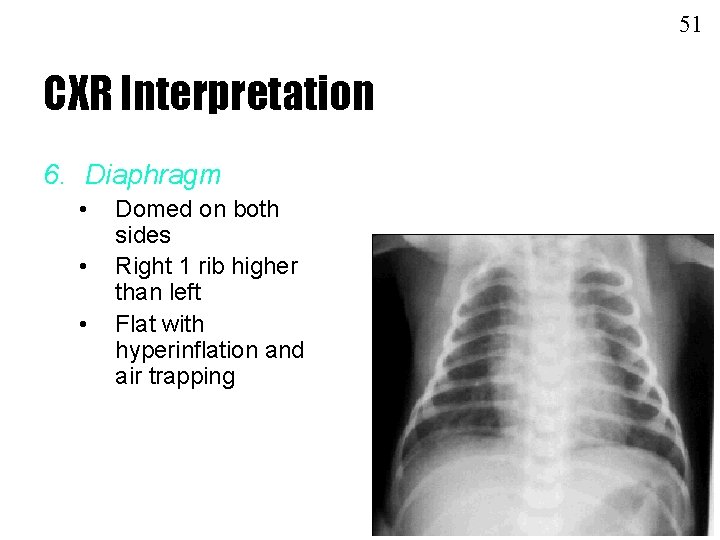
51 CXR Interpretation 6. Diaphragm • • • Domed on both sides Right 1 rib higher than left Flat with hyperinflation and air trapping
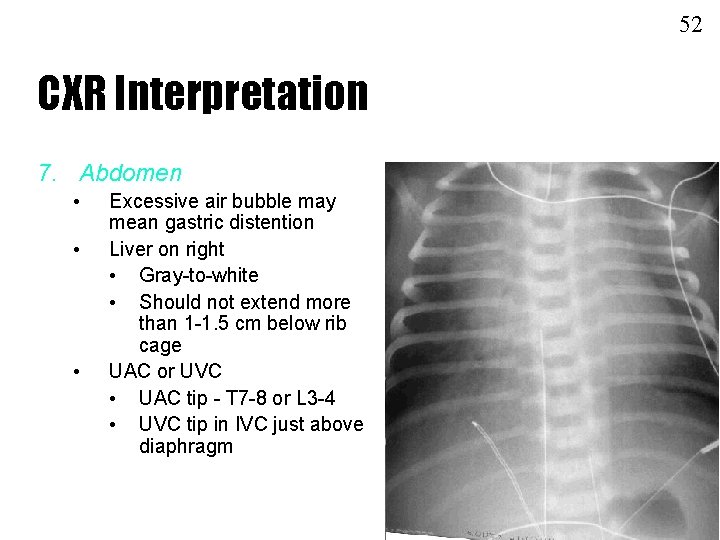
52 CXR Interpretation 7. Abdomen • • • Excessive air bubble may mean gastric distention Liver on right • Gray-to-white • Should not extend more than 1 -1. 5 cm below rib cage UAC or UVC • UAC tip - T 7 -8 or L 3 -4 • UVC tip in IVC just above diaphragm
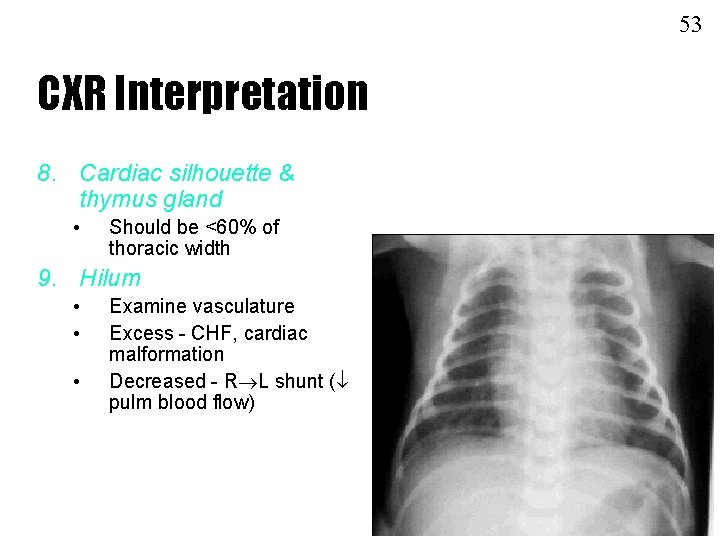
53 CXR Interpretation 8. Cardiac silhouette & thymus gland • Should be <60% of thoracic width 9. Hilum • • • Examine vasculature Excess - CHF, cardiac malformation Decreased - R L shunt ( pulm blood flow)
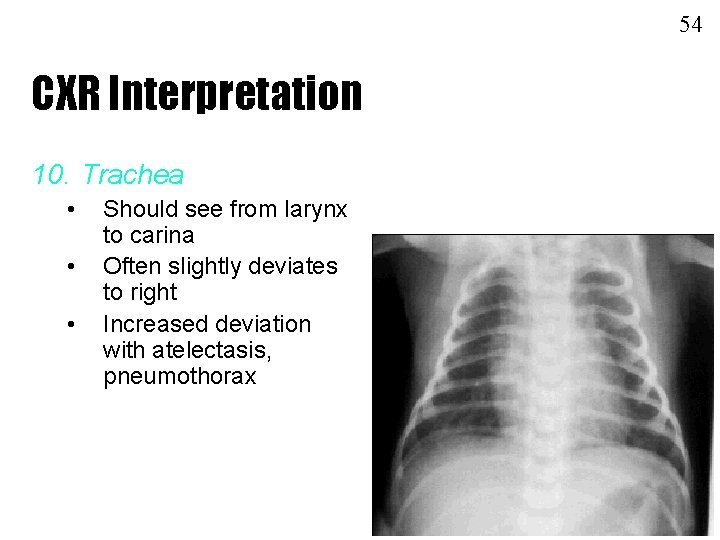
54 CXR Interpretation 10. Trachea • • • Should see from larynx to carina Often slightly deviates to right Increased deviation with atelectasis, pneumothorax
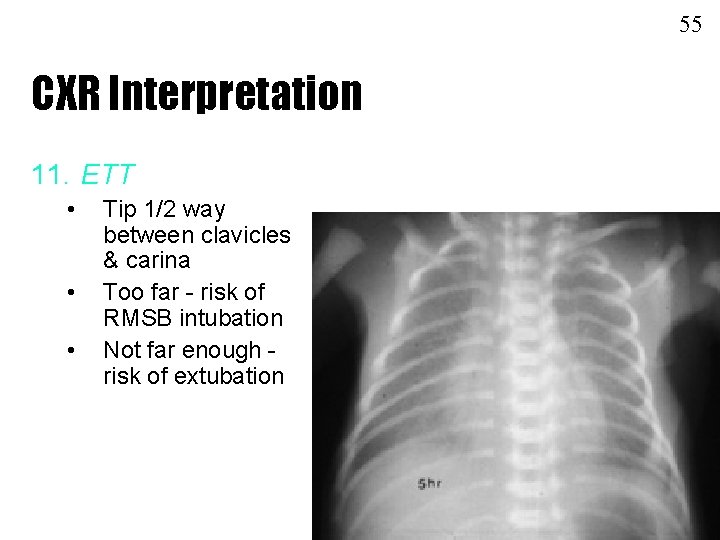
55 CXR Interpretation 11. ETT • • • Tip 1/2 way between clavicles & carina Too far - risk of RMSB intubation Not far enough risk of extubation
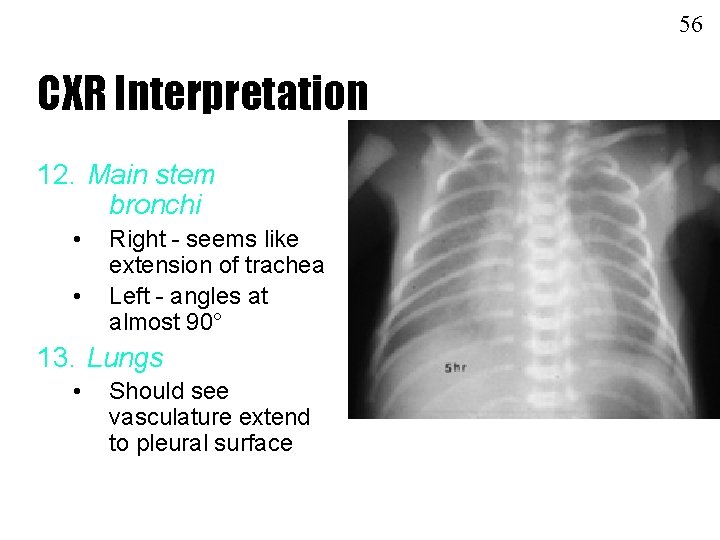
56 CXR Interpretation 12. Main stem bronchi • • Right - seems like extension of trachea Left - angles at almost 90° 13. Lungs • Should see vasculature extend to pleural surface