
Neonatal Tetany An Effect of Maternal Vitamin D
- Slides: 1
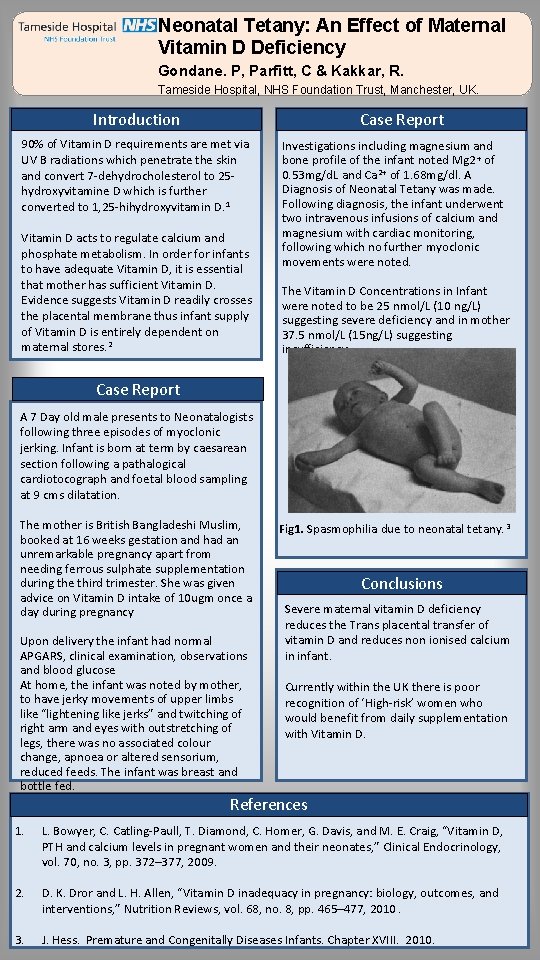
Neonatal Tetany: An Effect of Maternal Vitamin D Deficiency Gondane. P, Parfitt, C & Kakkar, R. Tameside Hospital, NHS Foundation Trust, Manchester, UK. Introduction Case Report 90% of Vitamin D requirements are met via UV B radiations which penetrate the skin and convert 7 -dehydrocholesterol to 25 hydroxyvitamine D which is further converted to 1, 25 -hihydroxyvitamin D. 1 Vitamin D acts to regulate calcium and phosphate metabolism. In order for infants to have adequate Vitamin D, it is essential that mother has sufficient Vitamin D. Evidence suggests Vitamin D readily crosses the placental membrane thus infant supply of Vitamin D is entirely dependent on maternal stores. 2 Investigations including magnesium and bone profile of the infant noted Mg 2 + of 0. 53 mg/d. L and Ca 2+ of 1. 68 mg/dl. A Diagnosis of Neonatal Tetany was made. Following diagnosis, the infant underwent two intravenous infusions of calcium and magnesium with cardiac monitoring, following which no further myoclonic movements were noted. The Vitamin D Concentrations in Infant were noted to be 25 nmol/L (10 ng/L) suggesting severe deficiency and in mother 37. 5 nmol/L (15 ng/L) suggesting insufficiency. Case Report A 7 Day old male presents to Neonatalogists following three episodes of myoclonic jerking. Infant is born at term by caesarean section following a pathalogical cardiotocograph and foetal blood sampling at 9 cms dilatation. The mother is British Bangladeshi Muslim, booked at 16 weeks gestation and had an unremarkable pregnancy apart from needing ferrous sulphate supplementation during the third trimester. She was given advice on Vitamin D intake of 10 ugm once a day during pregnancy Upon delivery the infant had normal APGARS, clinical examination, observations and blood glucose At home, the infant was noted by mother, to have jerky movements of upper limbs like “lightening like jerks” and twitching of right arm and eyes with outstretching of legs, there was no associated colour change, apnoea or altered sensorium, reduced feeds. The infant was breast and bottle fed. Fig 1. Spasmophilia due to neonatal tetany. 3 Conclusions Severe maternal vitamin D deficiency reduces the Trans placental transfer of vitamin D and reduces non ionised calcium in infant. Currently within the UK there is poor recognition of ‘High-risk’ women who would benefit from daily supplementation with Vitamin D. References 1. L. Bowyer, C. Catling-Paull, T. Diamond, C. Homer, G. Davis, and M. E. Craig, “Vitamin D, PTH and calcium levels in pregnant women and their neonates, ” Clinical Endocrinology, vol. 70, no. 3, pp. 372– 377, 2009. 2. D. K. Dror and L. H. Allen, “Vitamin D inadequacy in pregnancy: biology, outcomes, and interventions, ” Nutrition Reviews, vol. 68, no. 8, pp. 465– 477, 2010. 3. J. Hess. Premature and Congenitally Diseases Infants. Chapter XVIII. 2010.