
NeoMarxism The Frankfurt School The Neo Kids on








- Slides: 23
Neo-Marxism__ The Frankfurt School - The Neo Kids on the Block -
Learning Outcomes • All will be able to recap the key points relating to Marxism. • Most will understand how this developed into Neo Marxism • Some will be able to apply the ideas and concepts of the Frankfurt School.
Marxism Neo Marxism? What is Marxism?
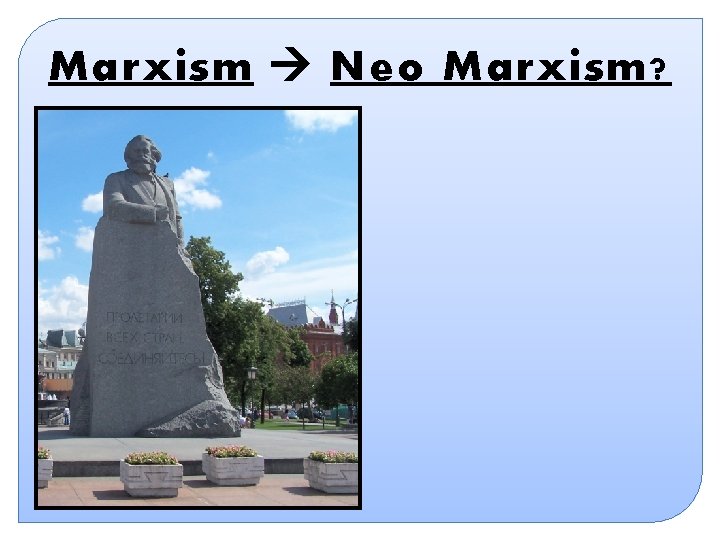
Marxism Neo Marxism?
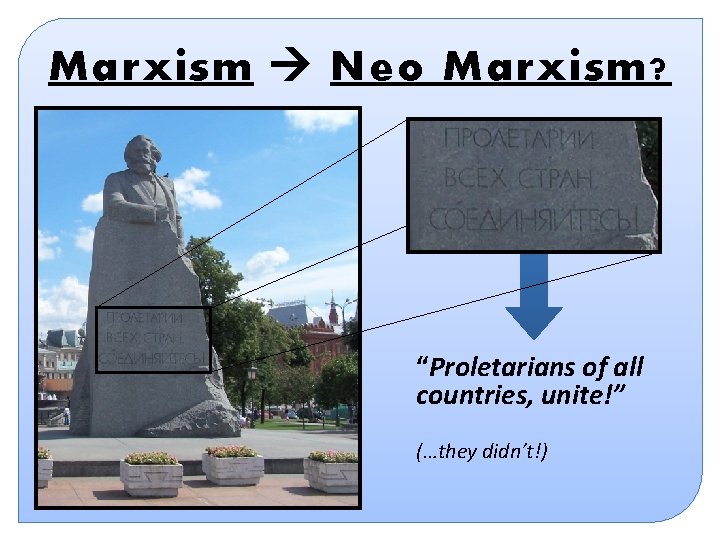
Marxism Neo Marxism? “Proletarians of all countries, unite!” (…they didn’t!)
Marxism Neo Marxism? ? • Karl Marx died in 1883. – The revolutionary social change by Marx hadn’t happened. predicted – Fascism, and capitalism, was emerging in Europe, eventually leading to the rise of the Nazis. – A capitalist consumer culture, promoted by the mass media, grew in the West.
Marxism Neo Marxism? • Marx’s ideas were therefore picked up – and updated – by a group of scholars who made up The Frankfurt School.
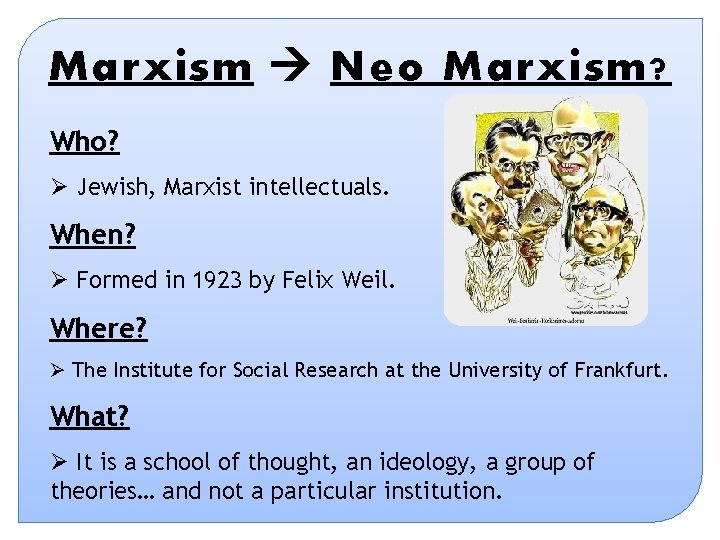
Marxism Neo Marxism? Who? Ø Jewish, Marxist intellectuals. When? Ø Formed in 1923 by Felix Weil. Where? Ø The Institute for Social Research at the University of Frankfurt. What? Ø It is a school of thought, an ideology, a group of theories… and not a particular institution.
Marxism Neo Marxism? Key Points about the Frankfurt School: Who? They held a very negative view of the mass media Ø Jewish, Marxist intellectuals. and its effect on the masses. When? It was, in Marixst terms, a means of production to legitimise capitalism. Ø Formed in 1923 by Felix Weil. Where? Their work focused on the emerging “culture Ø The Institute for Social Research at the University of Frankfurt. industry” What? q What do you think is included in the culture Ø It is a industry school of thought, today? an ideology, a group of theories… and not a particular institution.
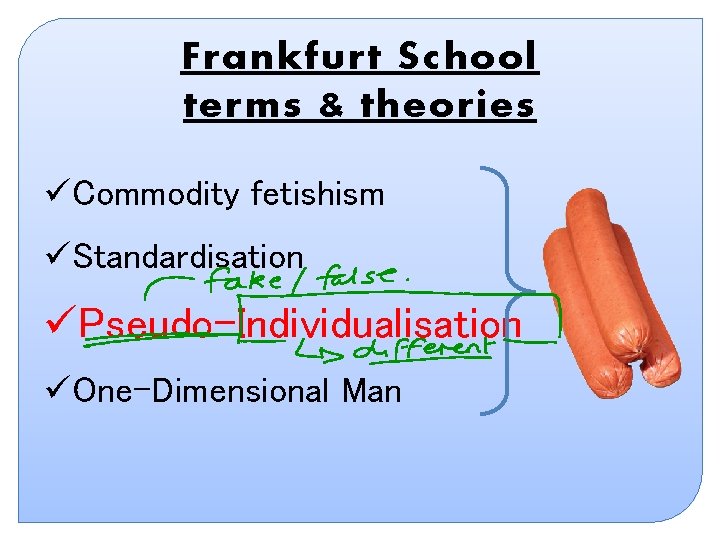
Frankfurt School terms & theories üCommodity fetishism üStandardisation üPseudo-Individualisation üOne-Dimensional Man
Frankfurt School terms & theories üCommodity fetishism üStandardisation üPseudo-Individualisation üOne-Dimensional Man
Commodity Fetishism • What is it? • “Exchange-value” (the marketplace value of an object. It’s PERCEIVED value). IS GREATER THAN • “Use-value” (the usefulness of an object). • This leads to conspicuous consumption. Lavish spending on goods and services that are acquired mainly for the purpose of displaying income or wealth.
Commodity Fetishism Is this still relevant today? Yes. More than ever! We have become compulsive consumers. Advertising has developed methods and techniques which make us fetishise commodities.
Commodity Fetishism Is this still relevant today? Yes. More than ever! Analyse and deconstruct this We have become compulsive ad. Write a PEEL paragraph: consumers! How is the ad constructed to Advertising has developed methods and techniques which makeencourage us fetishise its audience to fetishise the commodity? commodities.
Frankfurt School terms & theories üCommodity fetishism üStandardisation üPseudo-Individualisation üOne-Dimensional Man
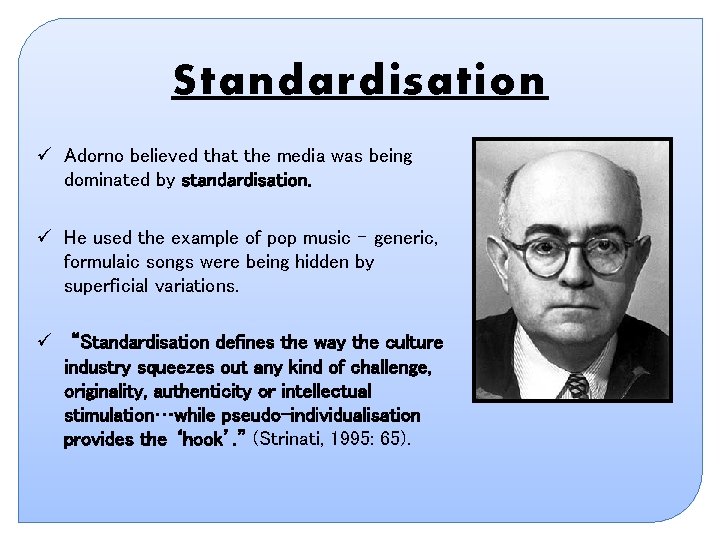
Standardisation ü Adorno believed that the media was being dominated by standardisation. ü He used the example of pop music – generic, formulaic songs were being hidden by superficial variations. ü “Standardisation defines the way the culture industry squeezes out any kind of challenge, originality, authenticity or intellectual stimulation…while pseudo-individualisation provides the ‘hook’. ” (Strinati, 1995: 65).
Standardisation ü Adorno thatthrough the media was being industry handout. Workbelieved your way the culture dominated standardisation. q Take notes on Adorno’s view of standardisation. ü He used the example of pop music – generic, formulaic songs were being hidden by novelties q What is standardisation and how does it relate to and stylistic variations. Marx’s ideas? ü “Standardisation defines the way the culture q What examples did Adorno reference in his works? industry squeezes out any kind of challenge, originality, authenticity or intellectual stimulation…while pseudo-individualisation provides the ‘hook’. ” (Strinati, 1995: 65).
Frankfurt School terms & theories üCommodity fetishism üStandardisation üPseudo-Individualisation üOne-Dimensional Man
Pseudo-Individualisation ü Pseudo-individualisation is a process (Adorno argued). Audiences are being duped into a false consciousness. ü E. g. Pop music today. Lady Gaga is sold to us as this UNIQUE artist. She is ‘packaged’ in a way that is highly individualised… ü IS SHE REALLY THOUGH? It’s still just pop music isn’t it? She still sings about the same things as other artists; her songs still have verses and choruses; she still releases singles and albums; makes music videos; collects awards. ü Is she therefore not just another ‘means of production’ in a highly standardised industry?
http: //www. youtube. com/wa tch? v=Qe. WBS 0 JBNz. Q ü As we watch, take notes in 2 columns: 1. Standardisation: what are the generic conventions Gaga displays that we are used to seeing. How is she just another pop artist? 2. Pseudo-individualisation: how is she sold to us (audiences) as different? How are they trying to ‘trick’ us into thinking she is unique?
Frankfurt School terms & theories üCommodity fetishism üStandardisation üPseudo-Individualisation üOne-Dimensional Man
One Dimensional Man q Herbert Marcuse looked at the impact standardisation was having on society. q What do you think the consequences might be if we live in a culture whereby ALL output is of the same values and low in quality?
One Dimensional Man q Herbert Marcuse looked at the impact standardisation was having on society. q What do you think the consequences might be if we live in a culture whereby ALL output is of the same values and low in quality?