
Neogene Salt Tectonics in the Offshore Salina Basin
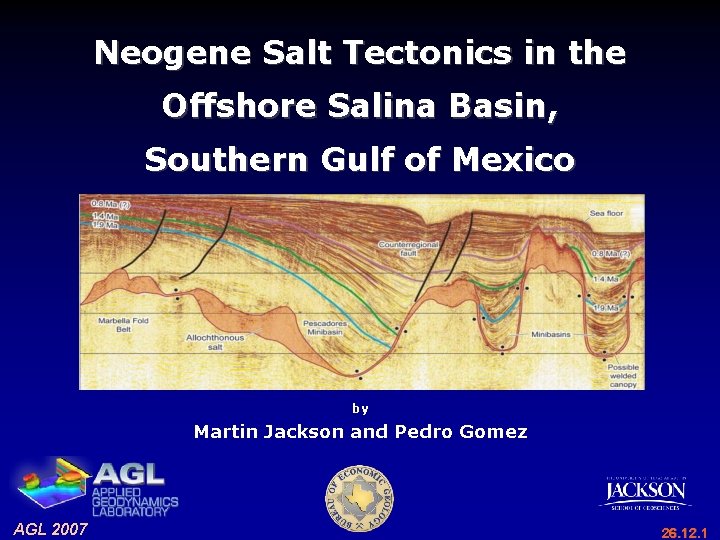
Neogene Salt Tectonics in the Offshore Salina Basin, Southern Gulf of Mexico by Martin Jackson and Pedro Gomez AGL 2007 26. 12. 1
Summary Bureau of Economic Geology Compared with the northern Gulf of Mexico, little has been published on the tectonics of its southern equivalent in the Bay of Campeche, especially in English. A mid-Miocene change in Pacific plate kinematics created the southern Mexico Neogene belt. This is locally expressed as four main fold belts underlying most of the study area: the Agua Dulce, Marbella Norte, and Catemaco fold belts. Each fold belt contains productive Upper Jurassic and Cretaceous sections and may be part of a much larger fold belt that merges with adjoining fold belts in the Chiapas and Campeche areas. During the final stages of folding, salt was squeezed from diapirs and extruded over the eroded and uplifted fold belts. The extruded salt coalesced to form the discontinuous Sal Somera canopy. The salt canopy or equivalent weld is roughly conformable with the underlying fold belts, indicating that the canopy extruded during the final stage of folding or soon after. Evacuation of the thickest parts of the salt canopy allowed the greatest Plio. Pleistocene subsidence and minibasin growth. Three counterregional minibasins formed by seaward evacuation of the underlying salt canopy in the Plio. Pleistocene. Counterregional systems dominate the study area, the largest of which forms the seaward boundary of the 100 -km-long Pescadores Minibasin. Some minibasins are floored by the allochthonous salt canopy or equivalent salt weld, others rest directly on the fold belts, and others are more deeply rooted. AGL 2007 26. 12. 2

Acknowledgments Bureau of Economic Geology Pemex: sponsoring Gomez Ph. D and permission to publish Landmark: use of Seis. Works Midland Valley: use of 2 DMove Bill Fisher for co-supervising Ph. D thesis (Gómez-Cabrera, 2003) Helpful comments by Mike Hudec, Fred Diegel, Mark Rowan, Lou Liro, and Carl Fiduk AGL 2007 26. 12. 3
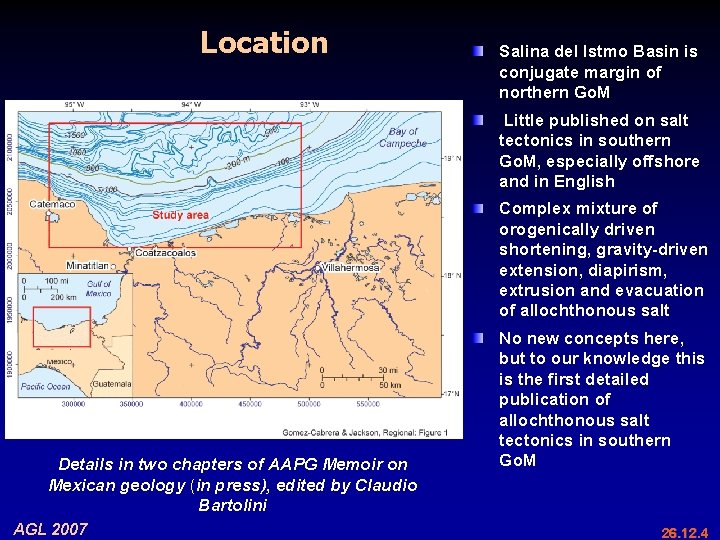
Location Salina del Istmo Basin is conjugate margin of northern Go. M Little published on salt tectonics in southern Go. M, especially offshore and in English Complex mixture of orogenically driven shortening, gravity-driven extension, diapirism, extrusion and evacuation of allochthonous salt Details in two chapters of AAPG Memoir on Mexican geology (in press), edited by Claudio Bartolini AGL 2007 No new concepts here, but to our knowledge this is the first detailed publication of allochthonous salt tectonics in southern Go. M 26. 12. 4
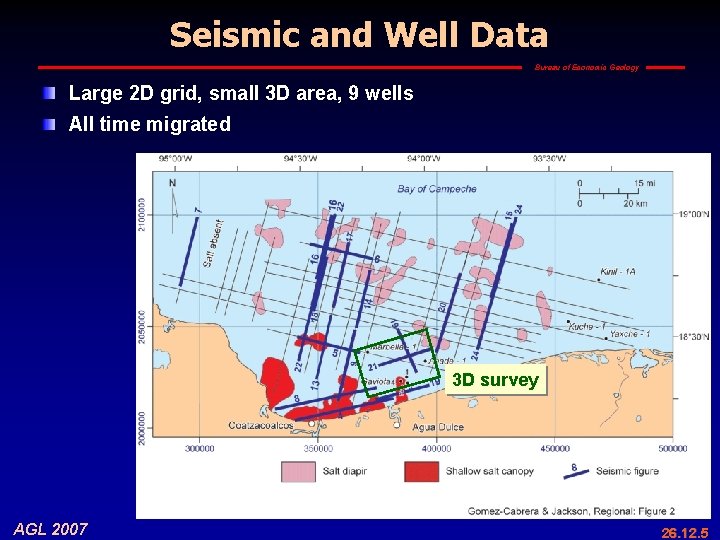
Seismic and Well Data Bureau of Economic Geology Large 2 D grid, small 3 D area, 9 wells All time migrated 3 D survey AGL 2007 26. 12. 5
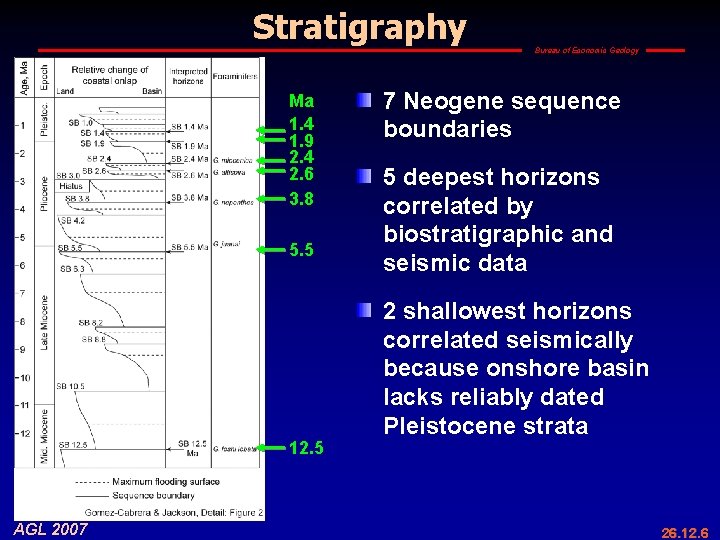
Stratigraphy Ma 1. 4 1. 9 2. 4 2. 6 3. 8 5. 5 12. 5 AGL 2007 Bureau of Economic Geology 7 Neogene sequence boundaries 5 deepest horizons correlated by biostratigraphic and seismic data 2 shallowest horizons correlated seismically because onshore basin lacks reliably dated Pleistocene strata 26. 12. 6
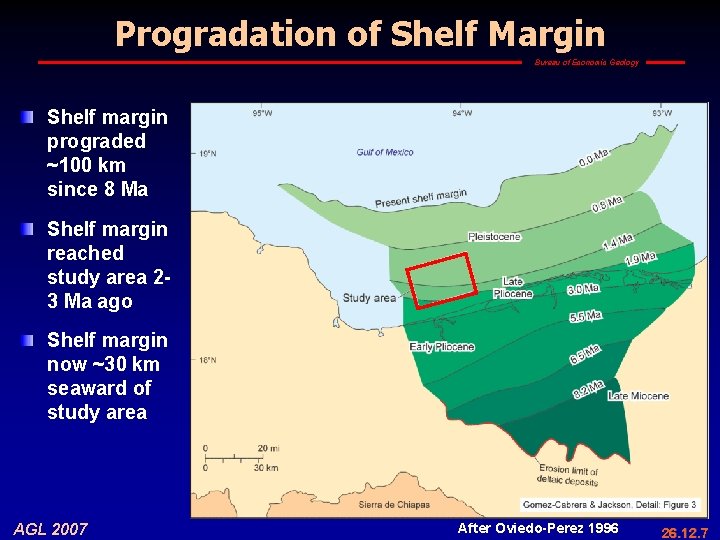
Progradation of Shelf Margin Bureau of Economic Geology Shelf margin prograded ~100 km since 8 Ma Shelf margin reached study area 23 Ma ago Shelf margin now ~30 km seaward of study area AGL 2007 After Oviedo-Perez 1996 26. 12. 7
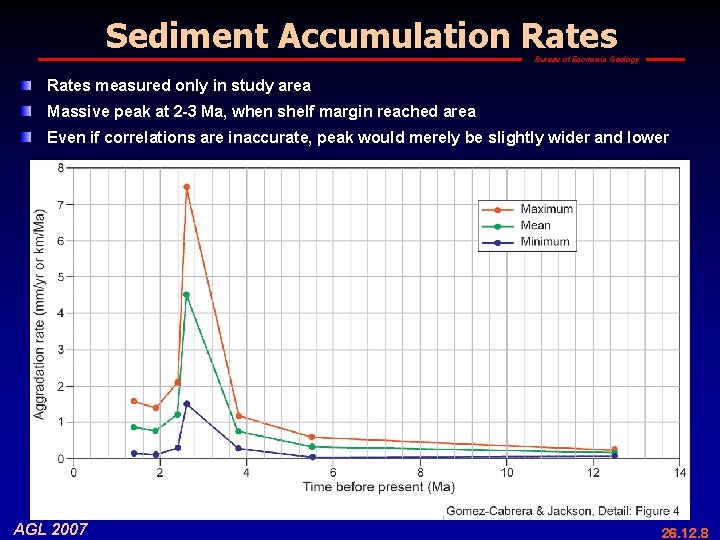
Sediment Accumulation Rates Bureau of Economic Geology Rates measured only in study area Massive peak at 2 -3 Ma, when shelf margin reached area Even if correlations are inaccurate, peak would merely be slightly wider and lower AGL 2007 26. 12. 8
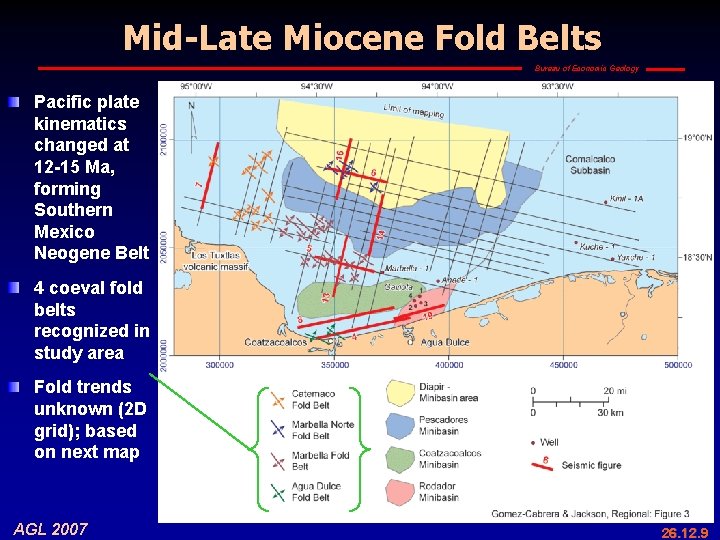
Mid-Late Miocene Fold Belts Bureau of Economic Geology Pacific plate kinematics changed at 12 -15 Ma, forming Southern Mexico Neogene Belt 4 coeval fold belts recognized in study area Fold trends unknown (2 D grid); based on next map AGL 2007 26. 12. 9
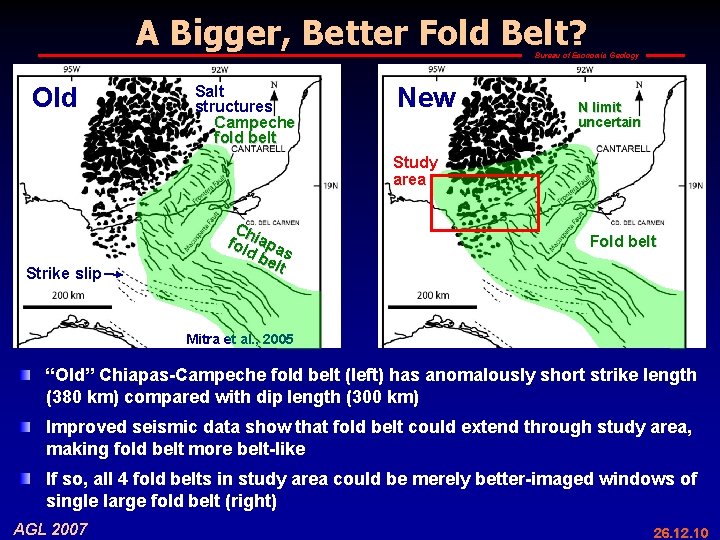
A Bigger, Better Fold Belt? Bureau of Economic Geology Old Salt structures Campeche fold belt New N limit uncertain Study area Strike slip Ch fol iapa db s elt Fold belt Mitra et al. , 2005 “Old” Chiapas-Campeche fold belt (left) has anomalously short strike length (380 km) compared with dip length (300 km) Improved seismic data show that fold belt could extend through study area, making fold belt more belt-like If so, all 4 fold belts in study area could be merely better-imaged windows of single large fold belt (right) AGL 2007 26. 12. 10
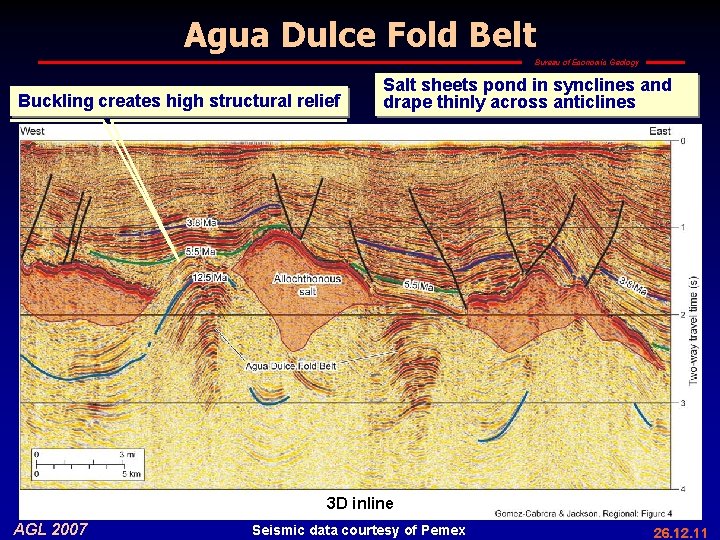
Agua Dulce Fold Belt Bureau of Economic Geology Buckling creates high structural relief Salt sheets pond in synclines and drape thinly across anticlines 3 D inline AGL 2007 Seismic data courtesy of Pemex 26. 12. 11
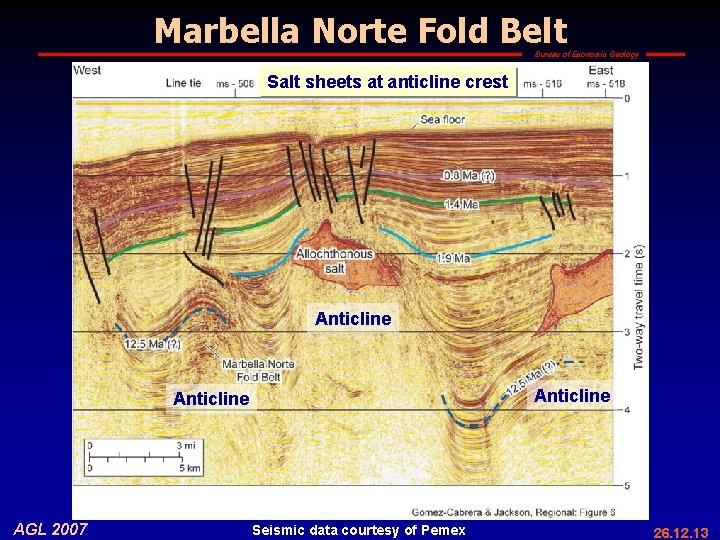
Marbella Norte Fold Belt Bureau of Economic Geology Salt sheets at anticline crest Anticline AGL 2007 Seismic data courtesy of Pemex 26. 12. 13
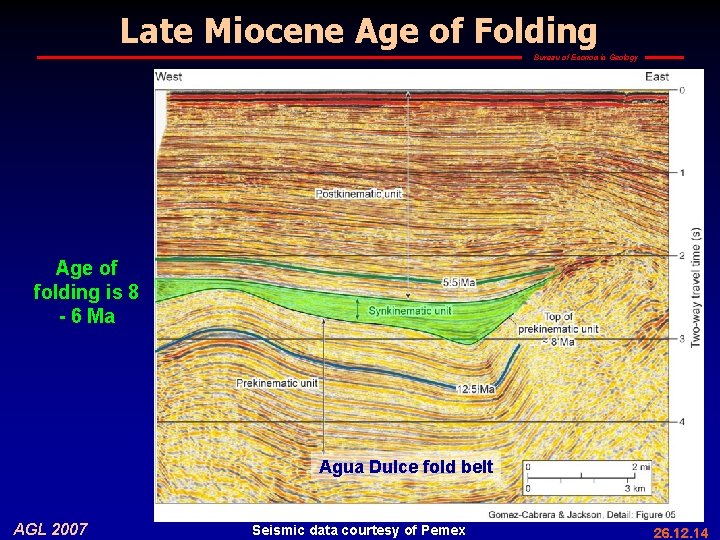
Late Miocene Age of Folding Bureau of Economic Geology Age of folding is 8 - 6 Ma Agua Dulce fold belt AGL 2007 Seismic data courtesy of Pemex 26. 12. 14
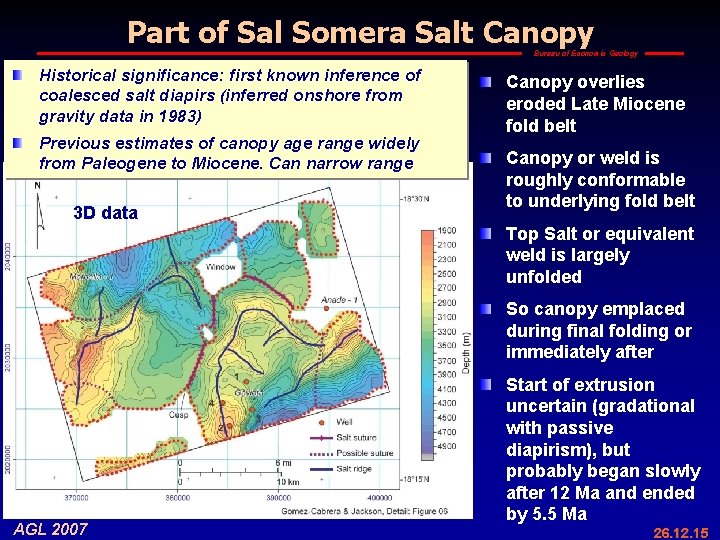
Part of Sal Somera Salt Canopy Bureau of Economic Geology Historical significance: first known inference of coalesced salt diapirs (inferred onshore from gravity data in 1983) Previous estimates of canopy age range widely from Paleogene to Miocene. Can narrow range 3 D data Canopy overlies eroded Late Miocene fold belt Canopy or weld is roughly conformable to underlying fold belt Top Salt or equivalent weld is largely unfolded So canopy emplaced during final folding or immediately after AGL 2007 Start of extrusion uncertain (gradational with passive diapirism), but probably began slowly after 12 Ma and ended by 5. 5 Ma 26. 12. 15
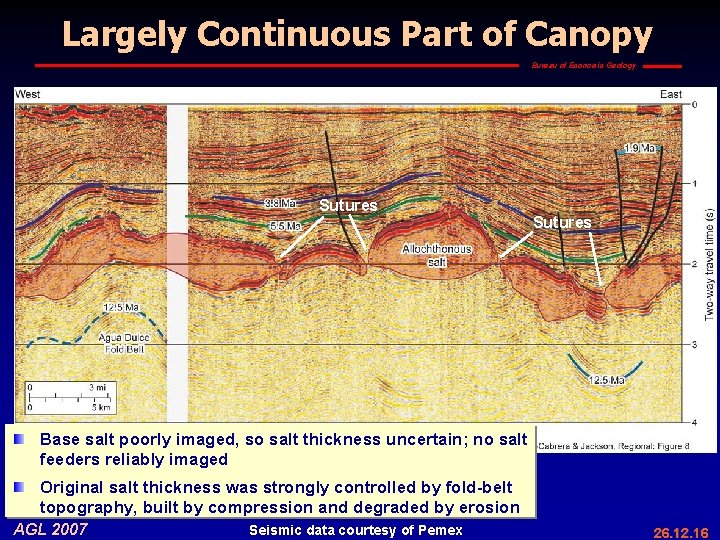
Largely Continuous Part of Canopy Bureau of Economic Geology Sutures Base salt poorly imaged, so salt thickness uncertain; no salt feeders reliably imaged Original salt thickness was strongly controlled by fold-belt topography, built by compression and degraded by erosion AGL 2007 Seismic data courtesy of Pemex 26. 12. 16
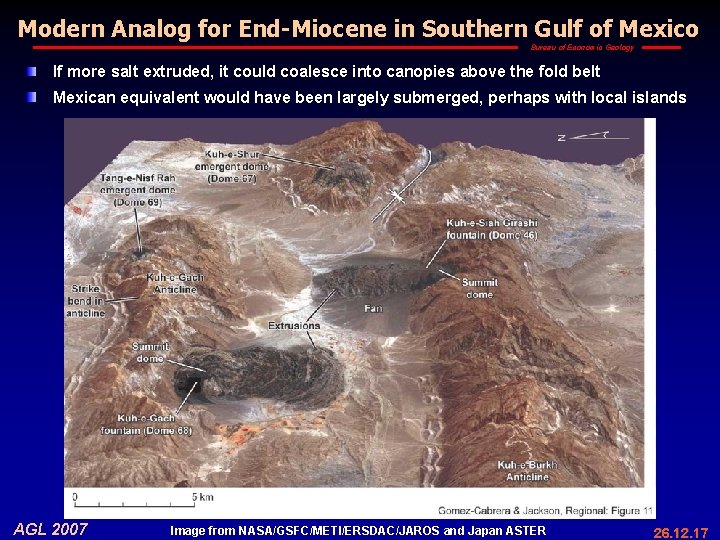
Modern Analog for End-Miocene in Southern Gulf of Mexico Bureau of Economic Geology If more salt extruded, it could coalesce into canopies above the fold belt Mexican equivalent would have been largely submerged, perhaps with local islands AGL 2007 Image from NASA/GSFC/METI/ERSDAC/JAROS and Japan ASTER 26. 12. 17
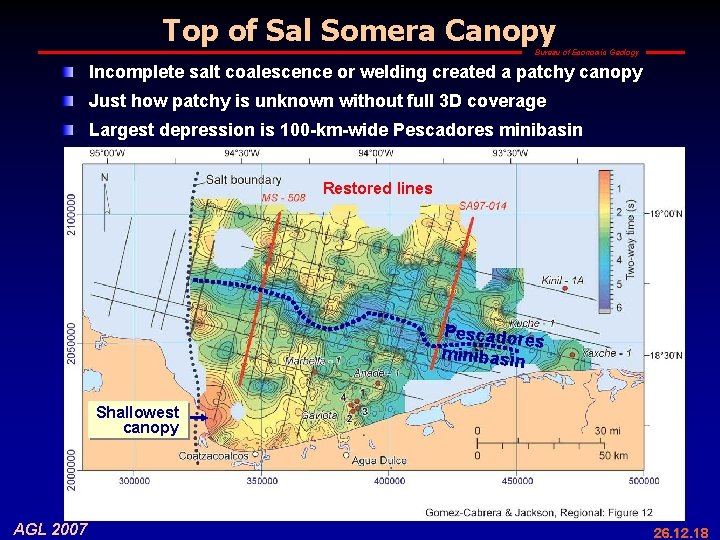
Top of Sal Somera Canopy Bureau of Economic Geology Incomplete salt coalescence or welding created a patchy canopy Just how patchy is unknown without full 3 D coverage Largest depression is 100 -km-wide Pescadores minibasin Restored lines Pescadore s minibasin Shallowest canopy AGL 2007 26. 12. 18
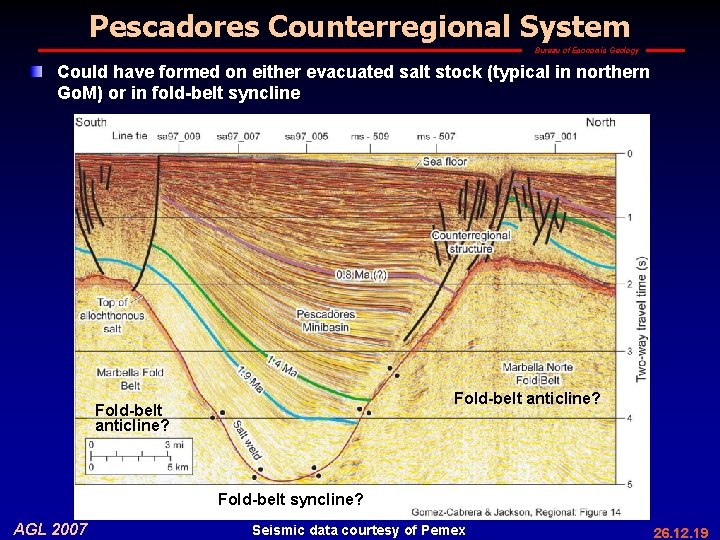
Pescadores Counterregional System Bureau of Economic Geology Could have formed on either evacuated salt stock (typical in northern Go. M) or in fold-belt syncline Fold-belt anticline? Fold-belt syncline? AGL 2007 Seismic data courtesy of Pemex 26. 12. 19
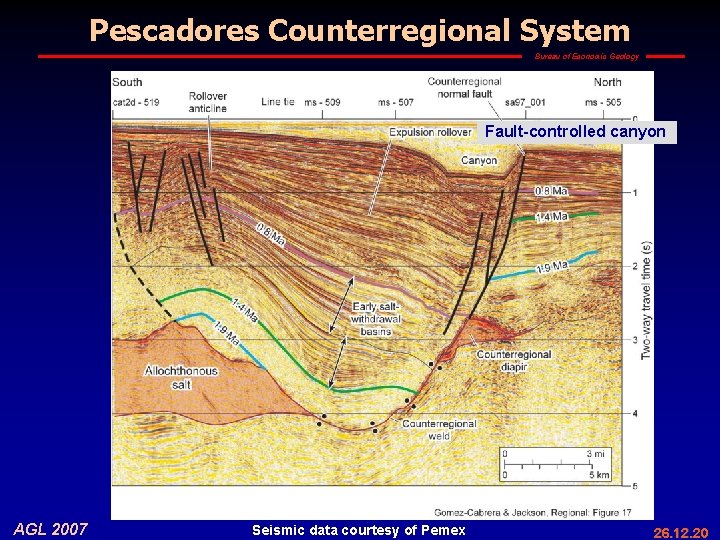
Pescadores Counterregional System Bureau of Economic Geology Fault-controlled canyon AGL 2007 Seismic data courtesy of Pemex 26. 12. 20
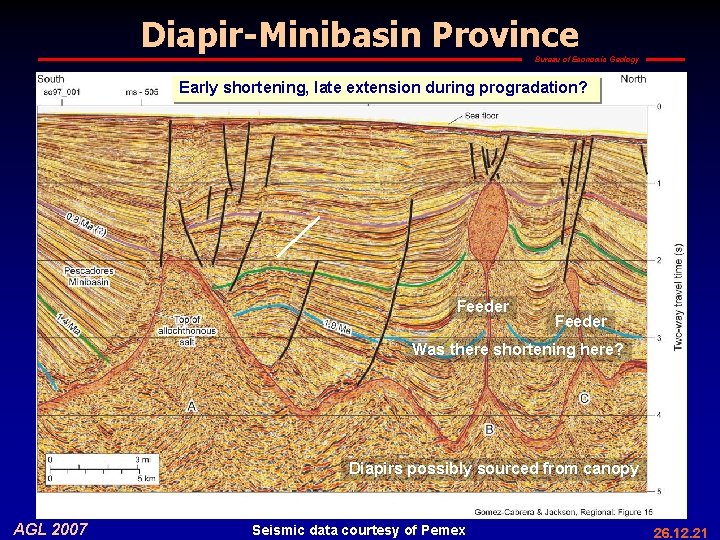
Diapir-Minibasin Province Bureau of Economic Geology Early shortening, late extension during progradation? Feeder Was there shortening here? Diapirs possibly sourced from canopy AGL 2007 Seismic data courtesy of Pemex 26. 12. 21
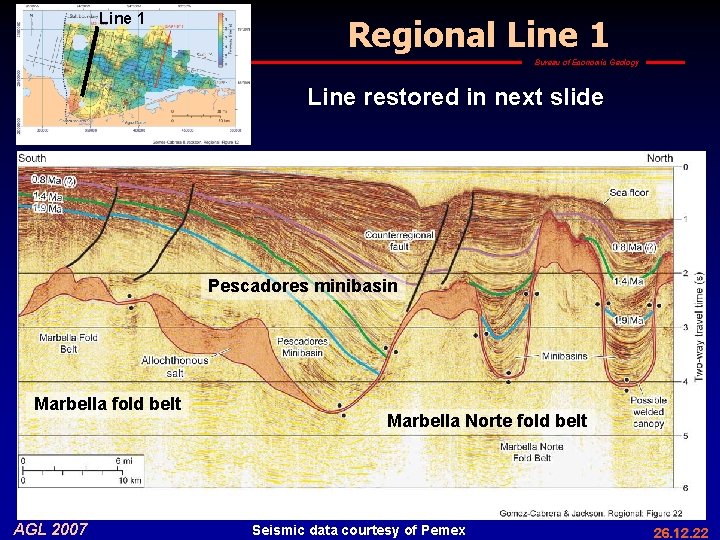
Line 1 Regional Line 1 Bureau of Economic Geology Line restored in next slide Pescadores minibasin Marbella fold belt AGL 2007 Marbella Norte fold belt Seismic data courtesy of Pemex 26. 12. 22
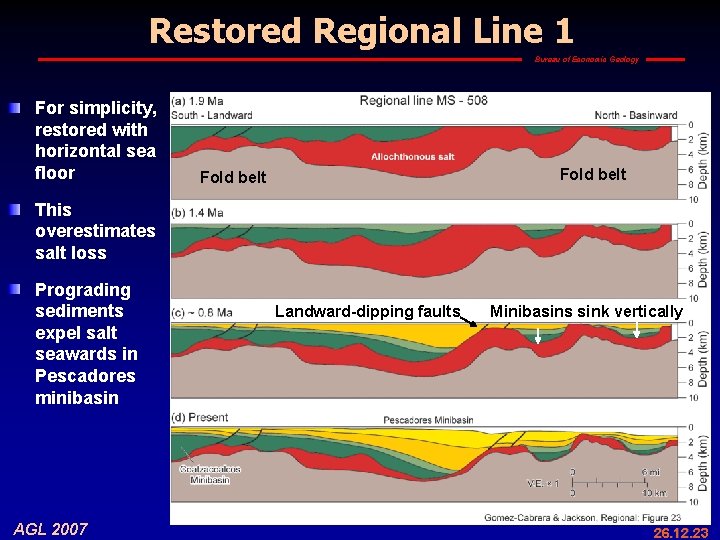
Restored Regional Line 1 Bureau of Economic Geology For simplicity, restored with horizontal sea floor Fold belt This overestimates salt loss Prograding sediments expel salt seawards in Pescadores minibasin AGL 2007 Landward-dipping faults Minibasins sink vertically 26. 12. 23
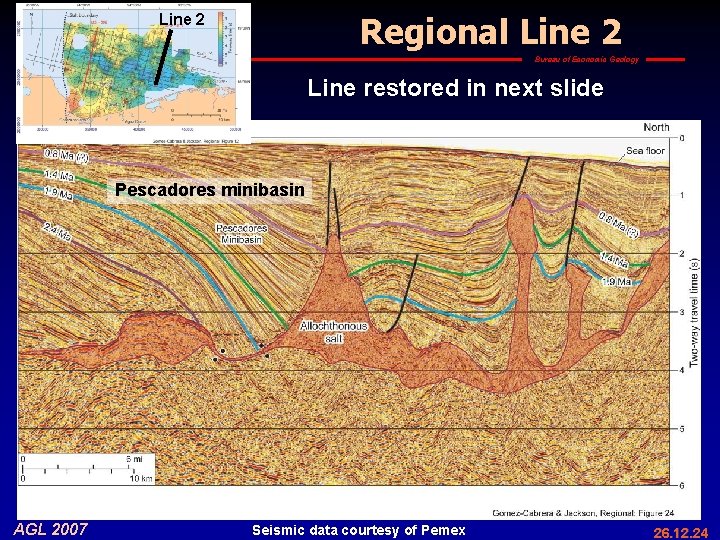
Regional Line 2 Bureau of Economic Geology Line restored in next slide Pescadores minibasin AGL 2007 Seismic data courtesy of Pemex 26. 12. 24
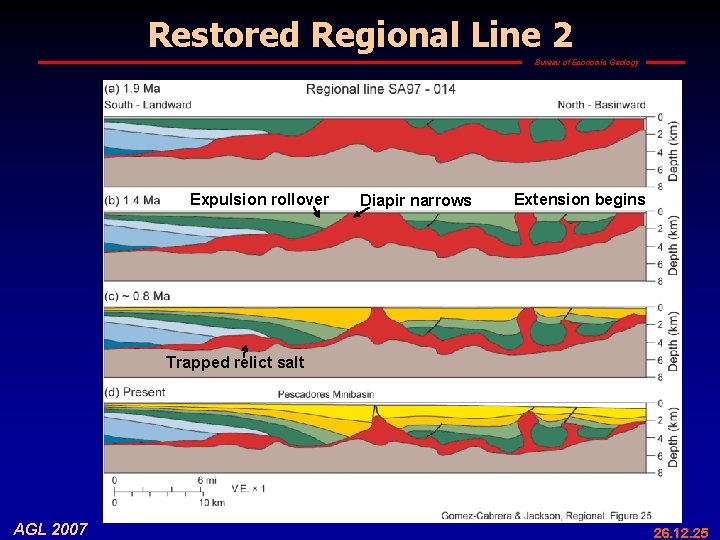
Restored Regional Line 2 Bureau of Economic Geology Expulsion rollover Diapir narrows Extension begins Trapped relict salt AGL 2007 26. 12. 25
Conclusions Bureau of Economic Geology At 15 -12 Ma, changing Pacific plate kinematics created 4 orogenic fold belts in offshore Salina Basin; all except 1 detach on salt. These 4 fold belts may be windows into one large Chiapas. Campeche fold belt, having strike length of >530 km, rather than the present estimate of 380 km. During or just after the final stages of folding at end Miocene, salt was squeezed from diapirs and extruded over mountainous, largely submerged fold belts. Salt coalesced in patches to form the discontinuous Sal Somera canopy. At greatly varying accumulation rates, sediments loaded, redistributed and partly welded the salt canopy in Plio. Pleistocene. 3 counterregional systems formed during progradation; Pescadores is the largest (100 km long). AGL 2007 26. 12. 26
References Cited Bureau of Economic Geology Gómez-Cabrera, P. T. , 2003, Stratigraphic and structural analysis of the Neogene sediments of the offshore part of the Salina del Istmo Basin, Southeastern Mexico: Ph. D. dissertation, The University of Texas at Austin, 274 p. Mitra, S. , G. C. Figueroa, J. H. Garcia, and A. M. Alvarado, 2005, three-dimensional structural model of the Cantarell and Sihil structures, Campeche Bay, Mexico: AAPG Bulletin, v. 89, p. 1– 26. Oviedo-Perez, A. E. , 1996, Evolución neógena de las Cuencas Terciarias del Sureste: Tesis de Maestría, División de Estudios de Posgrado, Facultad de Ingeniería, Universidad Nacional Autónoma de México, 91 p. AGL 2007 26. 12. 27
- Slides: 26