
NEOCLASSICISM WITH REFERENCE TO JACQUES LOUIS DAVID History
- Slides: 22
NEO-CLASSICISM WITH REFERENCE TO JACQUES LOUIS DAVID History of Western Art BFA-II (Visual Arts) Course Incharge: Ms. Farah Khan Institute of Design & Visual Arts (LCWU)
“There is but one way for the moderns to become great, and perhaps unequalled; I mean by imitating the ancient---especially the Greek art” -Johann Joachim Winckelmann
NEO-CLASSICISM • Neoclassicism began in Rome. Neoclassicism was inspired by the discovery of ancient Greek and Roman archeological sites and artifacts that became known throughout Europe in popular illustrated reports of various travel expeditions. Rome with its Roman ruins, Renaissance works, and recently discovered antiquities became a major stop. • Johann Joachim Winckelmann’s Thoughts on the Imitation of Greek Works in Painting and Sculpture (1750) played a leading role in establishing the aesthetic and theory of Neoclassicism. Though German, he lived most of his life in Rome where several notable Catholic officials became his patrons. Arguing that art should strive toward “noble simplicity and calm grandeur”, he advocated, “the one way for us to become great, perhaps inimitable, is by imitating the ancients”. • In 1738, the ruined city of Herculaneum was discovered and excavated, followed by the excavation of Pompeii and Paestum in 1748. In the sudden eruption of Mount Vesuvius in 79 CE the cities had been covered in volcanic ash, so that elements of ancient everyday life, noted sculptures, and many frescoes were preserved. In 1758 Winckelmann visited the excavations, and published the first accounts of the archeological finds in his Letter about the Discoveries at Herculaneum (1762).
NEO-CLASSICISM • Influenced by his close friend Winckelmann, Anton Raphael Mengs was an early pioneer of Neoclassical painting. The circle of artists that gathered around Mengs and Winckelmann positioned Rome as the center of the new movement. • Mengs influenced a number of noted artists, who were to lead the subsequent development of Neoclassicism in Britain. He also influenced Jacques-Louis David, who led the later period of Neoclassicism centered in France, as the two artists met during David's Prix de Rome stay from 17751780. • The Enlightenment: Neoclassicism developed with the Enlightenment, a political and philosophical movement that primarily valued science, reason, and exploration. Also called “The Age of Reason”, the Enlightenment was informed by the skepticism of the noted philosopher Rene Descartes and the political philosophy of John Locke as the absolutes of the monarchy and religious dogma were fundamentally questioned, and the ideals of individual liberty, religious tolerance, and constitutional governments were advanced. • This age of reason and enlightened thinking dominated Europe, inevitably birthing two important eras in philosophy and visual art.
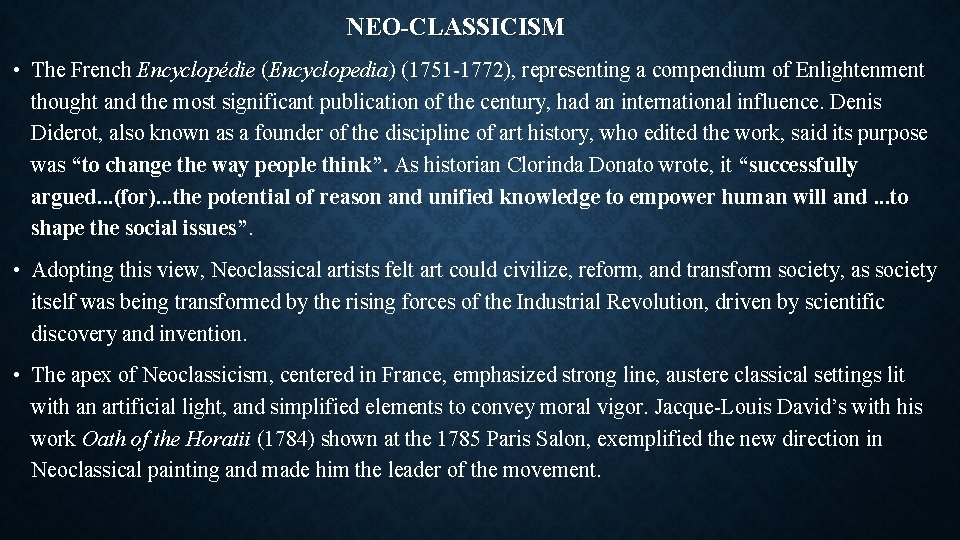
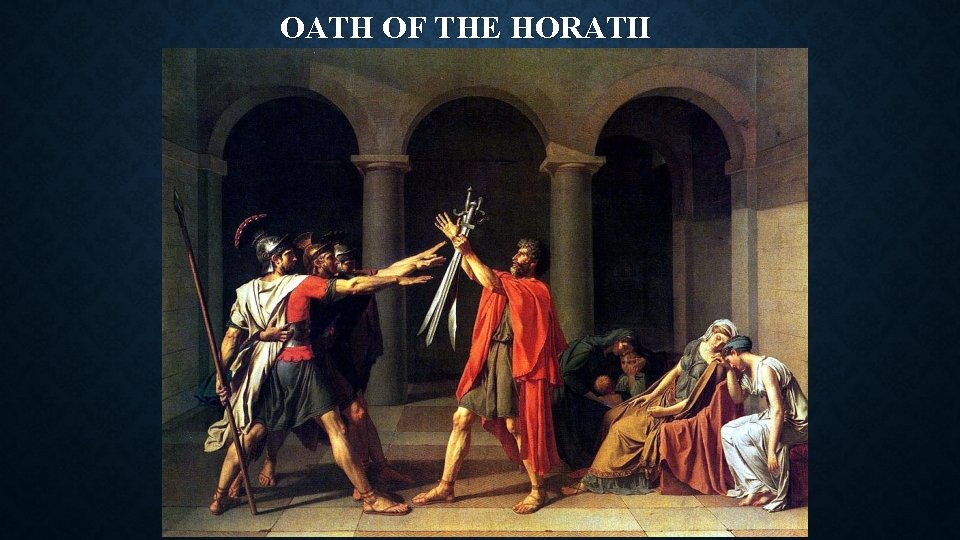
NEO-CLASSICISM • The French Encyclopédie (Encyclopedia) (1751 -1772), representing a compendium of Enlightenment thought and the most significant publication of the century, had an international influence. Denis Diderot, also known as a founder of the discipline of art history, who edited the work, said its purpose was “to change the way people think”. As historian Clorinda Donato wrote, it “successfully argued. . . (for). . . the potential of reason and unified knowledge to empower human will and. . . to shape the social issues”. • Adopting this view, Neoclassical artists felt art could civilize, reform, and transform society, as society itself was being transformed by the rising forces of the Industrial Revolution, driven by scientific discovery and invention. • The apex of Neoclassicism, centered in France, emphasized strong line, austere classical settings lit with an artificial light, and simplified elements to convey moral vigor. Jacque-Louis David’s with his work Oath of the Horatii (1784) shown at the 1785 Paris Salon, exemplified the new direction in Neoclassical painting and made him the leader of the movement.
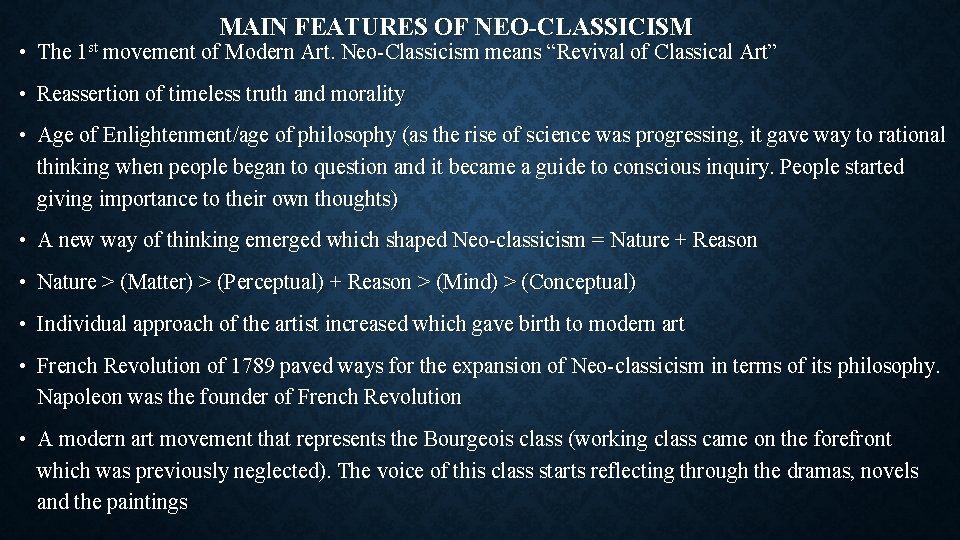
MAIN FEATURES OF NEO-CLASSICISM • The 1 st movement of Modern Art. Neo-Classicism means “Revival of Classical Art” • Reassertion of timeless truth and morality • Age of Enlightenment/age of philosophy (as the rise of science was progressing, it gave way to rational thinking when people began to question and it became a guide to conscious inquiry. People started giving importance to their own thoughts) • A new way of thinking emerged which shaped Neo-classicism = Nature + Reason • Nature > (Matter) > (Perceptual) + Reason > (Mind) > (Conceptual) • Individual approach of the artist increased which gave birth to modern art • French Revolution of 1789 paved ways for the expansion of Neo-classicism in terms of its philosophy. Napoleon was the founder of French Revolution • A modern art movement that represents the Bourgeois class (working class came on the forefront which was previously neglected). The voice of this class starts reflecting through the dramas, novels and the paintings
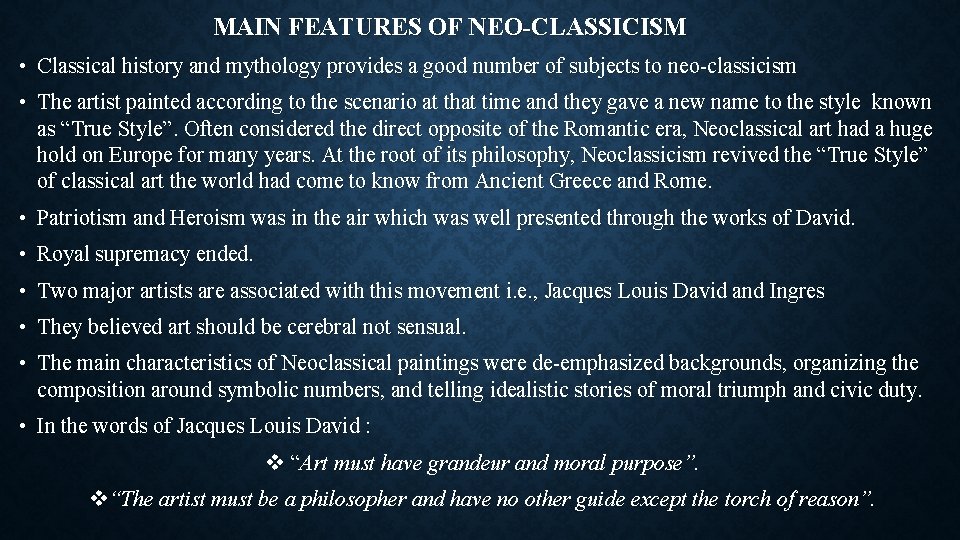
MAIN FEATURES OF NEO-CLASSICISM • Classical history and mythology provides a good number of subjects to neo-classicism • The artist painted according to the scenario at that time and they gave a new name to the style known as “True Style”. Often considered the direct opposite of the Romantic era, Neoclassical art had a huge hold on Europe for many years. At the root of its philosophy, Neoclassicism revived the “True Style” of classical art the world had come to know from Ancient Greece and Rome. • Patriotism and Heroism was in the air which was well presented through the works of David. • Royal supremacy ended. • Two major artists are associated with this movement i. e. , Jacques Louis David and Ingres • They believed art should be cerebral not sensual. • The main characteristics of Neoclassical paintings were de-emphasized backgrounds, organizing the composition around symbolic numbers, and telling idealistic stories of moral triumph and civic duty. • In the words of Jacques Louis David : v “Art must have grandeur and moral purpose”. v“The artist must be a philosopher and have no other guide except the torch of reason”.
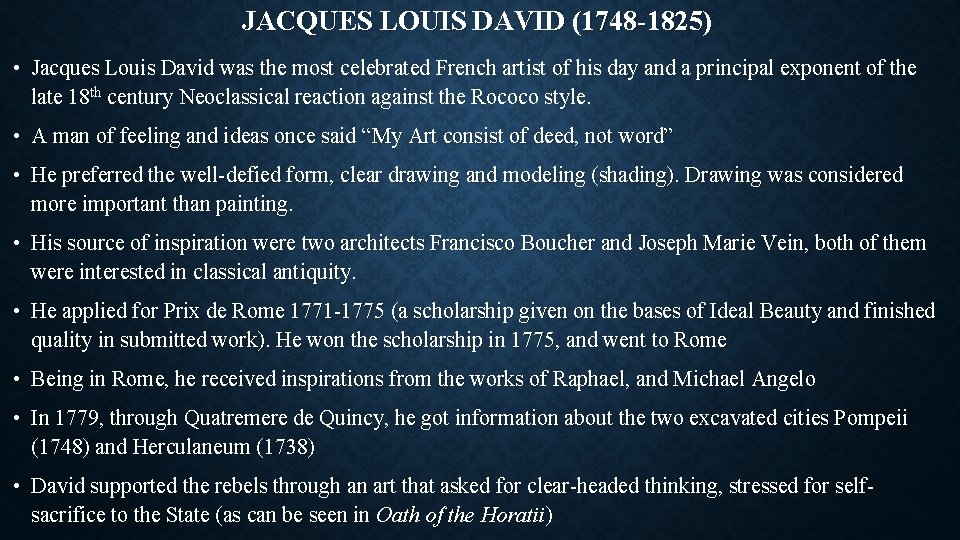
JACQUES LOUIS DAVID (1748 -1825) • Jacques Louis David was the most celebrated French artist of his day and a principal exponent of the late 18 th century Neoclassical reaction against the Rococo style. • A man of feeling and ideas once said “My Art consist of deed, not word” • He preferred the well-defied form, clear drawing and modeling (shading). Drawing was considered more important than painting. • His source of inspiration were two architects Francisco Boucher and Joseph Marie Vein, both of them were interested in classical antiquity. • He applied for Prix de Rome 1771 -1775 (a scholarship given on the bases of Ideal Beauty and finished quality in submitted work). He won the scholarship in 1775, and went to Rome • Being in Rome, he received inspirations from the works of Raphael, and Michael Angelo • In 1779, through Quatremere de Quincy, he got information about the two excavated cities Pompeii (1748) and Herculaneum (1738) • David supported the rebels through an art that asked for clear-headed thinking, stressed for selfsacrifice to the State (as can be seen in Oath of the Horatii)
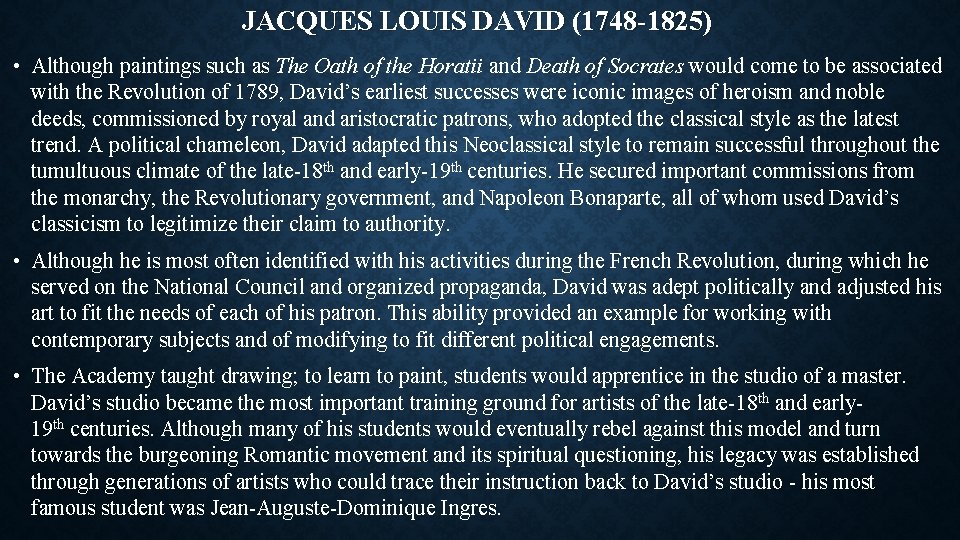
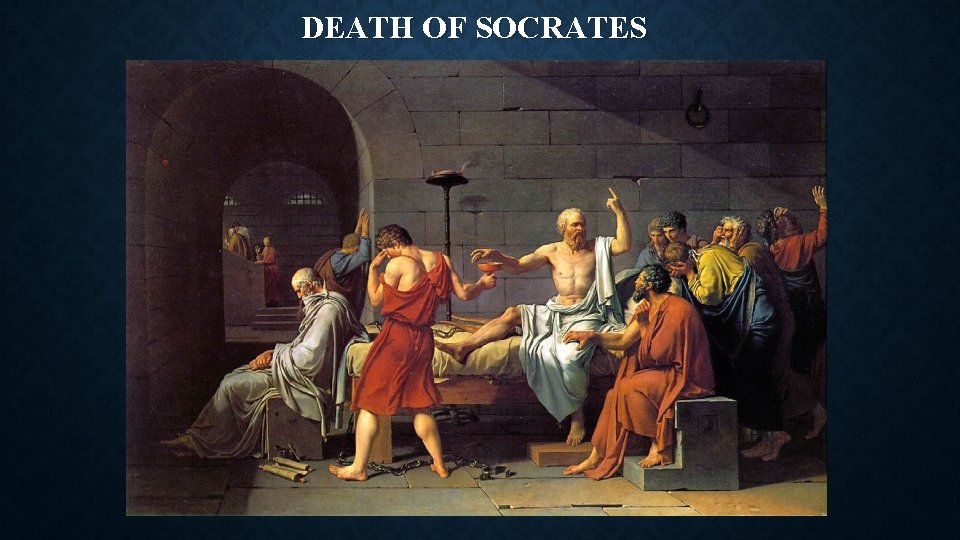
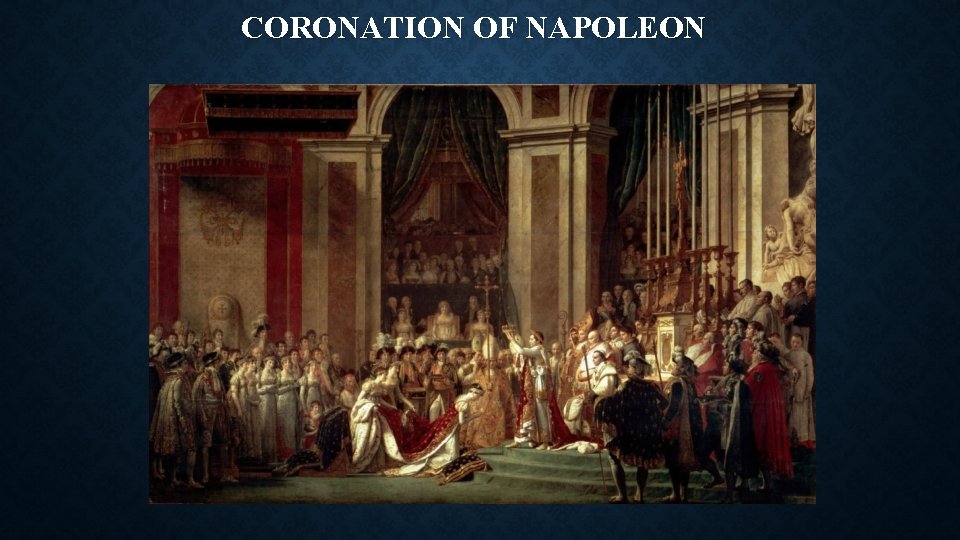
JACQUES LOUIS DAVID (1748 -1825) • Although paintings such as The Oath of the Horatii and Death of Socrates would come to be associated with the Revolution of 1789, David’s earliest successes were iconic images of heroism and noble deeds, commissioned by royal and aristocratic patrons, who adopted the classical style as the latest trend. A political chameleon, David adapted this Neoclassical style to remain successful throughout the tumultuous climate of the late-18 th and early-19 th centuries. He secured important commissions from the monarchy, the Revolutionary government, and Napoleon Bonaparte, all of whom used David’s classicism to legitimize their claim to authority. • Although he is most often identified with his activities during the French Revolution, during which he served on the National Council and organized propaganda, David was adept politically and adjusted his art to fit the needs of each of his patron. This ability provided an example for working with contemporary subjects and of modifying to fit different political engagements. • The Academy taught drawing; to learn to paint, students would apprentice in the studio of a master. David’s studio became the most important training ground for artists of the late-18 th and early 19 th centuries. Although many of his students would eventually rebel against this model and turn towards the burgeoning Romantic movement and its spiritual questioning, his legacy was established through generations of artists who could trace their instruction back to David’s studio - his most famous student was Jean-Auguste-Dominique Ingres.
OATH OF THE HORATII
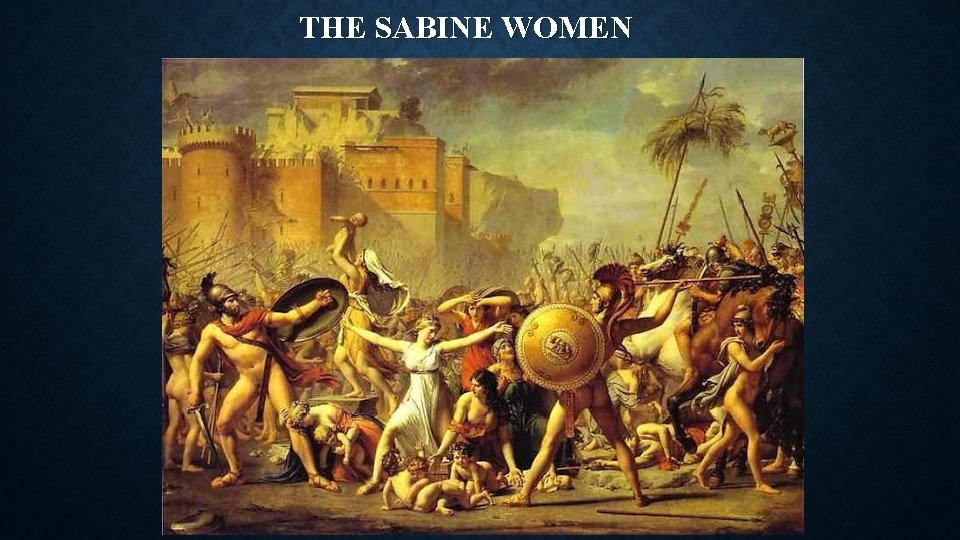
THE SABINE WOMEN
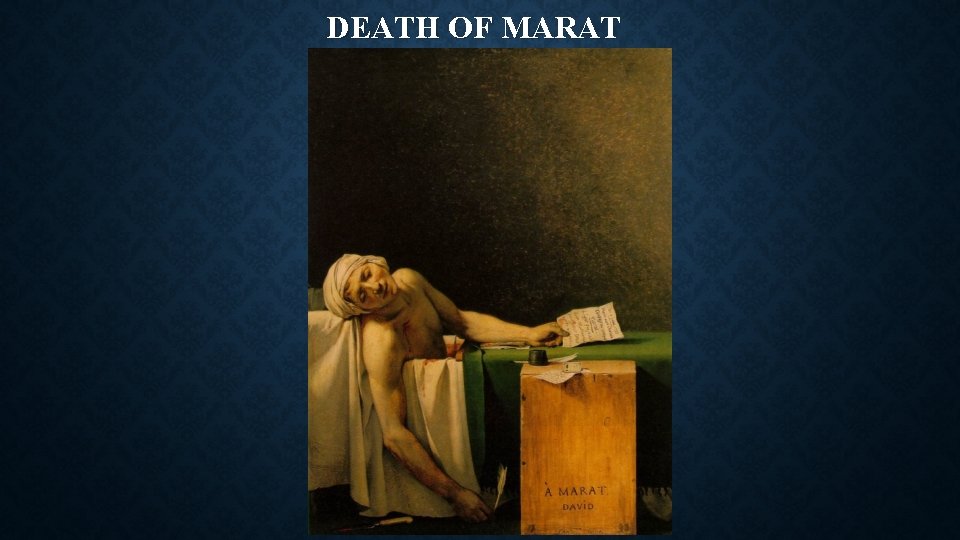
DEATH OF MARAT
DEATH OF SOCRATES
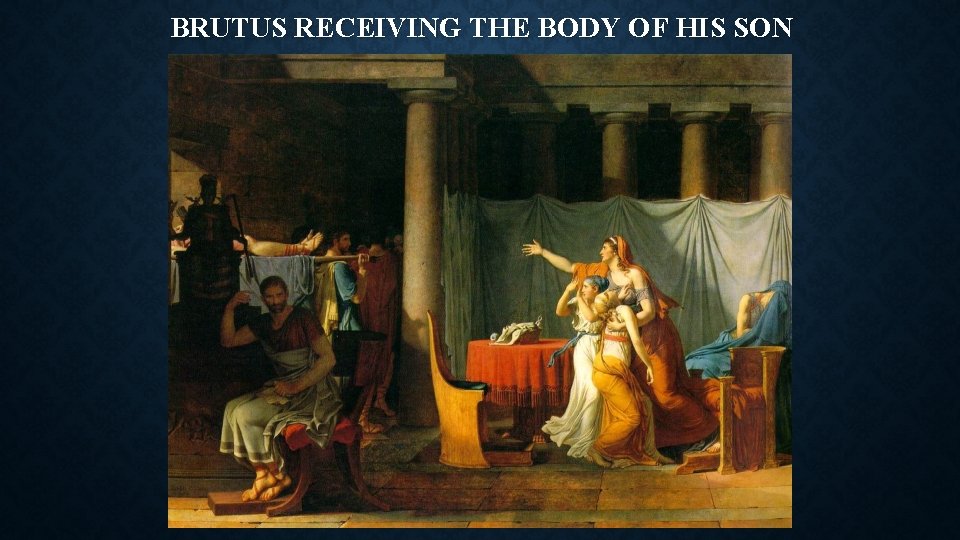
BRUTUS RECEIVING THE BODY OF HIS SON
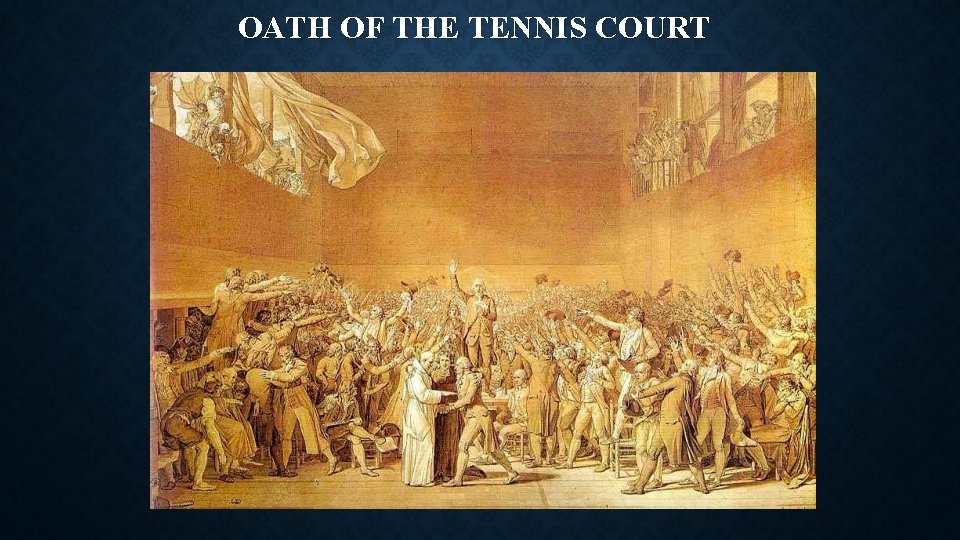
OATH OF THE TENNIS COURT
CORONATION OF NAPOLEON
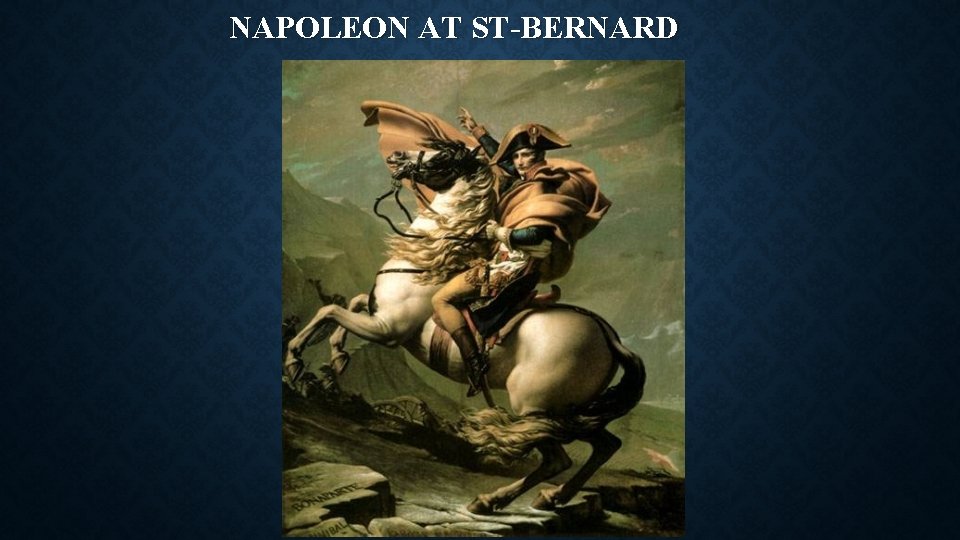
NAPOLEON AT ST-BERNARD
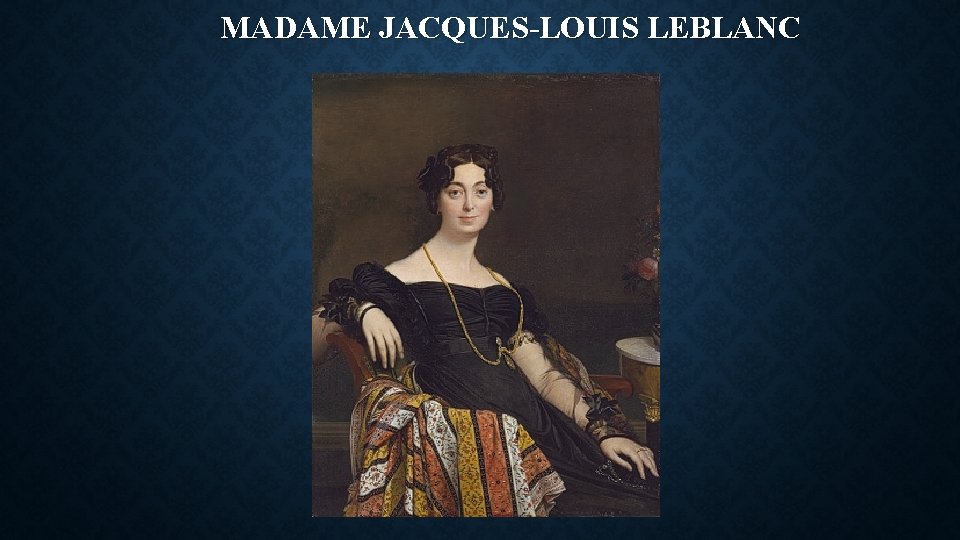
MADAME JACQUES-LOUIS LEBLANC
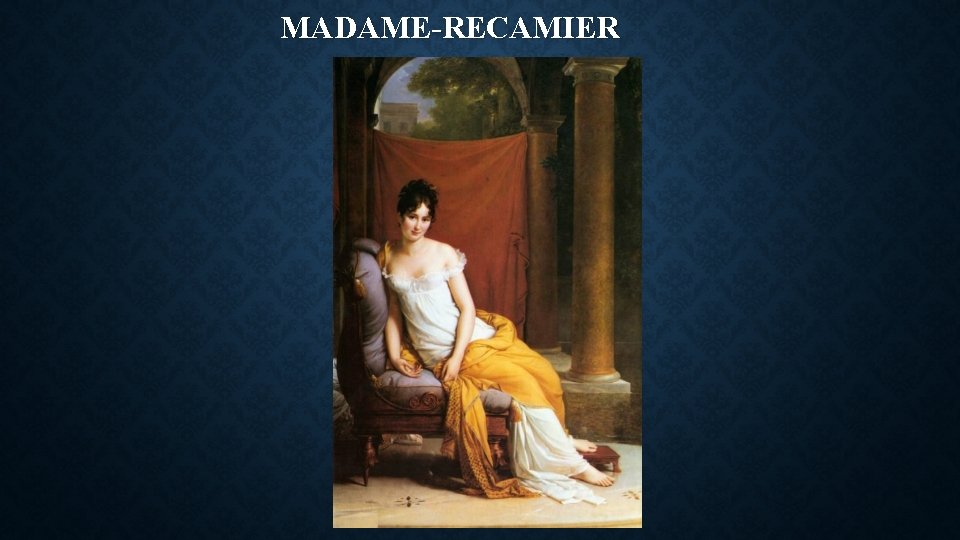
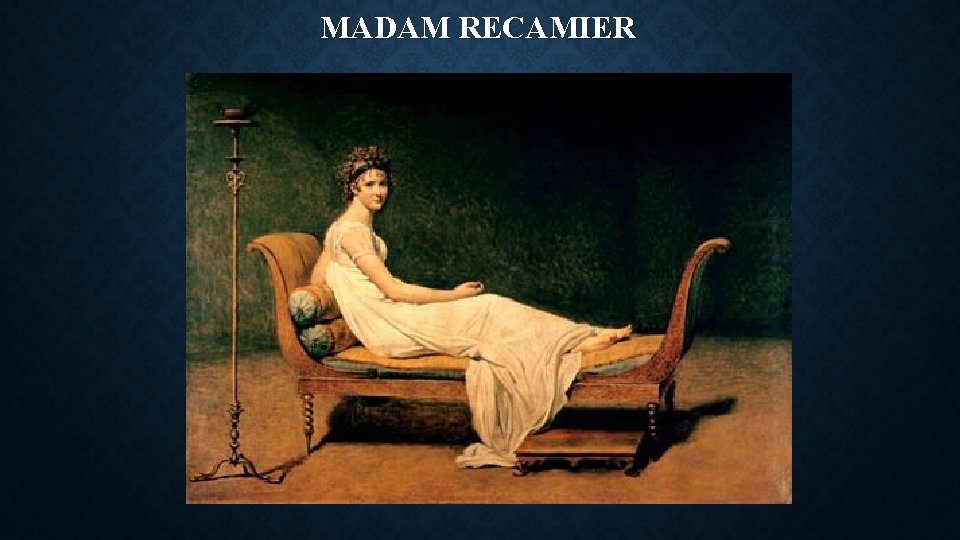
MADAME-RECAMIER
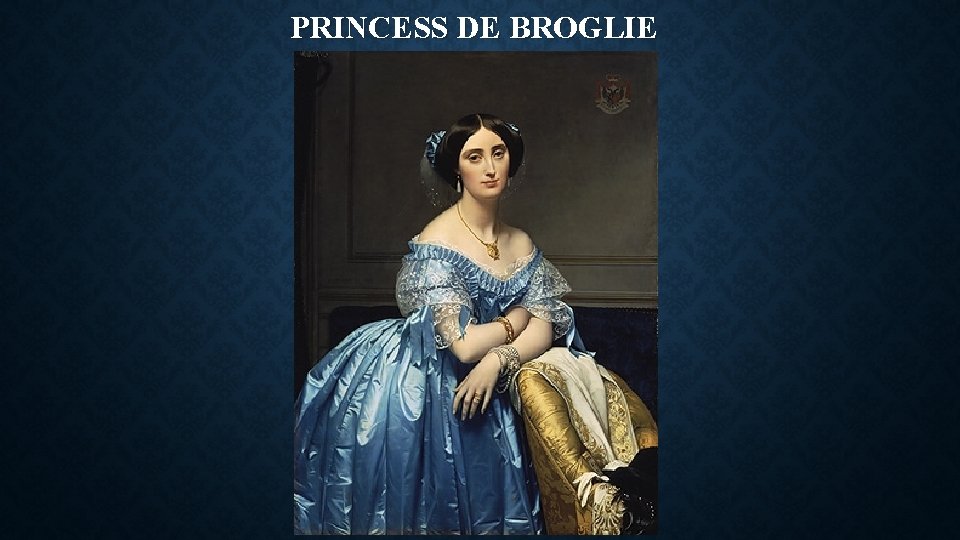
PRINCESS DE BROGLIE
MADAM RECAMIER
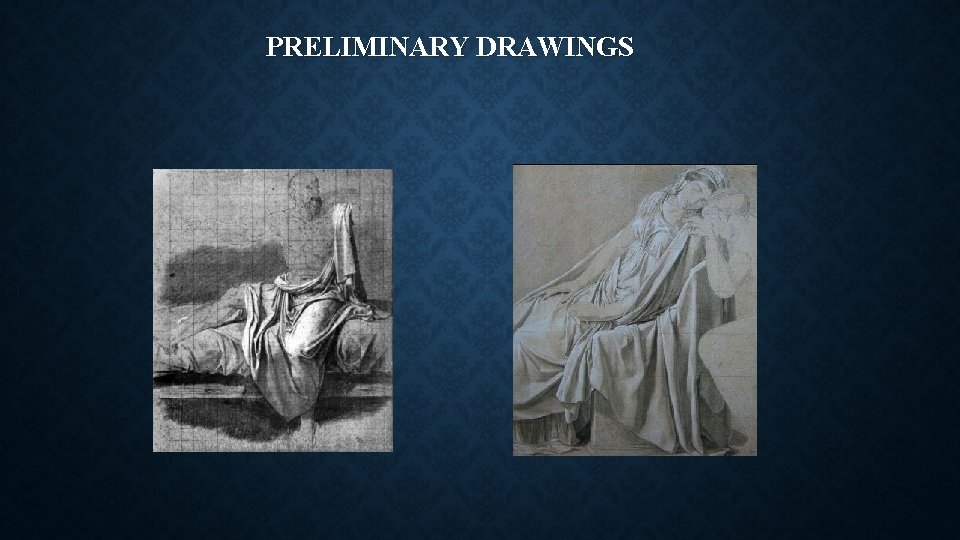
PRELIMINARY DRAWINGS