
Neoclassicism Romanticism AVI 3 M In the visual

- Slides: 17
* Neoclassicism & Romanticism AVI 3 M
* In the visual arts the European movement called "neoclassicism" began after A. D. 1765, as a reaction against both the surviving Baroque and Rococo styles, and as a desire to return to the perceived "purity" of the arts of Rome, the more vague perception ("ideal") of Ancient Greek arts, and, to a lesser extent, 16 th century Renaissance Classicism. *Neoclassicism
*Neoclassicism was based on and sought to revive the ideals of art from ancient Greece and Rome. The artists copied classical sculptures in an effort to draw and learn from what legendary ancient artists had done.
*The French artists rejected earlier Baroque and Rococo art styles. *It was characterized by balanced composition, flowing contour lines and noble gestures and expressions. *Art schools were created, called academies. They urged students to study famous works of the past as the best way of developing their own skills. *The royal Academies held yearly exhibitions of art created by Academy members. They were called Salons.
*Artist’s reputations were made and destroyed during theses important annual events. They aroused great interest and controversy because the artists who were acclaimed were those who best reflected the tastes of the Academy, not necessarily the most gifted. *Neo-classical paintings are devoid of pastel colors and haziness; instead, they have sharp colors with chiaroscuro. In the case of Neo-classicism in France, a prime example is Jacques Louis David whose paintings often use Roman and Greek elements to extol the French Revolution's virtues (state before family).
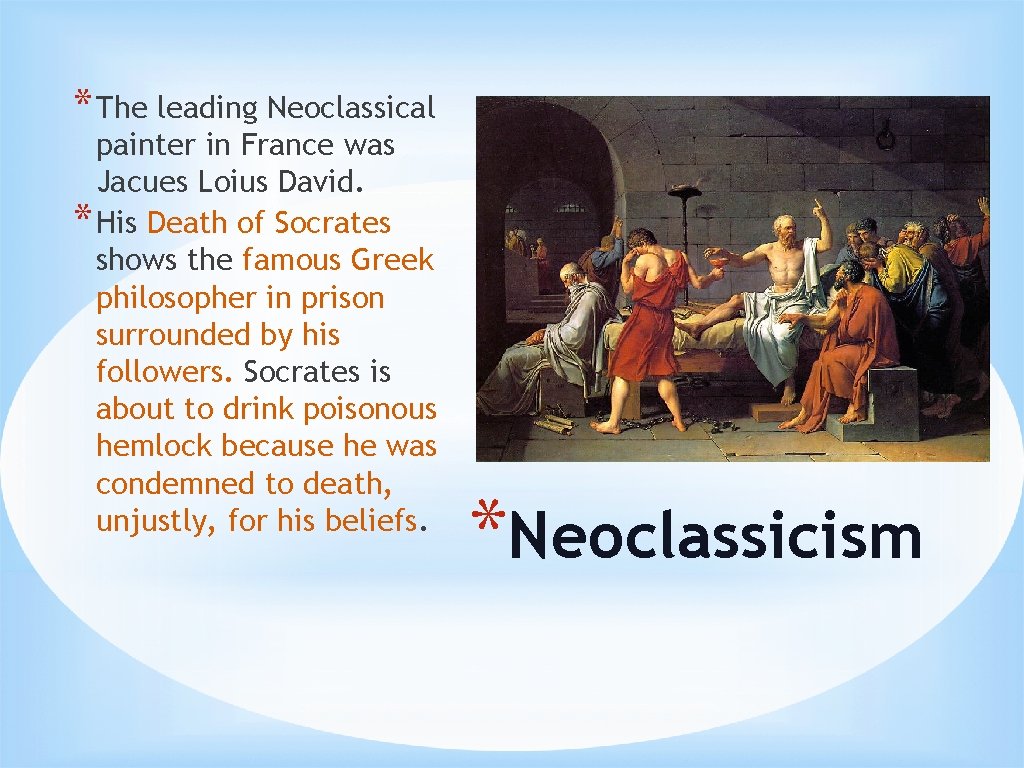
* The leading Neoclassical painter in France was Jacues Loius David. * His Death of Socrates shows the famous Greek philosopher in prison surrounded by his followers. Socrates is about to drink poisonous hemlock because he was condemned to death, unjustly, for his beliefs. *Neoclassicism
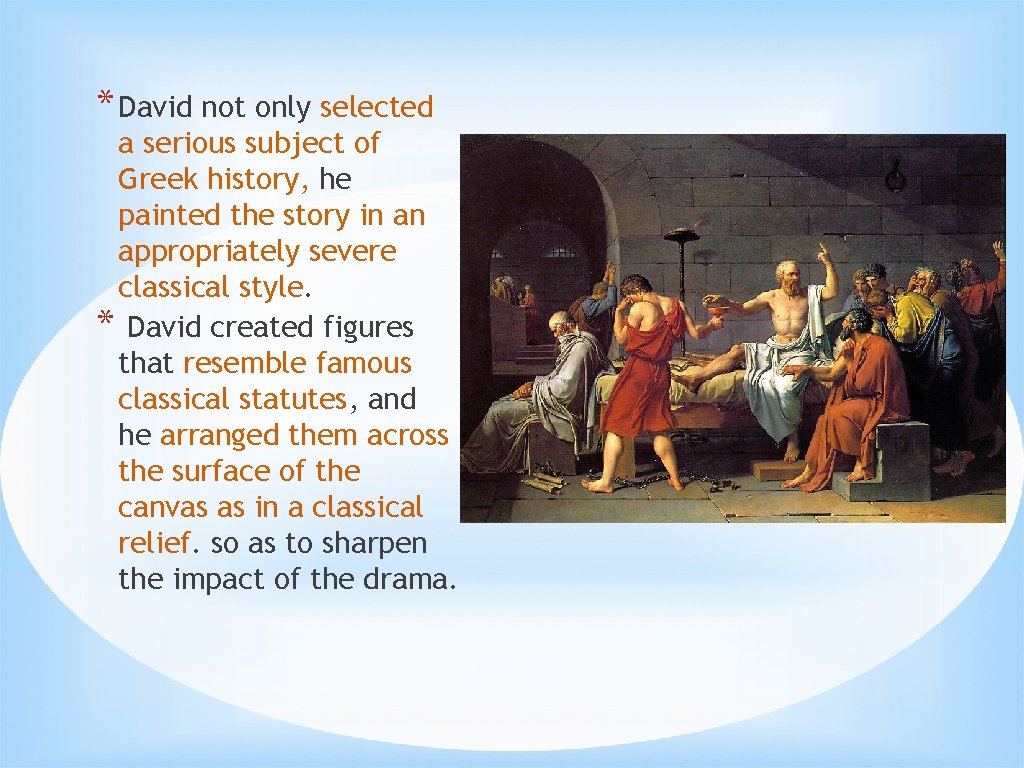
* David not only selected a serious subject of Greek history, he painted the story in an appropriately severe classical style. * David created figures that resemble famous classical statutes, and he arranged them across the surface of the canvas as in a classical relief. so as to sharpen the impact of the drama.
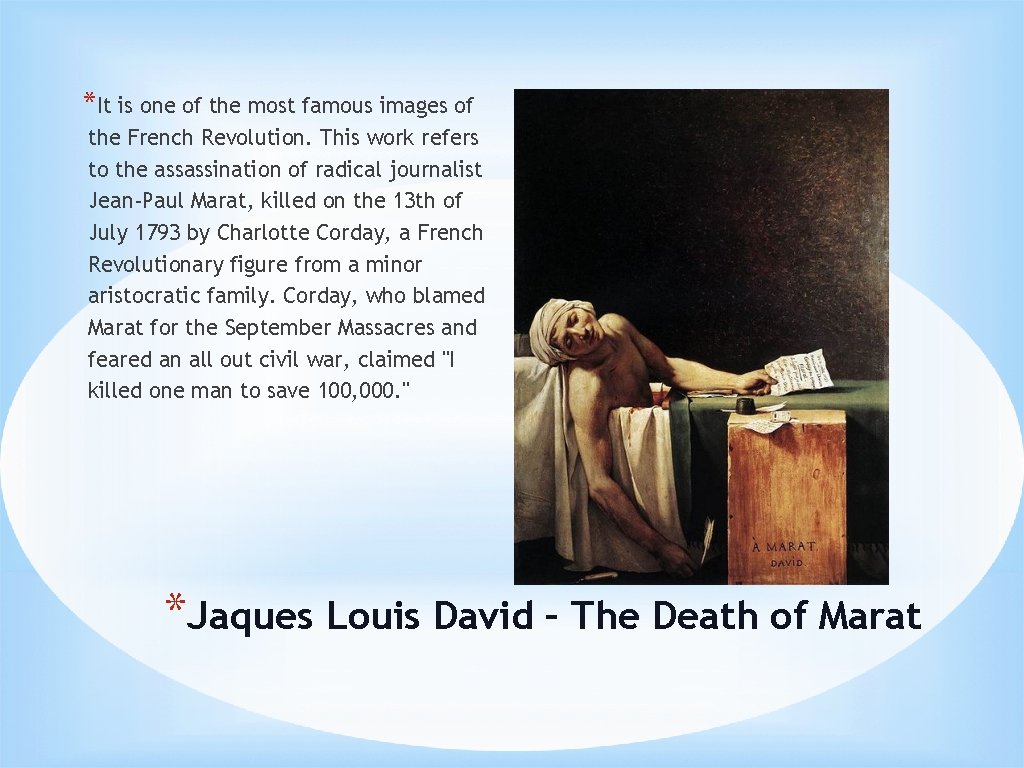
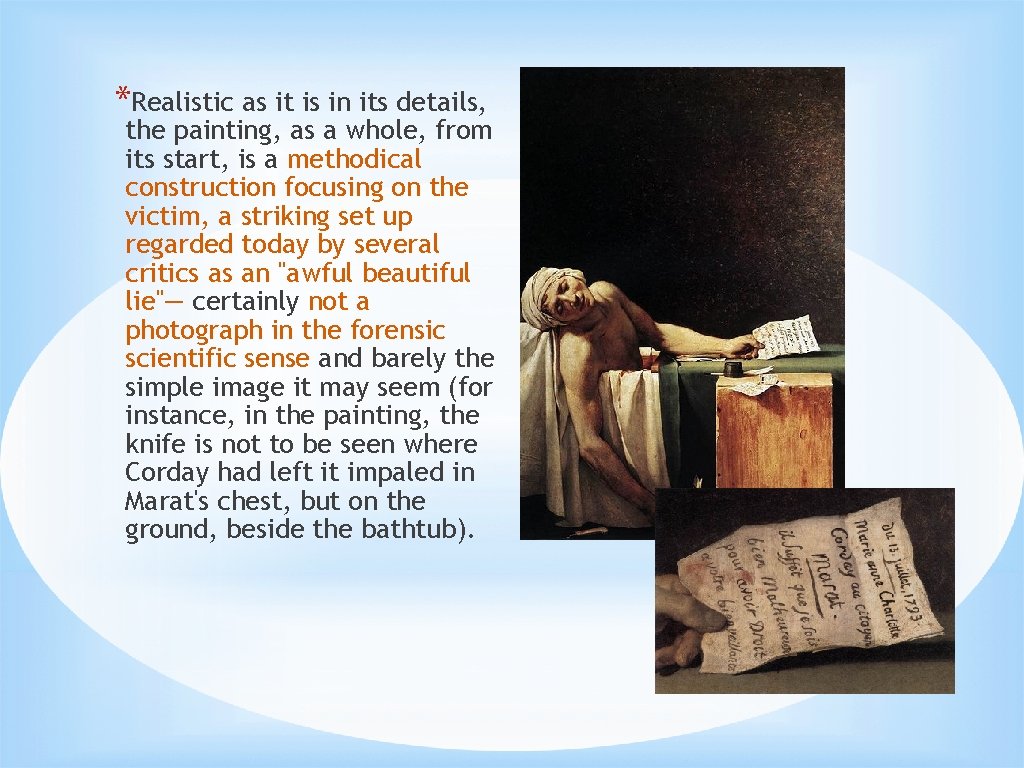
*It is one of the most famous images of the French Revolution. This work refers to the assassination of radical journalist Jean-Paul Marat, killed on the 13 th of July 1793 by Charlotte Corday, a French Revolutionary figure from a minor aristocratic family. Corday, who blamed Marat for the September Massacres and feared an all out civil war, claimed "I killed one man to save 100, 000. " *Jaques Louis David – The Death of Marat
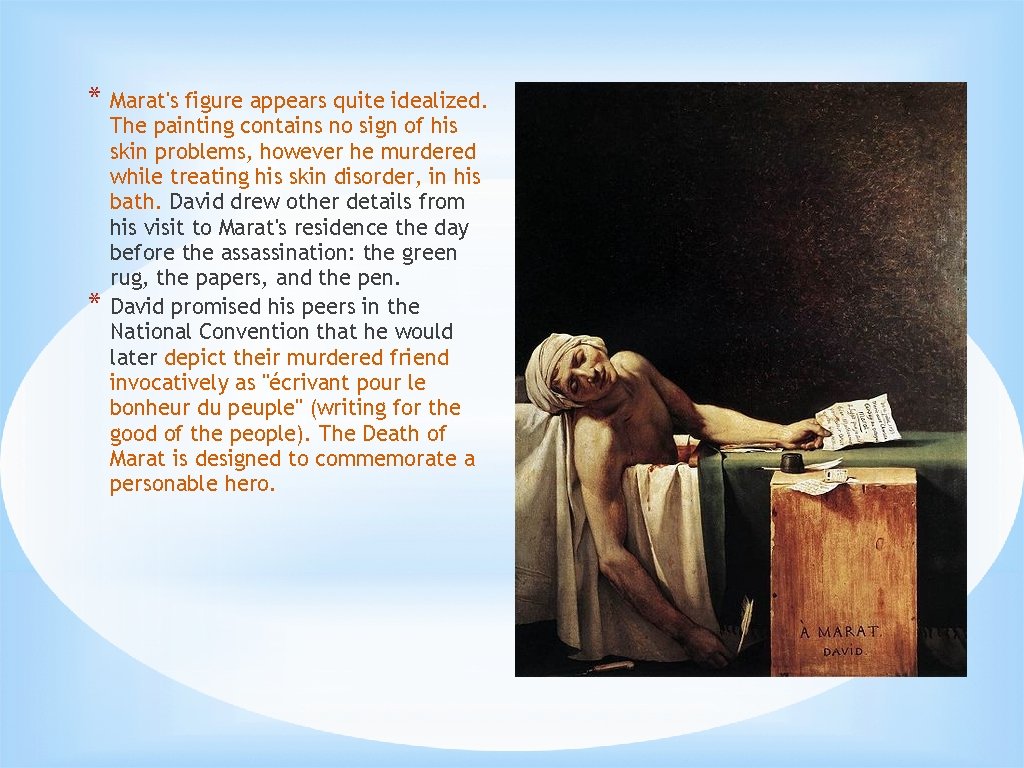
* Marat's figure appears quite idealized. * The painting contains no sign of his skin problems, however he murdered while treating his skin disorder, in his bath. David drew other details from his visit to Marat's residence the day before the assassination: the green rug, the papers, and the pen. David promised his peers in the National Convention that he would later depict their murdered friend invocatively as "écrivant pour le bonheur du peuple" (writing for the good of the people). The Death of Marat is designed to commemorate a personable hero.
*Realistic as it is in its details, the painting, as a whole, from its start, is a methodical construction focusing on the victim, a striking set up regarded today by several critics as an "awful beautiful lie"— certainly not a photograph in the forensic scientific sense and barely the simple image it may seem (for instance, in the painting, the knife is not to be seen where Corday had left it impaled in Marat's chest, but on the ground, beside the bathtub).
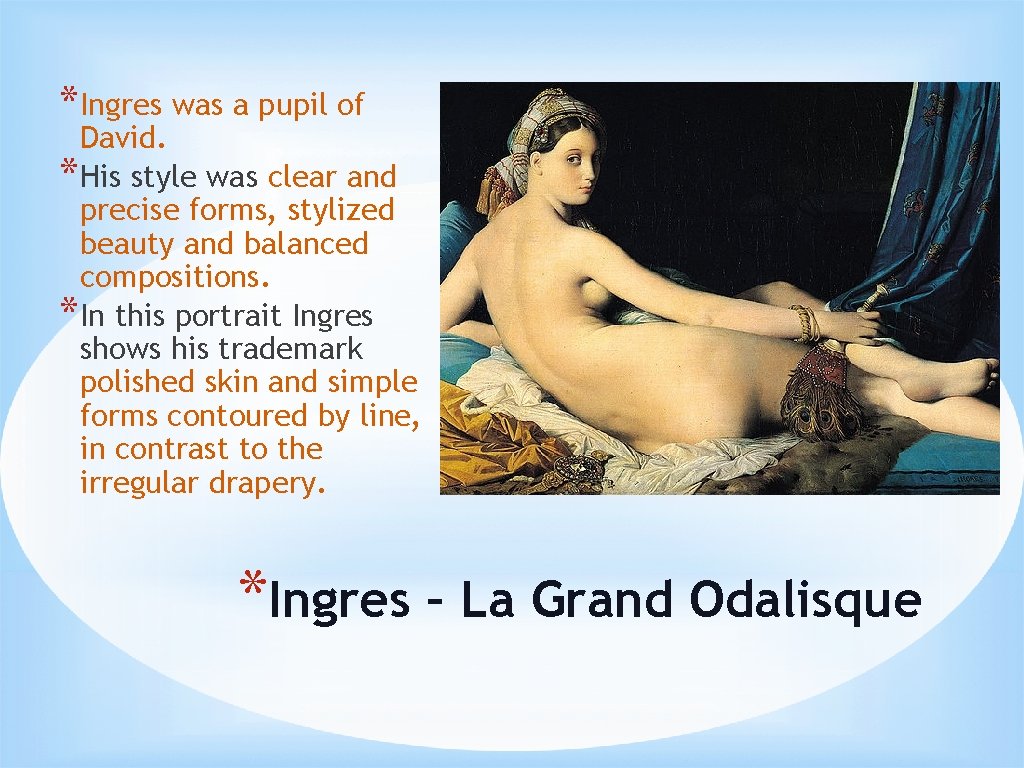
* Ingres was a pupil of David. * His style was clear and precise forms, stylized beauty and balanced compositions. * In this portrait Ingres shows his trademark polished skin and simple forms contoured by line, in contrast to the irregular drapery. *Ingres – La Grand Odalisque
* Romanticism started as an artistic and intellectual movement that emphasized a revulsion against established values (social order and religion). Romanticism promoted individualism, subjectivism, irrationalism, imagination, emotions and nature emotion over reason and senses over intellect. * Romantic artists were fascinated by the nature, the genius, their passions and inner struggles, their moods, mental potentials, the heroes. *Romanticism
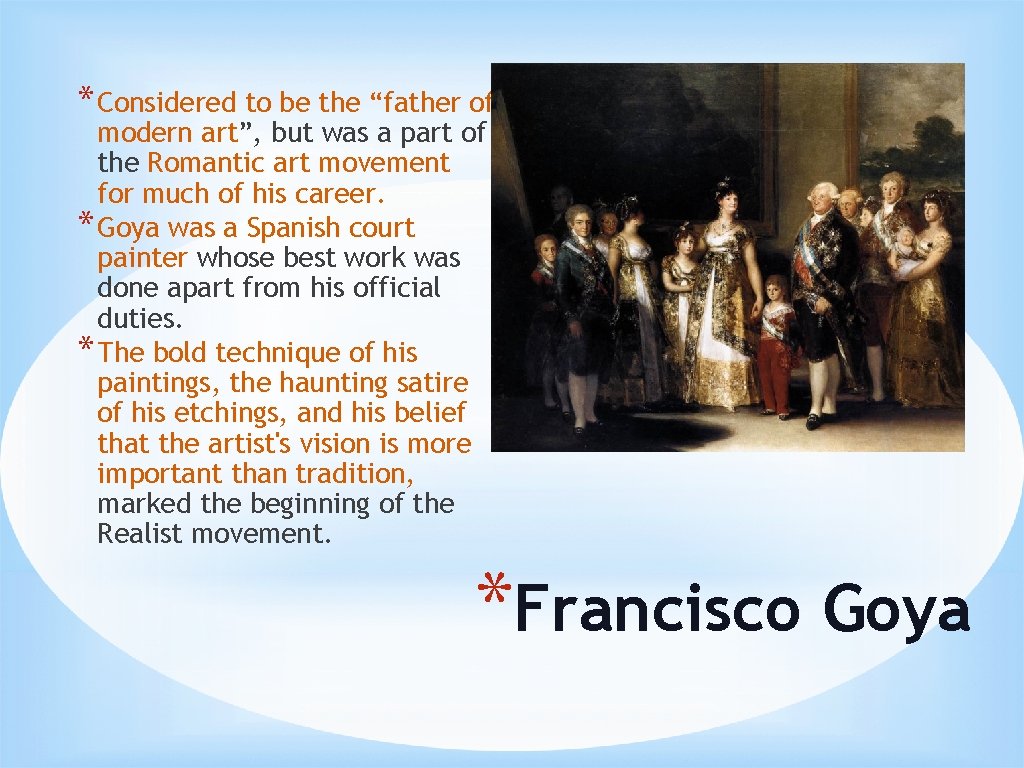
* Considered to be the “father of modern art”, but was a part of the Romantic art movement for much of his career. * Goya was a Spanish court painter whose best work was done apart from his official duties. * The bold technique of his paintings, the haunting satire of his etchings, and his belief that the artist's vision is more important than tradition, marked the beginning of the Realist movement. *Francisco Goya
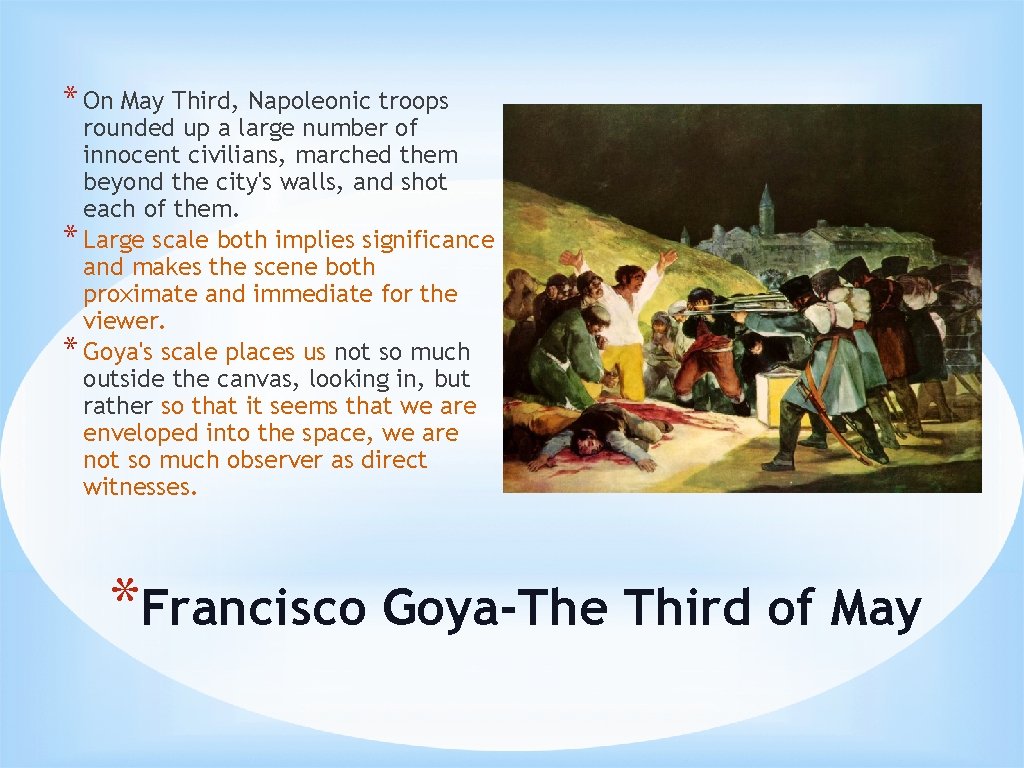
* On May Third, Napoleonic troops rounded up a large number of innocent civilians, marched them beyond the city's walls, and shot each of them. * Large scale both implies significance and makes the scene both proximate and immediate for the viewer. * Goya's scale places us not so much outside the canvas, looking in, but rather so that it seems that we are enveloped into the space, we are not so much observer as direct witnesses. *Francisco Goya-The Third of May
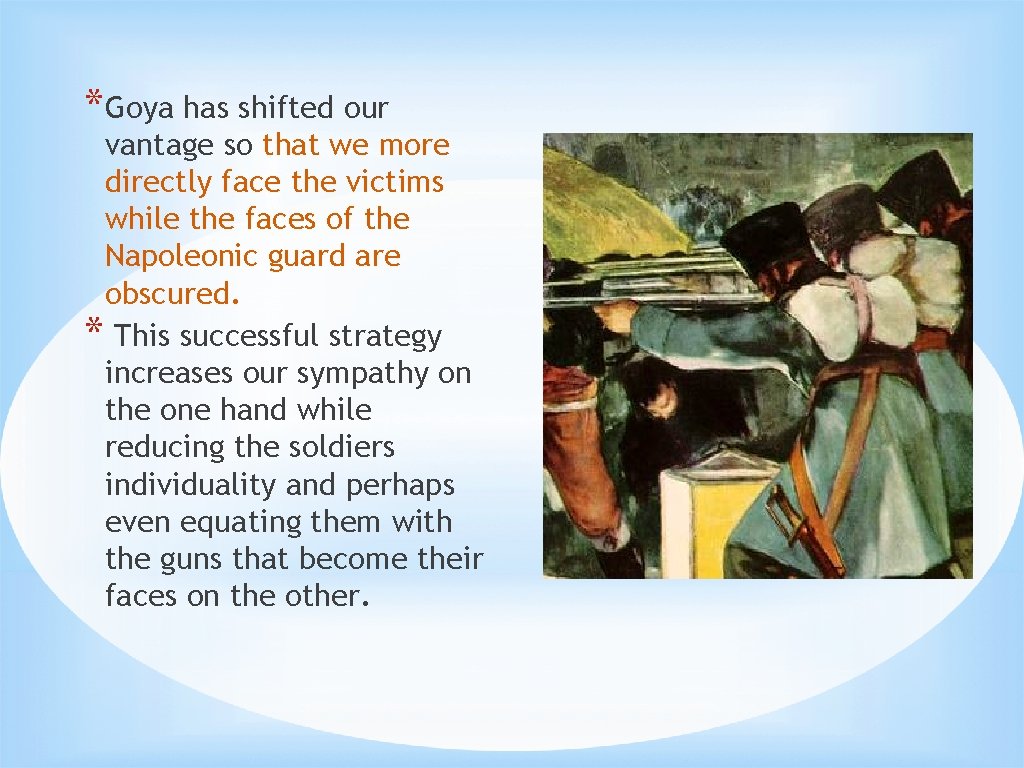
* Goya has shifted our vantage so that we more directly face the victims while the faces of the Napoleonic guard are obscured. * This successful strategy increases our sympathy on the one hand while reducing the soldiers individuality and perhaps even equating them with the guns that become their faces on the other.
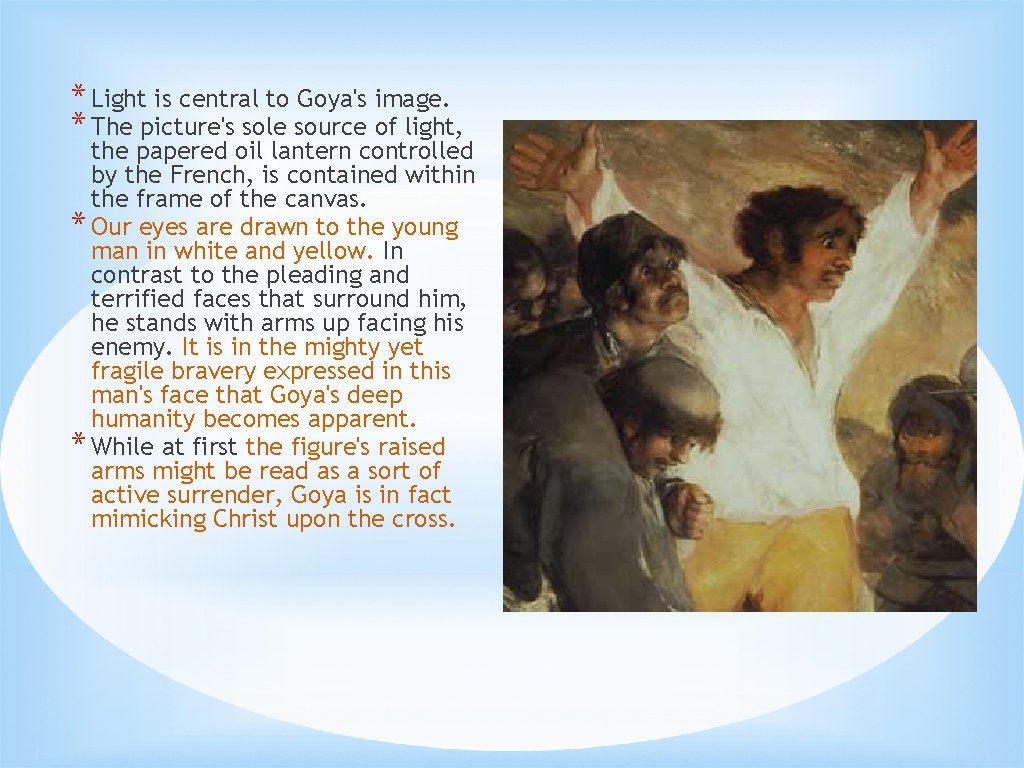
* Light is central to Goya's image. * The picture's sole source of light, the papered oil lantern controlled by the French, is contained within the frame of the canvas. * Our eyes are drawn to the young man in white and yellow. In contrast to the pleading and terrified faces that surround him, he stands with arms up facing his enemy. It is in the mighty yet fragile bravery expressed in this man's face that Goya's deep humanity becomes apparent. * While at first the figure's raised arms might be read as a sort of active surrender, Goya is in fact mimicking Christ upon the cross.
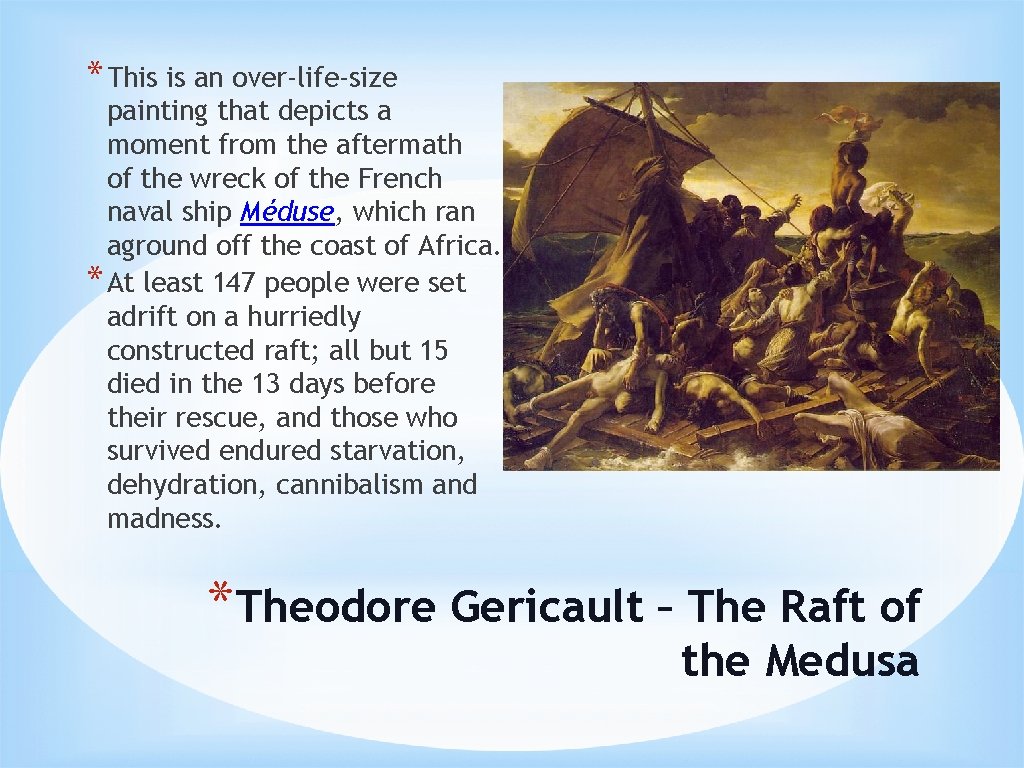
* This is an over-life-size painting that depicts a moment from the aftermath of the wreck of the French naval ship Méduse, which ran aground off the coast of Africa. * At least 147 people were set adrift on a hurriedly constructed raft; all but 15 died in the 13 days before their rescue, and those who survived endured starvation, dehydration, cannibalism and madness. *Theodore Gericault – The Raft of the Medusa