
NeoClassical Classical 1720 1827 Style in music Reacts
- Slides: 50
Neo-Classical & Classical 1720 -1827 Style in music. Reacts to the excesses of monarchy and ornamentation of the Baroque. Returns to order, reason and structural clarity Free Powerpoint Templates Page 1
A Classical Introduction • This era emphasized: morality and the study of beauty and understanding. • Music now had many layers (polyphony) and began to become homophonic (lots of harmonies). Free Powerpoint Templates Page 2
Musical Classicism • Music was composed to appeal not only to the aristocratic society but also to the middle classes as well. • In 1785, Michel Paul de Chabanon wrote that “Today there is but one music of all of Europe. ” Free Powerpoint Templates Page 3
Music Classicism • Ideas of reason, nature, and morality reflected in the form of music. • Focus on music in good taste, elegance, and would appeal to all people. • Predictable in order and form. Free Powerpoint Templates Page 4
Musical Classicism • Move toward equality and popularizing of ideals typical of philosophers. • Simplicity and carefully attentive to form (structure of music). • Classical – term not applied for music until the 19 th century. Free Powerpoint Templates Page 5
Musical Classicism • No known classical predecessors to revive. • No classical models like that of the visual arts. • Articulated structure in music (form). • Organized into short phrases – recur regularly and clearly. Free Powerpoint Templates Page 6
Musical Classicism • Clearly avoids the Baroque style of music. • Relies on melodic line that can be shaped into clear and expressive contours and brought to a defining cadence (conclusion). • New rhythmic patterns • Baroque – used numerous ornamental parts to flow together in a complex design. • Classical music allowed more opportunity for rhythm, variety, and contrasts in compositions. Free Powerpoint Templates Page 7
Musical Classicism • Developed key structures and harmonizing relationships. Free Powerpoint Templates Page 8
Classical Musical Forms • Major musical forms – opera, oratorio, and concerto changed due to new classical inventions. • A good example is Mozart’s Marriage of Figaro. • A comic opera – themes of love and marriage. • Fast-paced plot Free Powerpoint Templates Page 9
Classical Musical Forms • Subplots and dramatic conflict added to the music. • Tied to human concerns and less stereotyped than earlier dramas. Free Powerpoint Templates Page 10
Classical Musical Forms • Becomes essential to have 1 solo or single instrument. • 1 st piano concertos were formal. • Chamber music increased in popular appeal. • Chamber music is music for performance by a small group of instrumentalists. This was to be performed in private rooms verses public halls. Free Powerpoint Templates Page 11
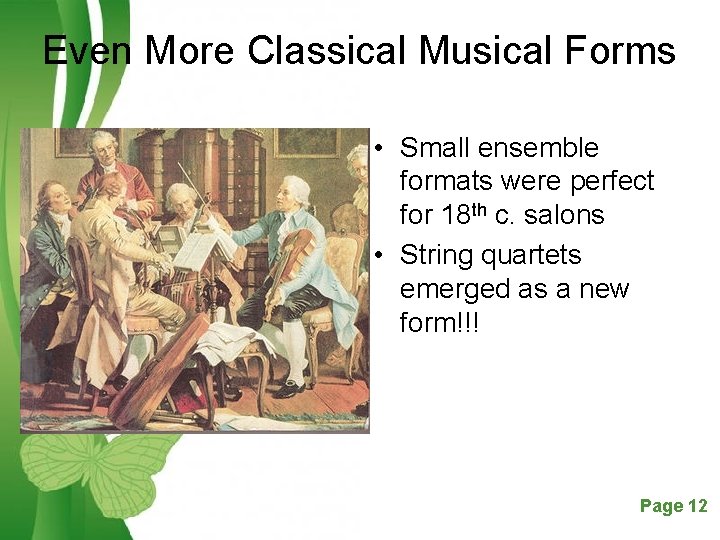
Even More Classical Musical Forms • Small ensemble formats were perfect for 18 th c. salons • String quartets emerged as a new form!!! Free Powerpoint Templates Page 12
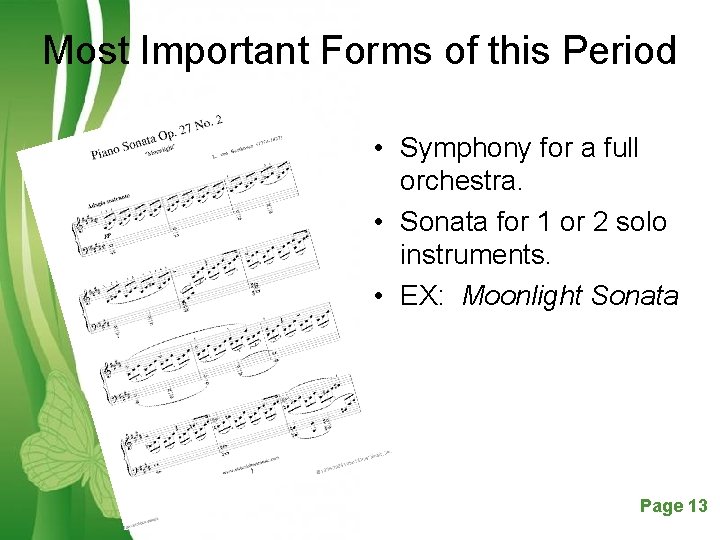
Most Important Forms of this Period • Symphony for a full orchestra. • Sonata for 1 or 2 solo instruments. • EX: Moonlight Sonata Free Powerpoint Templates Page 13
Composers for Englightenment, Classical and Neo-Classical… • Haydn • Mozart • Beethoven • Their works stood as supreme models to the Classical era. Free Powerpoint Templates Page 14
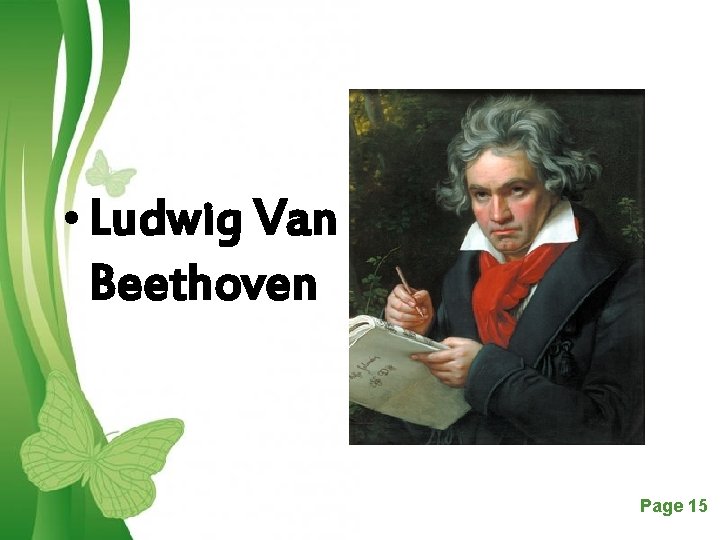
• Ludwig Van Beethoven Free Powerpoint Templates Page 15
Beethoven • • • Known as the “Musical Master” He wrote from the heart to reach others’ hearts. German (1770 -1827) Father and grandfather were both musicians. Father was his 1 st music teacher. Started playing the piano and violin when he wa 4. • Had his first concert at age 7. • At 12, he published his 1 st piece. Free Powerpoint Templates Page 16
Beethoven • Sometimes, his other music teacher would let him direct the orchestra part of the time! • His father was not the best of teachers or parents. • He would often beat Beethoven and lock him in the basement to make him practice. • Sometimes his father would come home drunk and wake Ludwig up to make him practice until morning… Free Powerpoint Templates Page 17
Beethoven • He moved to Vienna when he was 22 – his home for life and work. • He (like da Vinci and others) took a notebook religiously with him. If he was out and didn’t have it, he would write on napkins, menus, etc. • He studied composition under Haydn and others. Free Powerpoint Templates Page 18
Beethoven • He tried to establish himself as a pianist and a composer. • His good relations with the town’s aristocracy led him to a secure income. • This time was called his early period – trying to master the high classical styles. • During the middle period, he started losing his hearing in his 20 s. He started becoming suspicious of people and hard to get along with. Free Powerpoint Templates Page 19
Beethoven • Not only losing his hearing, he soon began to deal with the harshness of his early life. • Beethoven often would outburst into uncontrollable fits of rage due to his hearing loss and feelings of isolation. • He began thinking about suicide. • In fact, he wrote his brothers (whom he hated) and told them this. Free Powerpoint Templates Page 20
Beethoven • However, he still composed by hearing the songs in his head. • He even went as far as to saw the legs off of his piano to make it closer to the floor. • This way, while composing, he could put an ear to the ground and gather the vibrations!!! Free Powerpoint Templates Page 21
Beethoven • This hearing disorder began to affect his social life as well. • Due to his traumatic childhood (and some parts unknown), he never got involved with a woman in a normal relationship. • He seemed to be attracted to the women he couldn’t get or was hard to get. Free Powerpoint Templates Page 22
The Immortal Beloved… • A good example of this was his brief relationship with Antoine Bretano – who broke up with him to marry one of his friends. • As if this was not hard enough, he now was getting to the point where he could no longer perform. Free Powerpoint Templates Page 23
The Late Period • Many years went without much creative work. • He was tormented by personal matters concerning a nephew he was trying to gain custody of when his brother died. • He failed due to lack of “Capacity as a human being. ” • The music became less dramatic and more introverted. • It was, however, more mature and secure. • Developed pneumonia and died relatively poor. Free Powerpoint Templates Page 24
In Death… • It was said that over 10, 000 people attended Beethoven’s funeral… Free Powerpoint Templates Page 25
Beethoven • Critics often consider him the bridge between Classicism and Romanticism. • He wanted to expand classical symphonies to create a more emotional power for the people. • His symphonies are significantly different from those of Haydn and Mozart. Free Powerpoint Templates Page 26
Beethoven • They were more dramatic and used changing dynamics more often for emotional effects. • Uses silence as a device in pursuit of dramatic effect and structural ends. • His works are longer than the other two composers. Free Powerpoint Templates Page 27
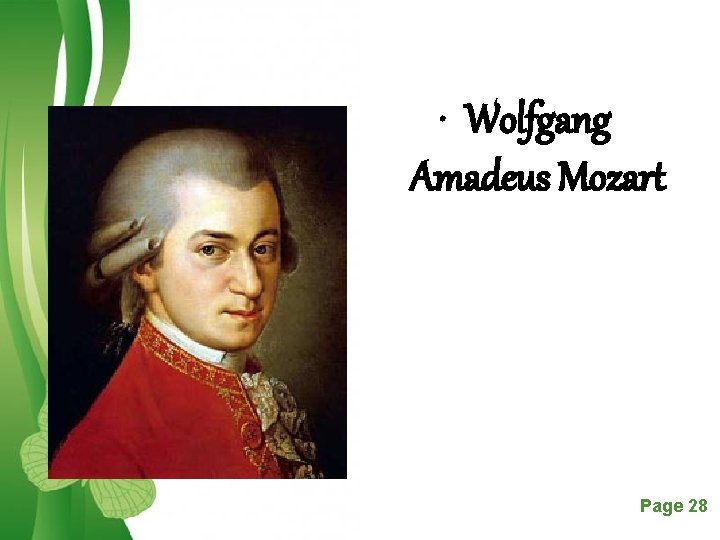
• Wolfgang Amadeus Mozart Free Powerpoint Templates Page 28
‘LOVED OF GOD” WOLFGANG AMADEUS MOZART • • Austrian Son of a musician – Leopold Mozart Influenced Mozart throughout life. By the age of 4, Mozart had composed his 1 st piece. • When he was 5 and 6, his father took him on concert tours around Europe. • COMPOSED HIS FIRST SYMPHONY AT THE AGE OF 8! Free Powerpoint Templates Page 29
Mozart • By the age of 11, he had written his 1 st opera and had already gained a reputation as a child prodigy! • Mozart was not satisfied with the musical standards of those around him, and often he invented his own set of standards. • Critics claim that Mozart possessed a gift of melody that has never been equaled in history. Free Powerpoint Templates Page 30
Mozart • He held several positions with important noblemen and rulers, including the prince, the archbishop, and Emperor Joseph II. • He longed to compose music that would pleasure both himself and others. • Mozart wanted to be a free-lance musician, but he was never able to fully free himself of the patronage system that had governed the arts for more than 600 years. Free Powerpoint Templates Page 31
Patronage System • The Patronage System was a system that was composed of wealthy individuals and/or families that offered money, food and shelter, protection, etc. to artists that were struggling… Free Powerpoint Templates Page 32
Mozart • BECAME SEMI-FAMOUS BY PUBLISHING AND PLAYING THE PIANO AND HAVING ONE OF HIS OPERAS PERFORMED • He was successful at any form of music he tried. • Sometimes, he would only write one draft of music. • Very few changes were ever made to his works. Free Powerpoint Templates Page 33
Mozart • Mozart excelled in operatic and symphonic compositions. • He also excelled in solo concertos as well (EX: piano) • Symphony: work made up of 4 movements (sections) separated by silence. • His symphonies were relatively short and simple. • They were tremendously emotional. • His later works were somewhat longer. Free Powerpoint Templates Page 34
Some interesting facts about Mozart… • He was known to carry on conversations with people while composing music at the same time. • He was best friends with Haydn. After Mozart died, Haydn could never speak of Mozart without tearing up! Free Powerpoint Templates Page 35
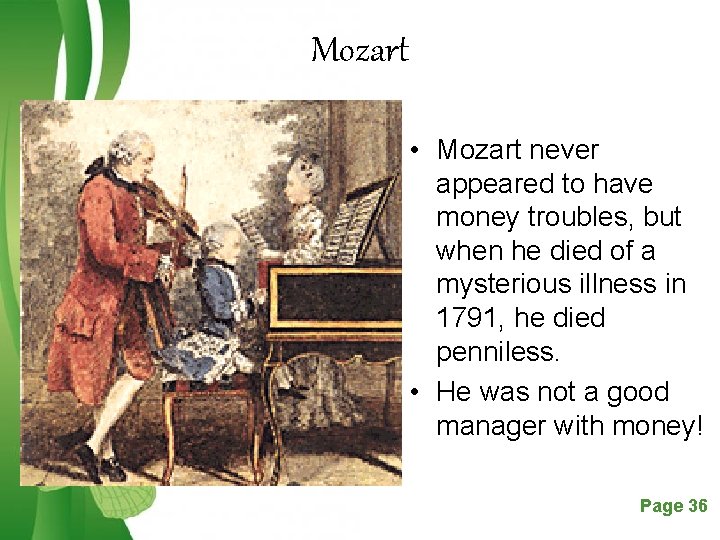
Mozart • Mozart never appeared to have money troubles, but when he died of a mysterious illness in 1791, he died penniless. • He was not a good manager with money! Free Powerpoint Templates Page 36
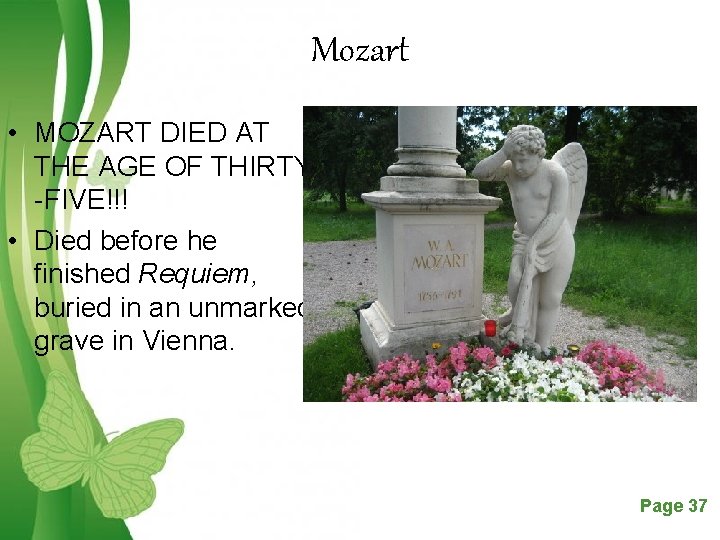
Mozart • MOZART DIED AT THE AGE OF THIRTY -FIVE!!! • Died before he finished Requiem, buried in an unmarked grave in Vienna. Free Powerpoint Templates Page 37
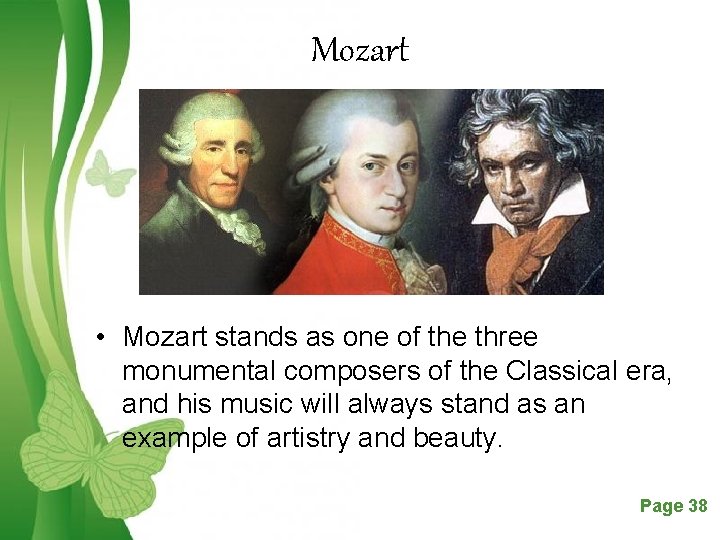
Mozart • Mozart stands as one of the three monumental composers of the Classical era, and his music will always stand as an example of artistry and beauty. Free Powerpoint Templates Page 38
A Quote from Mozart… • “Composing is not a very difficult thing for me. I simply copy down the music as it is in my head. ” Free Powerpoint Templates Page 39
• Franz Joseph Haydn Free Powerpoint Templates Page 40
• Hungarian • Celebrated as a composer of genius during his lifetime. • Known as “The Father of Symphony”. • A central figure in the growth of Classical style. Free Powerpoint Templates Page 41
Haydn • The 2 nd of 12 children; one of only six children that reached adulthood. • As a boy, he showed musical talent through singing and delighted his family with his talent. Free Powerpoint Templates Page 42
Haydn • When he was 6, his parents sent him away to study music. • His music teacher often beat he and the other students. • However, he encouraged Haydn’s gift of singing and instrumental talent; he taught Haydn to play several instruments. Free Powerpoint Templates Page 43
Haydn • He became a member of the St. Stephen’s Cathedral choir in Vienna. • When Haydn’s voice changed, the choirmaster lost interest in him. • When he was caught cutting off a choir member’s pigtail, he was thrown out of the choir. Free Powerpoint Templates Page 44
Haydn • Penniless and close to starvation at 18, Haydn worked under Nicola Porpora as an accompanist. • Haydn learned about composing and met important people. • He played for the emperor’s court, and performed as an assistant musical director. Free Powerpoint Templates Page 45
Trivia Fact… Adolph Hitler’s favorite composer was Haydn. He would listen to Haydn’s works while strategizing his plans!!!! Free Powerpoint Templates Page 46
Another Free Powerpoint Templates Page 47
Characteristics of Haydn • Pioneered the development of the symphony. • He turned them from short, simple works into longer, more sophisticated ones. • Diverse and numerous (wrote more than 104). • Previous symphonies had used the three-part movement form. • His symphonies have more emotion and are on a larger scale than the earlier works. Free Powerpoint Templates Page 48
Characteristics of Haydn • They were dramatic and employed sudden and unexpected changes/dynamics. • They contained great warmth; they utilized folk songs and Baroque dance music (so this is one composer that did utilize that of the Baroque era). Free Powerpoint Templates Page 49
Haydn’s Works • His works contain: • Symphony No. 1, Symphony No. 22: The Philosopher, Symphony No. 94: The Surprise, The Creation, Symphony No. 101: The Clock, and Symphony No. 104: The London. • He wrote sacred works, music of theatrical comedies, and chamber music. Free Powerpoint Templates Page 50