
Neo Darwinism Modern Synthetic Theory of Evolution Darwin
- Slides: 24
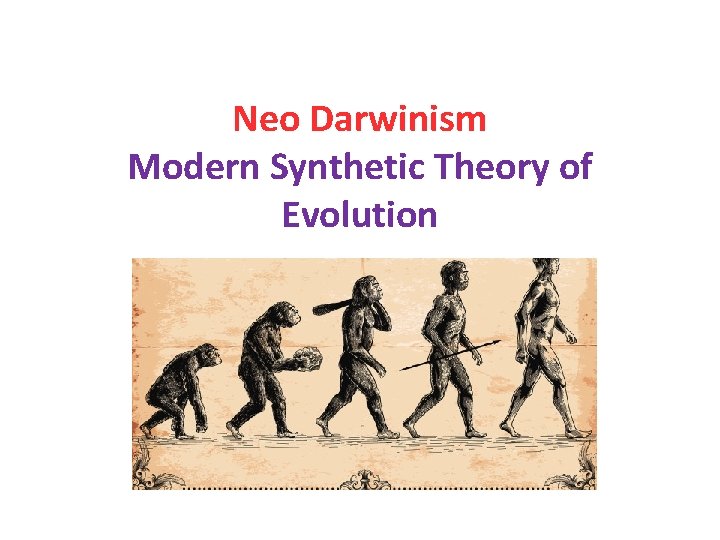
Neo Darwinism Modern Synthetic Theory of Evolution
• Darwin did recognize that evolution is inseparably linked to the process of inheritance. • However he could not explain the reason of variation as well as mechanism of inheritance of variations from one generation to next.
• In 1868 he tried to explain the mechanism by giving theory of ‘Pangenesis’ • According to him every organ of the body produces minute hereditary particles called as gemmules or Pengenes which travel through blood and get accumulated to form the gametes.
• But this concept of gemmules or Pengenes that forms the gametes was discarded by August Weisman in 1892 by suggesting that gametes or sex cells are formed separately than somatic cells during the very early development of the embryo. • August Weisman also suggested that the changes in the germplasm can only affect the characteristic of the body in the next generation and can not influence the body of the individual.
• In 1901 de Varies proposed theory of Mutation (after rediscovery of Mendelian) on the basis of his observations on sudden, discrete inheritable (transferable) variations in the wild variety of evening primrose. • De Varies first gave the term Mutation (i. e. sudden, discontinuous and heritable variations). • Darwin also noticed such sudden variations and called them ‘bud sports’
• According to de. Varies, mutations are the basic reason which control the evolutionary changes and then natural selection next. • Main point of de. Varies theory of Mutation are: • 1. New species originate as a result of mutation. • 2. This new species multiplies and produced large number of individuals.
• 3. Same mutation in certain population appears again and again so that chances of natural selection of new characters increases. • 4. Mutations in species occurs in all the directions so that characters may increase or decrease or lost. • 5. Mutations are generally large, discontinuous and non-directional whereas, fluctuating variation due to natural selection are small and directional.
• Criticism of de. Varies: • de. Varies believes that sudden and abrupt changes are responsible for origin of species. • However, Darwin and his supporters believed that evolution is the outcome of gradual fluctuating inheritable variations over a long series of generation.
• The “Neo Darwinism” or “Modern Synthetic Theory” or “Modern Theory of evolution” is based on important work done by a number of workers like: • R. S. Fisher, J. B. S. Haldane, Sewall Wright, Mayr and G. L. Stebbins in the last few decades. • It is the modern version of Mendelian genetics and Darwinism. • Modern scientists accept "Evolution" and "Natural Selection" as natural phenomena.
• Neo-Darwinism • The cause of incompleteness of Darwin’s Natural selection theory and De Vries Mutation theory was the unawareness of the basic principles of genetics (i. e. process of heredity of variations) that was discovered in the 20 th century. • This greatest drawback of Darwin's Theory, i. e. the ignorance about the process of heredity of variations has now been removed by applying "Principles of Mendelism" to "Population Dynamics", i. e. known as "Population Genetics“.
• As a result of this, "Neodarwinism" has gradually emerged out as the mathematically based "Modern Synthetic Theory of Evolution", so designated by Huxley (1942). • Dobzhansky's (1937) book, "Genetics and the Origin of Species", provided the initial basis of this theory. • Muller (1949), Fisher (1958), Wright (1968), Mayr (1963, 70), Stebbins (1966 -76), etc. further provided the help significantly in its formulation.
• Neo-Darwinism postulates that natural selection acts on the heritable (genetic) variations within individuals in populations and that mutations (especially random copying errors in DNA) provide the main source of these genetic variations. • Because positive mutations seem to be rare, Neo-Darwinism contends that evolution will be a slow, gradual process.
• Neo-Darwinsim holds that the processes responsible for small-scale microevolutionary changes can be extrapolated indefinitely to produce large-scale macroevolutionary changes leading to major innovations in form. • Neo-Darwinism is also called as the Modern Synthesis because it synthesizes or brings together classical Darwinism with modern genetic theory.
• Neo-Darwinism asserts that evolution takes place because the environment is slowly changing, exerting a selection pressure on the individuals within a population. • Those with characteristics that happen to adapt to the new environment are more likely to survive and have offspring and hence pass on these favourable characteristics. • Over time the genetic make-up of the population changes and ultimately a new species is formed.
• The Neo Darwinism or Modern Synthetic Theory emphasizes the role of: • (i) population genetics • (ii) sources of variations in evolution.
• (i) What is Population Genetics? • Population genetics is the study frequencies of genes in population. of • The natural selection alters relative frequency of various genes over a period of time. • Hardy and Weinberg observed that hereditary conservation of genes is the characteristic of a population.
• According to this law, under certain conditions of stability allelic frequencies remain constant for generations to generations in sexually reproducing organism (i. e. genetic equilibrium). • This law helps to determine when evolution is occurring. • Evolution occurs only when this equilibrium is upset.
• (ii) What are the sources of Variations? • Variations are raw material for evolution. • Natural selection can act on genetic variations, only when it is expressed in phenotype. • These variations are due to; • 1. Mutation: Alteration in the chemistry of gene (DNA) is able to change its phenotypic effect is called point mutation or gene mutation. Chromosomal mutation such as deletion, duplication, inversion, and translocation also result in variation.
• 2. Gene Recombination: Recombination i. e. new genotype from already existing genes was little known at the time of Darwin. Recombination is the important factor that increases the variability of individual genotypes in a population. • 3. Heredity: The transmission of characteristics or variations from parent to offspring is an important mechanism of evolution. As a result, the offsprings are able to benefit from the advantageous characteristics of their parents.
• 4. Natural Selection: Natural selection brings about evolutionary change by guiding different populations into different adaptive channels. • 5. Isolation: Isolation of organisms of a species into several populations or groups is supposed to be one of the most significant factors responsible for evolution.
• Isolation is a segregation of separation of populations by some barriers which prevent interbreeding between related organisms. • The reproductive isolation between the populations due to certain barriers leads to the formation of new species.
• 6. Origin of new Species: • The populations of a species present in different environments and are separated by geographical and physiological barriers, accumulate different genetic differences due to mutations, recombination, hybridization, genetic drift and natural selection. • The population’s thus become different from each other morphologically and genetically, they become reproductively segregated or isolated, forming a New Species.
• The first three factors namely Mutation, Gene Recombination and Heredity are responsible for providing genetic variability. • While the last two factors namely Natural Selection and Isolation are responsible for giving a direction to the evolutionary process.
• Besides these five basic factors outlined above, Migration of individuals from one to the other populations, Hybridization between members of closely related species and Genetic drift i. e. elimination of the genes of some original characteristics of a species by extreme reduction in a population due to epidemics add to the variability of genotypes as Accessory factors. • These processes increase the genetic variability available to the populations undergoing the process of evolution.