
Neo Classicism and Romanticism 1750 1850 Drum Roll
- Slides: 29
Neo Classicism and Romanticism 1750 -1850 (Drum Roll Please) “We Enter the Modern World. ”
• Entire Era based on the ideas of the Enlightenment-new way of thinking about the world and humankind that was independent of religion, myth, or tradition • Based on the scientific method (Newton) and empirical evidence (Locke) • Believed that humans are born good and nature grants them natural rights of life, liberty, property, and freedom of conscious • Art preceded by the Enlightenment (Voltaire, Rousseau)- all human affairs should be ruled by reason and the common good rather than established authority • Made knowledge accessible to everyone • Rousseau-arts and sciences have corrupted “natural man”, preached return to innocence, ignorance and happiness- against progress • Caused three major revolutions- French, American, and Industrial • Romanticism hard to define, overlapped Neo-Classicism and Rococo • For the first time, art was political commentary • Modern Era begins with the Revolutionary War and the French Revolution”Modern”- an awareness of history • This caused the return to the classics in art- the basis for all reason- based a lot on Poussin’s art • We keep revisiting classicism but for different reasons • Renaissance- humanism • Baroque- power • Neo Classicism- reason
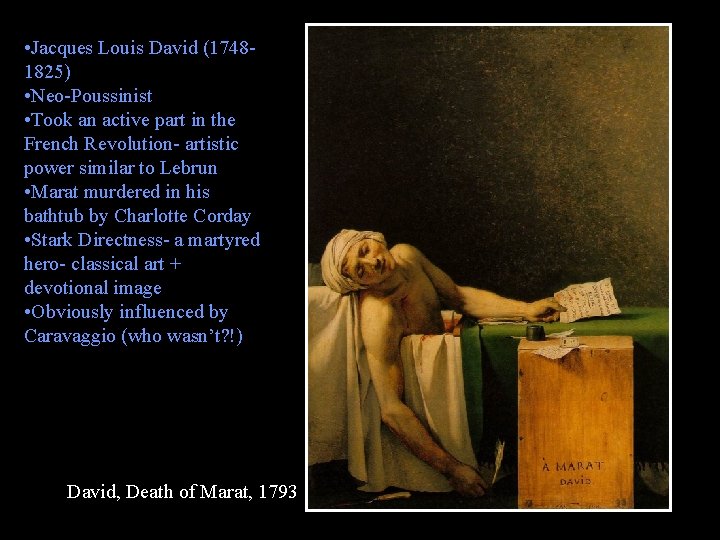
• Jacques Louis David (17481825) • Neo-Poussinist • Took an active part in the French Revolution- artistic power similar to Lebrun • Marat murdered in his bathtub by Charlotte Corday • Stark Directness- a martyred hero- classical art + devotional image • Obviously influenced by Caravaggio (who wasn’t? !) David, Death of Marat, 1793
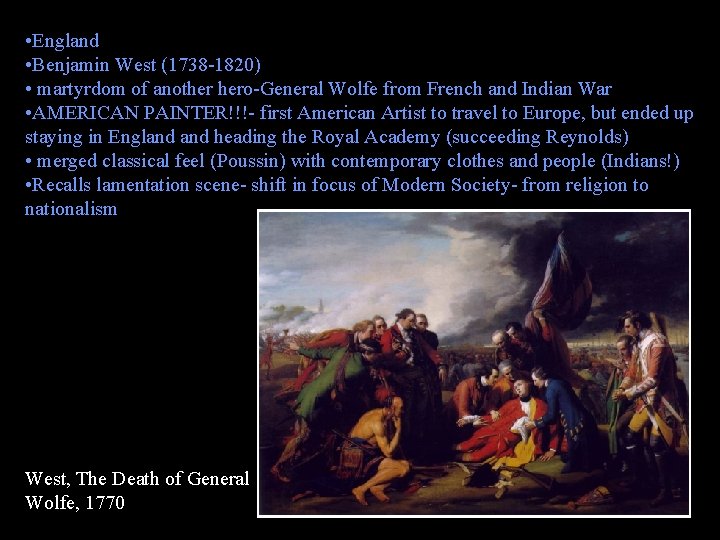
• England • Benjamin West (1738 -1820) • martyrdom of another hero-General Wolfe from French and Indian War • AMERICAN PAINTER!!!- first American Artist to travel to Europe, but ended up staying in England heading the Royal Academy (succeeding Reynolds) • merged classical feel (Poussin) with contemporary clothes and people (Indians!) • Recalls lamentation scene- shift in focus of Modern Society- from religion to nationalism West, The Death of General Wolfe, 1770
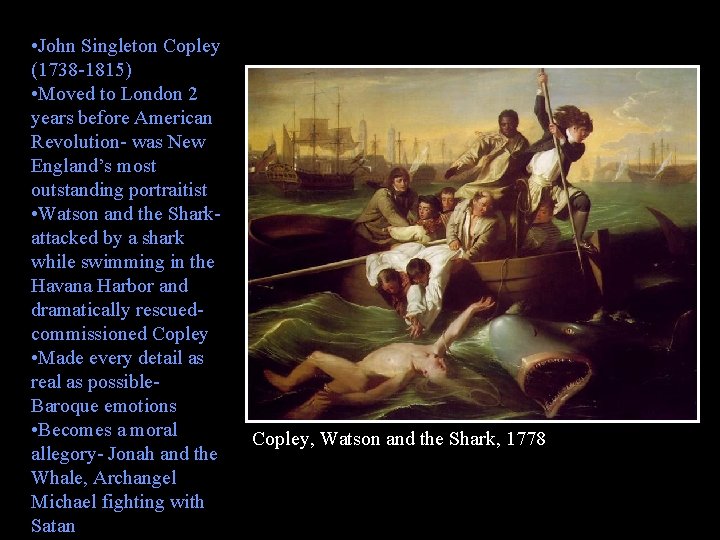
• John Singleton Copley (1738 -1815) • Moved to London 2 years before American Revolution- was New England’s most outstanding portraitist • Watson and the Sharkattacked by a shark while swimming in the Havana Harbor and dramatically rescuedcommissioned Copley • Made every detail as real as possible. Baroque emotions • Becomes a moral allegory- Jonah and the Whale, Archangel Michael fighting with Satan Copley, Watson and the Shark, 1778
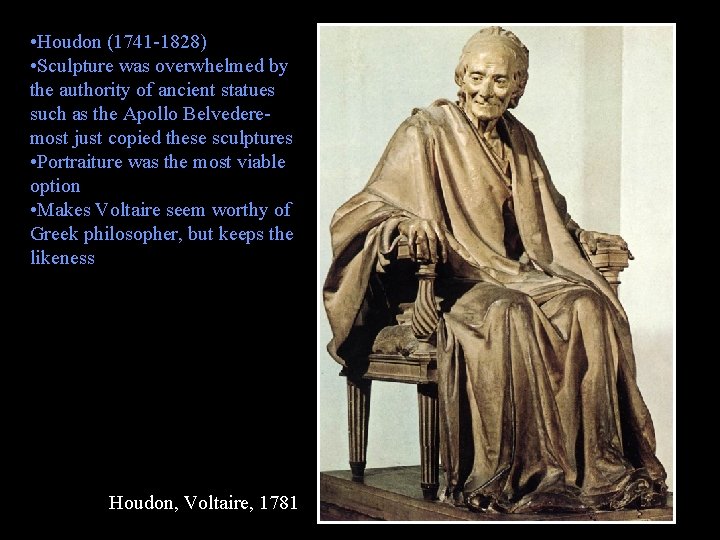
• Houdon (1741 -1828) • Sculpture was overwhelmed by the authority of ancient statues such as the Apollo Belvederemost just copied these sculptures • Portraiture was the most viable option • Makes Voltaire seem worthy of Greek philosopher, but keeps the likeness Houdon, Voltaire, 1781
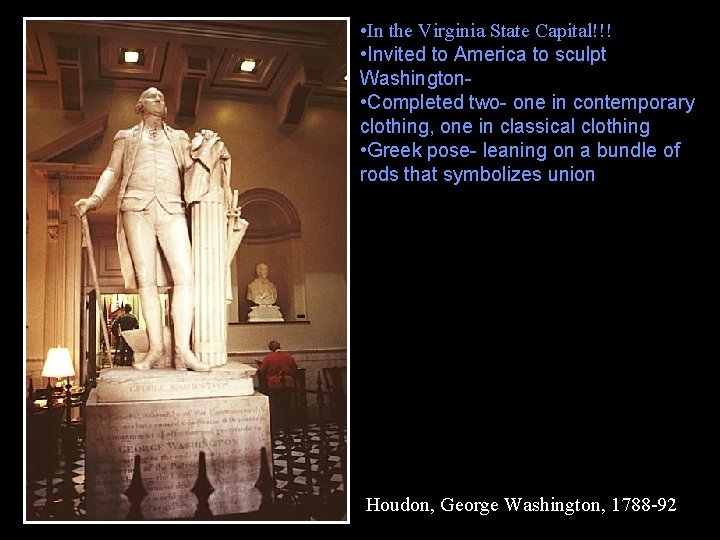
• In the Virginia State Capital!!! • Invited to America to sculpt Washington • Completed two- one in contemporary clothing, one in classical clothing • Greek pose- leaning on a bundle of rods that symbolizes union Houdon, George Washington, 1788 -92
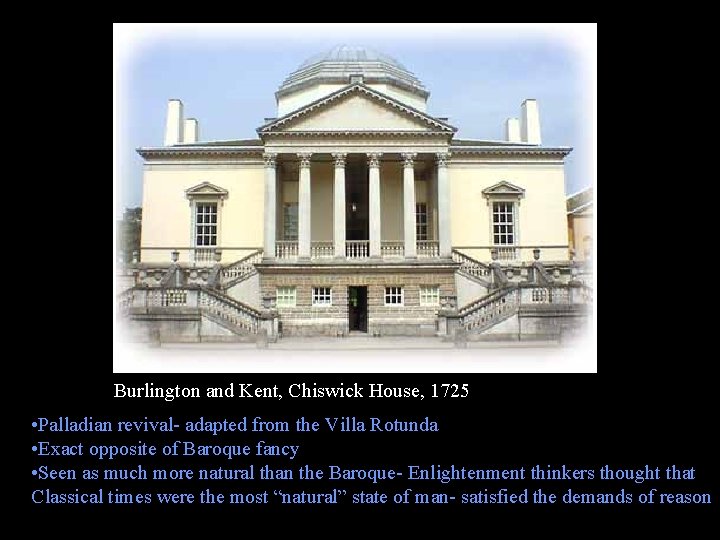
Burlington and Kent, Chiswick House, 1725 • Palladian revival- adapted from the Villa Rotunda • Exact opposite of Baroque fancy • Seen as much more natural than the Baroque- Enlightenment thinkers thought that Classical times were the most “natural” state of man- satisfied the demands of reason
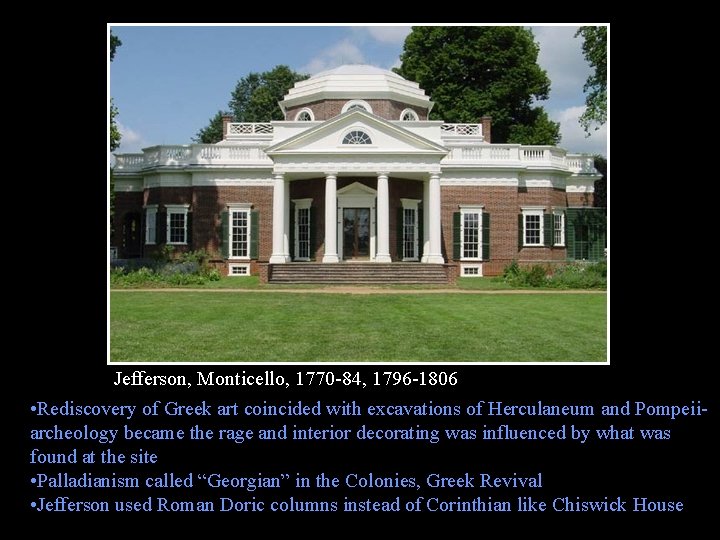
Jefferson, Monticello, 1770 -84, 1796 -1806 • Rediscovery of Greek art coincided with excavations of Herculaneum and Pompeiiarcheology became the rage and interior decorating was influenced by what was found at the site • Palladianism called “Georgian” in the Colonies, Greek Revival • Jefferson used Roman Doric columns instead of Corinthian like Chiswick House
Romanticism • Enlightenment let loose the opposite of reason too- helped to create a new wave of emotionalism- known as Romanticism • Word derived from medieval tales of adventure (King Arthur)Gothic! • Those that hated the current social, religious, or political order tried to form a new order based on reason, or seek release in an emotional experience • Romantic worshipped nature as unbounded and ever-changing • Believed that if people were free to behave “naturally”, then evil would disappear-exalted liberty, power, love, violence, Middle Ages • Creation of art cannot be truly Romantic because it requires detachment and discipline • Could not use established order of art, so revival of any past art was popular • Neo-classicism is actually part of this idea
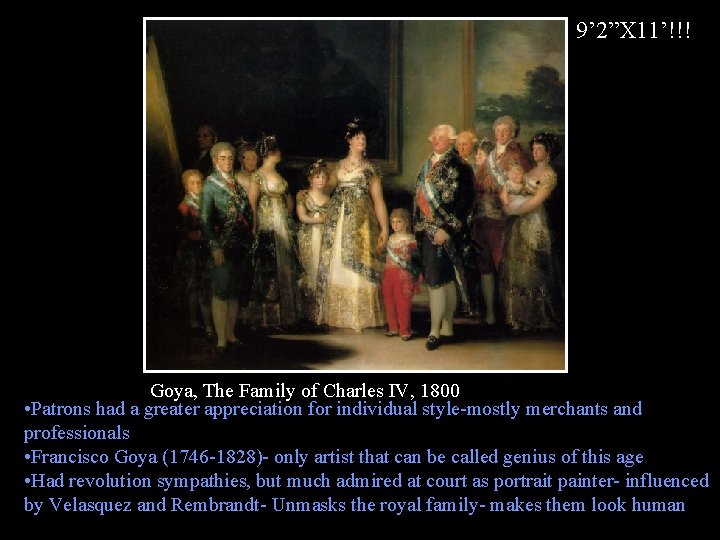
9’ 2”X 11’!!! Goya, The Family of Charles IV, 1800 • Patrons had a greater appreciation for individual style-mostly merchants and professionals • Francisco Goya (1746 -1828)- only artist that can be called genius of this age • Had revolution sympathies, but much admired at court as portrait painter- influenced by Velasquez and Rembrandt- Unmasks the royal family- makes them look human
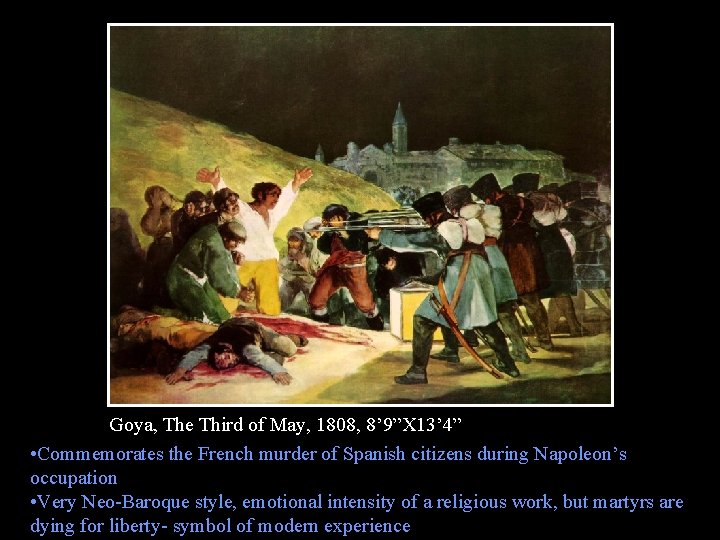
Goya, The Third of May, 1808, 8’ 9”X 13’ 4” • Commemorates the French murder of Spanish citizens during Napoleon’s occupation • Very Neo-Baroque style, emotional intensity of a religious work, but martyrs are dying for liberty- symbol of modern experience
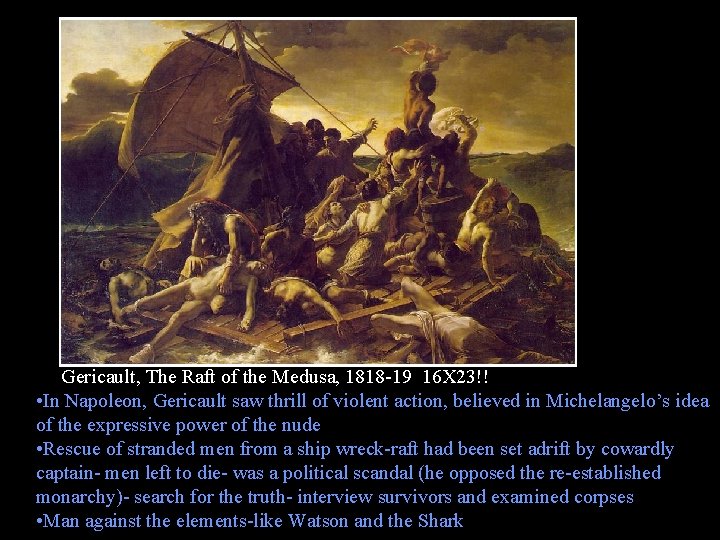
Gericault, The Raft of the Medusa, 1818 -19 16 X 23!! • In Napoleon, Gericault saw thrill of violent action, believed in Michelangelo’s idea of the expressive power of the nude • Rescue of stranded men from a ship wreck-raft had been set adrift by cowardly captain- men left to die- was a political scandal (he opposed the re-established monarchy)- search for the truth- interview survivors and examined corpses • Man against the elements-like Watson and the Shark
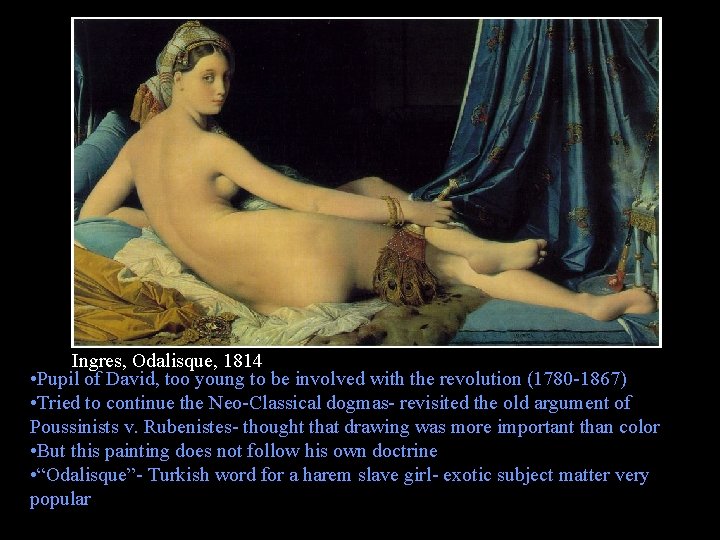
Ingres, Odalisque, 1814 • Pupil of David, too young to be involved with the revolution (1780 -1867) • Tried to continue the Neo-Classical dogmas- revisited the old argument of Poussinists v. Rubenistes- thought that drawing was more important than color • But this painting does not follow his own doctrine • “Odalisque”- Turkish word for a harem slave girl- exotic subject matter very popular
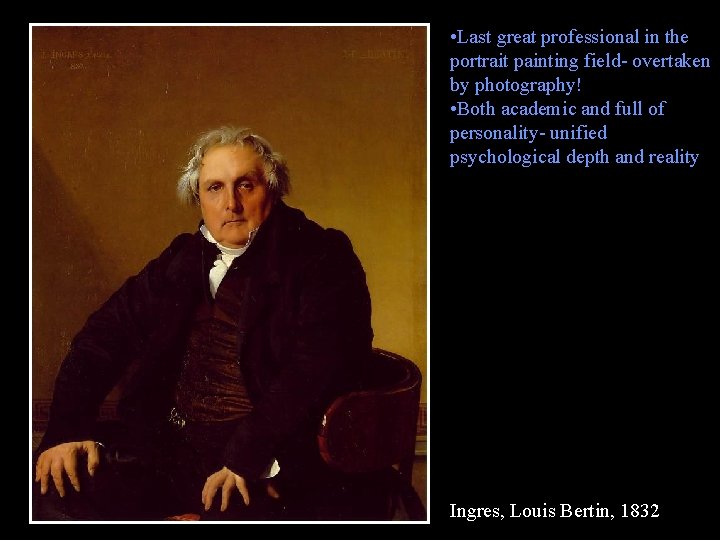
• Last great professional in the portrait painting field- overtaken by photography! • Both academic and full of personality- unified psychological depth and reality Ingres, Louis Bertin, 1832
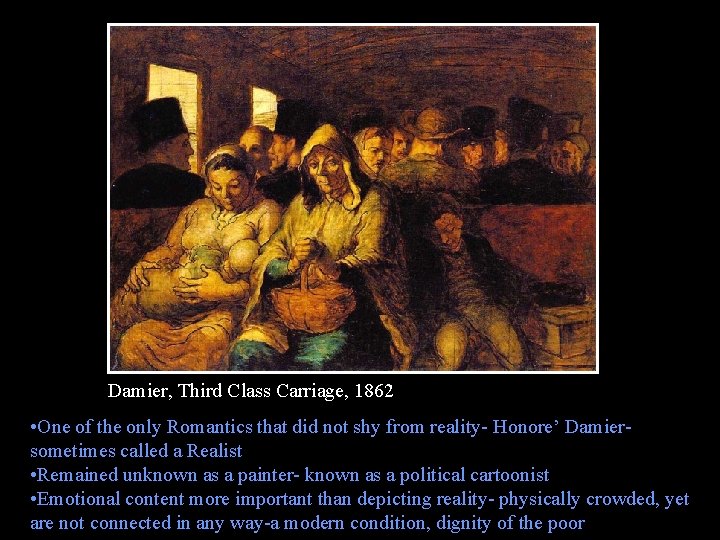
Damier, Third Class Carriage, 1862 • One of the only Romantics that did not shy from reality- Honore’ Damiersometimes called a Realist • Remained unknown as a painter- known as a political cartoonist • Emotional content more important than depicting reality- physically crowded, yet are not connected in any way-a modern condition, dignity of the poor
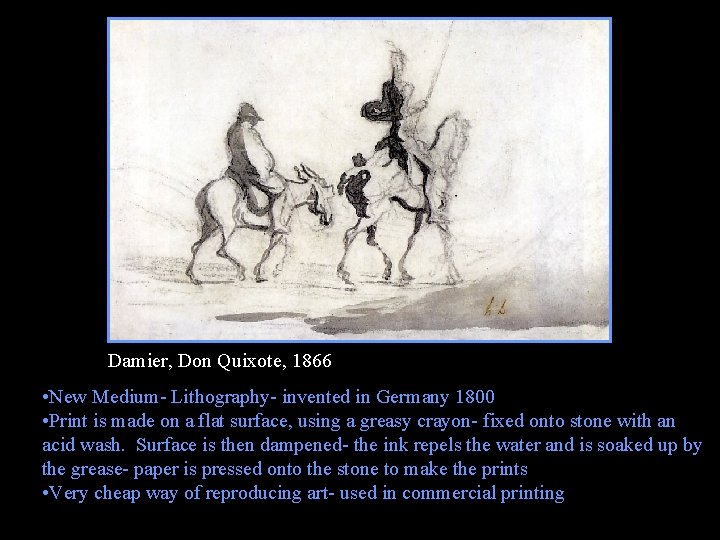
Damier, Don Quixote, 1866 • New Medium- Lithography- invented in Germany 1800 • Print is made on a flat surface, using a greasy crayon- fixed onto stone with an acid wash. Surface is then dampened- the ink repels the water and is soaked up by the grease- paper is pressed onto the stone to make the prints • Very cheap way of reproducing art- used in commercial printing
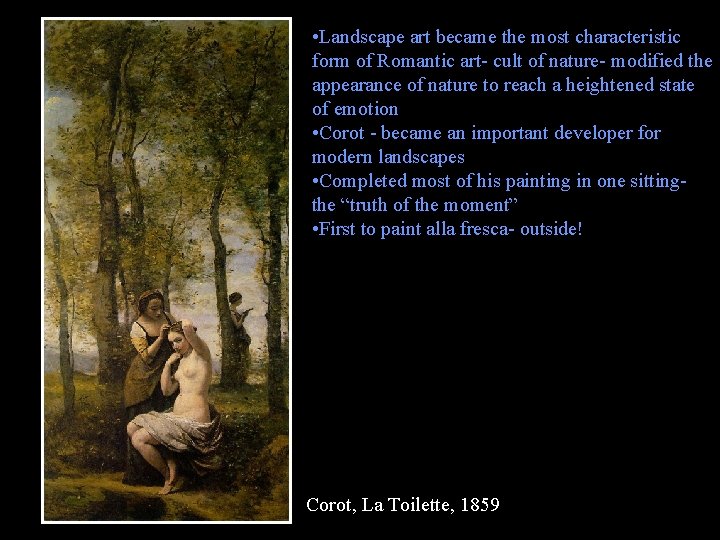
• Landscape art became the most characteristic form of Romantic art- cult of nature- modified the appearance of nature to reach a heightened state of emotion • Corot - became an important developer for modern landscapes • Completed most of his painting in one sittingthe “truth of the moment” • First to paint alla fresca- outside! Corot, La Toilette, 1859
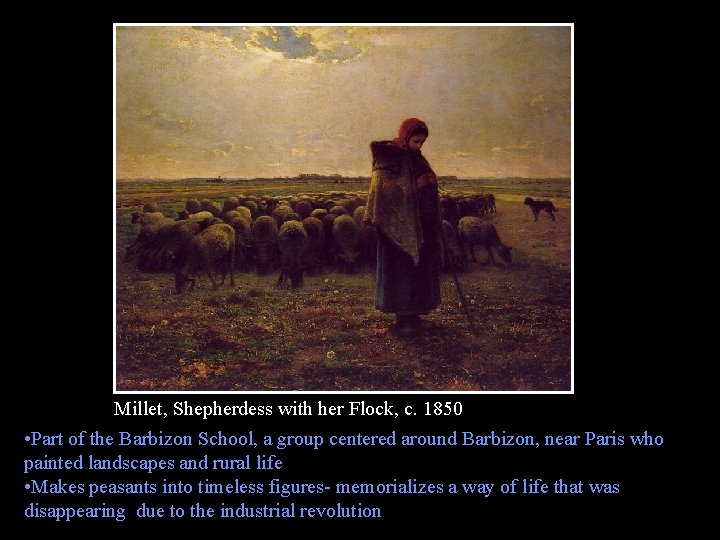
Millet, Shepherdess with her Flock, c. 1850 • Part of the Barbizon School, a group centered around Barbizon, near Paris who painted landscapes and rural life • Makes peasants into timeless figures- memorializes a way of life that was disappearing due to the industrial revolution
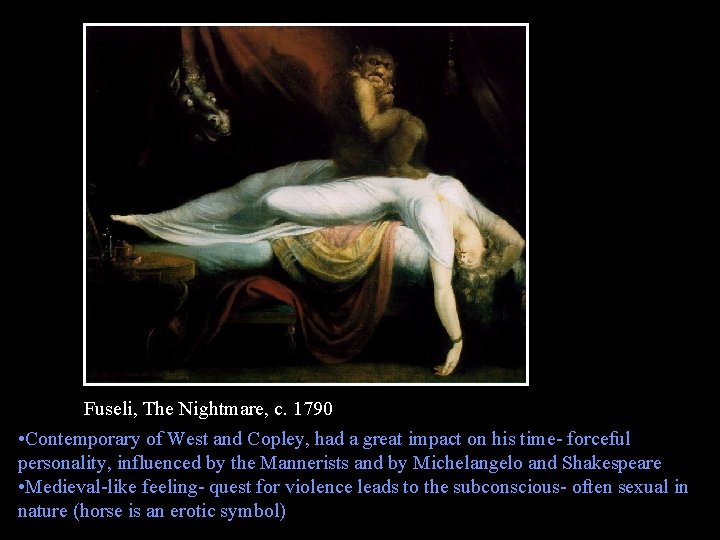
Fuseli, The Nightmare, c. 1790 • Contemporary of West and Copley, had a great impact on his time- forceful personality, influenced by the Mannerists and by Michelangelo and Shakespeare • Medieval-like feeling- quest for violence leads to the subconscious- often sexual in nature (horse is an erotic symbol)
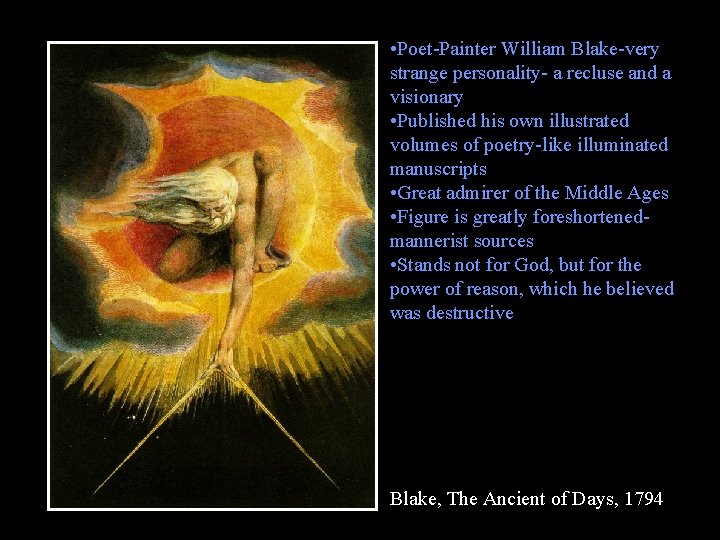
• Poet-Painter William Blake-very strange personality- a recluse and a visionary • Published his own illustrated volumes of poetry-like illuminated manuscripts • Great admirer of the Middle Ages • Figure is greatly foreshortenedmannerist sources • Stands not for God, but for the power of reason, which he believed was destructive Blake, The Ancient of Days, 1794
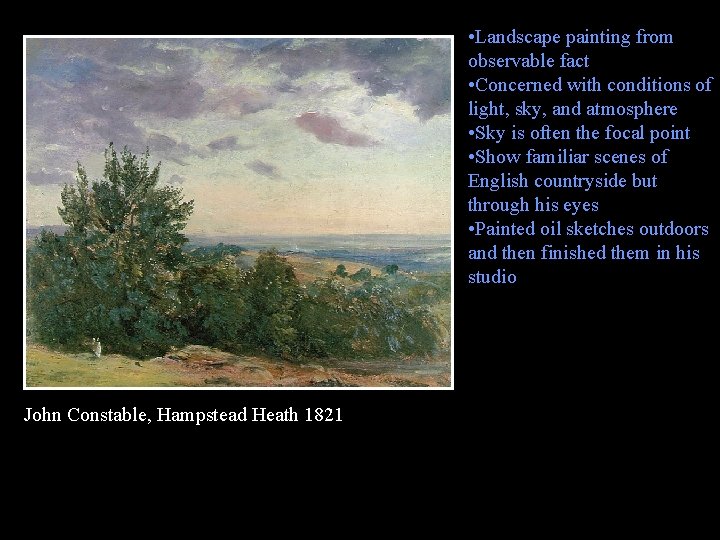
• Landscape painting from observable fact • Concerned with conditions of light, sky, and atmosphere • Sky is often the focal point • Show familiar scenes of English countryside but through his eyes • Painted oil sketches outdoors and then finished them in his studio John Constable, Hampstead Heath 1821
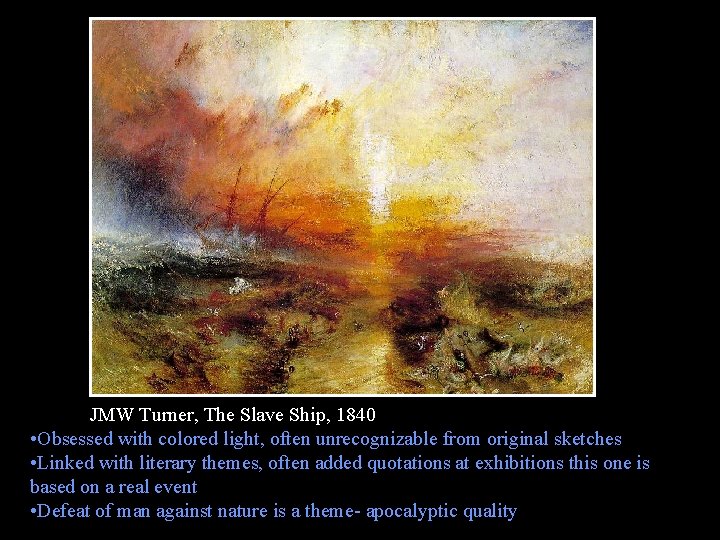
JMW Turner, The Slave Ship, 1840 • Obsessed with colored light, often unrecognizable from original sketches • Linked with literary themes, often added quotations at exhibitions this one is based on a real event • Defeat of man against nature is a theme- apocalyptic quality
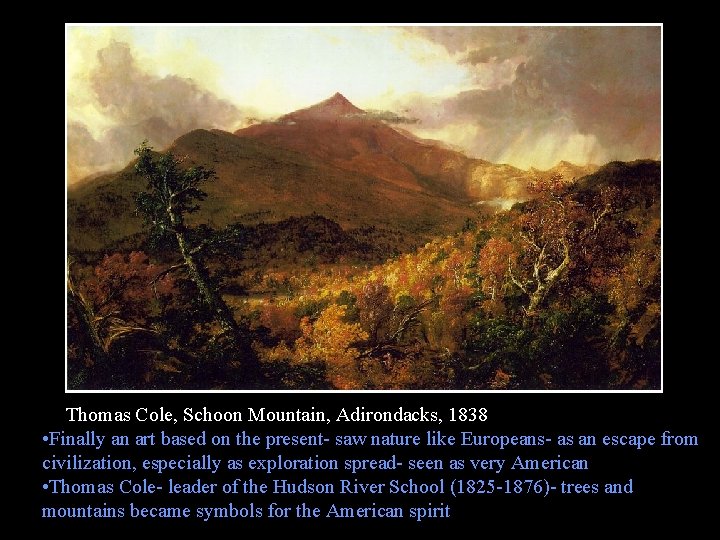
Thomas Cole, Schoon Mountain, Adirondacks, 1838 • Finally an art based on the present- saw nature like Europeans- as an escape from civilization, especially as exploration spread- seen as very American • Thomas Cole- leader of the Hudson River School (1825 -1876)- trees and mountains became symbols for the American spirit
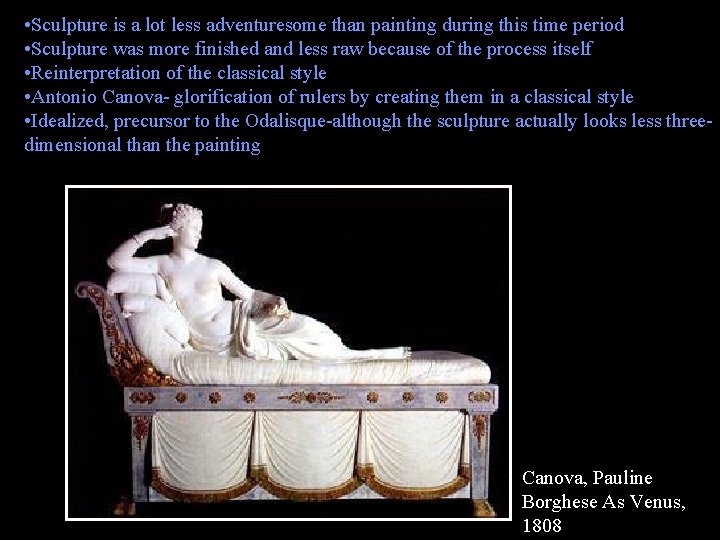
• Sculpture is a lot less adventuresome than painting during this time period • Sculpture was more finished and less raw because of the process itself • Reinterpretation of the classical style • Antonio Canova- glorification of rulers by creating them in a classical style • Idealized, precursor to the Odalisque-although the sculpture actually looks less threedimensional than the painting Canova, Pauline Borghese As Venus, 1808
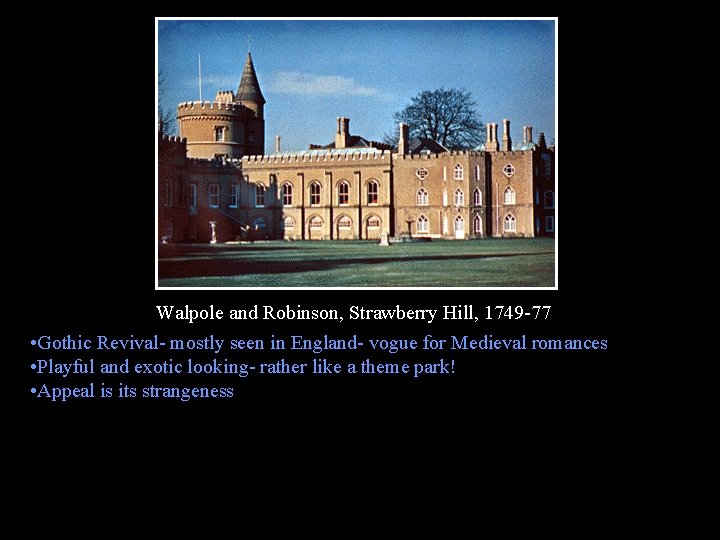
Walpole and Robinson, Strawberry Hill, 1749 -77 • Gothic Revival- mostly seen in England- vogue for Medieval romances • Playful and exotic looking- rather like a theme park! • Appeal is its strangeness
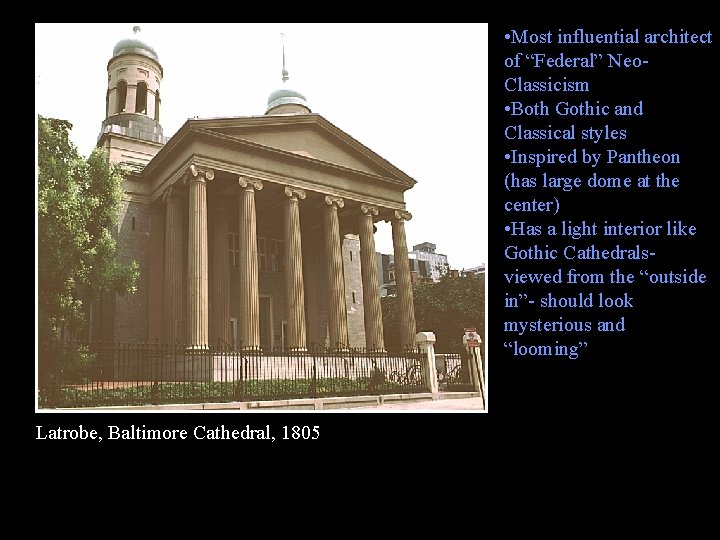
• Most influential architect of “Federal” Neo. Classicism • Both Gothic and Classical styles • Inspired by Pantheon (has large dome at the center) • Has a light interior like Gothic Cathedralsviewed from the “outside in”- should look mysterious and “looming” Latrobe, Baltimore Cathedral, 1805
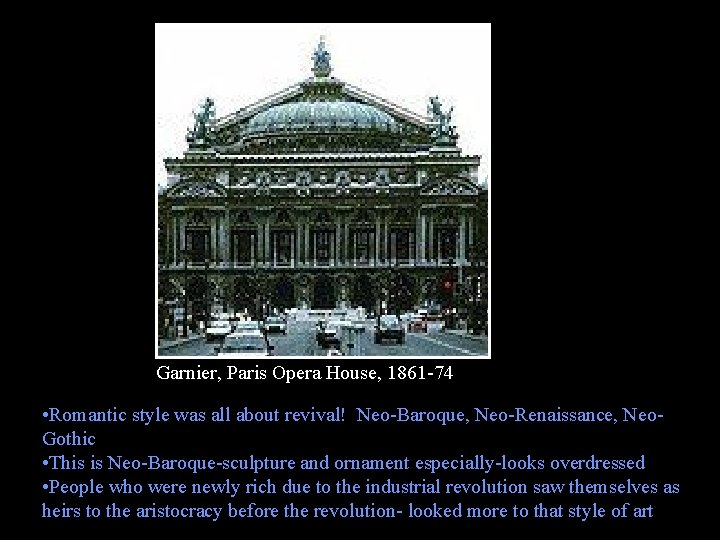
Garnier, Paris Opera House, 1861 -74 • Romantic style was all about revival! Neo-Baroque, Neo-Renaissance, Neo. Gothic • This is Neo-Baroque-sculpture and ornament especially-looks overdressed • People who were newly rich due to the industrial revolution saw themselves as heirs to the aristocracy before the revolution- looked more to that style of art
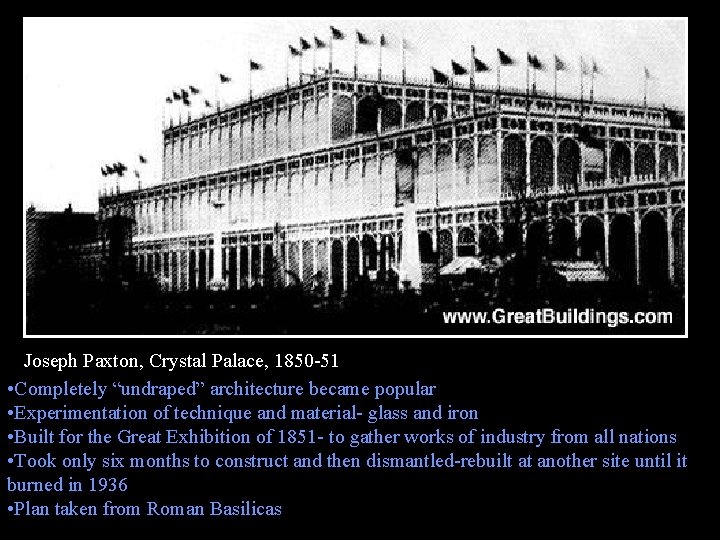
Joseph Paxton, Crystal Palace, 1850 -51 • Completely “undraped” architecture became popular • Experimentation of technique and material- glass and iron • Built for the Great Exhibition of 1851 - to gather works of industry from all nations • Took only six months to construct and then dismantled-rebuilt at another site until it burned in 1936 • Plan taken from Roman Basilicas