
Nemo MultiCriteria TestSuite Minimization with Integer Nonlinear Programming




- Slides: 34
Nemo: Multi-Criteria Test-Suite Minimization with Integer Nonlinear Programming Jun-Wei Lin, Reyhaneh Jabbarvand, Joshua Garcia, and Sam Malek Donald Bren School of Information and Computer Sciences University of California, Irvine
Software Evolves Rapidly … … … Source: https: //www. imore. com/evolution-social-media-icon 2
3
4
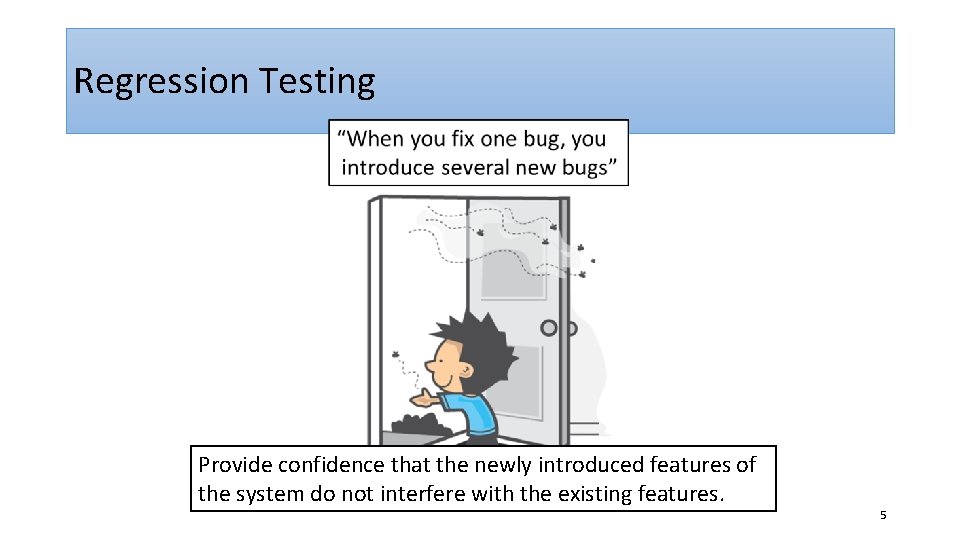
Regression Testing Provide confidence that the newly introduced features of the system do not interfere with the existing features. 5
6
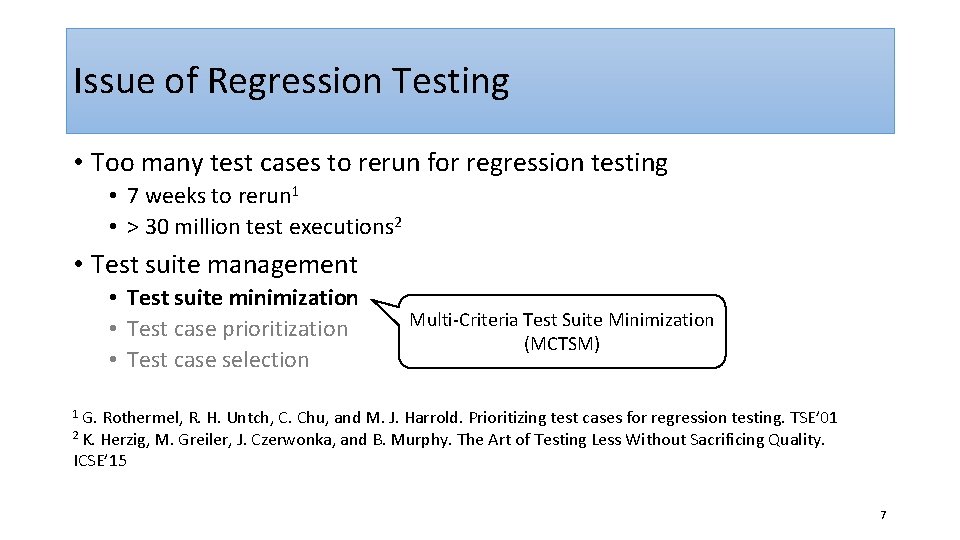
Issue of Regression Testing • Too many test cases to rerun for regression testing • 7 weeks to rerun 1 • > 30 million test executions 2 • Test suite management • Test suite minimization • Test case prioritization • Test case selection Multi-Criteria Test Suite Minimization (MCTSM) 1 G. Rothermel, R. H. Untch, C. Chu, and M. J. Harrold. Prioritizing test cases for regression testing. TSE’ 01 2 K. Herzig, M. Greiler, J. Czerwonka, and B. Murphy. The Art of Testing Less Without Sacrificing Quality. ICSE’ 15 7
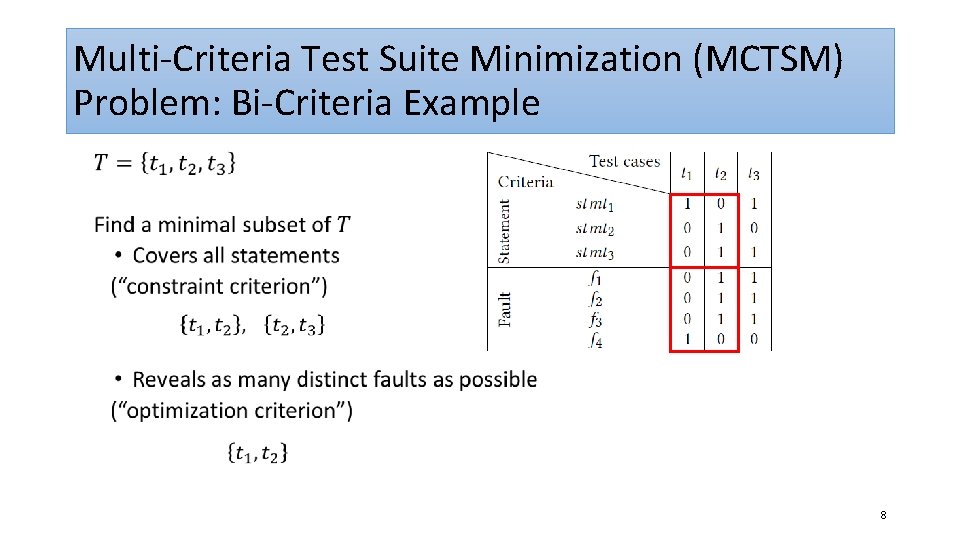
Multi-Criteria Test Suite Minimization (MCTSM) Problem: Bi-Criteria Example • 8
Outline • Background and motivation • Prior research (Linear formulation of MCTSM) • Nemo (Nonlinear formulation of MCTSM) • Evaluation • Conclusion 9
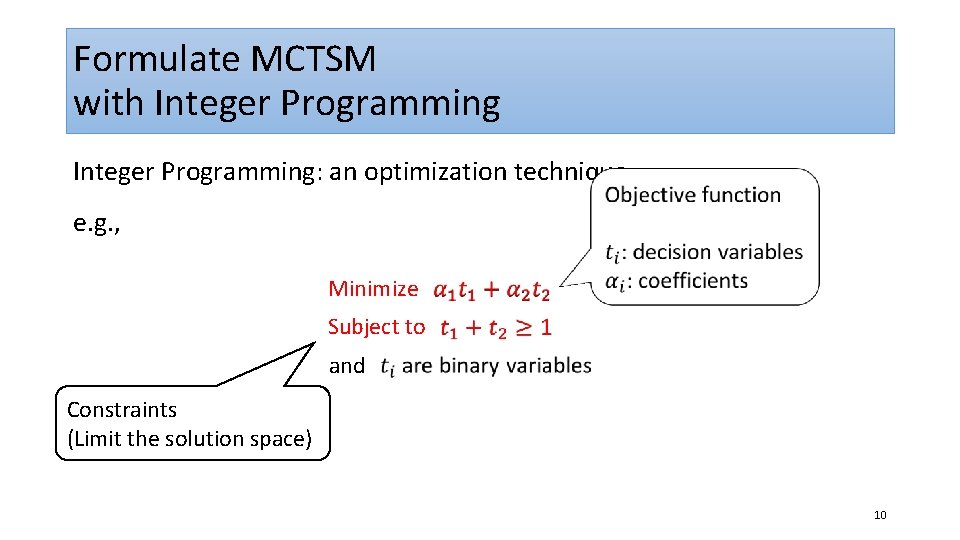
Formulate MCTSM with Integer Programming: an optimization technique e. g. , Minimize Subject to and Constraints (Limit the solution space) 10
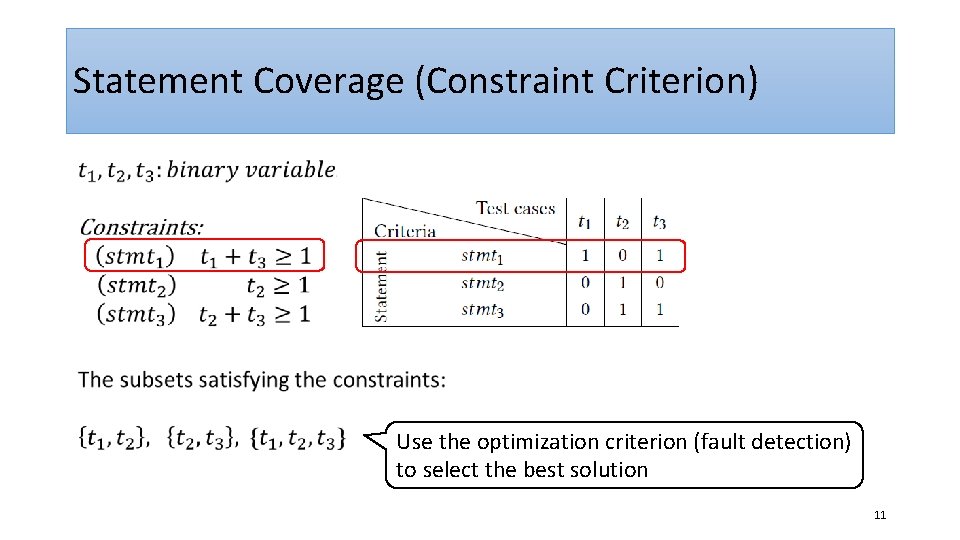
Statement Coverage (Constraint Criterion) Use the optimization criterion (fault detection) to select the best solution 11
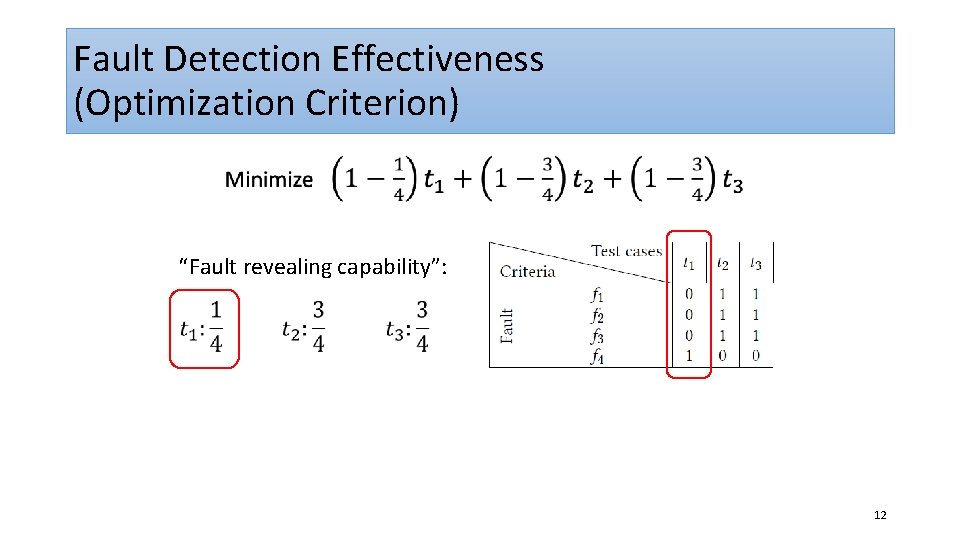
Fault Detection Effectiveness (Optimization Criterion) “Fault revealing capability”: 12
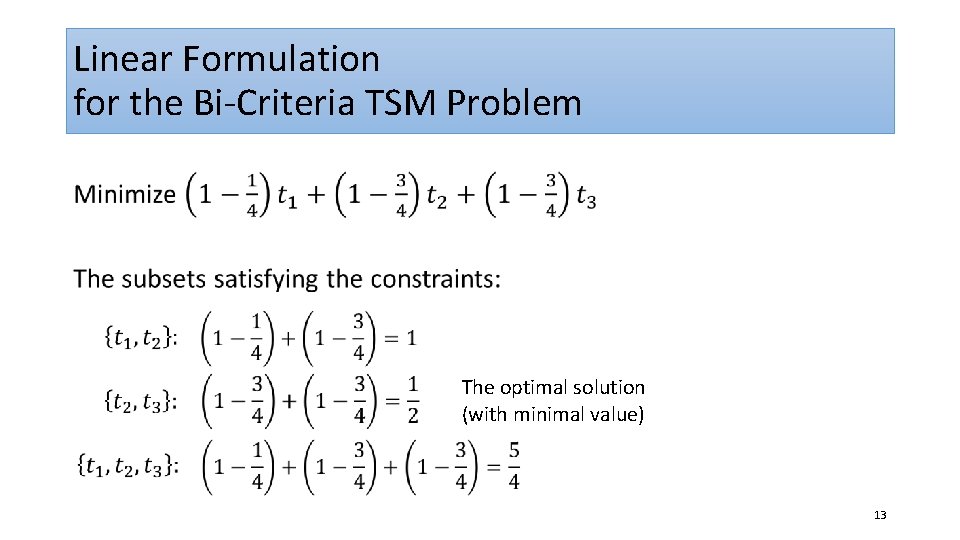
Linear Formulation for the Bi-Criteria TSM Problem • The optimal solution (with minimal value) 13
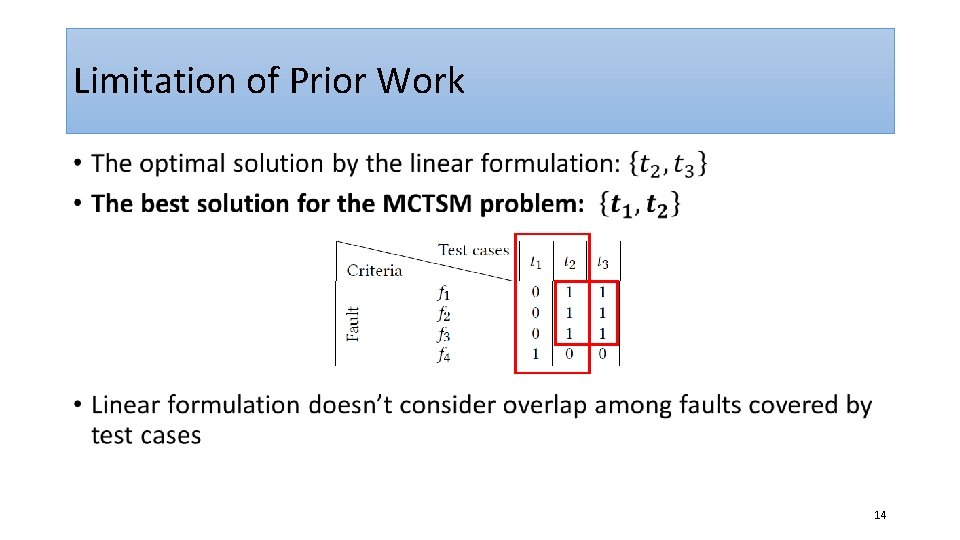
Limitation of Prior Work • 14
Outline • Background and motivation • Prior research (Linear formulation of MCTSM) • Nemo (Nonlinear formulation of MCTSM) • Evaluation • Conclusion 15
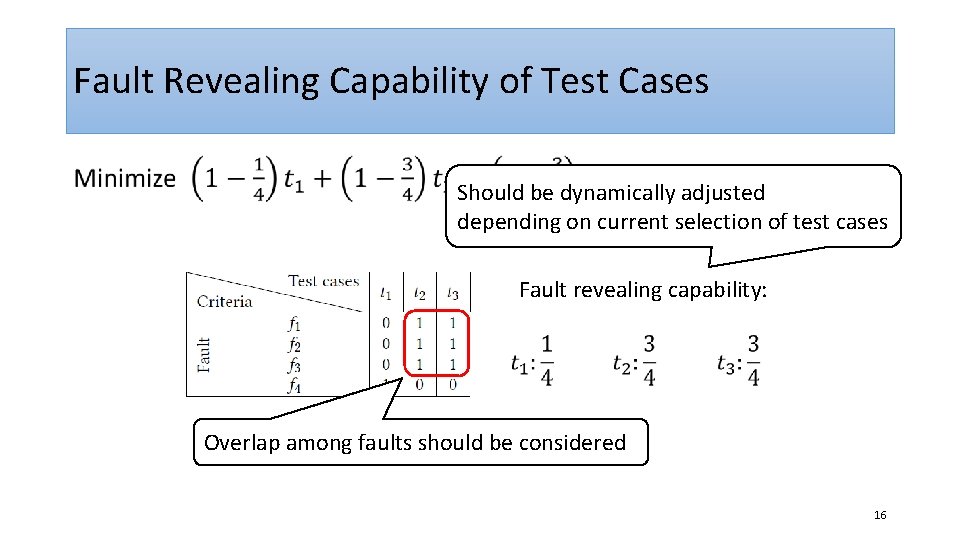
Fault Revealing Capability of Test Cases • Should be dynamically adjusted depending on current selection of test cases Fault revealing capability: Overlap among faults should be considered 16
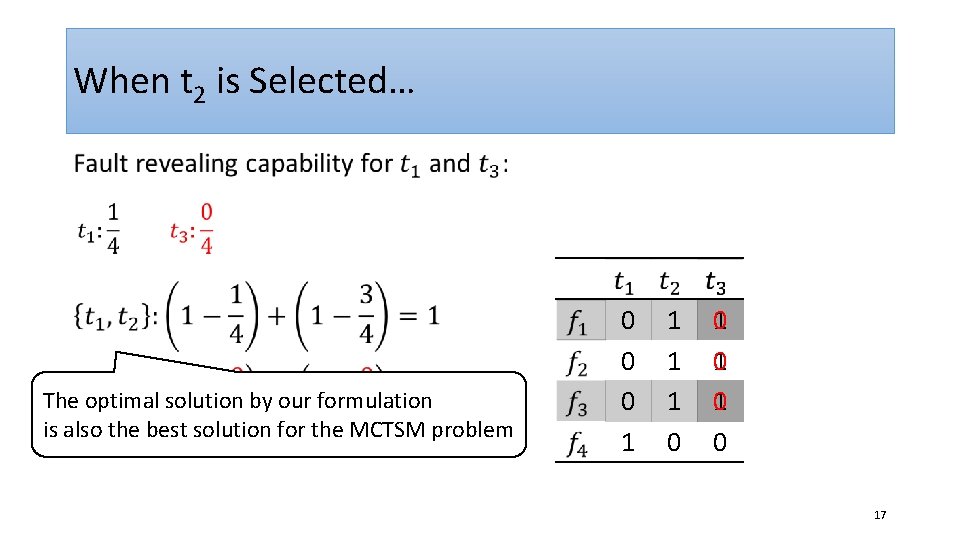
When t 2 is Selected… • The optimal solution by our formulation is also the best solution for the MCTSM problem 0 0 0 1 1 0 0 1 0 17
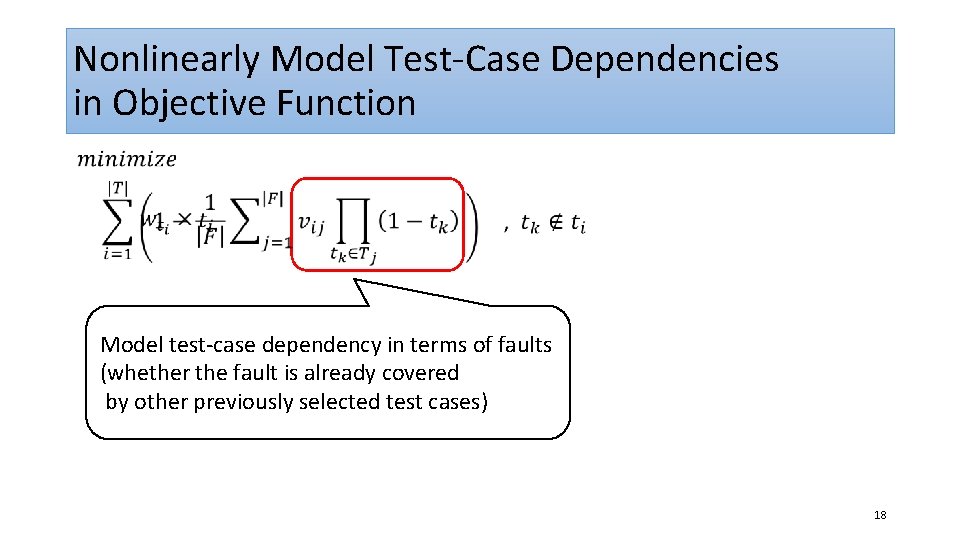
Nonlinearly Model Test-Case Dependencies in Objective Function Model test-case dependency in terms of faults (whether the fault is already covered by other previously selected test cases) 18
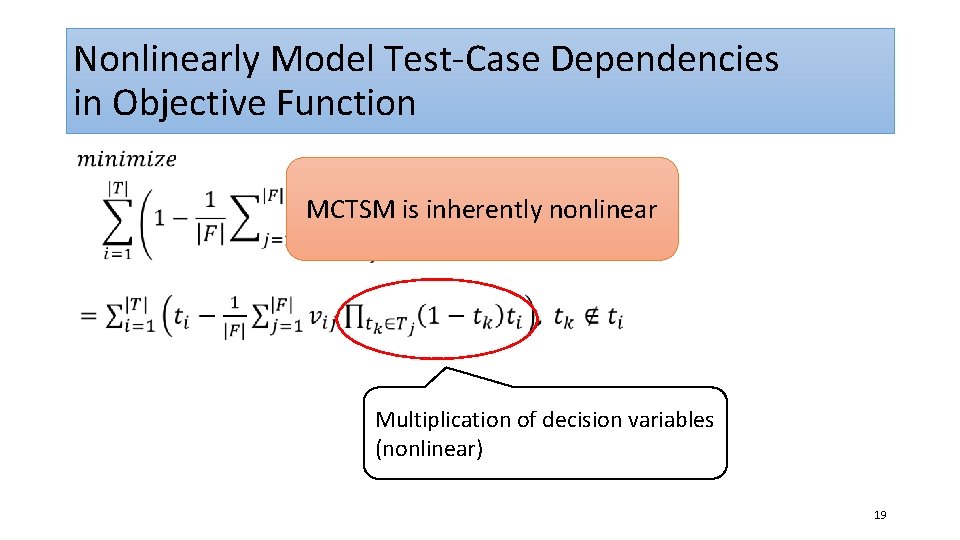
Nonlinearly Model Test-Case Dependencies in Objective Function MCTSM is inherently nonlinear Multiplication of decision variables (nonlinear) 19
Challenge of Solving Nonlinear Formulation • Issues of nonlinear solvers • No known efficient algorithm to find optimal solution • May return sub-optimal solution, if the objective function is non-convex • Use auxiliary variables 1 to transform the nonlinear formulation into an equivalent linear form • Linear solvers can be leveraged to find optimal solutions 1 L. A. Wolsey. 1998. Integer programming. Wiley-Interscience, New York, NY, USA. 20
Outline • Background and motivation • Prior research (Linear formulation of MCTSM) • Nemo (Nonlinear formulation of MCTSM) • Evaluation • Conclusion 21
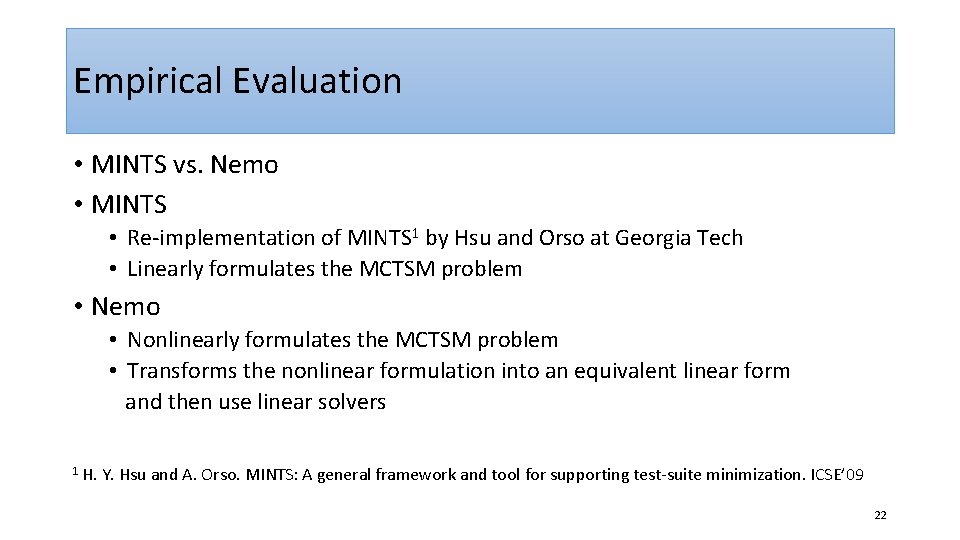
Empirical Evaluation • MINTS vs. Nemo • MINTS • Re-implementation of MINTS 1 by Hsu and Orso at Georgia Tech • Linearly formulates the MCTSM problem • Nemo • Nonlinearly formulates the MCTSM problem • Transforms the nonlinear formulation into an equivalent linear form and then use linear solvers 1 H. Y. Hsu and A. Orso. MINTS: A general framework and tool for supporting test-suite minimization. ICSE’ 09 22
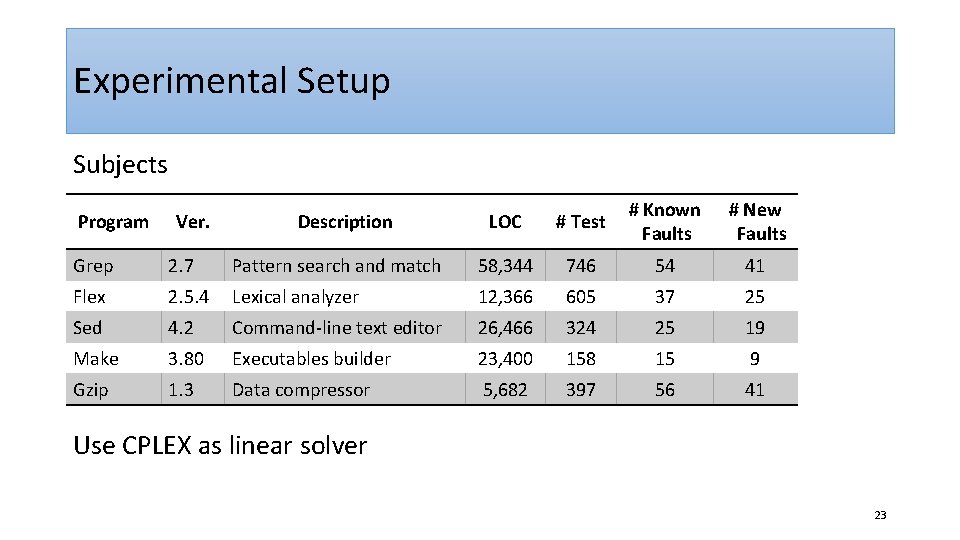
Experimental Setup Subjects Program Ver. Description LOC # Test # Known Faults # New Faults Grep 2. 7 Pattern search and match 58, 344 746 54 41 Flex 2. 5. 4 Lexical analyzer 12, 366 605 37 25 Sed 4. 2 Command-line text editor 26, 466 324 25 19 Make 3. 80 Executables builder 23, 400 158 15 9 Gzip 1. 3 Data compressor 5, 682 397 56 41 Use CPLEX as linear solver 23
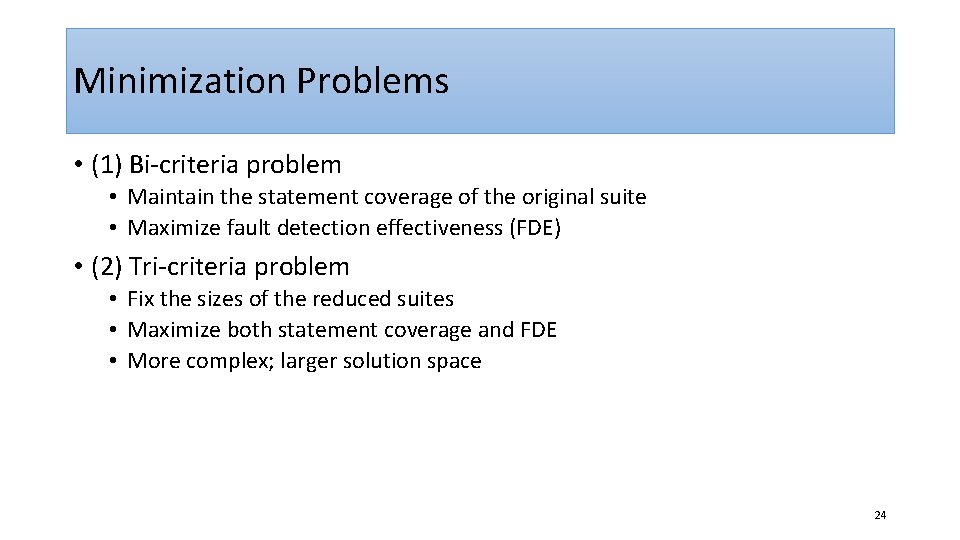
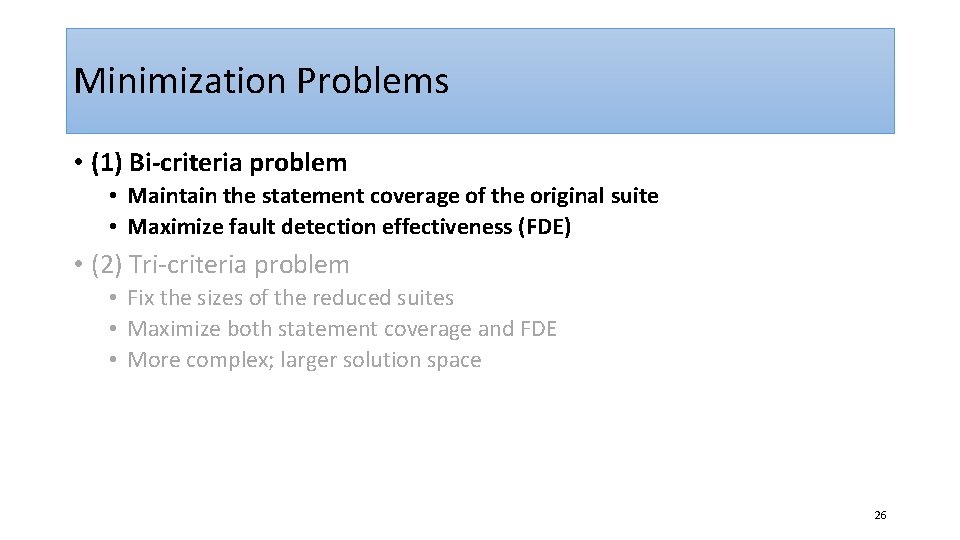
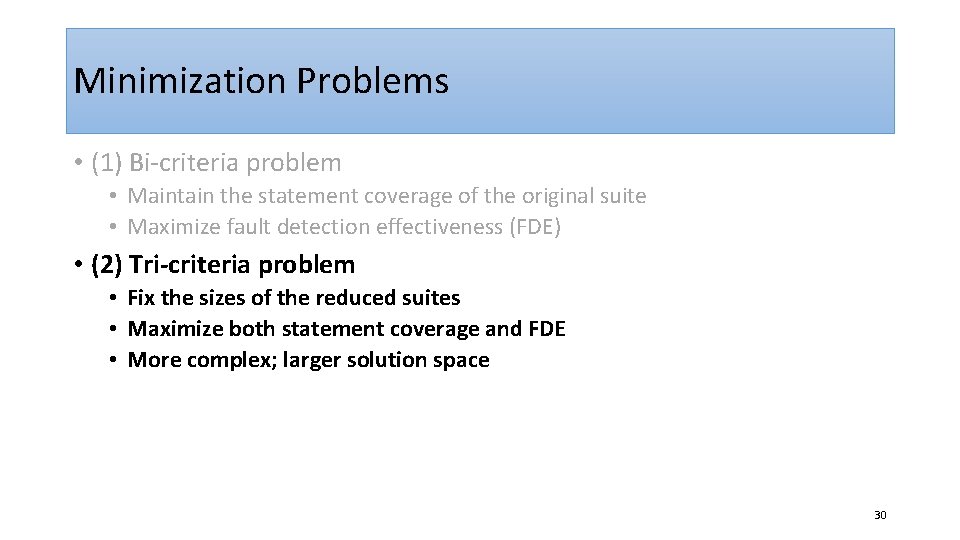
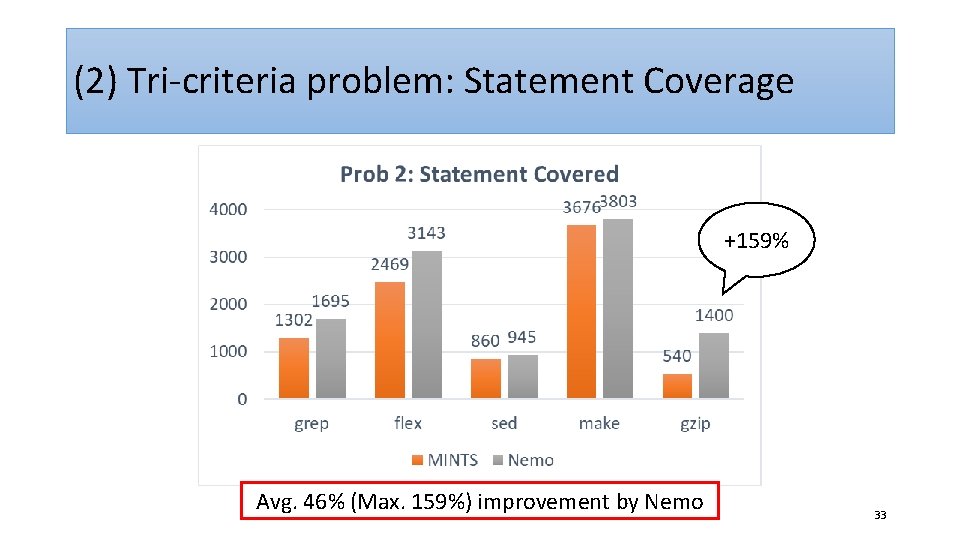
Minimization Problems • (1) Bi-criteria problem • Maintain the statement coverage of the original suite • Maximize fault detection effectiveness (FDE) • (2) Tri-criteria problem • Fix the sizes of the reduced suites • Maximize both statement coverage and FDE • More complex; larger solution space 24
MINTS vs. Nemo • Apply MINTS and Nemo to the minimization problems • Evaluate them on: • Suite size reduction • Effectiveness • Fault detection effectiveness (FDE) on both known and new faults • Statement coverage (for problem 2) 25
Minimization Problems • (1) Bi-criteria problem • Maintain the statement coverage of the original suite • Maximize fault detection effectiveness (FDE) • (2) Tri-criteria problem • Fix the sizes of the reduced suites • Maximize both statement coverage and FDE • More complex; larger solution space 26
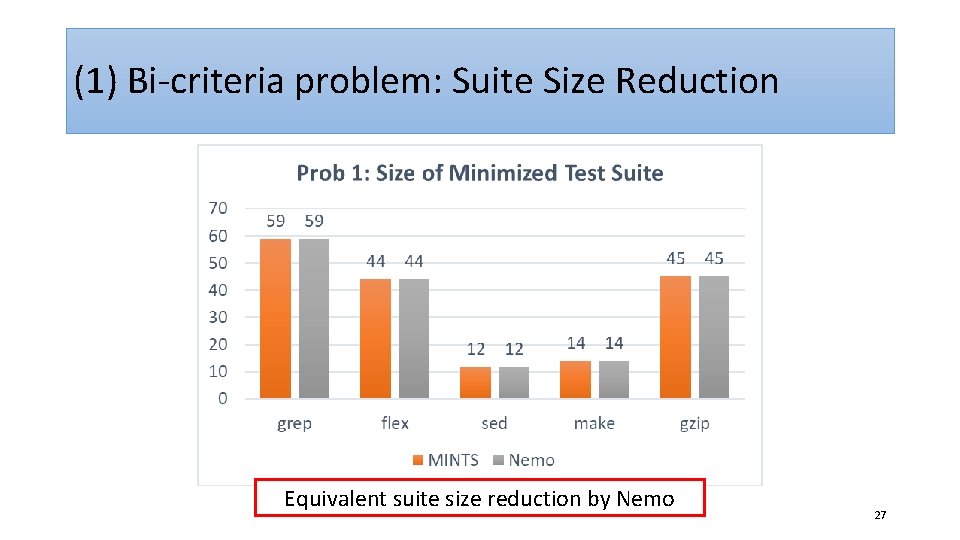
(1) Bi-criteria problem: Suite Size Reduction Equivalent suite size reduction by Nemo 27
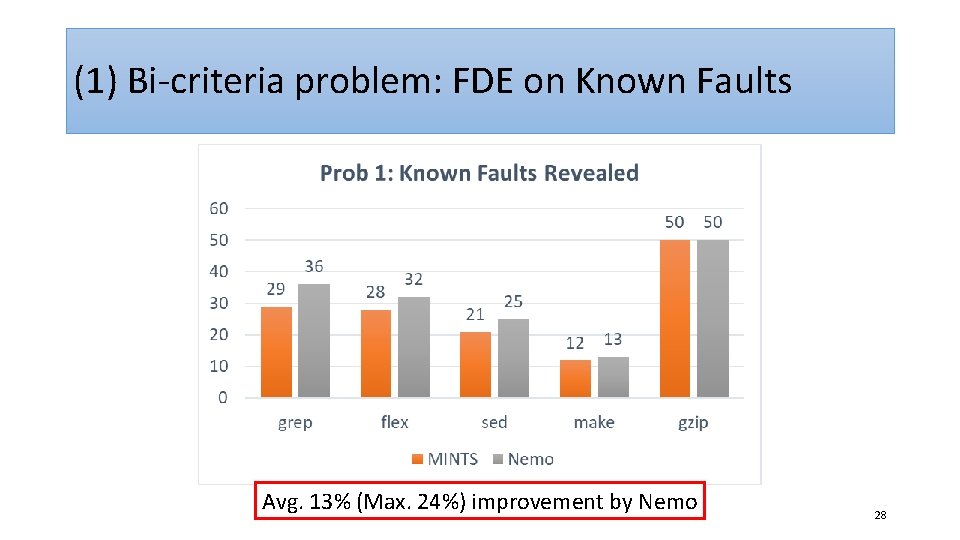
(1) Bi-criteria problem: FDE on Known Faults Avg. 13% (Max. 24%) improvement by Nemo 28
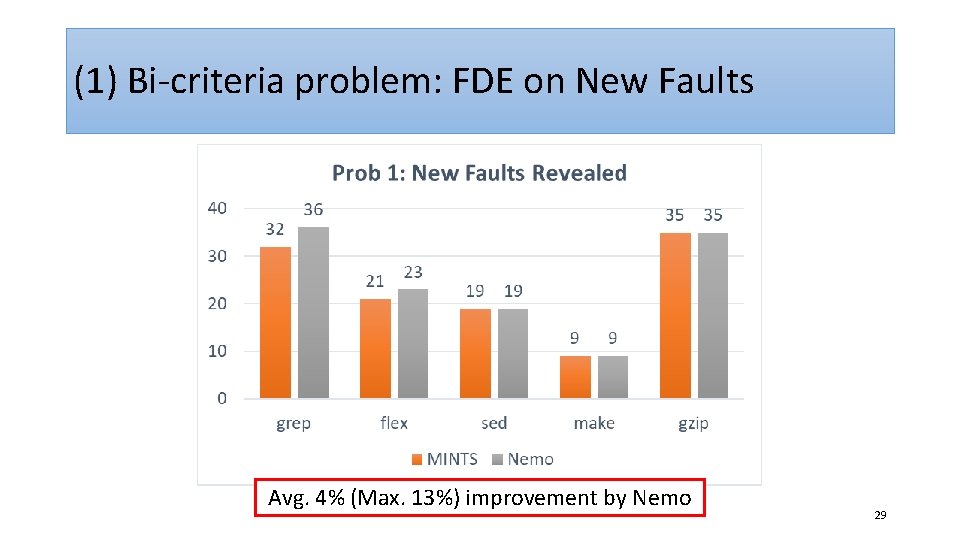
(1) Bi-criteria problem: FDE on New Faults Avg. 4% (Max. 13%) improvement by Nemo 29
Minimization Problems • (1) Bi-criteria problem • Maintain the statement coverage of the original suite • Maximize fault detection effectiveness (FDE) • (2) Tri-criteria problem • Fix the sizes of the reduced suites • Maximize both statement coverage and FDE • More complex; larger solution space 30
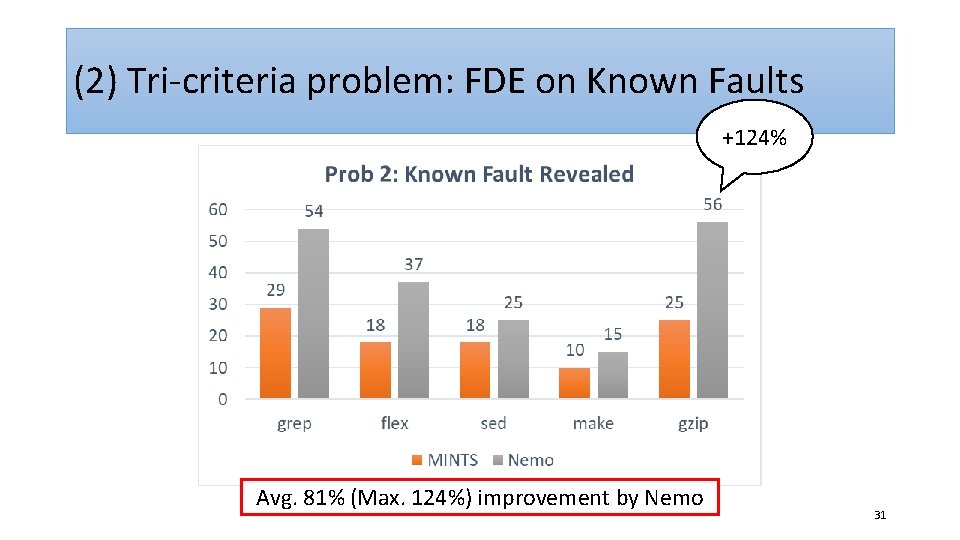
(2) Tri-criteria problem: FDE on Known Faults +124% Avg. 81% (Max. 124%) improvement by Nemo 31
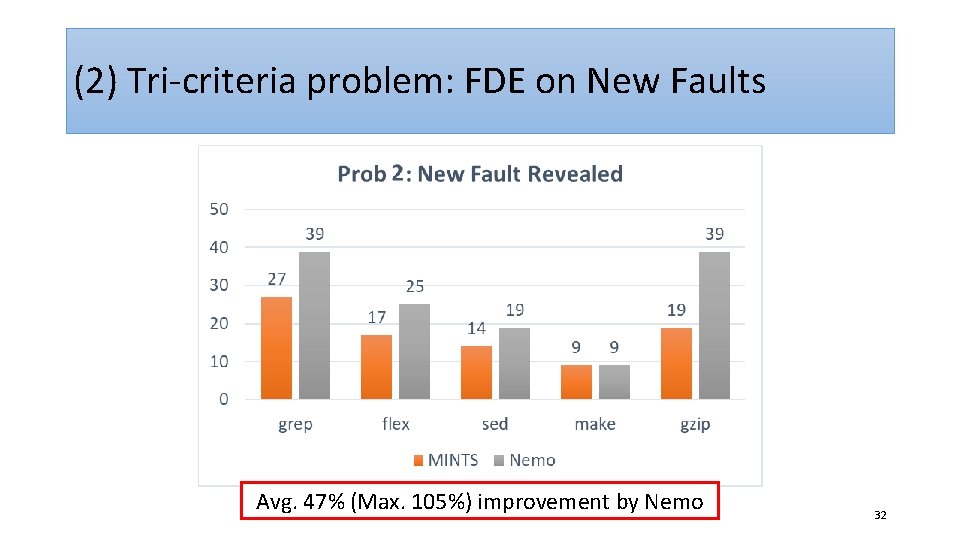
(2) Tri-criteria problem: FDE on New Faults Avg. 47% (Max. 105%) improvement by Nemo 32
(2) Tri-criteria problem: Statement Coverage +159% Avg. 46% (Max. 159%) improvement by Nemo 33
Conclusion • MCTSM problem is inherently nonlinear • Programmatically transform the nonlinear formulation to a linear form • Use modern ILP solvers to find optimal solutions • Evaluation on minimization problems • Executed up to 159% more statements and detected 124% more faults than prior work • Apply to other test case management problems (e. g. , selection, prioritization) Thank You! 34