
Nematodes Were Everywhere Objectives o o o Describe
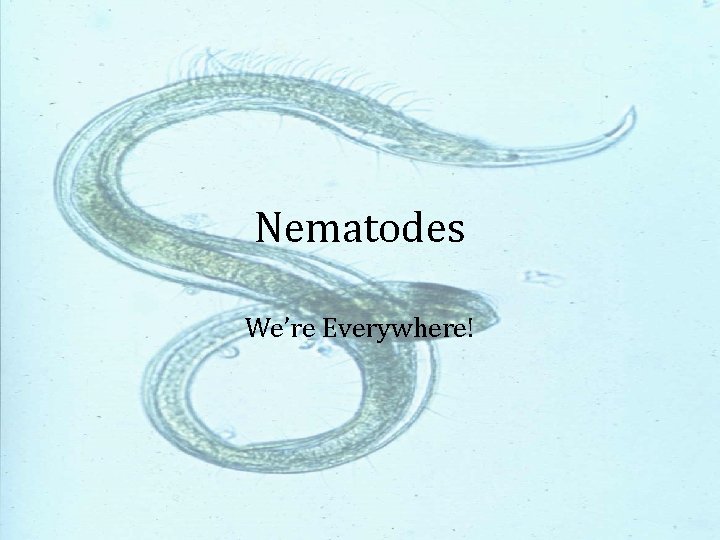
Nematodes We’re Everywhere!
Objectives o o o Describe body form and support systems. Explain reproduction methods. Describe internal structures. Identify defense mechanisms. Differentiate between functional types.
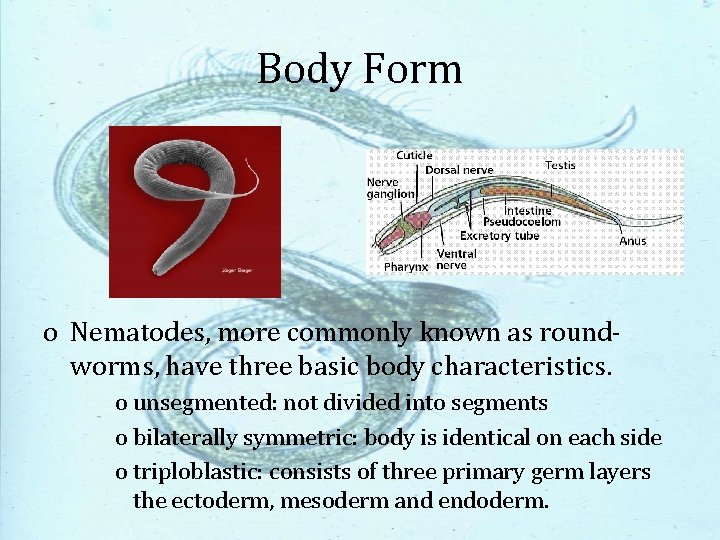
Body Form o Nematodes, more commonly known as roundworms, have three basic body characteristics. o unsegmented: not divided into segments o bilaterally symmetric: body is identical on each side o triploblastic: consists of three primary germ layers the ectoderm, mesoderm and endoderm.
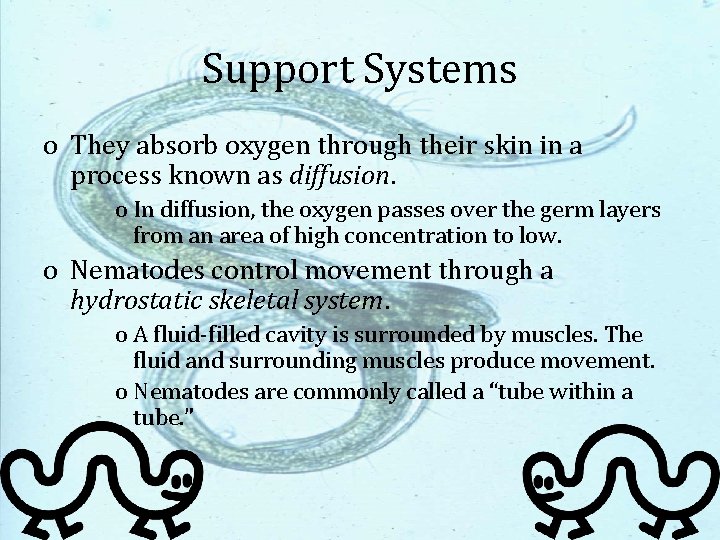
Support Systems o They absorb oxygen through their skin in a process known as diffusion. o In diffusion, the oxygen passes over the germ layers from an area of high concentration to low. o Nematodes control movement through a hydrostatic skeletal system. o A fluid-filled cavity is surrounded by muscles. The fluid and surrounding muscles produce movement. o Nematodes are commonly called a “tube within a tube. ”
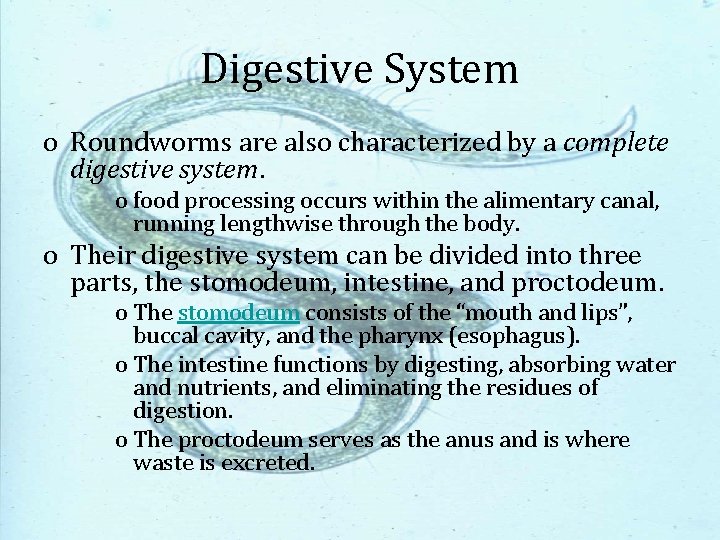
Digestive System o Roundworms are also characterized by a complete digestive system. o food processing occurs within the alimentary canal, running lengthwise through the body. o Their digestive system can be divided into three parts, the stomodeum, intestine, and proctodeum. o The stomodeum consists of the “mouth and lips”, buccal cavity, and the pharynx (esophagus). o The intestine functions by digesting, absorbing water and nutrients, and eliminating the residues of digestion. o The proctodeum serves as the anus and is where waste is excreted.
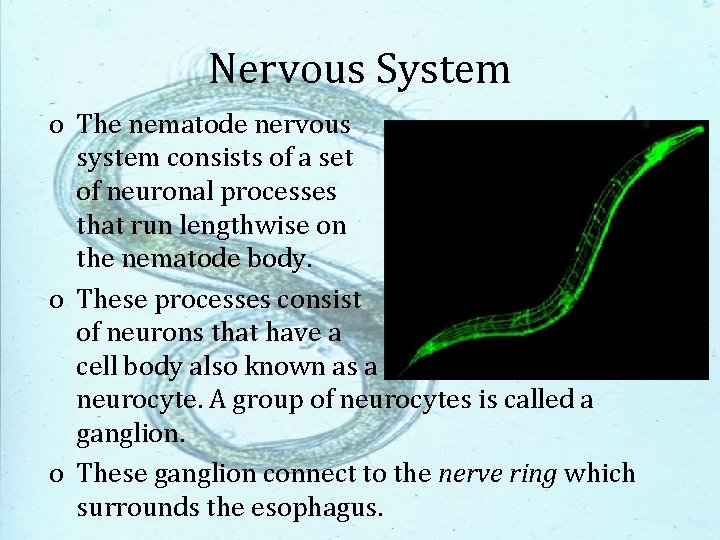
Nervous System o The nematode nervous system consists of a set of neuronal processes that run lengthwise on the nematode body. o These processes consist of neurons that have a cell body also known as a neurocyte. A group of neurocytes is called a ganglion. o These ganglion connect to the nerve ring which surrounds the esophagus.
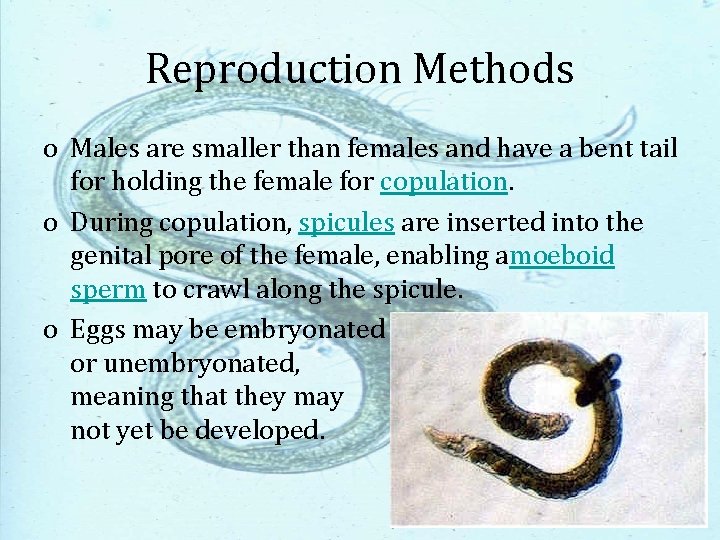
Reproduction Methods o Males are smaller than females and have a bent tail for holding the female for copulation. o During copulation, spicules are inserted into the genital pore of the female, enabling amoeboid sperm to crawl along the spicule. o Eggs may be embryonated or unembryonated, meaning that they may not yet be developed.
Defense Mechanisms o The cuticle is the flexible outer covering which acts as an exoskeleton, allowing the nematode to maintain internal stability. o It is formed by secretion of the hypodermis. o The hypodermis is a thin cellular layer underlying the cuticle. o The cuticle functions as a barrier, a sensory array, and as a hydrostatic skeleton. o As a barrier it provides protection. o As a as sensory array it detects changes. o As a hydrostatic skeleton it acts as an antagonist to longitudinal muscles.

Free-Living Species o Free-living species have a wide range of food they consume, such as: o o o living tissues small animals dead organisms fungi algae fecal matter
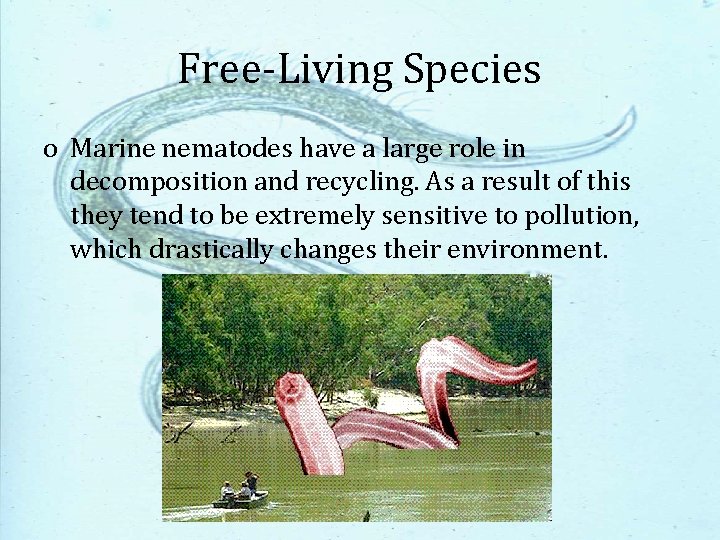
Free-Living Species o Marine nematodes have a large role in decomposition and recycling. As a result of this they tend to be extremely sensitive to pollution, which drastically changes their environment.
Parasitic Species o Parasitic nematodes can live off a wide variety of living organisms from plants to insects to humans. o They often lead very complicated lives in which they must transfer from different host species. o An appropriate example of this complicated lifestyle resides with the fig wasps along the Panama Canal. o Nematodes lay their eggs within the figs and hatch once the female fig wasps also emerge. o The nematodes penetrate the body cavity of the female wasp and slowly consume her from the inside once outside. o When the female fig wasp lands on a newly developing fig the wasp dies and the life cycle for the nematode begins anew.
Fun Facts o Nematodes are the most abundant multicellular organism. o Some Nematodes can undergo cryptobiosis. o In cryptobiosis the nematodes alter their metabolism in response to a drastic environmental change (like freezing or extreme heat). o Essentially, the nematodes shut down their bodies and “wake up” when conditions are habitable again. o Would you like to take a guess at how large the biggest nematode ever recorded was? o Placentonema gigantissima, was a little over 27 feet long! o It was discovered inside the placenta of a sperm whale. o Nematodes can be as small as 0. 01 inches. o They can be found in places like Antarctica and oceanic trenches. o One handful of soil contains thousands of roundworms
Works Cited o o o web. pml. ac. uk http: //en. wikipedia. org/wiki/Roundworms www. eb. tuebingen. mpg. de www. emc. maricopa. edu www. dictionary. com www. oardc. ohio-state. edu ucdnema. ucdavis. edu/imagemap/nemmap/Ent 156 html/intro/ner vous-system ucdnema. ucdavis. edu/imagemap/nemmap/ent 156 html/intro/cuti cle www. biani. unige. ch http: //books. google. com/books? id=Jekumao. JYV 8 C&pg=RA 1 PA 501&lpg=RA 1 PA 501&dq=nematode+dependent+wasps&source=web&ots=Tskos k. B 10 M&sig=3 Isrz. P 67 r. CRu 2 QZFW 7029 MLogeg http: //www. quizmoz. com/quizzes/Animal-Quizzes/n/Nematode. Quiz. asp
- Slides: 13