
Nematodes The Roundworms Characteristics Round cross section First
- Slides: 9
Nematodes The Roundworms
Characteristics • Round cross section • First group of organisms to have 2 openings to digestive tract • Unsegmented, smooth outer covering (cuticle) that needs to be molted • Wiggle from side to side (since they have only longitudinal muscles) • Tapered at both ends of organisms
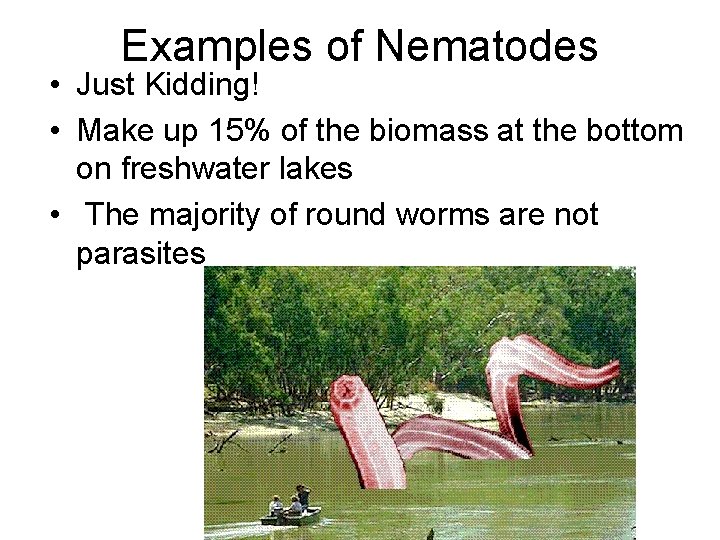
Examples of Nematodes • Just Kidding! • Make up 15% of the biomass at the bottom on freshwater lakes • The majority of round worms are not parasites
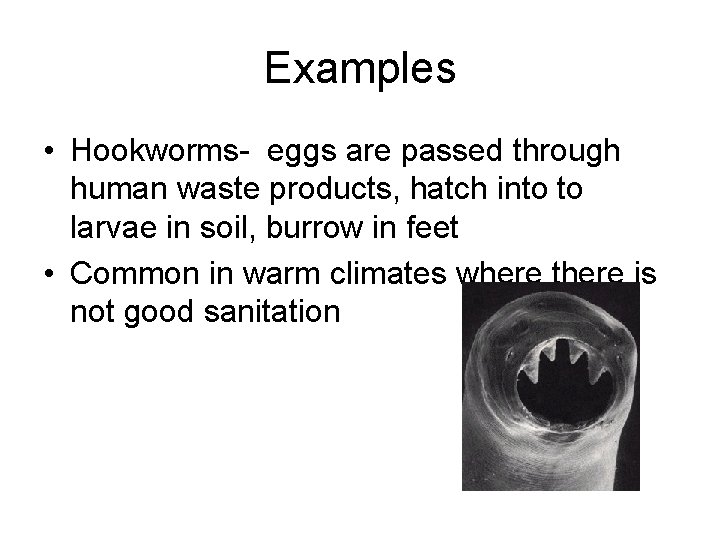
Examples • Hookworms- eggs are passed through human waste products, hatch into to larvae in soil, burrow in feet • Common in warm climates where there is not good sanitation
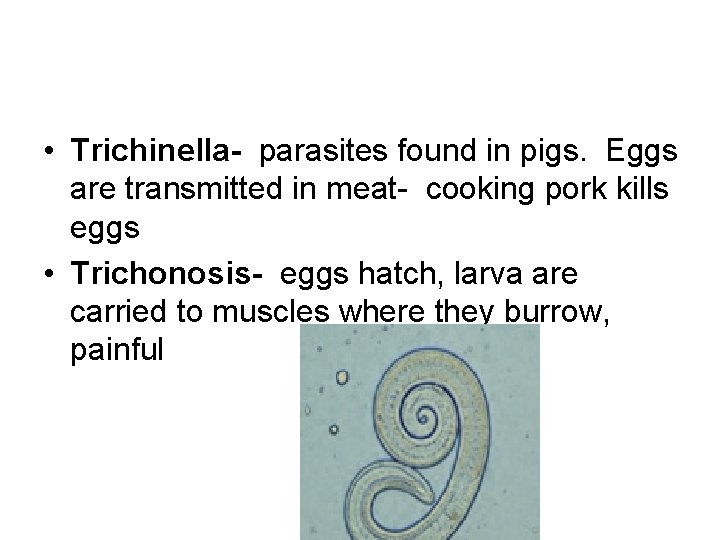
• Trichinella- parasites found in pigs. Eggs are transmitted in meat- cooking pork kills eggs • Trichonosis- eggs hatch, larva are carried to muscles where they burrow, painful
Digestive System • Most nematodes are free living and have a digestive track. Some are parasitic and absorb food from their host. • Mouth • Pharynx- Muscular tube that acts as a pump to bring food from the mouth • Intestine – A long tube in which food is both digested and absorbed. • Anus- Place where undigested food leaves
Respiratory and Circulatory system • Nematodes rely on diffusion to obtain oxygen from their environment and to have materials travel through their body. • Nematodes must have a wet film on their body in order to have diffusion in/out of body.
Reproduction • Most species have both male and female organisms. • Fertilization is internal and fertilized eggs are then released from the female. • The eggs hatch into larva with will eventually develop into a worm. • A few species can reproduce asexually by parthenogenesis – Embryos form from cells in the adult
Nematode Facts • A handful of soil will contain 1000’s of microscopic, free living nematodes. • Nematodes help enrich soil • Nematodes can stop all their life activities and go to sleep when conditions are unfavourable. • One species of Nematode is a parasite of the Sperm Whale and grows up to 13 meters long.