
NEMATODE ECOLOGY AND SOIL HEALTH Howard Ferris Department
- Slides: 23
NEMATODE ECOLOGY AND SOIL HEALTH Howard Ferris Department of Entomology & Nematology University of California, Davis, USA 6 th International Congress of Nematology, 2014
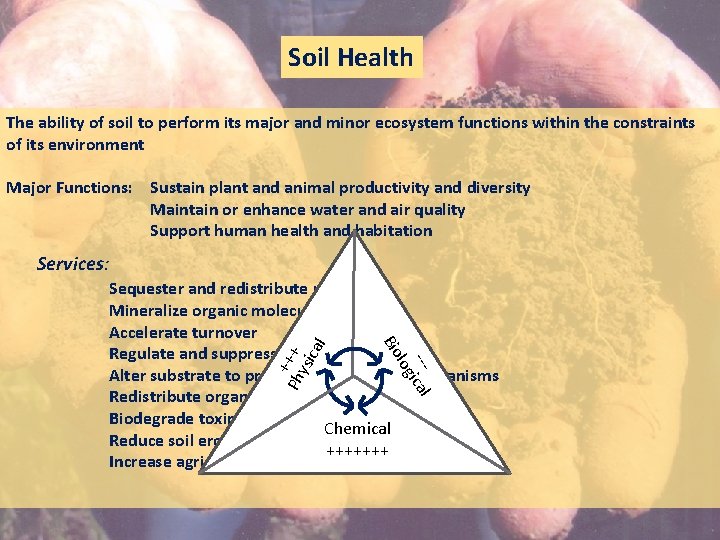
Soil Health The ability of soil to perform its major and minor ecosystem functions within the constraints of its environment Major Functions: Sustain plant and animal productivity and diversity Maintain or enhance water and air quality Support human health and habitation Services: + Ph ++ ysi cal --- ical log Bio Sequester and redistribute minerals Mineralize organic molecules Accelerate turnover Regulate and suppress pests Alter substrate to provide access to other organisms Redistribute organisms in space Physical Biodegrade toxins Chemical Reduce soil erosion +++++++ Increase agricultural production
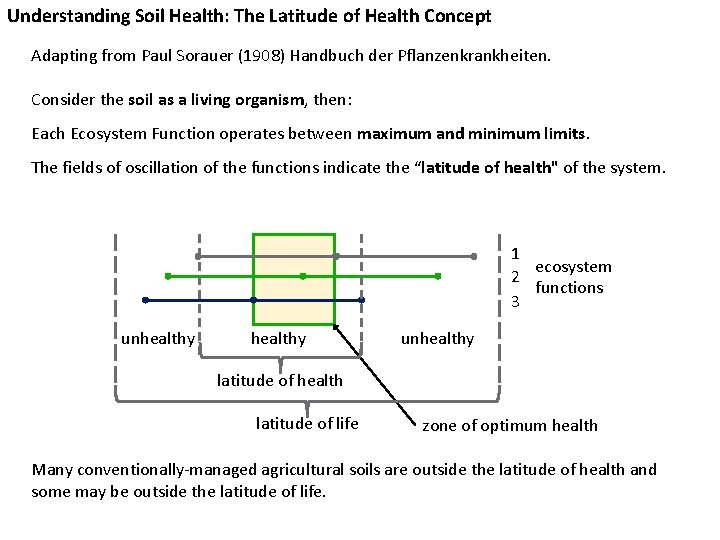
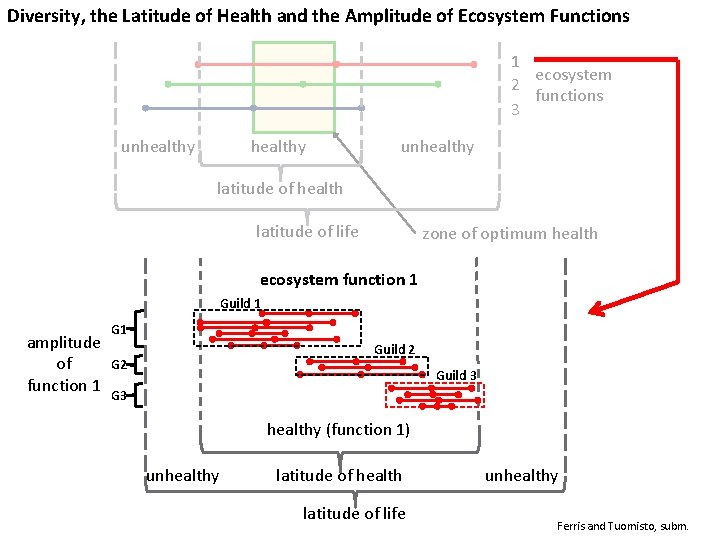
Understanding Soil Health: The Latitude of Health Concept Adapting from Paul Sorauer (1908) Handbuch der Pflanzenkrankheiten. Consider the soil as a living organism, then: Each Ecosystem Function operates between maximum and minimum limits. The fields of oscillation of the functions indicate the “latitude of health" of the system. 1 ecosystem 2 functions 3 unhealthy latitude of health latitude of life zone of optimum health Many conventionally-managed agricultural soils are outside the latitude of health and some may be outside the latitude of life.
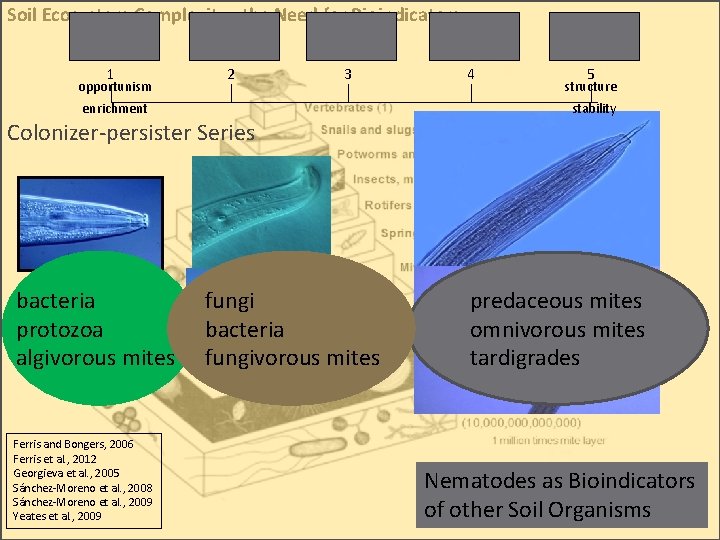
Soil Ecosystem Complexity: the Need for Bioindicators 1 opportunism 2 3 enrichment 4 5 structure stability Colonizer-persister Series bacteria protozoa algivorous mites Ferris and Bongers, 2006 Ferris et al. , 2012 Georgieva et al. , 2005 Sánchez-Moreno et al. , 2008 Sánchez-Moreno et al. , 2009 Yeates et al. , 2009 fungi bacteria fungivorous mites predaceous mites omnivorous mites tardigrades Nematodes as Bioindicators of other Soil Organisms
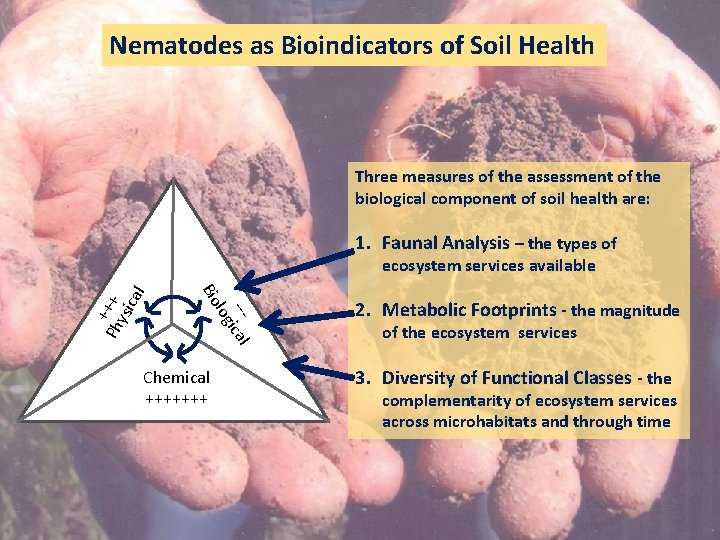
Nematodes as Bioindicators of Soil Health Three measures of the assessment of the biological component of soil health are: 1. Faunal Analysis – the types of Physical Chemical +++++++ --- ical log Bio + Ph ++ ysi cal ecosystem services available 2. Metabolic Footprints - the magnitude of the ecosystem services 3. Diversity of Functional Classes - the complementarity of ecosystem services across microhabitats and through time
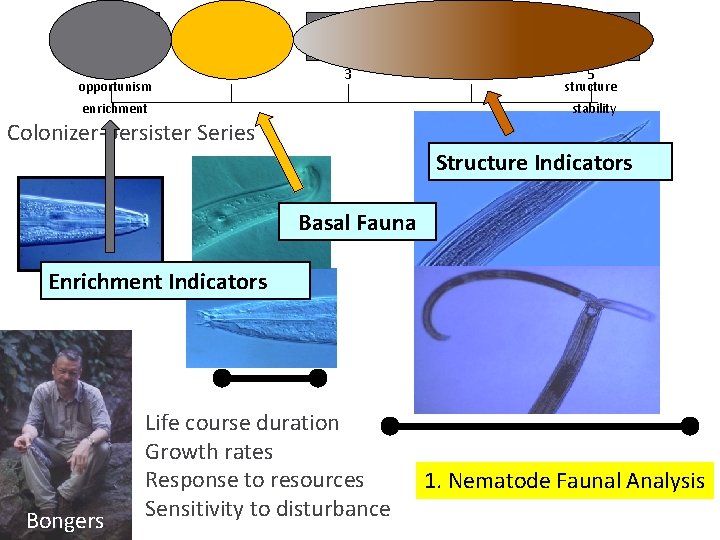
1 opportunism 2 3 enrichment 4 5 structure stability Colonizer-persister Series Structure Indicators Basal Fauna Enrichment Indicators Bongers Life course duration Growth rates Response to resources Sensitivity to disturbance 1. Nematode Faunal Analysis
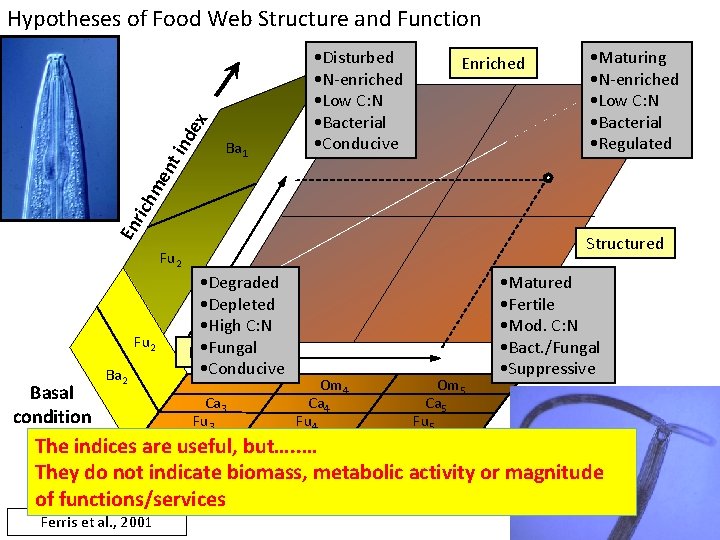
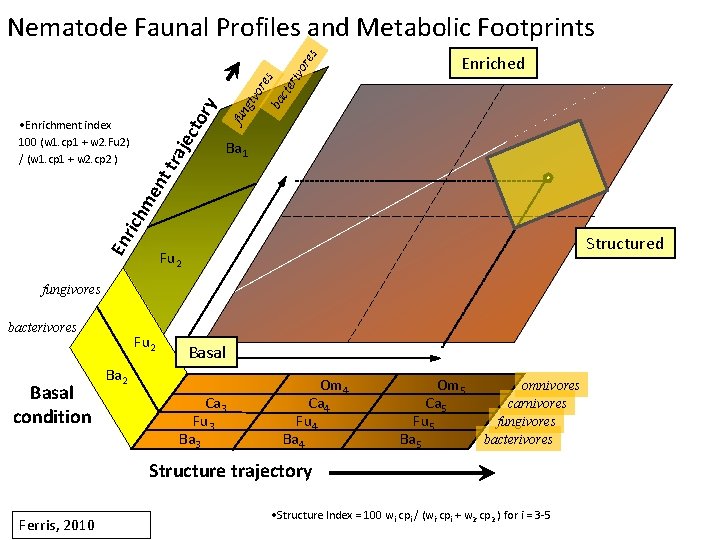
Hypotheses of Food Web Structure and Function Ba 1 Enriched • Maturing • N-enriched • Low C: N • Bacterial • Regulated En ric hm en t in de x • Disturbed • N-enriched • Low C: N • Bacterial • Conducive Structured Fu 2 Basal condition Ba 2 • Degraded • Depleted • High C: N • Fungal Basal • Conducive Ca 3 Fu 3 Ba 3 Om 4 Ca 4 Fu 4 Ba 4 Om 5 Ca 5 Fu 5 Ba 5 • Matured • Fertile • Mod. C: N • Bact. /Fungal • Suppressive The indices are useful, but…. . … Structure index metabolic activity or magnitude They do not indicate biomass, of functions/services Ferris et al. , 2001
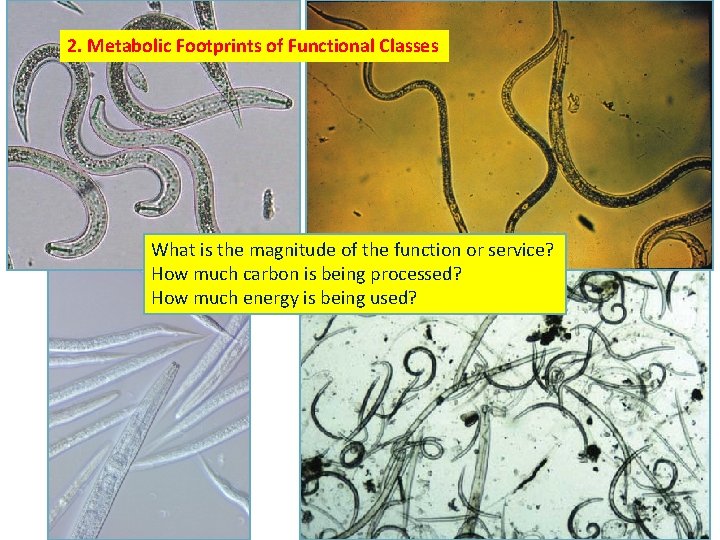
2. Metabolic Footprints of Functional Classes What is the magnitude of the function or service? How much carbon is being processed? How much energy is being used?
Enriched giv Ba 1 En ri ch me nt tra • Enrichment index 100 (w 1. cp 1 + w 2. Fu 2) / (w 1. cp 1 + w 2. cp 2 ) fun jec tor y or es ba cte riv o res Nematode Faunal Profiles and Metabolic Footprints Structured Fu 2 fungivores bacterivores Basal condition Fu 2 Basal Ba 2 Ca 3 Fu 3 Ba 3 Om 4 Ca 4 Fu 4 Ba 4 Om 5 Ca 5 Fu 5 Ba 5 omnivores carnivores fungivores bacterivores Structure trajectory Ferris, 2010 • Structure Index = 100 wi. cpi / (wi. cpi + w 2. cp 2 ) for i = 3 -5
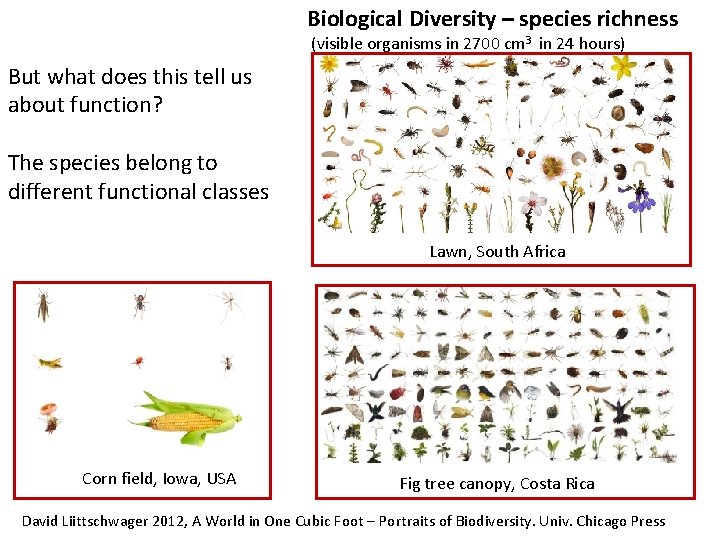
Biological Diversity – species richness (visible organisms in 2700 cm 3 in 24 hours) But what does this tell us about function? The species belong to different functional classes Lawn, South Africa Corn field, Iowa, USA Fig tree canopy, Costa Rica David Liittschwager 2012, A World in One Cubic Foot – Portraits of Biodiversity. Univ. Chicago Press
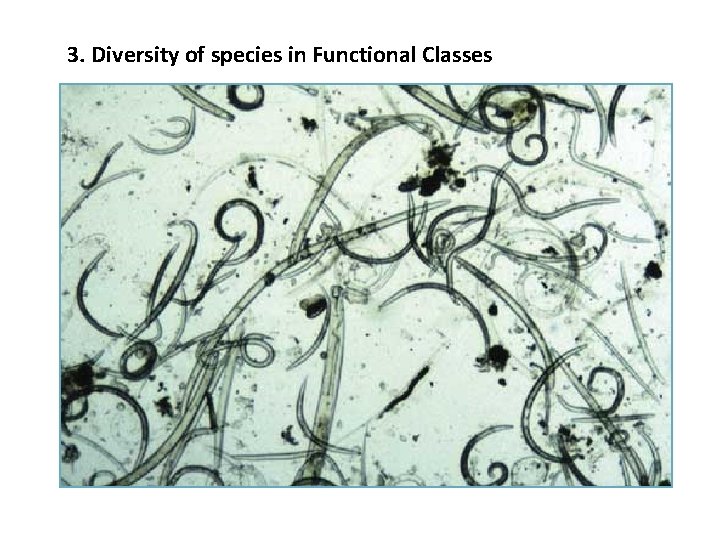
3. Diversity of species in Functional Classes
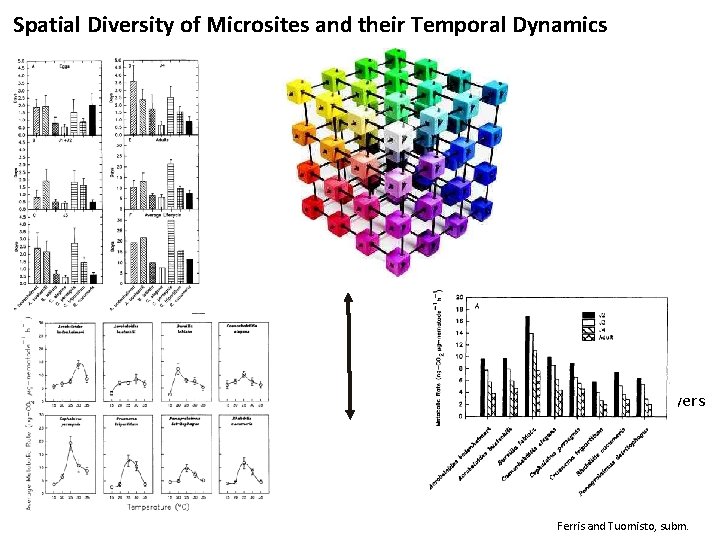
Spatial Diversity of Microsites and their Temporal Dynamics gradient drivers: temperature moisture aeration organic residues roots soil texture particle size temporal drivers: diurnal seasonal life course phenology degree-days stochastic factors: roots patch distribution patch composition weather events burrows stones restrictive layers Ferris and Tuomisto, subm.
Diversity, the Latitude of Health and the Amplitude of Ecosystem Functions 1 ecosystem 2 functions 3 unhealthy latitude of health latitude of life zone of optimum health ecosystem function 1 Guild 1 amplitude of function 1 Guild 2 Guild 3 G 3 healthy (function 1) unhealthy latitude of health latitude of life unhealthy Ferris and Tuomisto, subm.
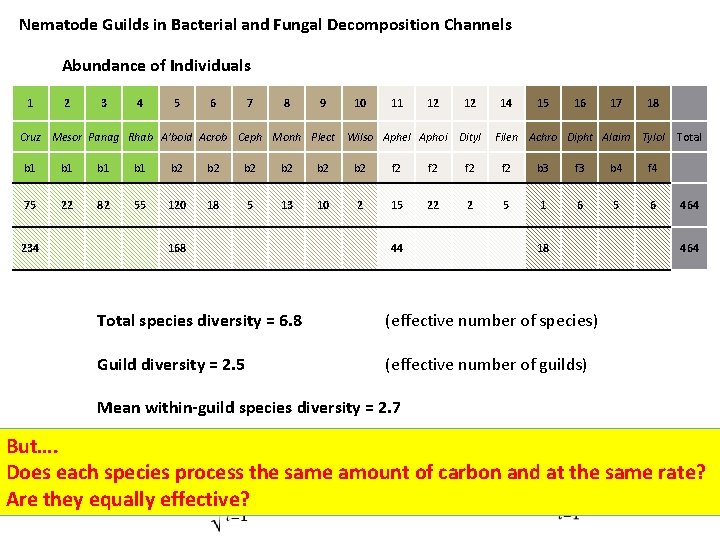
Nematode Guilds in Bacterial and Fungal Decomposition Channels Abundance of Individuals 1 2 3 4 5 6 7 8 9 10 11 12 12 Cruz Mesor Panag Rhab A’boid Acrob Ceph Monh Plect Wilso Aphel Aphoi Dityl 14 15 16 17 18 Filen Achro Dipht Alaim Tylol b 1 b 1 b 2 b 2 b 2 f 2 f 2 b 3 f 3 b 4 f 4 75 22 82 55 120 18 5 13 10 2 15 22 2 5 1 6 5 6 234 168 44 18 Total species diversity = 6. 8 (effective number of species) Guild diversity = 2. 5 (effective number of guilds) Total 464 Mean within-guild species diversity = 2. 7 But…. Does each species process the same amount of carbon and at the same rate? for q<>1 for q=1 Are they equally effective?
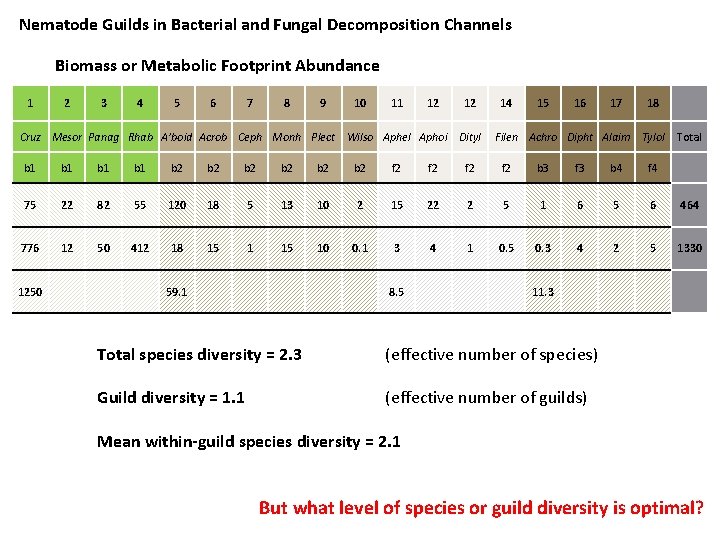
Nematode Guilds in Bacterial and Fungal Decomposition Channels Biomass or Metabolic Footprint Abundance 1 2 3 4 5 6 7 8 9 10 11 12 12 Cruz Mesor Panag Rhab A’boid Acrob Ceph Monh Plect Wilso Aphel Aphoi Dityl 14 15 16 17 18 Filen Achro Dipht Alaim Tylol Total b 1 b 1 b 2 b 2 b 2 f 2 f 2 b 3 f 3 b 4 f 4 75 22 82 55 120 18 5 13 10 2 15 22 2 5 1 6 5 6 464 776 12 50 412 18 15 10 0. 1 3 4 1 0. 5 0. 3 4 2 5 1330 1250 59. 1 8. 5 11. 3 Total species diversity = 2. 3 (effective number of species) Guild diversity = 1. 1 (effective number of guilds) Mean within-guild species diversity = 2. 1 But what level of species or guild diversity is optimal?
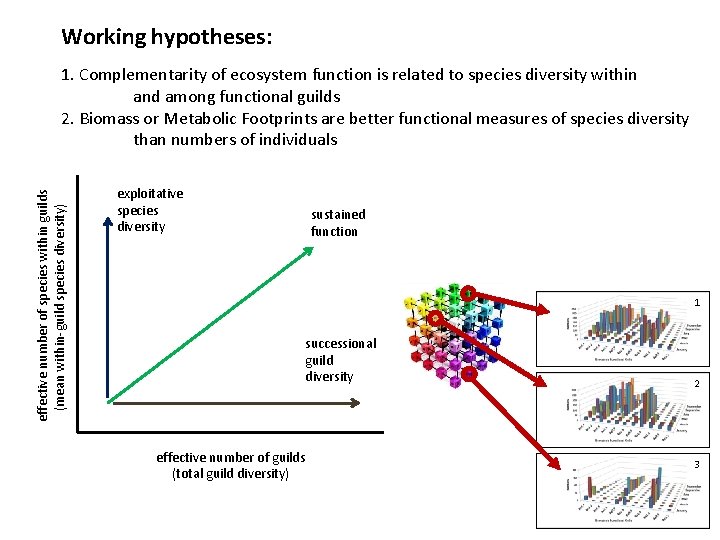
Working hypotheses: effective number of species within guilds (mean within-guild species diversity) 1. Complementarity of ecosystem function is related to species diversity within and among functional guilds 2. Biomass or Metabolic Footprints are better functional measures of species diversity than numbers of individuals exploitative species diversity sustained function 1 successional guild diversity effective number of guilds (total guild diversity) 2 3
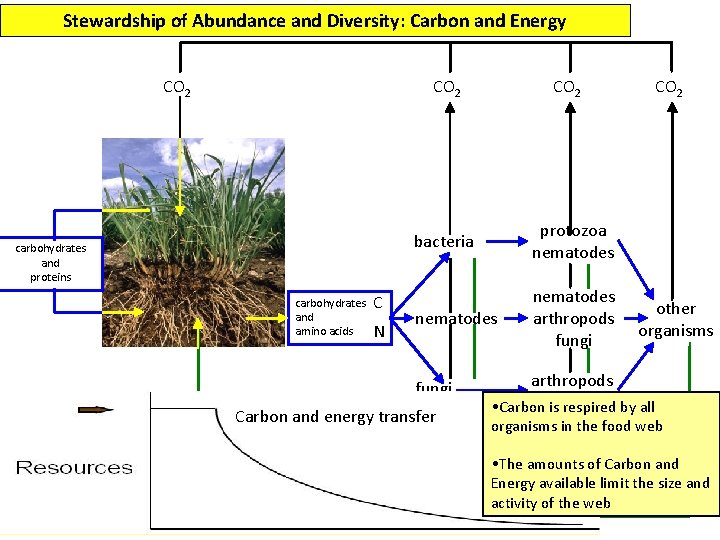
Stewardship of Abundance and Diversity: Carbon and Energy CO 2 carbohydrates and proteins carbohydrates and amino acids C N bacteria protozoa nematodes arthropods fungi NO 3 CO 2 Carbon and energy transfer CO 2 other organisms arthropods nematodes • Carbon is respired by all organisms in the food web NH 3 • The amounts of Carbon and NH 3 Energy available limit the size and activity of the web
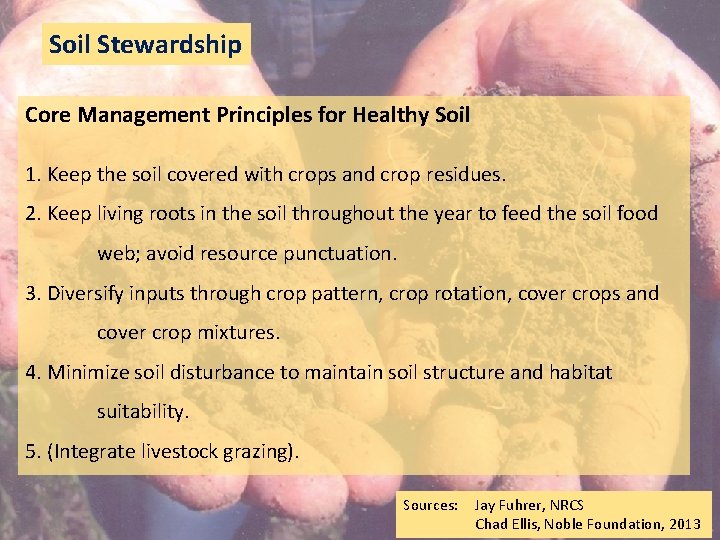
Soil Stewardship Core Management Principles for Healthy Soil 1. Keep the soil covered with crops and crop residues. 2. Keep living roots in the soil throughout the year to feed the soil food web; avoid resource punctuation. 3. Diversify inputs through crop pattern, crop rotation, cover crops and cover crop mixtures. 4. Minimize soil disturbance to maintain soil structure and habitat suitability. 5. (Integrate livestock grazing). Sources: Jay Fuhrer, NRCS Chad Ellis, Noble Foundation, 2013
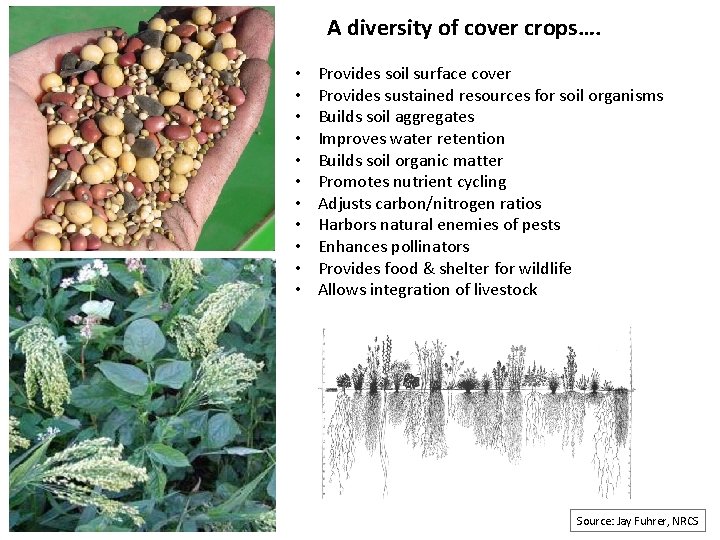
A diversity of cover crops…. • • • Provides soil surface cover Provides sustained resources for soil organisms Builds soil aggregates Improves water retention Builds soil organic matter Promotes nutrient cycling Adjusts carbon/nitrogen ratios Harbors natural enemies of pests Enhances pollinators Provides food & shelter for wildlife Allows integration of livestock Source: Jay Fuhrer, NRCS
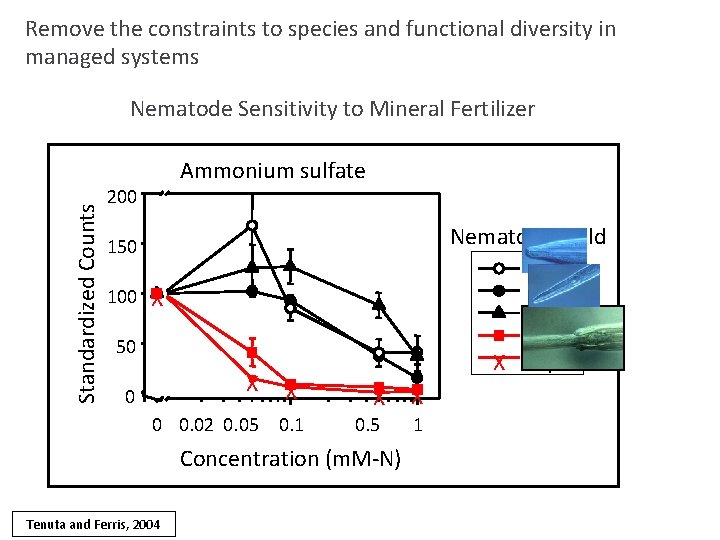
Remove the constraints to species and functional diversity in managed systems Standardized Counts Nematode Sensitivity to Mineral Fertilizer Ammonium sulfate 200 Nematode guild 150 100 c-p 1 c-p 2 c-p 3 c-p 4 X c-p 5 X 50 X 0 0 0. 02 0. 05 X 0. 1 X X 0. 5 1 Concentration (m. M-N) Tenuta and Ferris, 2004
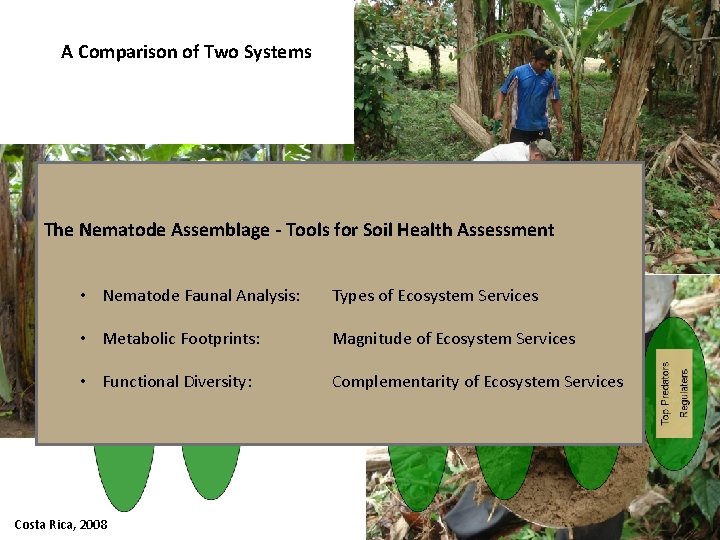
A Comparison of Two Systems The Nematode Assemblage - Tools for Soil Health Assessment • Nematode Faunal Analysis: Types of Ecosystem Services • Metabolic Footprints: Magnitude of Ecosystem Services • Functional Diversity: Complementarity of Ecosystem Services Costa Rica, 2008
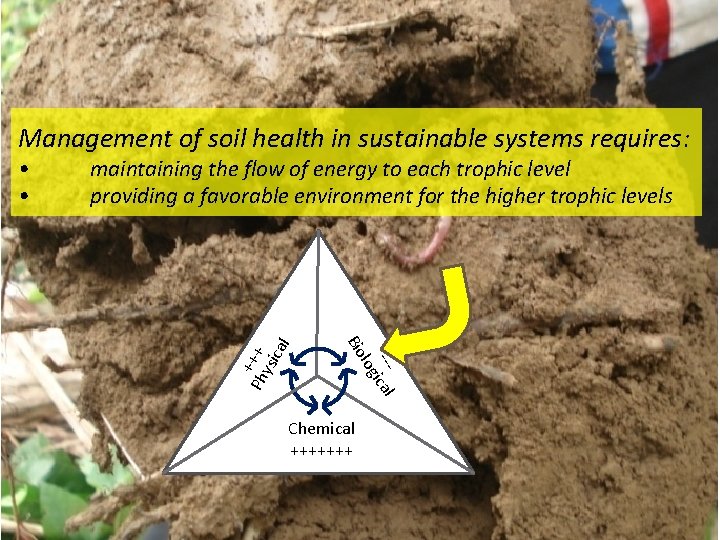
Management of soil health in sustainable systems requires: maintaining the flow of energy to each trophic level providing a favorable environment for the higher trophic levels Physical Chemical +++++++ --- ical log Bio + Ph ++ ysi cal • •
Thank you! http: //plpnemweb. ucdavis. edu/nemaplex