
NEIL POSTMAN Amusing Ourselves to Death First things




- Slides: 35
NEIL POSTMAN Amusing Ourselves to Death
First things first! My Christmas Present!
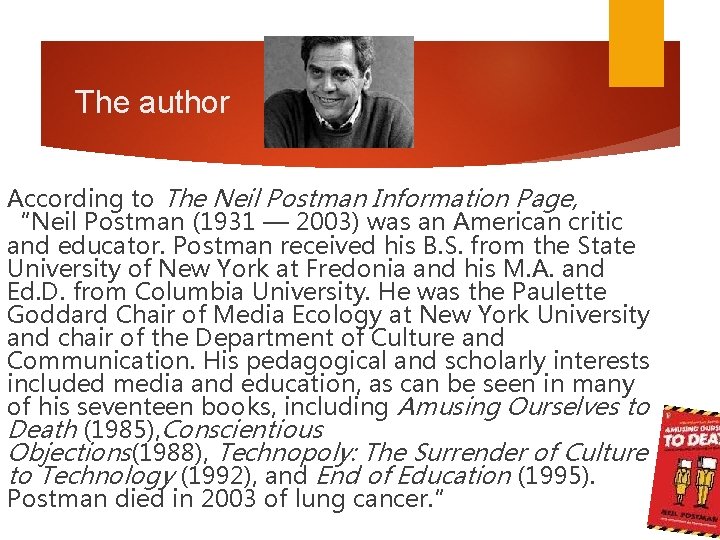
The author According to The Neil Postman Information Page, “Neil Postman (1931 — 2003) was an American critic and educator. Postman received his B. S. from the State University of New York at Fredonia and his M. A. and Ed. D. from Columbia University. He was the Paulette Goddard Chair of Media Ecology at New York University and chair of the Department of Culture and Communication. His pedagogical and scholarly interests included media and education, as can be seen in many of his seventeen books, including Amusing Ourselves to Death (1985), Conscientious Objections(1988), Technopoly: The Surrender of Culture to Technology (1992), and End of Education (1995). Postman died in 2003 of lung cancer. ”
Why Postman? Why Media Ecology? Postman is often viewed as the father of the study of pop culture or media ecology. Postman realized that mediums drive culture and pop culture reveals a lot about what a culture values and how a culture operates; therefore, a study of pop culture is a psychological, sociological, historical, economic, theological, philosophical, technological and even scientific study of culture… Postman is deemed by many critics as a master rhetorician. We want to learn from
Setting the Stage for an Argument… Look at how Postman begins his argument… During the late 1700 s, “Boston was the center of political radicalism that ignited a shot heard round the world…In the mid-nineteenth century, New York became the idea of a melting pot America—or at least a non-English one—as the wretched refuse of the world disembarked at Ellis Island …In the early twentieth century, Chicago,
Analyzing HOW Postman Set the Stage for an Argument… When studying writing of and reading of rhetoric, one must understand the art of argument and realize that it looks very different from a traditional study of literature or the devices used when writing about literature. What you have been taught perhaps: Never use first or second person in writing Always write formulaically (key hole or funnel) Always write in present tense
Structure with Argumentative Writing You may use first (I, me, my, we, our, etc) person and you may use third (one, he/she, they/their) person but STILL avoid second (you) person as it comes off as preaching, assuming, or projecting an opinion upon someone else! No more formulas—write with purpose and for that purpose and audience Write in past tense when you are writing about past events in nonfiction—which will be often Create an argumentative single-pronged claim. Frame all quotes at the inception of each new source. Cite ALL BORROWED Material.
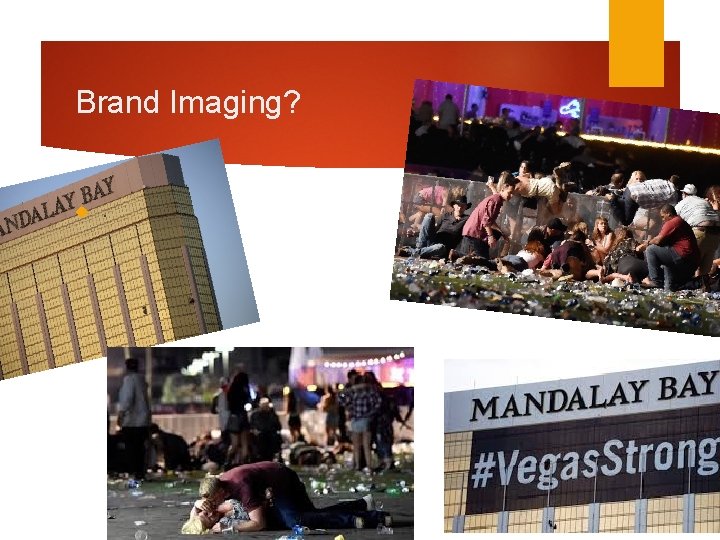
Postman’s structure and my purpose Postman uses “we” in the opening of the chapter Postman is taking us in his time machine to review America’s roots—Boston, New York, Chicago. Who were we? Who have we become…? Las Vegas… How has Las Vegas’ marketing changed since 2018?
Brand Imaging? .
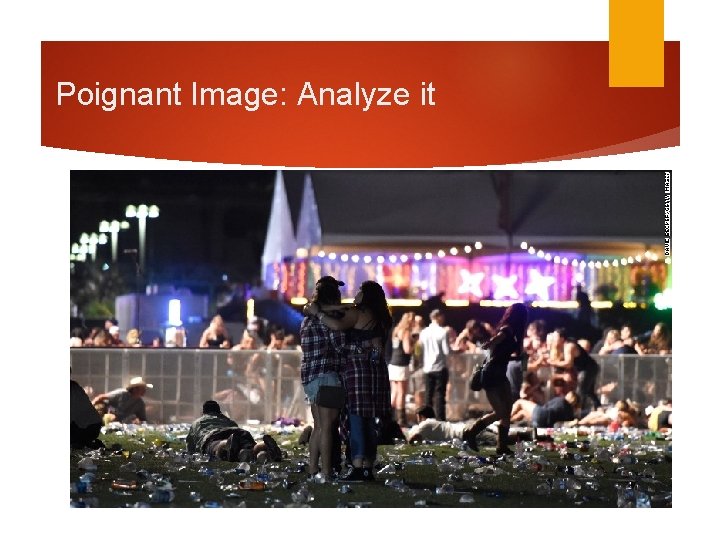
Poignant Image: Analyze it
This slogan has won more awards than any other state in $25 million campaign
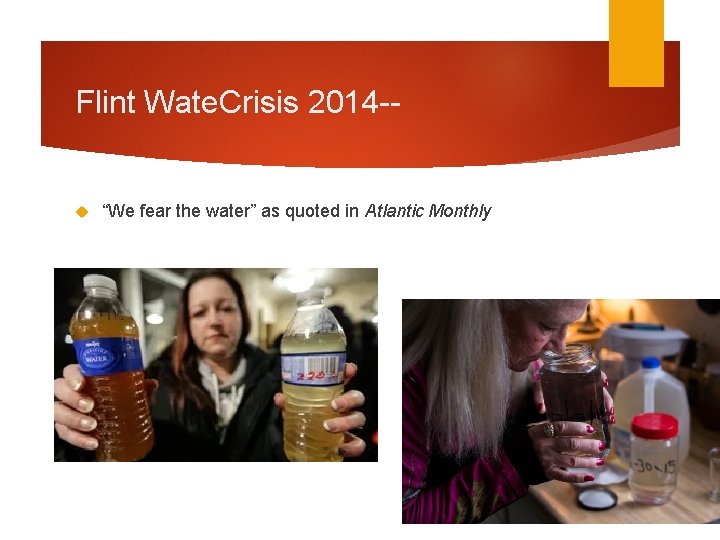
Flint Wate. Crisis 2014 -- “We fear the water” as quoted in Atlantic Monthly
Analyze What do you note about Postman’s structure, grammatically speaking? What do you notice about the way he lays down his ideas? What is the tone? How do you know?
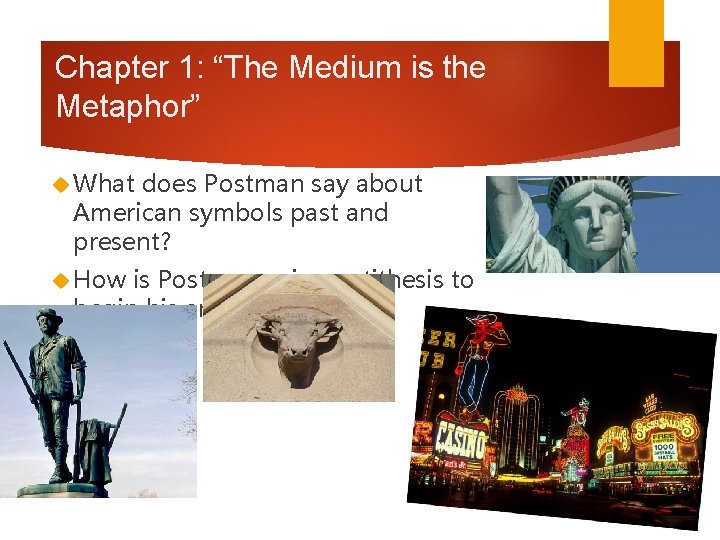
Chapter 1: “The Medium is the Metaphor” What does Postman say about American symbols past and present? How is Postman using antithesis to begin his argument?
Historically speaking… . “A desert metropolis built on gambling, vice and other forms of entertainment, in just a century of existence Las Vegas has drawn millions of visitors and trillions of dollars in wealth to southern Nevada. The city was founded by ranchers and railroad workers but quickly found that its greatest asset was not its springs but its casinos. Las Vegas’s embrace of Old West-style freedoms—gambling and prostitution—provided a perfect home for East Coast organized crime. Beginning in the 1940 s, money from drugs and racketeering built casinos and was laundered within them. Visitors came to partake in what the casinos
Anthesis: AN OPPOSITION OR CONTRAST OF IDEAS THAT IS OFTEN EXPRESSED IN BALANCED PHRASES OR CLAUSES.
Antithesis in this passage? Read pages 3 -4 and discuss where antithesis is present. Note and discuss other strategic details. Is Postman’s opening successful?
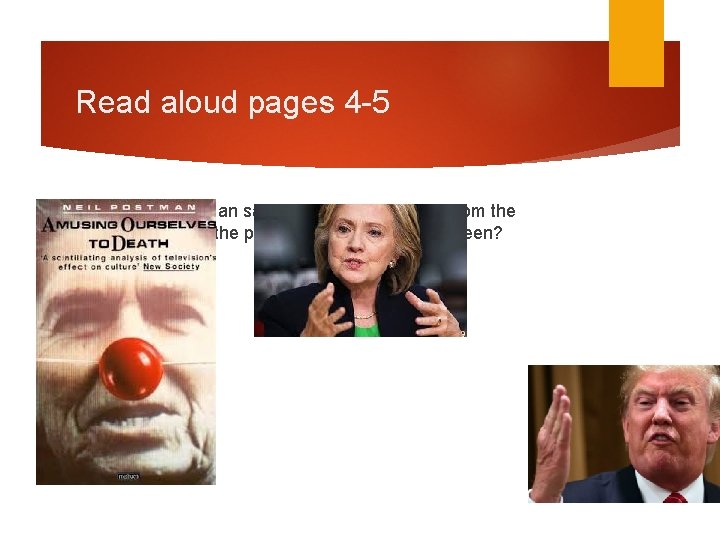
Read aloud pages 4 -5 What is Postman saying about our leaders: from the presidency to the pulpit and everyone in between?
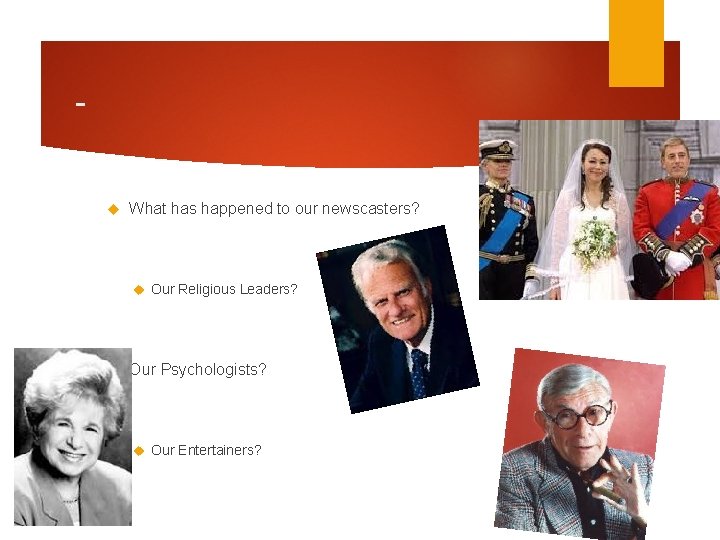
- What has happened to our newscasters? Our Religious Leaders? Our Psychologists? Our Entertainers?
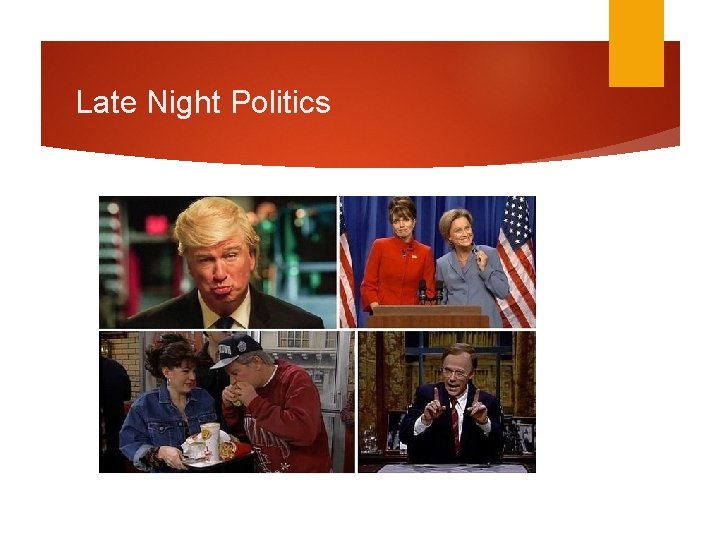
Late Night Politics
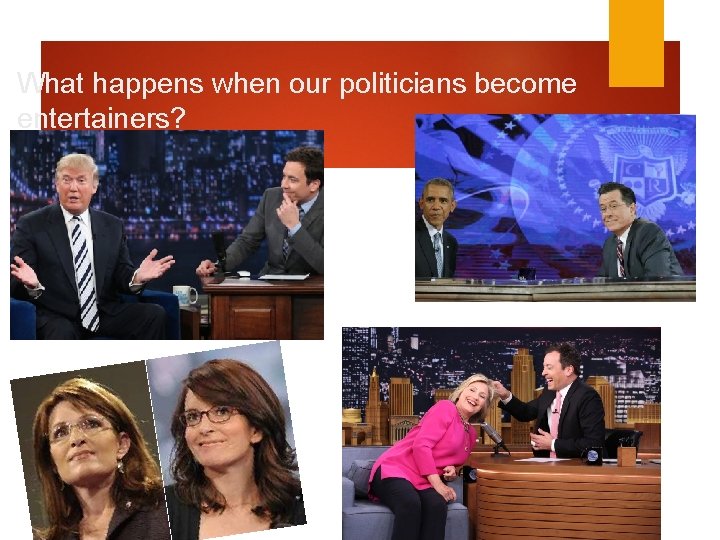
What happens when our politicians become entertainers?
So… What is Postman saying about the message? What is he saying about the modern medium? What is the problem here? How do modern mediums possibly limit communication?
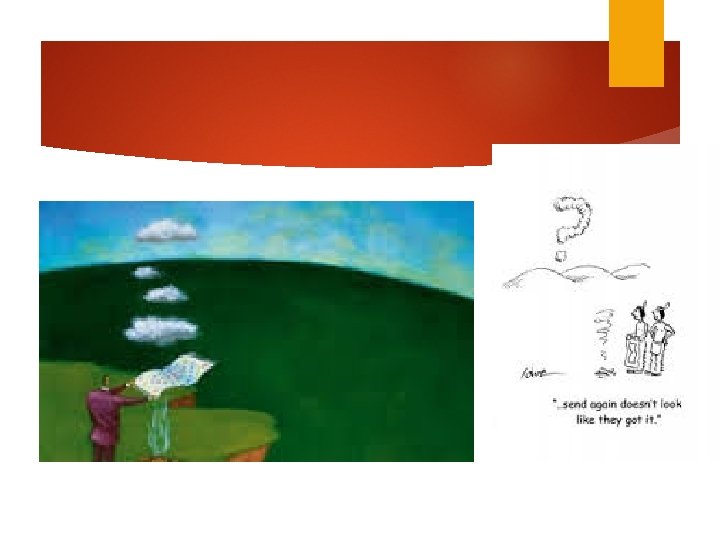
The Medium Changes the Message “To take a simple example of what it this means, consider the primitive technology of smoke signals. While I do not know exactly what content was once carried in the smoke signals of American Indians, I can safely guess that it did not include philosophical arguments. Puffs of smoke are insufficiently complex to express ideas on the nature of existence, and even if they were not, a Cherokee philosopher would run short of either wood or blankets long before he reached his second axiom. You cannot use smoke to do philosophy. Its form excludes the content” (Postman 7).
Now think about current technology… What technologies existed in 1985? https: //www. youtube. com/watch? v=vw r. U 8 s-M-gc What has happened to our “communication” in 2020? How has the “medium” changed the “message”?
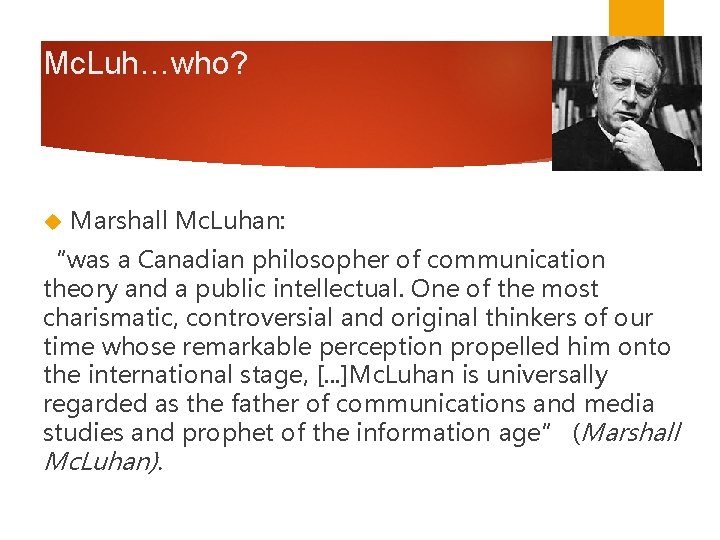
Mc. Luh…who? Marshall Mc. Luhan: “was a Canadian philosopher of communication theory and a public intellectual. One of the most charismatic, controversial and original thinkers of our time whose remarkable perception propelled him onto the international stage, [. . . ]Mc. Luhan is universally regarded as the father of communications and media studies and prophet of the information age” (Marshall Mc. Luhan).
And he coined the phrase… “The medium is the message” As the medium changes, so does the message. Examples…
The OTHER Mumford Lewis Mumford: 1895— 1990 Sociologist, philosopher of technology, American historian, literary critic. Wellknown for his study of urban planning and architecture; believed what set us apart from other animals is not our use of tools but rather our use of language; believed in earliest humans had a need/drive to communicate(“Lewis Mumford”).
Time Going back the 14 th Century, Mumford claimed that “the clock made us into time-keepers, and then time-savers, and now time servers. In the process, we have learned irreverence toward the sun and the seasons, for in a world made up of seconds and minutes, the authority of nature is superseded. And thus, though few would have imagined the connection, the inexorable ticking of the clock may have had more to do
supremacy than all the treatises produced by the philosophers of the Enlightenment; that is to say, the clock introduced a new form of conversation between man and God, in which God appears to have been the loser. Perhaps Moses should have included another Commandment: Thou shalt not make mechanical representations of time” (qtd. in Postman 11 -12). Discuss…tick tock.
Finally, the argument Look at pages 13— 15. What is it that Postman says he is going to prove to us? What does the last paragraph of the chapter mean?
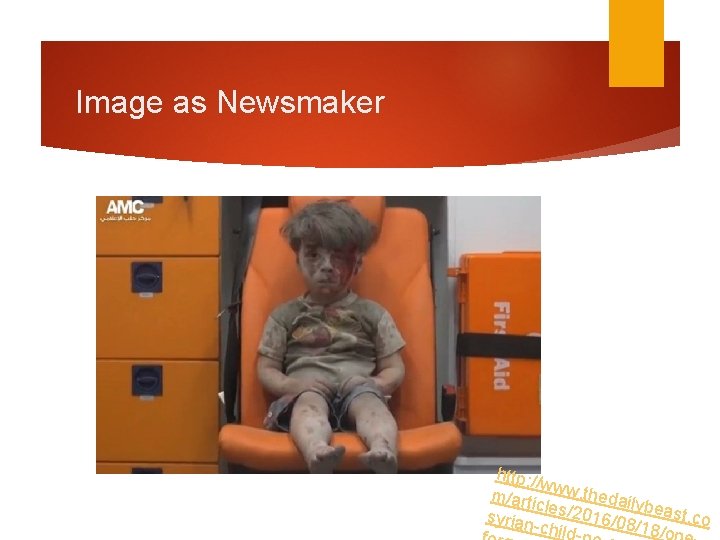
Image as Newsmaker http: // w m/arti ww. thedail yb cl syrian es/2016/08 east. co -child /18/o
Sound bites and Photos Now, find an image that you feel “told” the story”, “polarized” the story, “glamorized” the story, or “BECAME” the story? Is this dangerous? If so, why? If not, why?