
Neil F Comins William J Kaufmann III Discovering

- Slides: 74
Neil F. Comins • William J. Kaufmann III Discovering the Universe Ninth Edition CHAPTER 7 The Other Terrestrial Planets
WHAT DO YOU THINK? 1. 2. 3. 4. 5. 6. Which terrestrial planet—Mercury, Venus, Earth, or Mars—has the coolest surface temperature? Which planet is most similar in size to Earth? Which terrestrial planet—Mercury, Venus, Earth, or Mars—has the hottest surface temperature? What is the composition of the clouds that surround Venus? Does Mars have liquid water on its surface today? Did it have liquid surface water in the past? Is life known to exist on Mars today?
In this chapter you will discover… l l l Mercury, a Sun-scorched planet with dormant volcanoes, a heavily cratered surface, and a substantial iron core Venus, perpetually shrouded in thick, poisonous clouds and mostly covered by gently rolling hills Mars, a red, dusty planet that once had running water on its surface and may still have liquid water underground
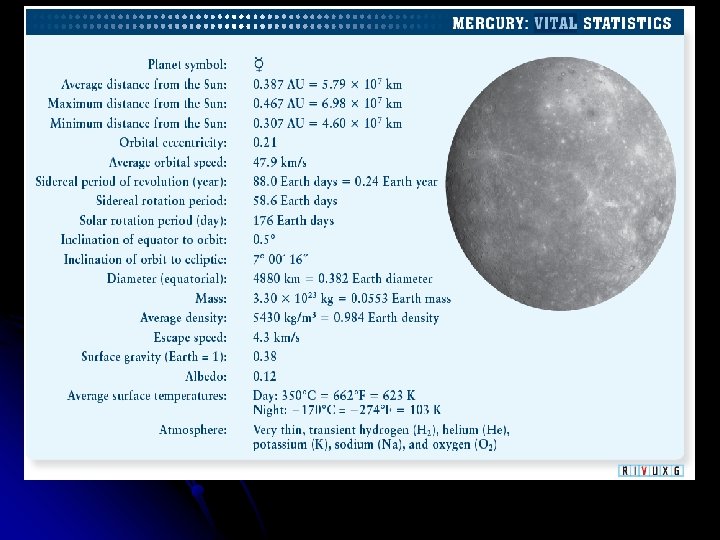
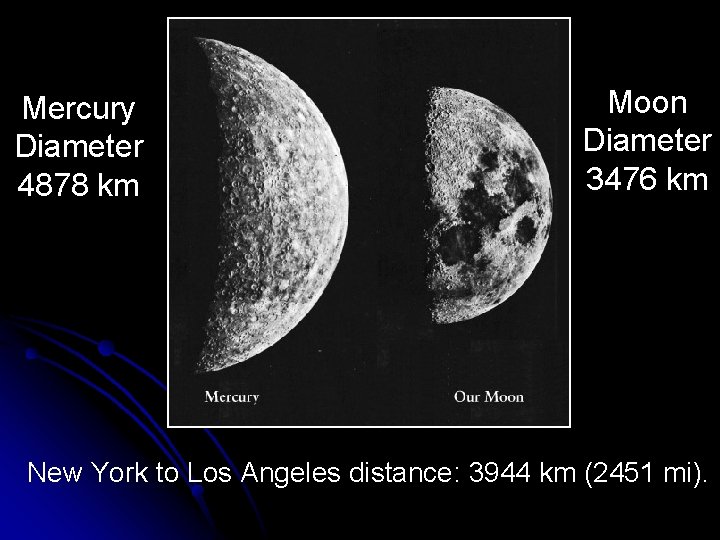
Mercury Diameter 4878 km Moon Diameter 3476 km New York to Los Angeles distance: 3944 km (2451 mi).
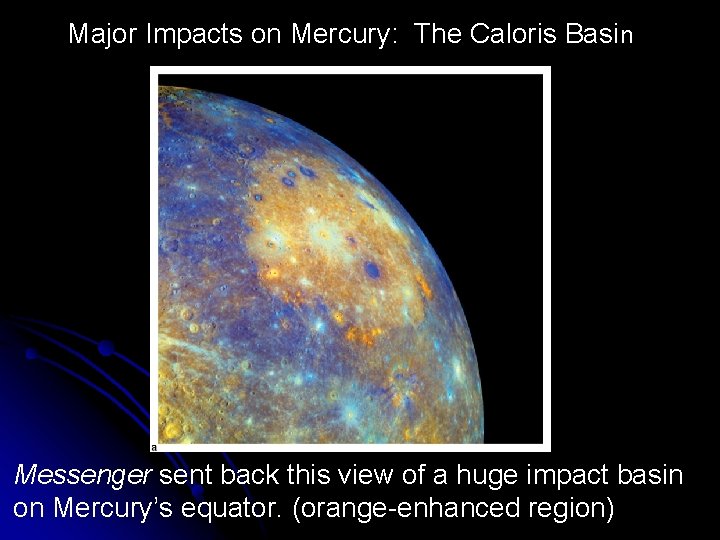
Major Impacts on Mercury: The Caloris Basin Messenger sent back this view of a huge impact basin on Mercury’s equator. (orange-enhanced region)
Missions to Mercury Mariner 10: 1973 -1974. One fly-by of Venus, three of Mercury. l Messenger : 2004 to present. Two Venus fly-by’s, three of Mercury, followed by Mercury orbit insertion and one year plus of operation. l
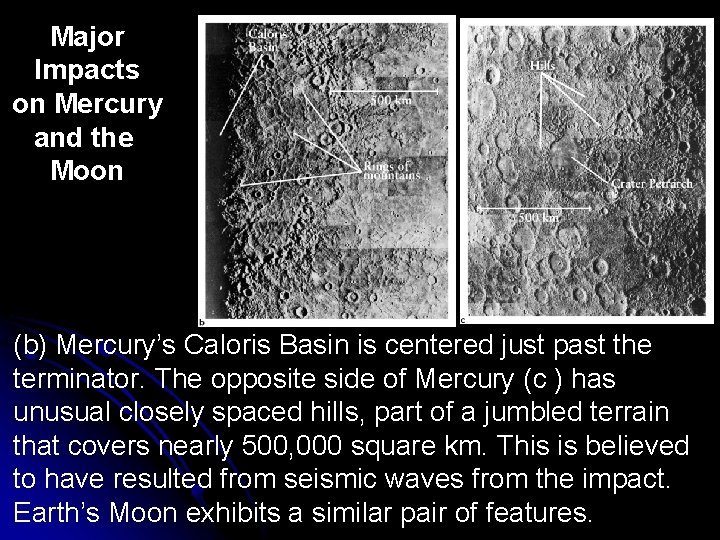
Major Impacts on Mercury and the Moon (b) Mercury’s Caloris Basin is centered just past the terminator. The opposite side of Mercury (c ) has unusual closely spaced hills, part of a jumbled terrain that covers nearly 500, 000 square km. This is believed to have resulted from seismic waves from the impact. Earth’s Moon exhibits a similar pair of features.
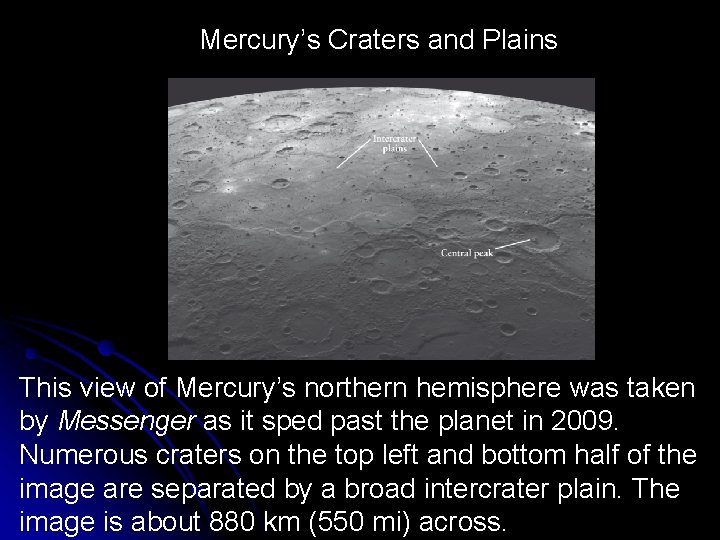
Mercury’s Craters and Plains This view of Mercury’s northern hemisphere was taken by Messenger as it sped past the planet in 2009. Numerous craters on the top left and bottom half of the image are separated by a broad intercrater plain. The image is about 880 km (550 mi) across.
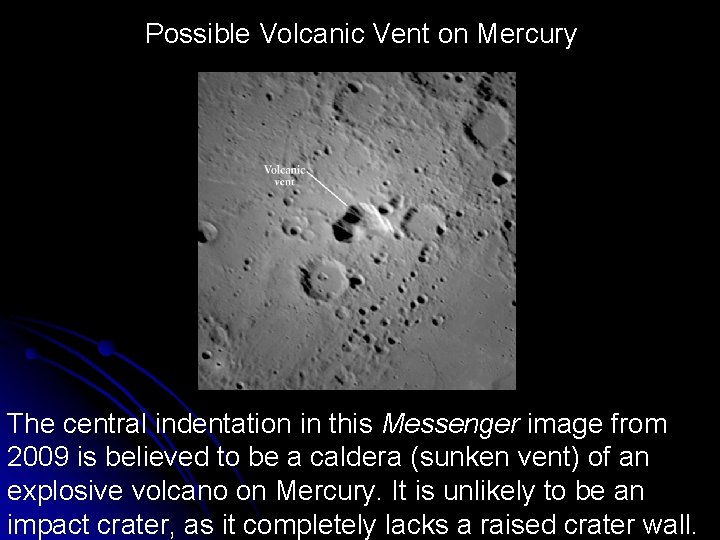
Possible Volcanic Vent on Mercury The central indentation in this Messenger image from 2009 is believed to be a caldera (sunken vent) of an explosive volcano on Mercury. It is unlikely to be an impact crater, as it completely lacks a raised crater wall.
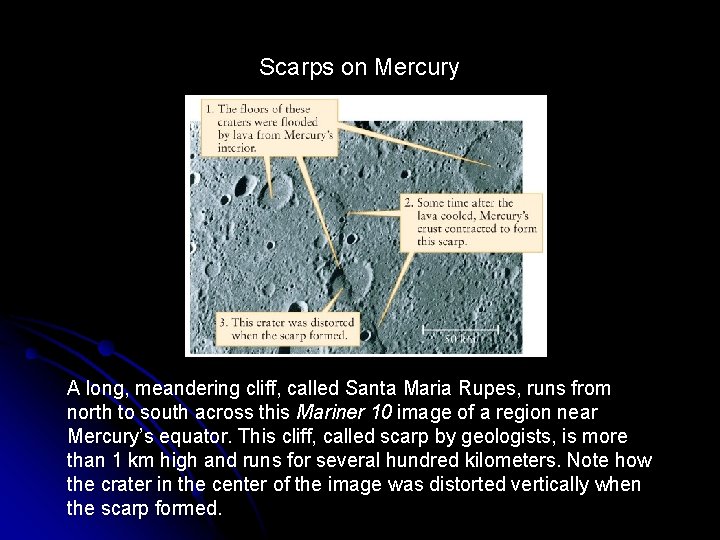
Scarps on Mercury A long, meandering cliff, called Santa Maria Rupes, runs from north to south across this Mariner 10 image of a region near Mercury’s equator. This cliff, called scarp by geologists, is more than 1 km high and runs for several hundred kilometers. Note how the crater in the center of the image was distorted vertically when the scarp formed.
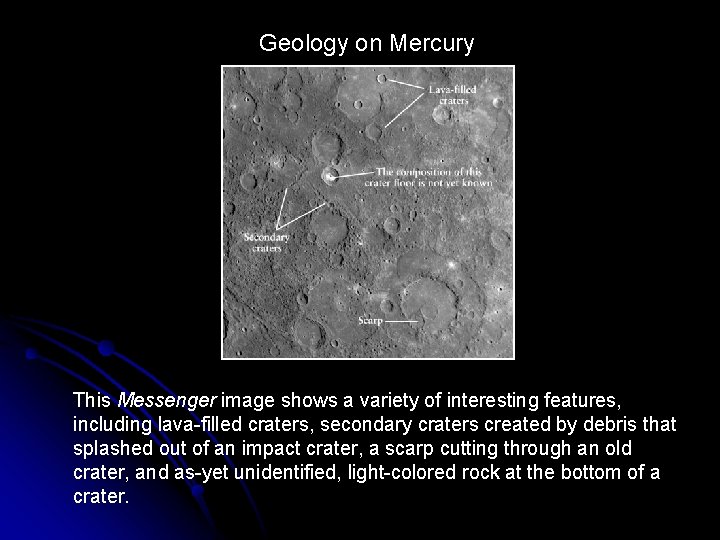
Geology on Mercury This Messenger image shows a variety of interesting features, including lava-filled craters, secondary craters created by debris that splashed out of an impact crater, a scarp cutting through an old crater, and as-yet unidentified, light-colored rock at the bottom of a crater.
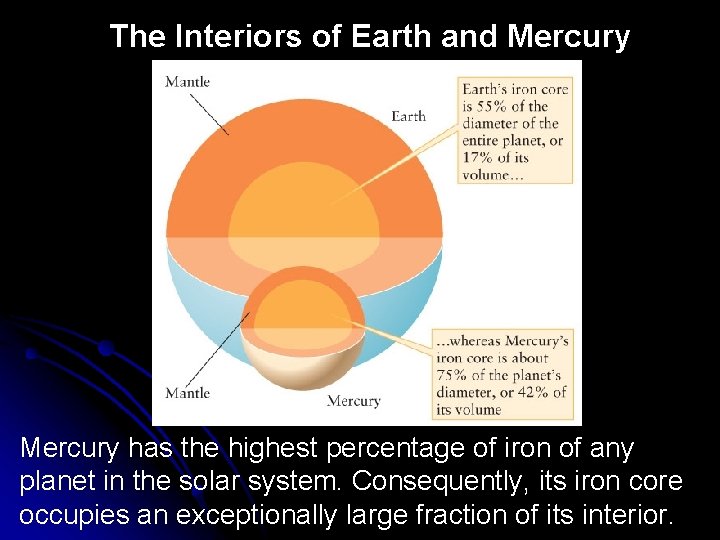
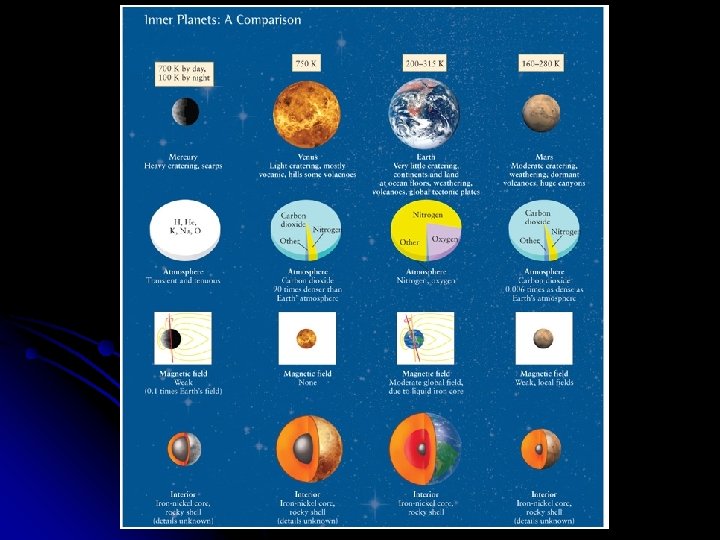
The Interiors of Earth and Mercury has the highest percentage of iron of any planet in the solar system. Consequently, its iron core occupies an exceptionally large fraction of its interior.
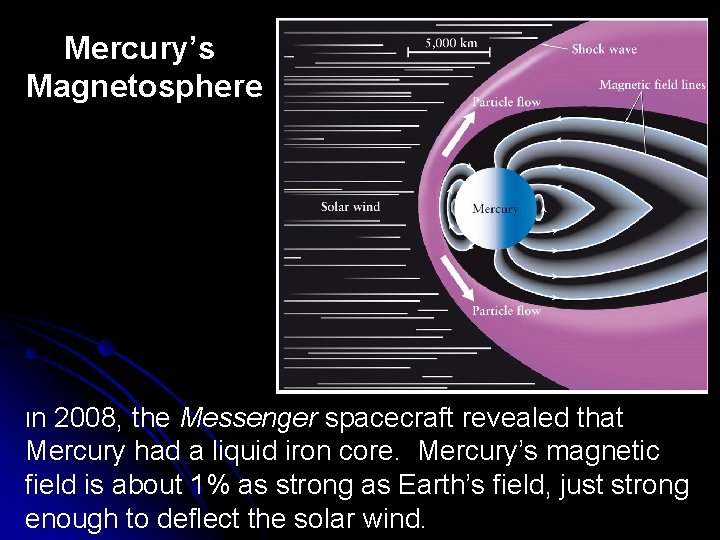
Mercury’s Magnetosphere In 2008, the Messenger spacecraft revealed that Mercury had a liquid iron core. Mercury’s magnetic field is about 1% as strong as Earth’s field, just strong enough to deflect the solar wind.
Planet Mercury Which is true about the core of Planet Mercury? A) It is composed of the liquid metal mercury. B) It is composed of iron, and larger than Earth’s iron core. C) It is composed of iron, and occupies a greater percentage of its planet compared to Earth’s iron core. D) ) It is composed of iron, and occupies a smaller percentage of its planet compared to Earth’s iron core.
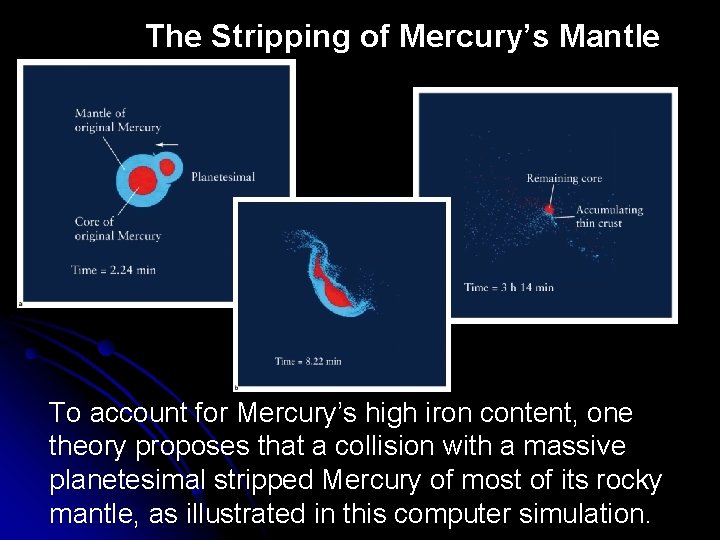
The Stripping of Mercury’s Mantle To account for Mercury’s high iron content, one theory proposes that a collision with a massive planetesimal stripped Mercury of most of its rocky mantle, as illustrated in this computer simulation.
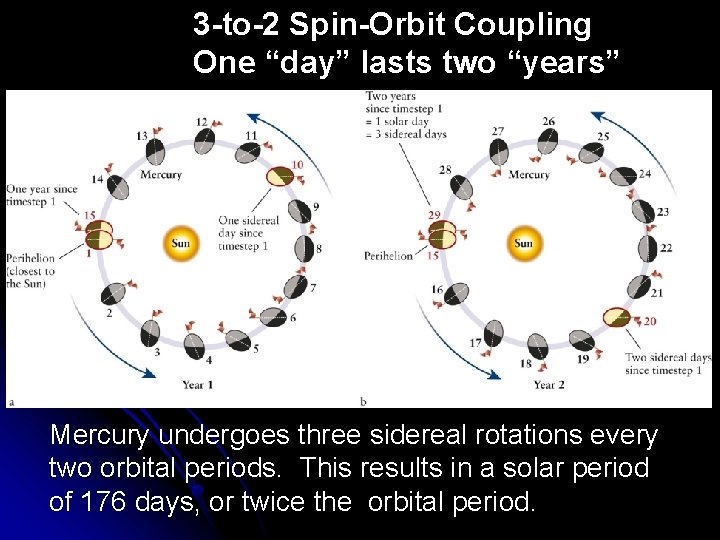
3 -to-2 Spin-Orbit Coupling One “day” lasts two “years” Mercury undergoes three sidereal rotations every two orbital periods. This results in a solar period of 176 days, or twice the orbital period.
Planet Mercury Orbit Which is NOT true about the orbit and solar cycle of Planet Mercury? A) A solar cycle (“day”) is longer than an orbital period (“year”). B) There is a 3: 2 synchronization between its orbit and spin. C) Its orbit is the most nearly circular of all planets. D) The Sun can be observed to move retrograde compared to the horizon.
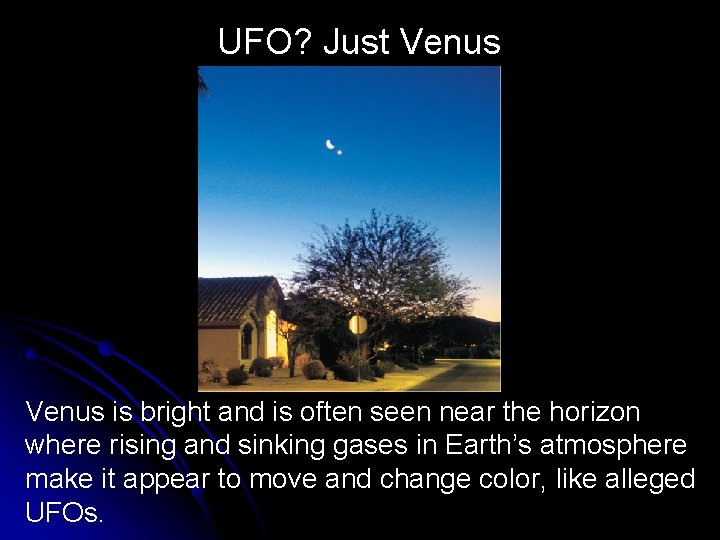
UFO? Just Venus is bright and is often seen near the horizon where rising and sinking gases in Earth’s atmosphere make it appear to move and change color, like alleged UFOs.
Missions to Venus Mariner 5 fly-by 1967 l Mariner 10 fly-by 1973 l Venera (Russian) 5 through 16 Landers and Orbiters l Magellan Orbiter 1989 -1990 l Fly-bys by missions to Mercury, Jupiter, Saturn 1990 to 2007 l Venus Express (ESA) l
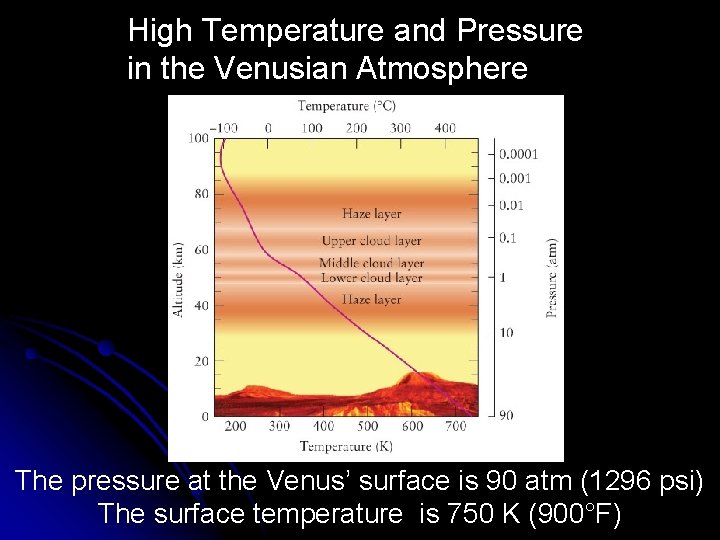
High Temperature and Pressure in the Venusian Atmosphere The pressure at the Venus’ surface is 90 atm (1296 psi) The surface temperature is 750 K (900°F)
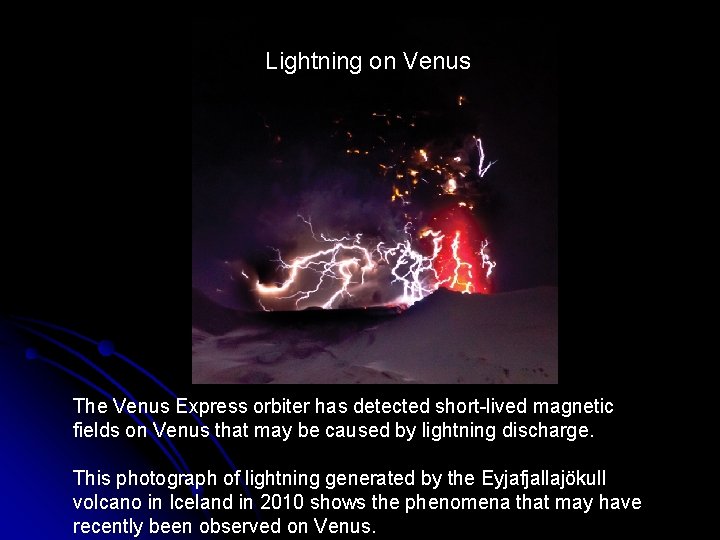
Lightning on Venus The Venus Express orbiter has detected short-lived magnetic fields on Venus that may be caused by lightning discharge. This photograph of lightning generated by the Eyjafjallajökull volcano in Iceland in 2010 shows the phenomena that may have recently been observed on Venus.
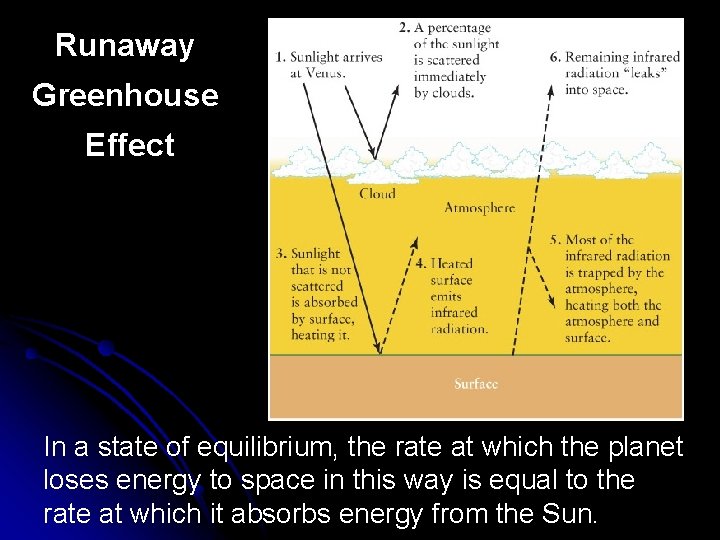
Runaway Greenhouse Effect In a state of equilibrium, the rate at which the planet loses energy to space in this way is equal to the rate at which it absorbs energy from the Sun.
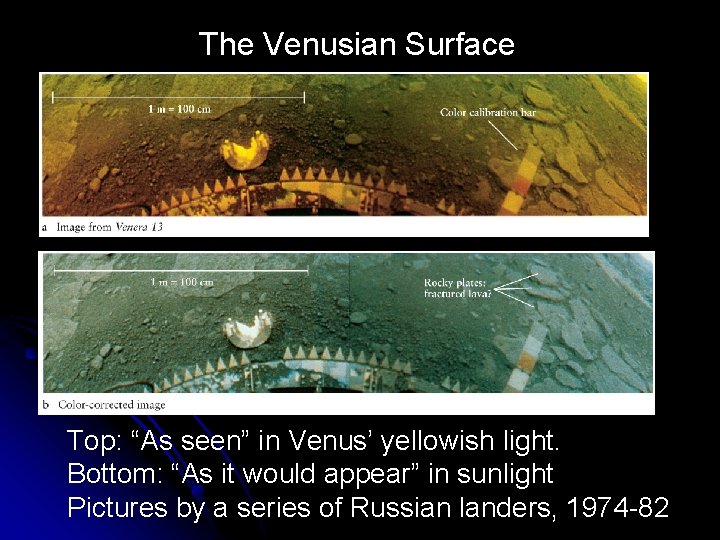
The Venusian Surface Top: “As seen” in Venus’ yellowish light. Bottom: “As it would appear” in sunlight Pictures by a series of Russian landers, 1974 -82
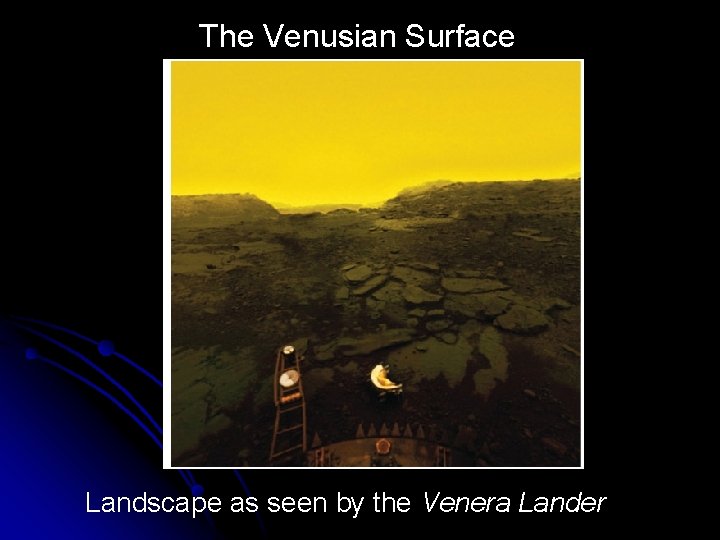
The Venusian Surface Landscape as seen by the Venera Lander
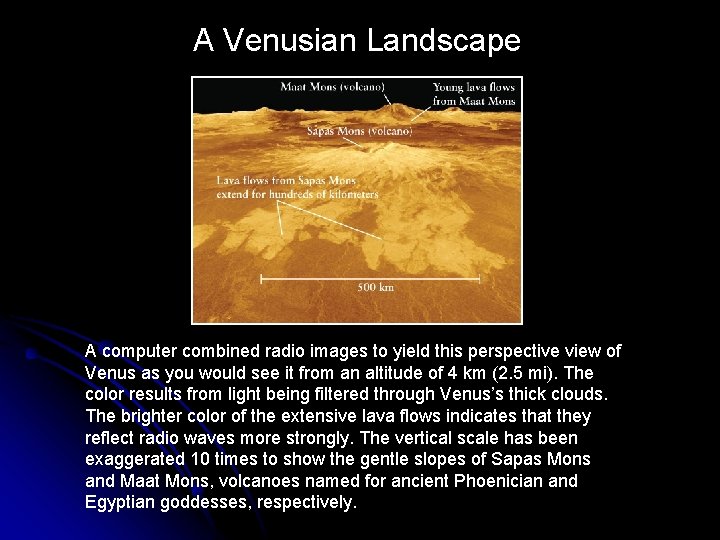
A Venusian Landscape A computer combined radio images to yield this perspective view of Venus as you would see it from an altitude of 4 km (2. 5 mi). The color results from light being filtered through Venus’s thick clouds. The brighter color of the extensive lava flows indicates that they reflect radio waves more strongly. The vertical scale has been exaggerated 10 times to show the gentle slopes of Sapas Mons and Maat Mons, volcanoes named for ancient Phoenician and Egyptian goddesses, respectively.
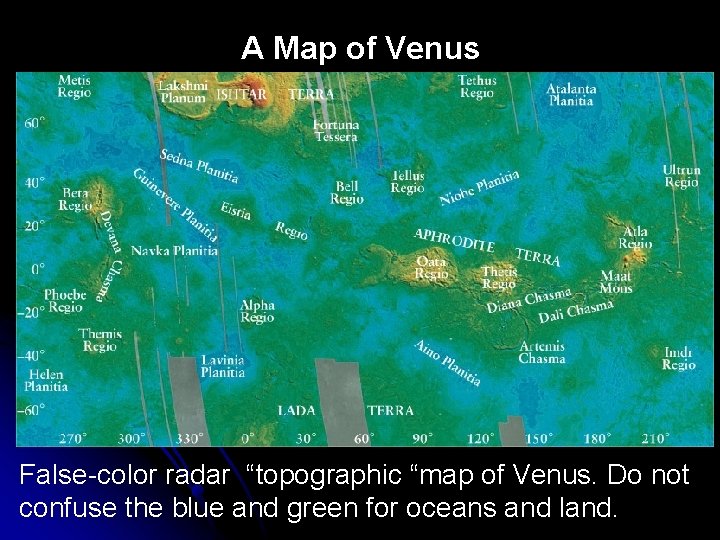
A Map of Venus False-color radar “topographic “map of Venus. Do not confuse the blue and green for oceans and land.
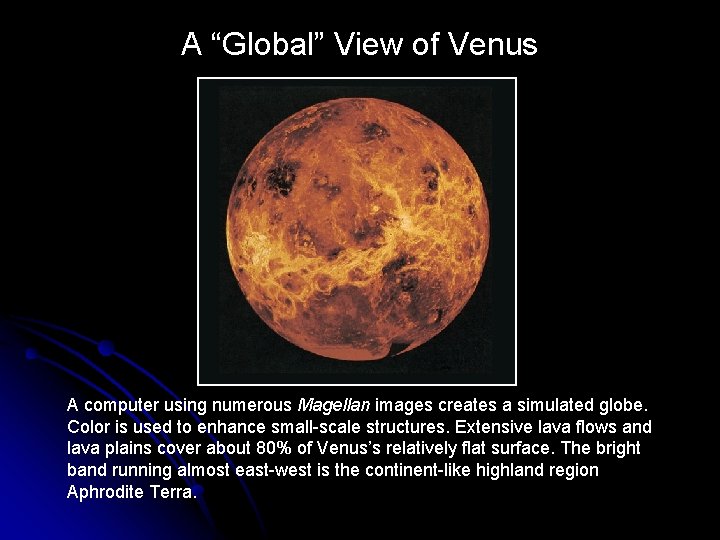
A “Global” View of Venus A computer using numerous Magellan images creates a simulated globe. Color is used to enhance small-scale structures. Extensive lava flows and lava plains cover about 80% of Venus’s relatively flat surface. The bright band running almost east-west is the continent-like highland region Aphrodite Terra.
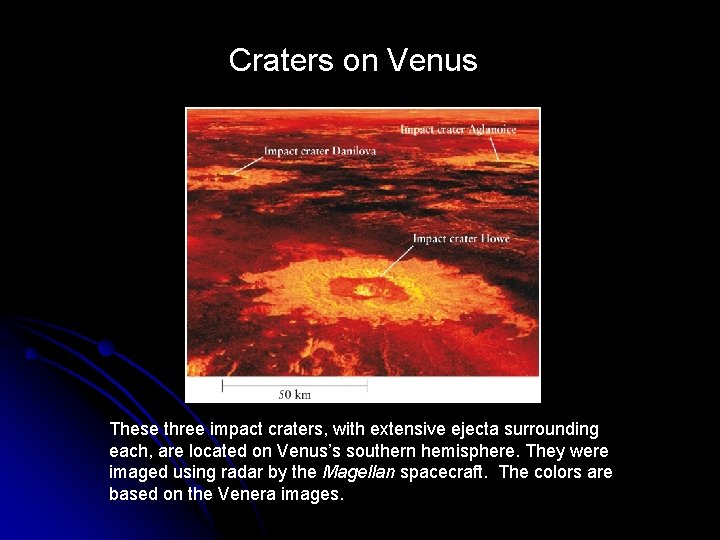
Craters on Venus These three impact craters, with extensive ejecta surrounding each, are located on Venus’s southern hemisphere. They were imaged using radar by the Magellan spacecraft. The colors are based on the Venera images.
Venus Why is the surface of Venus hotter than Mercury? A) Venus is closer to the Sun. B) Venus has more volcanoes. C) The Greenhouse Effect, which is a runaway in Venus’ atmosphere. D) No Way, Mercury’s surface is hotter than Venus’ surface.
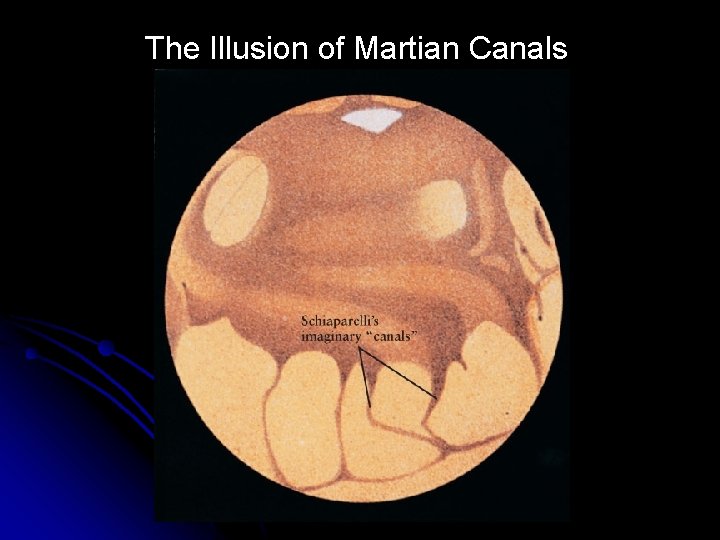
The Illusion of Martian Canals
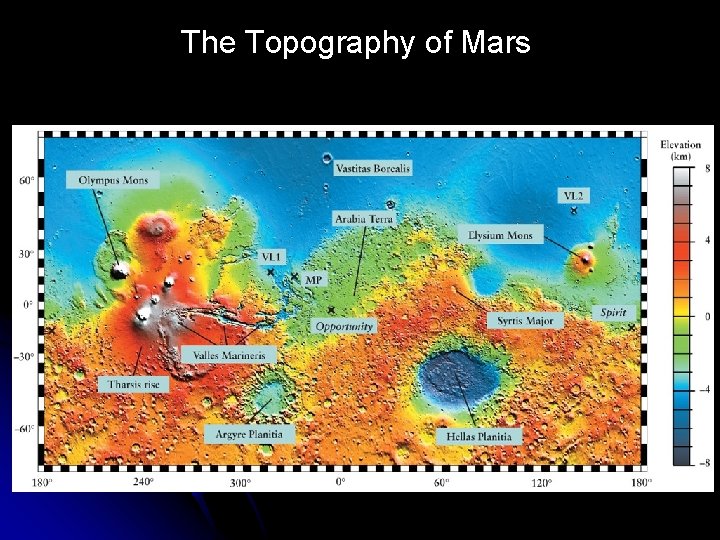
The Topography of Mars
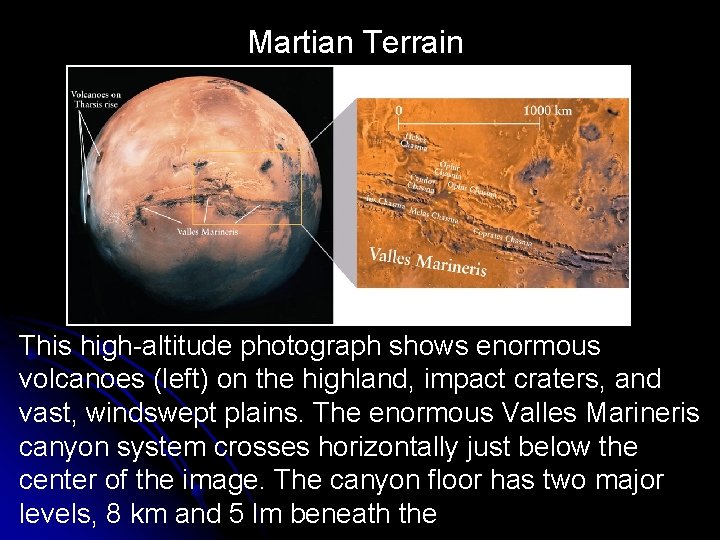
Martian Terrain This high-altitude photograph shows enormous volcanoes (left) on the highland, impact craters, and vast, windswept plains. The enormous Valles Marineris canyon system crosses horizontally just below the center of the image. The canyon floor has two major levels, 8 km and 5 lm beneath the
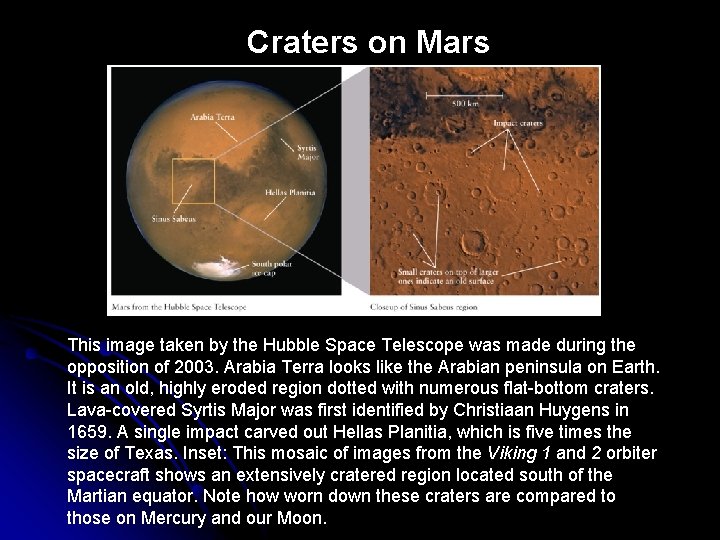
Craters on Mars This image taken by the Hubble Space Telescope was made during the opposition of 2003. Arabia Terra looks like the Arabian peninsula on Earth. It is an old, highly eroded region dotted with numerous flat-bottom craters. Lava-covered Syrtis Major was first identified by Christiaan Huygens in 1659. A single impact carved out Hellas Planitia, which is five times the size of Texas. Inset: This mosaic of images from the Viking 1 and 2 orbiter spacecraft shows an extensively cratered region located south of the Martian equator. Note how worn down these craters are compared to those on Mercury and our Moon.
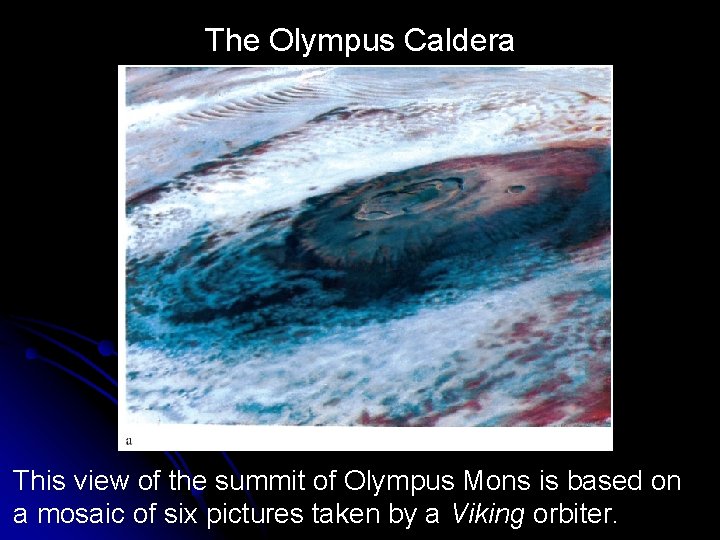
The Olympus Caldera This view of the summit of Olympus Mons is based on a mosaic of six pictures taken by a Viking orbiter.
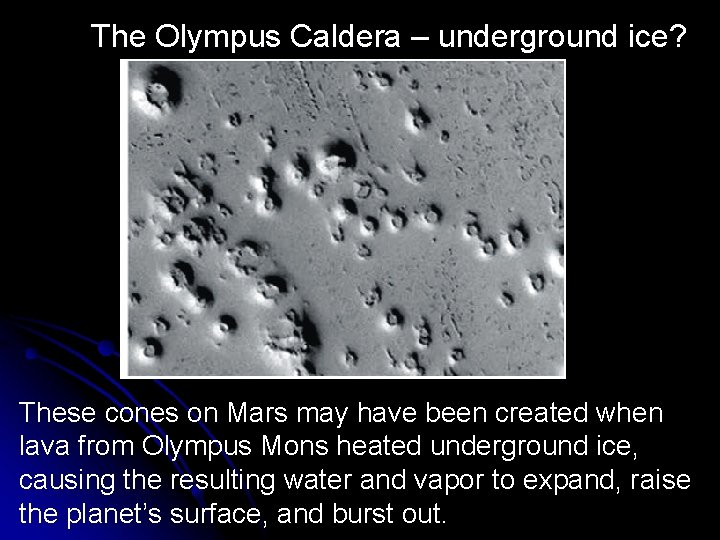
The Olympus Caldera – underground ice? These cones on Mars may have been created when lava from Olympus Mons heated underground ice, causing the resulting water and vapor to expand, raise the planet’s surface, and burst out.
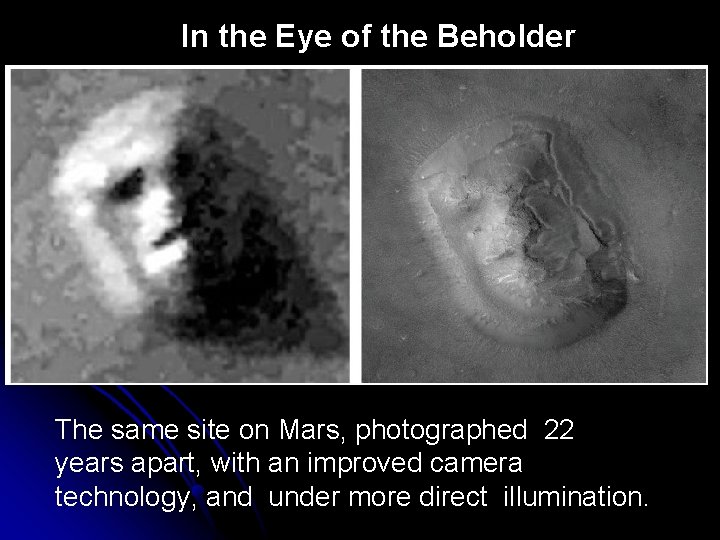
In the Eye of the Beholder The same site on Mars, photographed 22 years apart, with an improved camera technology, and under more direct illumination.
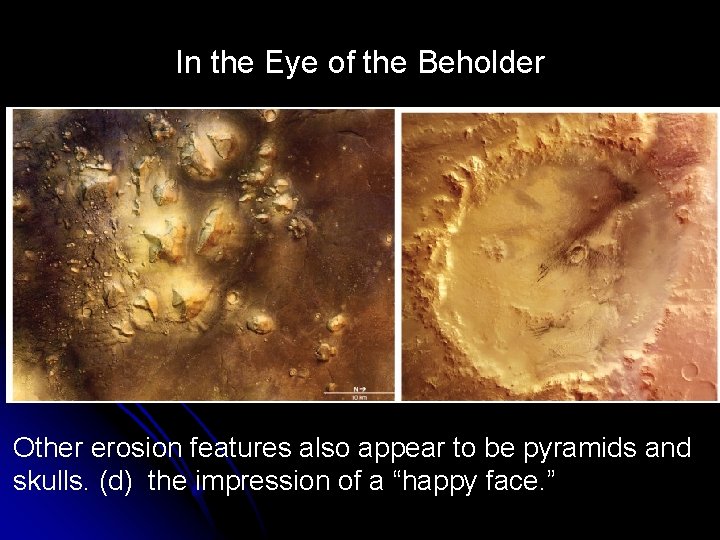
In the Eye of the Beholder Other erosion features also appear to be pyramids and skulls. (d) the impression of a “happy face. ”
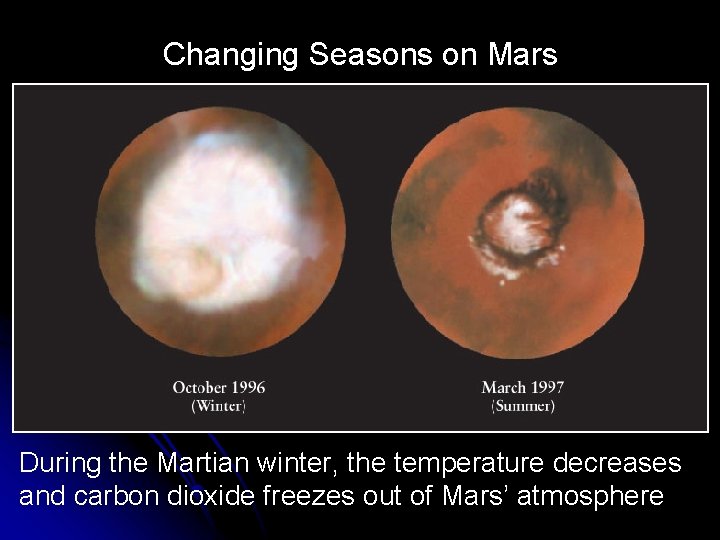
Changing Seasons on Mars During the Martian winter, the temperature decreases and carbon dioxide freezes out of Mars’ atmosphere
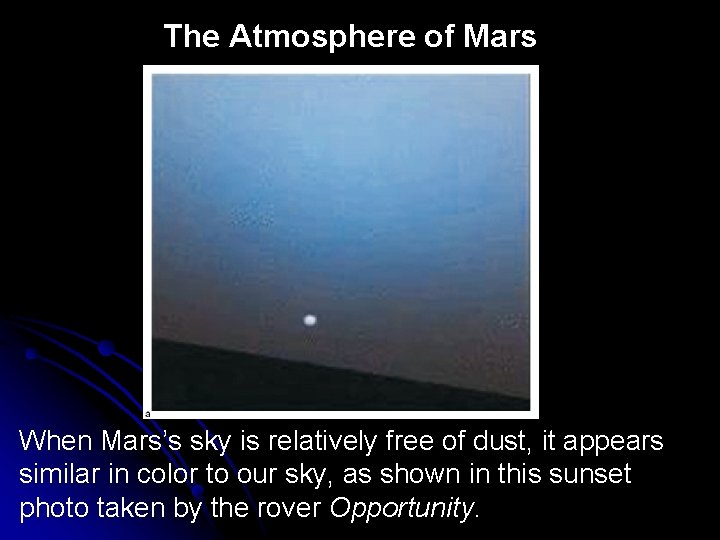
The Atmosphere of Mars When Mars’s sky is relatively free of dust, it appears similar in color to our sky, as shown in this sunset photo taken by the rover Opportunity.
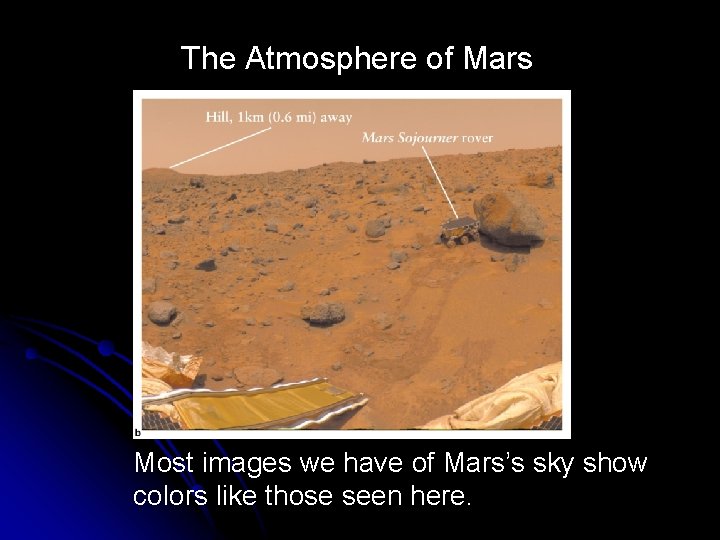
The Atmosphere of Mars Most images we have of Mars’s sky show colors like those seen here.
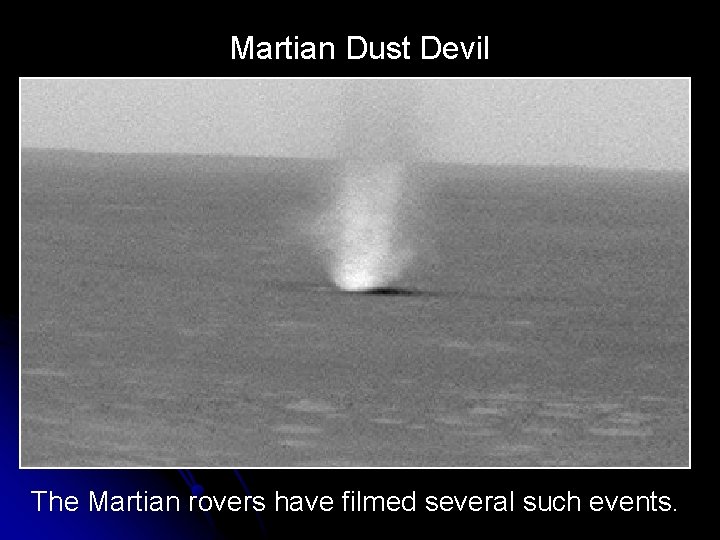
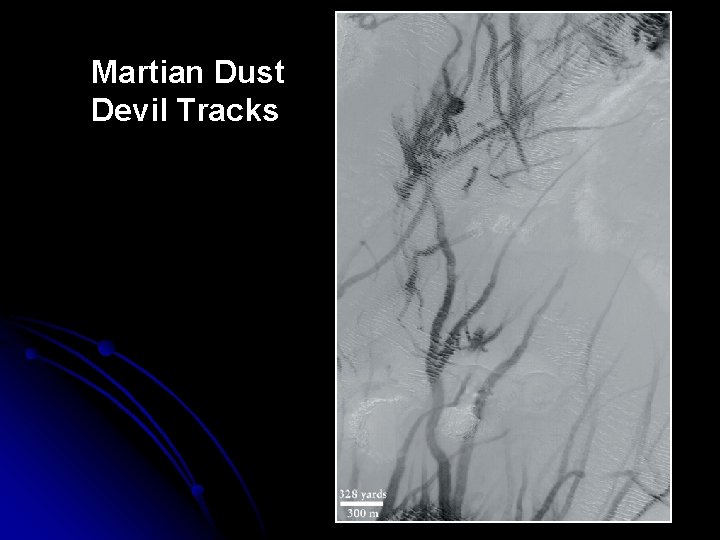
Martian Dust Devil The Martian rovers have filmed several such events.
Martian Dust Devil Tracks
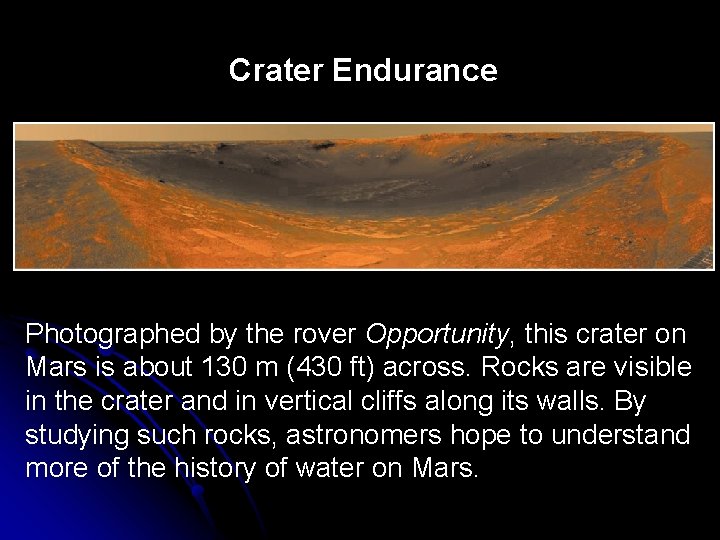
Crater Endurance Photographed by the rover Opportunity, this crater on Mars is about 130 m (430 ft) across. Rocks are visible in the crater and in vertical cliffs along its walls. By studying such rocks, astronomers hope to understand more of the history of water on Mars.
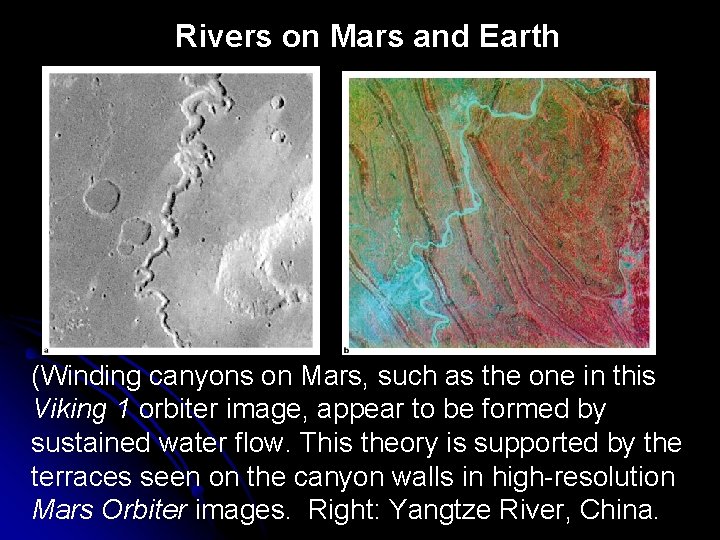
Rivers on Mars and Earth (Winding canyons on Mars, such as the one in this Viking 1 orbiter image, appear to be formed by sustained water flow. This theory is supported by the terraces seen on the canyon walls in high-resolution Mars Orbiter images. Right: Yangtze River, China.
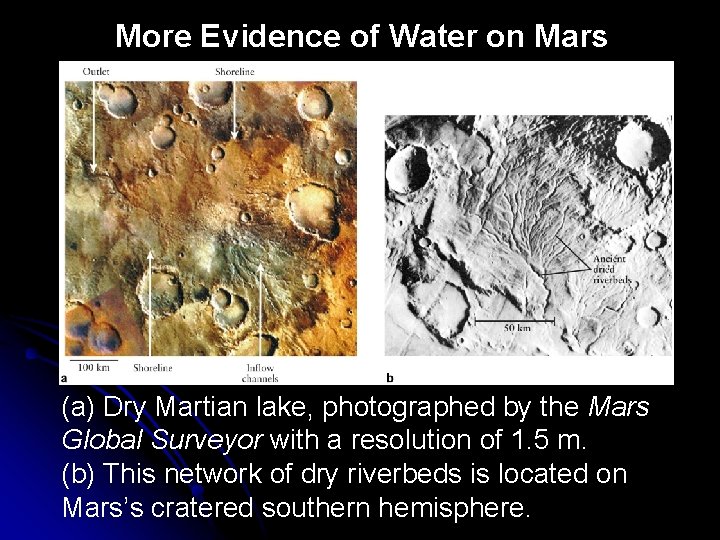
More Evidence of Water on Mars (a) Dry Martian lake, photographed by the Mars Global Surveyor with a resolution of 1. 5 m. (b) This network of dry riverbeds is located on Mars’s cratered southern hemisphere.
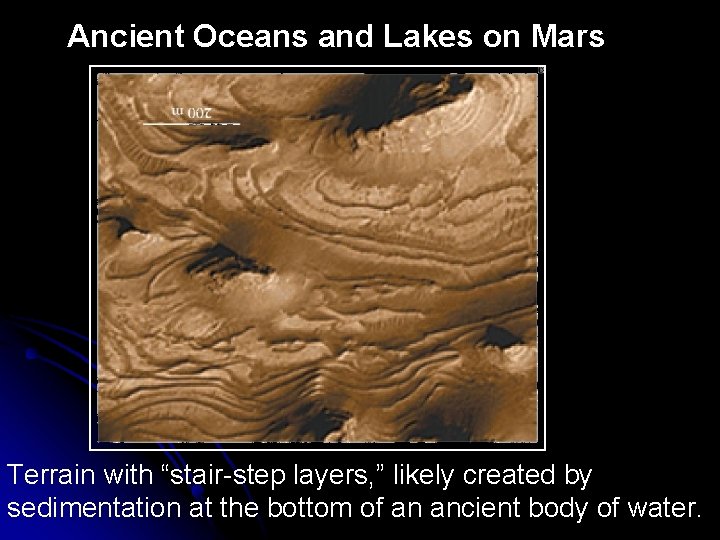
Ancient Oceans and Lakes on Mars Terrain with “stair-step layers, ” likely created by sedimentation at the bottom of an ancient body of water.
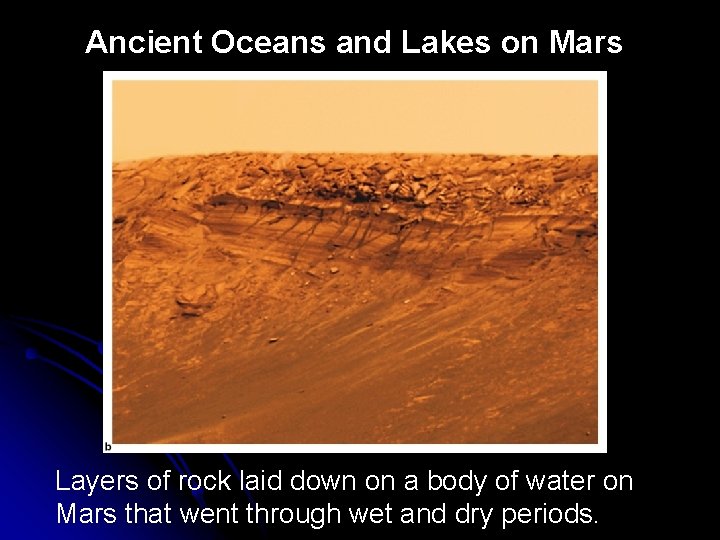
Ancient Oceans and Lakes on Mars Layers of rock laid down on a body of water on Mars that went through wet and dry periods.
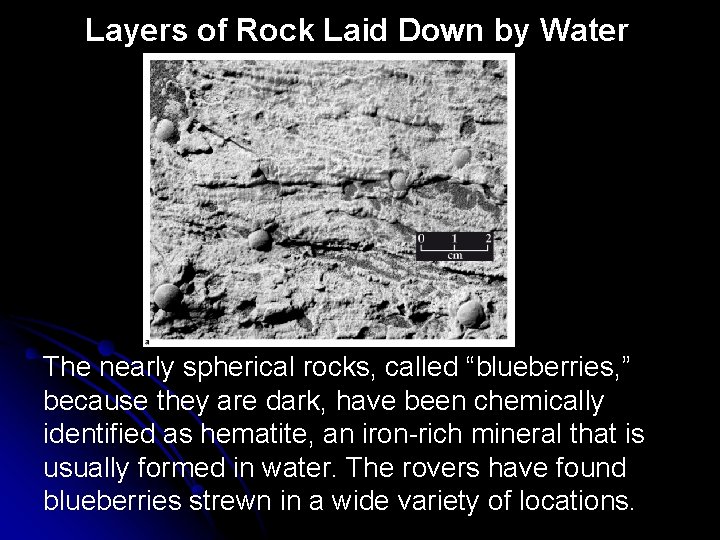
Layers of Rock Laid Down by Water The nearly spherical rocks, called “blueberries, ” because they are dark, have been chemically identified as hematite, an iron-rich mineral that is usually formed in water. The rovers have found blueberries strewn in a wide variety of locations.
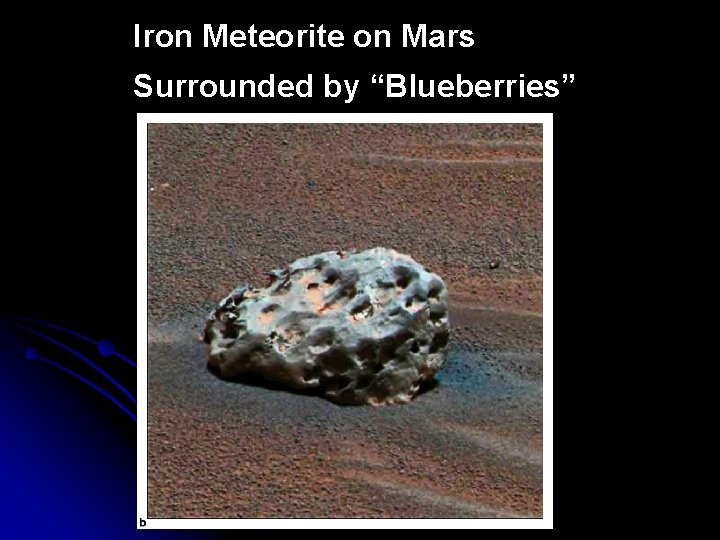
Iron Meteorite on Mars Surrounded by “Blueberries”
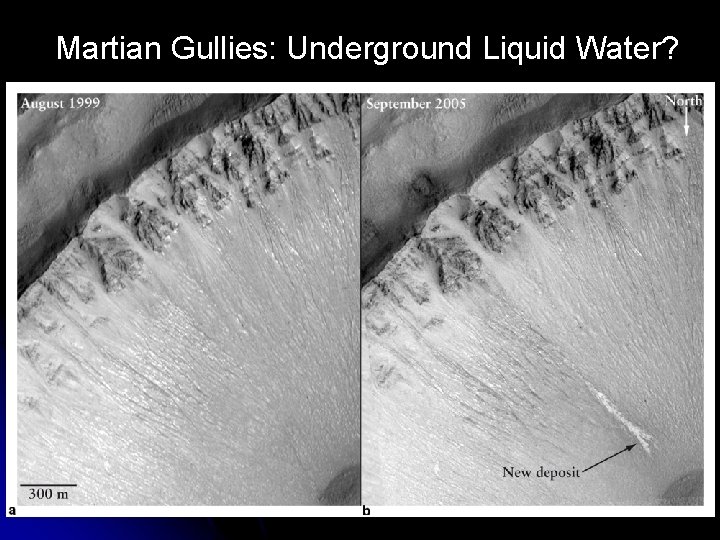
Martian Gullies: Underground Liquid Water?
Mars and Water Why do astronomers believe that there is no liquid water on the surface of Mars? A) The atmospheric pressure is too low. B) No oceans are visible, nor have the rovers found any lakes or rivers. C) The entire surface of Mars is so cold that any H 2 O would freeze to ice. . D) No way, two streams and a small lake were discovered by the rover Spirit in 2006, near Gusev crater.
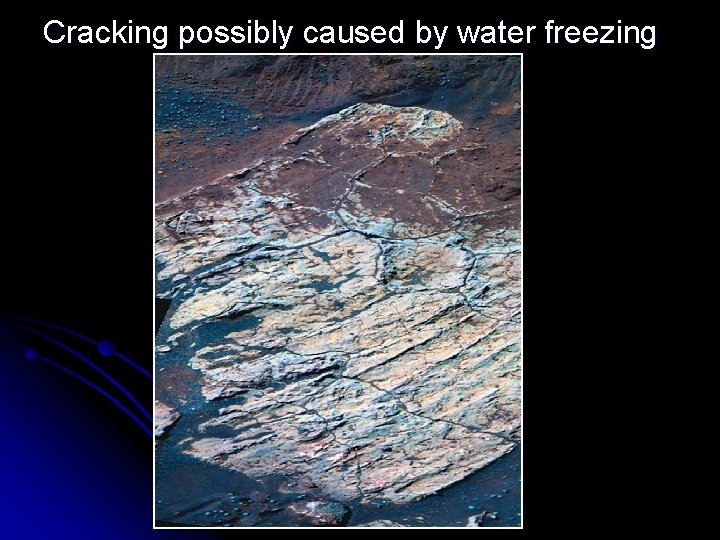
Cracking possibly caused by water freezing
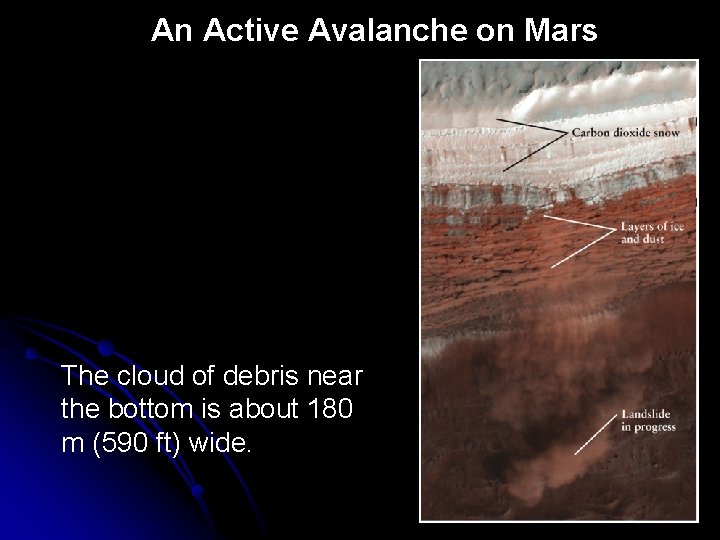
An Active Avalanche on Mars The cloud of debris near the bottom is about 180 m (590 ft) wide.
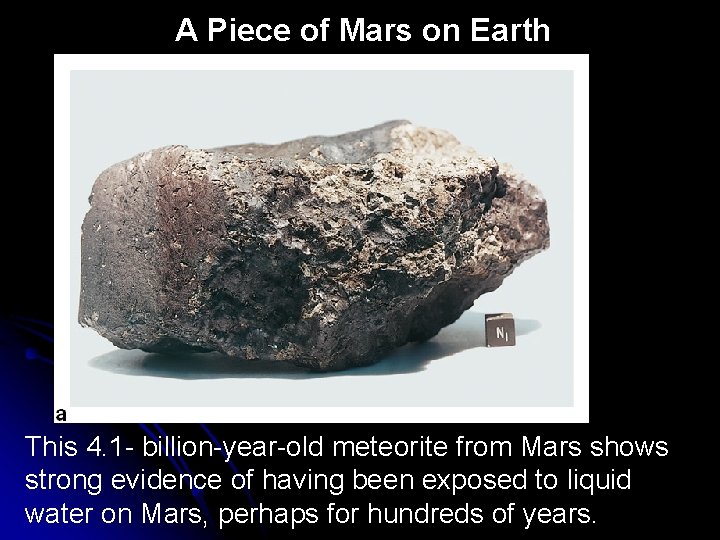
A Piece of Mars on Earth This 4. 1 - billion-year-old meteorite from Mars shows strong evidence of having been exposed to liquid water on Mars, perhaps for hundreds of years.
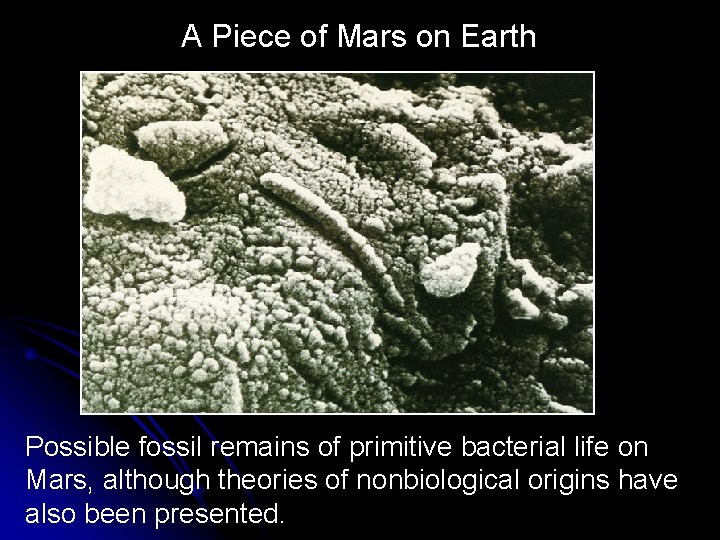
A Piece of Mars on Earth Possible fossil remains of primitive bacterial life on Mars, although theories of nonbiological origins have also been presented.
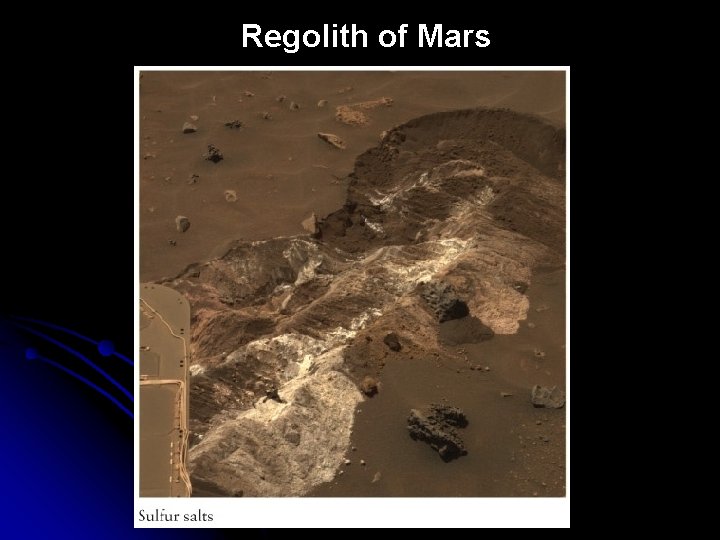
Regolith of Mars
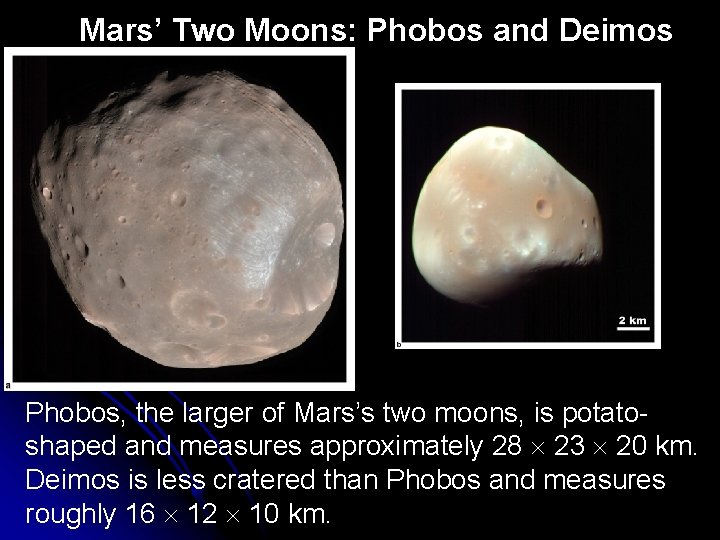
Mars’ Two Moons: Phobos and Deimos Phobos, the larger of Mars’s two moons, is potatoshaped and measures approximately 28 23 20 km. Deimos is less cratered than Phobos and measures roughly 16 12 10 km.
Summary of Key Ideas
Mercury l l l Even at its greatest orbital elongations, Mercury can be seen from Earth only briefly after sunset or before sunrise. The Mercurian surface is pocked with craters like the Moon’s, but extensive, smooth plains lie between these craters. Long cliffs meander across the surface of Mercury. These scarps probably formed as the planet cooled, solidified, and shrank. The long-ago impact of a large object formed the huge Caloris Basin on Mercury and shoved up jumbled hills on the opposite side of the planet. Several similar, but smaller, impact features also exist on Mercury has an iron core, which fills more of its interior than Earth’s core fills Earth. Mercury has a weak, global magnetic field that partially shields it from the solar wind.
Venus l l Venus is similar to Earth in size, mass, and average density, but it is covered by unbroken, highly reflective clouds that conceal its other features from observers using visible-light telescopes. Although most of Venus’s atmosphere is carbon dioxide, its dense clouds contain droplets of concentrated sulfuric acid mixed with yellowish sulfur dust. Active volcanoes on Venus may be a constant source of this sulfurous veil.
Venus l l Venus’s exceptionally high temperature is caused by the greenhouse effect, as the dense carbon dioxide atmosphere traps and retains heat emitted by the planet. The surface pressure on Venus is 90 atm, and the surface temperature is 750 K. Both temperature and pressure decrease as altitude increases. The surface of Venus is surprisingly flat and mostly covered with gently rolling hills. There are two major “continents” and several large volcanoes. The surface of Venus shows evidence of local tectonic activity but not the large-scale motions that play a major role in continually reshaping Earth’s surface.
Mars l l l Earth-based observers found that the Martian solar day is nearly the same as that of Earth, that Mars has polar ice caps of carbon dioxide snow that expand shrink with the seasons, and that the Martian surface undergoes seasonal color changes. A century ago, observers reported networks of linear features that many perceived as canals. These observations led to speculation about self-aware life on Mars. The Martian surface has many flat-bottomed craters, several huge volcanoes, a vast equatorial canyon, and dried-up riverbeds—but no canals formed by intelligent life. River deltas and dry riverbeds on the Martian surface indicate that large amounts of water once flowed there.
Mars l l l Liquid water would quickly boil away in Mars’s thin present-day atmosphere, but the planet’s polar ice caps contain significant quantities of frozen water, and a layer of permafrost exists beneath parts of the regolith. The Martian atmosphere is composed mostly of carbon dioxide. The surface pressure is less than 0. 01 atm. Chemical reactions in the regolith, together with ultraviolet radiation from the Sun, apparently act to sterilize the Martian surface. Mars has no global magnetic fields, but local fields pierce its surface in at least nine places. Mars has two potato-shaped moons, Phobos and Deimos. Both are in synchronous rotation with Mars. How they came into orbit is still under investigation.
Key Terms 3 -to-2 spin-orbit coupling caldera dust devil greenhouse effect hot-spot volcanism northern vastness (northern lowlands) retrograde rotation southern highlands
WHAT DID YOU THINK? l l Which terrestrial planet—Mercury, Venus, Earth, or Mars—has the coolest surface temperature? The nighttime side of Mercury, closest planet to the Sun, is the coldest surface of any terrestrial planet.
WHAT DID YOU THINK? l l Which planet is most similar in size to Earth? Venus is most similar to Earth in size.
WHAT DID YOU THINK? l l Which terrestrial planet—Mercury, Venus, Earth, or Mars—has the highest surface temperature? Venus is hottest, its temperature raised above that of Mercury by the greenhouse effect in Venus’s atmosphere.
WHAT DID YOU THINK? l l What is the composition of the clouds that surround Venus? The clouds are made primarily of sulfuric acid.
WHAT DID YOU THINK? l l Does Mars have liquid water on its surface today? Did it have liquid surface water in the past? Mars has no liquid surface water today, but there are very strong indications that it had liquid water on its surface in the past.
WHAT DID YOU THINK? l l Is life known to exist on Mars today? No current life has yet been discovered on Mars, but it may exist in underground water oceans.