
Neil Dennehy cornelius j dennehynasa gov Implementation Challenges


- Slides: 23
Neil Dennehy cornelius. j. dennehy@nasa. gov Implementation Challenges for Multivariable Control What you did not learn in school! by Dr. Sanjay Garg Learning from the Past, Looking to the Future
Learning from the Past, Looking to the Future
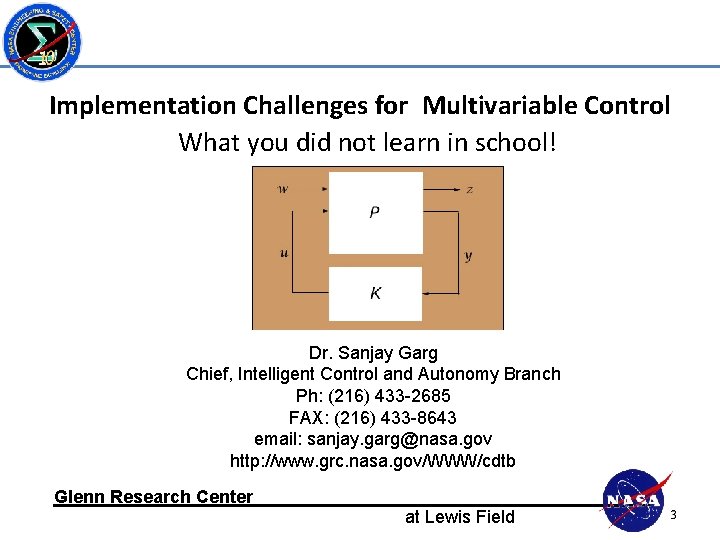
Implementation Challenges for Multivariable Control What you did not learn in school! Dr. Sanjay Garg Chief, Intelligent Control and Autonomy Branch Ph: (216) 433 -2685 FAX: (216) 433 -8643 email: sanjay. garg@nasa. gov http: //www. grc. nasa. gov/WWW/cdtb Glenn Research Center at Lewis Field 3
Overview • Control design problem & typical mathematical formulation • Unique nature of multivariable control (MVC) • Benefits and Capabilities of MVC • Challenges & barriers to using MVC in real systems (with reference to STOVL IFPC Design) – Right problem formulation – Major implementation issues – Making changes on-the-fly • Conclusion Glenn Research Center at Lewis Field 4
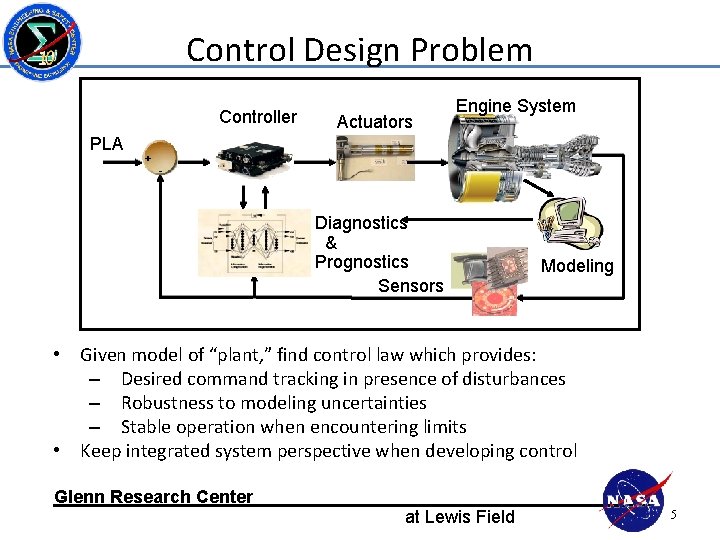
Control Design Problem Controller PLA + Actuators Engine System - Diagnostics & Prognostics Sensors Modeling • Given model of “plant, ” find control law which provides: – Desired command tracking in presence of disturbances – Robustness to modeling uncertainties – Stable operation when encountering limits • Keep integrated system perspective when developing control Glenn Research Center at Lewis Field 5
MVC Unique Nature • Systems with >1 output being controlled by >1 manipulated input, with any given input affecting more than single output: multi-input/multioutput (MIMO) • “Classical” methods: based primarily on frequency domain approach, extend single-input/single-output (SISO) transfer function techniques, e. g. , Nyquist, to MIMO transfer function matrix • “Modern” methods: based on state-space approach, formulation of quadratic cost function resulting in linear control law typically solved through system of Ricatti equations – Control solution easily amenable for digital implementation – Analysis typically done using multivariable frequency domain techniques • Unlike simple gain & phase margin measures for SISO, “robustness” determination of MVC control requires complex analyses usingular value techniques & Monte Carlo simulations Glenn Research Center at Lewis Field 6
MVC Benefits & Capabilities • “ 1 -step” control solution for complex intercoupled systems – Decoupled command tracking – “Optimal” control usage • When to use MVC: – System has high level of input/output coupling & not much separation in loop bandwidths – Physics of problem are reasonably well-understood to be able to use “design handles” effectively – System is complex with large number of states – When sequential SISO loop closure will not meet performance requirements! • Remember: MVC cannot make 747 fly like F-16 ! Glenn Research Center at Lewis Field 7
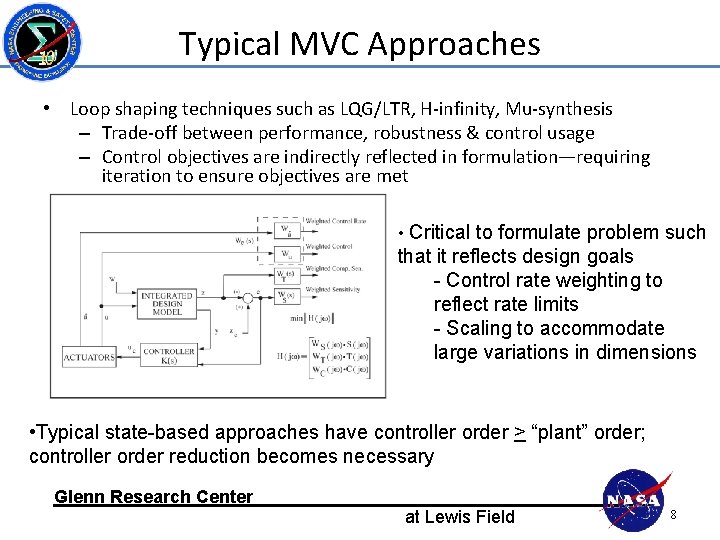
Typical MVC Approaches • Loop shaping techniques such as LQG/LTR, H-infinity, Mu-synthesis – Trade-off between performance, robustness & control usage – Control objectives are indirectly reflected in formulation—requiring iteration to ensure objectives are met • Critical to formulate problem such that it reflects design goals - Control rate weighting to reflect rate limits - Scaling to accommodate large variations in dimensions • Typical state-based approaches have controller order > “plant” order; controller order reduction becomes necessary Glenn Research Center at Lewis Field 8
MVC Design Challenges: Right Problem Formulation • Synthesis methods based on mathematical formulation that allows for “easier” solution—only indirectly address control objectives • Numerical stability might require some modifications: – Scaling (discussed earlier) – Replacing pure integrators with “slow poles” • Overlooking key physics of problem in process of formulating “design plant” can lead to problems – Control effector blending – Addressing nonlinearities – Controller stability Glenn Research Center at Lewis Field 9
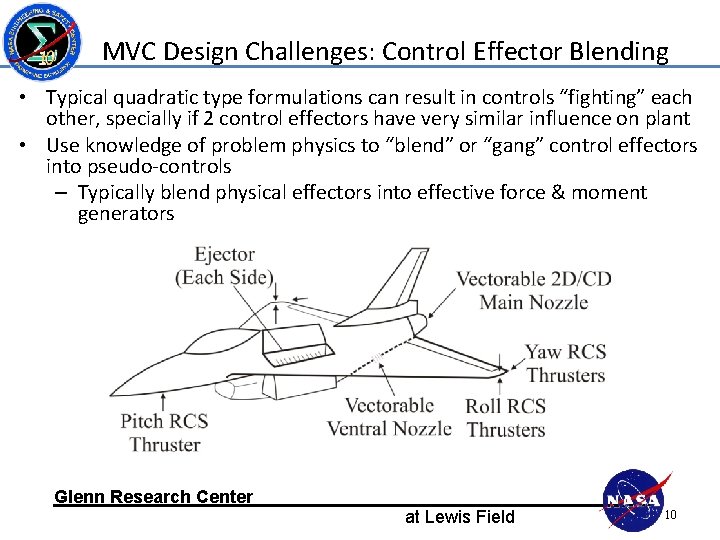
MVC Design Challenges: Control Effector Blending • Typical quadratic type formulations can result in controls “fighting” each other, specially if 2 control effectors have very similar influence on plant • Use knowledge of problem physics to “blend” or “gang” control effectors into pseudo-controls – Typically blend physical effectors into effective force & moment generators Glenn Research Center at Lewis Field 10
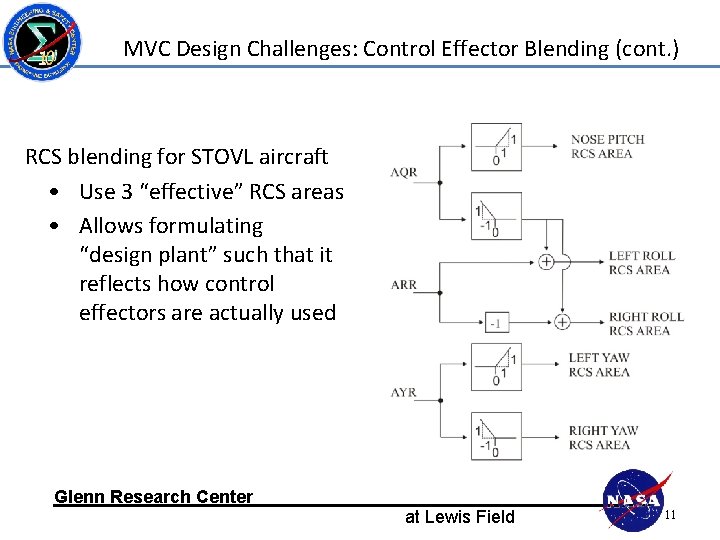
MVC Design Challenges: Control Effector Blending (cont. ) RCS blending for STOVL aircraft • Use 3 “effective” RCS areas • Allows formulating “design plant” such that it reflects how control effectors are actually used Glenn Research Center at Lewis Field 11
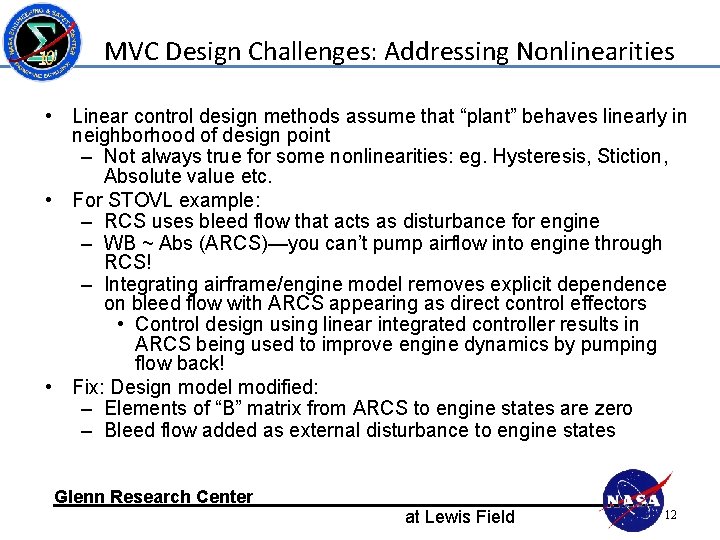
MVC Design Challenges: Addressing Nonlinearities • Linear control design methods assume that “plant” behaves linearly in neighborhood of design point – Not always true for some nonlinearities: eg. Hysteresis, Stiction, Absolute value etc. • For STOVL example: – RCS uses bleed flow that acts as disturbance for engine – WB ~ Abs (ARCS)—you can’t pump airflow into engine through RCS! – Integrating airframe/engine model removes explicit dependence on bleed flow with ARCS appearing as direct control effectors • Control design using linear integrated controller results in ARCS being used to improve engine dynamics by pumping flow back! • Fix: Design model modified: – Elements of “B” matrix from ARCS to engine states are zero – Bleed flow added as external disturbance to engine states Glenn Research Center at Lewis Field 12
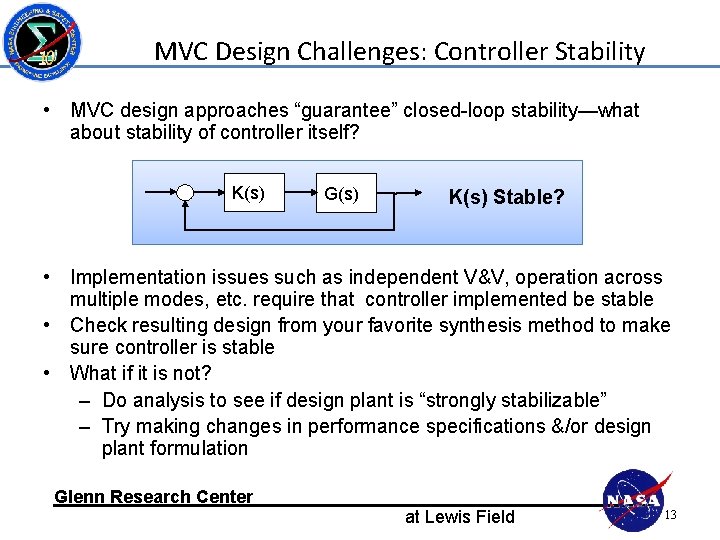
MVC Design Challenges: Controller Stability • MVC design approaches “guarantee” closed-loop stability—what about stability of controller itself? K(s) G(s) K(s) Stable? • Implementation issues such as independent V&V, operation across multiple modes, etc. require that controller implemented be stable • Check resulting design from your favorite synthesis method to make sure controller is stable • What if it is not? – Do analysis to see if design plant is “strongly stabilizable” – Try making changes in performance specifications &/or design plant formulation Glenn Research Center at Lewis Field 13
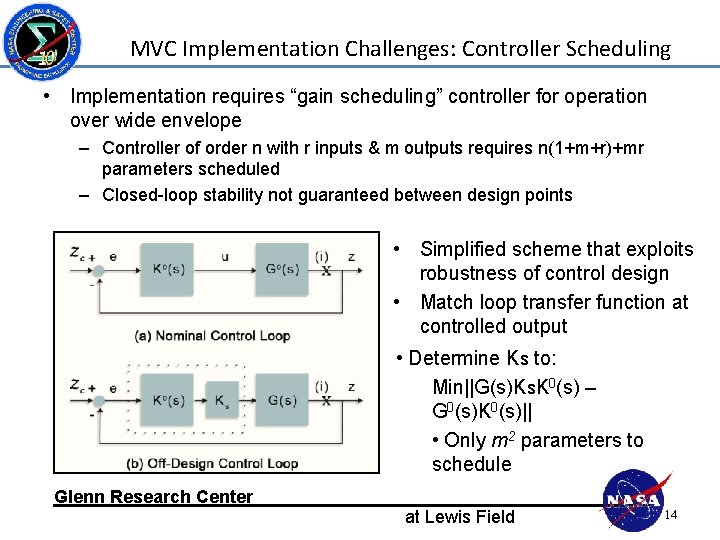
MVC Implementation Challenges: Controller Scheduling • Implementation requires “gain scheduling” controller for operation over wide envelope – Controller of order n with r inputs & m outputs requires n(1+m+r)+mr parameters scheduled – Closed-loop stability not guaranteed between design points • Simplified scheme that exploits robustness of control design • Match loop transfer function at controlled output • Determine Ks to: Min||G(s)Ks. K 0(s) – G 0(s)K 0(s)|| • Only m 2 parameters to schedule Glenn Research Center at Lewis Field 14
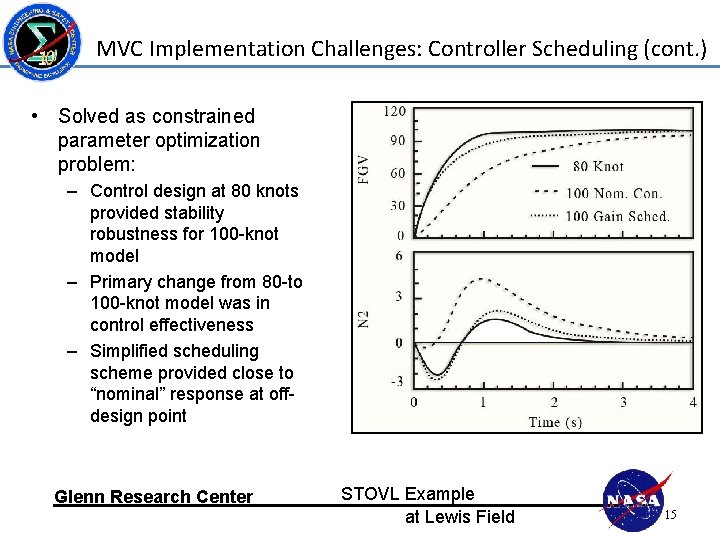
MVC Implementation Challenges: Controller Scheduling (cont. ) • Solved as constrained parameter optimization problem: – Control design at 80 knots provided stability robustness for 100 -knot model – Primary change from 80 -to 100 -knot model was in control effectiveness – Simplified scheduling scheme provided close to “nominal” response at offdesign point Glenn Research Center STOVL Example at Lewis Field 15
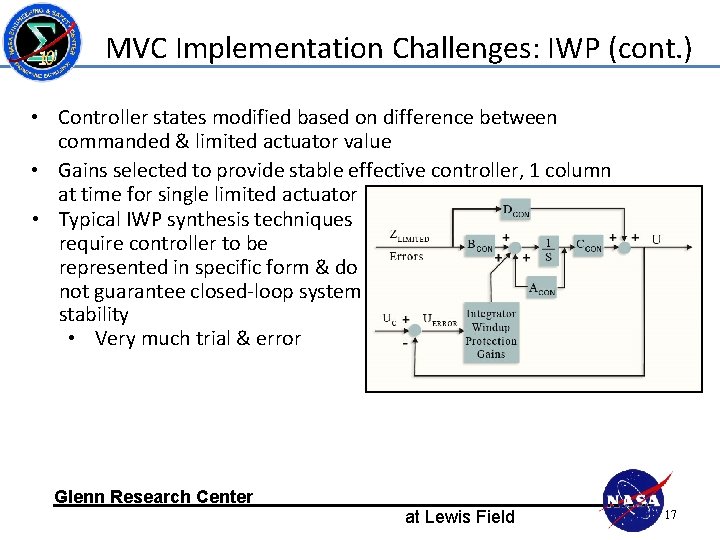
MVC Implementation Challenges: Integrator Windup Protection • What is integrator windup? – Integrator action in controller drives steady-state errors to zero – If controller outputs are limited, such as actuator position limit, integral action will continue to command higher controller output—thus controller integrator(s) will wind up – Results in deteriorated performance since controller integrator must first “unwind” when high actuator deflections are not needed – Windup can even lead to system instability • IWP Design Requirements: – Should: be memory-less; provide smooth transfer; be closed-loop stable; provide graceful performance degradation • For SISO, IWP simply requires “stopping” integration when limit is encountered • How to do this in MVC systems? Glenn Research Center at Lewis Field 16
MVC Implementation Challenges: IWP (cont. ) • Controller states modified based on difference between commanded & limited actuator value • Gains selected to provide stable effective controller, 1 column at time for single limited actuator • Typical IWP synthesis techniques require controller to be represented in specific form & do not guarantee closed-loop system stability • Very much trial & error Glenn Research Center at Lewis Field 17
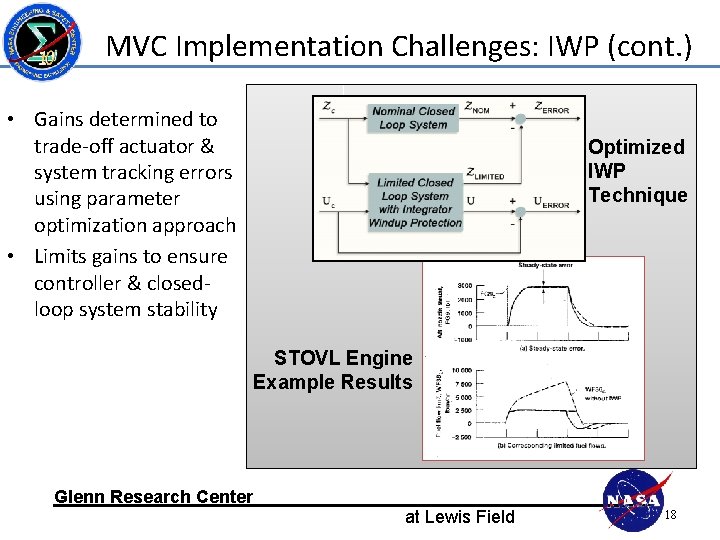
MVC Implementation Challenges: IWP (cont. ) • Gains determined to trade-off actuator & system tracking errors using parameter optimization approach • Limits gains to ensure controller & closedloop system stability Optimized IWP Technique STOVL Engine Example Results Glenn Research Center at Lewis Field 18
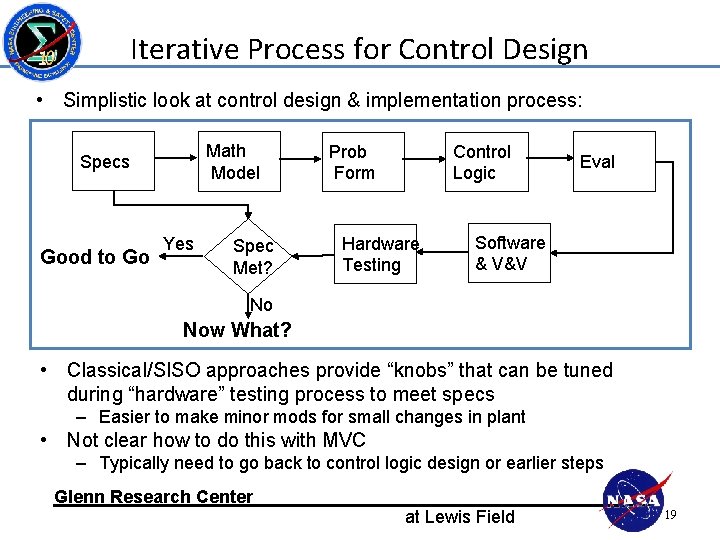
Iterative Process for Control Design • Simplistic look at control design & implementation process: Math Model Specs Good to Go Yes Spec Met? Prob Form Control Logic Hardware Testing Eval Software & V&V No Now What? • Classical/SISO approaches provide “knobs” that can be tuned during “hardware” testing process to meet specs – Easier to make minor mods for small changes in plant • Not clear how to do this with MVC – Typically need to go back to control logic design or earlier steps Glenn Research Center at Lewis Field 19
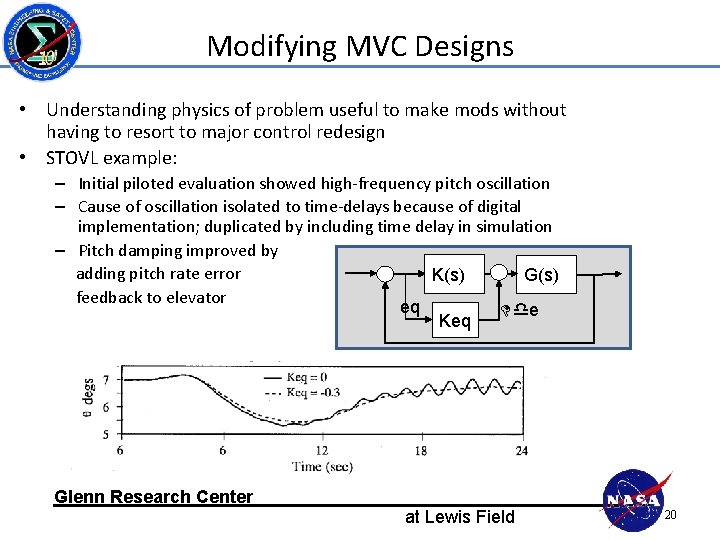
Modifying MVC Designs • Understanding physics of problem useful to make mods without having to resort to major control redesign • STOVL example: – Initial piloted evaluation showed high-frequency pitch oscillation – Cause of oscillation isolated to time-delays because of digital implementation; duplicated by including time delay in simulation – Pitch damping improved by adding pitch rate error K(s) G(s) feedback to elevator eq Dde Keq Glenn Research Center at Lewis Field 20
Conclusion • Potential benefit of multivariable control design: “Improved performance & robustness to modeling uncertainties achievable with highly complex systems” • Use MVC design with Caution: – Make sure MVC is really needed – Get good understanding of physics of problem • You cannot make 747 s fly like F-16 s, no matter how good a control engineer you are! – Make sure that synthesis problem is formulated right • Control effector blending • Nonlinearities around small perturbation model • Controller stability & order – Give thought to scheduling & IWP issues before deciding on control structure • Keep these as simple as possible – Use knowledge of system to make “smart” amendments based on test results Glenn Research Center at Lewis Field 21
QUESTIONS ? ? ? Learning from the Past, Looking to the Future
Fundamentals of Linear Stability Ken Lebsock – August 13 2014 Learning from the Past, Looking to the Future Page: 23