
Neighborhood Walkability and Bikeability Andrew Rundle Dr P
Neighborhood Walkability and Bikeability Andrew Rundle, Dr. P. H. Associate Professor of Epidemiology Mailman School of Public Health Columbia University
Neighborhood Walkability • A set of urban design characteristics that support pedestrian activity. • Low walkability neighborhoods are often discussed in reference to urban sprawl. • Low walkability is typified by: • Low population density • Poor access to public transit • Little pedestrian activity • Car dependence • Little mixing of residential and retail/commercial land uses
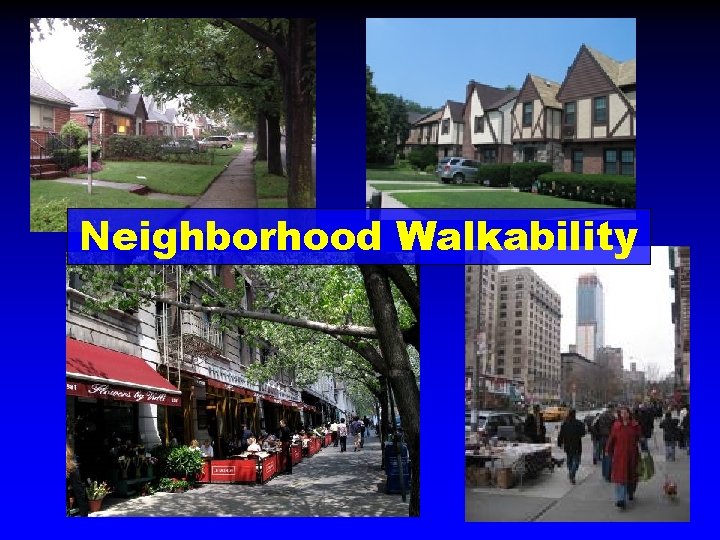
Neighborhood Walkability
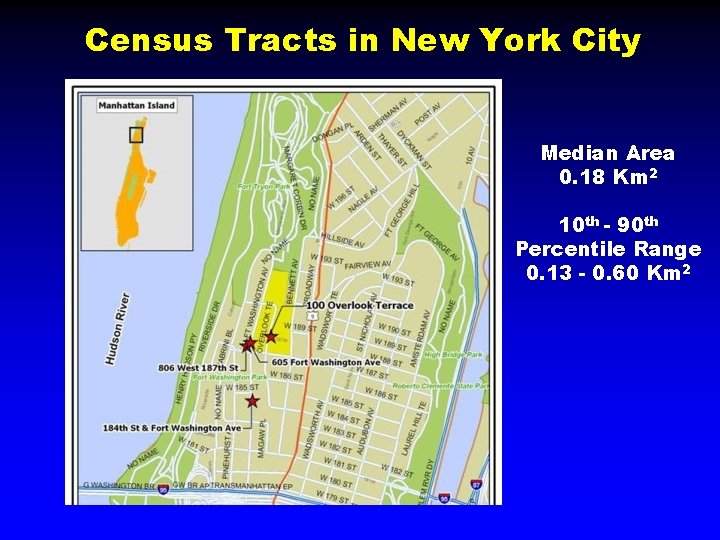
Census Tracts in New York City Median Area 0. 18 Km 2 10 th - 90 th Percentile Range 0. 13 - 0. 60 Km 2
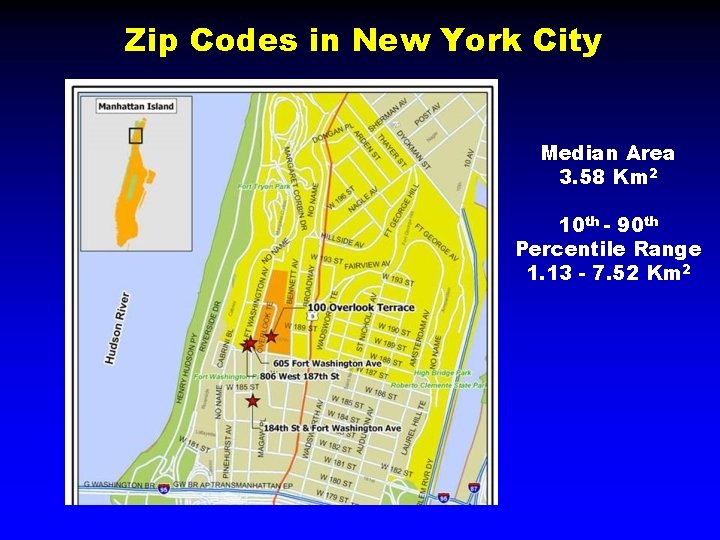
Zip Codes in New York City Median Area 3. 58 Km 2 10 th - 90 th Percentile Range 1. 13 - 7. 52 Km 2
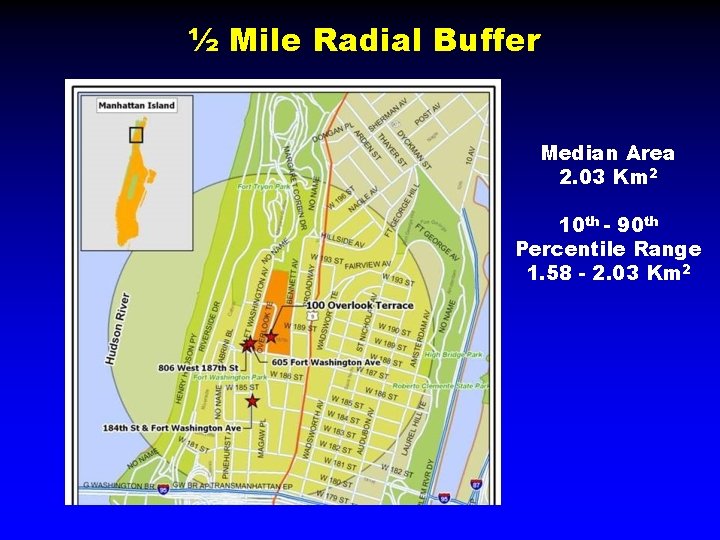
½ Mile Radial Buffer Median Area 2. 03 Km 2 10 th - 90 th Percentile Range 1. 58 - 2. 03 Km 2
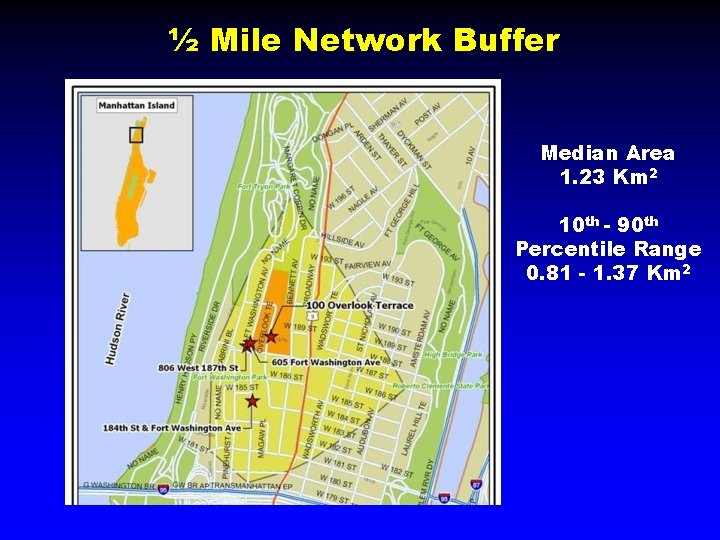
½ Mile Network Buffer Median Area 1. 23 Km 2 10 th - 90 th Percentile Range 0. 81 - 1. 37 Km 2
New York Cancer Project • A 2000 -2002 health survey of residents of New York City and the surrounding area, during which height and weight were measured. • 13, 102 subjects were geocoded to addresses within New York City. • 92% of residential census tracts in the City are represented. • 37% overweight, 28% obese.
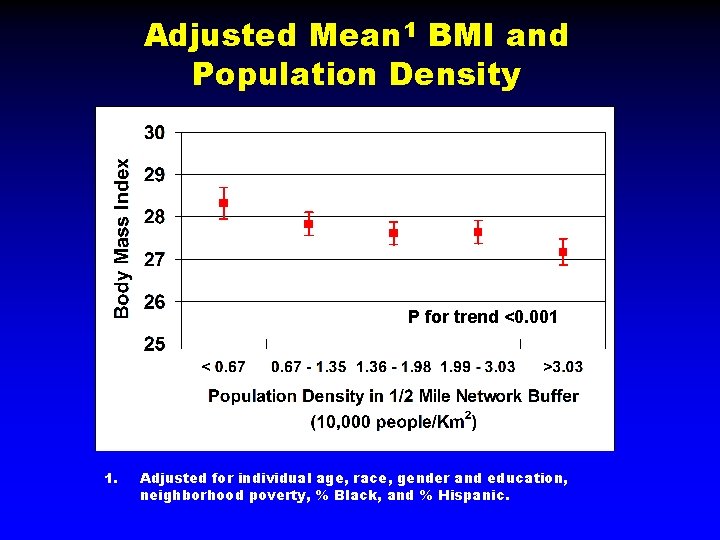
Adjusted Mean 1 BMI and Population Density P for trend <0. 001 1. Adjusted for individual age, race, gender and education, neighborhood poverty, % Black, and % Hispanic.
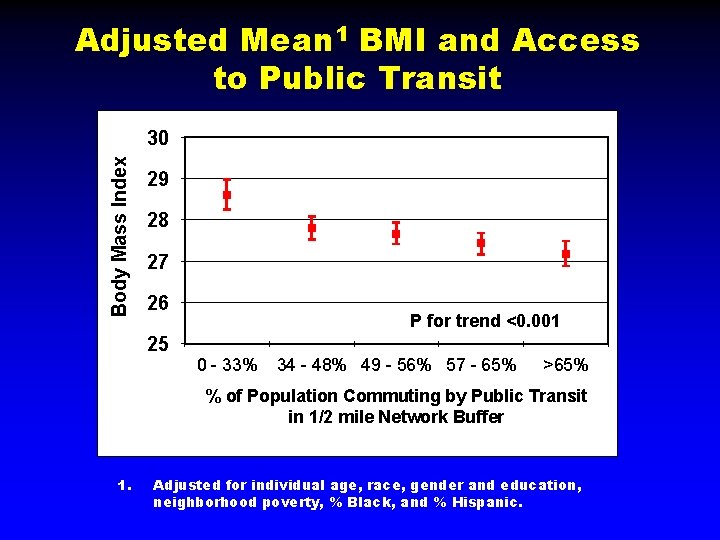
Adjusted Mean 1 BMI and Access to Public Transit Body Mass Index 30 29 28 27 26 P for trend <0. 001 25 0 - 33% 34 - 48% 49 - 56% 57 - 65% >65% % of Population Commuting by Public Transit in 1/2 mile Network Buffer 1. Adjusted for individual age, race, gender and education, neighborhood poverty, % Black, and % Hispanic.
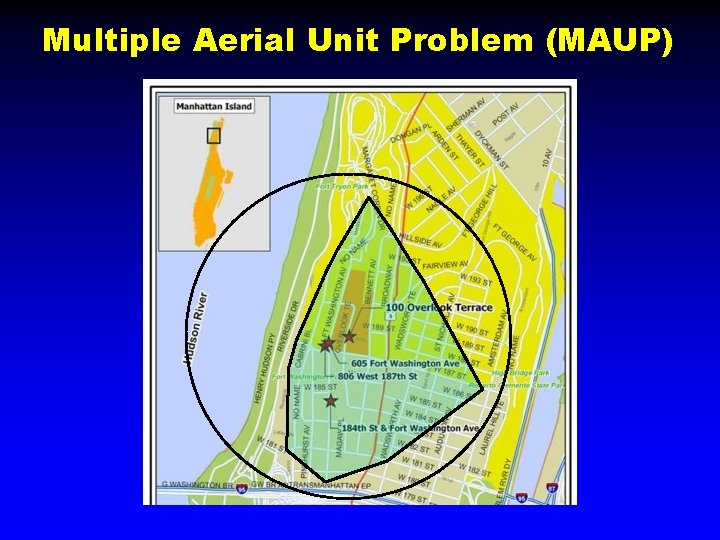
Multiple Aerial Unit Problem (MAUP)
Effect of Neighborhood Definition % Commuting by Transit
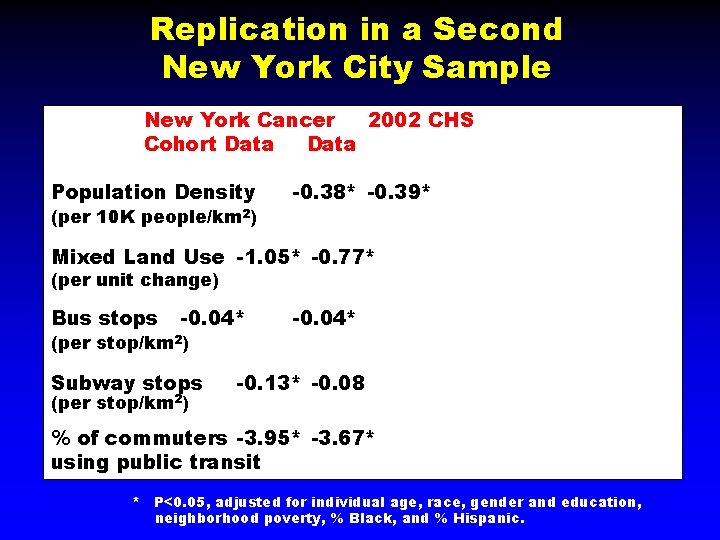
Replication in a Second New York City Sample New York Cancer 2002 CHS Cohort Data Population Density (per 10 K people/km 2) -0. 38* -0. 39* Mixed Land Use -1. 05* -0. 77* (per unit change) Bus stops -0. 04* (per stop/km 2) Subway stops (per stop/km 2) -0. 04* -0. 13* -0. 08 % of commuters -3. 95* -3. 67* using public transit * P<0. 05, adjusted for individual age, race, gender and education, neighborhood poverty, % Black, and % Hispanic.
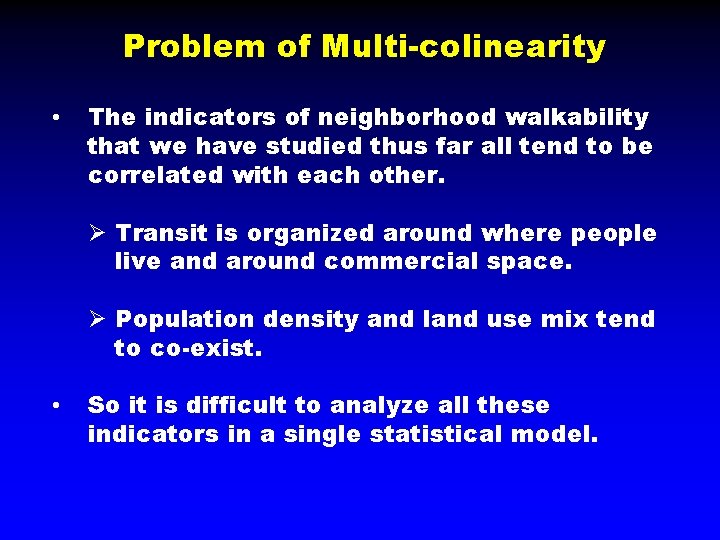
Problem of Multi-colinearity • The indicators of neighborhood walkability that we have studied thus far all tend to be correlated with each other. Ø Transit is organized around where people live and around commercial space. Ø Population density and land use mix tend to co-exist. • So it is difficult to analyze all these indicators in a single statistical model.
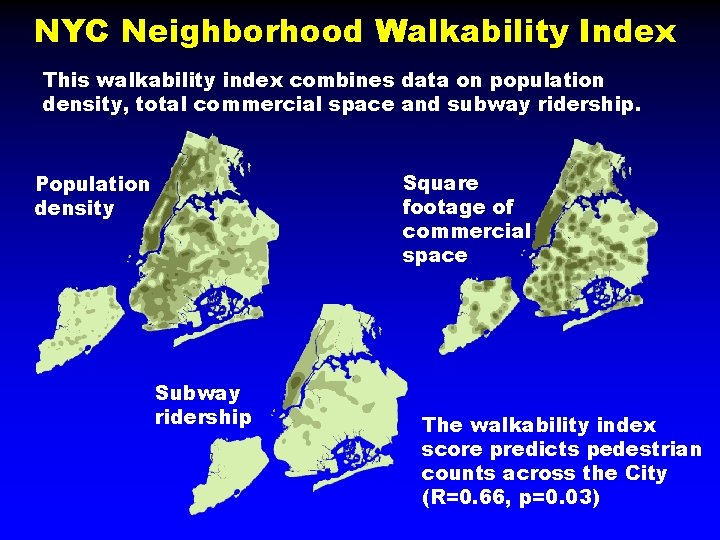
NYC Neighborhood Walkability Index This walkability index combines data on population density, total commercial space and subway ridership. Square footage of commercial space Population density Subway ridership The walkability index score predicts pedestrian counts across the City (R=0. 66, p=0. 03)
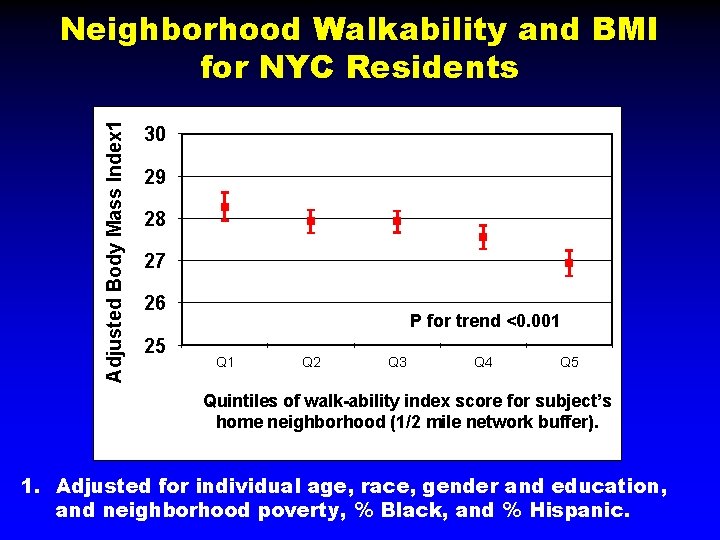
Adjusted Body Mass Index 1 Neighborhood Walkability and BMI for NYC Residents 30 29 28 27 26 25 P for trend <0. 001 Q 2 Q 3 Q 4 Q 5 Quintiles of walk-ability index score for subject’s home neighborhood (1/2 mile network buffer). 1. Adjusted for individual age, race, gender and education, and neighborhood poverty, % Black, and % Hispanic.
Active Transport and Neighborhood Walkability. • 2003 CHS respondents (N=9, 802) were asked how frequently they walked or cycled a distance of 10 blocks or more. • Subjects linked to Zip codes of residence. • Neighborhood walkability index measured for each Zip code. • 44% reported no episodes of active transport of 10 blocks or more. • Data analyzed using Zero-inflated negative binomial regression.
Modified Frank et al. , Neighborhood Walkability Index • Includes 5 urban design characteristics: 1) residential density; 2) intersection density; 3) land use mix for five types of land use - residential, office, retail, education, and entertainment; 4) subway stop density; 5) the ratio of retail building floor area to retail land area. • The index is the sum of the z-scores of each component.
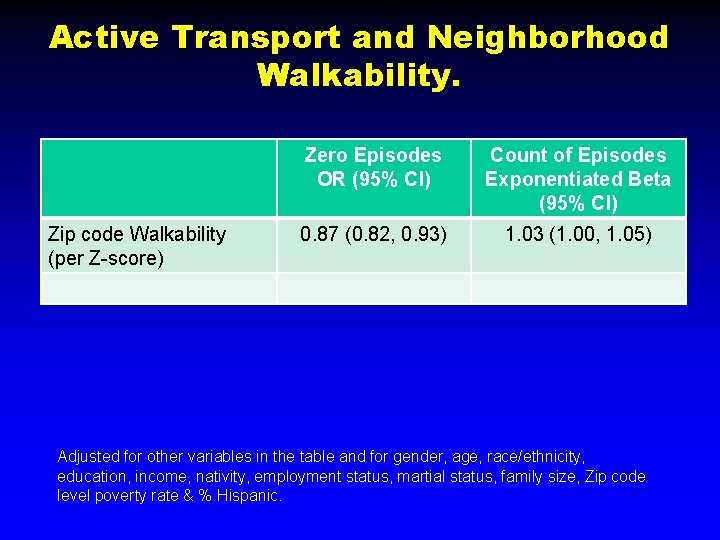
Active Transport and Neighborhood Walkability. Zip code Walkability (per Z-score) Zero Episodes OR (95% CI) Count of Episodes Exponentiated Beta (95% CI) 0. 87 (0. 82, 0. 93) 1. 03 (1. 00, 1. 05) Adjusted for other variables in the table and for gender, age, race/ethnicity, education, income, nativity, employment status, martial status, family size, Zip code level poverty rate & % Hispanic.
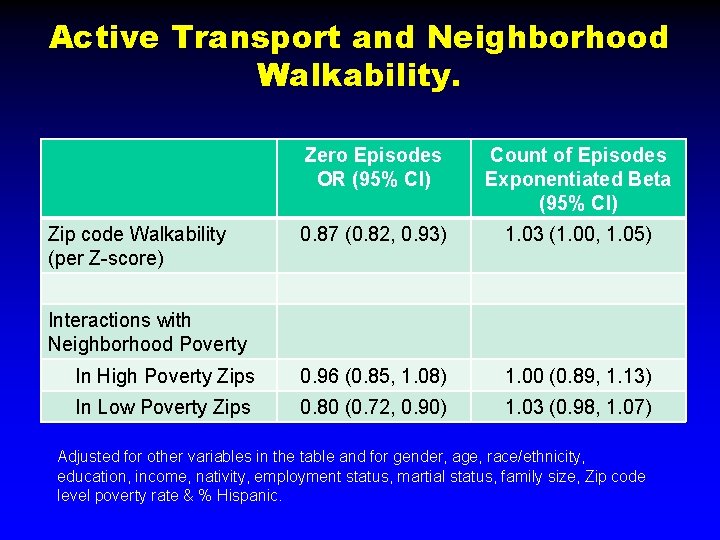
Active Transport and Neighborhood Walkability. Zero Episodes OR (95% CI) Count of Episodes Exponentiated Beta (95% CI) 0. 87 (0. 82, 0. 93) 1. 03 (1. 00, 1. 05) In High Poverty Zips 0. 96 (0. 85, 1. 08) 1. 00 (0. 89, 1. 13) In Low Poverty Zips 0. 80 (0. 72, 0. 90) 1. 03 (0. 98, 1. 07) Zip code Walkability (per Z-score) Interactions with Neighborhood Poverty Adjusted for other variables in the table and for gender, age, race/ethnicity, education, income, nativity, employment status, martial status, family size, Zip code level poverty rate & % Hispanic.
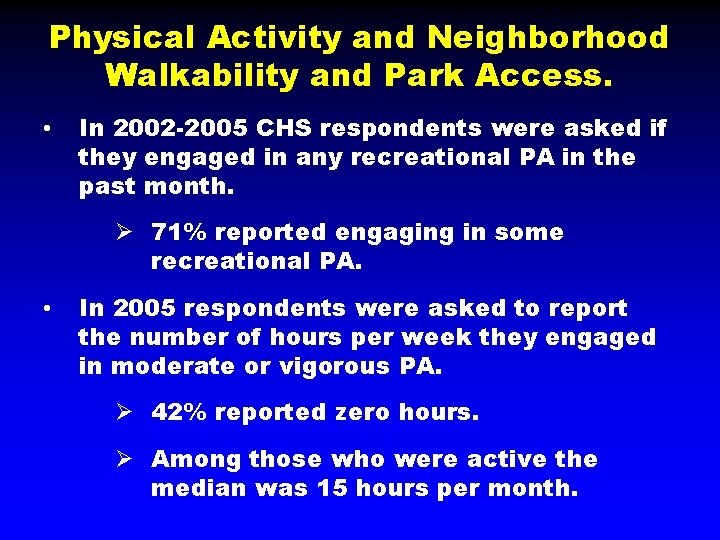
Physical Activity and Neighborhood Walkability and Park Access. • In 2002 -2005 CHS respondents were asked if they engaged in any recreational PA in the past month. Ø 71% reported engaging in some recreational PA. • In 2005 respondents were asked to report the number of hours per week they engaged in moderate or vigorous PA. Ø 42% reported zero hours. Ø Among those who were active the median was 15 hours per month.
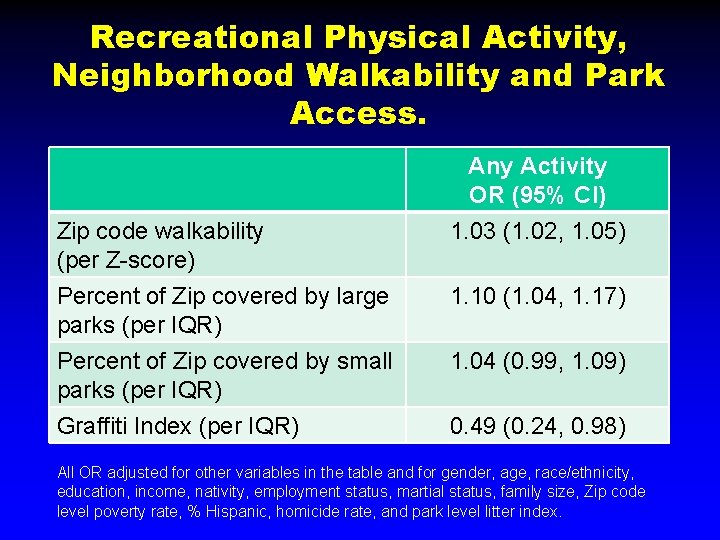
Recreational Physical Activity, Neighborhood Walkability and Park Access. Any Activity OR (95% CI) Zip code walkability (per Z-score) 1. 03 (1. 02, 1. 05) Percent of Zip covered by large parks (per IQR) Percent of Zip covered by small parks (per IQR) Graffiti Index (per IQR) 1. 10 (1. 04, 1. 17) 1. 04 (0. 99, 1. 09) 0. 49 (0. 24, 0. 98) All OR adjusted for other variables in the table and for gender, age, race/ethnicity, education, income, nativity, employment status, martial status, family size, Zip code level poverty rate, % Hispanic, homicide rate, and park level litter index.
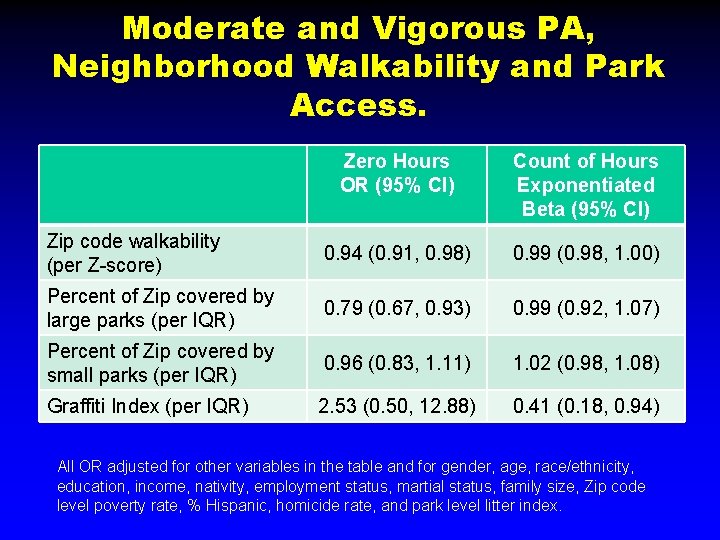
Moderate and Vigorous PA, Neighborhood Walkability and Park Access. Zero Hours OR (95% CI) Count of Hours Exponentiated Beta (95% CI) Zip code walkability (per Z-score) 0. 94 (0. 91, 0. 98) 0. 99 (0. 98, 1. 00) Percent of Zip covered by large parks (per IQR) 0. 79 (0. 67, 0. 93) 0. 99 (0. 92, 1. 07) Percent of Zip covered by small parks (per IQR) 0. 96 (0. 83, 1. 11) 1. 02 (0. 98, 1. 08) Graffiti Index (per IQR) 2. 53 (0. 50, 12. 88) 0. 41 (0. 18, 0. 94) All OR adjusted for other variables in the table and for gender, age, race/ethnicity, education, income, nativity, employment status, martial status, family size, Zip code level poverty rate, % Hispanic, homicide rate, and park level litter index.

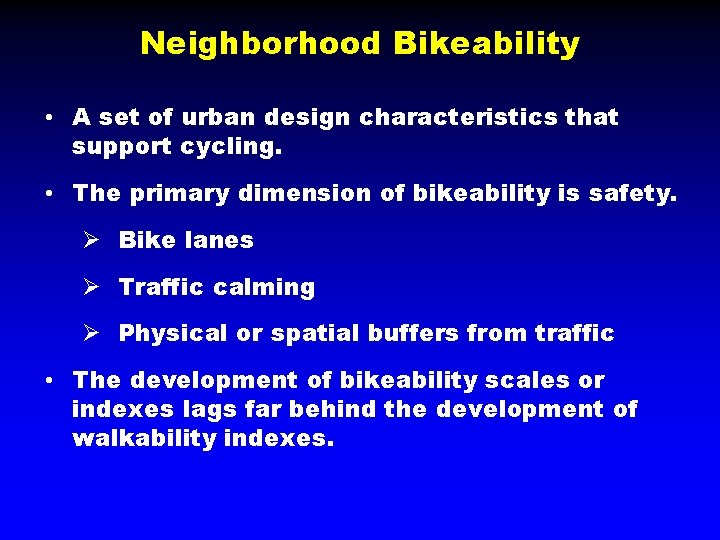
Neighborhood Bikeability • A set of urban design characteristics that support cycling. • The primary dimension of bikeability is safety. Ø Bike lanes Ø Traffic calming Ø Physical or spatial buffers from traffic • The development of bikeability scales or indexes lags far behind the development of walkability indexes.
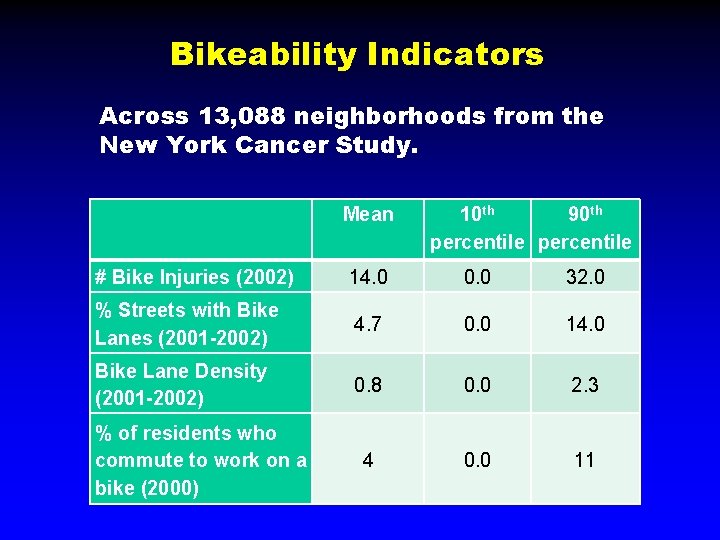
Bikeability Indicators Across 13, 088 neighborhoods from the New York Cancer Study. Mean 10 th 90 th percentile # Bike Injuries (2002) 14. 0 0. 0 32. 0 % Streets with Bike Lanes (2001 -2002) 4. 7 0. 0 14. 0 Bike Lane Density (2001 -2002) 0. 8 0. 0 2. 3 4 0. 0 11 % of residents who commute to work on a bike (2000)
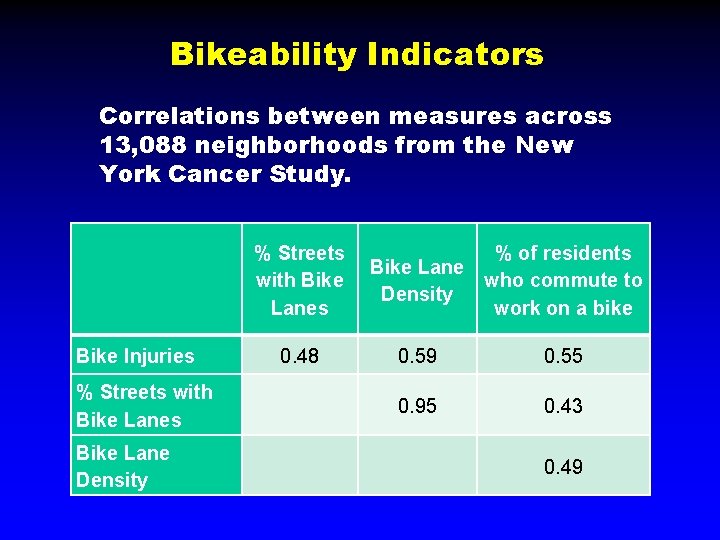
Bikeability Indicators Correlations between measures across 13, 088 neighborhoods from the New York Cancer Study. % Streets with Bike Lanes Bike Injuries % Streets with Bike Lanes Bike Lane Density 0. 48 % of residents Bike Lane who commute to Density work on a bike 0. 59 0. 55 0. 95 0. 43 0. 49
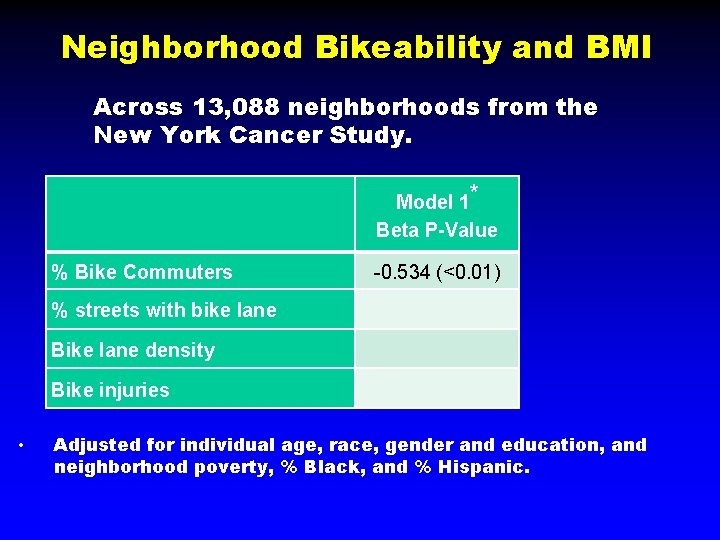
Neighborhood Bikeability and BMI Across 13, 088 neighborhoods from the New York Cancer Study. Model 1* Beta P-Value % Bike Commuters -0. 534 (<0. 01) % streets with bike lane Bike lane density Bike injuries • Adjusted for individual age, race, gender and education, and neighborhood poverty, % Black, and % Hispanic.
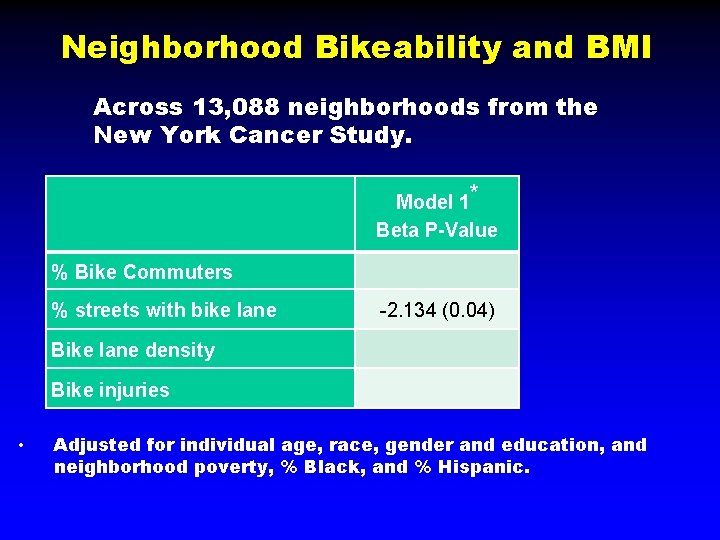
Neighborhood Bikeability and BMI Across 13, 088 neighborhoods from the New York Cancer Study. Model 1* Beta P-Value % Bike Commuters % streets with bike lane -2. 134 (0. 04) Bike lane density Bike injuries • Adjusted for individual age, race, gender and education, and neighborhood poverty, % Black, and % Hispanic.
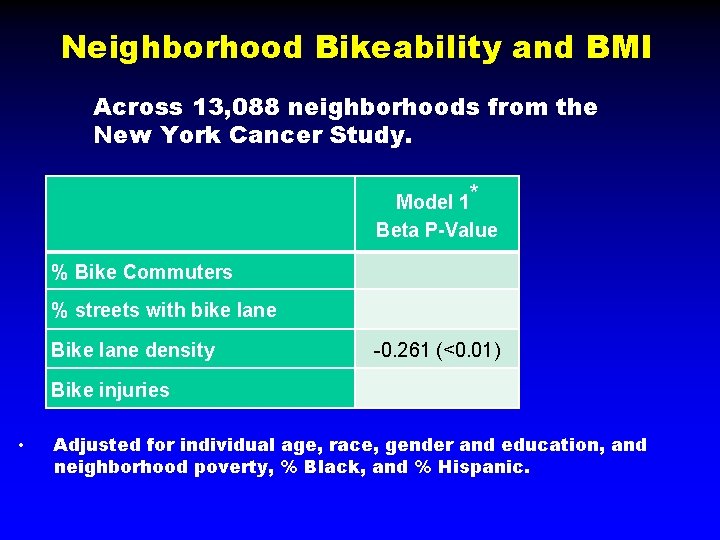
Neighborhood Bikeability and BMI Across 13, 088 neighborhoods from the New York Cancer Study. Model 1* Beta P-Value % Bike Commuters % streets with bike lane Bike lane density -0. 261 (<0. 01) Bike injuries • Adjusted for individual age, race, gender and education, and neighborhood poverty, % Black, and % Hispanic.
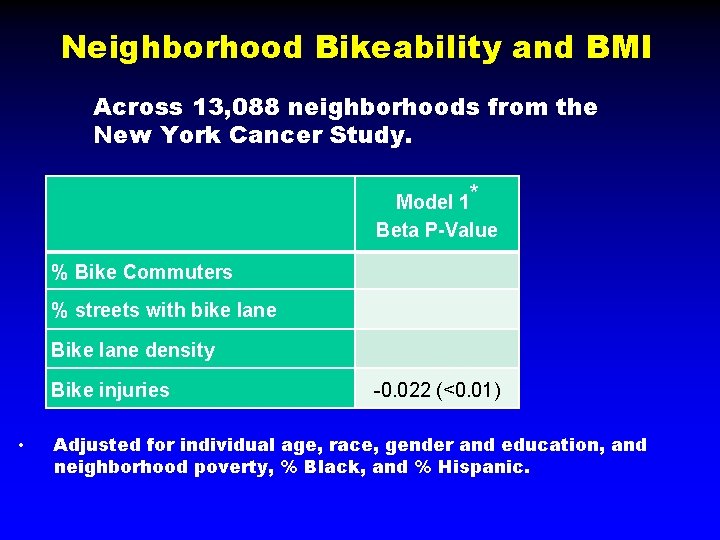
Neighborhood Bikeability and BMI Across 13, 088 neighborhoods from the New York Cancer Study. Model 1* Beta P-Value % Bike Commuters % streets with bike lane Bike lane density Bike injuries • -0. 022 (<0. 01) Adjusted for individual age, race, gender and education, and neighborhood poverty, % Black, and % Hispanic.
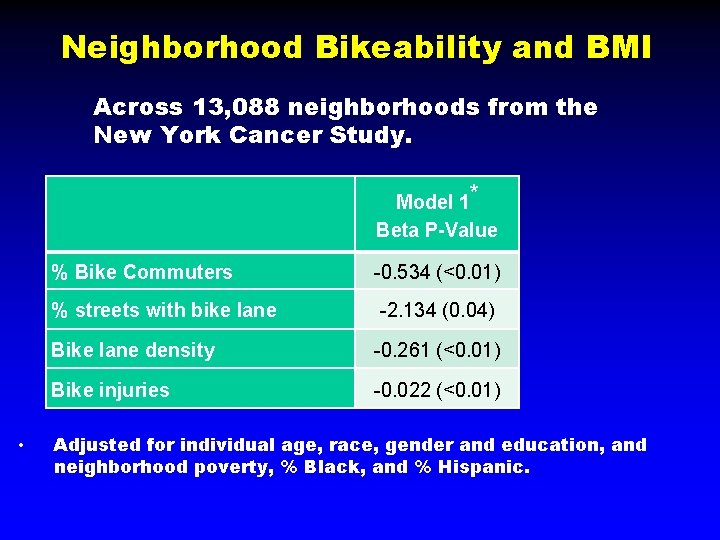
Neighborhood Bikeability and BMI Across 13, 088 neighborhoods from the New York Cancer Study. Model 1* Beta P-Value • % Bike Commuters -0. 534 (<0. 01) % streets with bike lane -2. 134 (0. 04) Bike lane density -0. 261 (<0. 01) Bike injuries -0. 022 (<0. 01) Adjusted for individual age, race, gender and education, and neighborhood poverty, % Black, and % Hispanic.
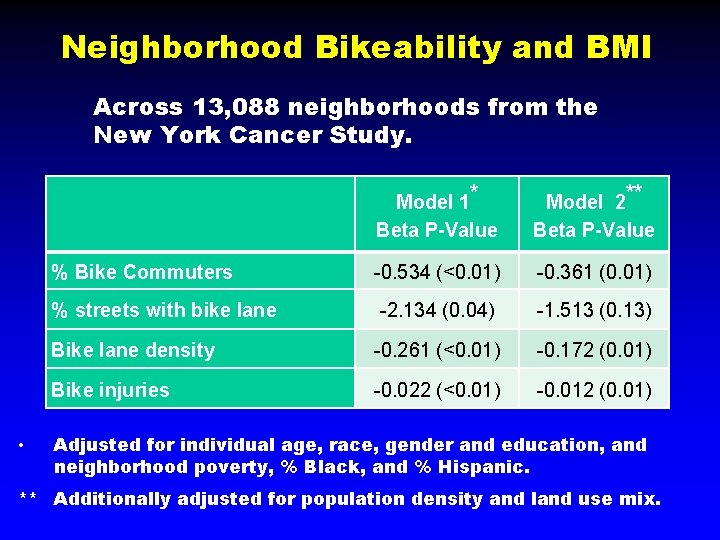
Neighborhood Bikeability and BMI Across 13, 088 neighborhoods from the New York Cancer Study. • Model 1* Beta P-Value Model 2** Beta P-Value % Bike Commuters -0. 534 (<0. 01) -0. 361 (0. 01) % streets with bike lane -2. 134 (0. 04) -1. 513 (0. 13) Bike lane density -0. 261 (<0. 01) -0. 172 (0. 01) Bike injuries -0. 022 (<0. 01) -0. 012 (0. 01) Adjusted for individual age, race, gender and education, and neighborhood poverty, % Black, and % Hispanic. ** Additionally adjusted for population density and land use mix.
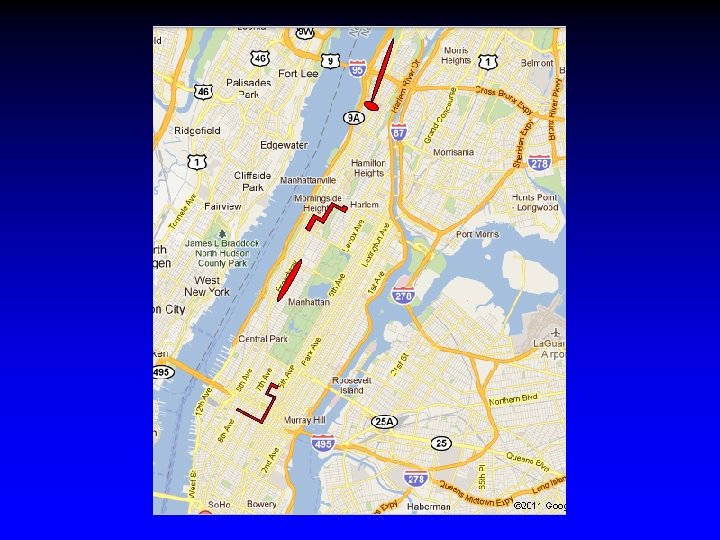
CPPW GPS and Accelerometer Study • Measure travel mode and route choice. • Measure activity and pedestrian patterns within the residential neighborhood. • Define individual’s activity spaces. • Evaluate how built environment characteristics being altered by NYC interventions affect pedestrian activity and total activity. E. g. Street trees, Intersection safety, Bike lanes, Transit, Land use, Park development, Age Friendly Streets……
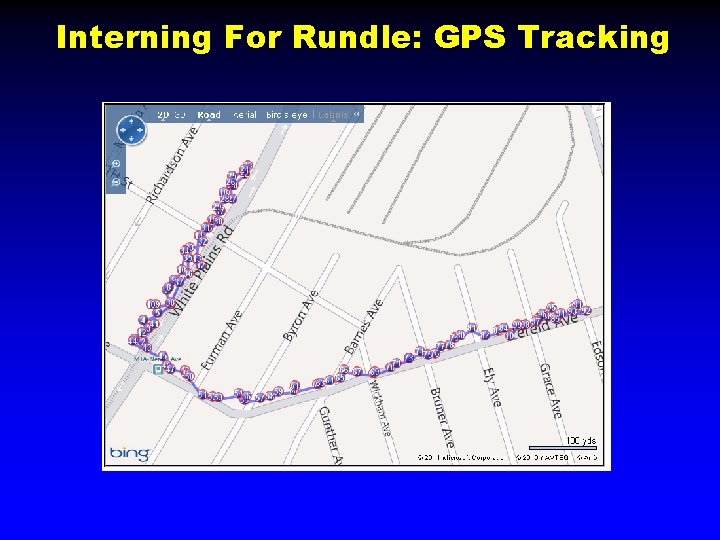
Interning For Rundle: GPS Tracking
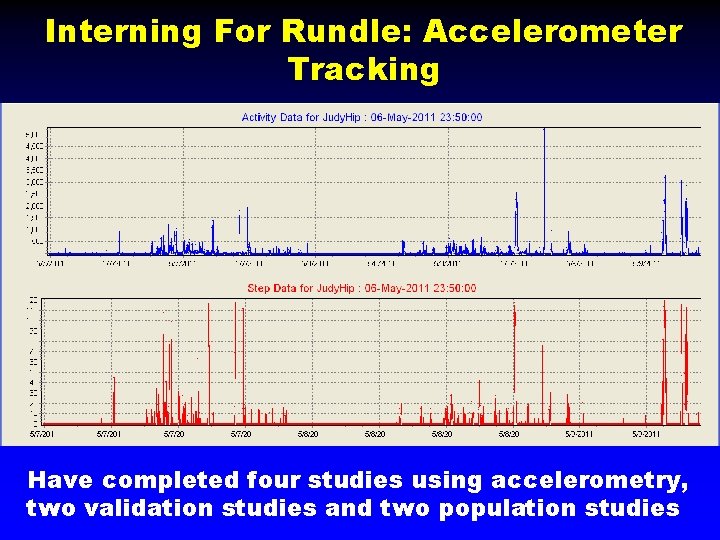
Interning For Rundle: Accelerometer Tracking Have completed four studies using accelerometry, two validation studies and two population studies
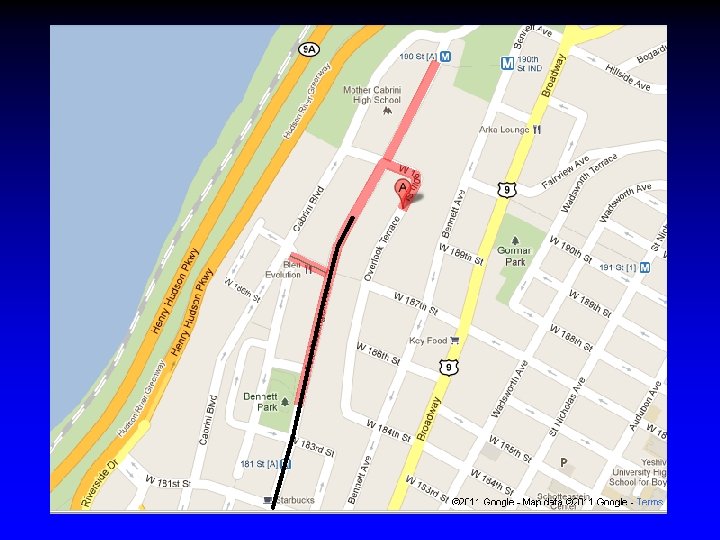
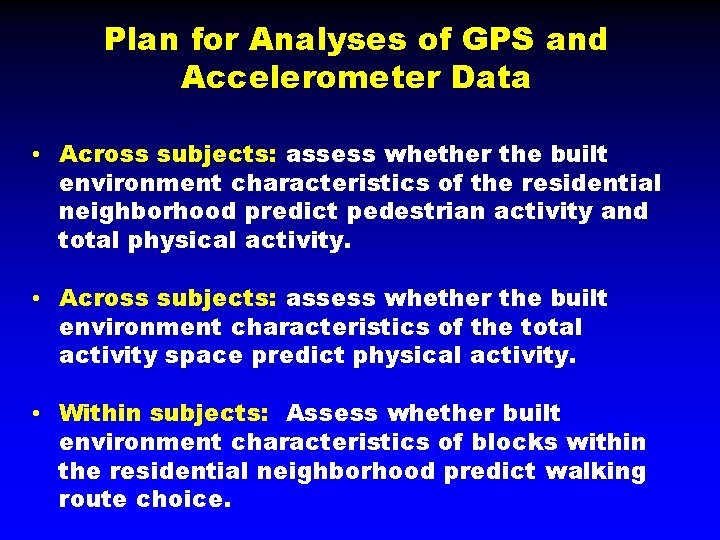
Plan for Analyses of GPS and Accelerometer Data • Across subjects: assess whether the built environment characteristics of the residential neighborhood predict pedestrian activity and total physical activity. • Across subjects: assess whether the built environment characteristics of the total activity space predict physical activity. • Within subjects: Assess whether built environment characteristics of blocks within the residential neighborhood predict walking route choice.
- Slides: 39