
Neighborhood Connectivity Adjacency Lecture 3 Lahore Leads University
Neighborhood, Connectivity, Adjacency Lecture 3 Lahore Leads University
Some Basic Relationships Between Pixels We know that an image is denoted by : f (x, y): intensity/brightness of the image at spatial coordinates (x, y) When referring to a particular pixel, we use lowercase letters, such as p and q. Lahore Leads University
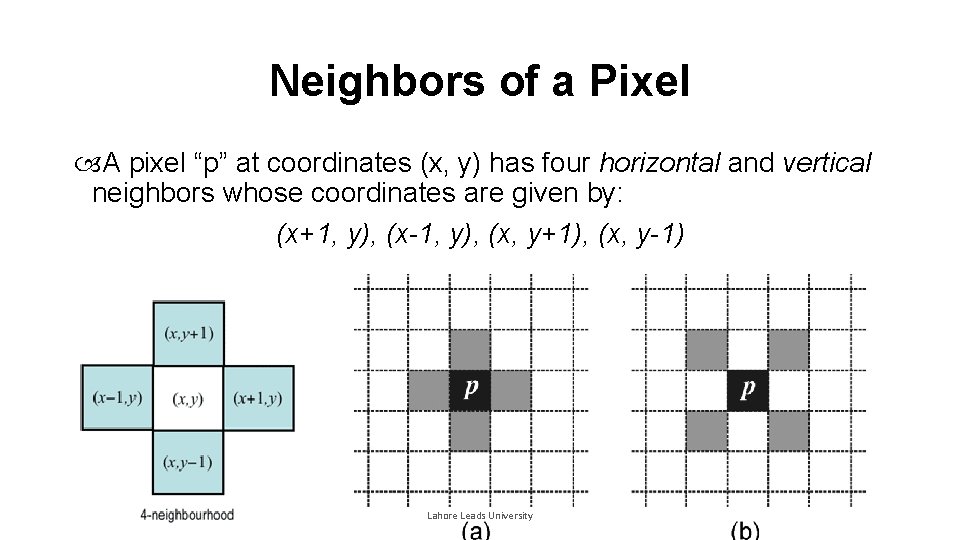
Neighbors of a Pixel A pixel “p” at coordinates (x, y) has four horizontal and vertical neighbors whose coordinates are given by: (x+1, y), (x-1, y), (x, y+1), (x, y-1) Lahore Leads University
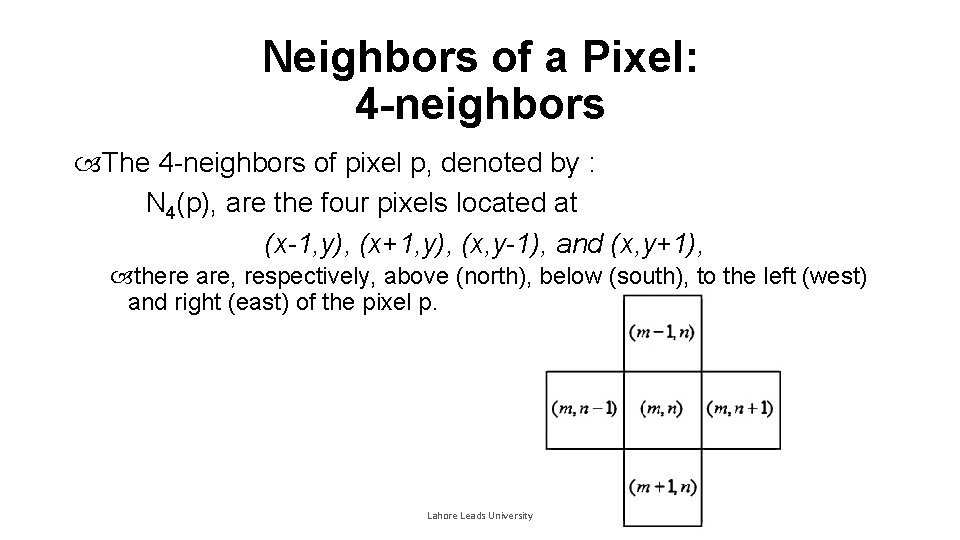
Neighbors of a Pixel: 4 -neighbors The 4 -neighbors of pixel p, denoted by : N 4(p), are the four pixels located at (x-1, y), (x+1, y), (x, y-1), and (x, y+1), there are, respectively, above (north), below (south), to the left (west) and right (east) of the pixel p. Lahore Leads University

Neighbors of a Pixel: 8 -neighbors The 8 -neighbors of pixel p, denoted by N 8 (p) , (x-1, y-1) (northwest), (x-1, y+1) (northeast), (x+1, y-1) (southwest), (x+1, y+1) (southeast) These points, together with the 4 -neighbors, are called the 8 neighbors of p, denoted by N 8(p). Lahore Leads University
Connectivity between pixels is a fundamental concept that simplifies the definition of numerous digital image concepts, such as regions and boundaries. if two pixels are connected, it must be determined: if they are neighbors and if their gray levels satisfy a specified criterion of similarity (say, if their gray levels are equal). For instance, in a binary image with values 0 and 1, two pixels may be 4 -neighbors, but they are said to be connected only if they have the same value. Lahore Leads University
Adjacency and Connectivity Let V: a set of intensity values used to define adjacency and connectivity. In a binary image, V = {1}, if we are referring to adjacency of pixels with value 1. In a gray-scale image, the idea is the same, but V typically contains more elements, for example, V = {180, 181, 182, …, 200} If the possible intensity values 0 – 255, V set can be any subset of these 256 values.
Types of Adjacency 1. 4 -adjacency: Two pixels p and q with values from V are 4 adjacent if q is in the set N 4(p). 2. 8 -adjacency: Two pixels p and q with values from V are 8 adjacent if q is in the set N 8(p). 3. m-adjacency =(mixed)

Types of Adjacency m-adjacency: Two pixels p and q with values from V are m-adjacent if : q is in N 4(p) or q is in ND(p) and the set N 4(p) ∩ N 4(q) has no pixel whose values are from V (no intersection) Important Note: the type of adjacency used must be specified
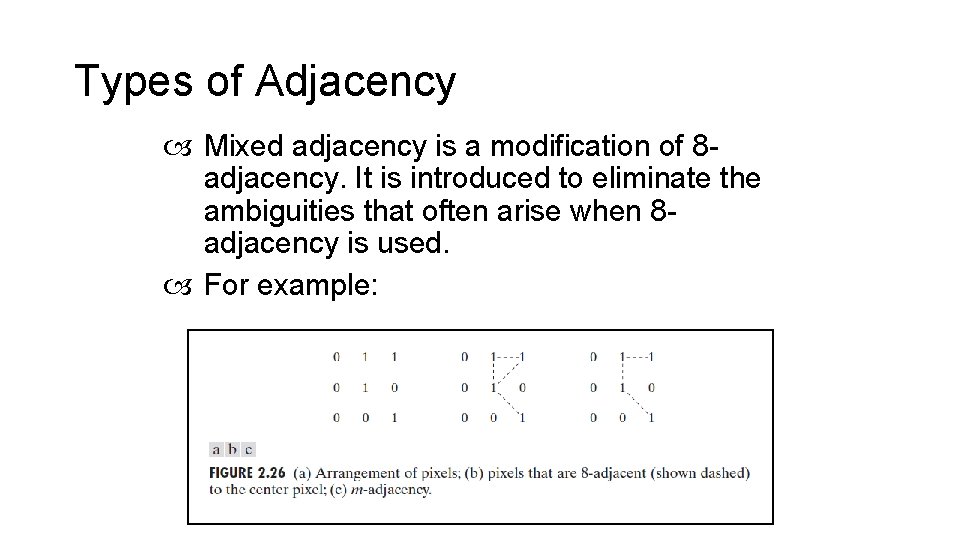
Types of Adjacency Mixed adjacency is a modification of 8 adjacency. It is introduced to eliminate the ambiguities that often arise when 8 adjacency is used. For example:
Types of Adjacency In this example, we can note that to connect between two pixels (finding a path between two pixels): In 8 -adjacency way, you can find multiple paths between two pixels While, in m-adjacency, you can find only one path between two pixels So, m-adjacency has eliminated the multiple path connection that has been generated by the 8 adjacency. Two subsets S 1 and S 2 are adjacent, if some pixel in S 1 is adjacent to some pixel in S 2. Adjacent means, either 4 -, 8 - or m-adjacency.
A Digital Path A digital path (or curve) from pixel p with coordinate (x, y) to pixel q with coordinate (s, t) is a sequence of distinct pixels with coordinates (x 0, y 0), (x 1, y 1), …, (xn, yn) where (x 0, y 0) = (x, y) and (xn, yn) = (s, t) and pixels (xi, yi) and (xi-1, yi-1) are adjacent for 1 ≤ i ≤ n n is the length of the path If (x 0, y 0) = (xn, yn), the path is closed. We can specify 4 -, 8 - or m-paths depending on the type of adjacency specified.
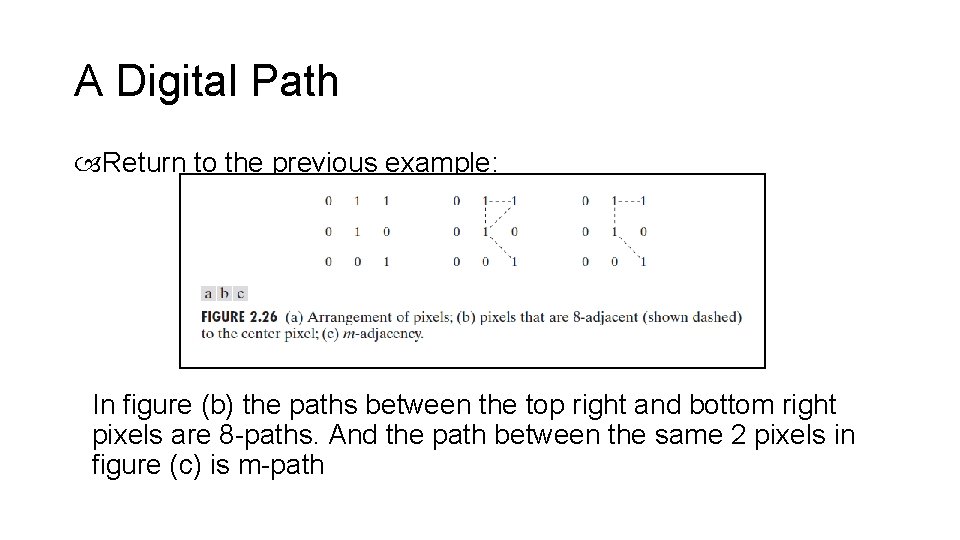
A Digital Path Return to the previous example: In figure (b) the paths between the top right and bottom right pixels are 8 -paths. And the path between the same 2 pixels in figure (c) is m-path
Connectivity Let S represent a subset of pixels in an image, two pixels p and q are said to be connected in S if there exists a path between them consisting entirely of pixels in S. For any pixel p in S, the set of pixels that are connected to it in S is called a connected component of S. If it only has one connected component, then set S is called a connected set.
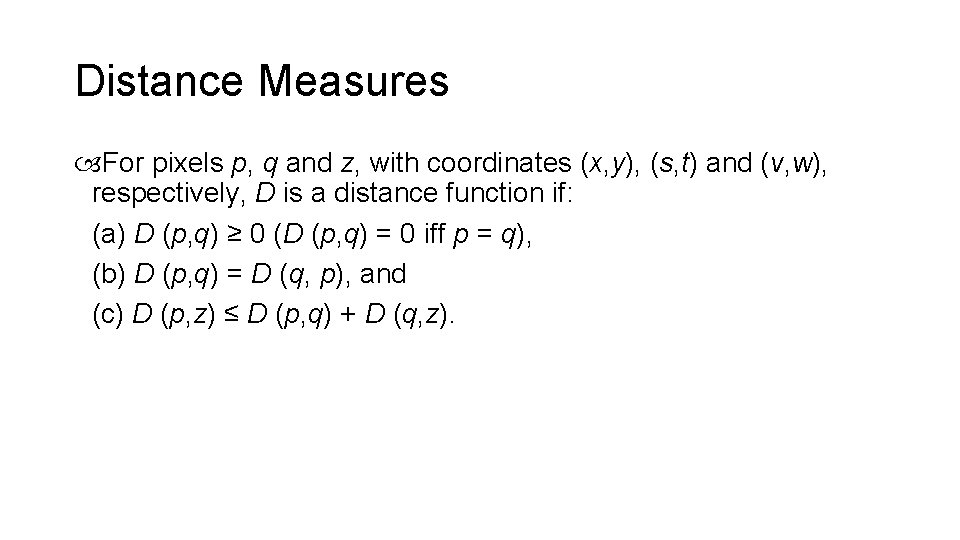
Distance Measures For pixels p, q and z, with coordinates (x, y), (s, t) and (v, w), respectively, D is a distance function if: (a) D (p, q) ≥ 0 (D (p, q) = 0 iff p = q), (b) D (p, q) = D (q, p), and (c) D (p, z) ≤ D (p, q) + D (q, z).
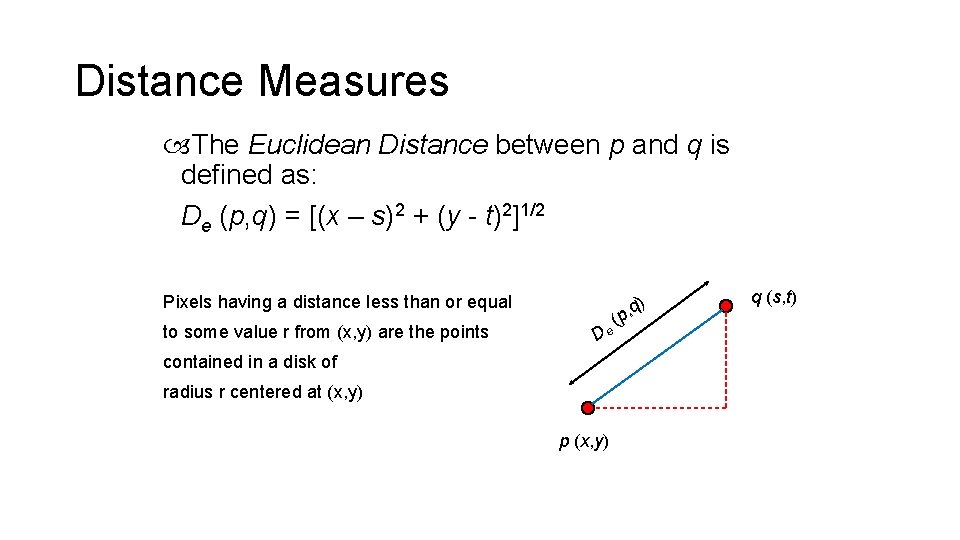
Distance Measures The Euclidean Distance between p and q is defined as: De (p, q) = [(x – s)2 + (y - t)2]1/2 Pixels having a distance less than or equal to some value r from (x, y) are the points De contained in a disk of radius r centered at (x, y) p (x, y) (p ) , q q (s, t)
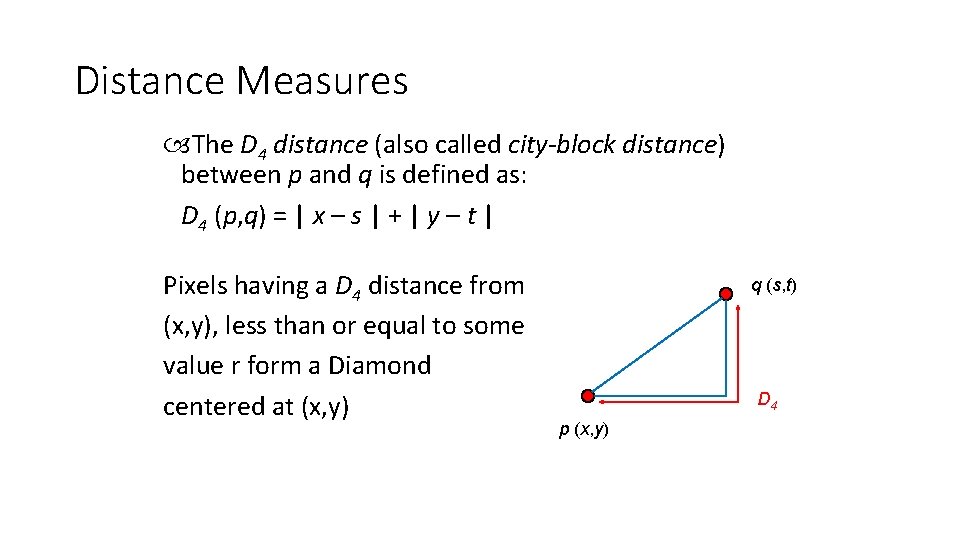
Distance Measures The D 4 distance (also called city-block distance) between p and q is defined as: D 4 (p, q) = | x – s | + | y – t | Pixels having a D 4 distance from (x, y), less than or equal to some value r form a Diamond centered at (x, y) q (s, t) D 4 p (x, y)
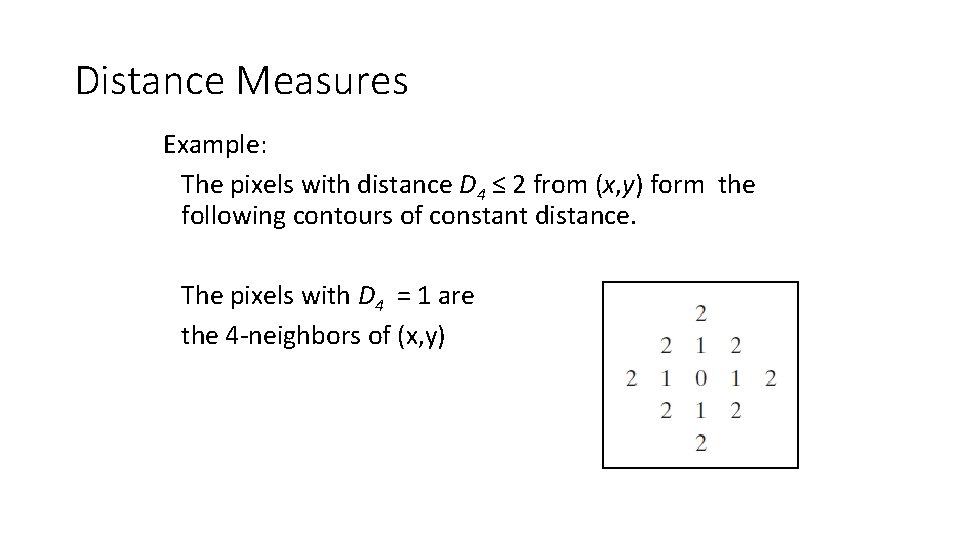
Distance Measures Example: The pixels with distance D 4 ≤ 2 from (x, y) form the following contours of constant distance. The pixels with D 4 = 1 are the 4 -neighbors of (x, y)
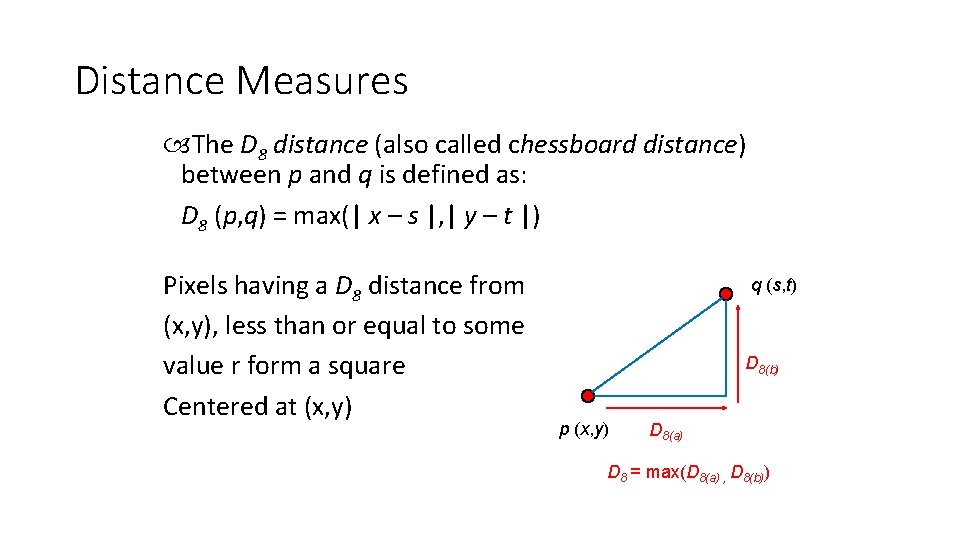
Distance Measures The D 8 distance (also called chessboard distance) between p and q is defined as: D 8 (p, q) = max(| x – s |, | y – t |) Pixels having a D 8 distance from (x, y), less than or equal to some value r form a square Centered at (x, y) q (s, t) D 8(b) p (x, y) D 8(a) D 8 = max(D 8(a) , D 8(b))
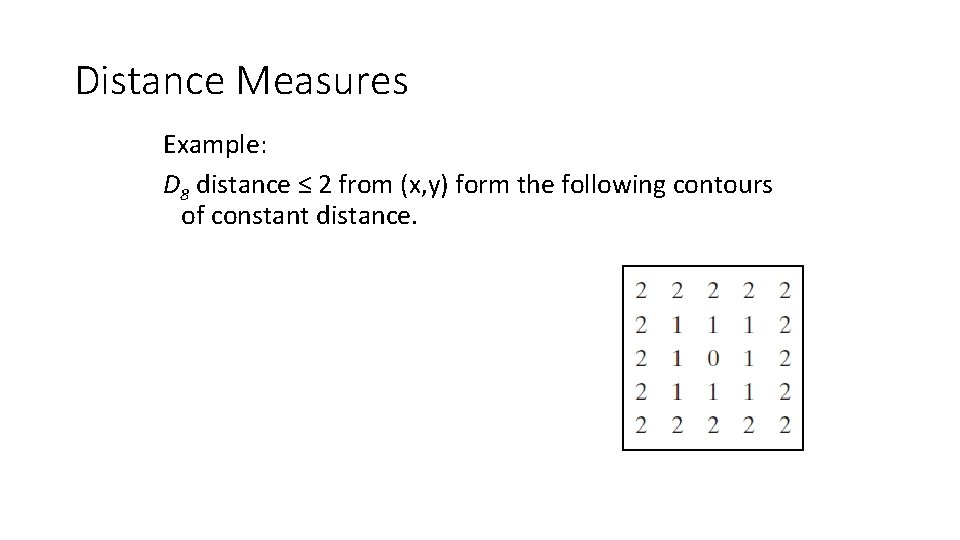
Distance Measures Example: D 8 distance ≤ 2 from (x, y) form the following contours of constant distance.
Distance Measures Dm distance: is defined as the shortest m-path between the points. In this case, the distance between two pixels will depend on the values of the pixels along the path, as well as the values of their neighbors.
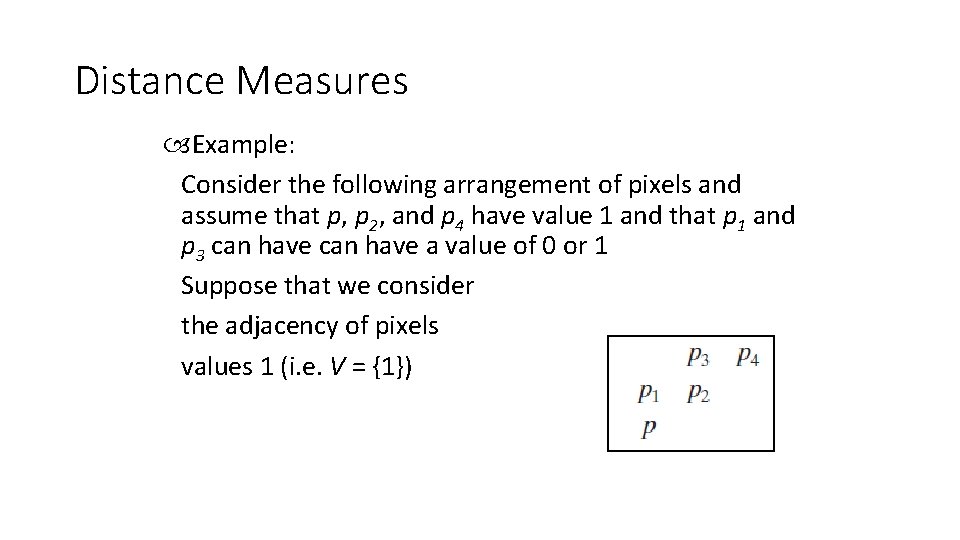
Distance Measures Example: Consider the following arrangement of pixels and assume that p, p 2, and p 4 have value 1 and that p 1 and p 3 can have a value of 0 or 1 Suppose that we consider the adjacency of pixels values 1 (i. e. V = {1})
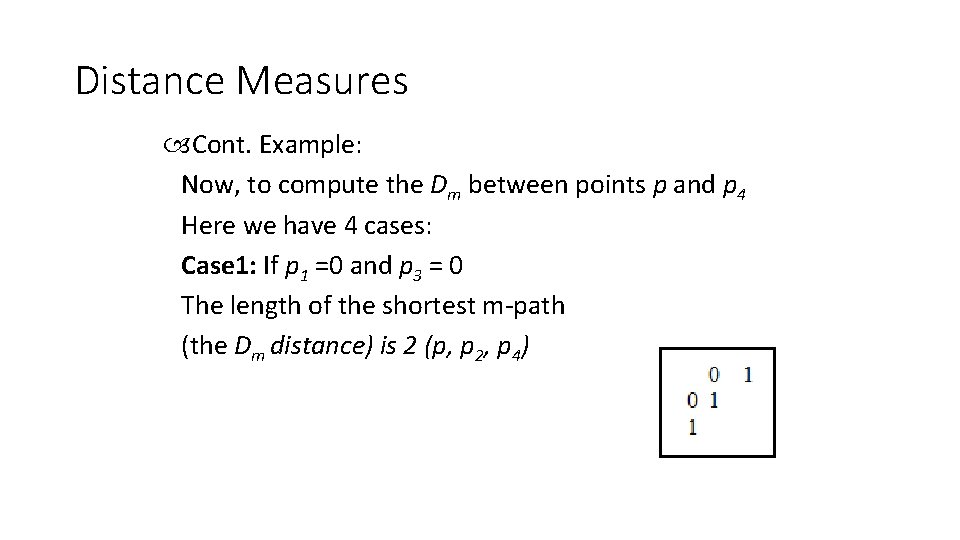
Distance Measures Cont. Example: Now, to compute the Dm between points p and p 4 Here we have 4 cases: Case 1: If p 1 =0 and p 3 = 0 The length of the shortest m-path (the Dm distance) is 2 (p, p 2, p 4)
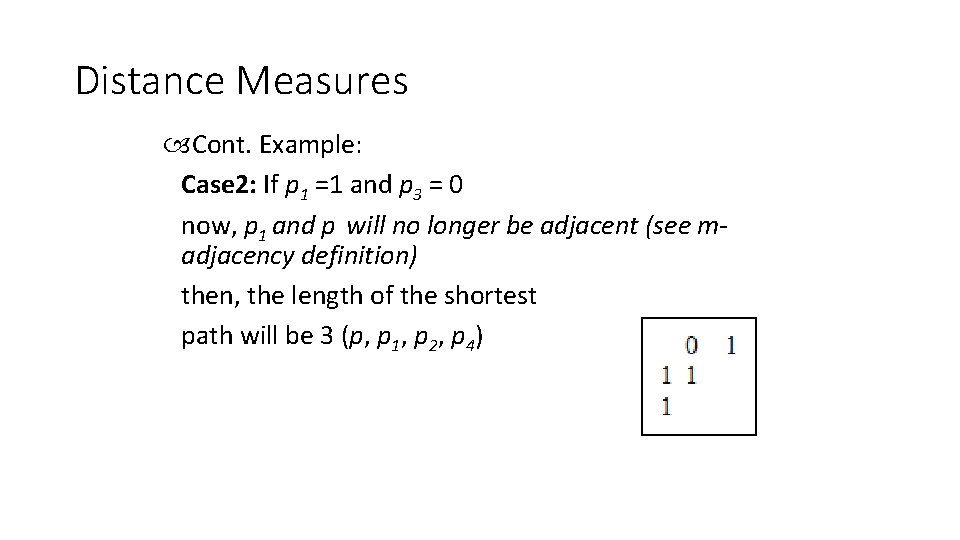
Distance Measures Cont. Example: Case 2: If p 1 =1 and p 3 = 0 now, p 1 and p will no longer be adjacent (see madjacency definition) then, the length of the shortest path will be 3 (p, p 1, p 2, p 4)
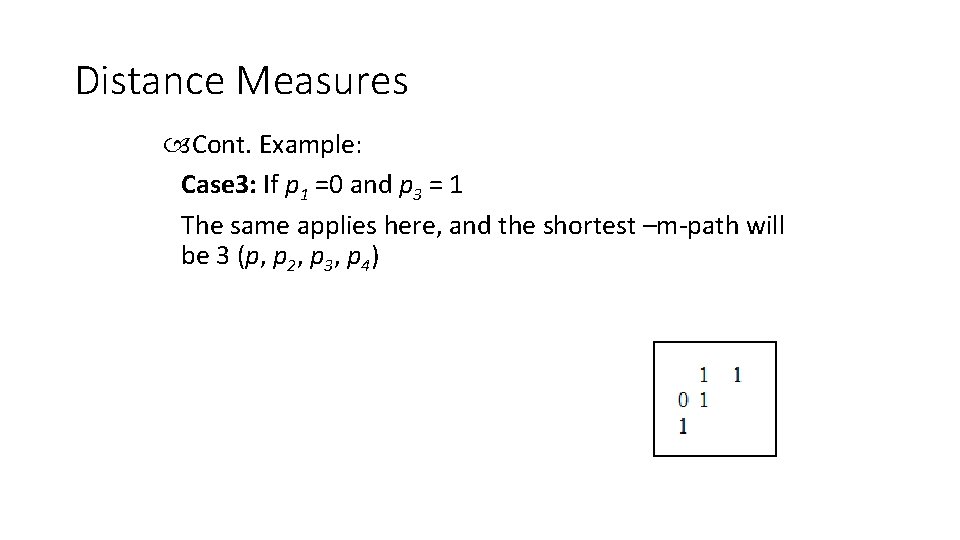
Distance Measures Cont. Example: Case 3: If p 1 =0 and p 3 = 1 The same applies here, and the shortest –m-path will be 3 (p, p 2, p 3, p 4)
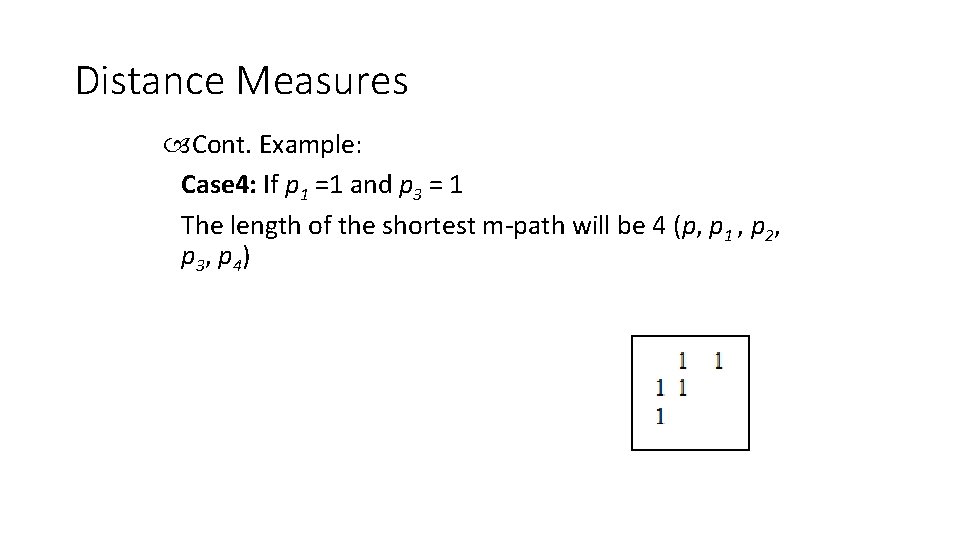
Distance Measures Cont. Example: Case 4: If p 1 =1 and p 3 = 1 The length of the shortest m-path will be 4 (p, p 1 , p 2, p 3 , p 4 )
- Slides: 26