
Negotiation The Mind and Heart Chapter 4 Dr

- Slides: 33
Negotiation: The Mind and Heart Chapter 4 Dr. Senem SÖNMEZ SELÇUK
2 One thing that business scholars and business people are in complete agreement on is that everyone negotiates nearly every day. “Getting to Yes” (Fisher & Ury. 1981) begins by stating, "Like it or not, you are a negotiator. . . Everyone negotiates something everyday". Lax and Sebenius in “The Manager as Negotiator” state that "Negotiating is a way of life for managers. . . when managers deal with their superiors, boards of directors, even legislators". INTF 356 - International Sales & Negotiation Techniques
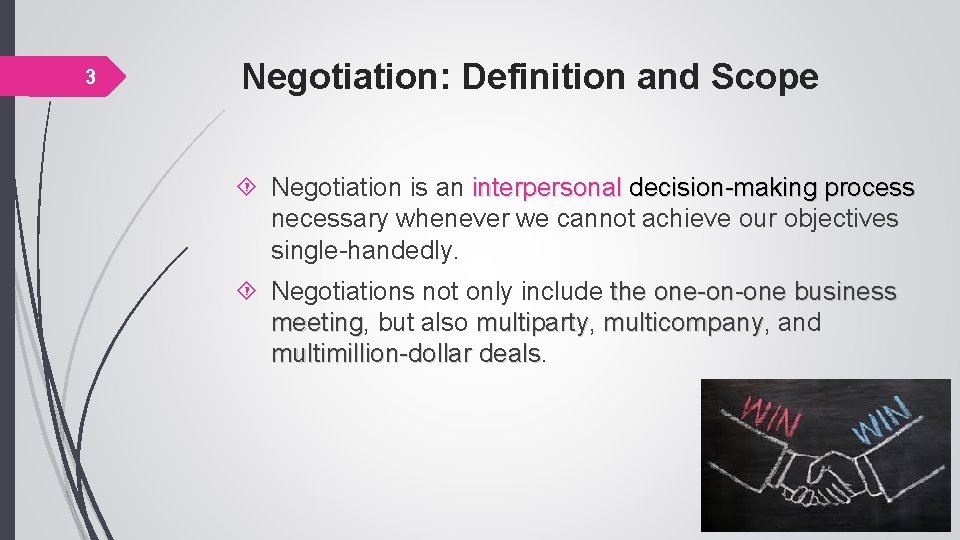
3 Negotiation: Definition and Scope Negotiation is an interpersonal decision-making process necessary whenever we cannot achieve our objectives single-handedly. Negotiations not only include the one-on-one business meeting, meeting but also multiparty, multiparty multicompany, multicompany and multimillion-dollar deals
4 People negotiate in their personal life (e. g. , with their spouses, children, school teachers, neighbors) as well as in their business life. Thus, the scope of negotiation ranges from one-on-one to highly complex multiparty and multination interactions. In the business world, people negotiate at multiple levels and contexts —within departmental or business units, between departments, between companies, and even across industries. INTF 356 - International Sales & Negotiation Techniques
Why Should Negotiation Be a Core Management Competency 5 Negotiation skills are increasingly important for executives, leaders, and managers in the business world. The five key reasons for the importance of negotiation skills include 1) 2) 3) 4) 5) Dynamic nature of business Interdependence Competition Information age Globalization INTF 356 - International Sales & Negotiation Techniques
6 1) Dynamic nature of business Mobility and flexibility are the dictates of the new world of work. The dynamic, changing nature of business means that people must negotiate and renegotiate their existence in organizations throughout the duration of their careers. People must continually create possibilities, integrate their interests with others, and recognize the inevitability of competition both within and between companies. INTF 356 - International Sales & Negotiation Techniques
7 In truth, negotiation comes into play when people participate in important meetings, get new assignments, head a team, participate in a reorganization process, and set priorities for their work unit. Negotiation should be second nature to the business manager, manager but often it is not. INTF 356 - International Sales & Negotiation Techniques
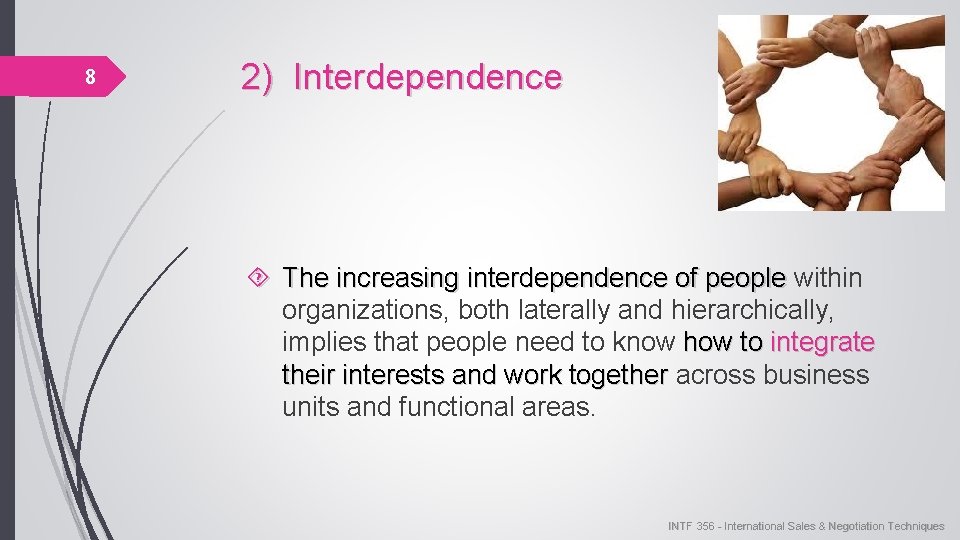
8 2) Interdependence The increasing interdependence of people within organizations, both laterally and hierarchically, implies that people need to know how to integrate their interests and work together across business units and functional areas. INTF 356 - International Sales & Negotiation Techniques
9 For example, when Chrysler and Mercedes Benz merged in 1998, 1998 there was extreme reluctance among different groups in the company to utilize synergies. For the first few years, Mercedes executives closely guarded their parts and designs for fear of eroding the Mercedes mystique. And Chrysler engineers tried to preserve some independence, even though it meant reinventing the wheel. INTF 356 - International Sales & Negotiation Techniques
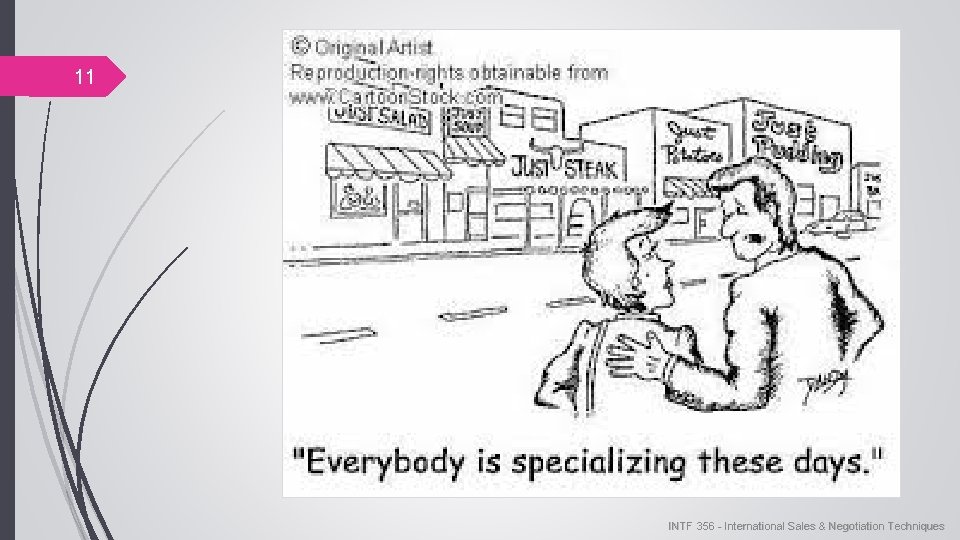
10 This reluctance not only occurs within companies, companies as people from different departments and units integrate their knowledge to create a product or service, but it also occurs between people from different companies, as is the case with strategic alliances. The increasing degree of specialization and expertise in the business world implies that people are more and more dependent on others to supply the components for a complete service or product. INTF 356 - International Sales & Negotiation Techniques
11 INTF 356 - International Sales & Negotiation Techniques
12 3) Competition Business is increasingly competitive. In today's economy, a few large companies are emerging as dominant players in the biggest markets. These industry leaders often enjoy vast economies of scale and earn tremendous profits. The losers are often left with little in the way of a market, let alone a marketable product. INTF 356 - International Sales & Negotiation Techniques
13 This reality means that companies must be experts in competitive environments. Managers not only need to function as advocates for their products and services, but they must also recognize the competition that is inevitable between companies and, in some cases, between units within a given company. Understanding how to navigate this competitive environment is essential for successful negotiation. INTF 356 - International Sales & Negotiation Techniques
14 4) Information Age The information age also provides special opportunities and challenges for the manager as negotiator. The information age has created a culture of 24/7 availability. With technology that makes it possible to communicate with people anywhere in the world, managers are expected to negotiate at a moment's notice. INTF 356 - International Sales & Negotiation Techniques
15 5) Globalization Most managers must effectively cross cultural boundaries in order to do their jobs. Setting aside obvious language and currency issues, issues globalization presents challenges in terms of different norms of communication Managers need to develop negotiation skills that can be successfully employed with people of different nationalities, backgrounds, and styles of communication. INTF 356 - International Sales & Negotiation Techniques
16 Consequently, negotiators who have developed a bargaining style that works only within a narrow subset of the business world will suffer unless they can broaden their negotiation skills to effectively work with different people across functional units, industries, and cultures. It is a challenge to develop a negotiation skill set general enough to be used across different contexts, groups, and continents, but specialized enough to provide meaningful behavioral strategies in any given situation. INTF 356 - International Sales & Negotiation Techniques
17 The Sandtraps of Negotiation Four major shortcomings in negotiation: 1) Leaving money on the table (“lose-lose” negotiation): occurs when negotiators fail to recognize and exploit win-win potential. 2) Settling for too little (the “winner’s curse”): occurs when negotiators make too-large concessions, concessions resulting in a too-small share of the bargaining pie. INTF 356 - International Sales & Negotiation Techniques
18 3) Walking away from the table: occurs when negotiators reject terms offered by the other party that are demonstrably better than any other option available to them. (Sometimes this shortcoming is traceable to hubris or overweening pride; other times, it results from gross miscalculation. ) 4) Settling for terms worse than your alternative (the “agreement bias”): occurs when negotiators feel obligated to reach agreement even when the settlement terms are not as good as their other alternatives. INTF 356 - International Sales & Negotiation Techniques
19 Why are People Ineffective Negotiators? The dramatic instances of lose-lose outcomes, outcomes the winner's curse, curse walking away from the table, table and the agreement bias raise the question of why people are not more effective at the bargaining table. The reason is not due to a lack of motivation or intelligence on the part of negotiators. The problem is rooted in three fundamental problems: Faulty Feedback Satisficing Self-Reinforcing Incompetence INTF 356 - International Sales & Negotiation Techniques
20 1) Faulty Feedback Most of us have plenty of opportunities to negotiate, negotiate but little opportunity to learn how to negotiate effectively. As we will see, arguably the most important component of learning is feedback Three things about feedback are key: accuracy, accuracy immediacy, immediacy and specificity The problem is not lack of experience but a shortage of timely and accurate feedback. INTF 356 - International Sales & Negotiation Techniques
21 The absence of feedback results in two human biases that further prevent negotiators from optimally benefiting from experience. The first problem is the confirmation bias, bias or the tendency for people to see what they want to see when appraising their own performance. The confirmation bias leads individuals to selectively seek information that confirms what they believe is true. Whereas the confirmation bias may seem perfectly harmless, it results in a myopic view of reality and can hinder learning. INTF 356 - International Sales & Negotiation Techniques
22 A second problem associated with the absence of relevant and diagnostic feedback is egocentrism, egocentrism which is the tendency for people to view their experiences in a way that is flattering or fulfilling for themselves. For example, this potentially inaccurate view may increase a manager's self-esteem: self-esteem however, in the long run it does a disservice by preventing a manager from learning effectively. INTF 356 - International Sales & Negotiation Techniques
23 2) Satisficing The second reason why people often fall short in negotiation is due to the human tendency to satisfice. Satisficing is the opposite of optimizing In a negotiation situation, it is important to optimize one's strategies by setting high aspirations and attempting to achieve as much as possible; possible in contrast, when people satisfice, they settle for something less than they could otherwise have. INTF 356 - International Sales & Negotiation Techniques
24 3) Self-Reinforcing Incompetence To achieve and maintain effectiveness in the business world, people must have insight into their limitations. The same is true for negotiation. However, most people are "blissfully unaware of their own incompetence" Moreover, it creates a cycle in which the lack of skill deprives them not only of the ability to produce correct responses, but also of the expertise necessary to surmise that they are not producing them. INTF 356 - International Sales & Negotiation Techniques
25 Related to the principle of self-reinforcing incompetence is the fact that people are reluctant to change their behavior and experiment with new courses of action because of the risks associated with experimentation. In short, the fear of losing keeps people from experimenting with change. Negotiators instead rationalize their behavior in a selfperpetuating fashion. The fear of making mistakes may result in a manager's inability to improve his or her negotiation skills. INTF 356 - International Sales & Negotiation Techniques
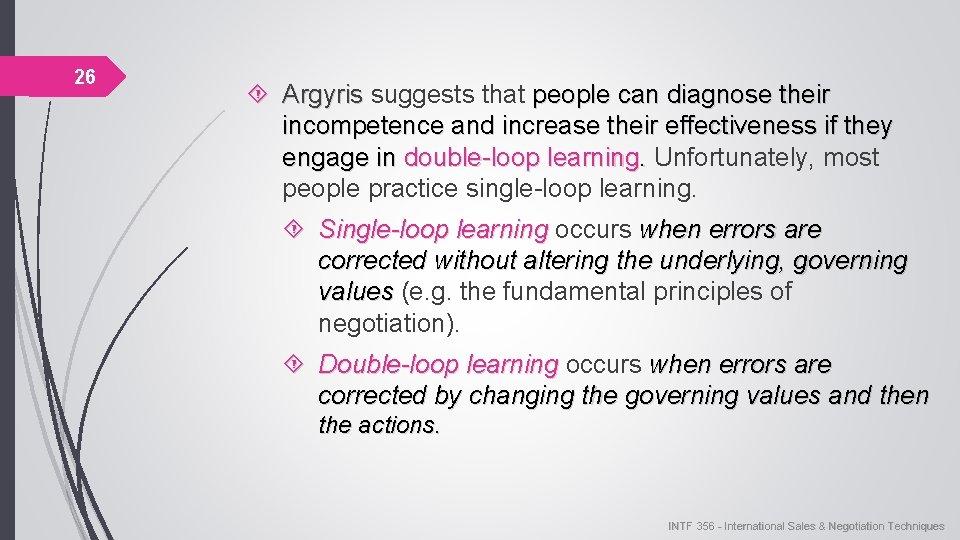
26 Argyris suggests that people can diagnose their incompetence and increase their effectiveness if they engage in double-loop learning. Unfortunately, most people practice single-loop learning. Single-loop learning occurs when errors are corrected without altering the underlying, governing values (e. g. the fundamental principles of negotiation). Double-loop learning occurs when errors are corrected by changing the governing values and then the actions. INTF 356 - International Sales & Negotiation Techniques
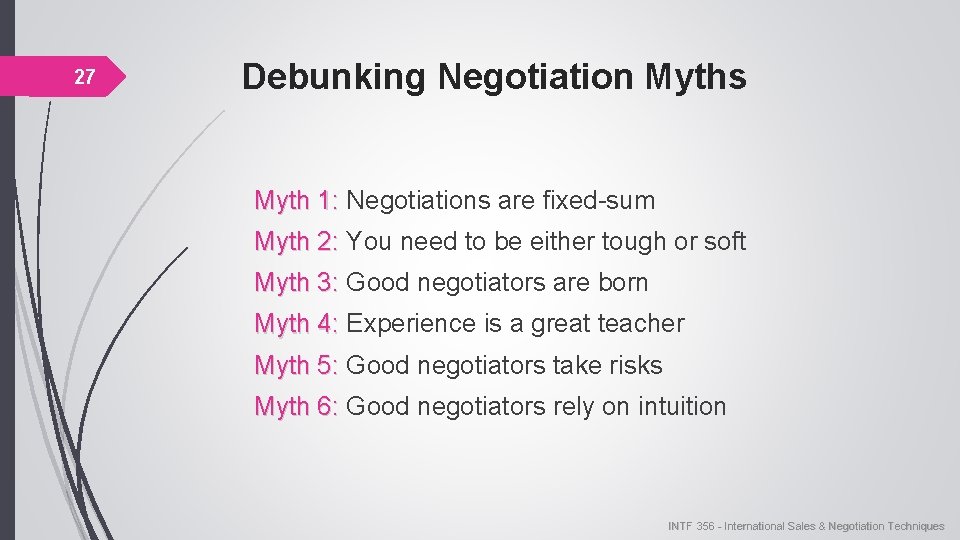
27 Debunking Negotiation Myths Myth 1: Negotiations are fixed-sum Myth 2: You need to be either tough or soft Myth 3: Good negotiators are born Myth 4: Experience is a great teacher Myth 5: Good negotiators take risks Myth 6: Good negotiators rely on intuition INTF 356 - International Sales & Negotiation Techniques
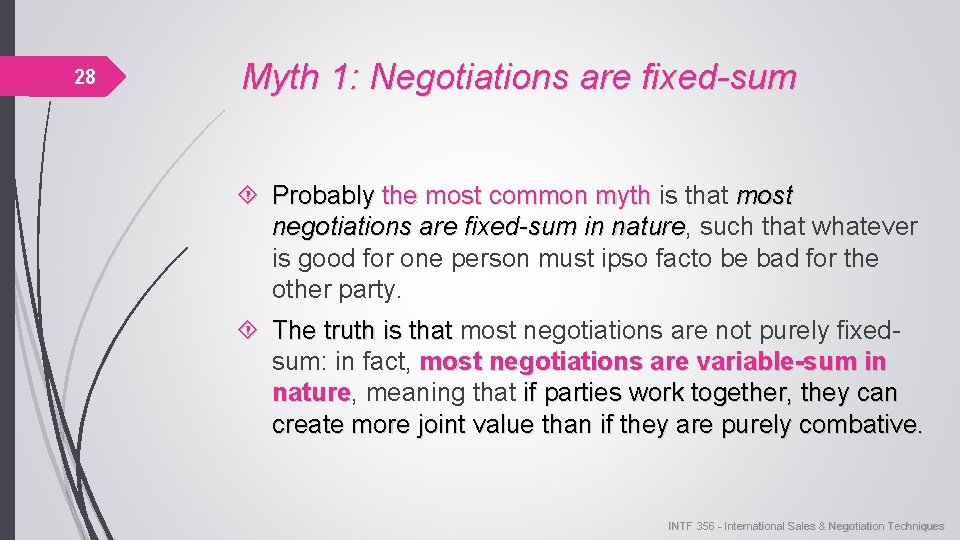
28 Myth 1: Negotiations are fixed-sum Probably the most common myth is that most negotiations are fixed-sum in nature, nature such that whatever is good for one person must ipso facto be bad for the other party. The truth is that most negotiations are not purely fixedsum: in fact, most negotiations are variable-sum in nature, nature meaning that if parties work together, they can create more joint value than if they are purely combative. INTF 356 - International Sales & Negotiation Techniques
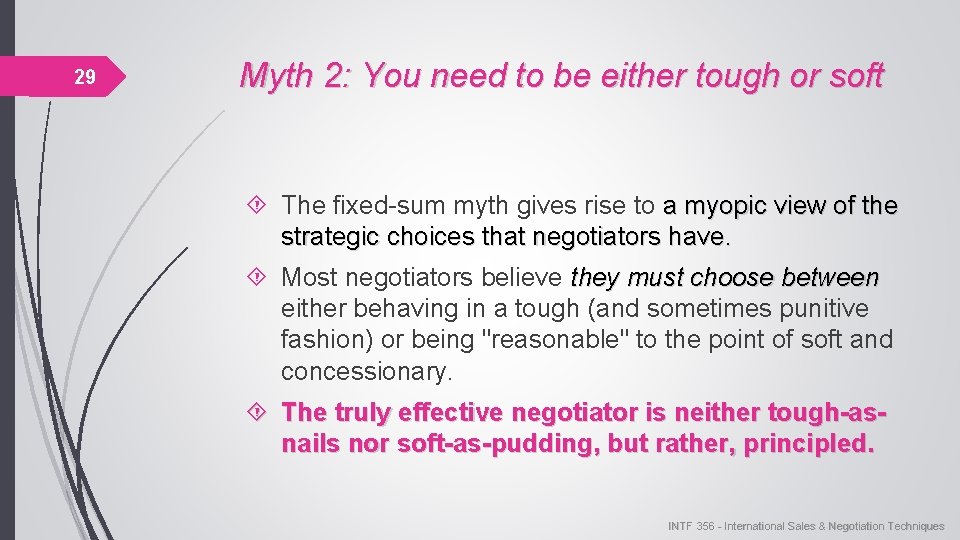
29 Myth 2: You need to be either tough or soft The fixed-sum myth gives rise to a myopic view of the strategic choices that negotiators have. Most negotiators believe they must choose between either behaving in a tough (and sometimes punitive fashion) or being "reasonable" to the point of soft and concessionary. The truly effective negotiator is neither tough-asnails nor soft-as-pudding, but rather, principled. INTF 356 - International Sales & Negotiation Techniques
30 Myth 3: Good negotiators are born A pervasive belief is that effective negotiation skills are something that people are born with, not something that can be readily learned. This notion is false because most excellent negotiators are self-made. In fact, naturally gifted negotiators are rare. Effective negotiation requires practice and feedback The problem is that most of us do not get an opportunity to develop effective negotiation skills in a disciplined fashion: rather, most of us learn by doing. Experience is helpful, but not sufficient
31 Myth 4: Experience is a great teacher It is only partly true that experience can improve negotiation skills: skills in fact, experience in the absence of feedback, is largely ineffective in improving negotiation skills. Natural experience as an effective teacher has three strikes against it. First, in the absence of feedback, it is nearly impossible to improve performance. The second problem is that our memories tend to be selective, selective meaning that people are more likely to remember their successes and forget their failures or shortcomings. Finally, experience improves our confidence, but not necessarily our accuracy. People with more experience grow more and more confident, but the accuracy of their judgment and the effectiveness of their behavior do not increase in a commensurate fashion.
32 Myth 5: Good negotiators take risks A pervasive myth is that effective negotiation necessitates taking risks and gambles In negotiation, this approach may mean saying things like, "This is my final offer" or "Take it or leave it" or using threats and bluffs. It is what we call a "tough" style of negotiation Tough negotiators are rarely effective: however, we tend to be impressed by the tough negotiator. Negotiators must learn how to evaluate risk, risk how to determine the appropriate time to make a final offer, and more importantly, how to make excellent decisions in the face of the uncertainty of negotiation.
33 Myth 6: Good negotiators rely on intuition Many seasoned negotiators believe that their negotiation style involves a lot of "gut feeling", intuition, and "in-themoment" responses. Effective negotiation involves deliberate thought and preparation and is quite systematic. The goal of this lesson is to help you effectively prepare for negotiation, become more self-aware of your own strengths and shortcomings, and develop strategies that are proactive (i. e. . those that anticipate the reactions of their opponent) rather than reactive (i. e. . those that are dependent upon the actions and reactions of their opponent). As a general rule, don't rely on your intuition unless you are an expert.