
Negotiation Rex Mitchell Fall 2011 Negotiation Conferring with

- Slides: 82
Negotiation Rex Mitchell Fall 2011
Negotiation • Conferring with another so as to arrive at the settlement of some matter (dictionary) • Negotiation is a basic means of getting what you want from others. It is back-and-forth communication designed to reach an agreement when you and the other side have some interests that are. . . opposed. (Fisher & Ury, xvii)
Persuasion • Moving by argument, entreaty, or expostulation (reasoning earnestly) to a belief, position, or course of action (dictionary) • Persuasion is a negotiating and learning process through which a persuader leads colleagues to a problem’s shared solution. Persuasion does involve moving people to a position they don’t currently hold, but not by begging or cajoling. (Conger, p. 86)
• Negotiation & persuasion are some ways to manage conflicts • Persuasion is an important part of negotiation and an important part of leadership and life, including situations we might not identify as negotiations
Negotiation Myths 1. 2. 3. 4. 5. 6. Good negotiators are born Experience is a great teacher Good negotiators take risks Good negotiators rely on intuition Negotiations are always win-lose The only negotiations are formal or explicit negotiations 7. Good negotiators are tough, intimidating, and try to get everything they can
Crucial Elements in Every Negotiation • Information • Time • Power
Information • Prepare • Inquire • Listen and observe – Direct – Indirect
Time • Good to have flexibility • Helps to know more about the others’ deadlines than they do about yours • Patience pays
Power • Many sources • Real and inferred • Can change during negotiations • Can be crafted and acquired • Sophistication & restraint in using power
Negotiation Requires • Interdependence, recognized • Motivation to engage • Parties engage between avoidance and domination • Enough power balance • Reaching an active phase
Two Main Approaches Competitive --- Collaborative • Desirable to consider (at least partly) collaborative negotiations • Not always possible, appropriate, or sufficient • Often combine competitive and collaborative approaches and tactics in versatile way, e. g. , in “principled negotiations”
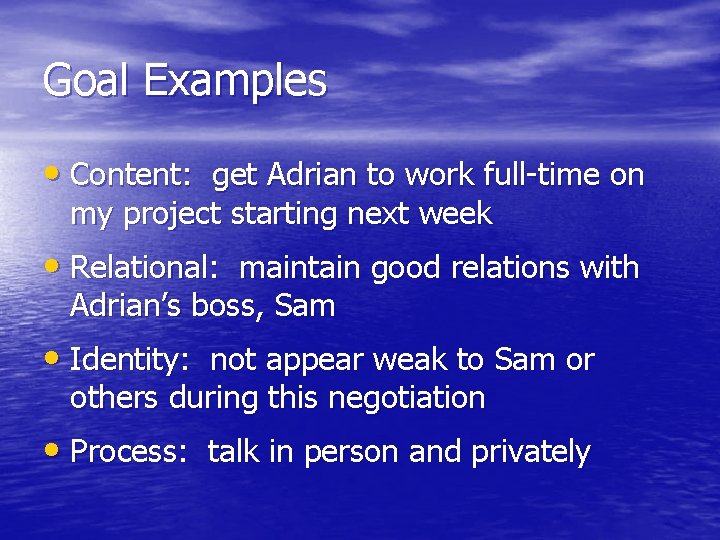
Differences re CRIP Goals • Content: win-lose vs • Relational: unfriendly • Identity/face-saving: vs flexible/supportive • Process: win-win vs friendly rigid/confrontational positional bargaining vs interest-based bargaining
Goal Examples • Content: get Adrian to work full-time on my project starting next week • Relational: maintain good relations with Adrian’s boss, Sam • Identity: not appear weak to Sam or others during this negotiation • Process: talk in person and privately
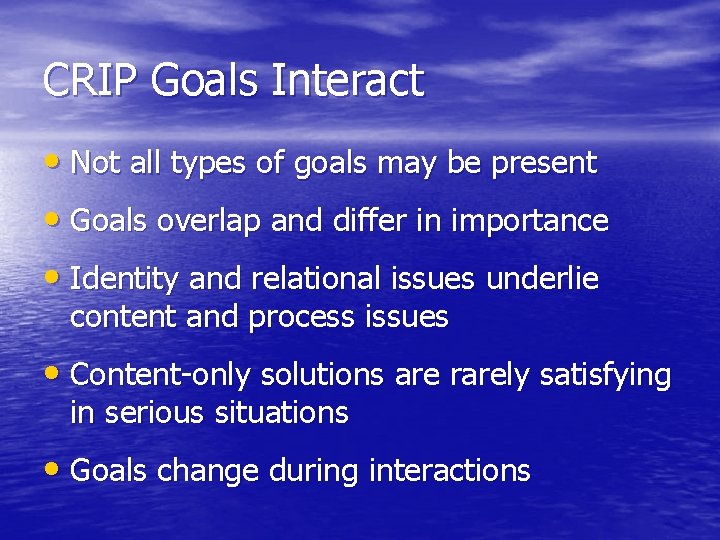
CRIP Goals Interact • Not all types of goals may be present • Goals overlap and differ in importance • Identity and relational issues underlie content and process issues • Content-only solutions are rarely satisfying in serious situations • Goals change during interactions
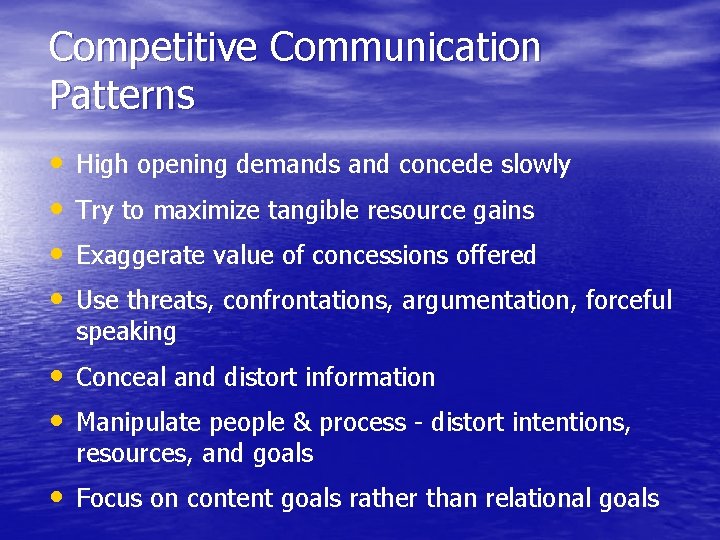
Competitive Communication Patterns • • High opening demands and concede slowly Try to maximize tangible resource gains Exaggerate value of concessions offered Use threats, confrontations, argumentation, forceful speaking • Conceal and distort information • Manipulate people & process - distort intentions, resources, and goals • Focus on content goals rather than relational goals
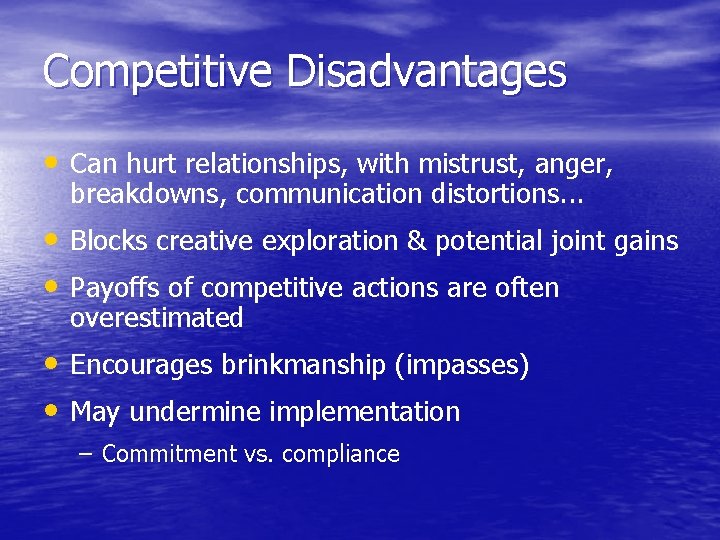
Competitive Disadvantages • Can hurt relationships, with mistrust, anger, breakdowns, communication distortions. . . • Blocks creative exploration & potential joint gains • Payoffs of competitive actions are often overestimated • Encourages brinkmanship (impasses) • May undermine implementation – Commitment vs. compliance
Collaborative Communication Patterns • Collaborative tactics: non-evaluative descriptive statements, disclosing statements, honest inquiry, requesting feedback, supportive remarks, concessions, accepting responsibility • Brainstorm creative new options to meet everyone’s interests, expand the pie • Logrolling (identify & try to deal with top-priority issues for each) • Bridging (invent new options to meet the other side’s needs) • Minimize costs to the other for going along with you
Collaborative Disadvantages • May pressure an individual to compromise and accommodate in ways not in his/her best interests • Avoids confrontational strategies (which can be helpful at times) • Increases vulnerability to deception & manipulation by a competitive opponent • Makes it hard to establish definite aspiration levels & bottom lines • Requires substantial skill and knowledge of the process • Requires strong confidence in one's perceptions regarding the interests and needs of the other side
The Ultimatum Game • First person proposes a division of $100 in whatever fashion s/he chooses. • If second person agrees, they distribute the $100 between themselves, as specified • If the second person disagrees, they both get nothing
Some Important Terms • Bargaining mix: the set of issues – Having multiple items & being creative can be very helpful • BATNA (best alternative to a negotiated settlement) – Sometimes are only two choices – (Good) alternatives are important • Target point (aka aspiration): desired end point • Resistance point (aka bottom line): furthest from the target point a negotiator will go • Starting point: the first position a negotiator plans to take • Bargaining range (aka zone of potential agreement): – Positive bargaining range – Negative bargaining range, & likely stalemate • Settlement point: the final point(s) of agreement
Engage with the readings • What do I like, agree with, find useful? Why? • How might I apply one or more concepts in my life – now and in the future? • What do I disagree with and/or would modify or expand on? Why? How?
Basic Points from F, U, P Book • Dilemma: hard or soft? • Offers third way - both hard and soft – Hard on merits and interests – Soft on people • How to obtain what you are entitled to & still be decent • If the other side learns this strategy, it makes the negotiations easier, not harder (it is not an advantage to negotiate with an unskilled opponent, if you will interact later)
Three Criteria for a Negotiation Method 1. Produce a “wise” agreement, if agreement is possible – An agreement that wisely reconciles the parties' interests 2. Efficient 3. Improve or at least not damage relationship Ø Bargaining over positions goes against all three Ø Being nice is no answer
Principled Negotiation • Oriented to collaborative negotiations, but can • be used in competitive Centered around four considerations – People: Disentangle people from the problem – Interests: Focus on interests, not positions (interests always underlie positions) – Options: Generate rich range before deciding what to do – Criteria: Insist that the result be based on objective standards • Uses "firm flexibility"
Some Facets of Principled Negotiation • Assume there is a solution • Join “with” the other to develop creative options • Identify complementary interests • Be firm in your goals and flexible in your means • Control the process, not the person • Use principles of productive and effective communication
Three (Iterative) Stages • Analysis • Planning • Discussion
PIOC: People • Negotiators are people first • Failure to deal with others as human beings prone to human reactions can be disastrous • • • People problems: theirs and yours Perceptions (and inferences) Emotions Communications Prevention works better than repair
PIOC: Interests • Usually are several possible positions that could satisfy any interest • Behind opposed positions lie shared and compatible interests, as well as conflicting ones • • • Usually are multiple interests Look forward, rather than back Commit to your interests, not your positions Stay open to take their interests into account Be hard on the problem, soft on the people
Need Clarity About Your Interests • “If you don't know where you're going, you might wind up somewhere else. ” (Yogi Berra) • Distinguish among interests, goals (aka objectives), positions, strategies, & actions • Define interests and goals in terms of results and outcomes, not actions • Frame goals as positive results to be achieved rather than problems to be avoided
• An interest is a motivator, an underlying need, desire, or concern, e. g. , I want to feel financially secure or I need more money with the arrival of a second child. • A goal is a desired outcome or result, e. g. , I want to make $60, 000 this year. • A position is a stated result or proposal, usually in a negotiation or conflict, e. g. , I deserve a 10% salary increase.
• A strategy is the method or path for achieving a goal, e. g. , I will first try to negotiate an increase in my salary, then, if this does not achieve my goal, I will search for a second job on weekends. • Tactics and actions are specific steps to be taken, hopefully following a strategy, e. g. , contact the placement office in my professional society to identify possible weekend positions
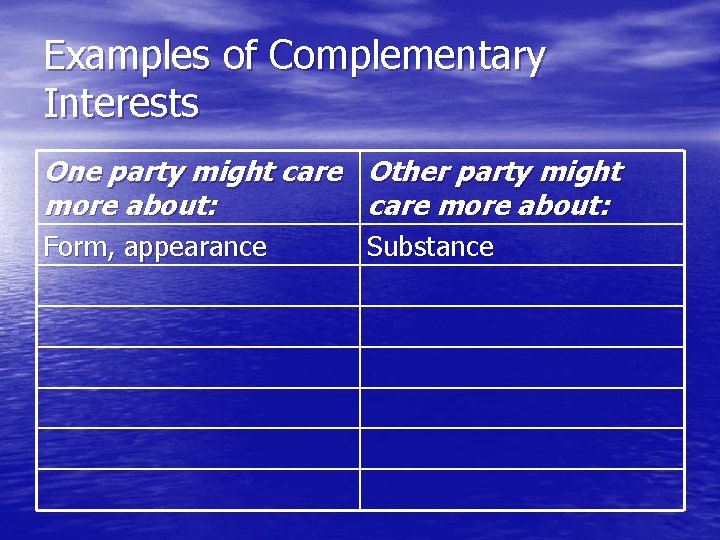
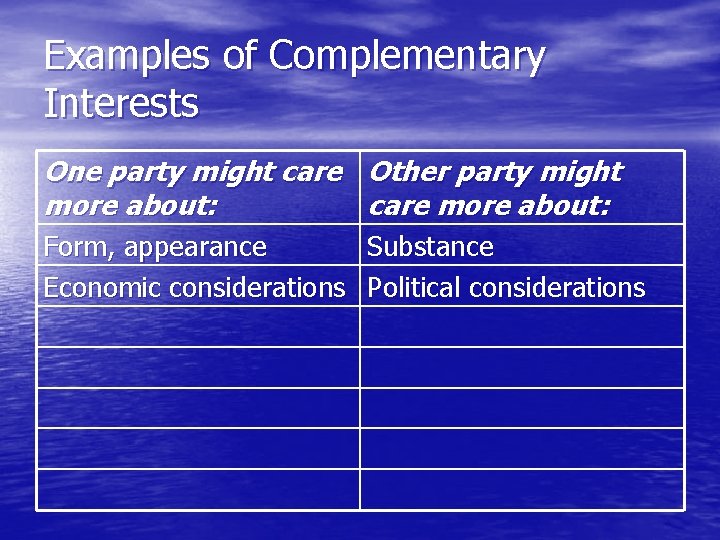
Examples of Complementary Interests One party might care Other party might more about: care more about: Form, appearance Substance
Examples of Complementary Interests One party might care Other party might more about: care more about: Form, appearance Substance Economic considerations Political considerations
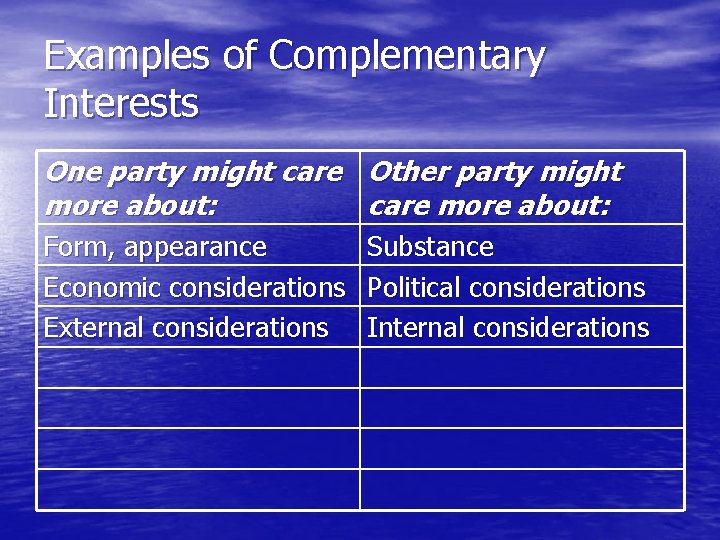
Examples of Complementary Interests One party might care Other party might more about: care more about: Form, appearance Economic considerations External considerations Substance Political considerations Internal considerations
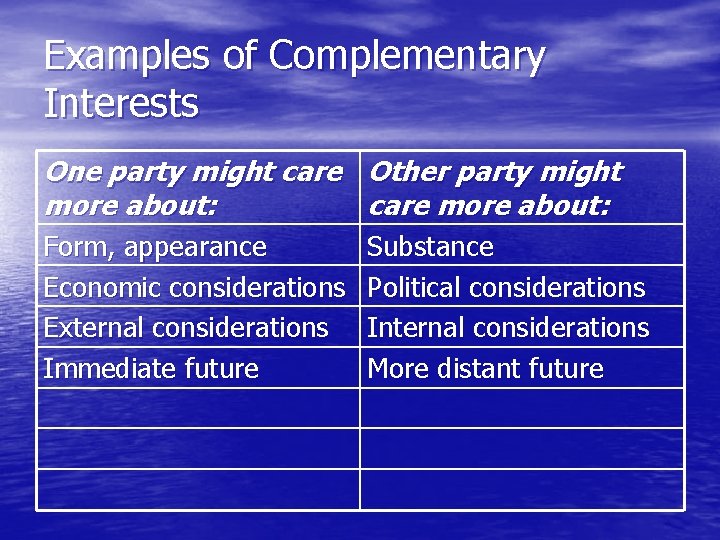
Examples of Complementary Interests One party might care Other party might more about: care more about: Form, appearance Economic considerations External considerations Immediate future Substance Political considerations Internal considerations More distant future
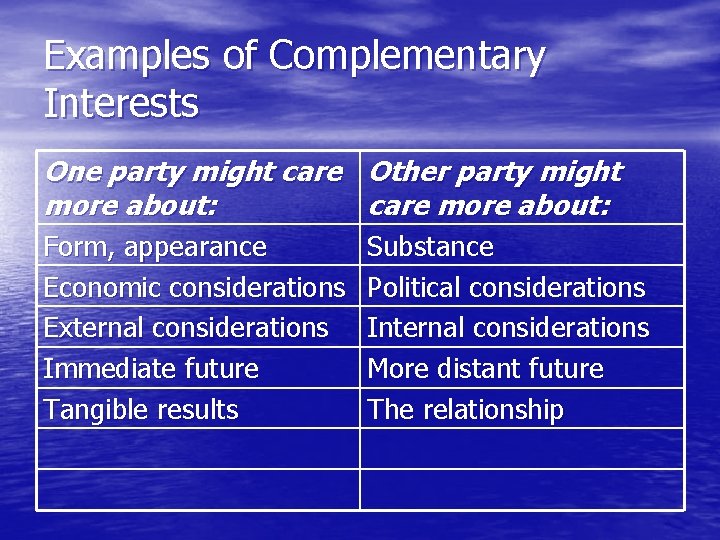
Examples of Complementary Interests One party might care Other party might more about: care more about: Form, appearance Economic considerations External considerations Immediate future Tangible results Substance Political considerations Internal considerations More distant future The relationship
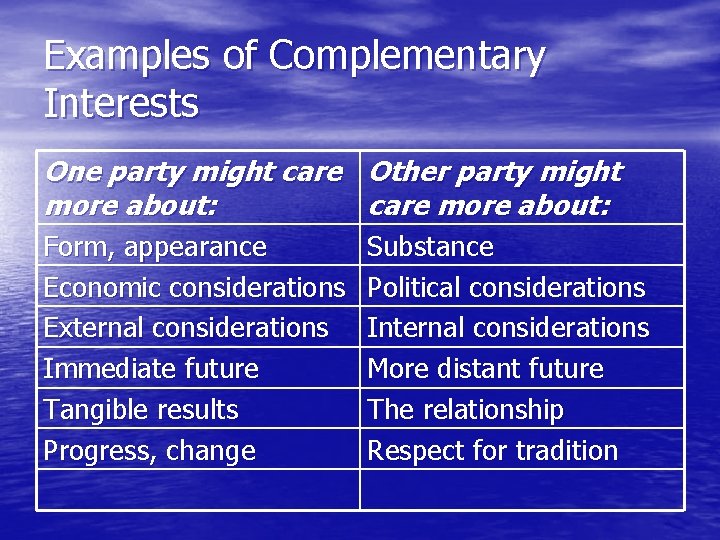
Examples of Complementary Interests One party might care Other party might more about: care more about: Form, appearance Economic considerations External considerations Immediate future Tangible results Progress, change Substance Political considerations Internal considerations More distant future The relationship Respect for tradition
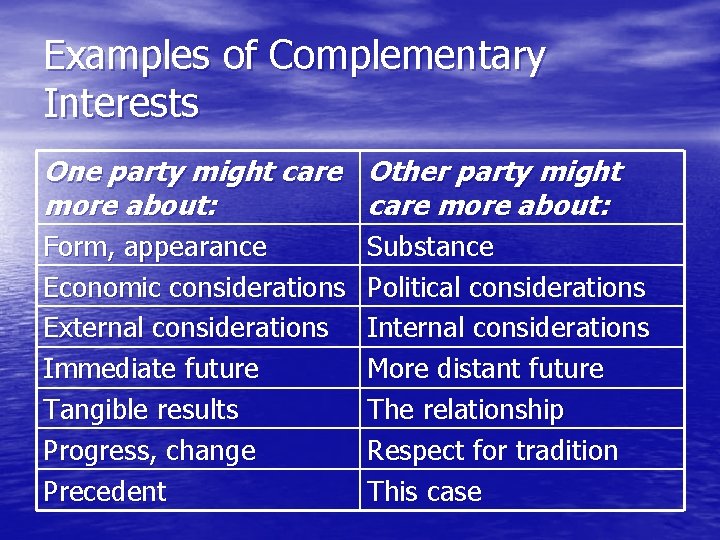
Examples of Complementary Interests One party might care Other party might more about: care more about: Form, appearance Economic considerations External considerations Immediate future Tangible results Progress, change Precedent Substance Political considerations Internal considerations More distant future The relationship Respect for tradition This case
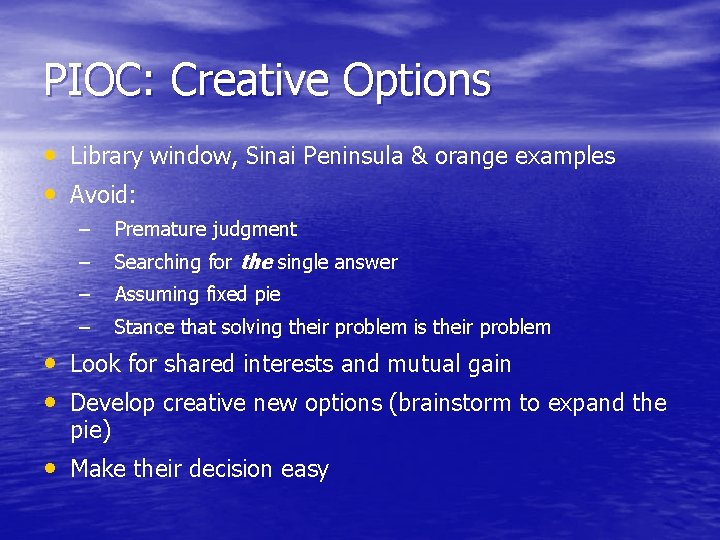
PIOC: Creative Options • Library window, Sinai Peninsula & orange examples • Avoid: – Premature judgment – Searching for the single answer – Assuming fixed pie – Stance that solving their problem is their problem • Look for shared interests and mutual gain • Develop creative new options (brainstorm to expand the pie) • Make their decision easy
PIOC: Use Objective Criteria • Commit to reaching a solution based on principle, • • not pressure Be open to reason, closed to threats Discuss objective standards for settling a problem instead of trying to force each other to back down • Frame issue as joint search for objective criteria • Reason & be open re which standards are • • appropriate & how to apply Yield only to principle & facts, not pressure Note that your position "is a matter of principle"
FURTHER NEGOTIATION SKILL BUILDING
Preparing for Negotiation • Define your interests (don't confuse these with positions) • Analyze the other party (gather information and make sense of it) • Define issues (usually are hidden ones) • Consult with your team and constituencies (and the other side)
Preparing (cont. ) • Assemble issues and define the bargaining mix. A larger bargaining mix takes: – Longer to negotiate – But opens up more opportunities for collaborative solutions • Prioritize interests and issues (your own and those of the other side)
Preparing (cont. ) • Develop and think through strategy options • Identify your BATNAs, try to develop better ones • Set target points, resistance points (understand identify your own limits, recognizing tradeoffs) • Develop starting points & effective openings with supporting arguments (do your homework research and organize information)
Negotiation Strategy Choices
Competitive Negotiation • Desirable to consider collaborative negotiation in majority of situations • But this is not always possible, appropriate, or sufficient • Can combine competitive and collaborative (appropriate for contract negotiation)
Competitive Negotiation • Three crucial variables: – Power – Information – Time • Strategies should discover & influence the other's resistance points • Iterative • Progression of concessions • “Commitments” are tricky
Competitive Strategies • Try for settlement close to other's resistance point • Get the other side to modify their resistance point • Modify your own resistance point • Expand and/or use multiple items in the bargaining mix creatively
Preventing/Dealing with Negotiation Problems 1. Reduce tension and encourage de-escalation: – – Take a break Active listening Acknowledge the other's feelings Make concessions to encourage reciprocation • Note the difference between accurately hearing what the other party has said plus acknowledging that s/he feels as s/he does. . . and agreeing with those statements
Preventing/Dealing with Negotiation Problems 2. Improve the accuracy of communication (including the concepts we practiced) 3. Control size & number of issues involved: – Fractionate big issues – Keep the number of parties small – State issues in concrete terms rather than as principles or value statements – Be selective re precedents involved
Preventing/Dealing with Negotiation Problems 4. Establish commonalities: – Look for similarities in interests of the parties – Reframe the situation – Identify superordinate goals, common enemies, mutually agreeable rules and procedures 5. Make preferred options more desirable to the opponent – Refine the proposal, sweeten the offer (rather than intensify the threat) – Use objective criteria to evaluate solutions
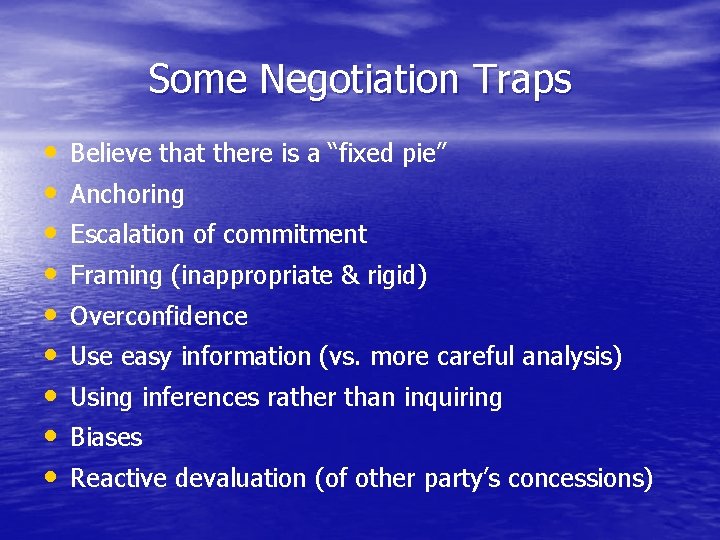
Some Negotiation Traps • • • Believe that there is a “fixed pie” Anchoring Escalation of commitment Framing (inappropriate & rigid) Overconfidence Use easy information (vs. more careful analysis) Using inferences rather than inquiring Biases Reactive devaluation (of other party’s concessions)
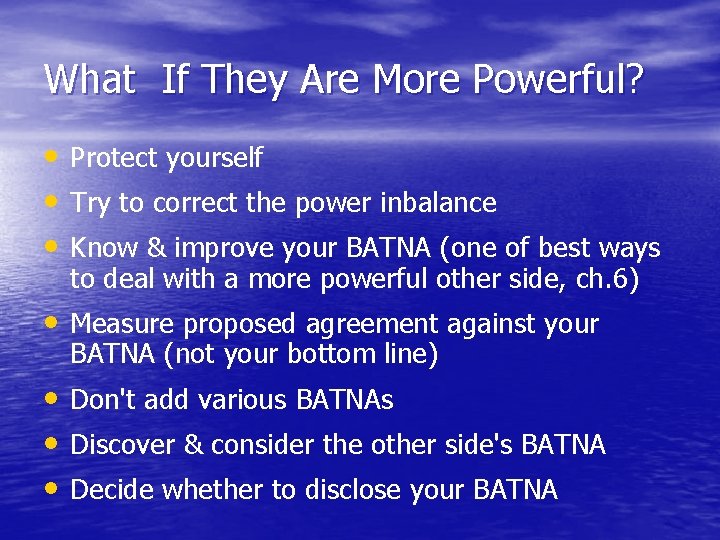
What If They Are More Powerful? • Protect yourself • Try to correct the power inbalance • Know & improve your BATNA (one (o of best ways to deal with a more powerful other side, ch. 6) • Measure proposed agreement against your BATNA (not your bottom line) • Don't add various BATNAs • Discover & consider the other side's BATNA • Decide whether to disclose your BATNA
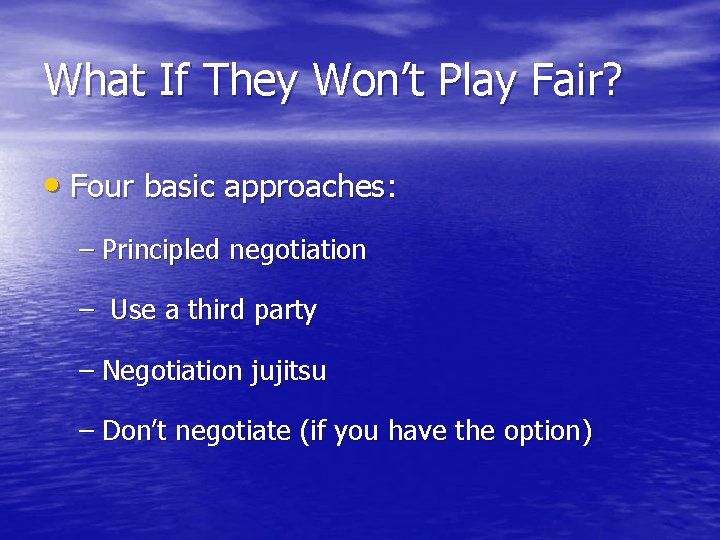
What If They Won’t Play Fair? • Four basic approaches: – Principled negotiation – Use a third party – Negotiation jujitsu – Don’t negotiate (if you have the option)
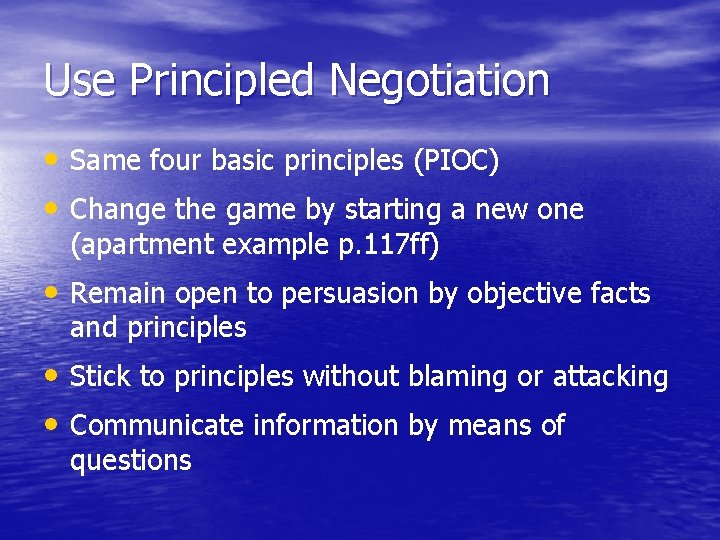
Use Principled Negotiation • Same four basic principles (PIOC) • Change the game by starting a new one (apartment example p. 117 ff) • Remain open to persuasion by objective facts and principles • Stick to principles without blaming or attacking • Communicate information by means of questions
Use PN (cont. ) • • Give personal support to the opposite person Inquire about reasons for the other’s positions Use effective listening Present your reasons before offering a proposal • Present proposal as one fair solution, rather than your proposal
One-Text Process • Best with a third-party • Single draft text • Attempts to integrate various interests & concerns • Multiple drafts • Feedback & critique from both sides on each draft • Eventually, yes or no
Negotiation Jujitsu • Prevent the cycle of action & reaction by not pushing back • Don't attack their position, look behind it, channel it into exploring interests – Don't reject or accept it – Assume every position is a genuine attempt to address the basic concerns of each side – Ask them how it does this – Seek & discuss principles underlying their positions
Negotiation Jujitsu (cont. ) • Invite feedback & suggestions, rather than re -defending your ideas • Reframe an attack on you as an attack on the problem • Inquire and pause ("Some of the most effective negotiating you will ever do is when you are not talking“ p. 112)
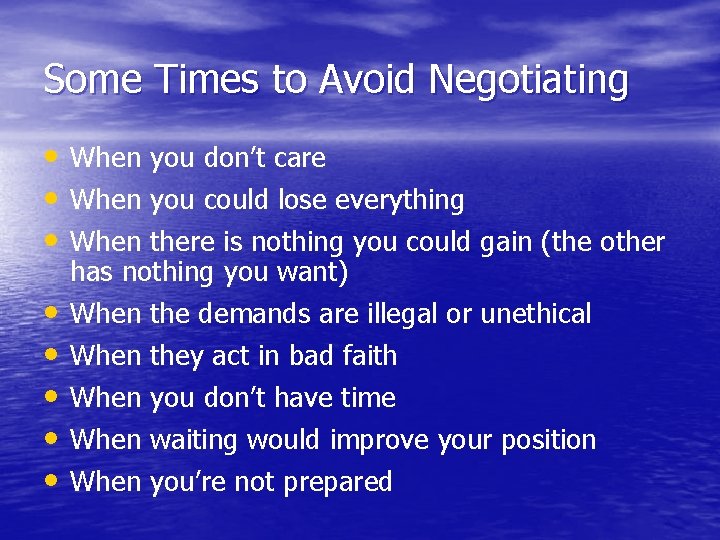
Some Times to Avoid Negotiating • When you don’t care • When you could lose everything • When there is nothing you could gain (the other has nothing you want) When the demands are illegal or unethical When they act in bad faith • • • When you don’t have time • When waiting would improve your position • When you’re not prepared
What If They Use Dirty Tricks? Read F. ch. 8 and be prepared Could also read Getting Past No by Ury
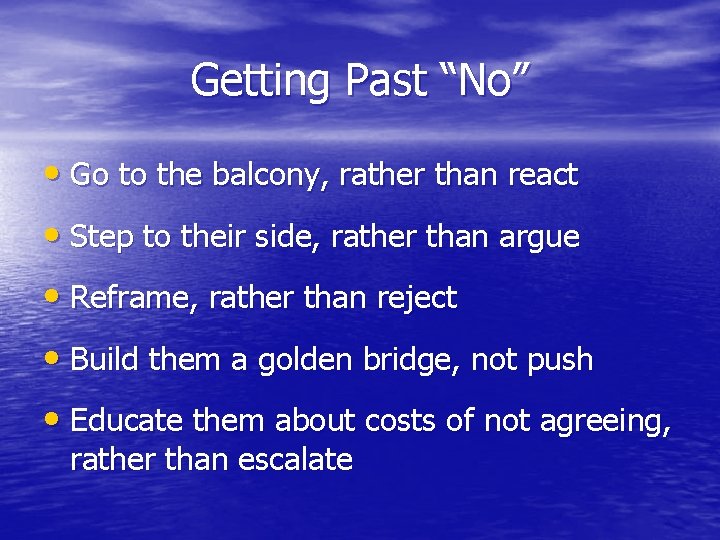
Getting Past “No” • Go to the balcony, rather than react • Step to their side, rather than argue • Reframe, rather than reject • Build them a golden bridge, not push • Educate them about costs of not agreeing, rather than escalate
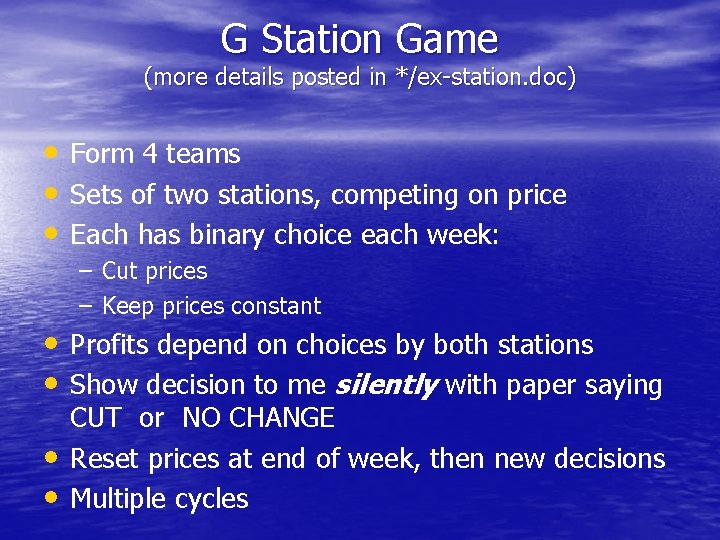
G Station Game (more details posted in */ex-station. doc) • Form 4 teams • Sets of two stations, competing on price • Each has binary choice each week: – Cut prices – Keep prices constant • Profits depend on choices by both stations • Show decision to me silently with paper saying • • CUT or NO CHANGE Reset prices at end of week, then new decisions Multiple cycles
Importance of Versatility • Broad repertoire • Flexibility and skill in use • Mindfulness: – Listen – Observe – Inquire – Manage assumptions, inferences, attributions
Versatility (cont. ) • Balance observation and action • Considerable use of questions, especially in early stages • Asking (inquiry) more than telling (advocacy)
Negotiation is a process of preparing, then making sense out of what is happening, and then working with those conditions to bring about a desirable outcome
Action Planning • Write down what you now regard as the 3 -5 most important points about negotiation • Take notes on how you can apply these points in: – The contract negotiation in this class – Other future negotiations in your life
PERSUASION
“The power of the president is the power to persuade. ” • Quotation from Presidential Power by Richard Neustadt, who studied many U. S. Presidents • “Presidents with all the power and economic support that goes with the office, will still only get real, dedicated action from cabinet, staff, and others when s/he persuades them to do it. ” • Other than in emergencies, people respond best through persuasion
"There are, then, these three means of effecting persuasion. The man who is to be in command of them must, it is clear, be able (1) to reason logically, (2) to understand human character and goodness in their various forms, and (3) to understand the emotions--that is, to name them and describe them, to know their causes and the way in which they are excited. “ -Aristotle
Four Essential Steps in Persuasion • Establish credibility • Frame for common ground • Provide evidence • Connect emotionally with your audience
Credibility • Earned over time • Requires expertise, trustworthiness, and relationships • Need to be honest, competent, inspiring (K&P 22)
Re Credibility • Think of a time when you willingly followed the direction of someone you admired and respected as a leader someone who energized and excited you about following, someone who had a high degree of credibility with you
Credibility Exercise (cont. ) • Make some notes for yourself re: – What was the situation? – How did this leader make you feel about yourself - what three or four words would best describe how you felt ? – What did this individual do as a leader that you admire and respect - what leadership actions did this person take that made others want to perform well?
How People Feel When Working With Admired Leaders • • • Valued Motivated Inspired Challenged Capable Enthusiastic Supported Respected Powerful Proud
Frame for Common Ground • Frame goals and arguments in a way that identifies common ground with those you wish to persuade • Outcome must appeal strongly to the people you are trying to persuade
Provide Evidence • Reinforce arguments and positions • Use vivid language and compelling evidence: – – Examples Stories Metaphors Analogies
Connect Emotionally With Your Audience • Show your own emotional commitment to a position • Without being overly emotional • Align your emotional approach with your audience • This requires dialogue with individuals involved • Get beyond your frame of reference to theirs
Four Essential Steps in Persuasion • Establish credibility • Frame for common ground • Provide evidence • Connect emotionally with your audience
Some Ways Not to Persuade • Up-front, hard sell • Resist compromise • Rely on presenting great arguments • Stay fixed in your frame of reference • Assume persuasion is a one-shot effort
More Persuasive Tools • Reuse some from conflict management, e. g. : – Conflict response modes – Move from complaints to requests – Use effective interpersonal skills