
NEGOTIATION Global Procurement Perspective From Chapter 13 Chapter
NEGOTIATION Global Procurement Perspective From: Chapter 13 Chapter 20 Presented by: Akshay Sharma 13 PGP 008
2 Chapter Overview • What is negotiation? • Negotiation framework • Negotiation planning • Power in negotiation • Concessions • Negotiation tactics: trying to reach agreement • Win-Win negotiation • International negotiation • Comprehensive global negotiation skills and enhanced cultural understanding • The impact of the Internet on negotiations
3 What Is Negotiation? Direct: • A process of formal communication, either face-to-face or via electronic means, where two or more people come together to seek mutual agreement about an issue or issues • Involves the management of time, information, and power between individuals and organizations who are interdependent Indirect: • Relationships between people, not just organizations • Persuasion • Negotiation skills can be honed and practiced
4 Terms Used in Negotiation • Positions • Interests • Needs • Wants • BATNA (Best Alternative To a Negotiated Agreement)
5 Positions • A negotiator’s opening offer • Represents the optimistic or target value of the issues being negotiated • The stated demand at the negotiation table
6 Needs vs. Wants • Needs – those negotiated outcomes that the negotiator must have in order to reach a successful conclusion • Wants – those negotiated outcomes that a negotiator would like to have • May often be exchanged as concessions
7 Interests • The unspoken motivation or reason that underlies any given position • Unlikely to be expressly stated or acknowledged during the negotiation • May not be directly germane to the position • May be personal in nature Key Points on Interests • Play detective and try to discern the other party’s interests through a series of open-ended, probing questions • Always focus on the other party’s underlying interests, not his/her stated positions

8 BATNA (Best Alternative To a Negotiated Agreement) • What is BATNA: • Negotiating Without Giving In. • A party should generally not accept a worse resolution than its BATNA. • Bottom line or reservation point • Walk away if outcome is better than BATNA • Need to ensure that a negotiator’s BATNA is never revealed to the other party • All settlements must be judged in light of all other viable alternatives • Accounts considered: relationship value, time value of money and the likelihood that the other party will live up to their side of the bargain

9 Triangle Talk Step 3: Propose Action in a Way that They Can Accept Step 1: Know Exactly What You Want The Negotiation Process Step 2: Know Exactly What They Want
10 Know Exactly What You Want • Determine and write down specific goals and objectives • Can be referred during the negotiation • The more clearly defined, the more likely that can be achieved
11 Know Exactly What They Want • Attempt to discern the other party’s likely needs and wants • Estimate underlying interests to the other party’s stated positions • Beware of expecting the other party to think in the same way • Ask open-ended questions to confirm or counter preconceived notions
12 Propose Action They Can Accept • Frame your own needs in terms of the other party’s needs • Make it easy for the other party to say, “Yes” • Remain fair, flexible, and reasonable
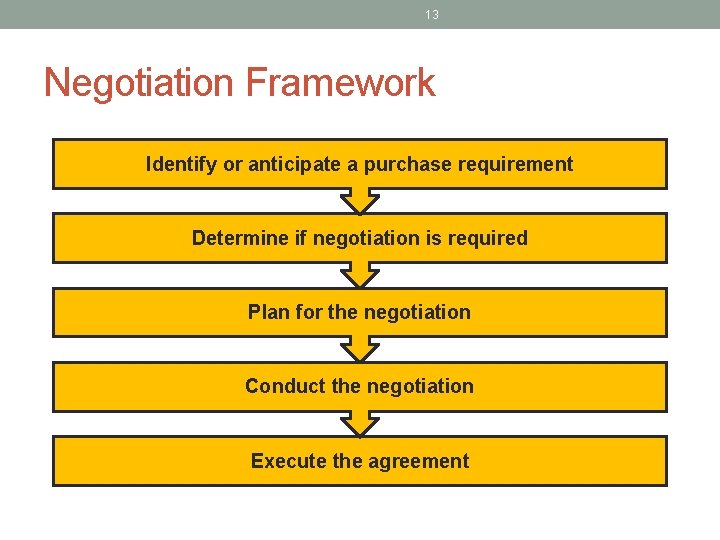
13 Negotiation Framework Identify or anticipate a purchase requirement Determine if negotiation is required Plan for the negotiation Conduct the negotiation Execute the agreement
14 Identify or Anticipate a Need • Purchase requisitions • Inventory counts • Reorder point systems • New product development • New facilities
15 Is Negotiation Required? • Is bid process inadequate? • Are many non-price issues involved? • Is contract large? • Are technical requirements complex? • Does contract involve plant and equipment? • Does contract involve a partnership? • Will supplier perform value-adding activities? • Will there be high risk or uncertainty?
16 When to Negotiate • Identification of allowable costs • Delivery schedules and lead times • Expected product and service quality levels • Performance metrics • Technological support needed • Contract volumes • Special packaging • Loss and damage liability • Payment terms and currency issues • Progress payment schedules
17 When to Negotiate • Transportation mode selection • Carrier selection • Filing freight claims • Warranties and replacements • Capacity issues • Material lead times • Penalty clauses • Performance incentives • Contract length • Contract renewal mechanism • Proprietary information

18 When to Negotiate • Intellectual property • Resources related to closer buyer-supplier relationships • Contract resolution mechanisms • Spare parts • After-sale service • Operator and maintenance training • Improvement requirements • • Quality Delivery performance Lead time Cost
19 Reasons for Negotiation • Total contract value or volume is large • Purchase involves complex technical requirements, perhaps even product and process requirements and specification still evolving • Purchase involves capital-intensive plant and equipment • Agreement involves a special or collaborative buyersupplier relationship • Supplier will perform important value-adding activities
20 Plan for the Negotiation • Identify participants • Develop objectives • Analyze strengths and weaknesses • Gather information • Recognize other party’s needs • Identify facts and issues • Establish positions • Develop strategies and tactics • Brief personnel • Practice the negotiation
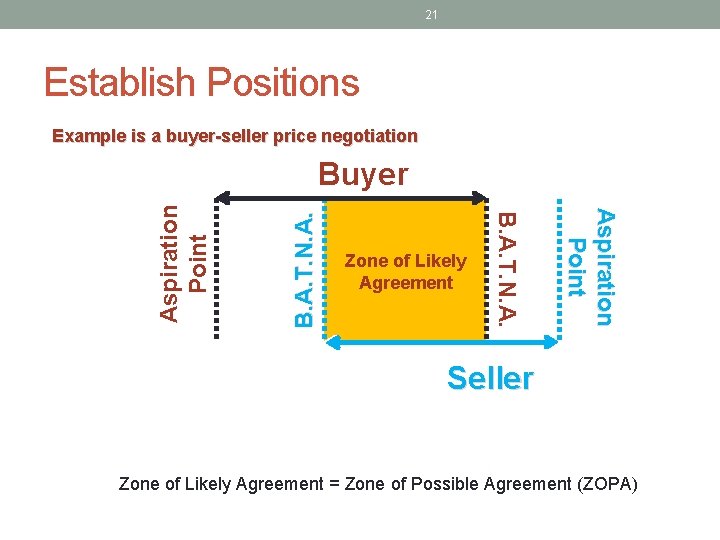
21 Establish Positions Example is a buyer-seller price negotiation B. A. T. N. A. Aspiration Point Zone of Likely Agreement B. A. T. N. A. Aspiration Point Buyer Seller Zone of Likely Agreement = Zone of Possible Agreement (ZOPA)
22 Conduct the Negotiation • Perform fact finding • Recess or caucus as necessary • Work to narrow differences • Manage time pressures • Maintain informal atmosphere • Summarize progress periodically • Employ tactics • Keep relationships positive
23 Points to Focus On • Defining the issues • Defining interests • Defining objectives and openings • Assessing constituents and social context • Analyzing the other party • Planning issue presentation and defense • Defining protocols • Where to negotiate
24 Face-to-Face Negotiation Phases • Fact finding and information sharing • Recess to: • Reassess relative strengths and weaknesses • Review and revise objectives and positions • Reorganize the negotiation agenda • Narrow differences • Seek agreement and conclusion • May involve several iterations
25 Being an Effective Negotiator • Willing to compromise or revise goals • View issues independently • Establish upper and lower ranges for each major issue • Explore additional options • Build on common ground between parties • Avoid making irritating comments • Avoid argumentation by presenting too many reasons • Make fewer counterproposals
26 Execute the Agreement • Provide performance feedback • Build on the success of the negotiation • Monitor contract provisions
27 Power in Negotiation • Power is the ability to influence another person or organization • Power by itself is neither good or bad; it is the application or use of power that makes it good or bad • Sources of negotiating power
28 Sources of Negotiating Power • Informational power • Reward power • Coercive power • Legitimate power • Expert power • Referent power
29 Informational Power • Ready access to relevant and useful information • Presentation of facts, data, and persuasive arguments • Can be manipulated by withholding information or by providing false information
30 Reward Power • One party is able to offer something of perceived value to the other • Direct attempt to exert control • Individuals respond and behave accordingly when valued rewards are available
31 Coercive Power • Taking away or withholding something of value to the other party • Ability to punish – financially, physically, or mentally • Can have damaging effects on long-term relationships • Promotes escalation of conflict or retaliation
32 Legitimate Power • Special form of informational power • Often represented by verifiable credentials • Reduces the likelihood of refuting a position • Other party must value the expertise in order to be effective
33 Referent Power • Comes from attraction based on socially acceptable personal qualities and attributes • Physical • Honesty • Charisma • Friendliness • Sensitivity
34 Use of Power • Used to support one’s advantage • Need to be careful not to abuse power • Damaged relationships • Invited retaliation • Diminished value of that power • Some types of power interact synergistically with others • Example - expert and referent power
35 Concessions • Movement away from a negotiating position that has value to the other party • Give-and-take process is normal in most negotiations • Need to avoid giving away concessions without receiving something of equal or greater value in return
36 Guidelines for Making Concessions • Give yourself enough room to make concessions • Try to get the other party to start revealing its needs and objectives first • Be the first to concede on a minor issue but not the first on a major one • Make unimportant concessions and portray them as valuable • Make the other party work hard for every concession you make • Use tradeoffs to obtain something for every concession you make
37 Guidelines for Making Concessions • Generally, concede slowly and give a little with each concession • Do not reveal your deadline to the other party – ever • Occasionally, say “No” to the other party • Be careful trying to take back concessions, even tentative ones • Keep a record of concessions made to try and identify a pattern • Do not concede too often, too soon, or too much
38 Negotiation Tactics • Low ball • High ball • Honesty and • Best and final offer openness • Questions • Caucus • Trial balloon • Price increase • Silence • Planned concessions • Venue
39 Power of Influence • Reciprocation • Consistency • Social proof • Liking • Authority • Scarcity
40 Reciprocation • An obligation to give something back of equal or greater value to someone after having received something from them • Creates a powerful obligation response • Can be used effectively when giving concessions • Patterns of concession (quid pro quo)
41 Consistency • People tend to want to be perceived as being consistent in their beliefs and actions • It is difficult to back away from something already agreed to • Beware the consistency trap • Small commitments often lead to larger ones
42 Social Proof • Looking to the behavior of others to determine what is desirable, appropriate, or correct • Power of the endorsement • Everyone is doing it
43 Liking • People work well and are more agreeable with others that we like or who are like us • Get to know the other party better to build on the relationship when concessions are being offered
44 Authority • People are more likely to accept the positions, arguments, and directions from recognized authority figures • Power of titles and perceived importance
45 Scarcity • Can also be the perception of scarcity • Act now • For a limited time only • Offer expires tomorrow • Suppliers often use potential price increases as a scarcity technique
46 Overcoming Tactics • Modify tactics when they don’t work • Prepare for likely tactics to be used against you • Tactics are more effective on you if you are unprepared, stressed, under severe deadlines, inexperienced, fatigued, or disinterested • Try not to react without thinking
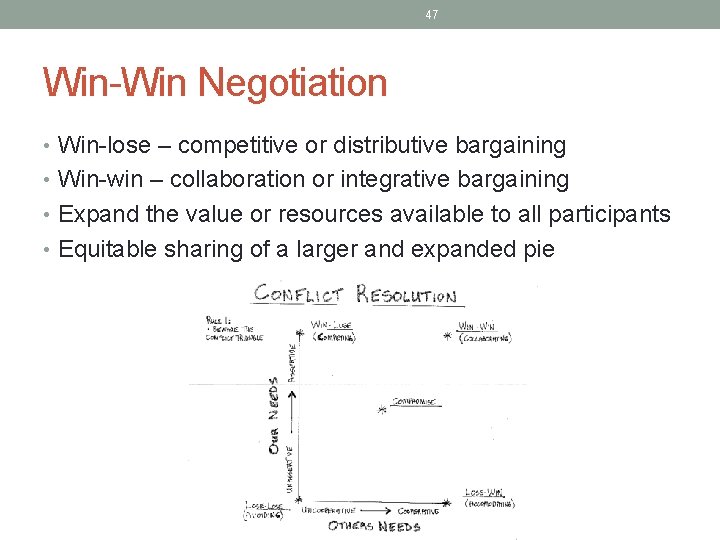
47 Win-Win Negotiation • Win-lose – competitive or distributive bargaining • Win-win – collaboration or integrative bargaining • Expand the value or resources available to all participants • Equitable sharing of a larger and expanded pie
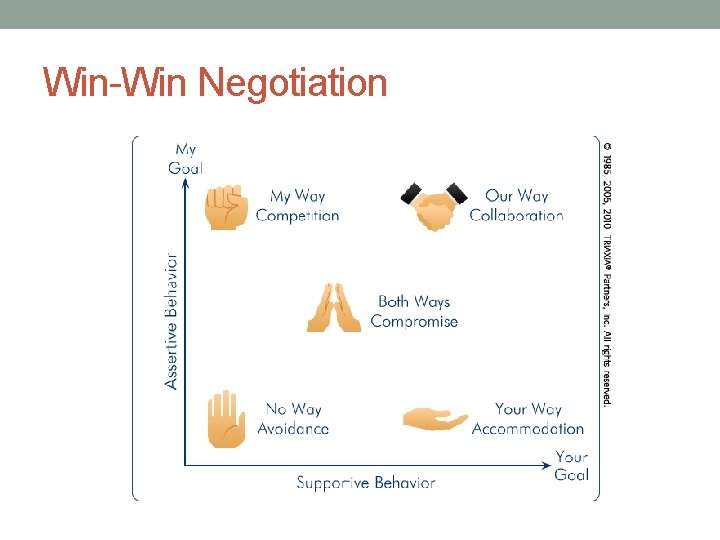
Win-Win Negotiation
49 Win-Win Methods • Expand the pie • Logroll • Use nonspecific compensation • Cut the costs for compliance • Find a bridge solution
50 International Negotiation • Added complexity and challenge • Substantial extra time and effort required • Culture shock • Barriers and obstacles • Need for translators
51 Barriers and Obstacles • Miscommunication due to language • Time limitations • Cultural differences • Limited authority of international negotiators Characteristics to Overcome Barriers • Patience • Knowledge of the contract agreement • Honest and polite attitude • Familiarity with foreign cultures and customs
52 Caveats when Negotiating Overseas • Don’t think that everyone else negotiates like the Americans • There is a danger in stereotyping or oversimplifying characteristics of other cultures • There is always substantial interpersonal variation within any culture • However, there are often common tendencies
53 Impact of the Internet on Negotiations • Electronically-based negotiations tend to equalize the differences between the parties • Normal visual and auditory clues are diminished or not readily apparent • Status differences and social differences are less discernible • Problem of being anonymous • Negotiators tend to be more risk taking
54 Impact of the Internet on Negotiations • Real time vs. asynchronous • Loss of information richness • More difficult to provide feedback and conduct active listening • E-negotiators ask fewer questions and tend to make more assumptions
- Slides: 54