
Negative Impacts of Working Night Shift can Lead
- Slides: 11
Negative Impacts of Working Night Shift can Lead to: Higher Body Mass Index and Decreased Mental Function Alexa Cama
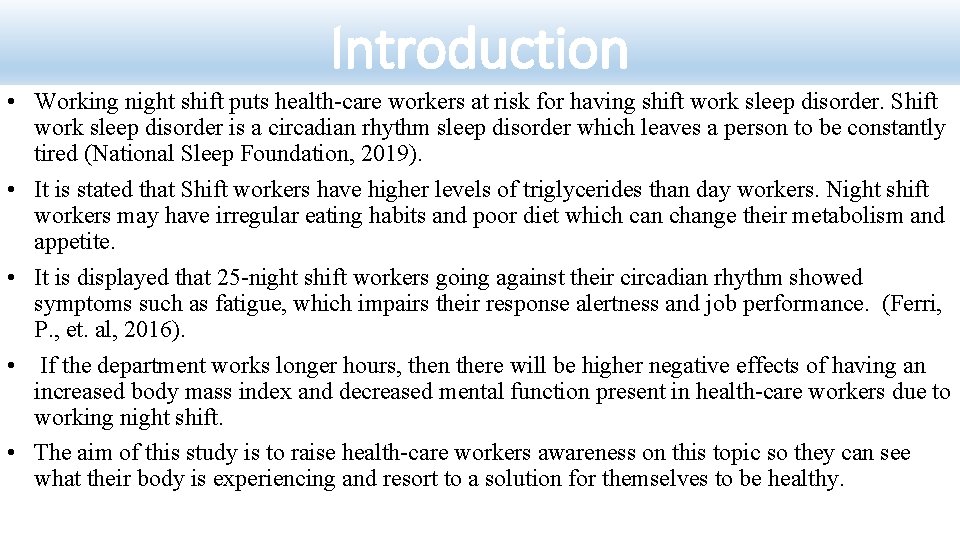
Introduction • Working night shift puts health-care workers at risk for having shift work sleep disorder. Shift work sleep disorder is a circadian rhythm sleep disorder which leaves a person to be constantly tired (National Sleep Foundation, 2019). • It is stated that Shift workers have higher levels of triglycerides than day workers. Night shift workers may have irregular eating habits and poor diet which can change their metabolism and appetite. • It is displayed that 25 -night shift workers going against their circadian rhythm showed symptoms such as fatigue, which impairs their response alertness and job performance. (Ferri, P. , et. al, 2016). • If the department works longer hours, then there will be higher negative effects of having an increased body mass index and decreased mental function present in health-care workers due to working night shift. • The aim of this study is to raise health-care workers awareness on this topic so they can see what their body is experiencing and resort to a solution for themselves to be healthy.
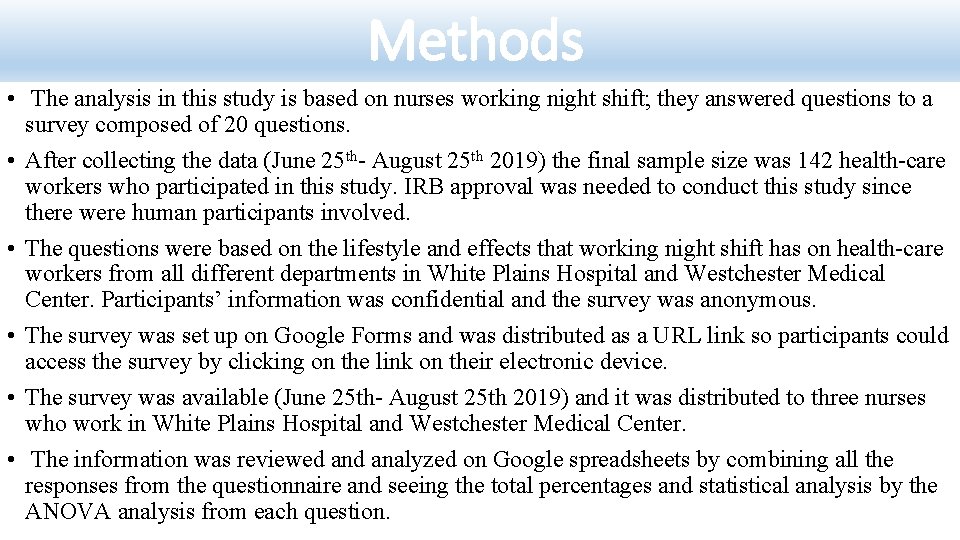
Methods • The analysis in this study is based on nurses working night shift; they answered questions to a survey composed of 20 questions. • After collecting the data (June 25 th- August 25 th 2019) the final sample size was 142 health-care workers who participated in this study. IRB approval was needed to conduct this study since there were human participants involved. • The questions were based on the lifestyle and effects that working night shift has on health-care workers from all different departments in White Plains Hospital and Westchester Medical Center. Participants’ information was confidential and the survey was anonymous. • The survey was set up on Google Forms and was distributed as a URL link so participants could access the survey by clicking on the link on their electronic device. • The survey was available (June 25 th- August 25 th 2019) and it was distributed to three nurses who work in White Plains Hospital and Westchester Medical Center. • The information was reviewed analyzed on Google spreadsheets by combining all the responses from the questionnaire and seeing the total percentages and statistical analysis by the ANOVA analysis from each question.
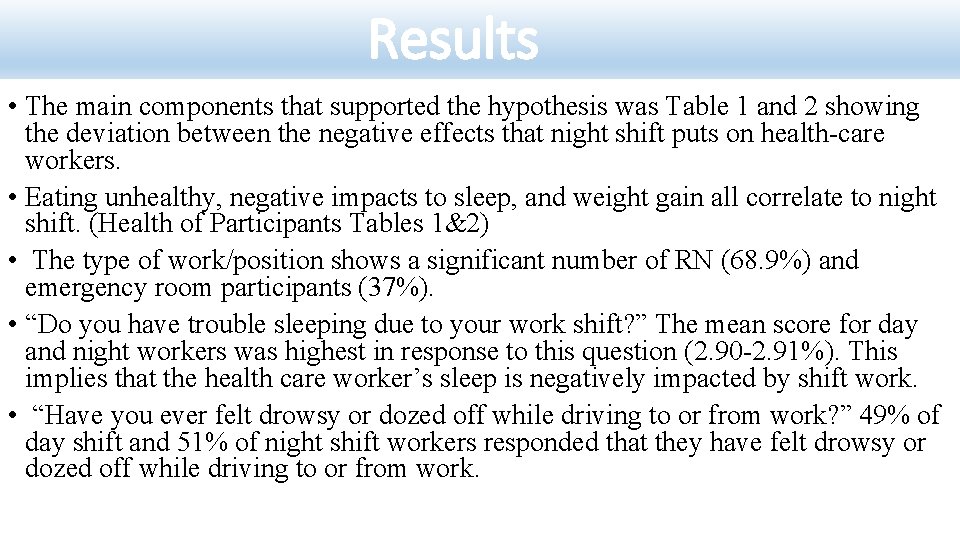
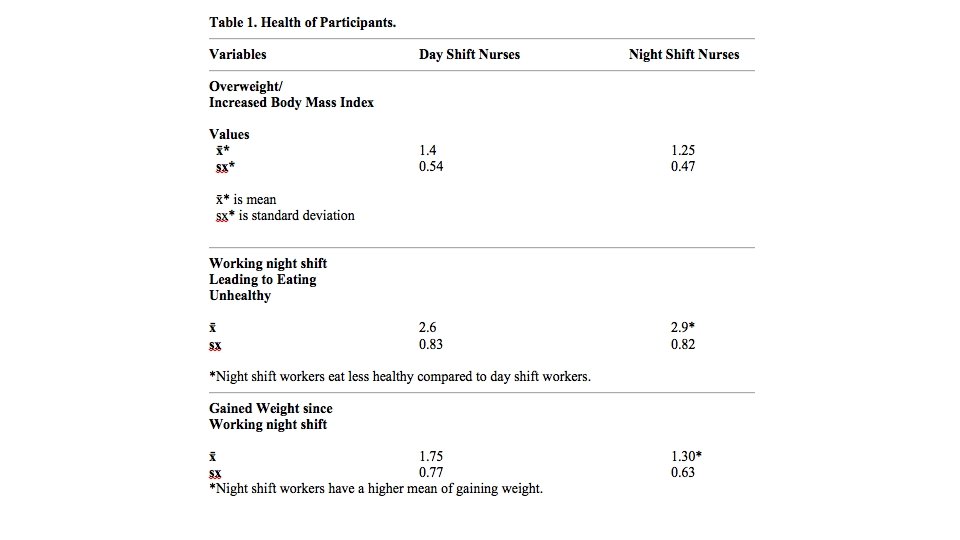
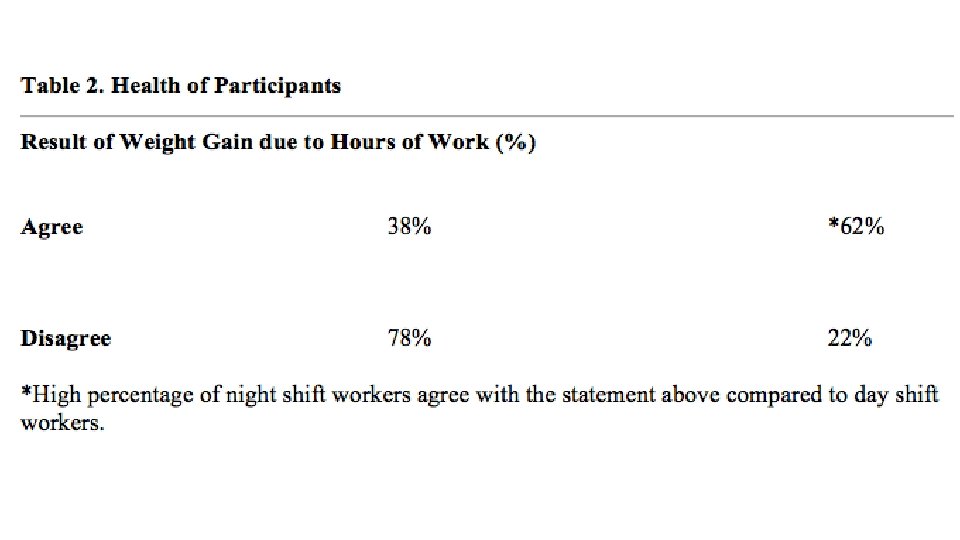
Results • The main components that supported the hypothesis was Table 1 and 2 showing the deviation between the negative effects that night shift puts on health-care workers. • Eating unhealthy, negative impacts to sleep, and weight gain all correlate to night shift. (Health of Participants Tables 1&2) • The type of work/position shows a significant number of RN (68. 9%) and emergency room participants (37%). • “Do you have trouble sleeping due to your work shift? ” The mean score for day and night workers was highest in response to this question (2. 90 -2. 91%). This implies that the health care worker’s sleep is negatively impacted by shift work. • “Have you ever felt drowsy or dozed off while driving to or from work? ” 49% of day shift and 51% of night shift workers responded that they have felt drowsy or dozed off while driving to or from work.
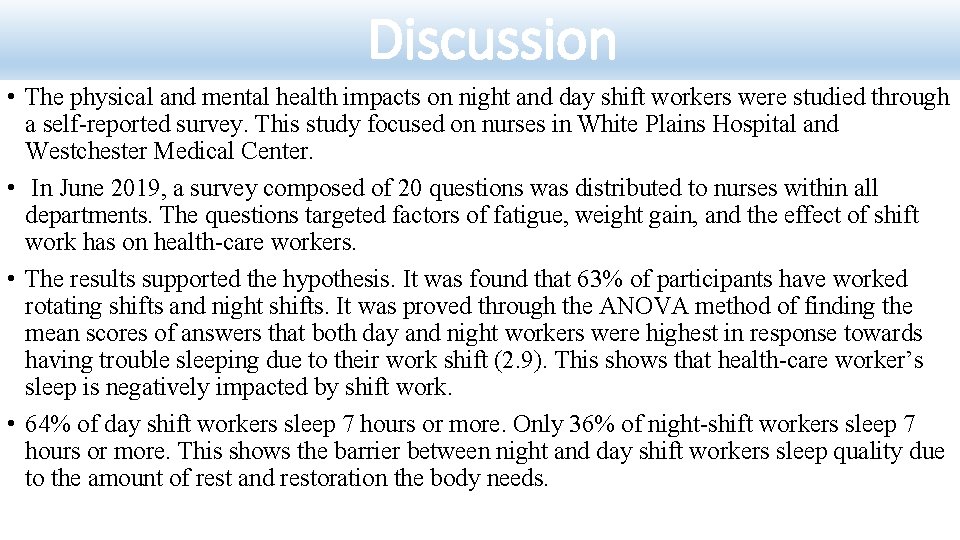
Discussion • The physical and mental health impacts on night and day shift workers were studied through a self-reported survey. This study focused on nurses in White Plains Hospital and Westchester Medical Center. • In June 2019, a survey composed of 20 questions was distributed to nurses within all departments. The questions targeted factors of fatigue, weight gain, and the effect of shift work has on health-care workers. • The results supported the hypothesis. It was found that 63% of participants have worked rotating shifts and night shifts. It was proved through the ANOVA method of finding the mean scores of answers that both day and night workers were highest in response towards having trouble sleeping due to their work shift (2. 9). This shows that health-care worker’s sleep is negatively impacted by shift work. • 64% of day shift workers sleep 7 hours or more. Only 36% of night-shift workers sleep 7 hours or more. This shows the barrier between night and day shift workers sleep quality due to the amount of rest and restoration the body needs.
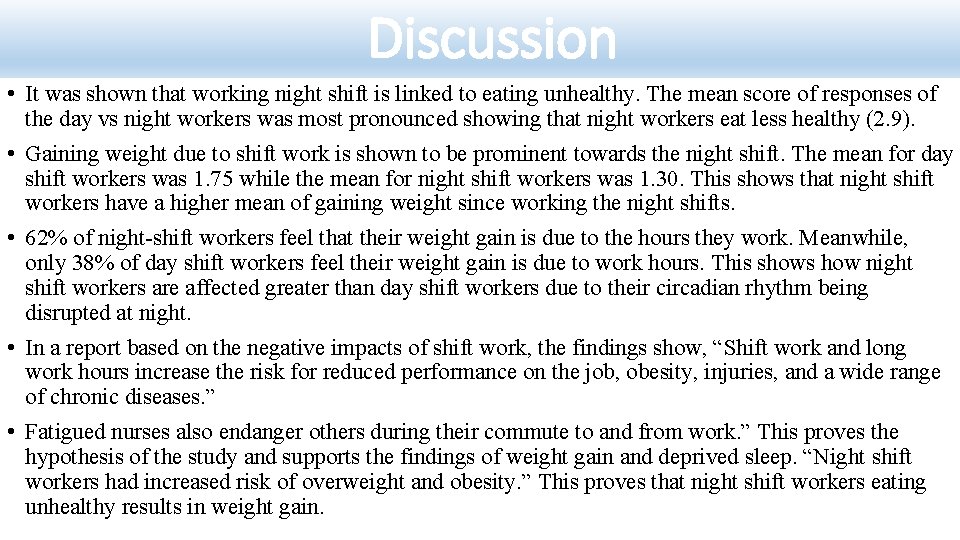
Discussion • It was shown that working night shift is linked to eating unhealthy. The mean score of responses of the day vs night workers was most pronounced showing that night workers eat less healthy (2. 9). • Gaining weight due to shift work is shown to be prominent towards the night shift. The mean for day shift workers was 1. 75 while the mean for night shift workers was 1. 30. This shows that night shift workers have a higher mean of gaining weight since working the night shifts. • 62% of night-shift workers feel that their weight gain is due to the hours they work. Meanwhile, only 38% of day shift workers feel their weight gain is due to work hours. This shows how night shift workers are affected greater than day shift workers due to their circadian rhythm being disrupted at night. • In a report based on the negative impacts of shift work, the findings show, “Shift work and long work hours increase the risk for reduced performance on the job, obesity, injuries, and a wide range of chronic diseases. ” • Fatigued nurses also endanger others during their commute to and from work. ” This proves the hypothesis of the study and supports the findings of weight gain and deprived sleep. “Night shift workers had increased risk of overweight and obesity. ” This proves that night shift workers eating unhealthy results in weight gain.
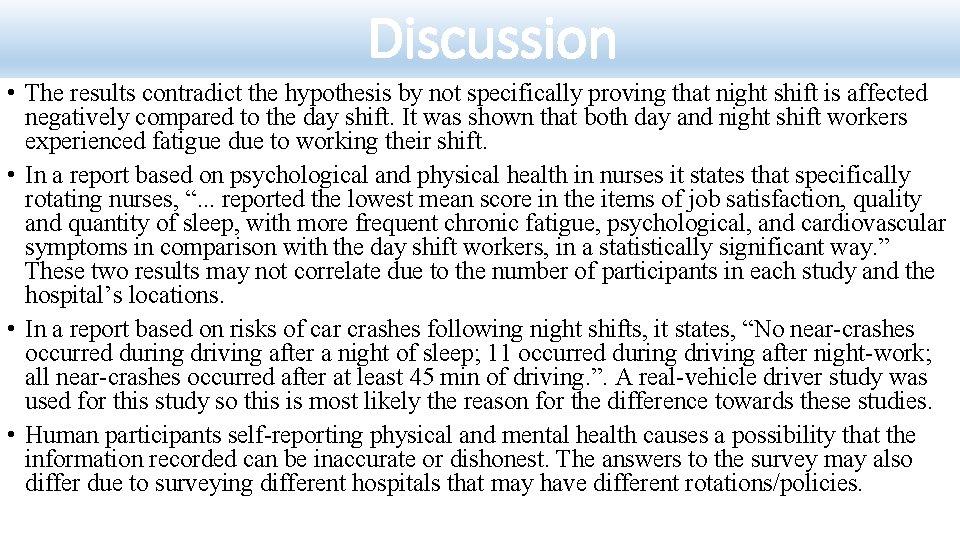
Discussion • The results contradict the hypothesis by not specifically proving that night shift is affected negatively compared to the day shift. It was shown that both day and night shift workers experienced fatigue due to working their shift. • In a report based on psychological and physical health in nurses it states that specifically rotating nurses, “. . . reported the lowest mean score in the items of job satisfaction, quality and quantity of sleep, with more frequent chronic fatigue, psychological, and cardiovascular symptoms in comparison with the day shift workers, in a statistically significant way. ” These two results may not correlate due to the number of participants in each study and the hospital’s locations. • In a report based on risks of car crashes following night shifts, it states, “No near-crashes occurred during driving after a night of sleep; 11 occurred during driving after night-work; all near-crashes occurred after at least 45 min of driving. ”. A real-vehicle driver study was used for this study so this is most likely the reason for the difference towards these studies. • Human participants self-reporting physical and mental health causes a possibility that the information recorded can be inaccurate or dishonest. The answers to the survey may also differ due to surveying different hospitals that may have different rotations/policies.
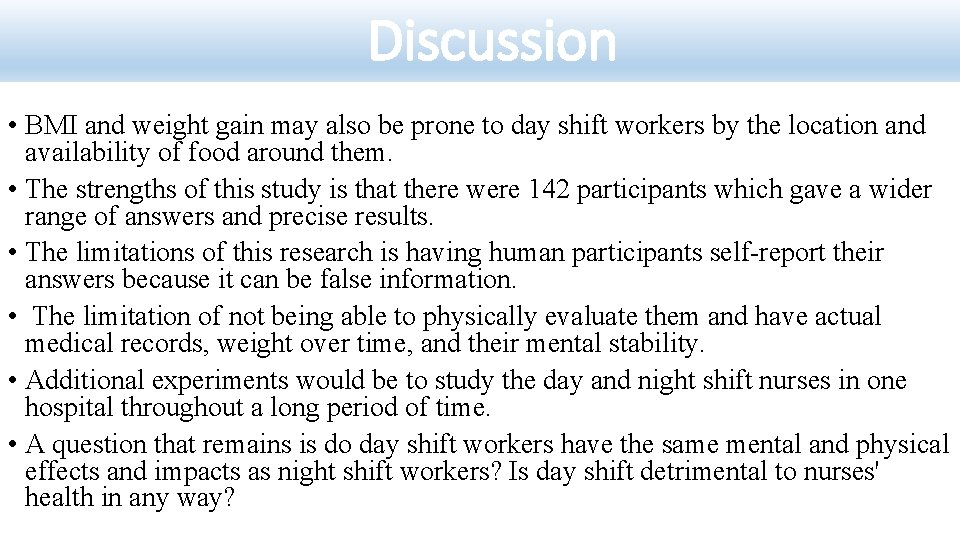
Discussion • BMI and weight gain may also be prone to day shift workers by the location and availability of food around them. • The strengths of this study is that there were 142 participants which gave a wider range of answers and precise results. • The limitations of this research is having human participants self-report their answers because it can be false information. • The limitation of not being able to physically evaluate them and have actual medical records, weight over time, and their mental stability. • Additional experiments would be to study the day and night shift nurses in one hospital throughout a long period of time. • A question that remains is do day shift workers have the same mental and physical effects and impacts as night shift workers? Is day shift detrimental to nurses' health in any way?
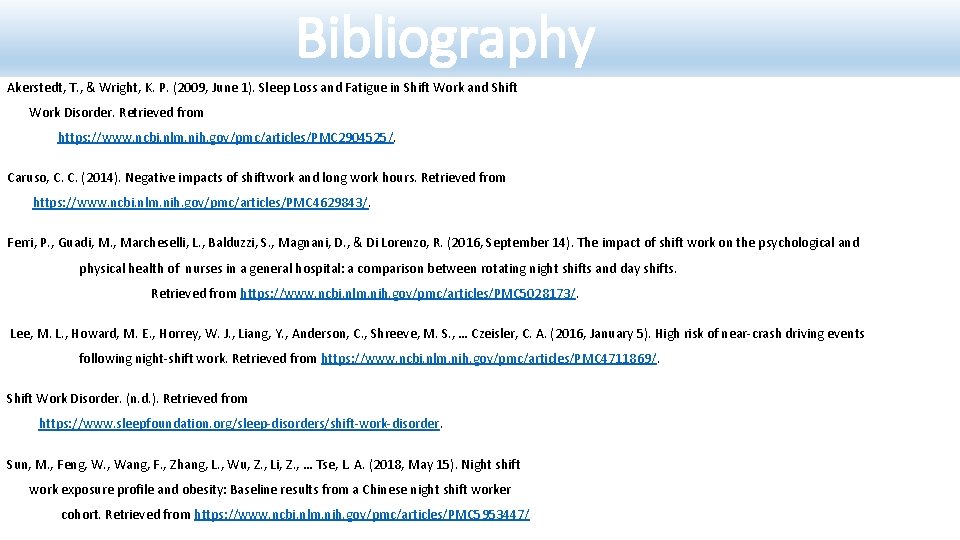
Bibliography Akerstedt, T. , & Wright, K. P. (2009, June 1). Sleep Loss and Fatigue in Shift Work and Shift Work Disorder. Retrieved from https: //www. ncbi. nlm. nih. gov/pmc/articles/PMC 2904525/. Caruso, C. C. (2014). Negative impacts of shiftwork and long work hours. Retrieved from https: //www. ncbi. nlm. nih. gov/pmc/articles/PMC 4629843/. Ferri, P. , Guadi, M. , Marcheselli, L. , Balduzzi, S. , Magnani, D. , & Di Lorenzo, R. (2016, September 14). The impact of shift work on the psychological and physical health of nurses in a general hospital: a comparison between rotating night shifts and day shifts. Retrieved from https: //www. ncbi. nlm. nih. gov/pmc/articles/PMC 5028173/. Lee, M. L. , Howard, M. E. , Horrey, W. J. , Liang, Y. , Anderson, C. , Shreeve, M. S. , … Czeisler, C. A. (2016, January 5). High risk of near-crash driving events following night-shift work. Retrieved from https: //www. ncbi. nlm. nih. gov/pmc/articles/PMC 4711869/. Shift Work Disorder. (n. d. ). Retrieved from https: //www. sleepfoundation. org/sleep-disorders/shift-work-disorder. Sun, M. , Feng, W. , Wang, F. , Zhang, L. , Wu, Z. , Li, Z. , … Tse, L. A. (2018, May 15). Night shift work exposure profile and obesity: Baseline results from a Chinese night shift worker cohort. Retrieved from https: //www. ncbi. nlm. nih. gov/pmc/articles/PMC 5953447/.