
Negative Exponents Recall how we divide powers with


- Slides: 11
Negative Exponents • Recall how we divide powers with the same base … • Use the same property on a different problem … • This suggests that …
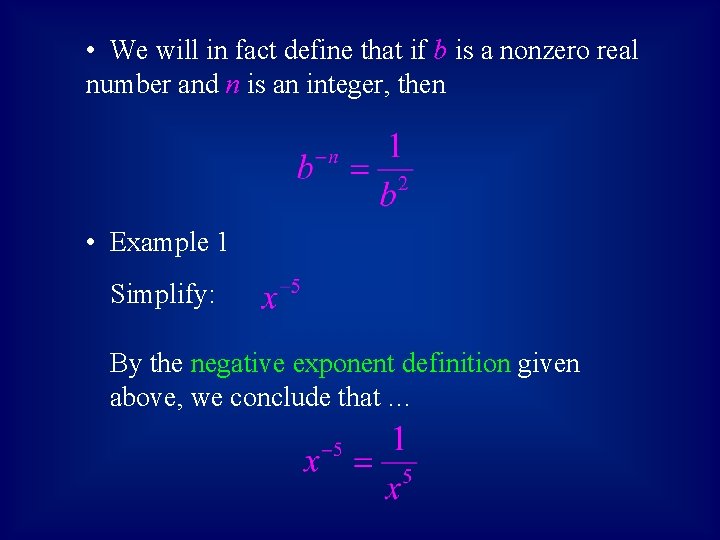
• We will in fact define that if b is a nonzero real number and n is an integer, then • Example 1 Simplify: By the negative exponent definition given above, we conclude that …
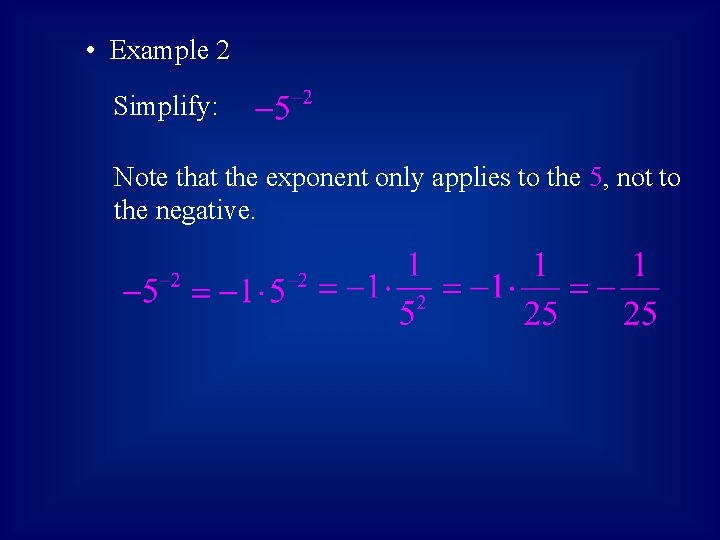
• Example 2 Simplify: Note that the exponent only applies to the 5, not to the negative.
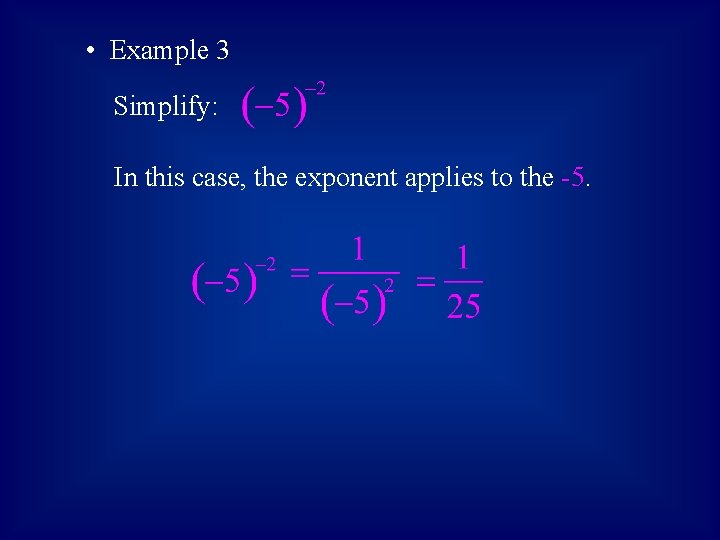
• Example 3 Simplify: In this case, the exponent applies to the -5.
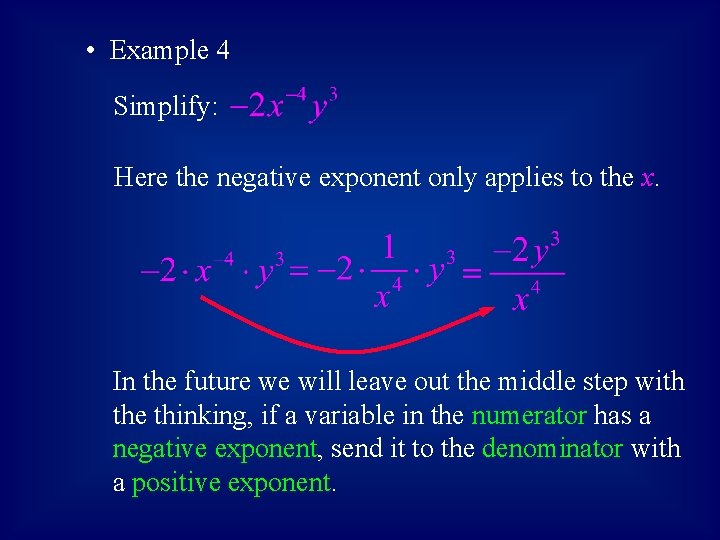
• Example 4 Simplify: Here the negative exponent only applies to the x. In the future we will leave out the middle step with the thinking, if a variable in the numerator has a negative exponent, send it to the denominator with a positive exponent.
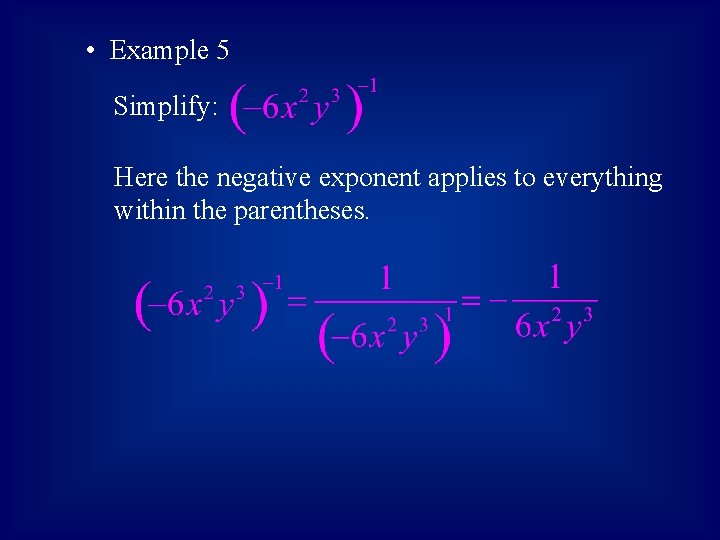
• Example 5 Simplify: Here the negative exponent applies to everything within the parentheses.
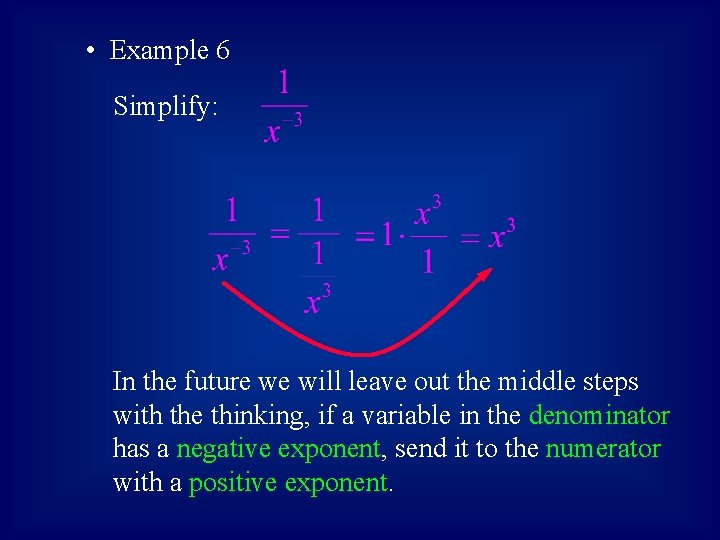
• Example 6 Simplify: In the future we will leave out the middle steps with the thinking, if a variable in the denominator has a negative exponent, send it to the numerator with a positive exponent.
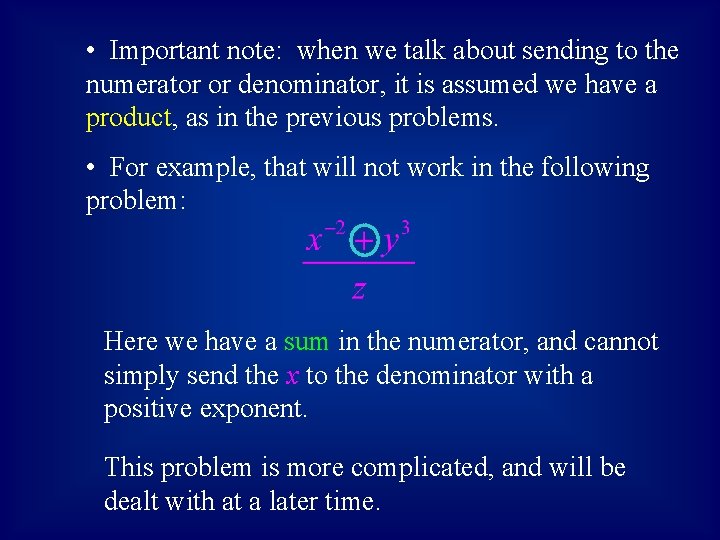
• Important note: when we talk about sending to the numerator or denominator, it is assumed we have a product, as in the previous problems. • For example, that will not work in the following problem: Here we have a sum in the numerator, and cannot simply send the x to the denominator with a positive exponent. This problem is more complicated, and will be dealt with at a later time.
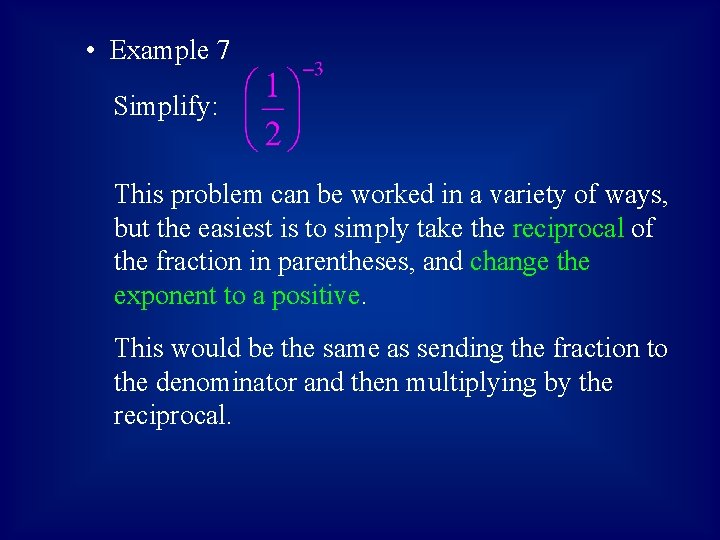
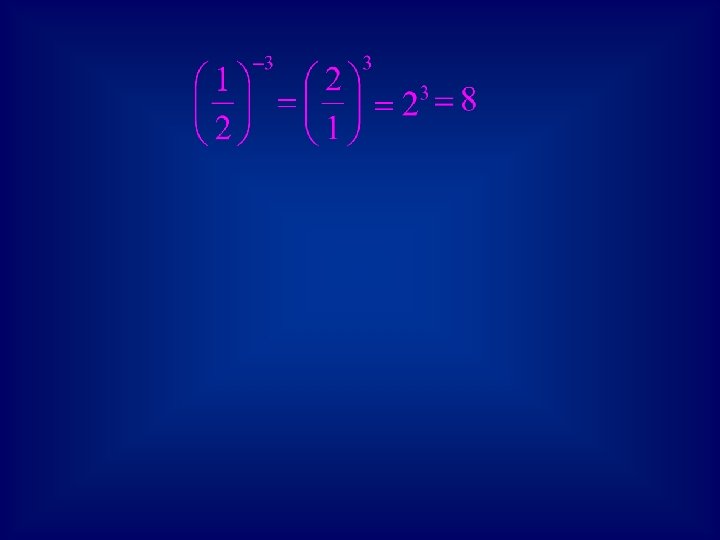
• Example 7 Simplify: This problem can be worked in a variety of ways, but the easiest is to simply take the reciprocal of the fraction in parentheses, and change the exponent to a positive. This would be the same as sending the fraction to the denominator and then multiplying by the reciprocal.