
Negative Binomial Experiment A case of Geometric Distribution
Negative Binomial Experiment A case of Geometric Distribution
Geometric Distribution A geometric experiment is a statistical experiment that has the following properties: * The experiment consists of x repeated trials * Each trial can result in just two possible outcomes. We call one of these outcomes a success and the other, a failure. * The probability of success, denoted by P, is the same on every trial. * The trials are independent; that is, the outcome on one trial does not affect the outcome on other trials. * The experiment continues until r successes are observed, where r is specified in advance.
Example You flip a coin repeatedly and count the number of times the coin lands on heads. You continue flipping the coin until it has landed 5 times on heads. * The experiment consists of repeated trials. We flip a coin repeatedly until it has landed 5 times on heads. * Each trial can result in just two possible outcomes - heads or tails. * The probability of success is constant - 0. 5 on every trial. * The trials are independent; that is, getting heads on one trial does not affect whether we get heads on other trials. * The experiment continues until a fixed number of successes have occurred; in this case, 5 heads.
Geometric Random Variable. . . is the number X of repeated trials to produce r successes in a negative binomial experiment Example: 1. Flip a coin until you get a tail 2. Roll a die until you get a 3 3. In basketball, attempt a three-point shot until you make a basket.
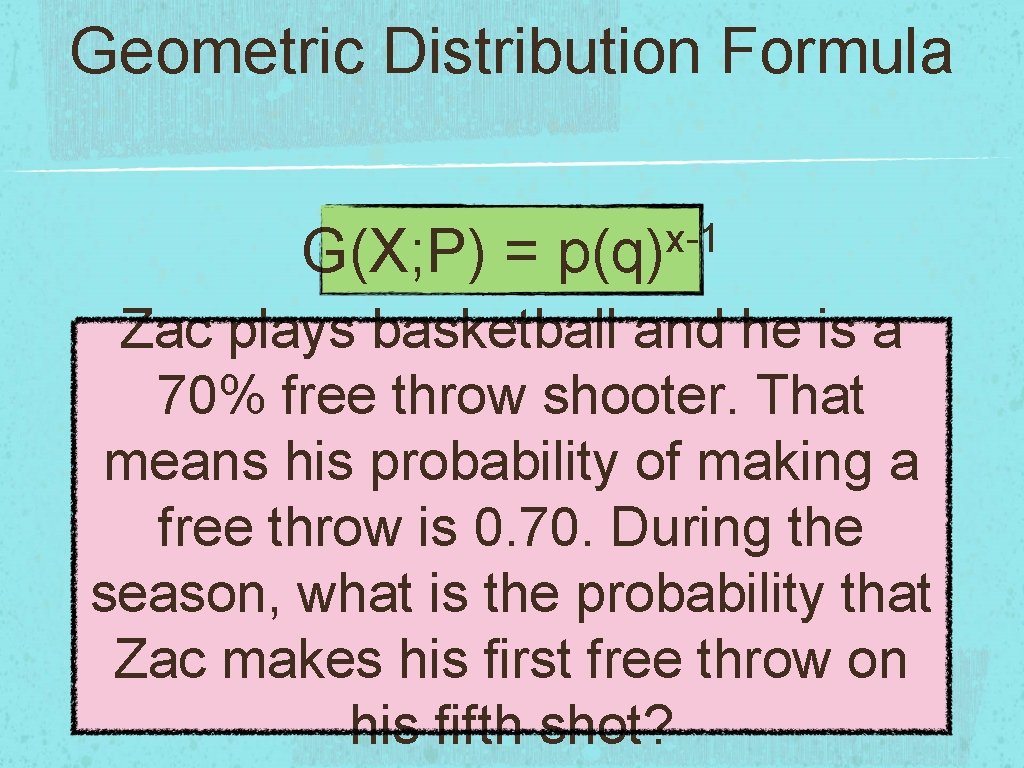
Geometric Distribution Formula G(X; P) = x-1 p(q) Zac plays basketball and he is a 70% free throw shooter. That means his probability of making a free throw is 0. 70. During the season, what is the probability that Zac makes his first free throw on his fifth shot?
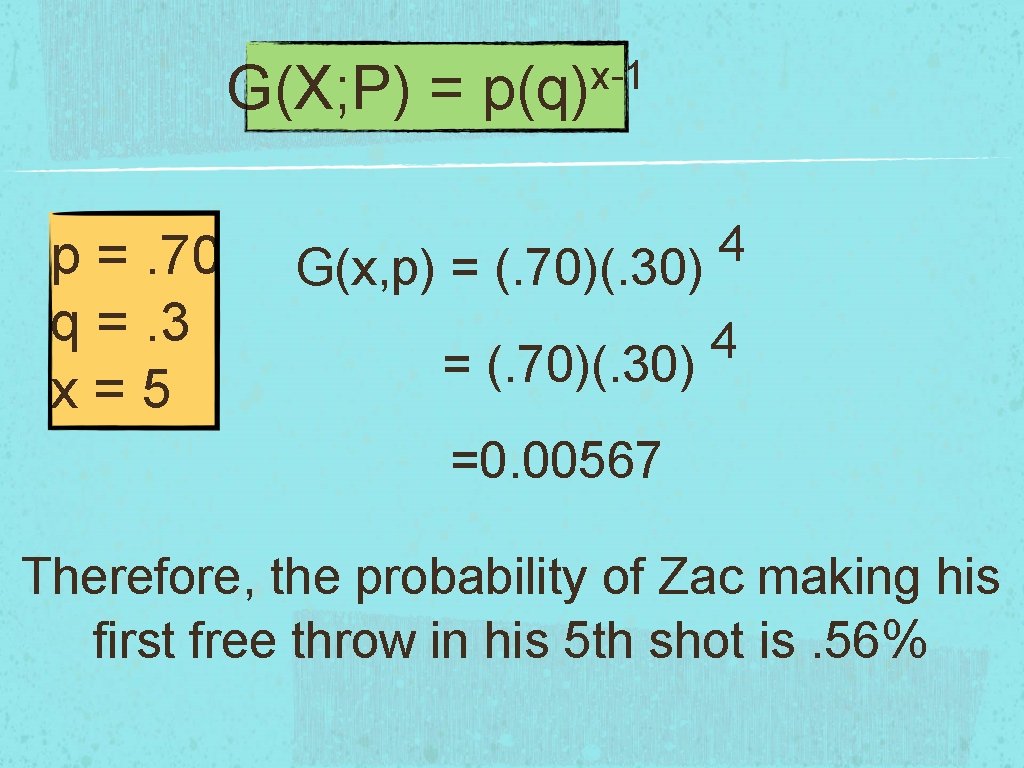
G(X; P) = p =. 70 q =. 3 x=5 x-1 p(q) 4 G(x, p) = (. 70)(. 30) 4 = (. 70)(. 30) =0. 00567 Therefore, the probability of Zac making his first free throw in his 5 th shot is. 56%
- Slides: 6