
Needs Assessment Tools to Guide Decisionmaking Multicriteria Analysis
- Slides: 24
+ Needs Assessment Tools to Guide Decision-making: Multicriteria Analysis and Pair-wise Comparison Ryan Watkins, Ph. D. George Washington University www. Needs. Assessment. org Maurya West Meiers World Bank Group
+ 2 What is a Needs Assessment? n A decision-making tool n A strategic planning tool n A logical process for differentiating “needs” from “wants” n A precursor to accomplishing desired results
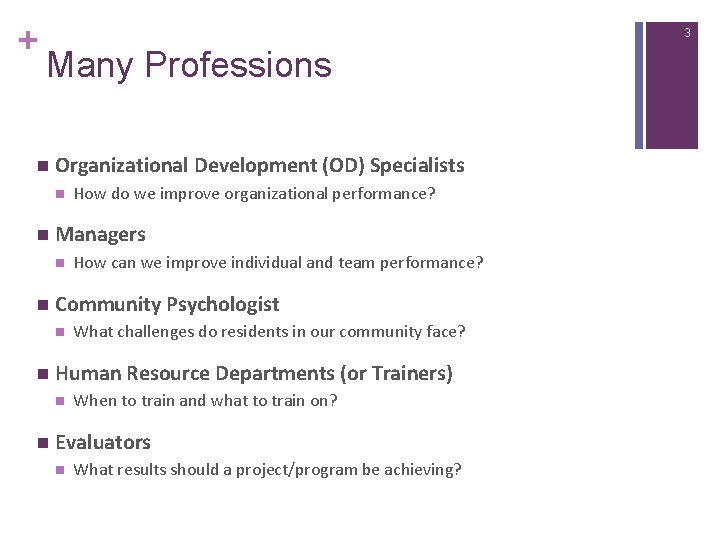
+ 3 Many Professions n Organizational Development (OD) Specialists n n Managers n n What challenges do residents in our community face? Human Resource Departments (or Trainers) n n How can we improve individual and team performance? Community Psychologist n n How do we improve organizational performance? When to train and what to train on? Evaluators n What results should a project/program be achieving?
+ Definitions for Needs Assessments n A systematic study of a problem or innovation, incorporating data and opinions from varied sources, in order to make effective decisions or recommendations about what should happen next (Rossett) n A process for identifying and prioritizing gaps in results based on the cost to meet the need versus the cost to ignore the need (Kaufman)
Why Needs Assessment? n Provides a systematic process to guide decisions. n Provides justification for decisions before they are made. n It is scalable for any size project, time frame, or budget. n Offers a replicable model that can be applied by novices or experts. n Provides a systemic perspective for decision makers. n Allows for interdisciplinary solutions for complex problems. 5
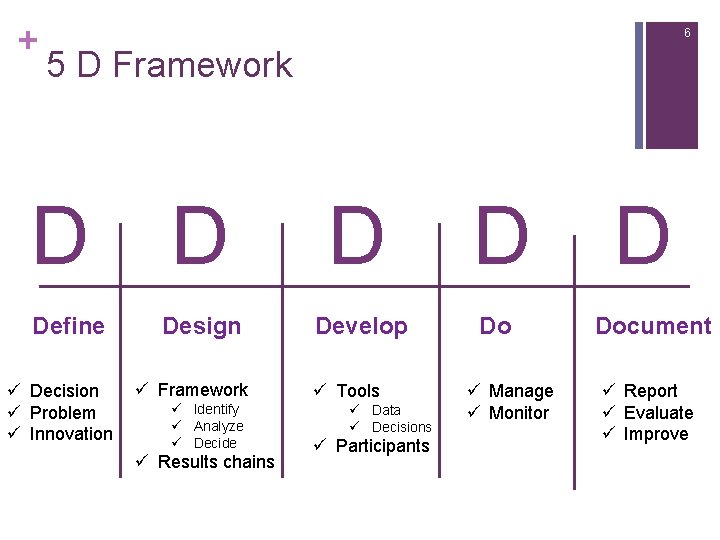
+ 6 5 D Framework D Define Decision Problem Innovation D Design Develop Do Framework Identify Analyze Decide Results chains Tools Data Decisions Participants Manage Monitor D Document Report Evaluate Improve
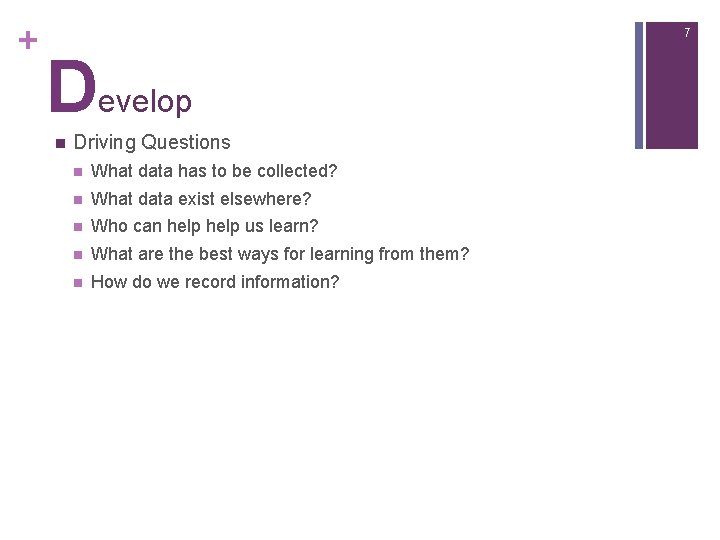
+ 7 Develop n Driving Questions n What data has to be collected? n What data exist elsewhere? n Who can help us learn? n What are the best ways for learning from them? n How do we record information?
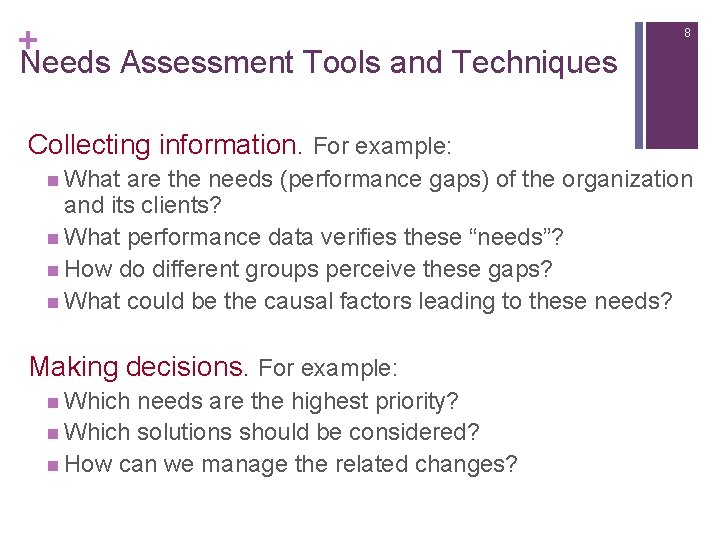
+ 8 Needs Assessment Tools and Techniques Collecting information. For example: n What are the needs (performance gaps) of the organization and its clients? n What performance data verifies these “needs”? n How do different groups perceive these gaps? n What could be the causal factors leading to these needs? Making decisions. For example: n Which needs are the highest priority? n Which solutions should be considered? n How can we manage the related changes?
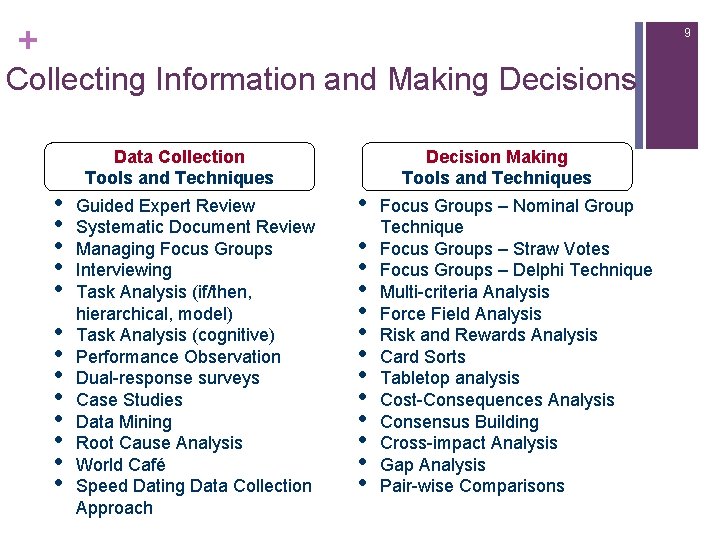
+ 9 Collecting Information and Making Decisions • • • • Data Collection Tools and Techniques Guided Expert Review Systematic Document Review Managing Focus Groups Interviewing Task Analysis (if/then, hierarchical, model) Task Analysis (cognitive) Performance Observation Dual-response surveys Case Studies Data Mining Root Cause Analysis World Café Speed Dating Data Collection Approach • • • • Decision Making Tools and Techniques Focus Groups – Nominal Group Technique Focus Groups – Straw Votes Focus Groups – Delphi Technique Multi-criteria Analysis Force Field Analysis Risk and Rewards Analysis Card Sorts Tabletop analysis Cost-Consequences Analysis Consensus Building Cross-impact Analysis Gap Analysis Pair-wise Comparisons
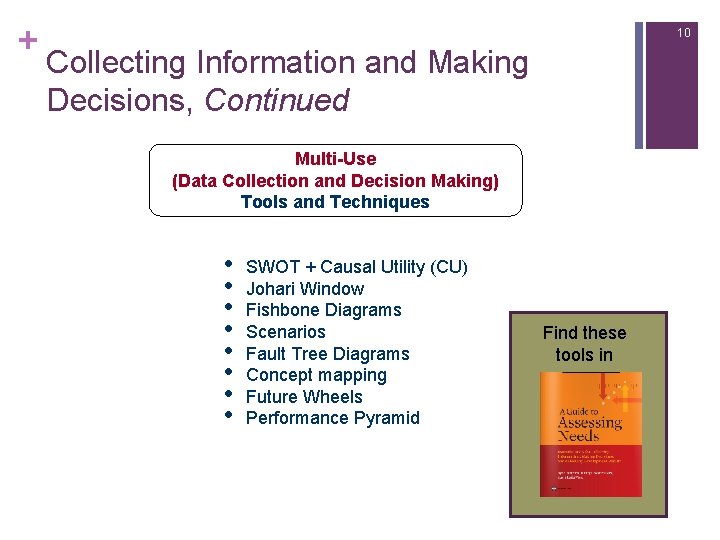
+ 10 Collecting Information and Making Decisions, Continued Multi-Use (Data Collection and Decision Making) Tools and Techniques • • SWOT + Causal Utility (CU) Johari Window Fishbone Diagrams Scenarios Fault Tree Diagrams Concept mapping Future Wheels Performance Pyramid Find these tools in
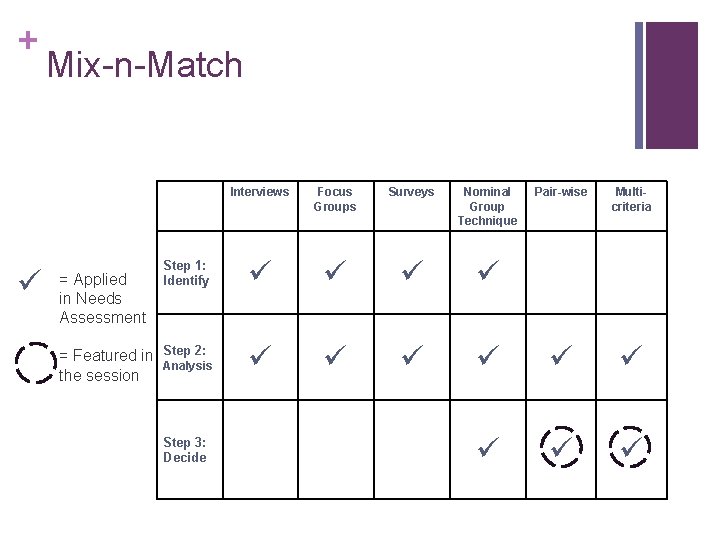
+ Mix-n-Match Interviews Focus Groups Surveys Nominal Group Technique Step 1: Identify = Featured in Step 2: Analysis the session = Applied in Needs Assessment Step 3: Decide Pair-wise Multicriteria 11
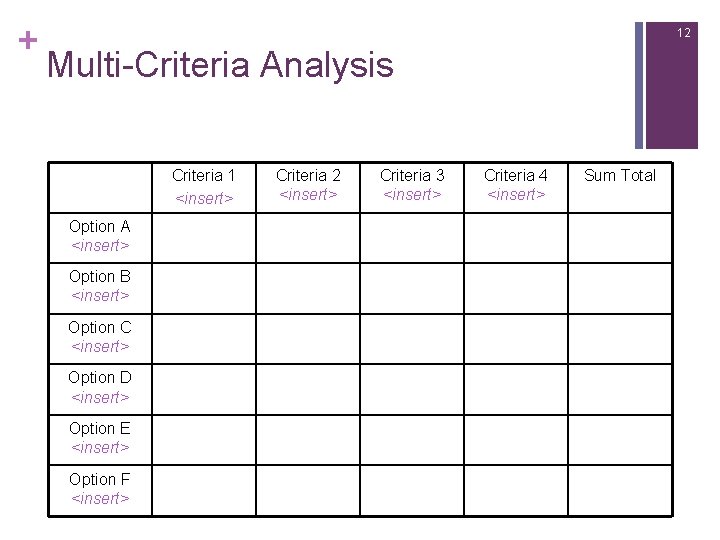
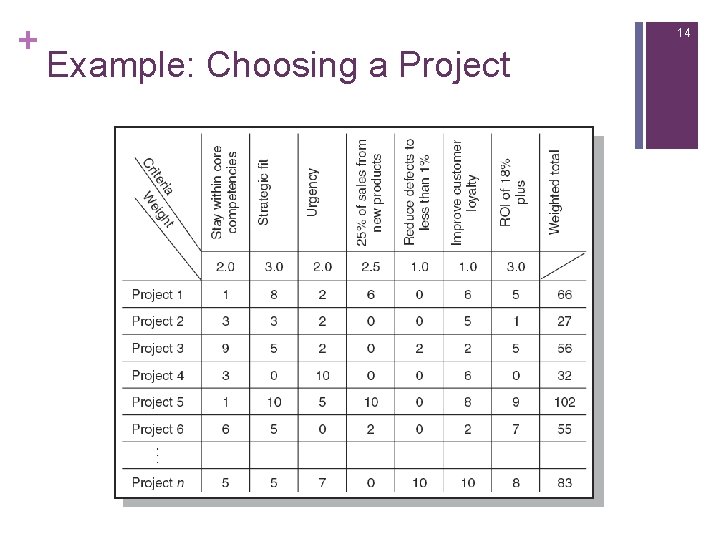
+ 12 Multi-Criteria Analysis Criteria 1 <insert> Option A <insert> Option B <insert> Option C <insert> Option D <insert> Option E <insert> Option F <insert> Criteria 2 <insert> Criteria 3 <insert> Criteria 4 <insert> Sum Total
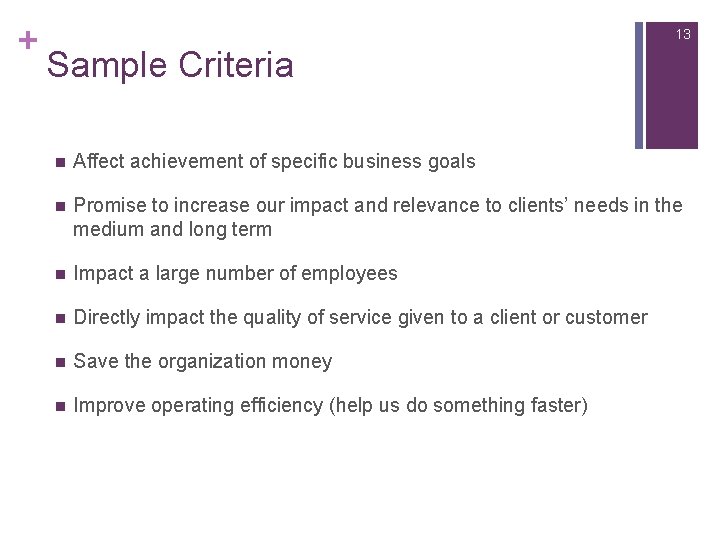
+ 13 Sample Criteria n Affect achievement of specific business goals n Promise to increase our impact and relevance to clients’ needs in the medium and long term n Impact a large number of employees n Directly impact the quality of service given to a client or customer n Save the organization money n Improve operating efficiency (help us do something faster)
+ 14 Example: Choosing a Project
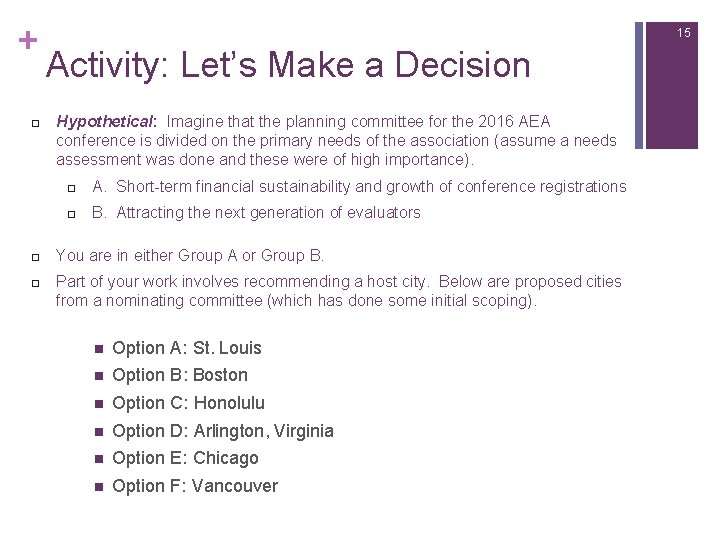
+ 15 Activity: Let’s Make a Decision Hypothetical: Imagine that the planning committee for the 2016 AEA conference is divided on the primary needs of the association (assume a needs assessment was done and these were of high importance). A. Short-term financial sustainability and growth of conference registrations B. Attracting the next generation of evaluators You are in either Group A or Group B. Part of your work involves recommending a host city. Below are proposed cities from a nominating committee (which has done some initial scoping). n Option A: St. Louis n Option B: Boston n Option C: Honolulu n Option D: Arlington, Virginia n Option E: Chicago n Option F: Vancouver
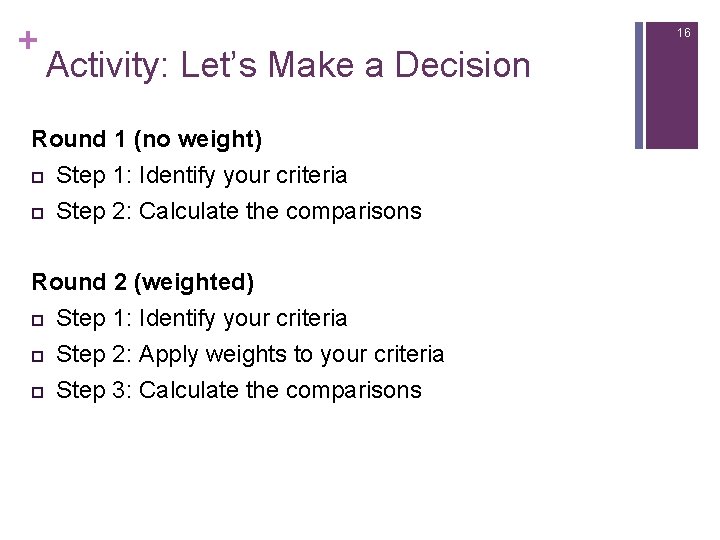
+ 16 Activity: Let’s Make a Decision Round 1 (no weight) Step 1: Identify your criteria Step 2: Calculate the comparisons Round 2 (weighted) Step 1: Identify your criteria Step 2: Apply weights to your criteria Step 3: Calculate the comparisons
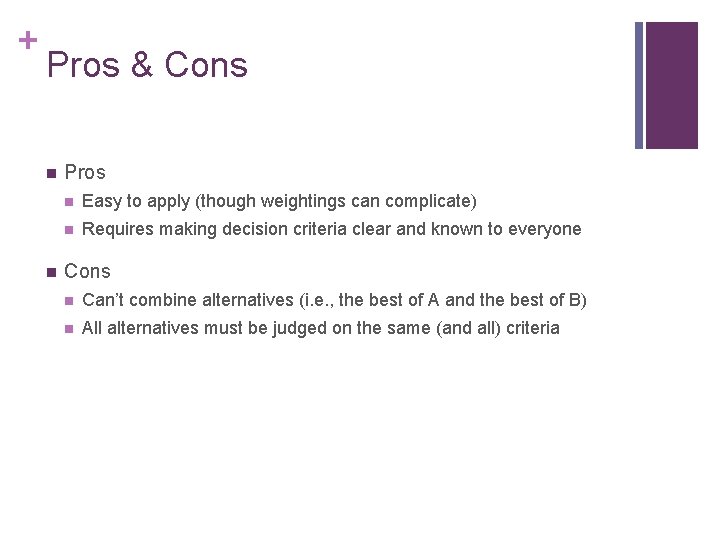
+ Pros & Cons n n Pros n Easy to apply (though weightings can complicate) n Requires making decision criteria clear and known to everyone Cons n Can’t combine alternatives (i. e. , the best of A and the best of B) n All alternatives must be judged on the same (and all) criteria
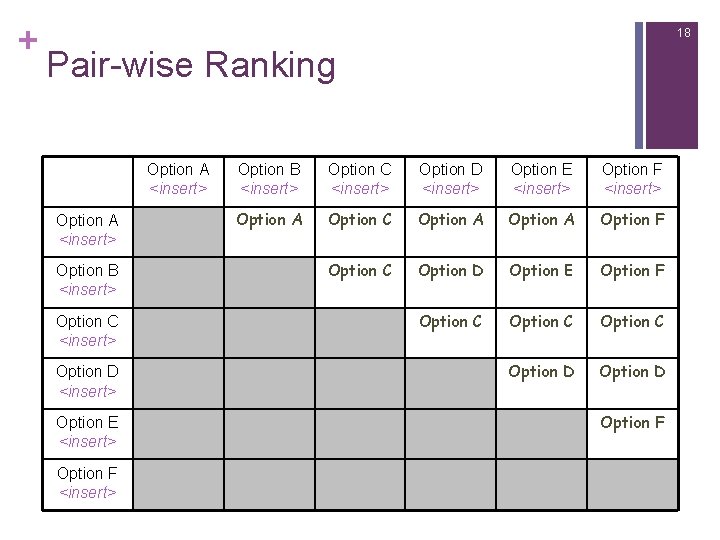
+ 18 Pair-wise Ranking Option A <insert> Option B <insert> Option C <insert> Option D <insert> Option E <insert> Option F <insert> Option A Option C Option A Option F Option C Option D Option E Option F Option C Option D Option F
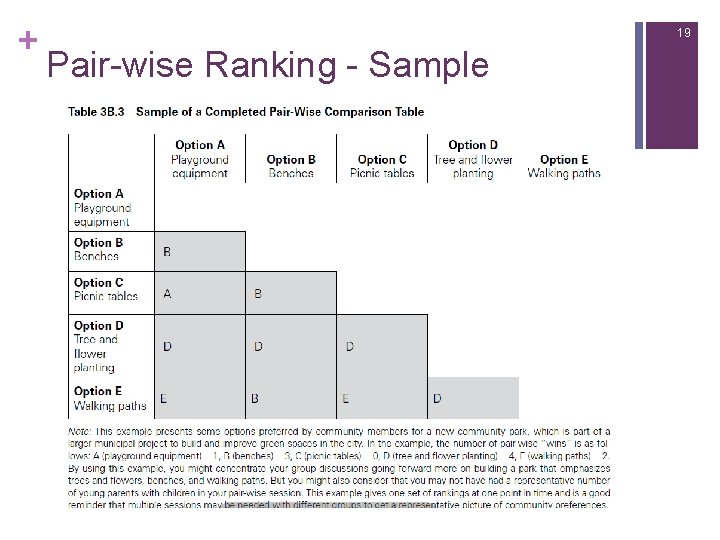
+ 19 Pair-wise Ranking - Sample
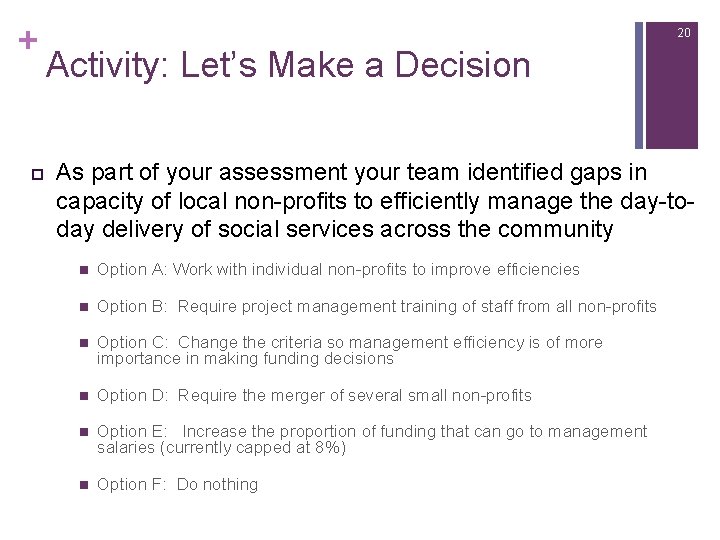
+ 20 Activity: Let’s Make a Decision As part of your assessment your team identified gaps in capacity of local non-profits to efficiently manage the day-today delivery of social services across the community n Option A: Work with individual non-profits to improve efficiencies n Option B: Require project management training of staff from all non-profits n Option C: Change the criteria so management efficiency is of more importance in making funding decisions n Option D: Require the merger of several small non-profits n Option E: Increase the proportion of funding that can go to management salaries (currently capped at 8%) n Option F: Do nothing
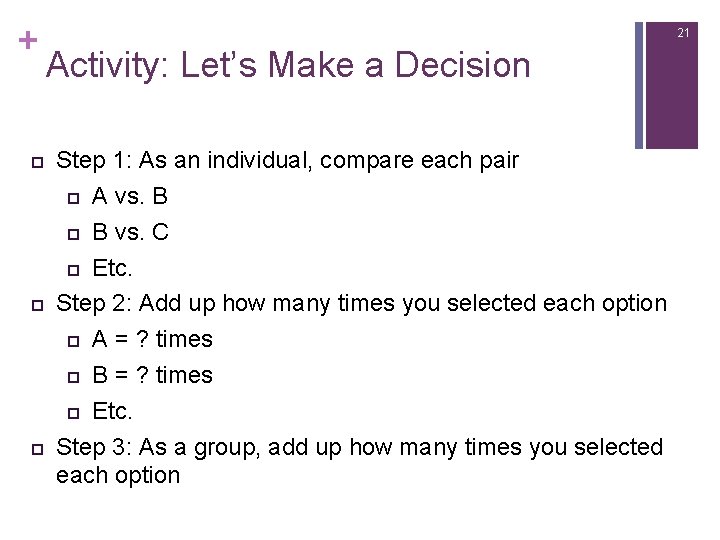
+ 21 Activity: Let’s Make a Decision Step 1: As an individual, compare each pair A vs. B B vs. C Etc. Step 2: Add up how many times you selected each option A = ? times B = ? times Etc. Step 3: As a group, add up how many times you selected each option
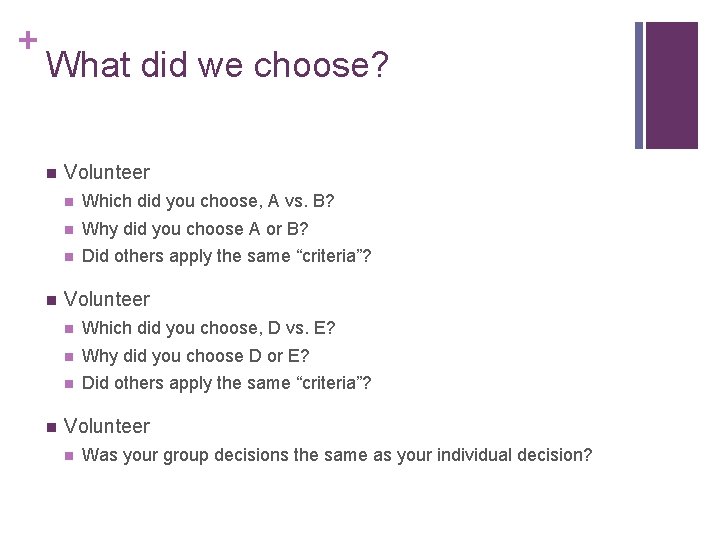
+ What did we choose? n n n Volunteer n Which did you choose, A vs. B? n Why did you choose A or B? n Did others apply the same “criteria”? Volunteer n Which did you choose, D vs. E? n Why did you choose D or E? n Did others apply the same “criteria”? Volunteer n Was your group decisions the same as your individual decision?
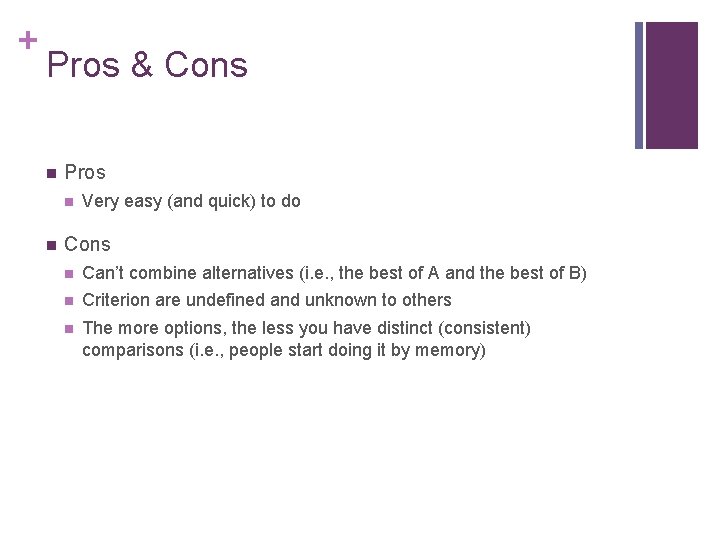
+ Pros & Cons n Pros n n Very easy (and quick) to do Cons n Can’t combine alternatives (i. e. , the best of A and the best of B) n Criterion are undefined and unknown to others n The more options, the less you have distinct (consistent) comparisons (i. e. , people start doing it by memory)
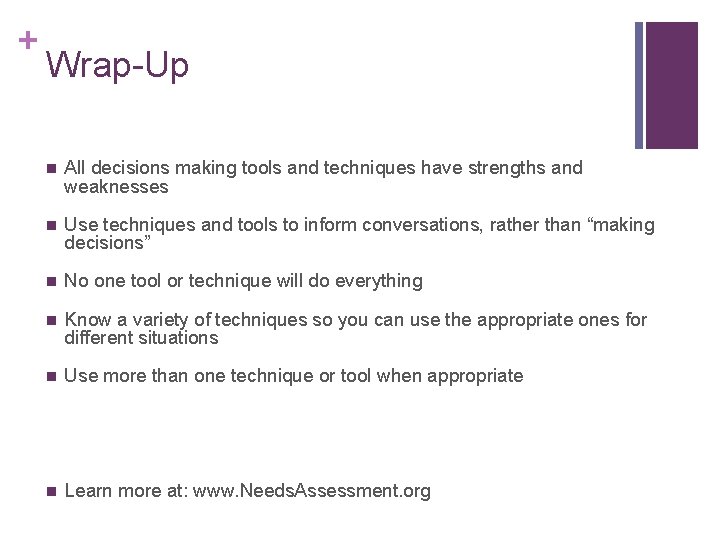
+ Wrap-Up n All decisions making tools and techniques have strengths and weaknesses n Use techniques and tools to inform conversations, rather than “making decisions” n No one tool or technique will do everything n Know a variety of techniques so you can use the appropriate ones for different situations n Use more than one technique or tool when appropriate n Learn more at: www. Needs. Assessment. org