
Needs Assessment Slides for Module 4 Topic Needs

- Slides: 23
Needs Assessment Slides for Module 4 Topic: Needs Assessment Overview
Needs Assessment Overview • • • Definition and Importance Legislative Requirements HRSA/HAB Expectations Needs Assessment Components Focus Areas for Needs Assessment Obtaining Needs Assessment Data
Training Objectives Following the needs assessment overview training, participants will be able to: 1. Define needs assessment 2. Explain 3 major uses of needs assessment in RWHAP Part A planning 3. Explain the legislative requirements and HRSA/HAB expectations for RWHAP Part A needs assessment 4. Identify the 6 components of a RWHAP Part A needs assessment
What is Needs Assessment? • Needs assessment is a systematic process of collecting and analyzing information in order to understand service needs or gaps between current and desired conditions • Resulting knowledge is used to determine what changes are needed to help fill those service gaps and meet identified needs • Action requires setting priorities and deciding how best to use available resources for positive change
What is Part A Needs Assessment? • A process of collecting information about the needs of people living with HIV (PLWH) in a Part A jurisdiction, both those receiving care and those not in care • Includes both quantitative (numerical) and qualitative (non-numerical) data obtained from multiple sources using a variety of methods • A planning task usually led by the planning council/planning body (PC/PB)
Importance of Needs Assessment 1 • The most important decisions of a planning council – or recommendations of a planning body – involve how RWHAP Part A program funds will be used – What service categories to give priority for funding – How much money to allocate to each service category – How to ensure equal access to services for all PLWH, regardless of their characteristics or where they live in the service area • Sound decisions require sound data – and needs assessment is a key source of such data
Importance of Needs Assessment 2 Needs assessment helps PC/PB and recipient find out: • What medical and support services PLWH need to enter or return to care, stay in care, and reach and maintain HIV viral suppression • To what extent those needs are being met by the current system of care • What kinds of services are most needed and work best for different groups of PLWH – and what disparities in access and services remain for affected subpopulations and historically underserved communities
Legislative Requirements for Needs Assessment by RWHAP Part A Planning Councils 1 Described in the legislation as a duty of RWHAP planning councils, which every Eligible Metropolitan Area (EMA) must have: “Determine the size and demographics of the population of individuals with HIV/AIDS, as well as the size and demographics of the estimated population of individuals with HIV/AIDS who are unaware of their HIV status” − 2009 legislation, § 2602(b)(4)(A)
Legislative Requirements for Needs Assessment by RWHAP Part A Planning Councils 2 “Determine the needs of such population, with particular attention to— • individuals with HIV/AIDS who know their HIV status and are not receiving HIV-related services; • disparities in access and services among affected subpopulations and historically underserved communities; and • individuals with HIV/AIDS who do not know their HIV status” − 2009 legislation, § 2602(b)(4)(B)
Legislative Requirement for PLWH Input to Needs Assessment • Decision making about priority setting and resource allocation must consider “priorities of the communities with HIV/AIDS for whom the services are intended” • Planning council must “establish methods for obtaining input on community needs and priorities which may include public meetings. . . conducting focus groups, and convening ad-hoc panels” − 2009 Legislation, § 2602(b)(4)(C)(III) and (G)
Quick Activity A: Importance of Needs Assessment Needs assessment can be expensive, and you have heard some PC/PB members wonder how important it is to spend money on reaching out to people living with HIV in the community about their service needs and barriers, when a lot of information about actual use of services is available from the recipient, and both consumers and service providers serve on the PC/PB. 1. If someone asked you why structured needs assessment to gather information from PLWH is important, what would you tell them? 2. What examples might you give to help convince them?
Legislative Requirements for TGAs without Planning Councils A Part A Transitional Grant Area (TGA) without a planning council is still responsible for obtaining community input for decision making: The CEO must provide documentation: “that details the process used to obtain community input (particularly from those with HIV) in the transitional area formulating the overall plan for priority setting and allocating funds…” − 2009 Legislation, § 2609(d)(1)(A)
HRSA/HAB Expectations for Needs Assessment • Meet all legislative requirements • Work in partnership with the recipient and community – consumers, other PLWH, and service providers – Include providers with funding from Part A, other RWHAP Parts, and non-RWHAP sources • Generate data for key planning tasks: – Priority Setting and Resource Allocation (PSRA), including developing directives – Developing or updating the HRSA/CDC Integrated Prevention and Care Plan – Improving services, with particular emphasis on reducing HIV-related health disparities
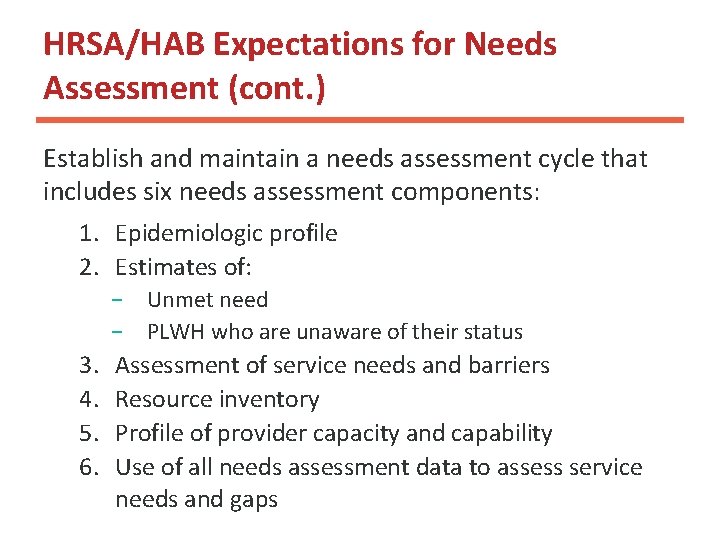
HRSA/HAB Expectations for Needs Assessment (cont. ) Establish and maintain a needs assessment cycle that includes six needs assessment components: 1. Epidemiologic profile 2. Estimates of: − Unmet need − PLWH who are unaware of their status 3. 4. 5. 6. Assessment of service needs and barriers Resource inventory Profile of provider capacity and capability Use of all needs assessment data to assess service needs and gaps
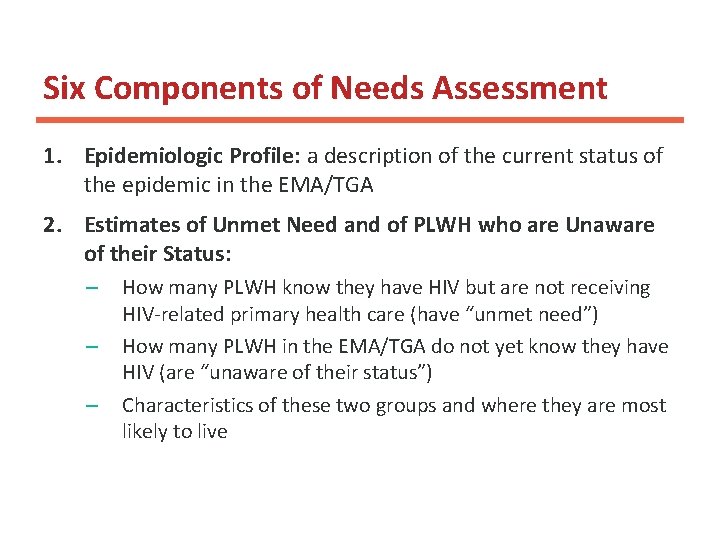
Six Components of Needs Assessment 1 1. Epidemiologic Profile: a description of the current status of the epidemic in the EMA/TGA 2. Estimates of Unmet Need and of PLWH who are Unaware of their Status: – – – How many PLWH know they have HIV but are not receiving HIV-related primary health care (have “unmet need”) How many PLWH in the EMA/TGA do not yet know they have HIV (are “unaware of their status”) Characteristics of these two groups and where they are most likely to live
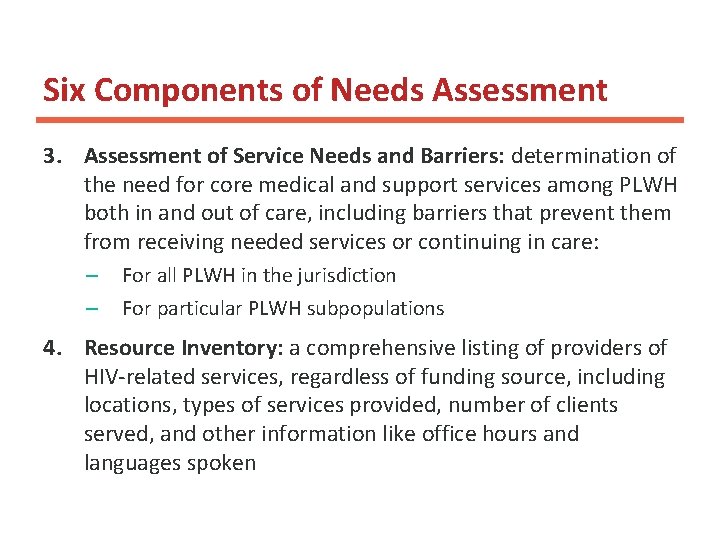
Six Components of Needs Assessment 2 3. Assessment of Service Needs and Barriers: determination of the need for core medical and support services among PLWH both in and out of care, including barriers that prevent them from receiving needed services or continuing in care: – – For all PLWH in the jurisdiction For particular PLWH subpopulations 4. Resource Inventory: a comprehensive listing of providers of HIV-related services, regardless of funding source, including locations, types of services provided, number of clients served, and other information like office hours and languages spoken
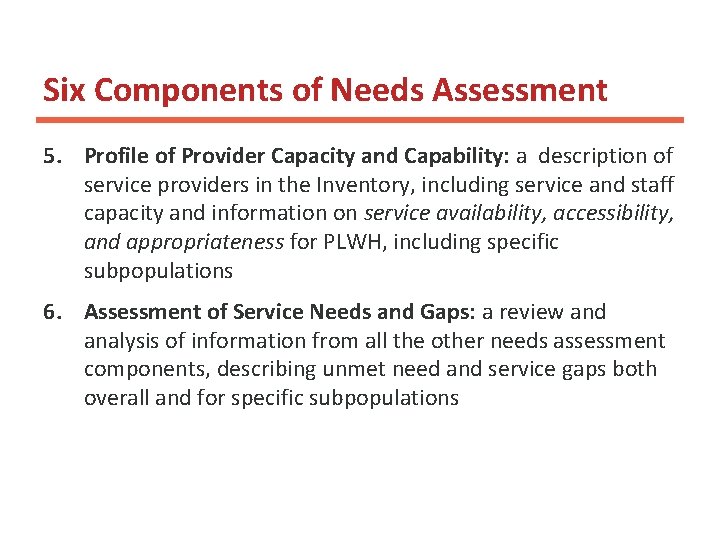
Six Components of Needs Assessment 5. Profile of Provider Capacity and Capability: a description of service providers in the Inventory, including service and staff capacity and information on service availability, accessibility, and appropriateness for PLWH, including specific subpopulations 6. Assessment of Service Needs and Gaps: a review and analysis of information from all the other needs assessment components, describing unmet need and service gaps both overall and for specific subpopulations
Quick Activity B: Needs Assessment Priorities Your Needs Assessment Committee is planning next year’s needs assessment. Based on your knowledge of the EMA or TGA: 1. What 3 -4 populations in your EMA/TGA do you most need to better understand because they are disproportionately affected by HIV or seem to face special barriers to care? 2. What are some things you need to learn about their needs and about available services, in order to ensure that PLWH from these populations receive appropriate, high quality HIV care?
Multiple Interrelated Components Needs assessment requires: • Receiving or obtaining data for all the different components, often over a multi-year cycle • Analyzing and comparing data from multiple components and sources to answer key questions about service needs, current system of care, service gaps, and barriers to care • Using that information for decision making about use of resources and ways to improve service access and care – and increase retention and viral suppression
Three Focus Areas for Needs Assessment 1 1. Focus on individuals with HIV: – Epidemiologic Profile – Estimates of the Number and Characteristics of: • PLWH with Unmet Need • PLWH who are Unaware of their Status – Assessment of PLWH Service Needs and Barriers of all PLWH who know their status, whether in or out of care, and for affected subpopulations
Three Focus Areas for Needs Assessment 2 2. Focus on current services/system of care: – Resource Inventory – Profile of Provider Capacity and Capability 3. Combined focus on PLWH and services – Assessment of PLWH service needs and gaps, based on data from all needs assessment components
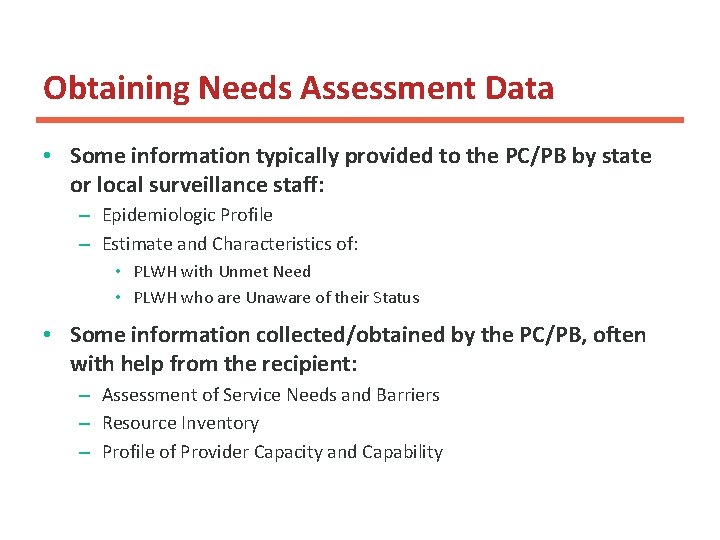
Obtaining Needs Assessment Data • Some information typically provided to the PC/PB by state or local surveillance staff: – Epidemiologic Profile – Estimate and Characteristics of: • PLWH with Unmet Need • PLWH who are Unaware of their Status • Some information collected/obtained by the PC/PB, often with help from the recipient: – Assessment of Service Needs and Barriers – Resource Inventory – Profile of Provider Capacity and Capability
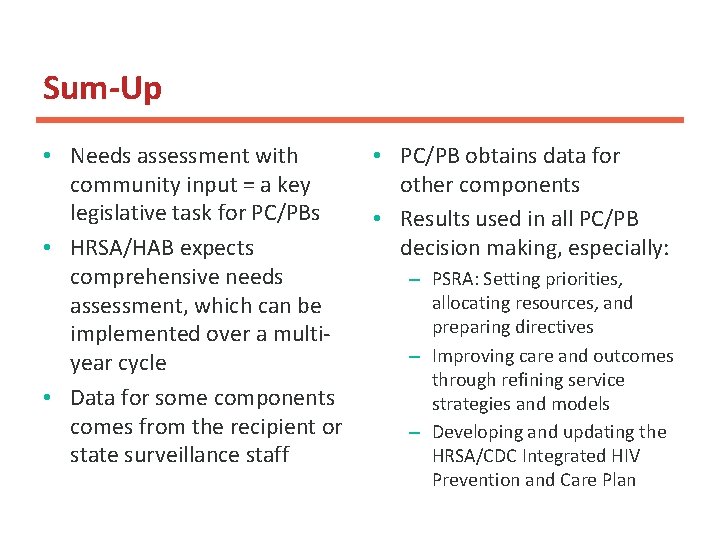
Sum-Up • Needs assessment with community input = a key legislative task for PC/PBs • HRSA/HAB expects comprehensive needs assessment, which can be implemented over a multiyear cycle • Data for some components comes from the recipient or state surveillance staff • PC/PB obtains data for other components • Results used in all PC/PB decision making, especially: – PSRA: Setting priorities, allocating resources, and preparing directives – Improving care and outcomes through refining service strategies and models – Developing and updating the HRSA/CDC Integrated HIV Prevention and Care Plan