
Need Recognition Search Prepurchase Alternative Evaluation Purchase Need
- Slides: 25
Need Recognition, Search, Prepurchase Alternative Evaluation, Purchase
Need Recognition Depends on how much discrepancy exists between the actual state and the desired state
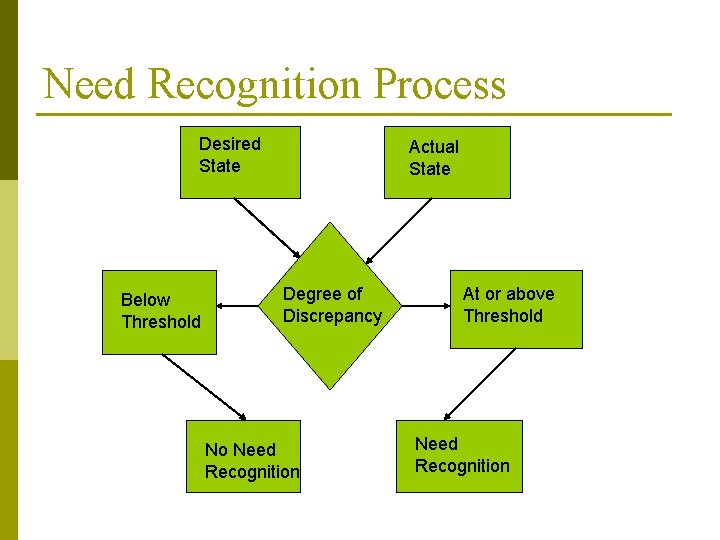
Need Recognition Process Desired State Below Threshold Actual State Degree of Discrepancy No Need Recognition At or above Threshold Need Recognition
Need must first be activated before it can be recognised Such factors operate by altering the person’s actual / desired states
Need activation factors Time p Changed circumstances p Product acquisition p Product consumption p Individual differences p Marketing Influences p
Search Motivated activation of knowledge stored in memory or acquisition of information from the environment
Search can be Internal – memory, knowledge, habit, purchase, degree of satisfaction p External – when internal search is inadequate. External search could be prepurchase search or on-going search p
Dimensions of Search Degree p Direction p sequence p
Degree of Search How many brands? p How many stores? p How many attributes? p No. of information sources? p How much time? p
Direction of Search Which p brands? stores? attributes? information sources?
Sequence of Search In what order processed? p of of brands considered? stores visited? attributes considered? information sources
Determinants of Search Situational p Product p Retail p Consumer p
Consumers engage in more search as their attitude towards shopping become more favourable “Age and income is often negatively related to search”
Prepurchase Alternative Evaluation The process by which a choice alternative gets evaluated and selected
Evaluative criteria Price p Brand name p Country of origin p Situational influence p Similarity of choice alternatives p Motivation p Knowledge p Involvement p
Decision Rules Non-compensatory methods p Compensatory methods p
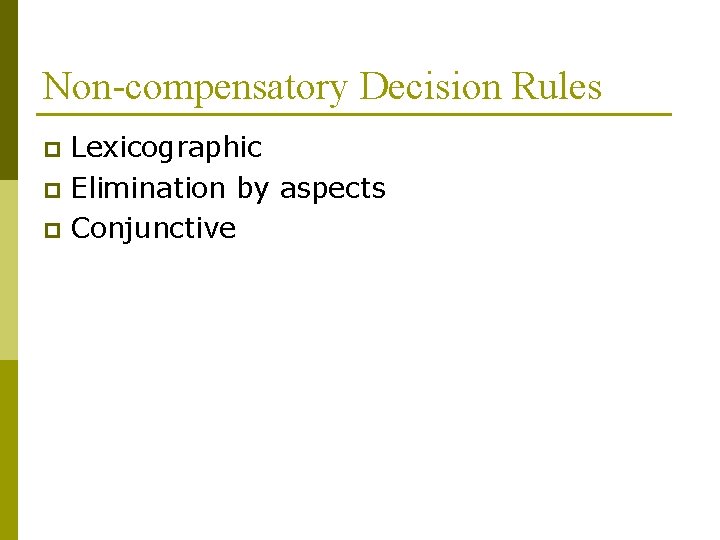
Non-compensatory Decision Rules Lexicographic p Elimination by aspects p Conjunctive p
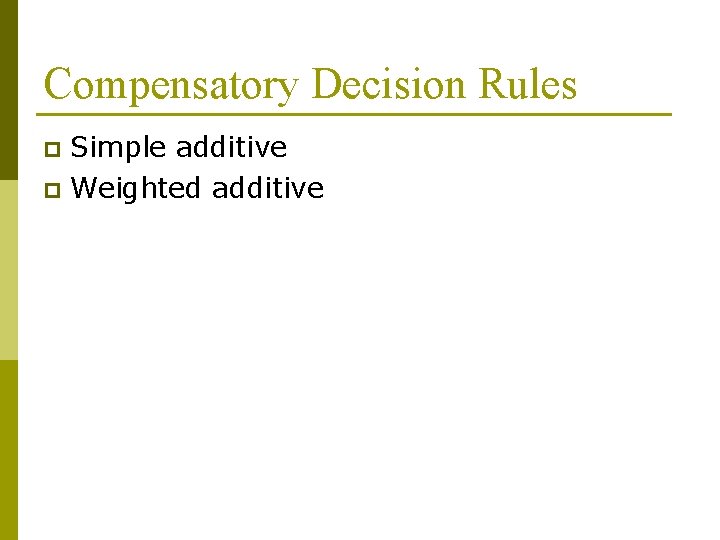
Compensatory Decision Rules Simple additive p Weighted additive p
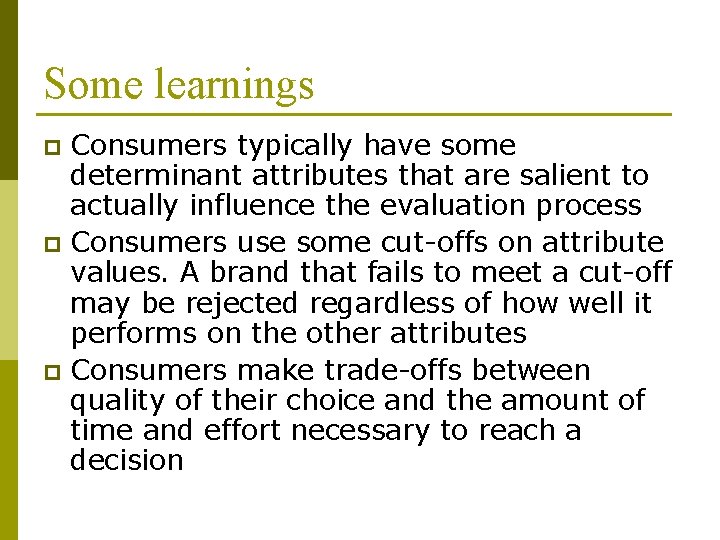
Some learnings Consumers typically have some determinant attributes that are salient to actually influence the evaluation process p Consumers use some cut-offs on attribute values. A brand that fails to meet a cut-off may be rejected regardless of how well it performs on the other attributes p Consumers make trade-offs between quality of their choice and the amount of time and effort necessary to reach a decision p
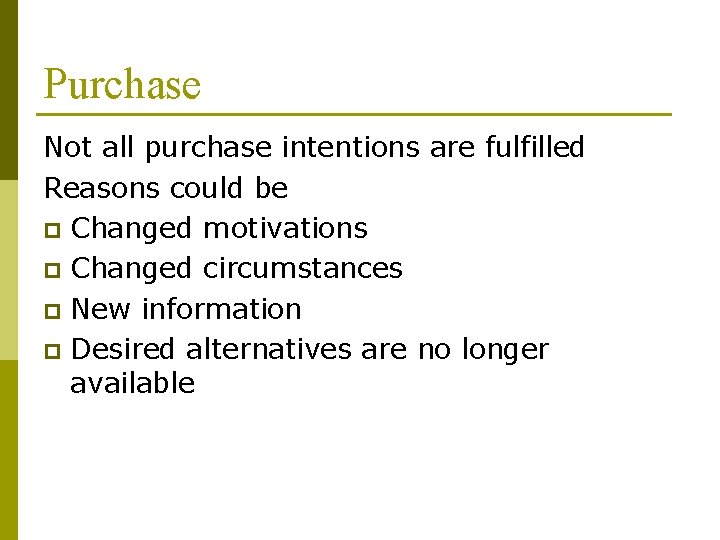
Purchase Not all purchase intentions are fulfilled Reasons could be p Changed motivations p Changed circumstances p New information p Desired alternatives are no longer available
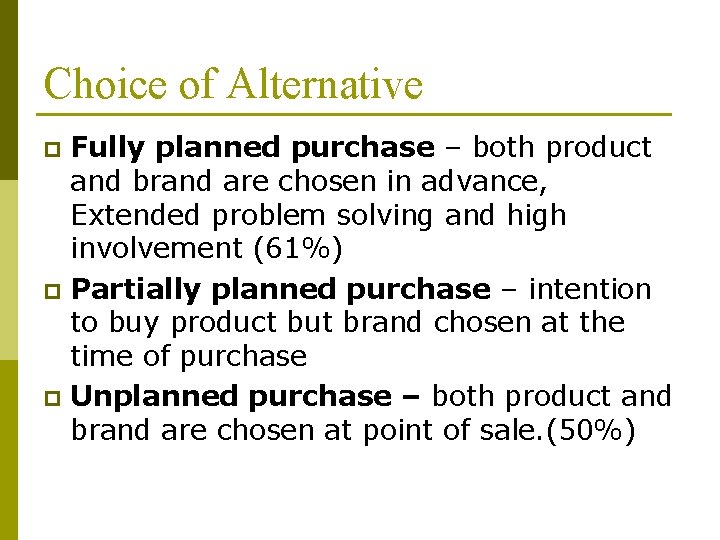
Choice of Alternative Fully planned purchase – both product and brand are chosen in advance, Extended problem solving and high involvement (61%) p Partially planned purchase – intention to buy product but brand chosen at the time of purchase p Unplanned purchase – both product and brand are chosen at point of sale. (50%) p
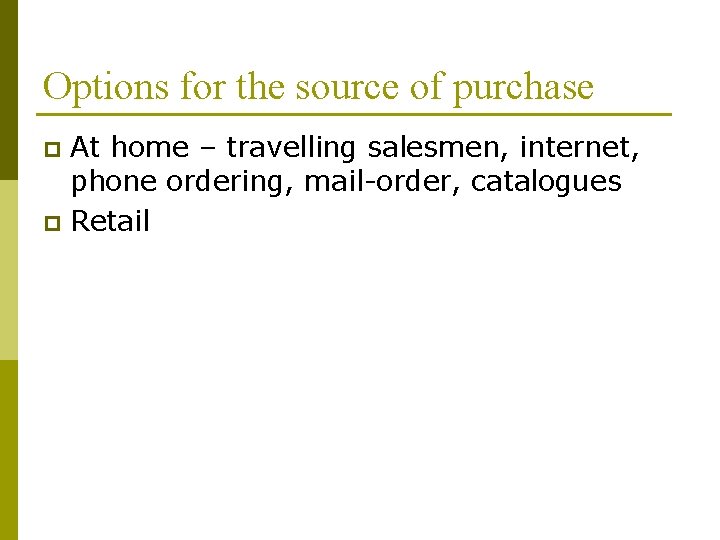
Options for the source of purchase At home – travelling salesmen, internet, phone ordering, mail-order, catalogues p Retail p
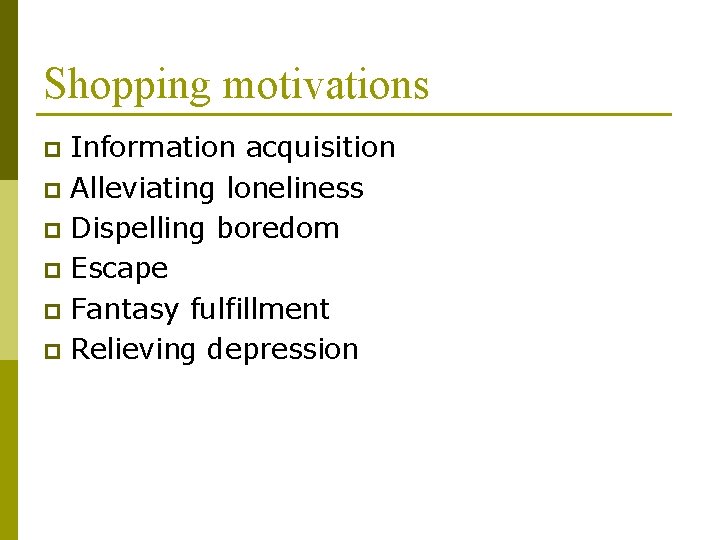
Shopping motivations Information acquisition p Alleviating loneliness p Dispelling boredom p Escape p Fantasy fulfillment p Relieving depression p
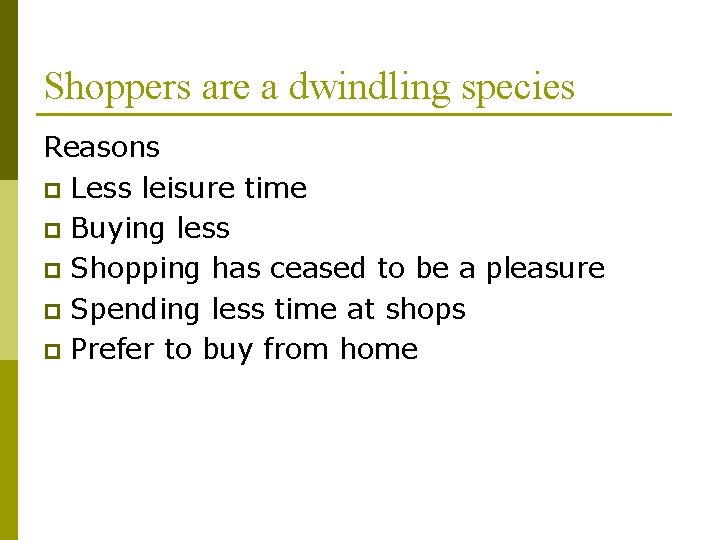
Shoppers are a dwindling species Reasons p Less leisure time p Buying less p Shopping has ceased to be a pleasure p Spending less time at shops p Prefer to buy from home
Enhancing Relationship Marketing p Consumer value addition – quality, consistency, EDLP p Personal selling- perceived knowledge and expertise, perceived trustworthiness, customer knowledge, adaptability p Sales Promotion – to avoid the rigour of EPS p Databased marketing – ongoing personalized contact, loyalty programmes, direct mailers