
Necrotising enterocolitis Why you need to know about
Necrotising enterocolitis
Why you need to know about NEC • Scary • Very sick, very quickly • First signs: – Increased aspirates – Abdominal distension
Framework • • Most common GI emergency in the NICU 1 -5% of admissions GIT and systemic Combination of factors (some known, some unknown): – Immature gut – Vascular insult – Metabolic insult
Who?
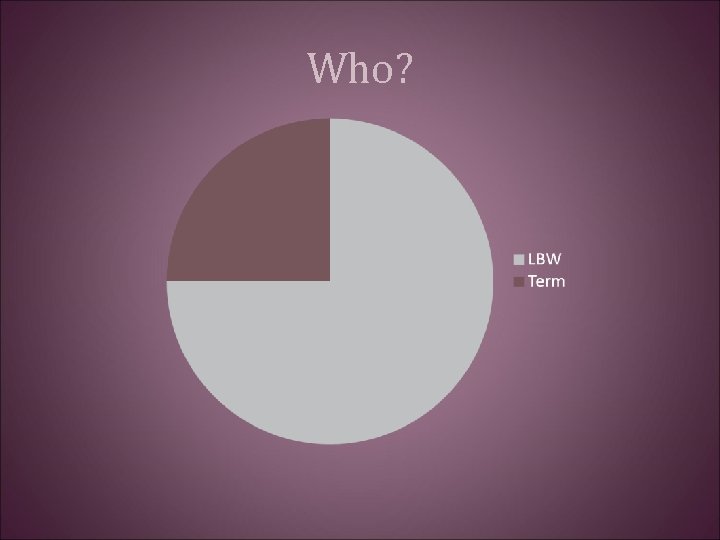
Risk factors • Prematurity: – Younger more prone – 10% of infants <1500 g • Why prems? – Immaturity of motility (less mobile, more disorganised) – Greater permeability of gut (less barrier)
Risk factors (cont’d) • Relative hypoxia: – Acute insult (e. g. asphyxia) – Cardiopulmonary disease (that includes all the RDS babies!) – Polycythaemia (watershed areas)
Risk factors (cont’d) • Enteral feeds: – Rare in unfed infants – Breast-feeding lowers risk – Formula and stored EBM have less immunoprotective factors – ? Mechanism: substrate for bug breeding (partial malabsorption of carbohydrate, fats; add relative dysmotility. . . )
Risk factors (cont’d) • Feeding patterns – controversial: – ? Rate of increase: no relationship (Cochrane database review) – ? Timing of initiation of feeds: no relationship (Cochrane database review) – Minimal enteral or trophic feeds do not increase incidence of NEC
Why? • Nobel Prize answer • No clear unifying theory • One possibility: – Loss of mucosal integrity (ischaemic/toxic): infarction – Bacterial proliferation (? aided by feeds) – Invasion – Transmural necrosis, perforation, peritonitis
When? • Classically 2 -3 weeks after enteral feeds introduced (prems) • First week of life (terms) • (Anytime: be on guard especially e. g. the NICU graduate feeding and growing in SCN)

Nursing observation sheet § § § Increased volumes of gastric aspirate Bilious aspirate (2/3 cases) Bloody stools Temperature fluctuations A&Bs “Vitals” – evolving systemic shock
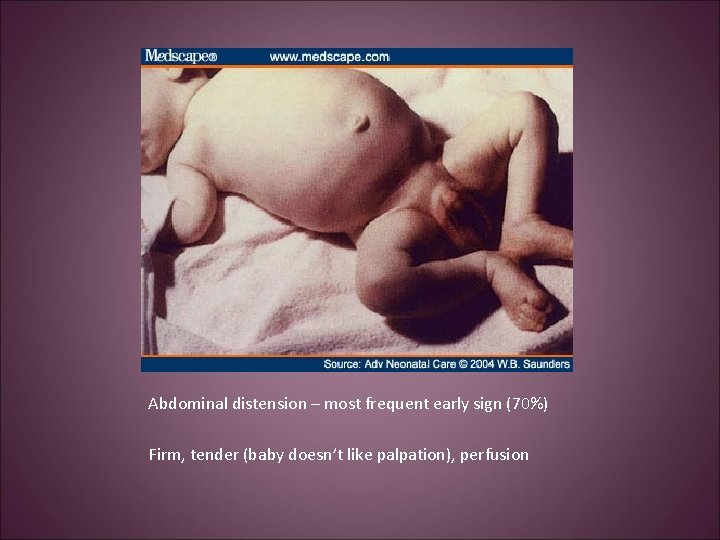
Abdominal distension – most frequent early sign (70%) Firm, tender (baby doesn’t like palpation), perfusion
Worry when. . . Abdominal distension Feed intolerance Changes in stool (bloody) (especially when timing/set-up for NEC)
Immediate action • Consider: 1. “Resuscitation”: things you can do before and while you’re chasing confirmation of diagnosis; 2. “Investigations”: seeking further weight to add to clinical suspicion of diagnosis • Treat baby before chasing tests!
Treating baby (“pre-investigation”) • Involve senior medical staff • Manage as acute abdomen: – Hold/stop feeds – Ensure NGT down – Treat shock (initial fluid bolus/es if required) – IV access (after ordering AXR) for resuscitation and bloods
Investigations • AXR: supine and lateral decubitus • Bloods: – FBE – U&Es – Blood culture (including anaerobic) – Blood gas – (CRP as baseline)


AXR findings • Early: non-specific intestinal dilatation, oedema • Free intra-peritoneal gas • Portal venous gas (25%? ) • Pneumatosis (70 -80%) • Persistent, fixed sentinel bowel loop

Tangent 1 – Intraperitoneal gas • Supine AXR: – “Double wall sign” (Rigler’s sign) – Visualization of falciform ligament (Silver’s sign) – “Football sign” – abnormal lucency over liver, or central part of abdoemn – Morrison’s pouch (hepatorenal abscess) – visible free edge of liver
Intraperitoneal gas (cont’d) • Lateral decubitus: – Patient right-side up – May need to wait (up to 15 mins) to allow air to rise! • Lateral shoot-through

Rigler’s sign (child post-VP shunt insertion)

NEC complicated by pneumoperitoneum Rigler’s sign (white arrows); falciform ligament (black arrow); free air over liver; intramural gas in bowel in left lower quadrant

NEC complicated by perforation “Football sign” (small black arrows); falciform ligament (large arrow)
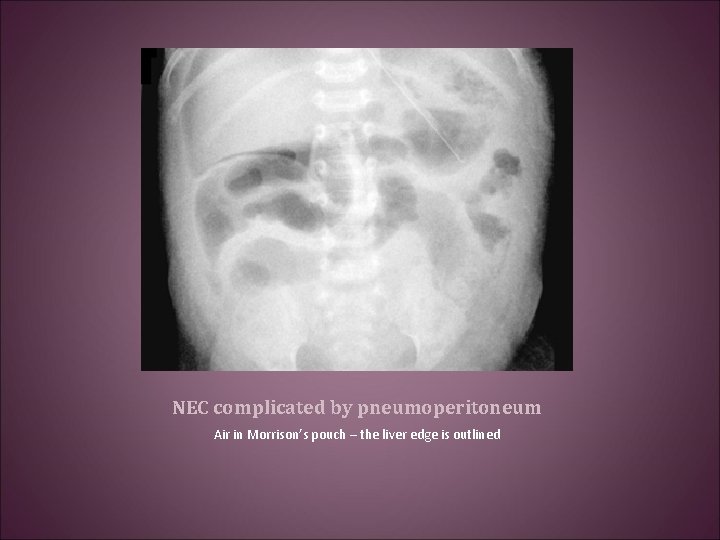
NEC complicated by pneumoperitoneum Air in Morrison’s pouch – the liver edge is outlined

Pneumoperitoneum Subtle lucency outlined by arrows in image on left; pneumoperitoneum confirmed on lateral decubitus
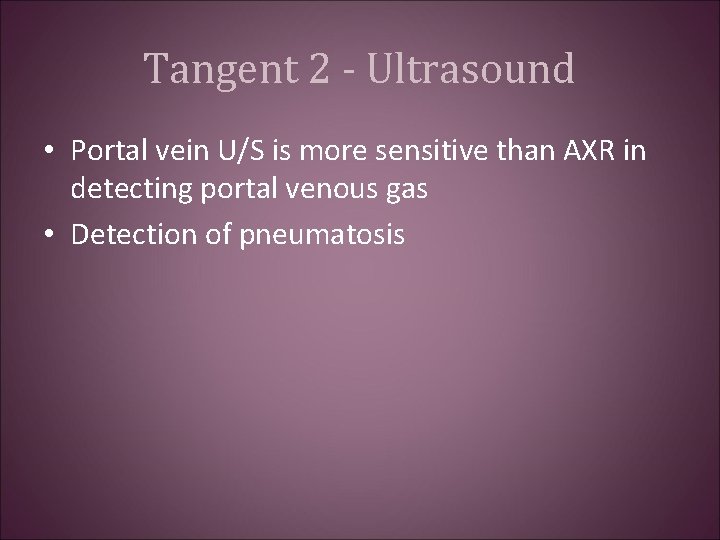
Tangent 2 - Ultrasound • Portal vein U/S is more sensitive than AXR in detecting portal venous gas • Detection of pneumatosis
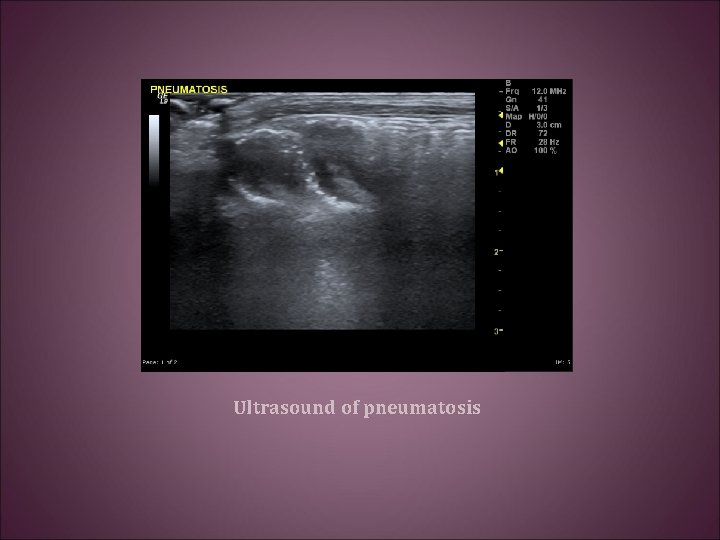
Ultrasound of pneumatosis
Bloods

Bloods findings • FBE: – WCC: too high or too low – Platelets: too low (50%) – poorer prognosis – (Hb/h’crit: rule out polycythaemia as exacerbating factor) • U&Es: – Na+: too high or too low – K+: usually too high • Gas: acidosis (metabolic or combined) • (Blood group: especially if possible transfer)
Management • Check previous management happening: – Nil orally (order TPN!) – NGT down (check position on AXR) – IV access – Fluid resuscitation/circulatory support (may need inotropes)
Management (cont’d) • Antibiotics: – Usually triple (including anaerobic cover) e. g. ampicillin, gentamicin, metronidazole – Bacteraemia in up to 30% • Treat derangement of: – Electrolytes (Na+, K+) – Blood gas derangement (ventilation, fluid +/Na. HCO 3) • Strict fluid balance (and watch urine output)
Decision-making • Appropriate site for management: here, or transfer to RCH (access to surgeons) • Liaison with RCH surgery and RCH Neonatal Unit (+/- NETS) • AXR for surgeons to view • If for transfer: resuscitation, medical optimization of baby’s status
Medical management • Nil orally for 7 -10 days (TPN) • Antibiotics for 10 days • ? Peritoneal drainage (especially in VLBW)
Medical management (cont’d) • • Respiratory support (abdominal splinting) Inotropic support prn Fluid, electrolyte management Regular surveillance of abdomen for complications (e. g. perforation)
Surgical management • Laparotomy – Especially if perforation – Resection, stoma formation – May leave borderline bowel, opt for “second-look” laparotomy

Prognosis • Serious illness: 20 -40% mortality (NEC with perforation) • Laparotomy = major surgery • Degree of resection can have long-term consequences (e. g. short-gut syndrome)
Take home points (for regs!) 1. Beware nursing concern re big bellies and aspirates – Especially either on an upward trend – Bilious aspirate is never a good thing 2. Feel the belly every day – ? Most important part of daily examination 3. Any suspicion: – Involve senior (hard diagnosis, serious illness) – Initial management measures (won’t harm baby)
Acknowledgements Images from: Royal Women’s Hospital, Melbourne. Williams H. Perforation: how to spot free intraperitoneal air on abdominal radiograph. Arch Dis Child Educ Pract Ed 2006; 91: ep 54 -ep 57.
- Slides: 38