
Nebuliser o principles of operation function use scientific
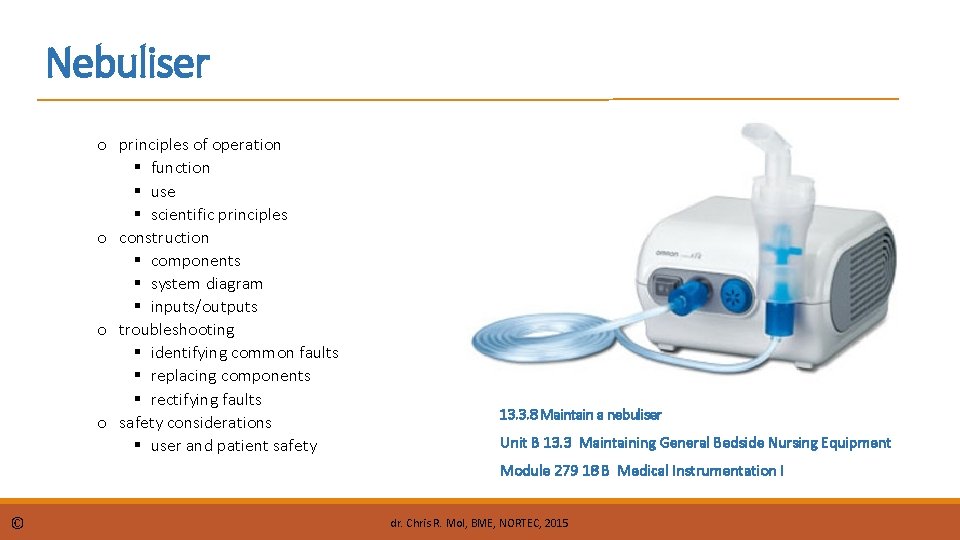
Nebuliser o principles of operation function use scientific principles o construction components system diagram inputs/outputs o troubleshooting identifying common faults replacing components rectifying faults o safety considerations user and patient safety 13. 3. 8 Maintain a nebuliser Unit B 13. 3 Maintaining General Bedside Nursing Equipment Module 279 18 B Medical Instrumentation I © dr. Chris R. Mol, BME, NORTEC, 2015
Function: deliver drugs What is a nebuliser ? a nebuliser is a drug delivery device used to administer medication in the form of a mist inhaled into the lungs. It converts liquid medicine into a fine mist that is easily inhaled. Why is it important ? Nebulizers are commonly used for the treatment of asthma and other respiratory diseases The reason these pharmaceuticals are inhaled instead of ingested is in order to target their effect to the respiratory tract, which speeds up the onset of action of the medicine and reduces side effects, compared to other alternative intake routes. © dr. Chris R. Mol, BME, NORTEC, 2015 Maintain a nebuliser
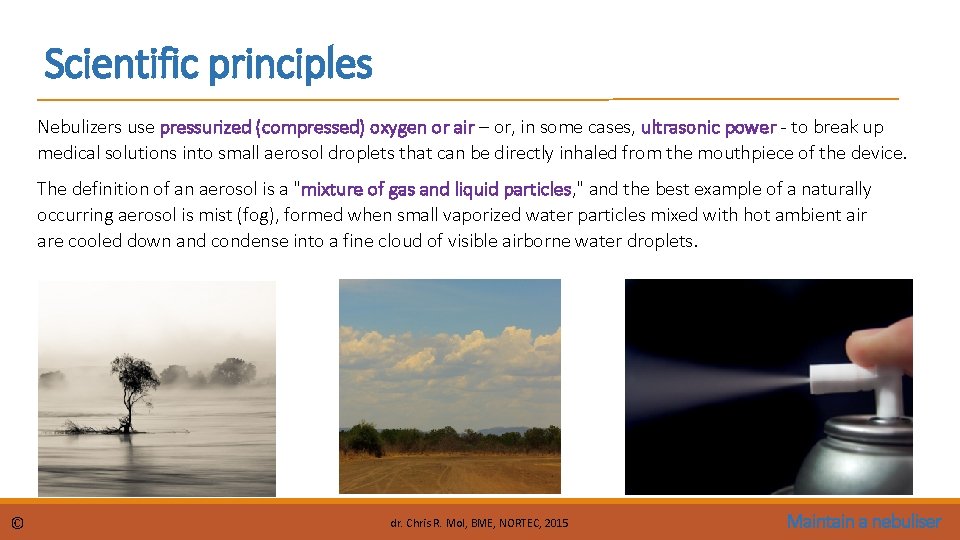
Scientific principles Nebulizers use pressurized (compressed) oxygen or air – or, in some cases, ultrasonic power - to break up medical solutions into small aerosol droplets that can be directly inhaled from the mouthpiece of the device. The definition of an aerosol is a "mixture of gas and liquid particles, " and the best example of a naturally occurring aerosol is mist (fog), formed when small vaporized water particles mixed with hot ambient air are cooled down and condense into a fine cloud of visible airborne water droplets. © dr. Chris R. Mol, BME, NORTEC, 2015 Maintain a nebuliser
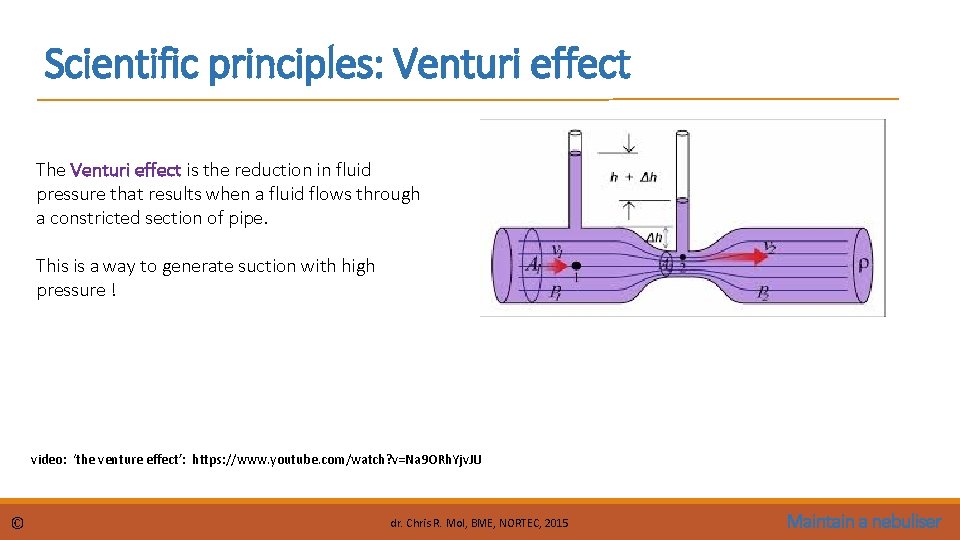
Scientific principles: Venturi effect The Venturi effect is the reduction in fluid pressure that results when a fluid flows through a constricted section of pipe. This is a way to generate suction with high pressure ! video: ‘the venture effect’: https: //www. youtube. com/watch? v=Na 9 ORh. Yjv. JU © dr. Chris R. Mol, BME, NORTEC, 2015 Maintain a nebuliser
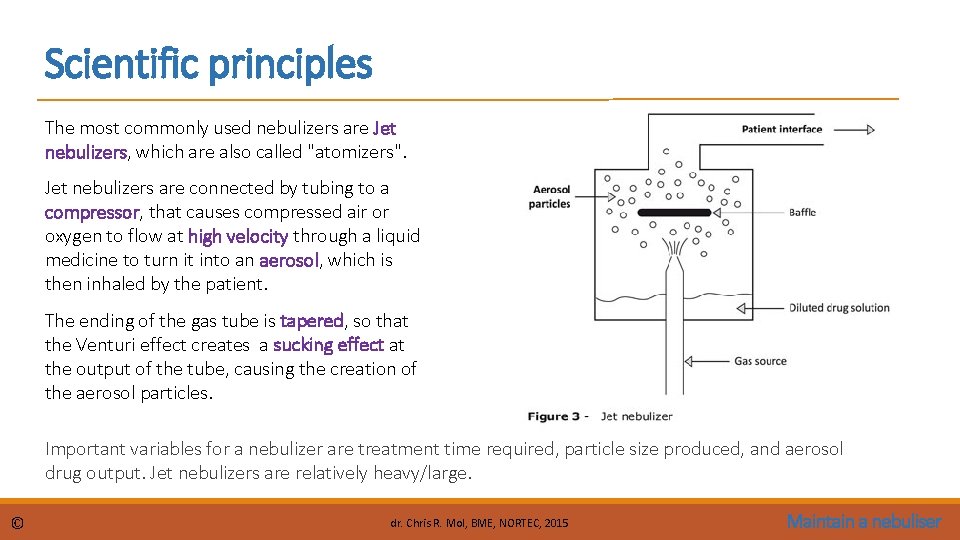
Scientific principles The most commonly used nebulizers are Jet nebulizers, which are also called "atomizers". Jet nebulizers are connected by tubing to a compressor, that causes compressed air or oxygen to flow at high velocity through a liquid medicine to turn it into an aerosol, which is then inhaled by the patient. The ending of the gas tube is tapered, so that the Venturi effect creates a sucking effect at the output of the tube, causing the creation of the aerosol particles. Important variables for a nebulizer are treatment time required, particle size produced, and aerosol drug output. Jet nebulizers are relatively heavy/large. © dr. Chris R. Mol, BME, NORTEC, 2015 Maintain a nebuliser
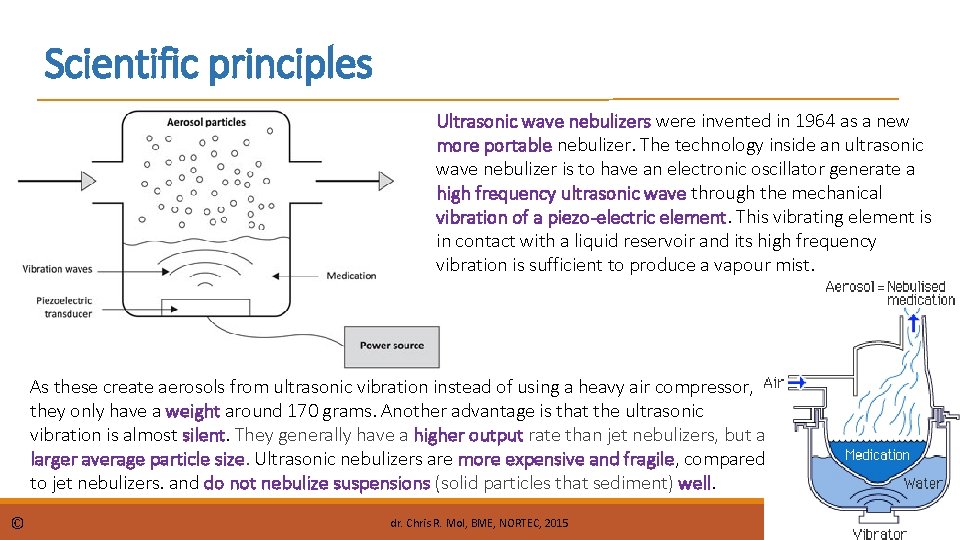
Scientific principles Ultrasonic wave nebulizers were invented in 1964 as a new more portable nebulizer. The technology inside an ultrasonic wave nebulizer is to have an electronic oscillator generate a high frequency ultrasonic wave through the mechanical vibration of a piezo-electric element. This vibrating element is in contact with a liquid reservoir and its high frequency vibration is sufficient to produce a vapour mist. As these create aerosols from ultrasonic vibration instead of using a heavy air compressor, they only have a weight around 170 grams. Another advantage is that the ultrasonic vibration is almost silent. They generally have a higher output rate than jet nebulizers, but a larger average particle size. Ultrasonic nebulizers are more expensive and fragile, compared to jet nebulizers. and do not nebulize suspensions (solid particles that sediment) well. © dr. Chris R. Mol, BME, NORTEC, 2015 Maintain a nebuliser
Preventive Maintenance Jet Nebulizer 1. Inspect exterior of equipment for damaged or missing hardware 2. Inspect power cord and plug for signs of damage 3. Turn unit off, open covers and inspect for damage 4. Clean the unit interior with vacuum or compressed air. 5. Inspect interior for signs of corrosion or missing hardware. Repair as required. 6. Inspect electrical components for signs of excessive heat or deterioration. 7. Inspect water jet assembly including orifice. Check for water leakage. 8. Check gaskets and O-rings. 9. Verify correct operation of unit with all settings. 10. Clean exterior of the unit including accessories, cables, etc. 11. Change air intake filter when it is grey or dirty. © dr. Chris R. Mol, BME, NORTEC, 2015 Maintain a nebuliser
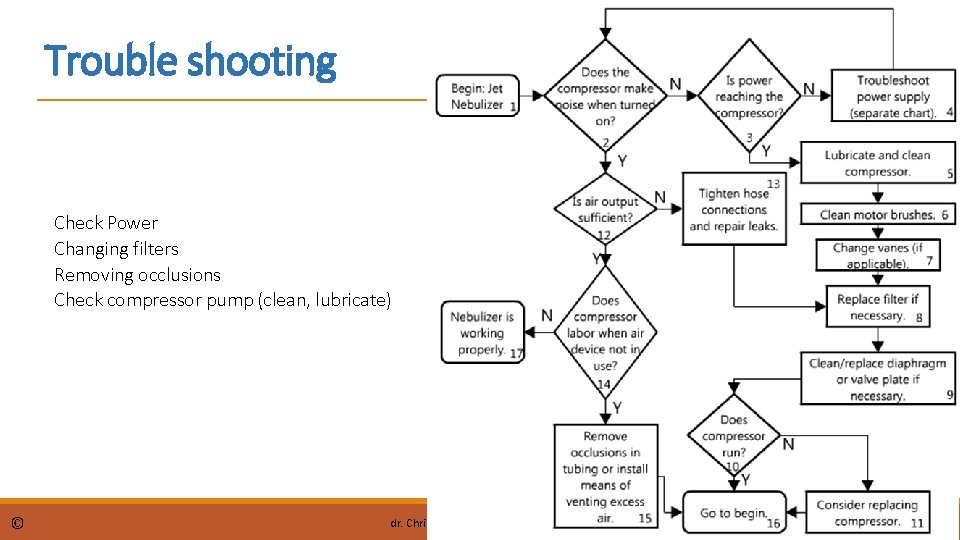
Trouble shooting Check Power Changing filters Removing occlusions Check compressor pump (clean, lubricate) © dr. Chris R. Mol, BME, NORTEC, 2015 Maintain a nebuliser

END The creation of this presentation was supported by a grant from THET: see https: //www. thet. org/
- Slides: 9