
NearXHV Pressure Characterization for the Jefferson Lab Polarized
Near-XHV Pressure Characterization for the Jefferson Lab Polarized Electron Source Marcy Stutzman, P. Adderley, Md. A. Mamun, A. A. Elmustafa, M. Poelker
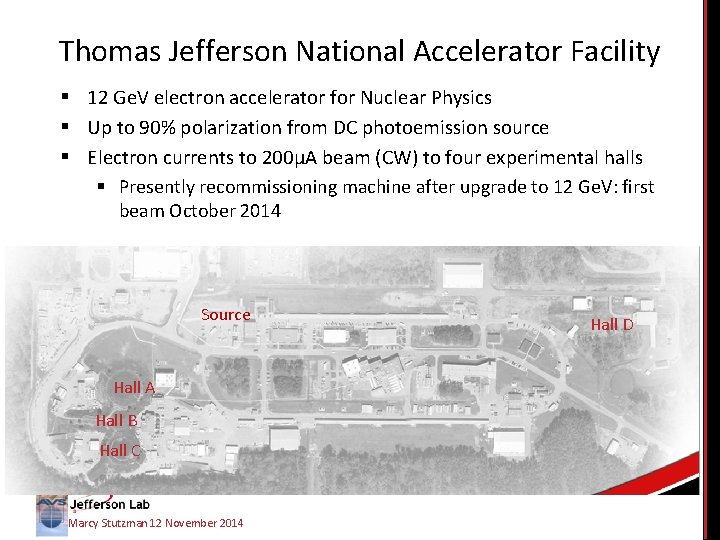
Thomas Jefferson National Accelerator Facility § 12 Ge. V electron accelerator for Nuclear Physics § Up to 90% polarization from DC photoemission source § Electron currents to 200μA beam (CW) to four experimental halls § Presently recommissioning machine after upgrade to 12 Ge. V: first beam October 2014 Source Hall A Hall B Hall C Marcy Stutzman 12 November 2014 Hall D
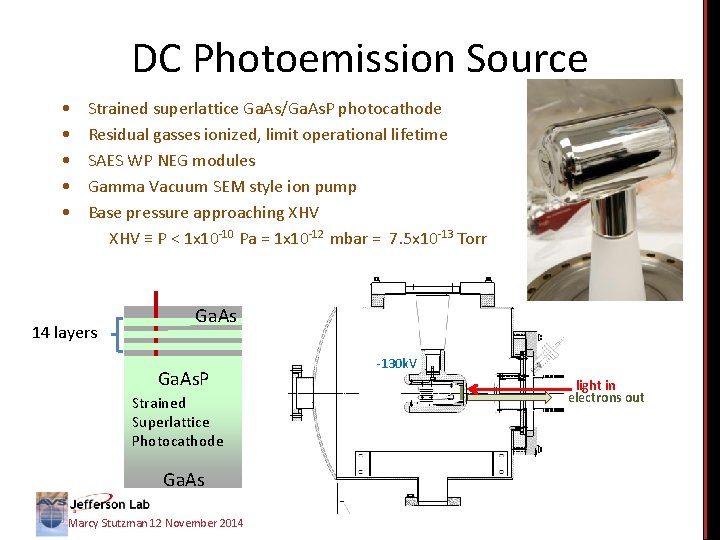
DC Photoemission Source • • • Strained superlattice Ga. As/Ga. As. P photocathode Residual gasses ionized, limit operational lifetime SAES WP NEG modules Gamma Vacuum SEM style ion pump Base pressure approaching XHV ≡ P < 1 x 10 -10 Pa = 1 x 10 -12 mbar = 7. 5 x 10 -13 Torr Ga. As 14 layers Ga. As. P 0. Strained 36 Superlattice Photocathode Ga. As Marcy Stutzman 12 November 2014 -130 k. V light in electrons out
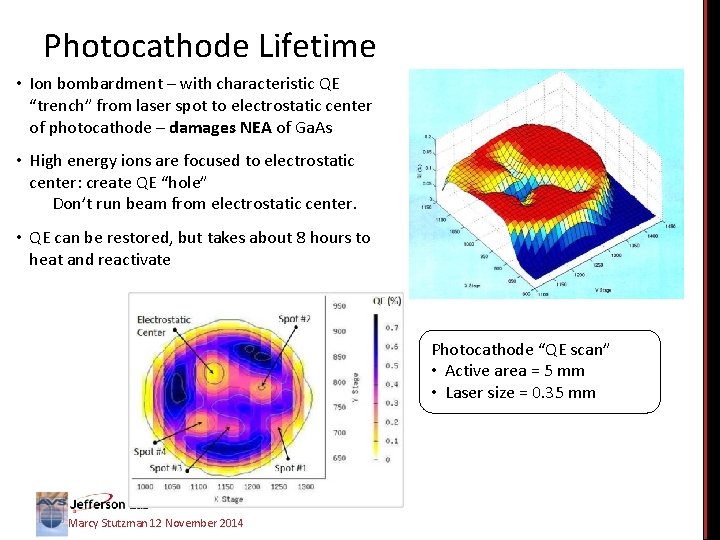
Photocathode Lifetime • Ion bombardment – with characteristic QE “trench” from laser spot to electrostatic center of photocathode – damages NEA of Ga. As • High energy ions are focused to electrostatic center: create QE “hole” Don’t run beam from electrostatic center. • QE can be restored, but takes about 8 hours to heat and reactivate Photocathode “QE scan” • Active area = 5 mm • Laser size = 0. 35 mm Marcy Stutzman 12 November 2014
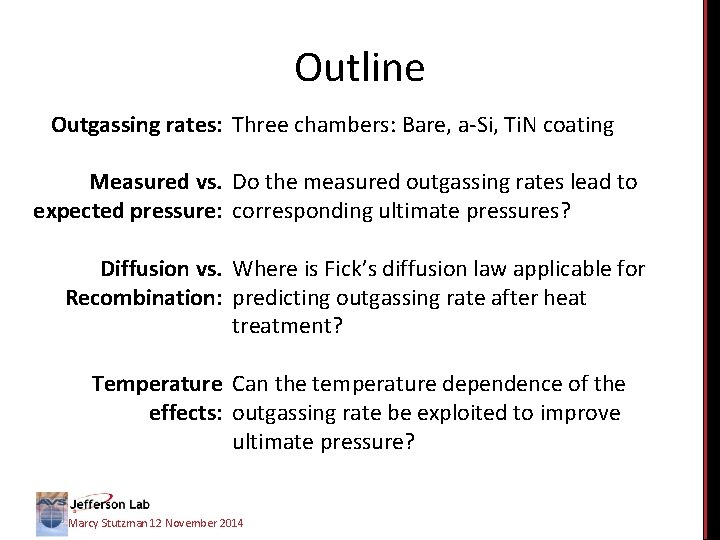
Outline Outgassing rates: Three chambers: Bare, a-Si, Ti. N coating Measured vs. Do the measured outgassing rates lead to expected pressure: corresponding ultimate pressures? Diffusion vs. Where is Fick’s diffusion law applicable for Recombination: predicting outgassing rate after heat treatment? Temperature Can the temperature dependence of the effects: outgassing rate be exploited to improve ultimate pressure? Marcy Stutzman 12 November 2014
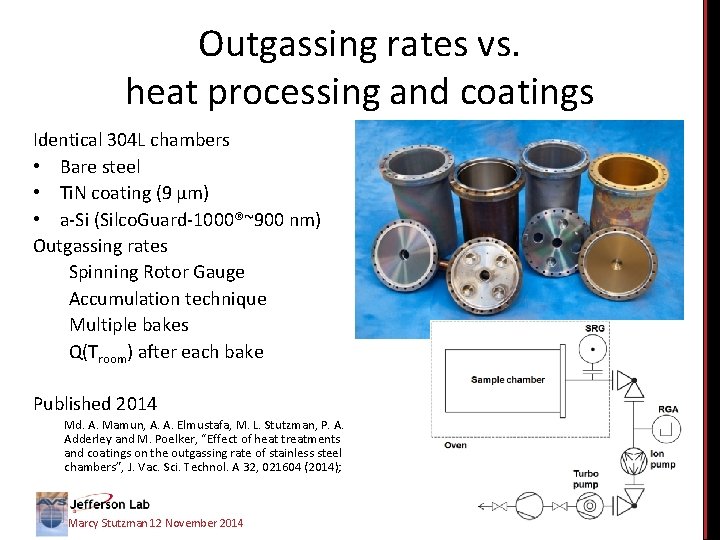
Outgassing rates vs. heat processing and coatings Identical 304 L chambers • Bare steel • Ti. N coating (9 µm) • a-Si (Silco. Guard-1000®~900 nm) Outgassing rates Spinning Rotor Gauge Accumulation technique Multiple bakes Q(Troom) after each bake Published 2014 Md. A. Mamun, A. A. Elmustafa, M. L. Stutzman, P. A. Adderley and M. Poelker, “Effect of heat treatments and coatings on the outgassing rate of stainless steel chambers”, J. Vac. Sci. Technol. A 32, 021604 (2014); Marcy Stutzman 12 November 2014
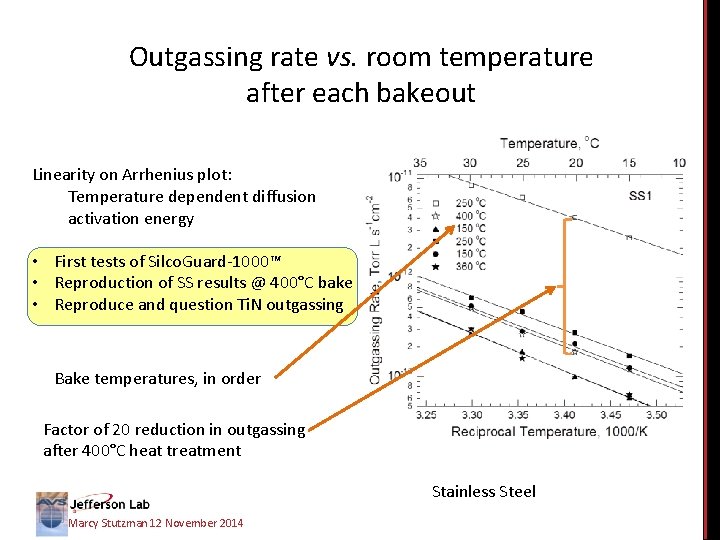
Outgassing rate vs. room temperature after each bakeout Linearity on Arrhenius plot: Temperature dependent diffusion activation energy • First tests of Silco. Guard-1000™ • Reproduction of SS results @ 400°C bake • Reproduce and question Ti. N outgassing Bake temperatures, in order Factor of 20 reduction in outgassing after 400°C heat treatment Stainless Steel Marcy Stutzman 12 November 2014
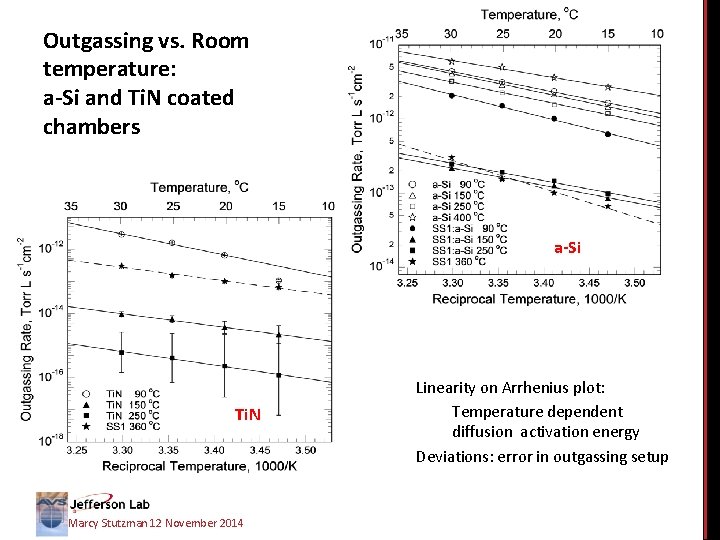
Outgassing vs. Room temperature: a-Si and Ti. N coated chambers a-Si Ti. N Marcy Stutzman 12 November 2014 Linearity on Arrhenius plot: Temperature dependent diffusion activation energy Deviations: error in outgassing setup
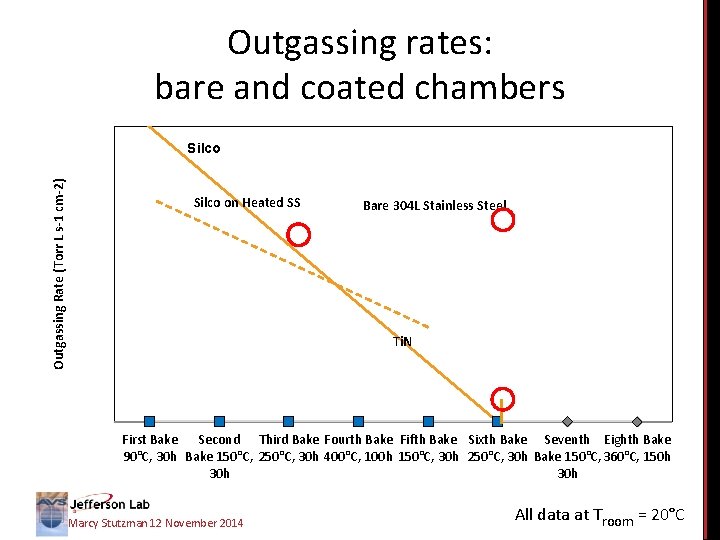
Outgassing Rate (Torr L s-1 cm-2) Outgassing rates: bare and coated chambers Marcy Stutzman 12 November 2014
Marcy Stutzman 12 November 2014
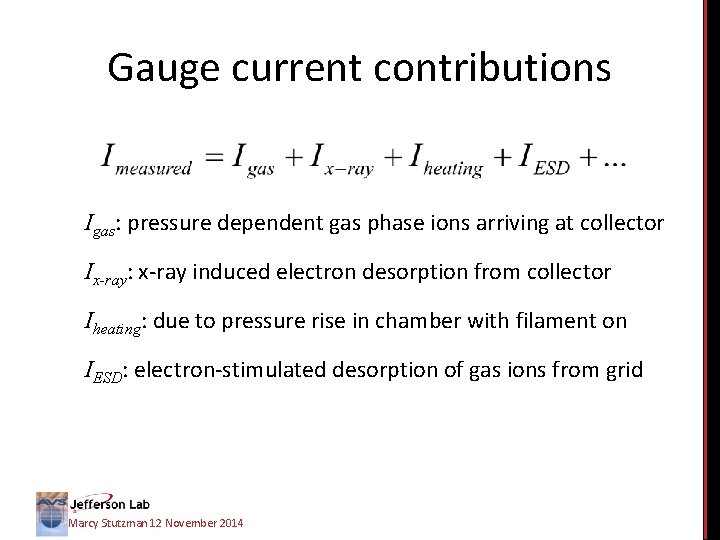
Gauge current contributions Igas: pressure dependent gas phase ions arriving at collector Ix-ray: x-ray induced electron desorption from collector Iheating: due to pressure rise in chamber with filament on IESD: electron-stimulated desorption of gas ions from grid Marcy Stutzman 12 November 2014
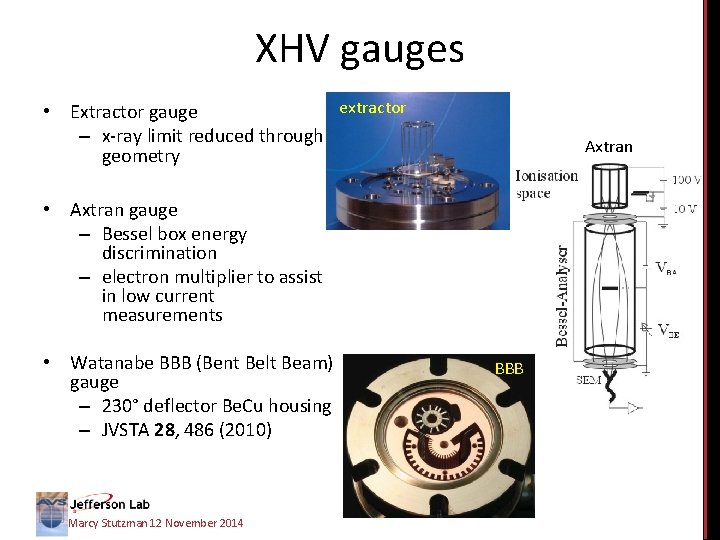
XHV gauges extractor • Extractor gauge – x-ray limit reduced through geometry Axtran • Axtran gauge – Bessel box energy discrimination – electron multiplier to assist in low current measurements • Watanabe BBB (Bent Belt Beam) gauge – 230° deflector Be. Cu housing – JVSTA 28, 486 (2010) Marcy Stutzman 12 November 2014 BBB
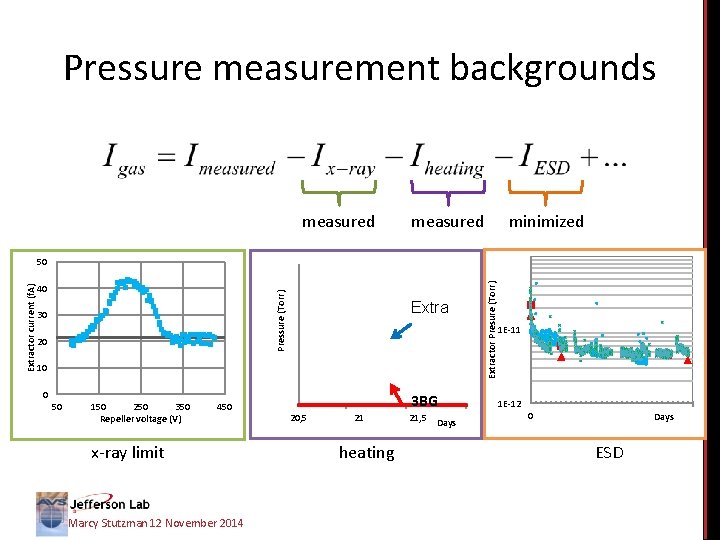
3 E-12 Pressure measurement backgrounds measured minimized 30 20 Extractor 10 0 50 150 250 350 Repeller voltage (V) 450 x-ray limit Marcy Stutzman 12 November 2014 3 BG 20, 5 21 heating 21, 5 Days Extractor Presure (Torr) 40 Pressure (Torr) Extractor current (f. A) 50 1 E-11 1 E-12 0 Days ESD
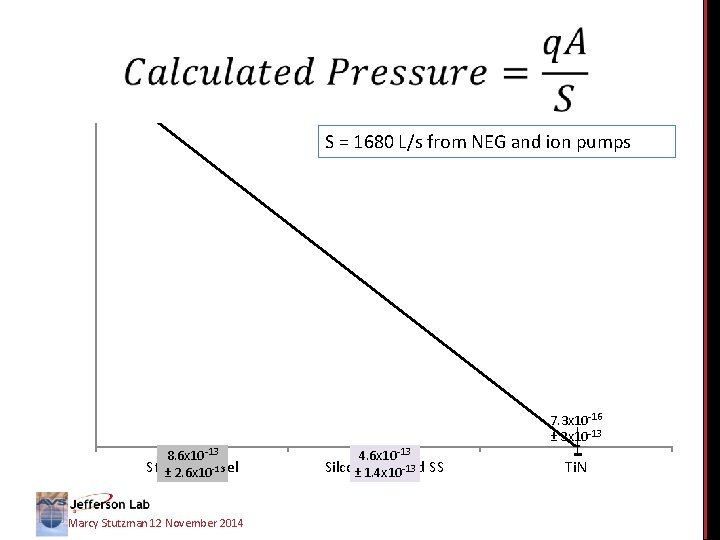
Coated chambers with NEG & ion pumps Measured vs. calculated pressures 5 Extractor 3 BG Pressure (x 10 -12 Torr) 4 Calculated Silco on Heated SS 3 Ti. N on SS 2 Heat Treated bare 304 L 1 0 Calculated -0, 2 -1 Marcy Stutzman 12 November 2014 Calculated 7. 34 x 10 -16
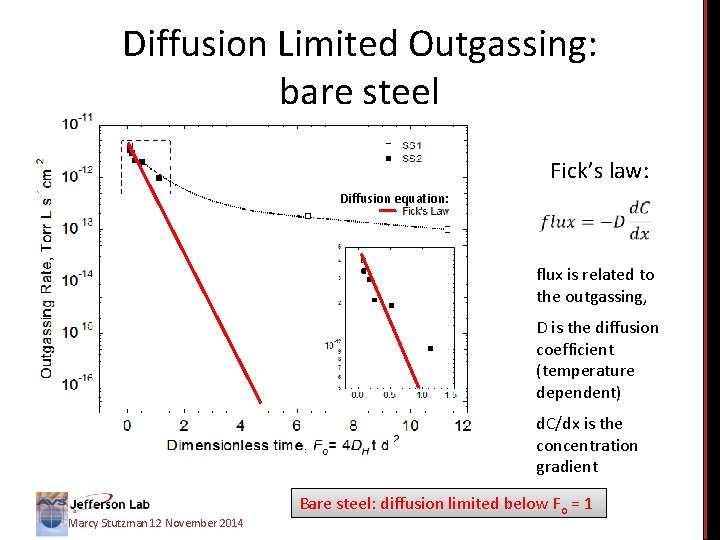
Diffusion Limited Outgassing: bare steel Fick’s law: Diffusion equation: flux is related to the outgassing, D is the diffusion coefficient (temperature dependent) d. C/dx is the concentration gradient Marcy Stutzman 12 November 2014 Bare steel: diffusion limited below Fo = 1
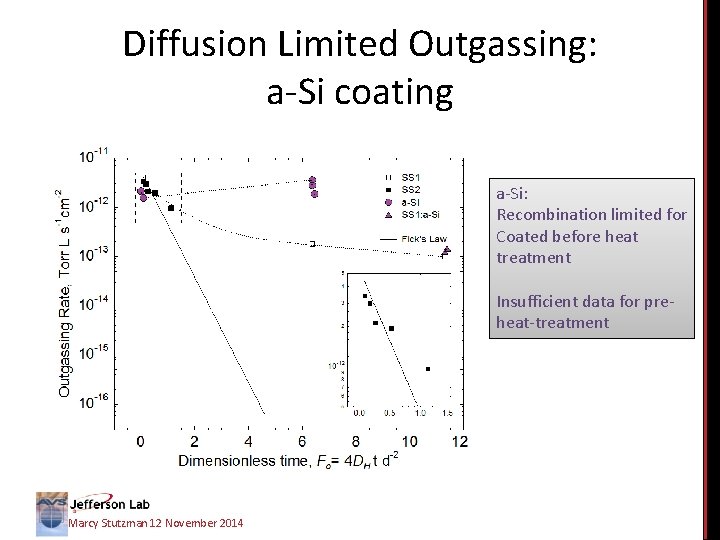
Diffusion Limited Outgassing: a-Si coating a-Si: Recombination limited for Coated before heat treatment Insufficient data for preheat-treatment Marcy Stutzman 12 November 2014
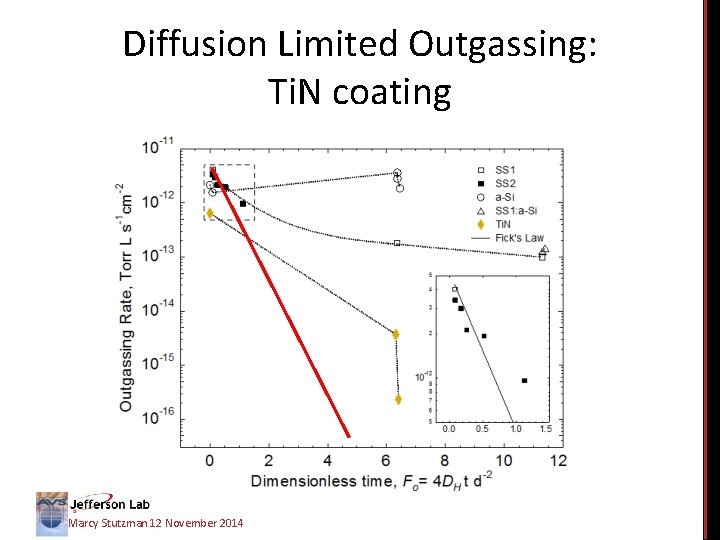
Diffusion Limited Outgassing: Ti. N coating Marcy Stutzman 12 November 2014
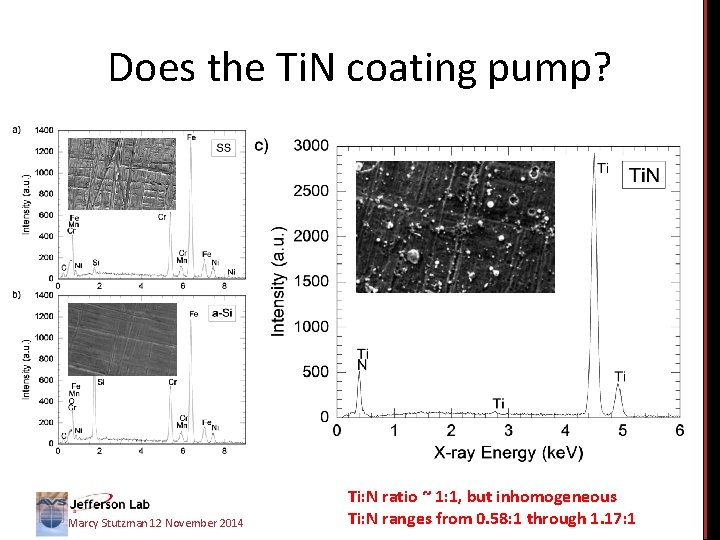
Does the Ti. N coating pump? Marcy Stutzman 12 November 2014 Ti: N ratio ~ 1: 1, but inhomogeneous Ti: N ranges from 0. 58: 1 through 1. 17: 1
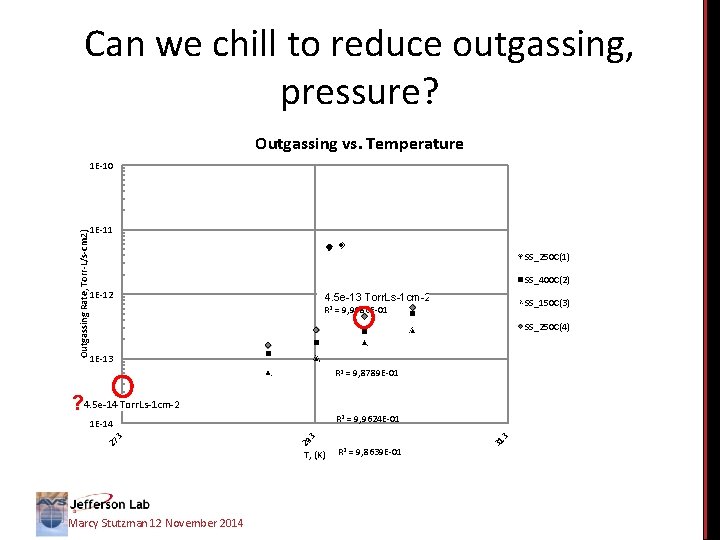
Can we chill to reduce outgassing, pressure? Outgassing vs. Temperature Outgassing Rate, Torr-L/s-cm 2) 1 E-10 1 E-11 SS_250 C(1) SS_400 C(2) 1 E-12 4. 5 e-13 Torr. Ls-1 cm-2 SS_150 C(3) R 2 = 9, 9986 E-01 SS_250 C(4) 1 E-13 R 2 = 9, 8789 E-01 ? 4. 5 e-14 Torr. Ls-1 cm-2 Marcy Stutzman 12 November 2014 R 2 = 9, 8639 E-01 31 3 29 3 27 T, (K) 3 R 2 = 9, 9624 E-01 1 E-14
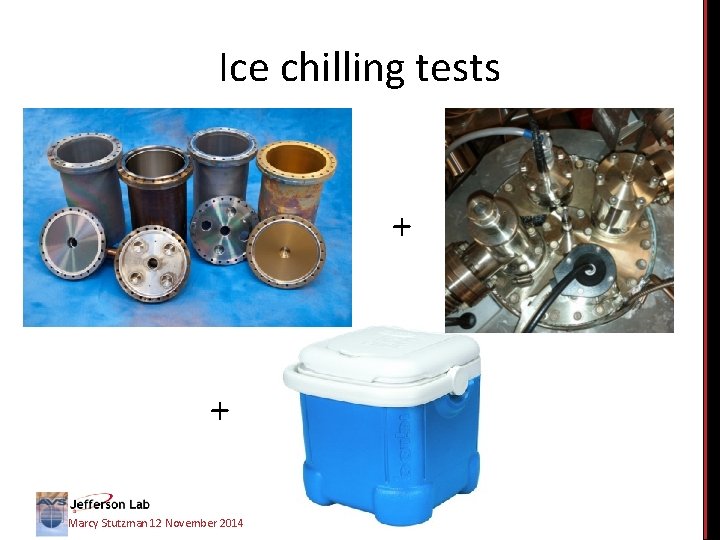
Ice chilling tests + + Marcy Stutzman 12 November 2014
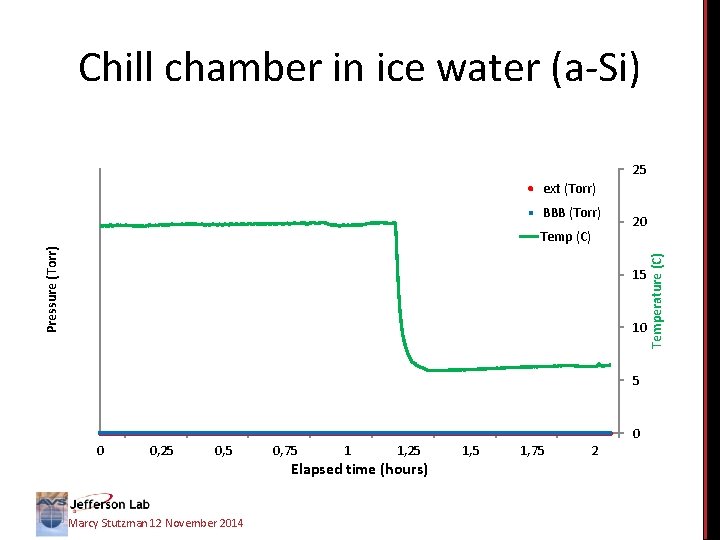
Temperature (C) Pressure (Torr) Chill chamber in ice water (a-Si) Elapsed time (hours) Marcy Stutzman 12 November 2014
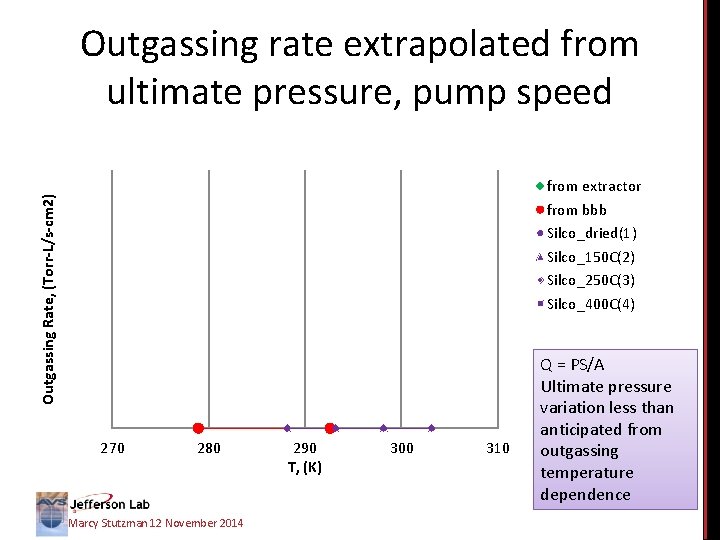
Outgassing Rate, (Torr-L/s-cm 2) T, (K) Marcy Stutzman 12 November 2014
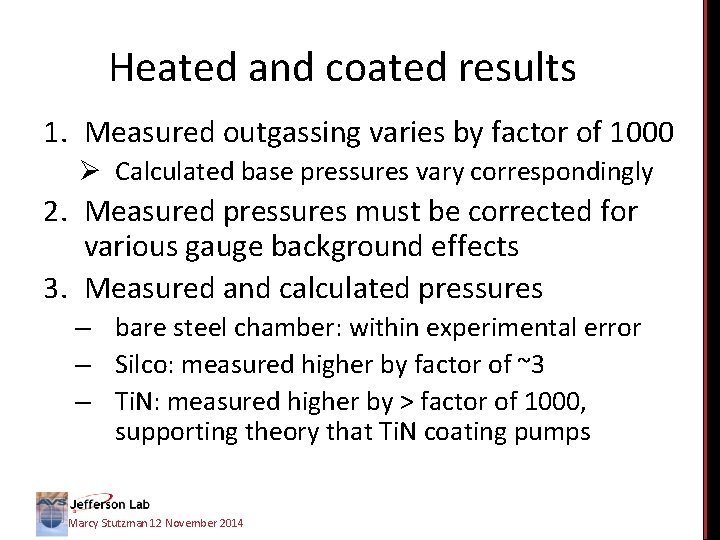
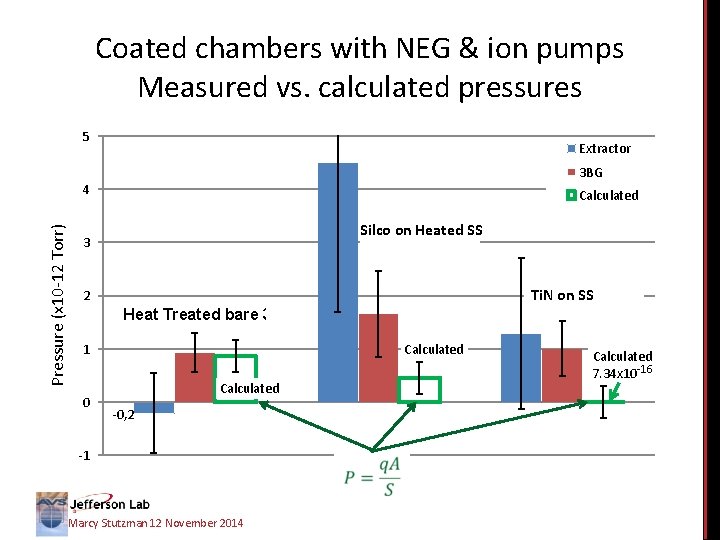
Heated and coated results 1. Measured outgassing varies by factor of 1000 Ø Calculated base pressures vary correspondingly 2. Measured pressures must be corrected for various gauge background effects 3. Measured and calculated pressures – bare steel chamber: within experimental error – Silco: measured higher by factor of ~3 – Ti. N: measured higher by > factor of 1000, supporting theory that Ti. N coating pumps Marcy Stutzman 12 November 2014
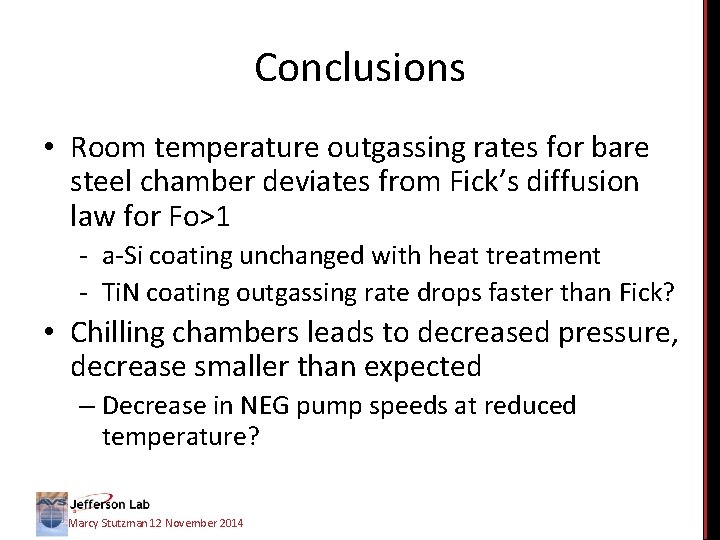
Conclusions • Room temperature outgassing rates for bare steel chamber deviates from Fick’s diffusion law for Fo>1 - a-Si coating unchanged with heat treatment - Ti. N coating outgassing rate drops faster than Fick? • Chilling chambers leads to decreased pressure, decrease smaller than expected – Decrease in NEG pump speeds at reduced temperature? Marcy Stutzman 12 November 2014
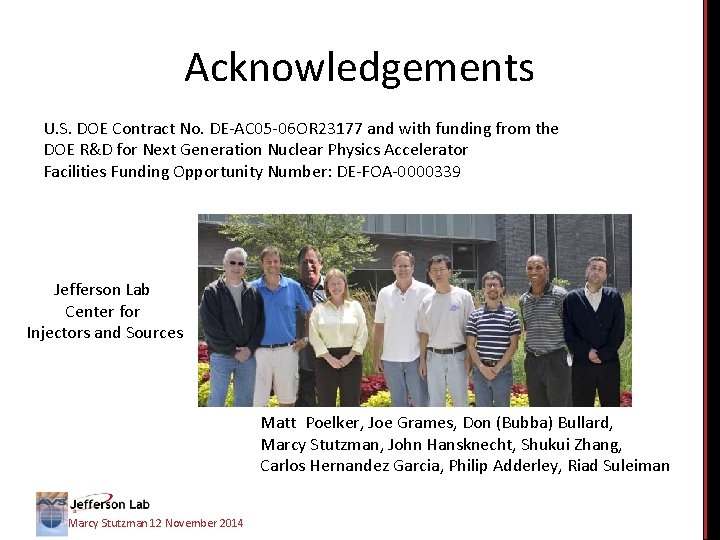
Acknowledgements U. S. DOE Contract No. DE-AC 05 -06 OR 23177 and with funding from the DOE R&D for Next Generation Nuclear Physics Accelerator Facilities Funding Opportunity Number: DE-FOA-0000339 Jefferson Lab Center for Injectors and Sources Matt Poelker, Joe Grames, Don (Bubba) Bullard, Marcy Stutzman, John Hansknecht, Shukui Zhang, Carlos Hernandez Garcia, Philip Adderley, Riad Suleiman Marcy Stutzman 12 November 2014
- Slides: 25