
NearlyAutomated Metadata Hierarchy Creation Emilia Stoica and Marti
- Slides: 26
Nearly-Automated Metadata Hierarchy Creation Emilia Stoica and Marti Hearst SIMS University of California, Berkeley
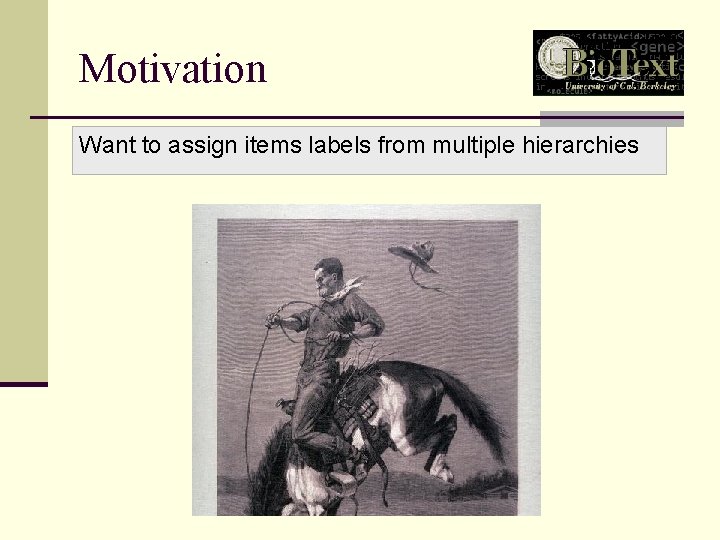
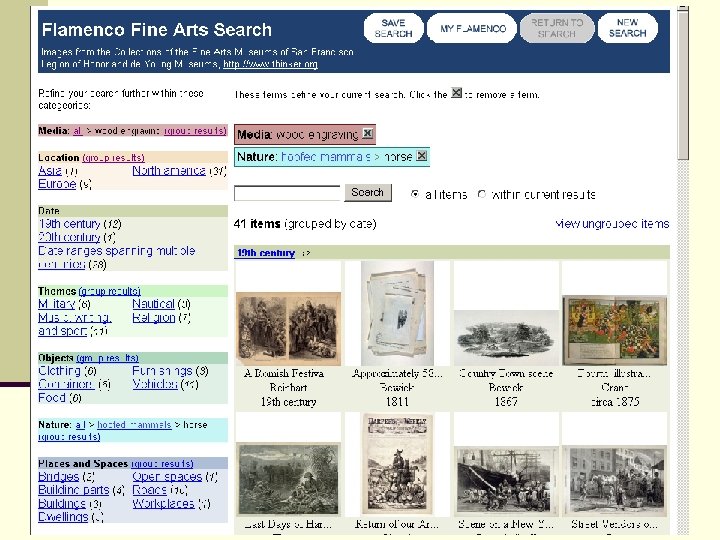
Motivation Want to assign items labels from multiple hierarchies
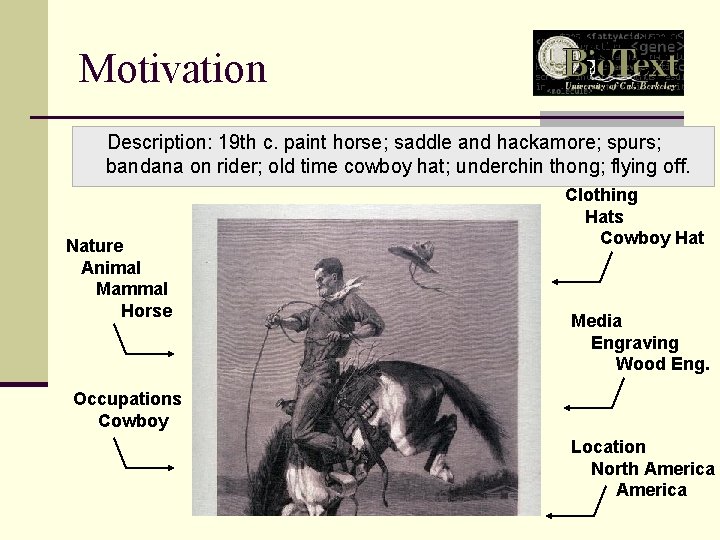
Motivation Description: 19 th c. paint horse; saddle and hackamore; spurs; bandana on rider; old time cowboy hat; underchin thong; flying off. Nature Animal Mammal Horse Clothing Hats Cowboy Hat Media Engraving Wood Eng. Occupations Cowboy Location North America
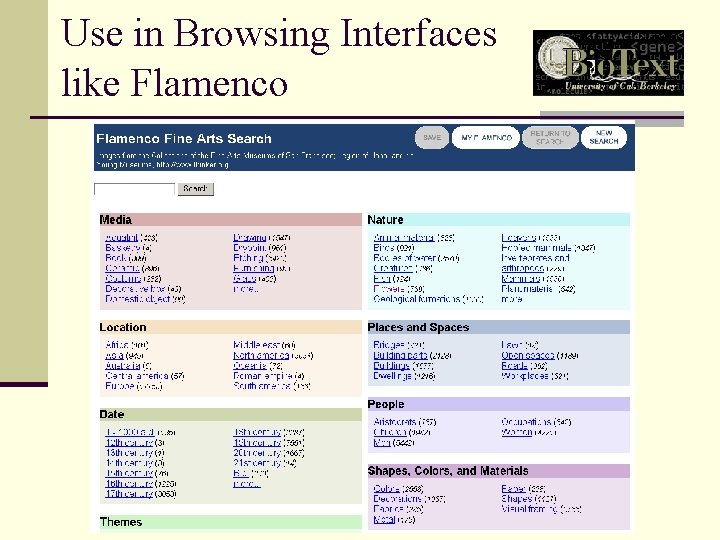
Use in Browsing Interfaces like Flamenco
Use in Browsing Interfaces like Flamenco
How to Obtain the Hierarchies? n Goal: n Help an information architect get started n n n Currently they do it all by hand! Assume they will do some editing Nearly automated Multiple hierarchies (facets) n Automatically assign items to multiple hierarchies n
Related Work n Automated text categorization n LOTS of work on this n Assumes that a set of categories is already created n To be intuitive, a categorization should contain sets of IS-A relations (hierarchical) n n Rosenfeld and Morville, (2002) Pratt, Hearst, and Fagan (1999) n Current automated approaches contain only associative relations
Examples of Associative Relations n Hofmann 1999 n Collection: Machine learning abstracts n Top-level categories: learn, paper, base, model, new train n Problem: n These are not intuitive categories for machine learning n Sanderson and Croft 1999 n Collection: Medical texts n Top level categories: disease, post polio, serious disease, dengue, infection control, immunology, … n Problem: n These are at different levels of generality
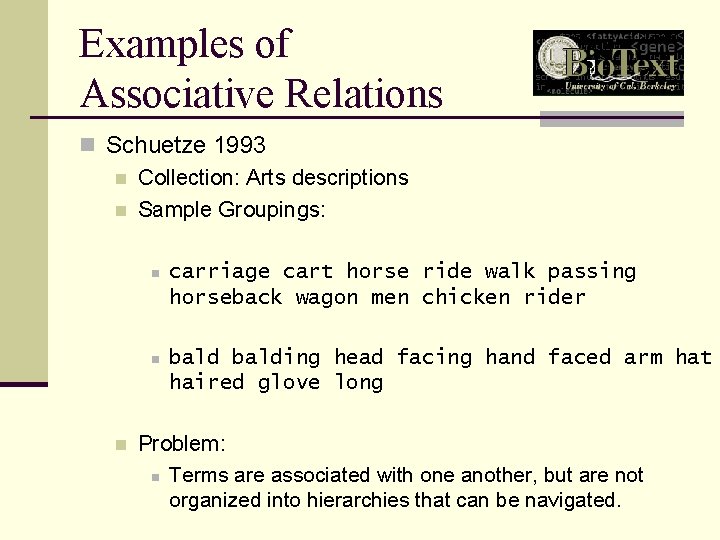
Examples of Associative Relations n Schuetze 1993 n Collection: Arts descriptions n Sample Groupings: n n carriage cart horse ride walk passing horseback wagon men chicken rider n balding head facing hand faced arm hat haired glove long Problem: n Terms are associated with one another, but are not organized into hierarchies that can be navigated.
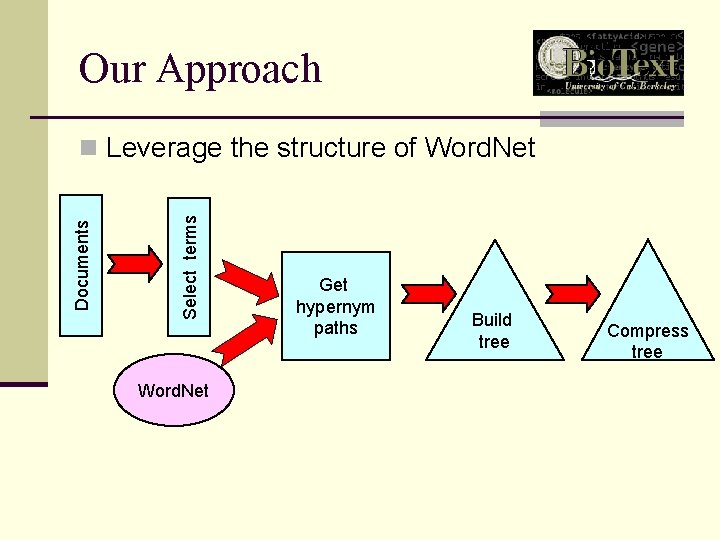
Our Approach Select terms Documents n Leverage the structure of Word. Net Get hypernym paths Build tree Compress tree
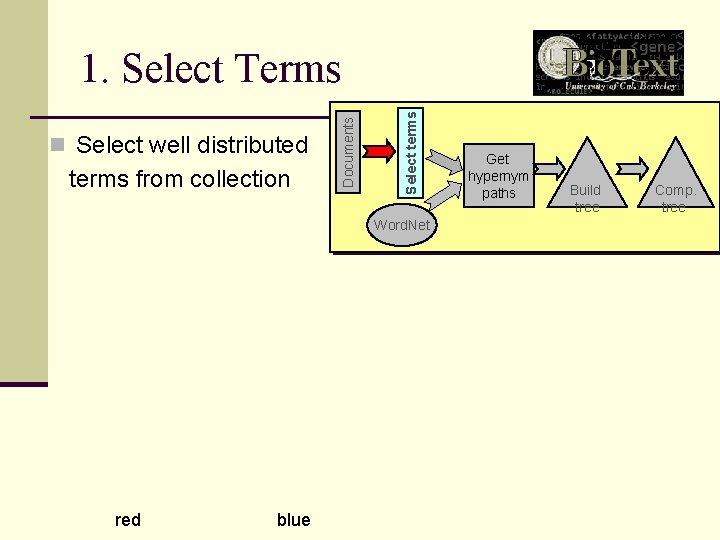
terms from collection Select terms n Select well distributed Documents 1. Select Terms Word. Net red blue Get hypernym paths Build tree Comp. tree
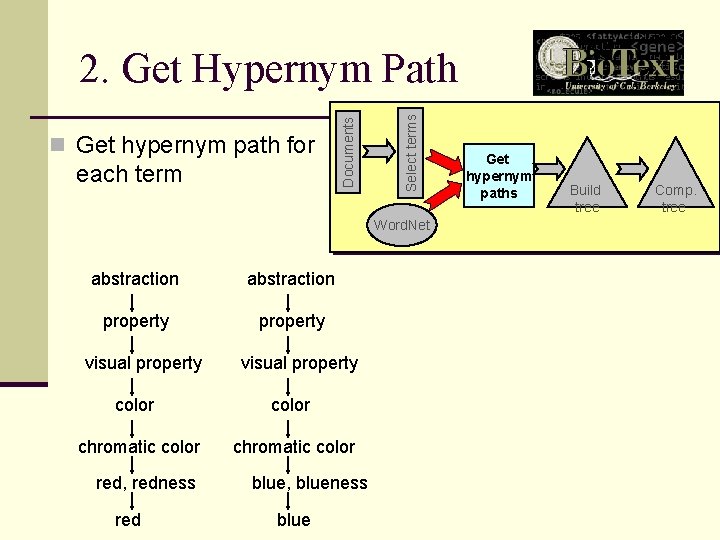
each term Select terms n Get hypernym path for Documents 2. Get Hypernym Path Word. Net abstraction property visual property color chromatic color red, redness red blue, blueness blue Get hypernym paths Build tree Comp. tree
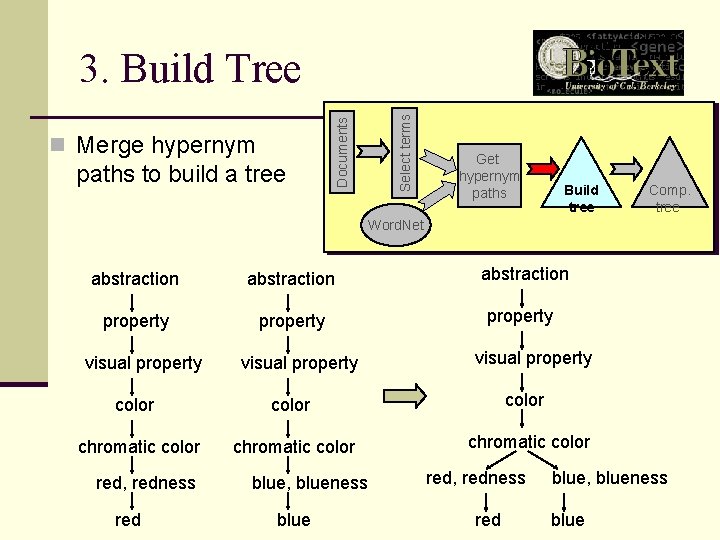
paths to build a tree Select terms n Merge hypernym Documents 3. Build Tree Get hypernym paths Build tree Comp. tree Word. Net abstraction property visual property color chromatic color red, redness red blue, blueness blue
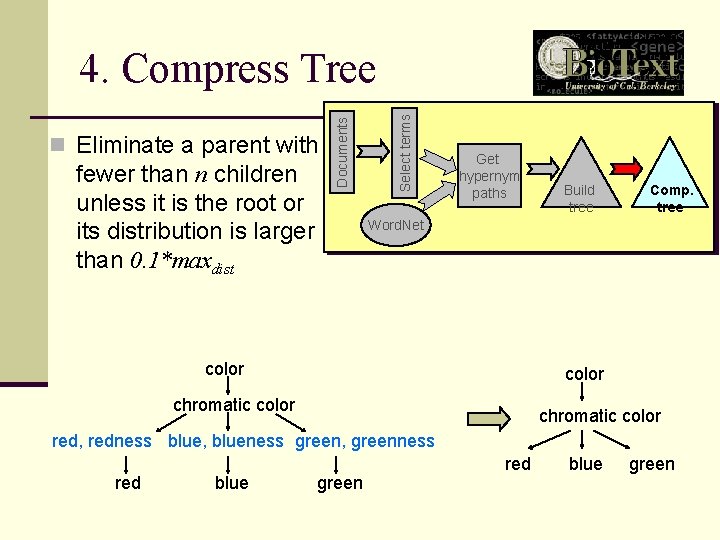
fewer than n children unless it is the root or its distribution is larger than 0. 1*maxdist Select terms n Eliminate a parent with Documents 4. Compress Tree Get hypernym paths Build tree Comp. tree Word. Net color chromatic color red, redness blue, blueness green, greenness red blue green
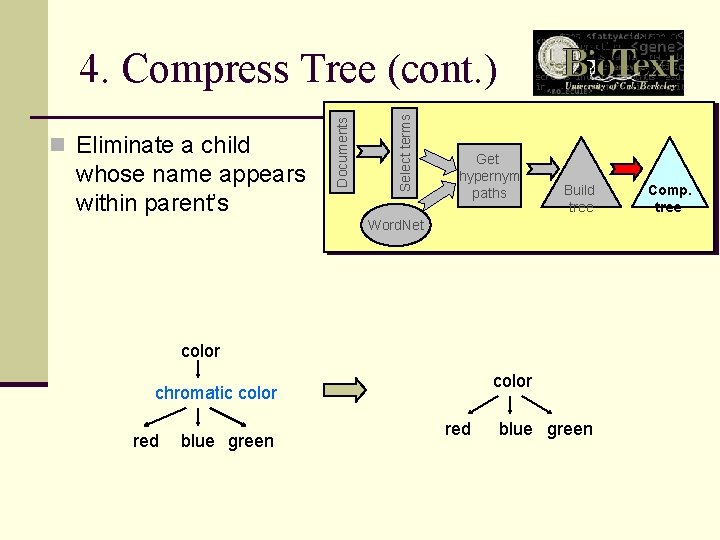
whose name appears within parent’s Select terms n Eliminate a child Documents 4. Compress Tree (cont. ) Get hypernym paths Build tree Word. Net color chromatic color red blue green Comp. tree
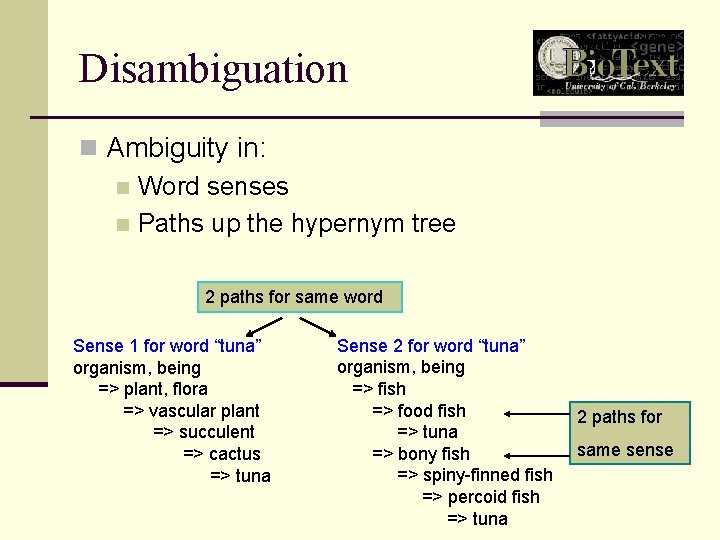
Disambiguation n Ambiguity in: n Word senses n Paths up the hypernym tree 2 paths for same word Sense 1 for word “tuna” organism, being => plant, flora => vascular plant => succulent => cactus => tuna Sense 2 for word “tuna” organism, being => fish => food fish => tuna => bony fish => spiny-finned fish => percoid fish => tuna 2 paths for same sense
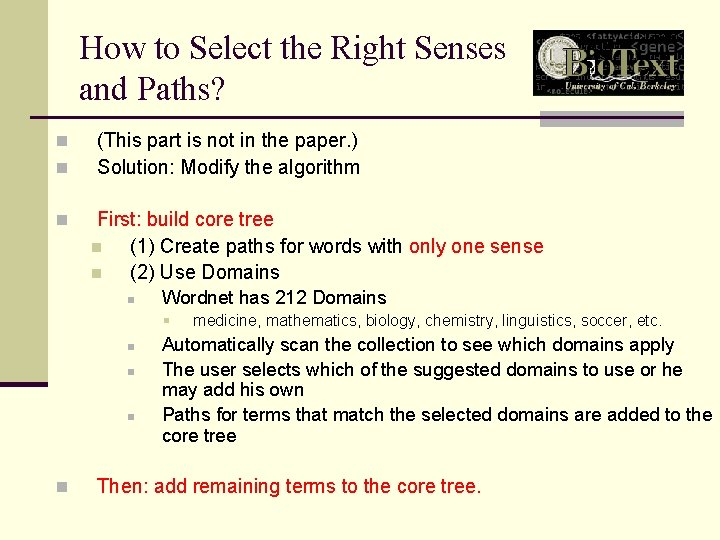
How to Select the Right Senses and Paths? n n n (This part is not in the paper. ) Solution: Modify the algorithm First: build core tree n (1) Create paths for words with only one sense n (2) Use Domains n Wordnet has 212 Domains § n n medicine, mathematics, biology, chemistry, linguistics, soccer, etc. Automatically scan the collection to see which domains apply The user selects which of the suggested domains to use or he may add his own Paths for terms that match the selected domains are added to the core tree Then: add remaining terms to the core tree.
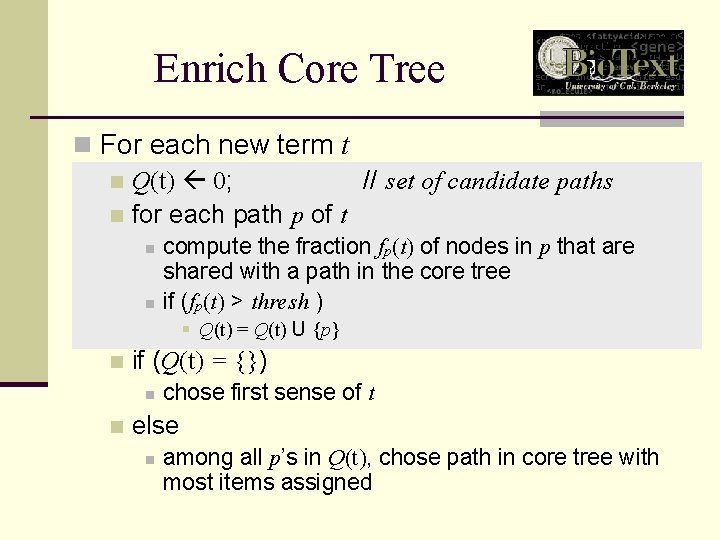
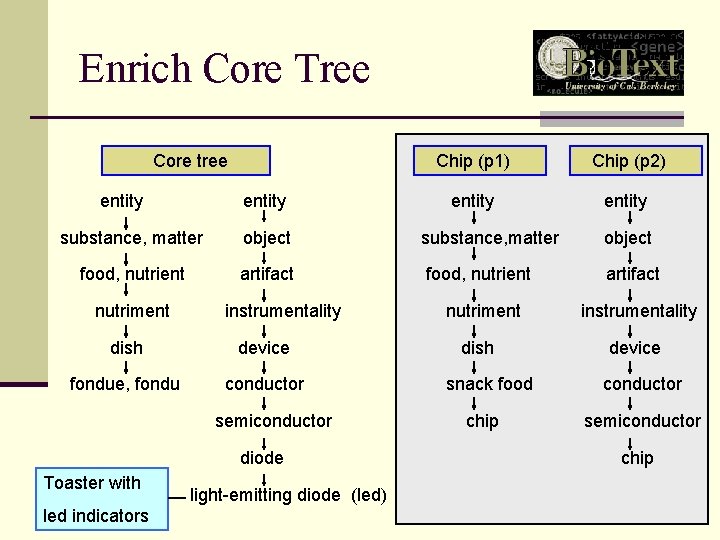
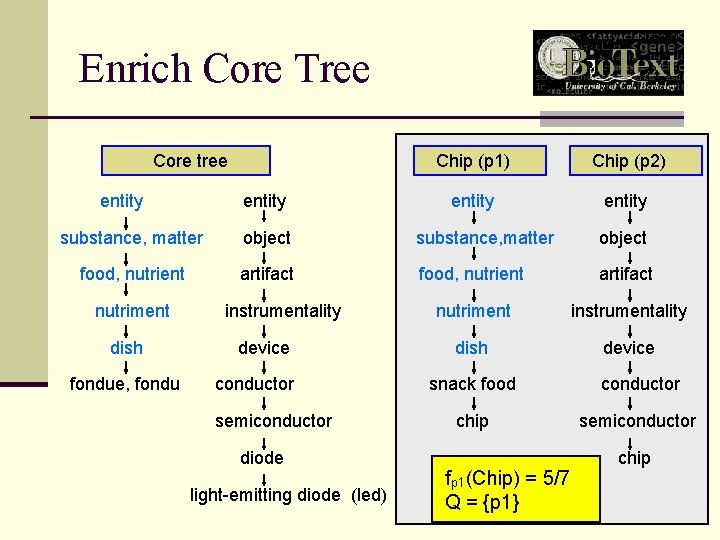
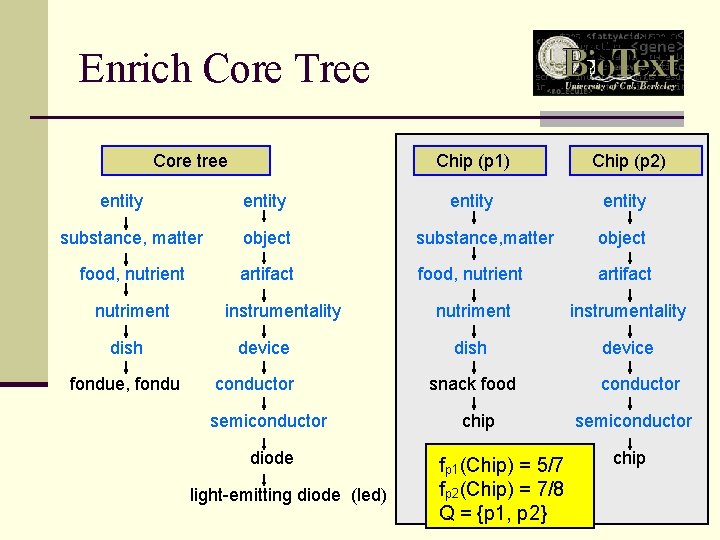
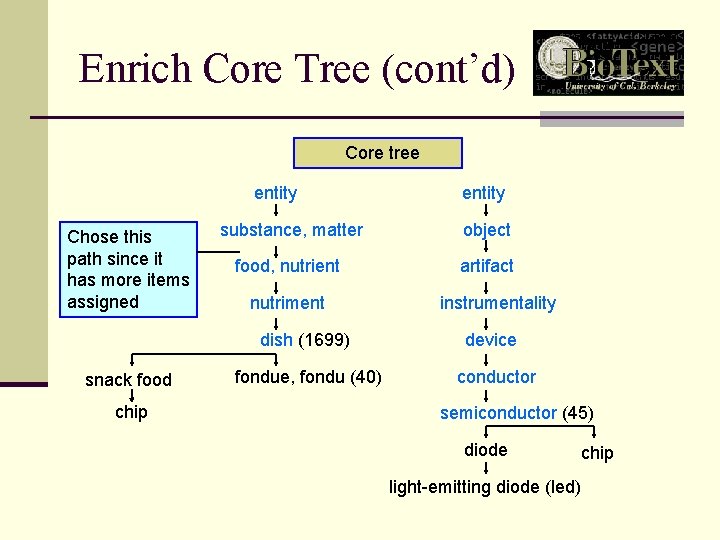
Enrich Core Tree n For each new term t n Q(t) 0; // set of candidate paths n for each path p of t n n compute the fraction fp(t) of nodes in p that are shared with a path in the core tree if (fp(t) > thresh ) § Q(t) = Q(t) U {p} n if (Q(t) = {}) n n chose first sense of t else n among all p’s in Q(t), chose path in core tree with most items assigned
Enrich Core Tree Core tree entity Chip (p 1) Chip (p 2) entity substance, matter object food, nutrient artifact nutriment instrumentality dish device fondue, fondu conductor semiconductor diode Toaster with led indicators light-emitting diode (led) nutriment dish snack food chip instrumentality device conductor semiconductor chip
Enrich Core Tree Core tree entity Chip (p 1) Chip (p 2) entity substance, matter object food, nutrient artifact nutriment instrumentality dish device nutriment dish fondue, fondu instrumentality device conductor semiconductor diode light-emitting diode (led) snack food conductor chip semiconductor fp 1(Chip) = 5/7 Q = {p 1} chip
Enrich Core Tree Core tree entity Chip (p 1) Chip (p 2) entity substance, matter object food, nutrient artifact nutriment instrumentality dish device nutriment dish fondue, fondu instrumentality device conductor semiconductor diode light-emitting diode (led) snack food chip fp 1(Chip) = 5/7 fp 2(Chip) = 7/8 Q = {p 1, p 2} conductor semiconductor chip
Enrich Core Tree (cont’d) Core tree entity Chose this path since it has more items assigned substance, matter object food, nutrient artifact nutriment dish (1699) snack food chip entity fondue, fondu (40) instrumentality device conductor semiconductor (45) diode chip light-emitting diode (led)
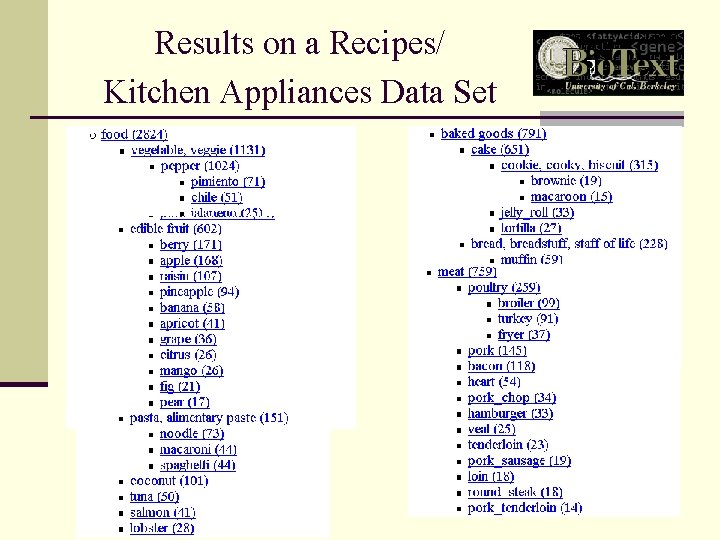
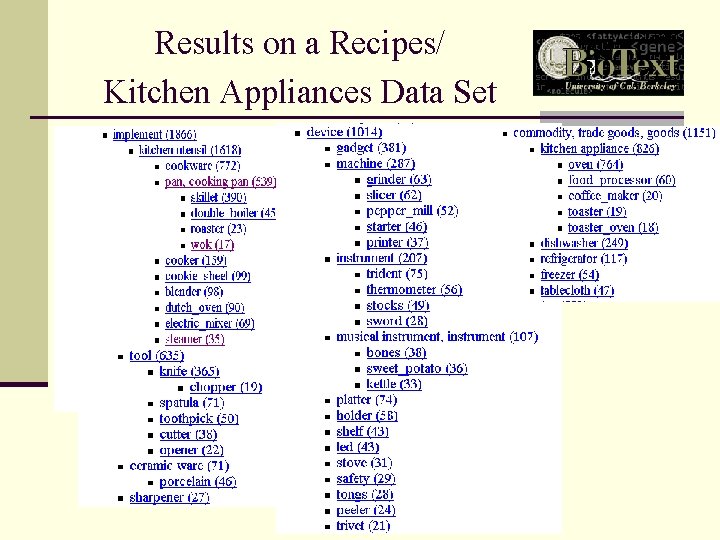
Results on a Recipes/ Kitchen Appliances Data Set
Results on a Recipes/ Kitchen Appliances Data Set
Discussion n This is very simple, but works very well n Why hasn’t this been done before? n Because Word. Net did not have enough coverage?
Conclusions n Can nearly-automatically build a set of hierarchies by finding IS-A relations between terms using Word. Net n The method has been tested on various domains: n medicine, mathematics, recipes, news, arts n User study in progress n Limitations: n The ontology has to be appropriate for the target domain n No disambiguation between nouns, verbs, and adjectives