
NearInfrared Spectroscopy of Small Protonated Water Clusters International
- Slides: 17
Near-Infrared Spectroscopy of Small Protonated Water Clusters International Symposium on Molecular Spectroscopy J. Philipp Wagner, David C. Mc. Donald II, Anne B. Mc. Coy and Michael A. Duncan Jun 20, 2017 Department of Chemistry University of Georgia Athens, Georgia 30602
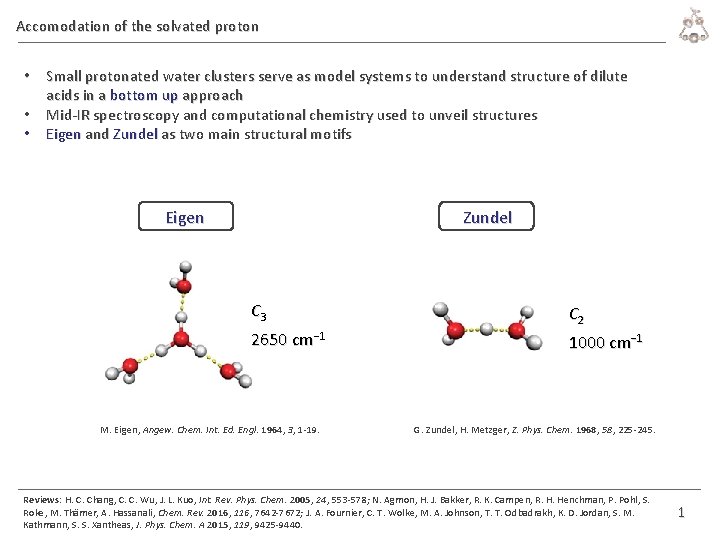
Accomodation of the solvated proton • Small protonated water clusters serve as model systems to understand structure of dilute acids in a bottom up approach • Mid-IR spectroscopy and computational chemistry used to unveil structures • Eigen and Zundel as two main structural motifs Eigen Zundel C 3 C 2 2650 cm− 1 1000 cm− 1 M. Eigen, Angew. Chem. Int. Ed. Engl. 1964, 3, 1 -19. G. Zundel, H. Metzger, Z. Phys. Chem. 1968, 58, 225 -245. Reviews: H. C. Chang, C. C. Wu, J. L. Kuo, Int. Rev. Phys. Chem. 2005, 24, 553 -578; N. Agmon, H. J. Bakker, R. K. Campen, R. H. Henchman, P. Pohl, S. Roke, M. Thämer, A. Hassanali, Chem. Rev. 2016, 116, 7642 -7672; J. A. Fournier, C. T. Wolke, M. A. Johnson, T. T. Odbadrakh, K. D. Jordan, S. M. Kathmann, S. S. Xantheas, J. Phys. Chem. A 2015, 119, 9425 -9440. 1
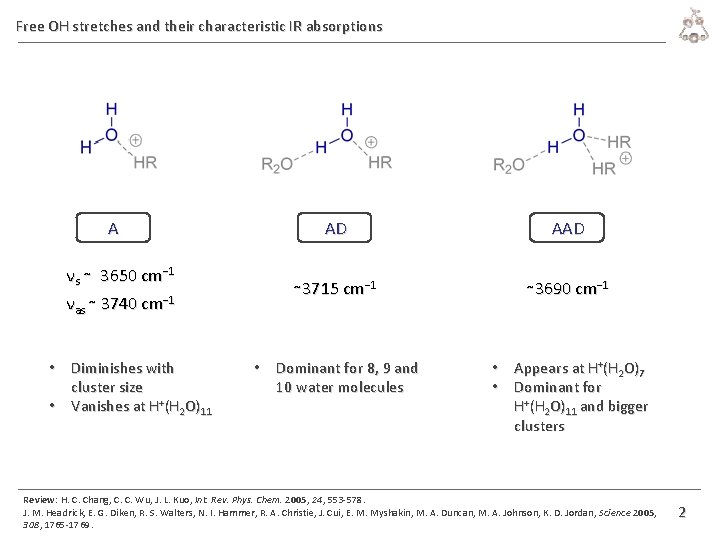
Free OH stretches and their characteristic IR absorptions A νs ∼ 3650 cm− 1 νas ∼ 3740 cm− 1 • Diminishes with cluster size • Vanishes at H+(H 2 O)11 AD AAD ∼ 3715 cm− 1 ∼ 3690 cm− 1 • Dominant for 8, 9 and 10 water molecules • Appears at H+(H 2 O)7 • Dominant for H+(H 2 O)11 and bigger clusters Review: H. C. Chang, C. C. Wu, J. L. Kuo, Int. Rev. Phys. Chem. 2005, 24, 553 -578. J. M. Headrick, E. G. Diken, R. S. Walters, N. I. Hammer, R. A. Christie, J. Cui, E. M. Myshakin, M. A. Duncan, M. A. Johnson, K. D. Jordan, Science 2005, 308, 1765 -1769. 2
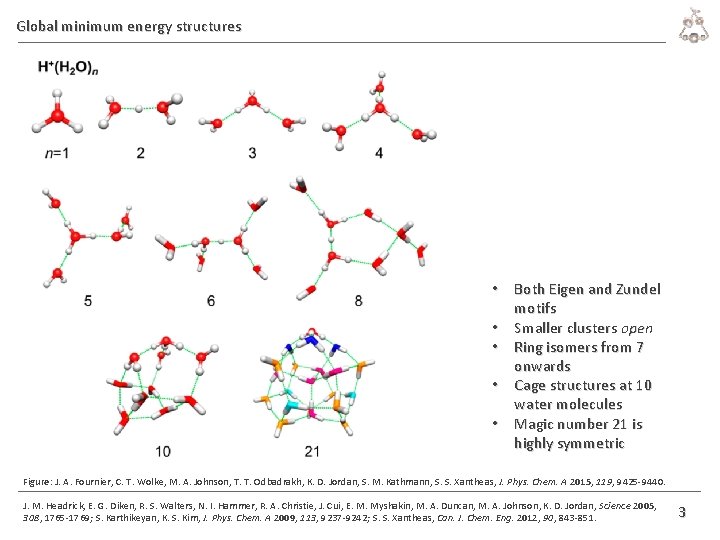
Global minimum energy structures • Both Eigen and Zundel motifs • Smaller clusters open • Ring isomers from 7 onwards • Cage structures at 10 water molecules • Magic number 21 is highly symmetric Figure: J. A. Fournier, C. T. Wolke, M. A. Johnson, T. T. Odbadrakh, K. D. Jordan, S. M. Kathmann, S. S. Xantheas, J. Phys. Chem. A 2015, 119, 9425 -9440. J. M. Headrick, E. G. Diken, R. S. Walters, N. I. Hammer, R. A. Christie, J. Cui, E. M. Myshakin, M. A. Duncan, M. A. Johnson, K. D. Jordan, Science 2005, 308, 1765 -1769; S. Karthikeyan, K. S. Kim, J. Phys. Chem. A 2009, 113, 9237 -9242; S. S. Xantheas, Can. J. Chem. Eng. 2012, 90, 843 -851. 3
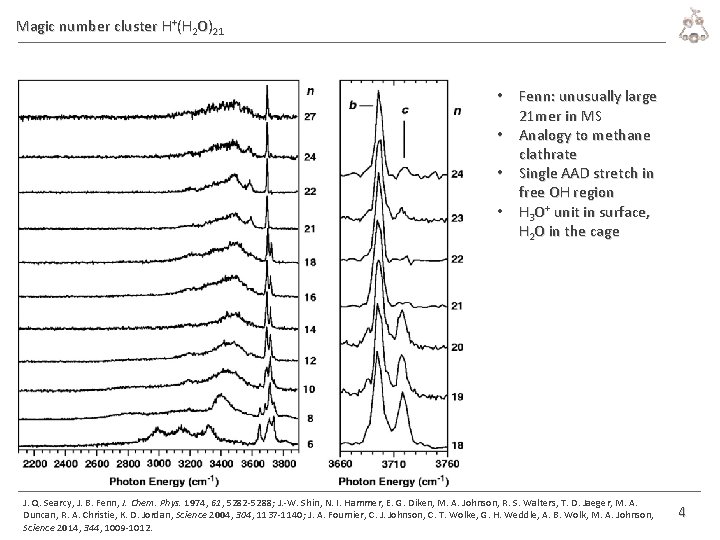
Magic number cluster H+(H 2 O)21 • Fenn: unusually large 21 mer in MS • Analogy to methane clathrate • Single AAD stretch in free OH region • H 3 O+ unit in surface, H 2 O in the cage J. Q. Searcy, J. B. Fenn, J. Chem. Phys. 1974, 61, 5282 -5288; J. -W. Shin, N. I. Hammer, E. G. Diken, M. A. Johnson, R. S. Walters, T. D. Jaeger, M. A. Duncan, R. A. Christie, K. D. Jordan, Science 2004, 304, 1137 -1140; J. A. Fournier, C. J. Johnson, C. T. Wolke, G. H. Weddle, A. B. Wolk, M. A. Johnson, Science 2014, 344, 1009 -1012. 4
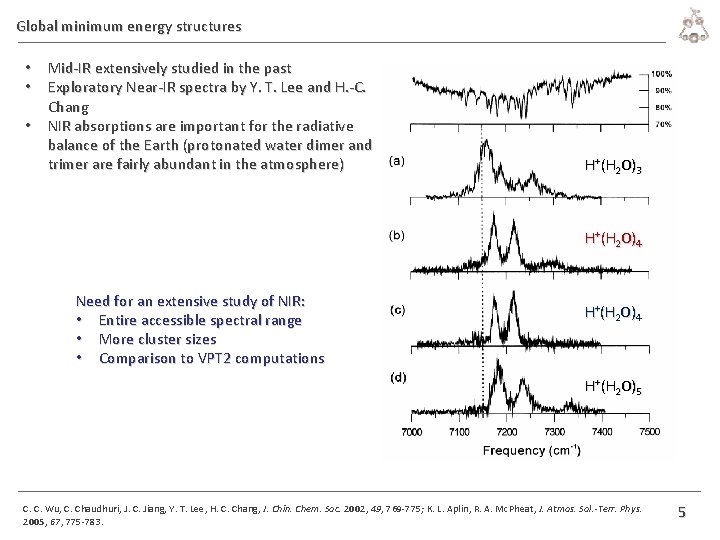
Global minimum energy structures • Mid-IR extensively studied in the past • Exploratory Near-IR spectra by Y. T. Lee and H. -C. Chang • NIR absorptions are important for the radiative balance of the Earth (protonated water dimer and trimer are fairly abundant in the atmosphere) H+(H 2 O)3 H+(H 2 O)4 Need for an extensive study of NIR: • Entire accessible spectral range • More cluster sizes • Comparison to VPT 2 computations H+(H 2 O)4 H+(H 2 O)5 C. C. Wu, C. Chaudhuri, J. C. Jiang, Y. T. Lee, H. C. Chang, J. Chin. Chem. Soc. 2002, 49, 769 -775; K. L. Aplin, R. A. Mc. Pheat, J. Atmos. Sol. -Terr. Phys. 2005, 67, 775 -783. 5
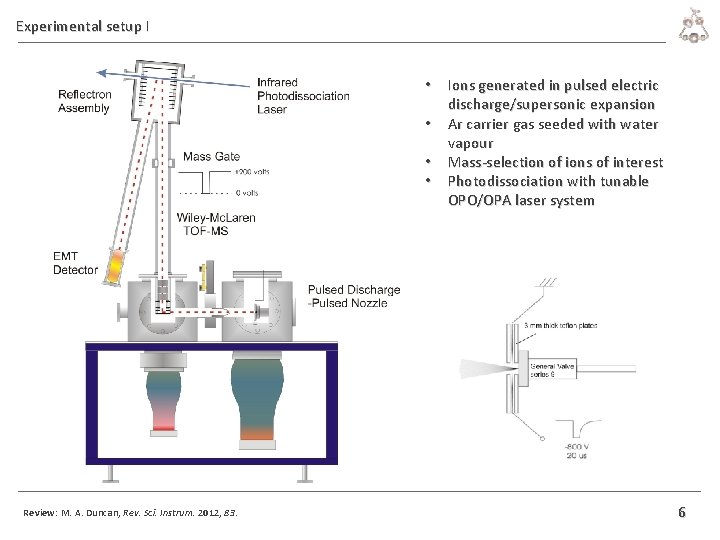
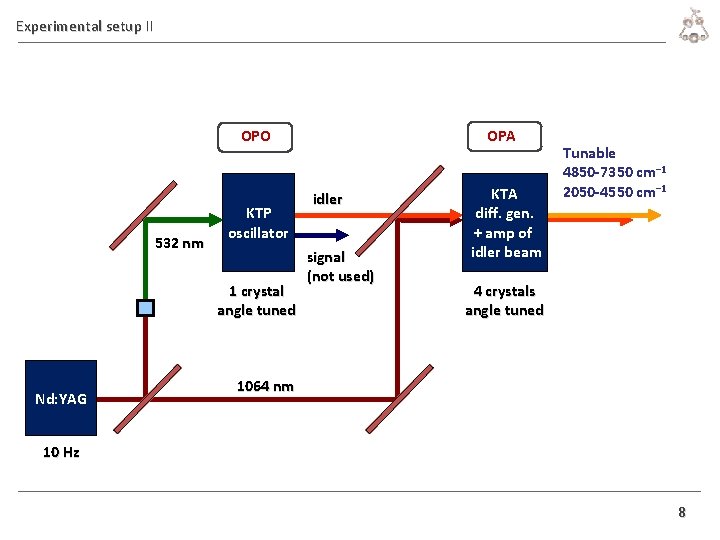
Experimental setup I • Ions generated in pulsed electric discharge/supersonic expansion • Ar carrier gas seeded with water vapour • Mass-selection of ions of interest • Photodissociation with tunable OPO/OPA laser system Review: M. A. Duncan, Rev. Sci. Instrum. 2012, 83. 6
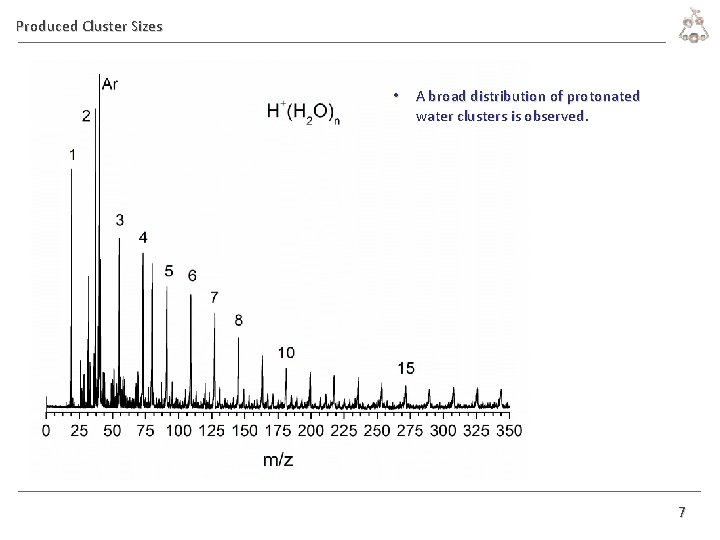
Produced Cluster Sizes • A broad distribution of protonated water clusters is observed. 7
Experimental setup II OPO 532 nm KTP oscillator 1 crystal angle tuned Nd: YAG OPA idler signal (not used) KTA diff. gen. + amp of idler beam Tunable 4850 -7350 cm− 1 2050 -4550 cm− 1 4 crystals angle tuned 1064 nm 10 Hz 8
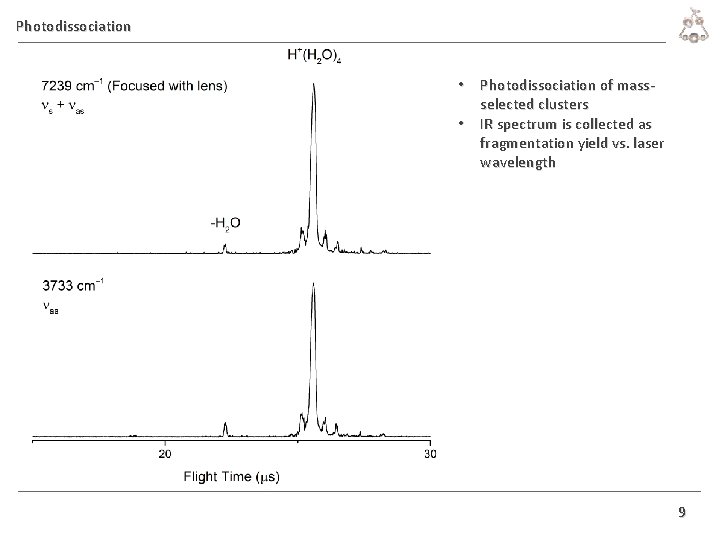
Photodissociation • Photodissociation of massselected clusters • IR spectrum is collected as fragmentation yield vs. laser wavelength 9
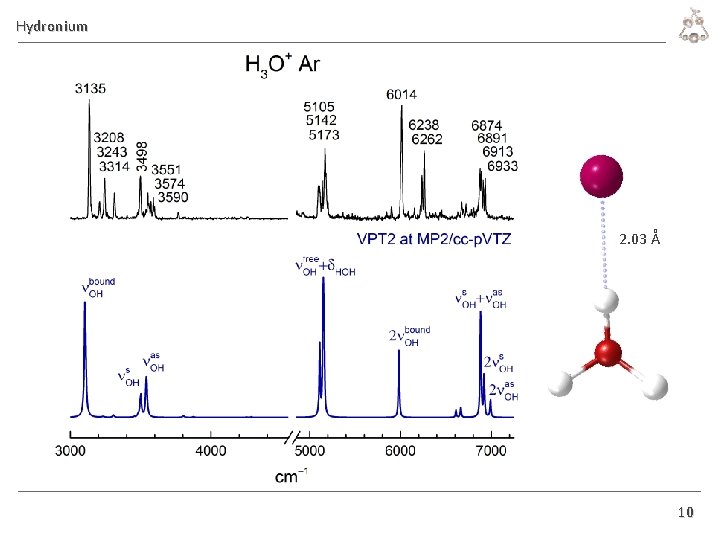
Hydronium 2. 03 Å 10
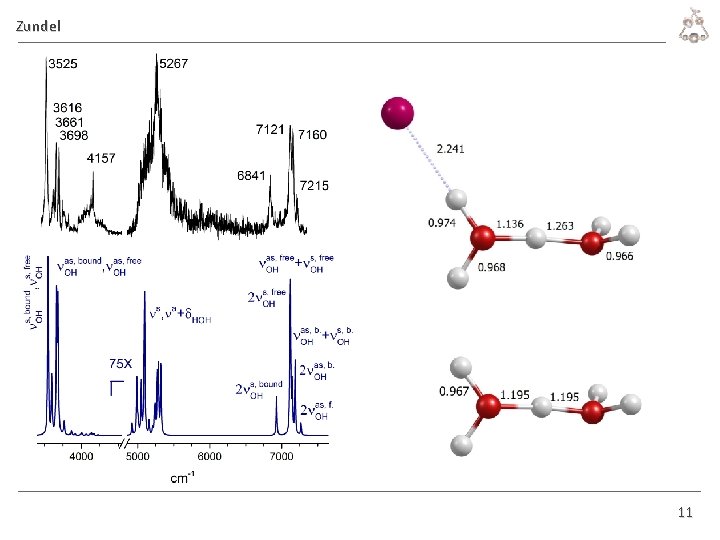
Zundel 11
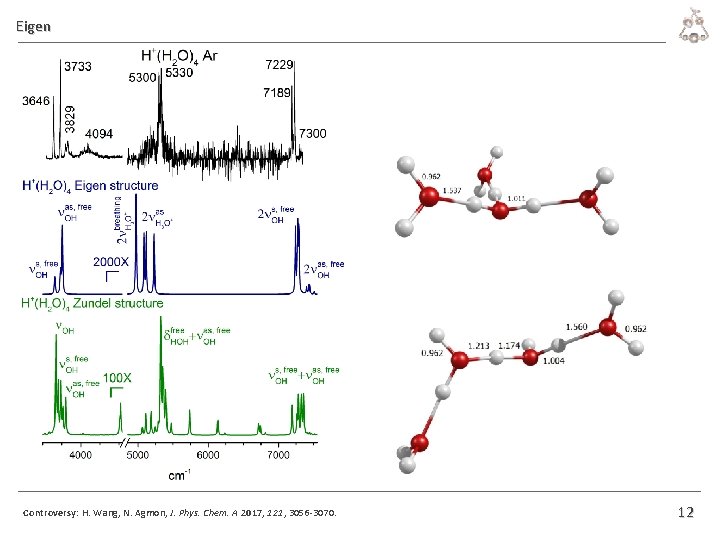
Eigen Controversy: H. Wang, N. Agmon, J. Phys. Chem. A 2017, 121, 3056 -3070. 12
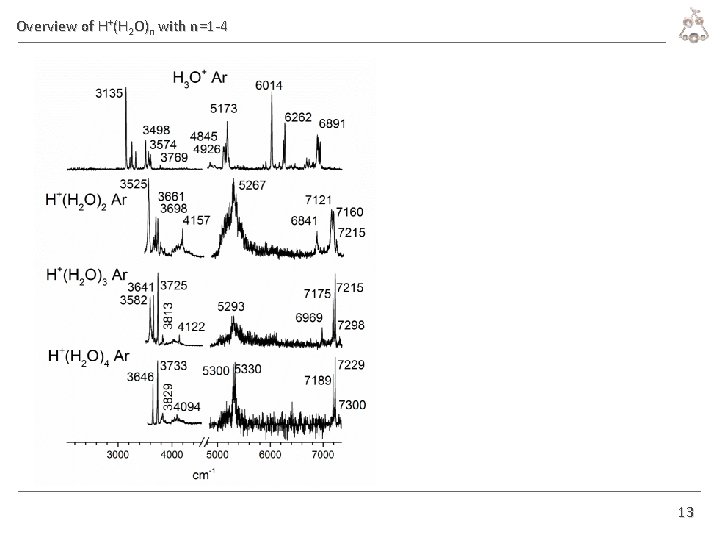
Overview of H+(H 2 O)n with n=1 -4 13
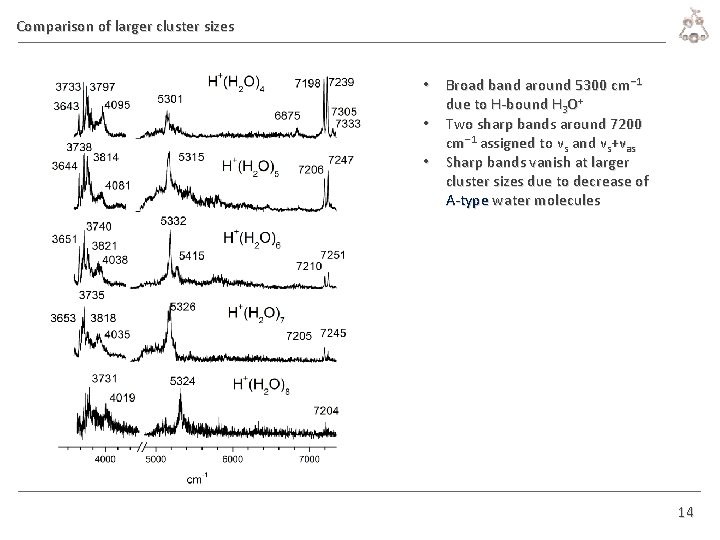
Comparison of larger cluster sizes • Broad band around 5300 cm− 1 due to H-bound H 3 O+ • Two sharp bands around 7200 cm− 1 assigned to νs and νs+νas • Sharp bands vanish at larger cluster sizes due to decrease of A-type water molecules 14
Summary • We have measured NIR spectra of small protonated water clusters up to H+(H 2 O)8 • VPT 2 theory is in good agreement with experimental data • Further high-resolution studies are desirable due to the atmospheric relevance of the small clusters 14
Acknowledgment • • Prof. Dr. Michael A. Duncan David C. Mc. Donald II Prof. Dr. Anne B. Mc. Coy Alexander von Humboldt-Foundation Thanks for your attention!!!