
NearInfra Red Imager and Slitless Spectrograph Imaging and
![AMI in [Simulated] Action Direct Simulations Include: ü Read Noise ü Poisson Noise ü](https://slidetodoc.com/presentation_image_h/7f105b3b3f258de1f0970609a6deb92c/image-10.jpg "AMI in [Simulated] Action Direct Simulations Include: ü Read Noise ü Poisson Noise ü")
- Slides: 16
Near-Infra. Red Imager and Slitless Spectrograph: Imaging and Interferometry Alex Fullerton STSc. I / NIRISS Team Lead OUTLINE 1) Introducing NIRISS 2) Imaging 3) Aperture Masking Interferometry
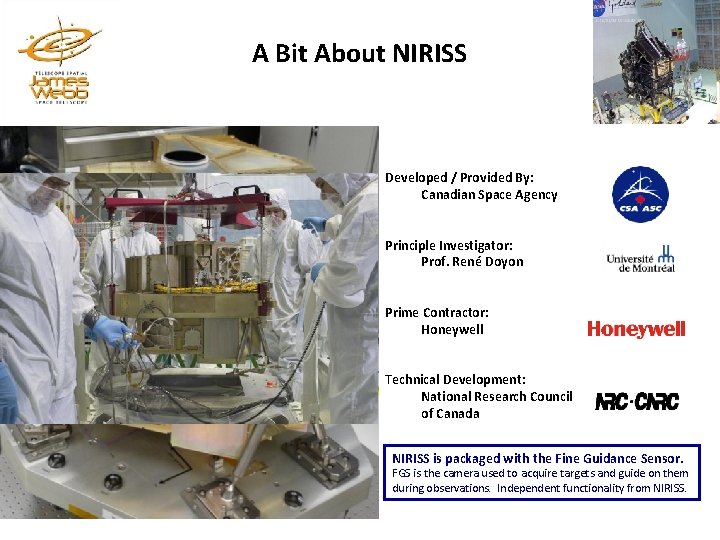
A Bit About NIRISS Developed / Provided By: Canadian Space Agency Principle Investigator: Prof. René Doyon Prime Contractor: Honeywell Technical Development: National Research Council of Canada NIRISS is packaged with the Fine Guidance Sensor. FGS is the camera used to acquire targets and guide on them during observations. Independent functionality from NIRISS.
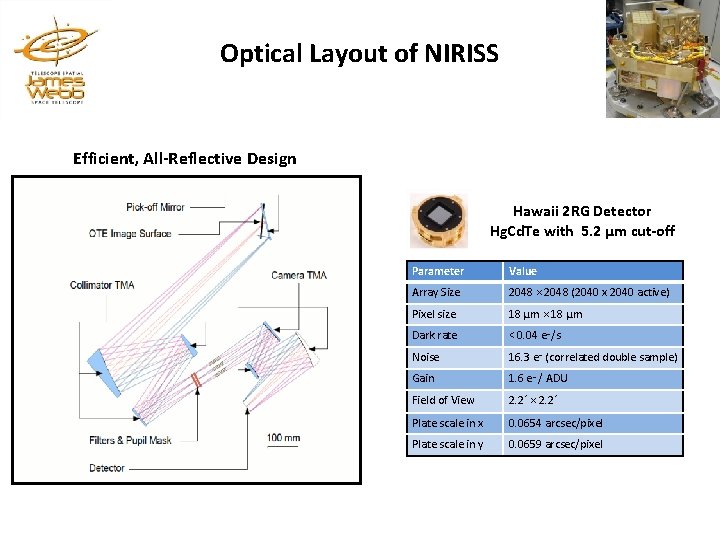
Optical Layout of NIRISS Efficient, All-Reflective Design Hawaii 2 RG Detector Hg. Cd. Te with 5. 2 μm cut-off Parameter Value Array Size 2048 × 2048 (2040 x 2040 active) Pixel size 18 μm × 18 μm Dark rate < 0. 04 e−/s Noise 16. 3 e− (correlated double sample) Gain 1. 6 e− / ADU Field of View 2. 2´ × 2. 2´ Plate scale in x 0. 0654 arcsec/pixel Plate scale in y 0. 0659 arcsec/pixel
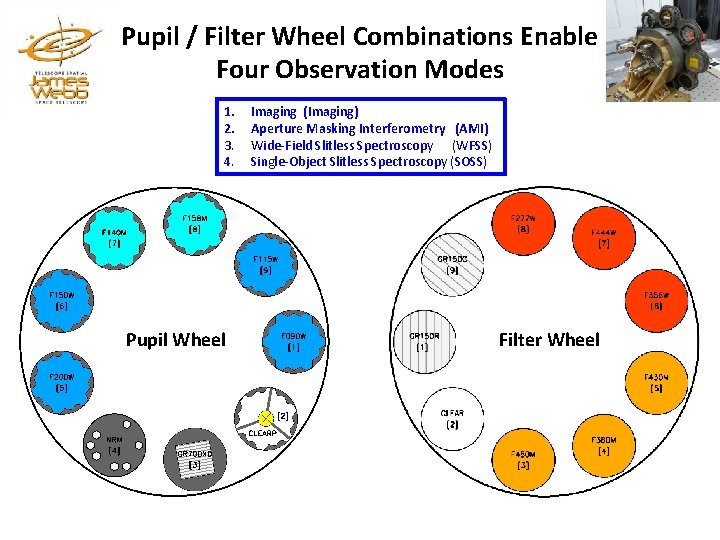
Pupil / Filter Wheel Combinations Enable Four Observation Modes 1. 2. 3. 4. Pupil Wheel Imaging (Imaging) Aperture Masking Interferometry (AMI) Wide-Field Slitless Spectroscopy (WFSS) Single-Object Slitless Spectroscopy (SOSS) Filter Wheel
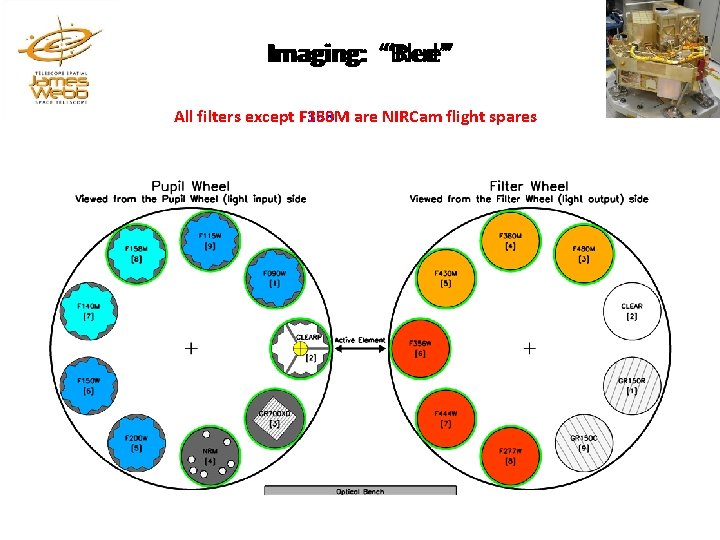
Imaging: “Blue” “Red” F 158 M are NIRCam flight spares All filters except F 380 M
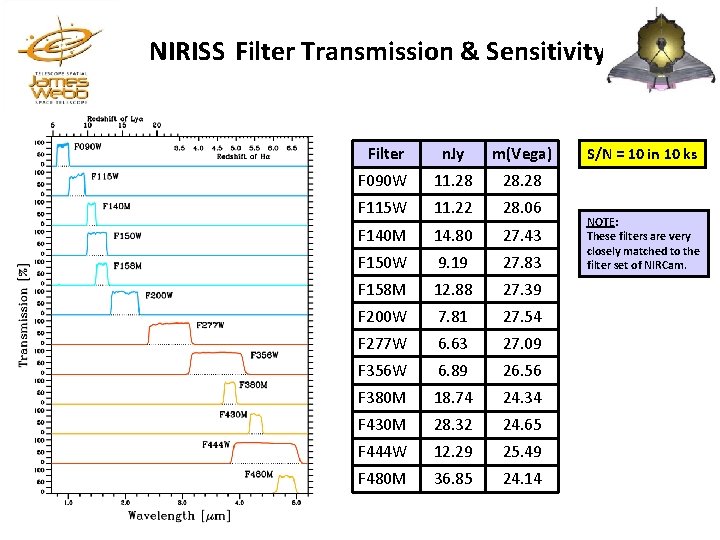
NIRISS Filter Transmission & Sensitivity Filter n. Jy m(Vega) F 090 W 11. 28 28. 28 F 115 W 11. 22 28. 06 F 140 M 14. 80 27. 43 F 150 W 9. 19 27. 83 F 158 M 12. 88 27. 39 F 200 W 7. 81 27. 54 F 277 W 6. 63 27. 09 F 356 W 6. 89 26. 56 F 380 M 18. 74 24. 34 F 430 M 28. 32 24. 65 F 444 W 12. 29 25. 49 F 480 M 36. 85 24. 14 S/N = 10 in 10 ks NOTE: These filters are very closely matched to the filter set of NIRCam.
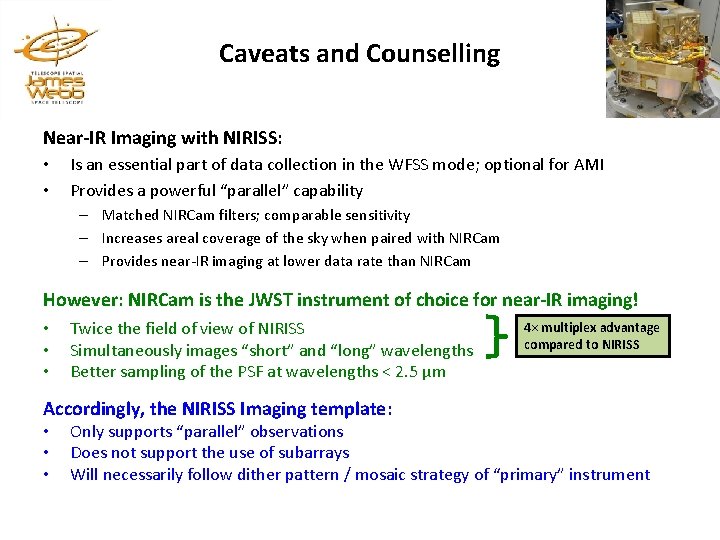
Caveats and Counselling Near-IR Imaging with NIRISS: • • Is an essential part of data collection in the WFSS mode; optional for AMI Provides a powerful “parallel” capability – Matched NIRCam filters; comparable sensitivity – Increases areal coverage of the sky when paired with NIRCam – Provides near-IR imaging at lower data rate than NIRCam However: NIRCam is the JWST instrument of choice for near-IR imaging! • • • Twice the field of view of NIRISS Simultaneously images “short” and “long” wavelengths Better sampling of the PSF at wavelengths < 2. 5 µm Accordingly, the NIRISS Imaging template: • • • 4× multiplex advantage compared to NIRISS Only supports “parallel” observations Does not support the use of subarrays Will necessarily follow dither pattern / mosaic strategy of “primary” instrument
Aperture Masking Interferometry Un “ami” des astronomes NIRISS provides the first space-based implementation of aperture masking
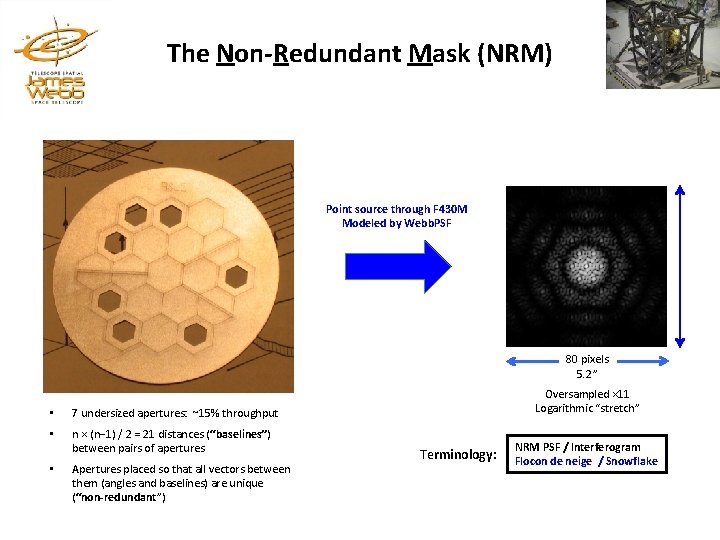
The Non-Redundant Mask (NRM) Point source through F 430 M Modeled by Webb. PSF 80 pixels 5. 2” • 7 undersized apertures: ~15% throughput • n × (n− 1) / 2 = 21 distances (“baselines”) between pairs of apertures • Apertures placed so that all vectors between them (angles and baselines) are unique (“non-redundant”) Oversampled × 11 Logarithmic “stretch” Terminology: NRM PSF / Interferogram Flocon de neige / Snowflake
AMI in [Simulated] Action Direct Simulations Include: ü Read Noise ü Poisson Noise ü Dark Current ü Background ü Flat-Field Error AMI Slide courtesy of D. Thatte
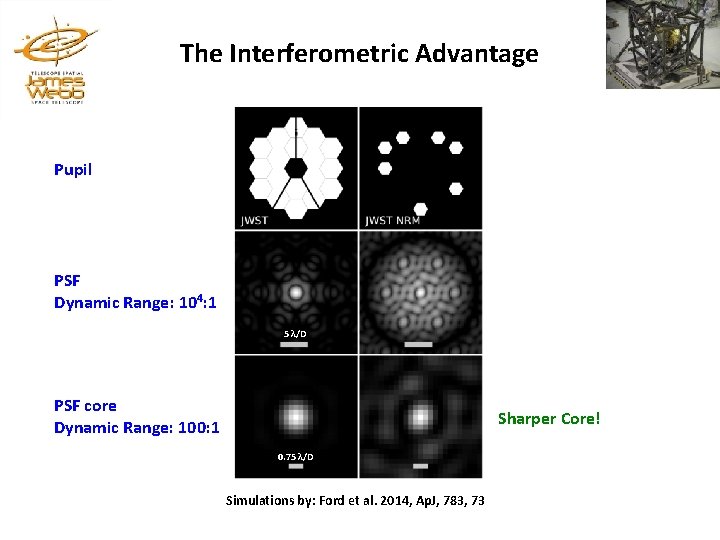
The Interferometric Advantage Pupil PSF Dynamic Range: 104: 1 5 λ/D PSF core Dynamic Range: 100: 1 Sharper Core! 0. 75 λ/D Simulations by: Ford et al. 2014, Ap. J, 783, 73
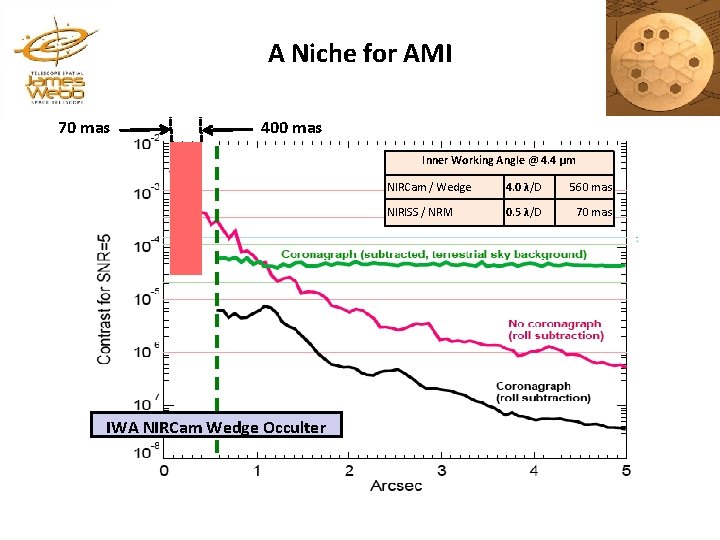
A Niche for AMI 70 mas 400 mas Inner Working Angle @ 4. 4 μm IWA NIRCam Wedge Occulter NIRCam / Wedge 4. 0 λ/D 560 mas NIRISS / NRM 0. 5 λ/D 70 mas
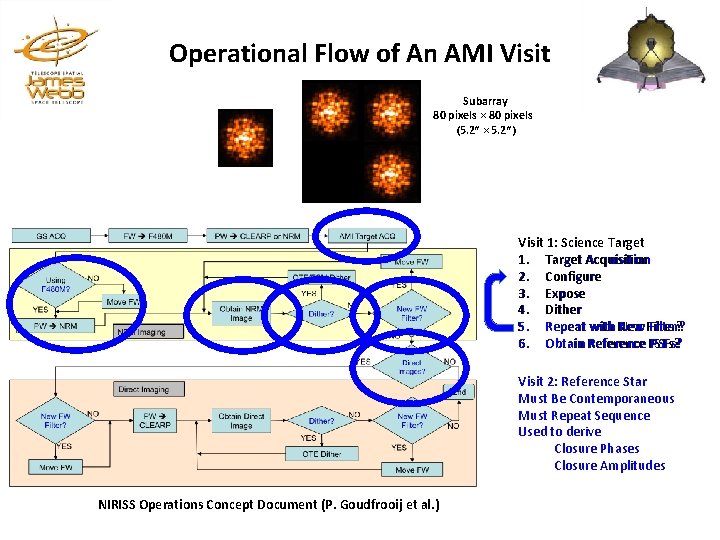
Operational Flow of An AMI Visit Subarray 80 pixels × 80 pixels (5. 2″ × 5. 2″) Visit 1: Science Target 1. Target Acquisition 2. Configure 3. Expose 4. Dither 5. Repeat with New Filter? 6. Obtain Reference PSFs? Visit 2: Reference Star Must Be Contemporaneous Must Repeat Sequence Used to derive Closure Phases Closure Amplitudes NIRISS Operations Concept Document (P. Goudfrooij et al. )
Predicted Performance of AMI Figure courtesy of É. Artigau (U de Montréal)
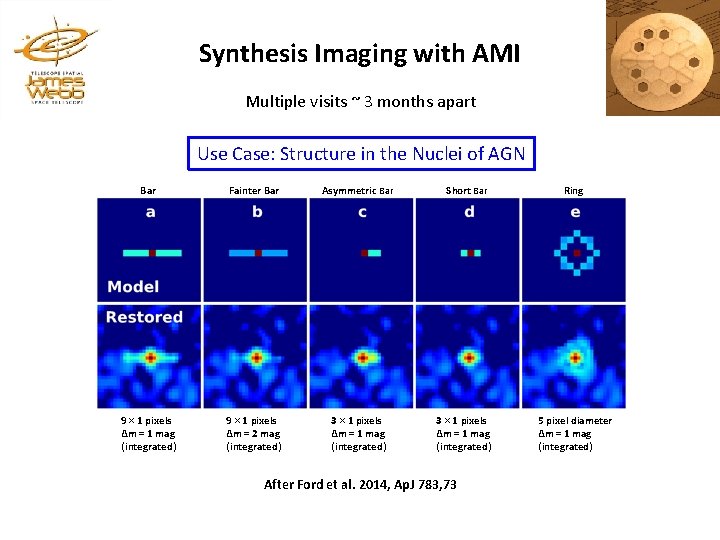
Synthesis Imaging with AMI Multiple visits ~ 3 months apart Use Case: Structure in the Nuclei of AGN Bar Fainter Bar Asymmetric Bar Short Bar Ring 9 × 1 pixels Δm = 1 mag (integrated) 9 × 1 pixels Δm = 2 mag (integrated) 3 × 1 pixels Δm = 1 mag (integrated) 5 pixel diameter Δm = 1 mag (integrated) After Ford et al. 2014, Ap. J 783, 73
Near-Infra. Red Imager and Slitless Spectrograph: Imaging and Interferometry L− 734 SUMMARY: Days and Counting! NIRISS has imaging capability with a filter set closely matched to NIRCam. • Integral part of observing sequence for WFSS; optional for AMI • Powerful mode when used as a science “parallel” • But otherwise you should use NIRCam for near-IR imaging Aperture Masking Interferometry (AMI) is a powerful capability. • Provides very high spatial resolution and good contrast • Very stable, self-calibrating • Can be used for synthesis imaging • AMI is a friend! Use it!