
NearField Focused Phased Array and Scanning Antennas for
- Slides: 15
Near-Field Focused Phased Array and Scanning Antennas for RFID Applications Greg Mendolia Vice President, Product Strategy Office: 443 -259 -0140 x 130 Fax: 443 -259 -0451 Paratek Microwave, Inc. 6935 Oakland Mills Road, Suite G Columbia, MD 21045 Paratek Confidential and Proprietary
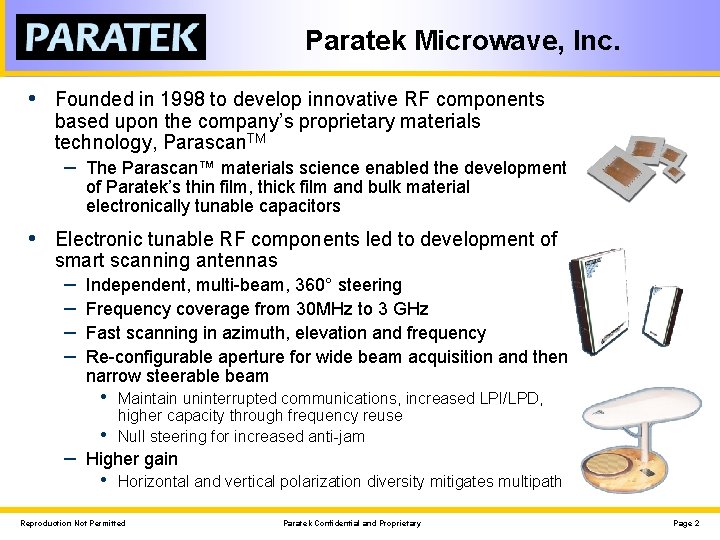
Paratek Microwave, Inc. • Founded in 1998 to develop innovative RF components based upon the company’s proprietary materials technology, Parascan. TM – The Parascan™ materials science enabled the development of Paratek’s thin film, thick film and bulk material electronically tunable capacitors • Electronic tunable RF components led to development of smart scanning antennas – – Independent, multi-beam, 360° steering Frequency coverage from 30 MHz to 3 GHz Fast scanning in azimuth, elevation and frequency Re-configurable aperture for wide beam acquisition and then narrow steerable beam • Maintain uninterrupted communications, increased LPI/LPD, • higher capacity through frequency reuse Null steering for increased anti-jam – Higher gain • Horizontal and vertical polarization diversity mitigates multipath Reproduction Not Permitted Paratek Confidential and Proprietary Page 2
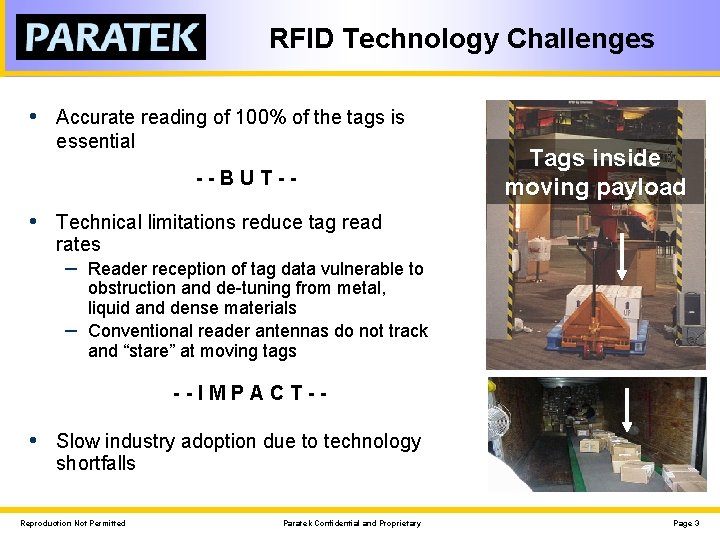
RFID Technology Challenges • Accurate reading of 100% of the tags is essential --BUT-- Tags inside moving payload • Technical limitations reduce tag read rates – Reader reception of tag data vulnerable to – obstruction and de-tuning from metal, liquid and dense materials Conventional reader antennas do not track and “stare” at moving tags --IMPACT-- • Slow industry adoption due to technology shortfalls Reproduction Not Permitted Paratek Confidential and Proprietary Page 3
Paratek Solution Near Field Focused, Scanning Phased Array (NFA) • Antenna power is surgically directed at – and focused on – targeted RFID tags by increasing power levels in the near field without polluting spectrum in the far field – Antenna RF power is focused at the tag instead of spread over the entire – – – area • More signal power delivered at the tag => more tags read and better ability to write to tags Multipath and interference problems reduced => decreased tag contention Antenna tracks tags as they pass by • Increased beam dwell time on tag => longer read time Direction of tag movement can be detected • Are items entering or leaving the area? • KEY RESULT: Dramatically improved tag read rates for RFID unfriendly materials Reproduction Not Permitted Paratek Confidential and Proprietary Page 4
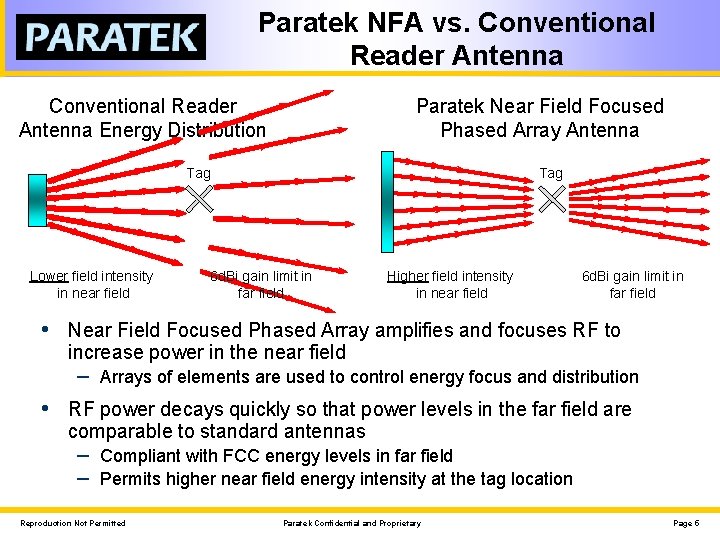
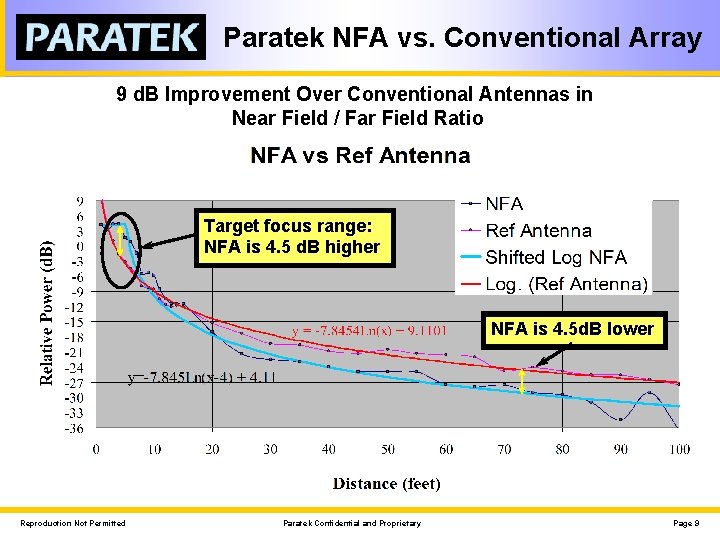
Paratek NFA vs. Conventional Reader Antenna Energy Distribution Paratek Near Field Focused Phased Array Antenna Tag Lower field intensity in near field Tag 6 d. Bi gain limit in far field Higher field intensity in near field 6 d. Bi gain limit in far field • Near Field Focused Phased Array amplifies and focuses RF to increase power in the near field – Arrays of elements are used to control energy focus and distribution • RF power decays quickly so that power levels in the far field are comparable to standard antennas – Compliant with FCC energy levels in far field – Permits higher near field energy intensity at the tag location Reproduction Not Permitted Paratek Confidential and Proprietary Page 5
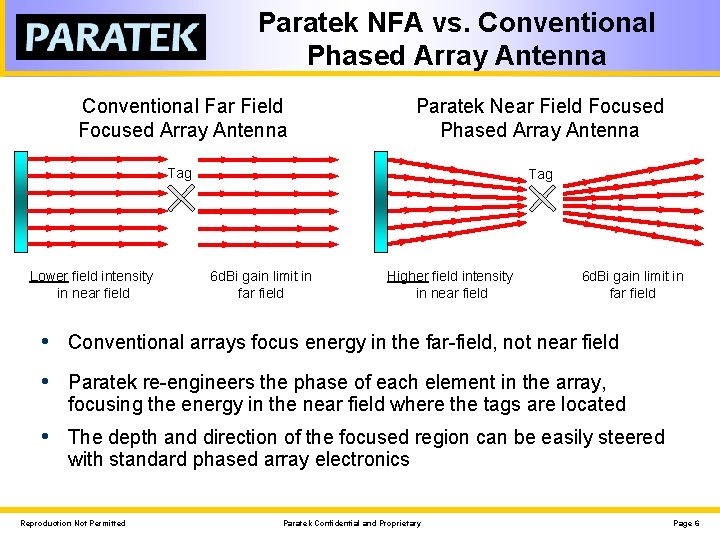
Paratek NFA vs. Conventional Phased Array Antenna Conventional Far Field Focused Array Antenna Paratek Near Field Focused Phased Array Antenna Tag Lower field intensity in near field 6 d. Bi gain limit in far field Higher field intensity in near field 6 d. Bi gain limit in far field • Conventional arrays focus energy in the far-field, not near field • Paratek re-engineers the phase of each element in the array, focusing the energy in the near field where the tags are located • The depth and direction of the focused region can be easily steered with standard phased array electronics Reproduction Not Permitted Paratek Confidential and Proprietary Page 6
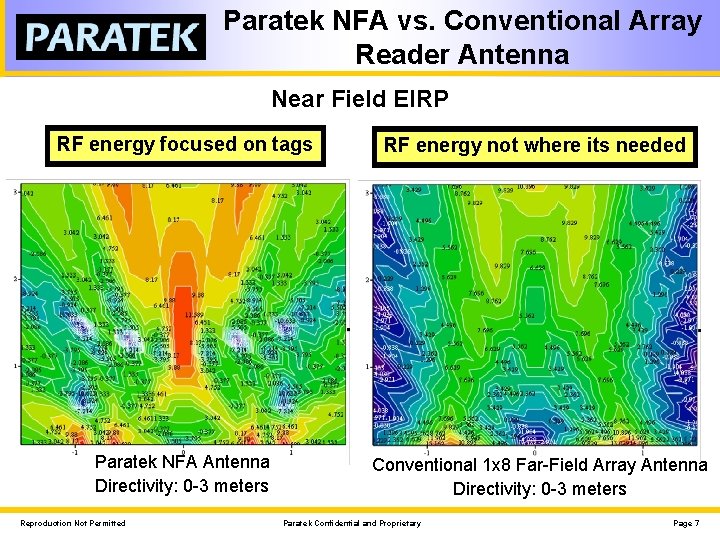
Paratek NFA vs. Conventional Array Reader Antenna Near Field EIRP RF energy focused on tags RF energy not where its needed Paratek NFA Antenna Directivity: 0 -3 meters Conventional 1 x 8 Far-Field Array Antenna Directivity: 0 -3 meters Reproduction Not Permitted Paratek Confidential and Proprietary Page 7
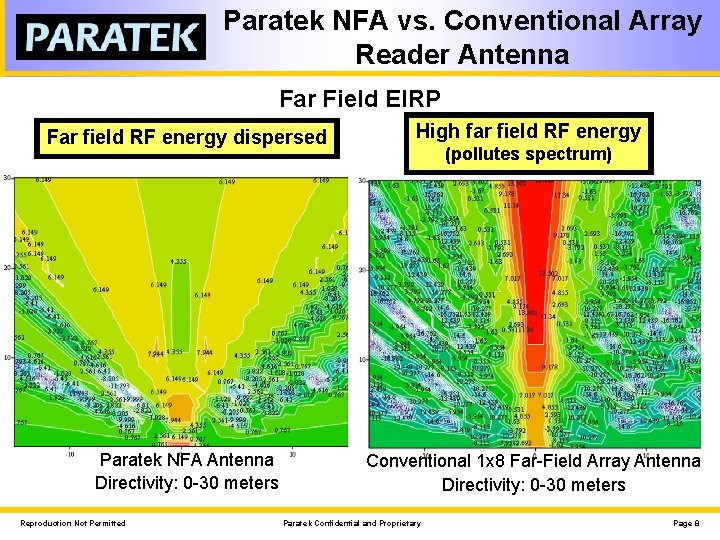
Paratek NFA vs. Conventional Array Reader Antenna Far Field EIRP Far field RF energy dispersed High far field RF energy Paratek NFA Antenna Directivity: 0 -30 meters Conventional 1 x 8 Far-Field Array Antenna Directivity: 0 -30 meters Reproduction Not Permitted (pollutes spectrum) Paratek Confidential and Proprietary Page 8
Paratek NFA vs. Conventional Array 9 d. B Improvement Over Conventional Antennas in Near Field / Far Field Ratio Target focus range: NFA is 4. 5 d. B higher NFA is 4. 5 d. B lower Reproduction Not Permitted Paratek Confidential and Proprietary Page 9
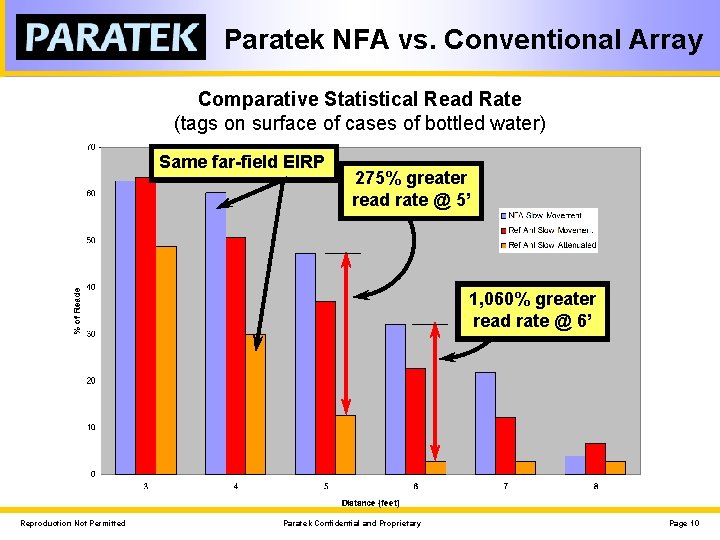
Paratek NFA vs. Conventional Array Comparative Statistical Read Rate (tags on surface of cases of bottled water) Same far-field EIRP 275% greater read rate @ 5’ 1, 060% greater read rate @ 6’ Reproduction Not Permitted Paratek Confidential and Proprietary Page 10
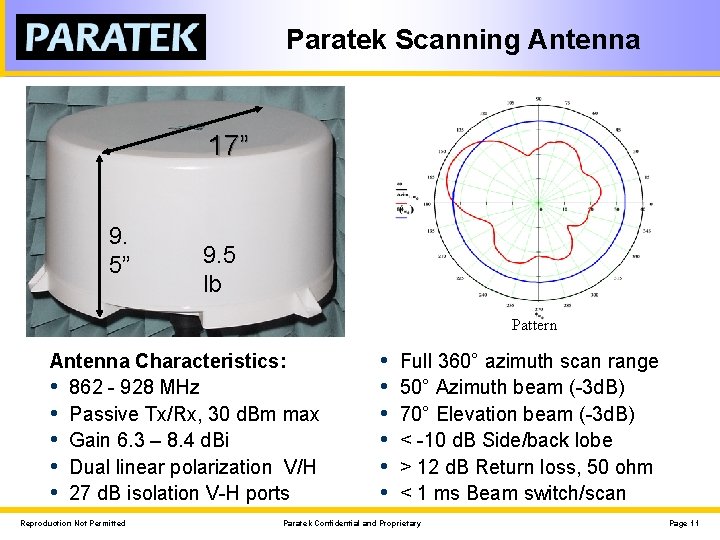
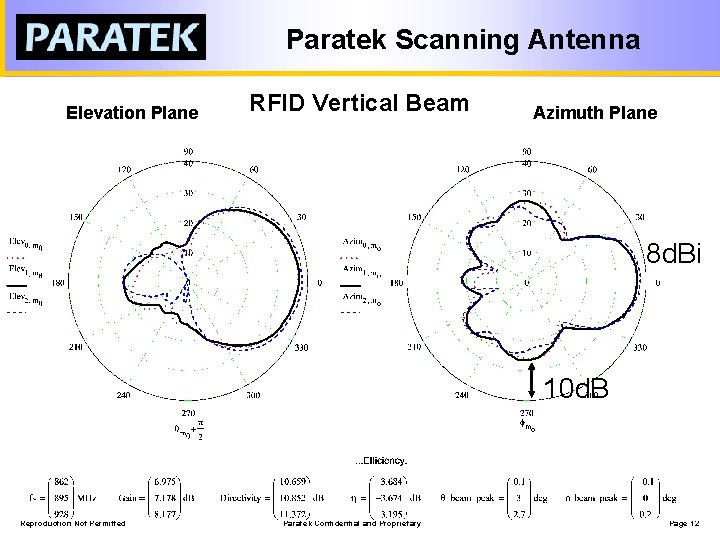
Paratek Scanning Antenna 17” 9. 5 lb Pattern Antenna Characteristics: • 862 - 928 MHz • Passive Tx/Rx, 30 d. Bm max • Gain 6. 3 – 8. 4 d. Bi • Dual linear polarization V/H • 27 d. B isolation V-H ports Reproduction Not Permitted • • • Full 360° azimuth scan range 50° Azimuth beam (-3 d. B) 70° Elevation beam (-3 d. B) < -10 d. B Side/back lobe > 12 d. B Return loss, 50 ohm < 1 ms Beam switch/scan Paratek Confidential and Proprietary Page 11
Paratek Scanning Antenna Elevation Plane RFID Vertical Beam Azimuth Plane 8 d. Bi 10 d. B Reproduction Not Permitted Paratek Confidential and Proprietary Page 12
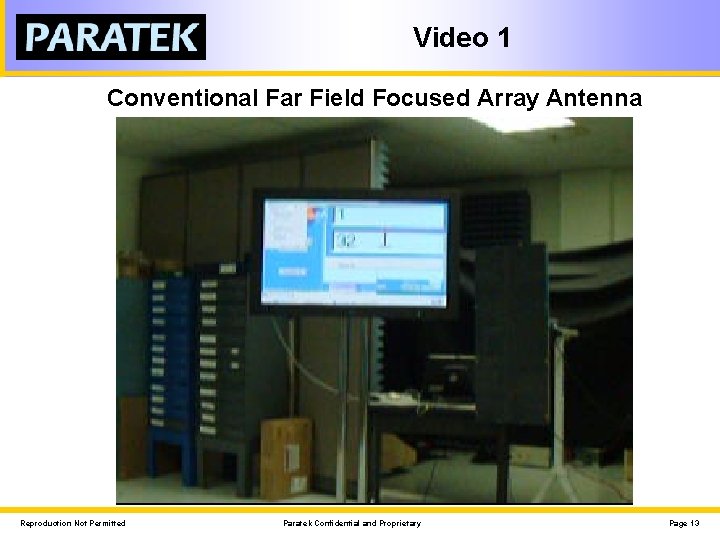
Video 1 Conventional Far Field Focused Array Antenna Reproduction Not Permitted Paratek Confidential and Proprietary Page 13
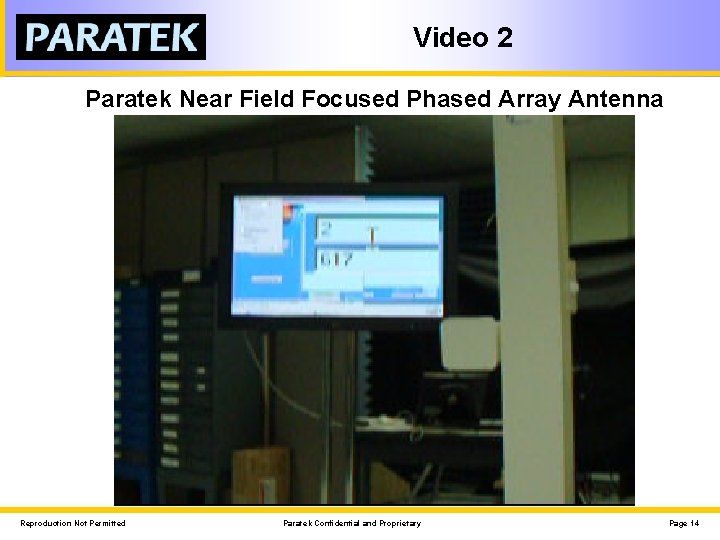
Video 2 Paratek Near Field Focused Phased Array Antenna Reproduction Not Permitted Paratek Confidential and Proprietary Page 14
Summary • Paratek’s Near Field Focused, Scanning Phased Array (NFA) antenna dramatically improves tag read rates under all conditions, especially RFID unfriendly materials, while also enhancing the ability to write to tags • Electronic steering enables tracking of tags for increased acquisition time => Results in dramatically improved read rates, as well as identification of direction of travel for tagged products • Directed and controlled RF energy reduces tag contention and multipath issues • NFA transmitted RF energy (EIRP) decays at a faster rate over distance => Results in lower far field interference to other products or to other RFID systems Reproduction Not Permitted Paratek Confidential and Proprietary Page 15