
NEARAFAR A framework for applying the Behaviour Change
NEAR-AFAR: A framework for applying the Behaviour Change Wheel to policies and interventions Robert West Susan Michie University College London Twitter: @robertjwest Email: robertwest 100@gmail. com

Aims • To assess how the Behaviour Change Wheel (BCW) relates to the MINDSPACE and EAST frameworks • To introduce the NEAR-AFAR framework as a way of implementing the BCW • To consider successful large scale successful behaviour change interventions in terms of the NEAR-AFAR framework
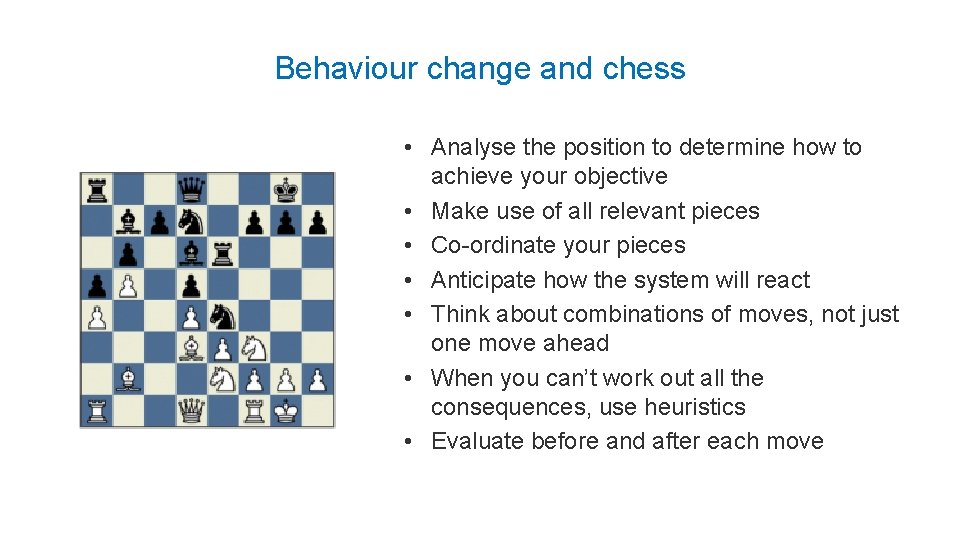
Behaviour change and chess • Analyse the position to determine how to achieve your objective • Make use of all relevant pieces • Co-ordinate your pieces • Anticipate how the system will react • Think about combinations of moves, not just one move ahead • When you can’t work out all the consequences, use heuristics • Evaluate before and after each move

The Behaviour Change Wheel • • • A system for developing behaviour change interventions Inter-disciplinary - not psychological Promotes systems thinking Multi-level: Individual, organisational and population Synthesis of 19 frameworks Comprehensive and coherent Links interventions with models of behaviour Uses whatever evidence is available, and guides search for evidence A tool to guide thinking and action - not a rigid prescription

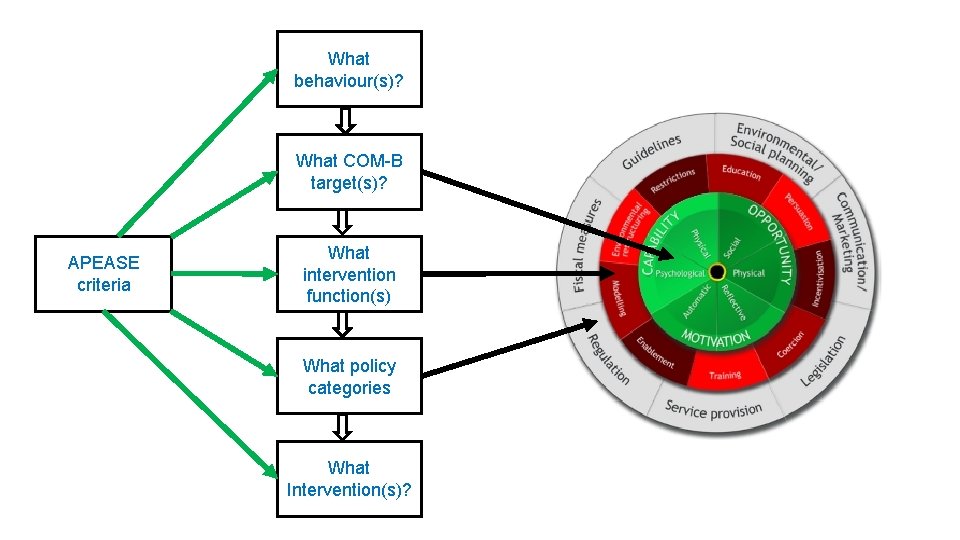
What behaviour(s)? What COM-B target(s)? APEASE criteria What intervention function(s) What policy categories What Intervention(s)?
What behaviour(s)? • Choose ones that are: – Impactful – Changeable – Understood – Sustainable • Do not be side-tracked by ones that are: – Appealing to stakeholders – Unsupportable – Unachievable – Narrow in focus
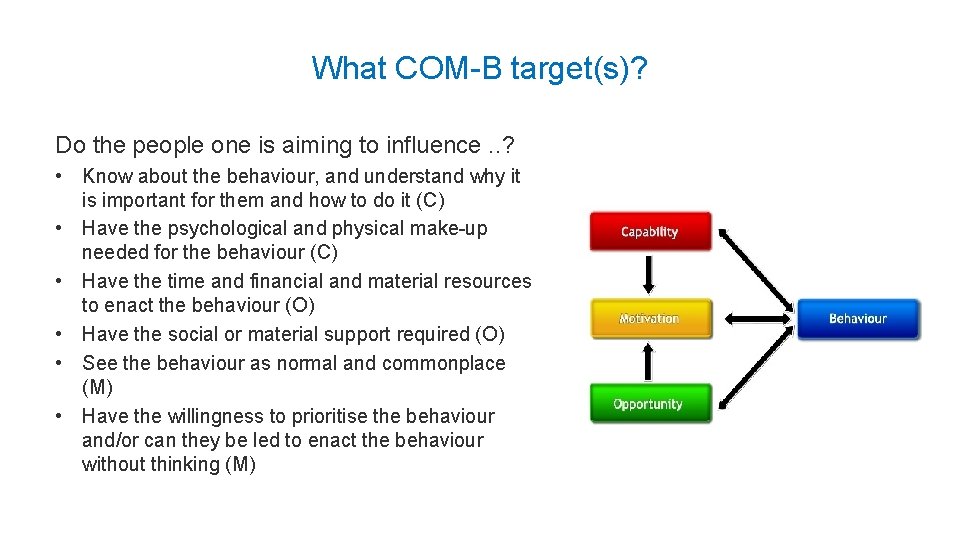
What COM-B target(s)? Do the people one is aiming to influence. . ? • Know about the behaviour, and understand why it is important for them and how to do it (C) • Have the psychological and physical make-up needed for the behaviour (C) • Have the time and financial and material resources to enact the behaviour (O) • Have the social or material support required (O) • See the behaviour as normal and commonplace (M) • Have the willingness to prioritise the behaviour and/or can they be led to enact the behaviour without thinking (M)
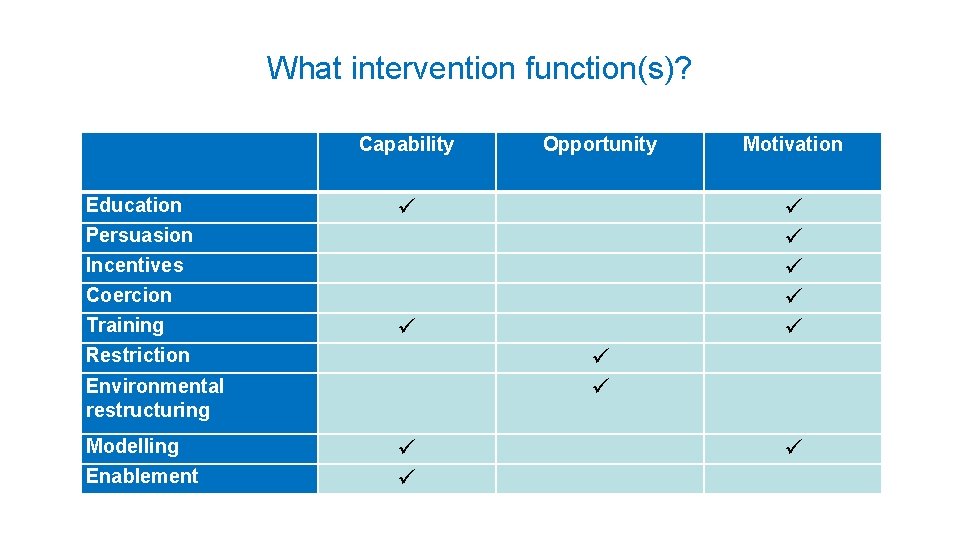
What intervention function(s)? Education Persuasion Incentives Coercion Training Restriction Environmental restructuring Modelling Enablement Capability Opportunity Motivation
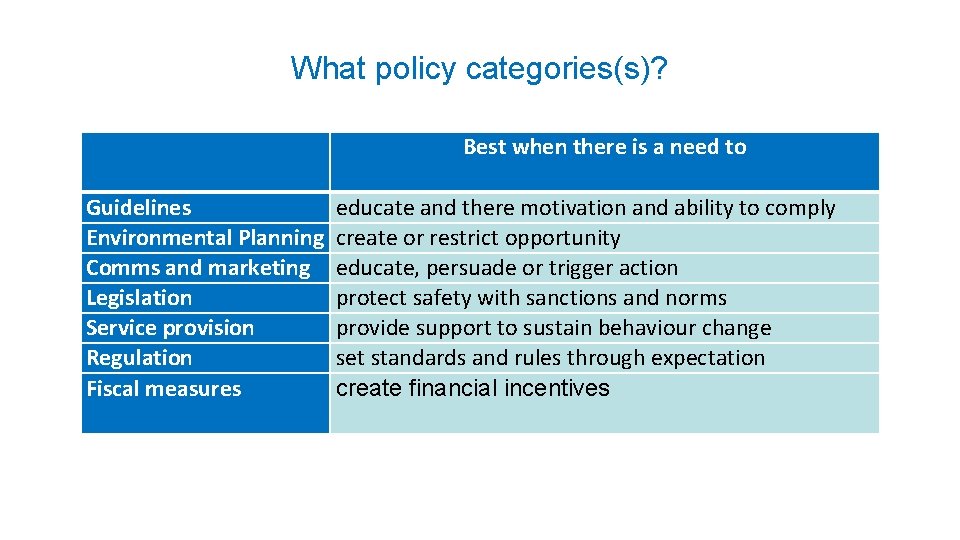
What policy categories(s)? Guidelines Environmental Planning Comms and marketing Legislation Service provision Regulation Fiscal measures Best when there is a need to educate and there motivation and ability to comply create or restrict opportunity educate, persuade or trigger action protect safety with sanctions and norms provide support to sustain behaviour change set standards and rules through expectation create financial incentives

Evaluation using APEASE Acceptability How far is it acceptable to all key stakeholders? Practicability Can it be implemented as designed within the intended context, material and human resources? Effectiveness How effective and cost-effective is it in achieving desired objectives in the target population? Affordability How far can it be afforded when delivered at the scale intended? How far does it lead to unintended adverse or beneficial outcomes? How far does it increase or decrease differences between advantaged and disadvantaged sectors of society? Side-effects Equity
What behaviour(s)? What COM-B target(s)? APEASE criteria What intervention function(s) What policy categories What Intervention(s)?

MINDSPACE Messenger Incentives COM-B and the BCW In education and persuasion, source features will influence their effectiveness. The nature of the incentive or the way it is framed can influence effectiveness. Norms In modelling and environmental restructuring, seeing or knowing how others behave influences our actions Defaults Create an environment in which certain behaviours occur without conscious effort Salience Priming In education and persuasion, novelty and relevance increase our likelihood of paying attention Unnoticed cues in the environment can shape our behaviour Affect Use of emotional content in persuasion can change behaviour. Commitments Making promises can coerce us into complying Ego Feeling good about ourselves can be an important behavioural goal.
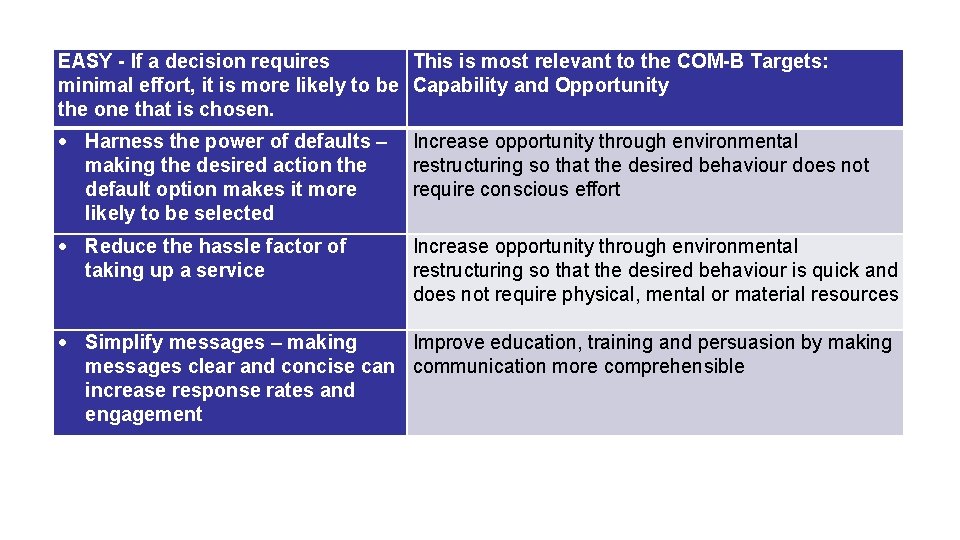
EASY - If a decision requires This is most relevant to the COM-B Targets: minimal effort, it is more likely to be Capability and Opportunity the one that is chosen. Harness the power of defaults – Increase opportunity through environmental making the desired action the restructuring so that the desired behaviour does not default option makes it more require conscious effort likely to be selected Reduce the hassle factor of taking up a service Increase opportunity through environmental restructuring so that the desired behaviour is quick and does not require physical, mental or material resources Simplify messages – making Improve education, training and persuasion by making messages clear and concise can communication more comprehensible increase response rates and engagement
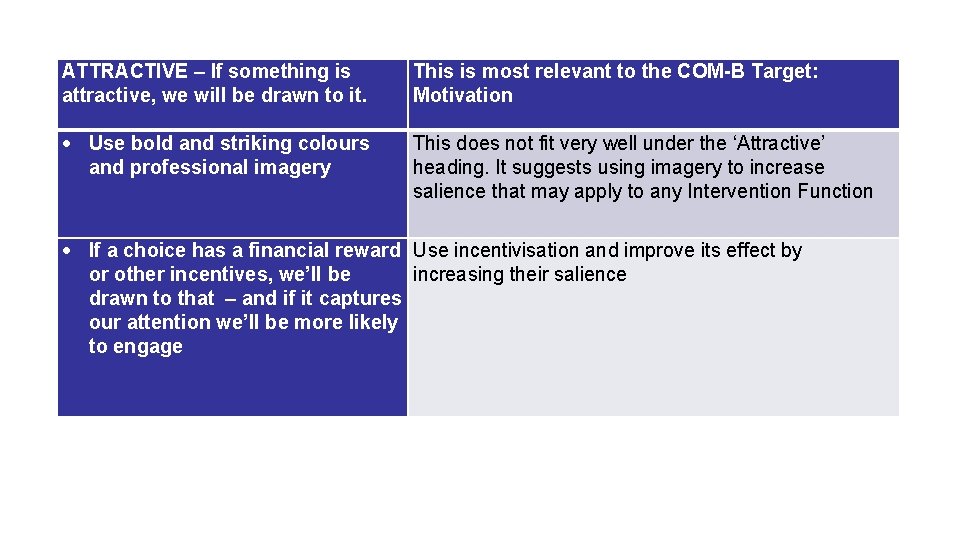
ATTRACTIVE – If something is attractive, we will be drawn to it. This is most relevant to the COM-B Target: Motivation Use bold and striking colours and professional imagery This does not fit very well under the ‘Attractive’ heading. It suggests using imagery to increase salience that may apply to any Intervention Function If a choice has a financial reward Use incentivisation and improve its effect by or other incentives, we’ll be increasing their salience drawn to that – and if it captures our attention we’ll be more likely to engage
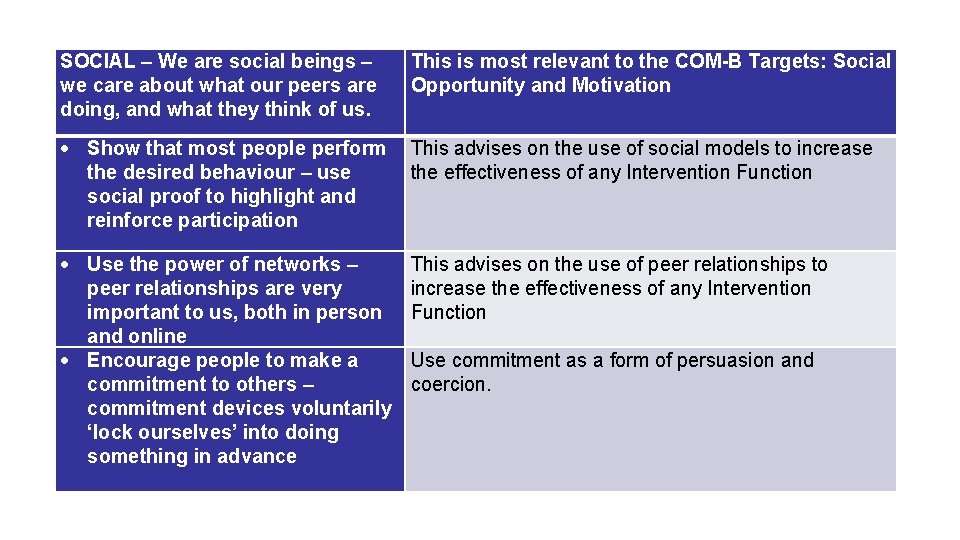
SOCIAL – We are social beings – we care about what our peers are doing, and what they think of us. This is most relevant to the COM-B Targets: Social Opportunity and Motivation Show that most people perform This advises on the use of social models to increase the desired behaviour – use the effectiveness of any Intervention Function social proof to highlight and reinforce participation Use the power of networks – peer relationships are very important to us, both in person and online Encourage people to make a commitment to others – commitment devices voluntarily ‘lock ourselves’ into doing something in advance This advises on the use of peer relationships to increase the effectiveness of any Intervention Function Use commitment as a form of persuasion and coercion.
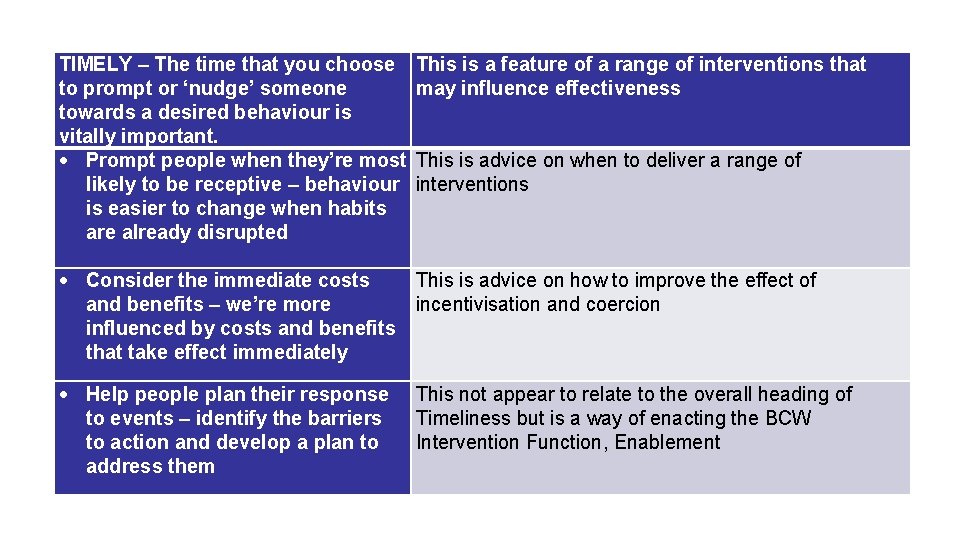
TIMELY – The time that you choose This is a feature of a range of interventions that to prompt or ‘nudge’ someone may influence effectiveness towards a desired behaviour is vitally important. Prompt people when they’re most This is advice on when to deliver a range of likely to be receptive – behaviour interventions is easier to change when habits are already disrupted Consider the immediate costs This is advice on how to improve the effect of and benefits – we’re more incentivisation and coercion influenced by costs and benefits that take effect immediately Help people plan their response to events – identify the barriers to action and develop a plan to address them This not appear to relate to the overall heading of Timeliness but is a way of enacting the BCW Intervention Function, Enablement
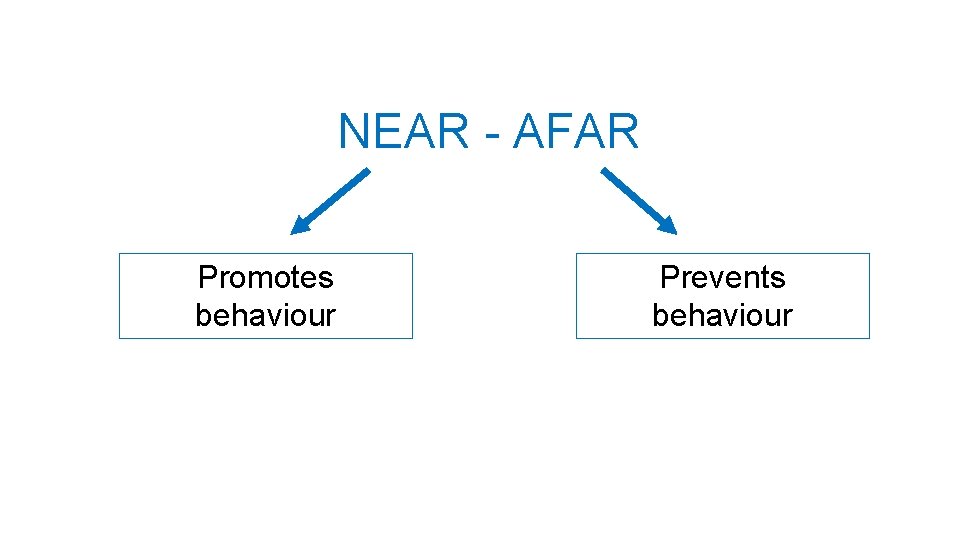
NEAR - AFAR Promotes behaviour Prevents behaviour
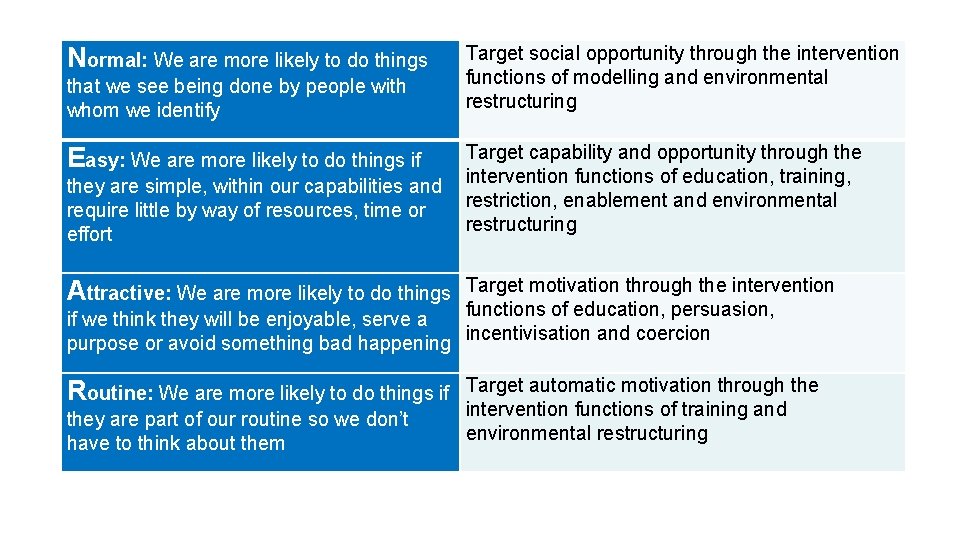
Normal: We are more likely to do things that we see being done by people with whom we identify Target social opportunity through the intervention functions of modelling and environmental restructuring Target capability and opportunity through they are simple, within our capabilities and intervention functions of education, training, restriction, enablement and environmental require little by way of resources, time or restructuring effort Easy: We are more likely to do things if Target motivation through the intervention functions of education, persuasion, if we think they will be enjoyable, serve a purpose or avoid something bad happening incentivisation and coercion Attractive: We are more likely to do things Routine: We are more likely to do things if they are part of our routine so we don’t have to think about them Target automatic motivation through the intervention functions of training and environmental restructuring
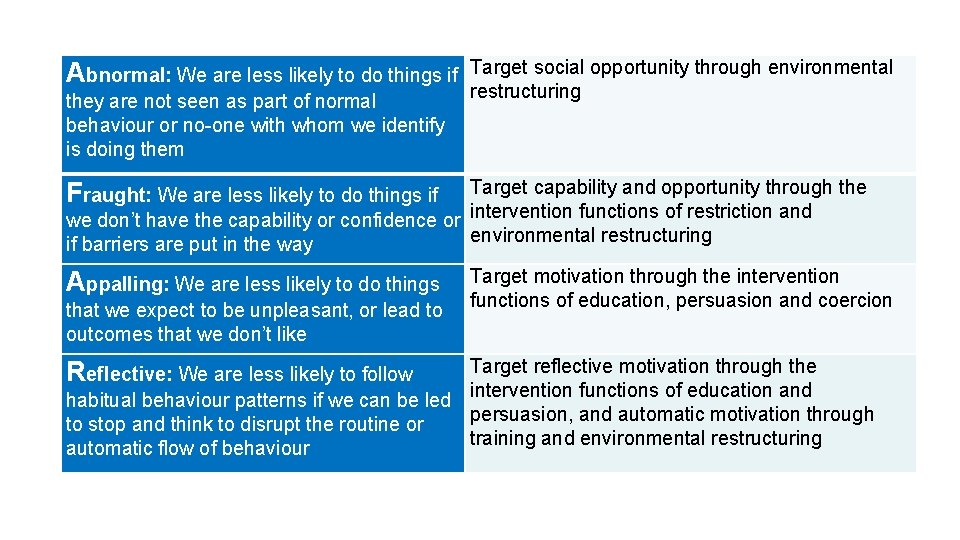
Abnormal: We are less likely to do things if Target social opportunity through environmental restructuring they are not seen as part of normal behaviour or no-one with whom we identify is doing them Target capability and opportunity through the we don’t have the capability or confidence or intervention functions of restriction and environmental restructuring if barriers are put in the way Fraught: We are less likely to do things if Appalling: We are less likely to do things that we expect to be unpleasant, or lead to outcomes that we don’t like Target motivation through the intervention functions of education, persuasion and coercion Target reflective motivation through the habitual behaviour patterns if we can be led intervention functions of education and persuasion, and automatic motivation through to stop and think to disrupt the routine or training and environmental restructuring automatic flow of behaviour Reflective: We are less likely to follow
Successful behaviour change interventions Reducing driving speed in built up areas Reducing smoking uptake Increasing smoking cessation Reducing drink-driving Increasing recycling Seat-belt usage Increasing cycling Increasing organ donation
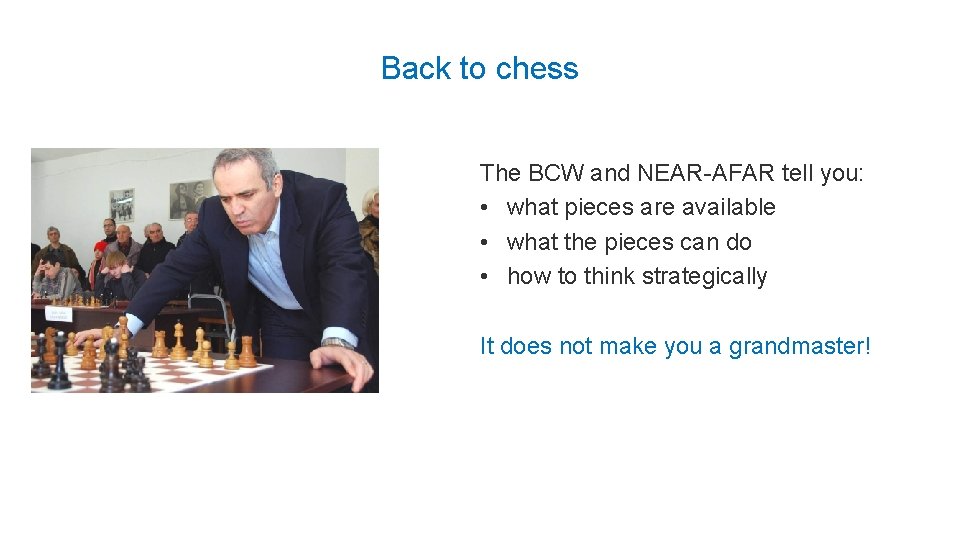
Back to chess The BCW and NEAR-AFAR tell you: • what pieces are available • what the pieces can do • how to think strategically It does not make you a grandmaster!
Key points • Changing behaviour requires an in depth understanding of behaviour as part of a complex multi-level system • The BCW promotes the kind of thinking required and provides structured guidance • MINDSPACE and EAST provide useful mnemonics to help develop interventions but are not comprehensive or linked to models of behaviour • NEAR-AFAR may provide a framework for focusing on ‘big picture’ guidance when applying the BCW
Resources www. unlockingbehaviourchange. com www. ucl. ac. uk/behaviour-change http: //www. behaviourchangewheel. com
- Slides: 23