
Near Full Density As Sintered Powdered Metal PM
- Slides: 29
Near Full Density As Sintered Powdered Metal (P/M) Parts Produced From Water Atomized Powder With Properties Comparable To Wrought Steel Richard R. Phillips - Engineered Pressed Materials Dennis Hammond - APEX Advanced Technologies, LLC 1
Key Features of the Technology • Water atomized powder • Low alloy steel -100 mesh • >99. 5% theoretical density • Properties comparable or superior to wrought steel • Standard tooling/ conventional pressing • Normal compaction range 2
Key Features of the Technology Continued • High temperature sintering < 2500 F (atmospheric or vacuum) • Conventional steel heat treating • Post heat treating operations similar to wrought processing 3
Lubricant Requirements For Near Full Density P/M Parts • • Increase green density Mobility of the lubricant Effective removal of the lubricant Excellent dimensional stability 4
High Green Density with Standard Equipment • Reduced level of lubricant, typical use level. 25%. 4% • Green Densities 7. 2 -7. 4 g/cc typical for common formulas • Micro cracking and delamination eliminated • Green density increased due to reduced volume of lubricant and better fit of particles resulting from mobility of the lubricant • Lubricant is more effective 5
Mobility of Lubricant • Lubricant transforms with shear, pressure, and friction from a solid to a viscous liquid at relatively low pressure (~ 4 tsi with shear) • Mobility allows for effective rearrangement of metal particles • Mobility allows for lubricant to be forced to the die wall as well as hydrostatic environment within the compact 6
Effective Removal of the Lubricant • Environmentally friendly, contains no metal • Staggered decomposition rate • Up to 70% less gas trying to exit the part at peak decomposition relative to conventional lubricants • Elimination of cracking and blistering with high nickel formulas • Elimination of recondensation of lubricant on part surfaces 7
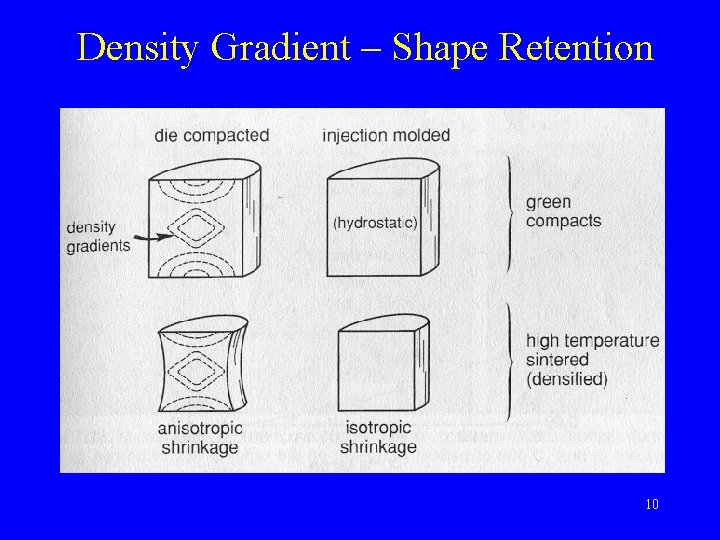
Excellent Dimensional Stability • • No micro cracks or delamination Small uniform pore size in the green state No unplanned density gradients in the part Relatively stress free green part Density split eliminated Uniform, predictable shrinkage Enhanced sintering efficiency 8
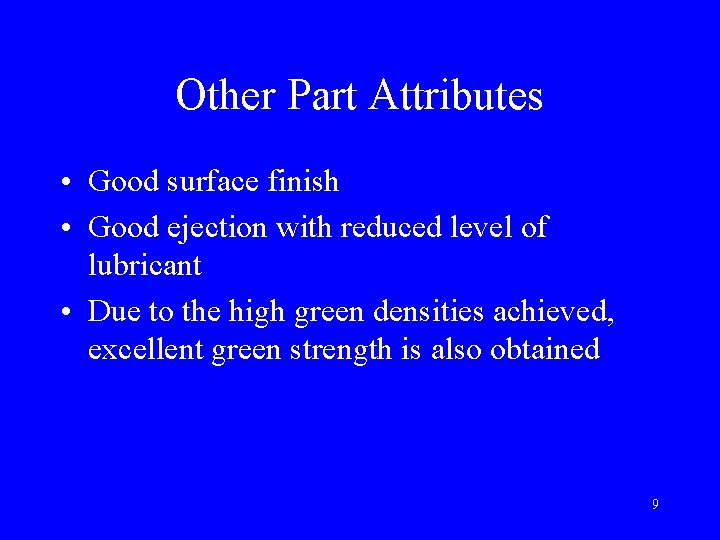
Other Part Attributes • Good surface finish • Good ejection with reduced level of lubricant • Due to the high green densities achieved, excellent green strength is also obtained 9
Density Gradient – Shape Retention 10
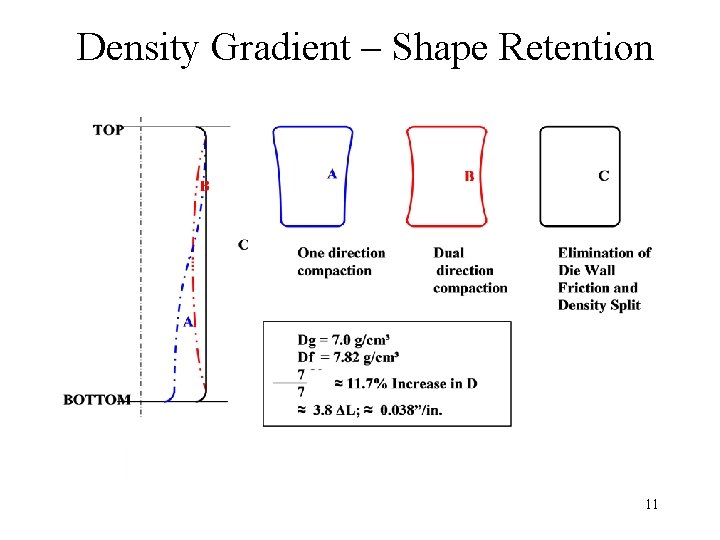
Density Gradient – Shape Retention 11
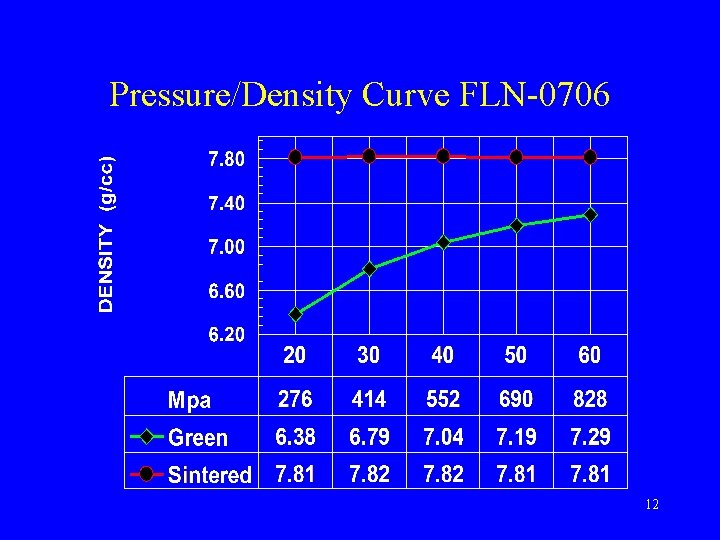
Pressure/Density Curve FLN-0706 12
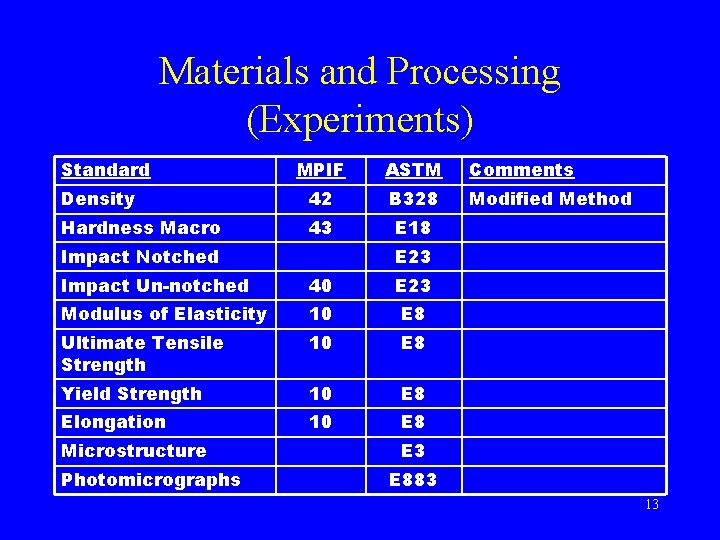
Materials and Processing (Experiments) Standard MPIF ASTM Comments Density 42 B 328 Modified Method Hardness Macro 43 E 18 Impact Notched E 23 Impact Un-notched 40 E 23 Modulus of Elasticity 10 E 8 Ultimate Tensile Strength 10 E 8 Yield Strength 10 E 8 Elongation 10 E 8 Microstructure Photomicrographs E 3 E 883 13
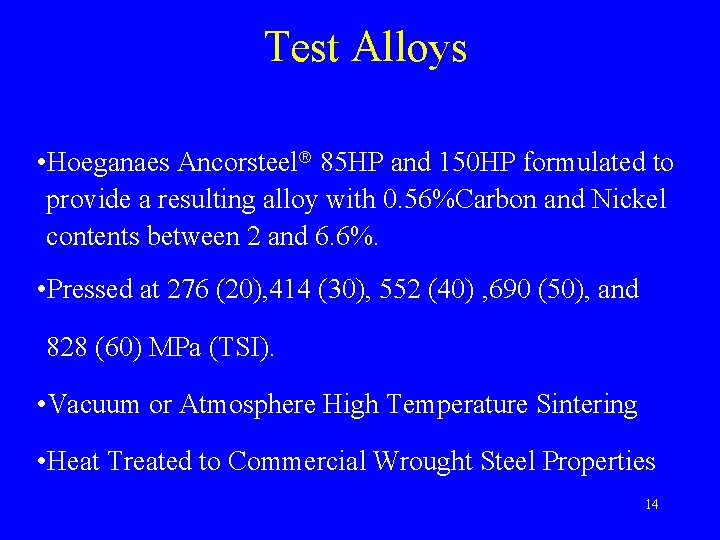
Test Alloys • Hoeganaes Ancorsteel 85 HP and 150 HP formulated to provide a resulting alloy with 0. 56%Carbon and Nickel contents between 2 and 6. 6%. • Pressed at 276 (20), 414 (30), 552 (40) , 690 (50), and 828 (60) MPa (TSI). • Vacuum or Atmosphere High Temperature Sintering • Heat Treated to Commercial Wrought Steel Properties 14
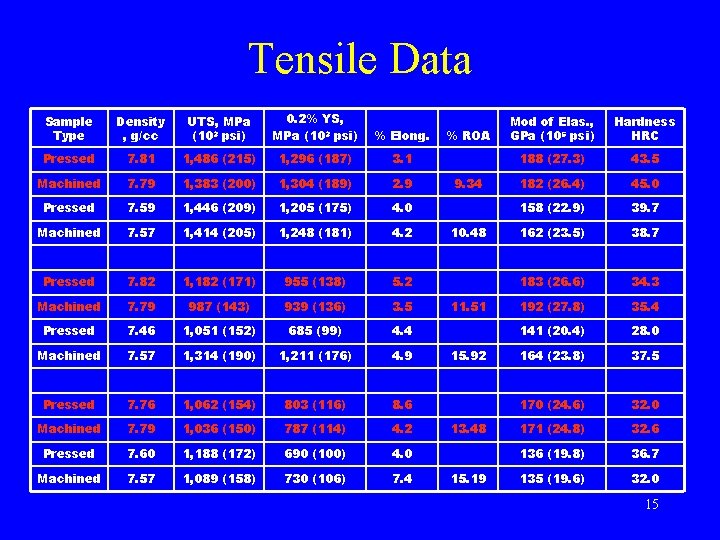
Tensile Data Sample Type Density , g/cc UTS, MPa (103 psi) 0. 2% YS, MPa (103 psi) % Elong. Pressed 7. 81 1, 486 (215) 1, 296 (187) 3. 1 Machined 7. 79 1, 383 (200) 1, 304 (189) 2. 9 Pressed 7. 59 1, 446 (209) 1, 205 (175) 4. 0 Machined 7. 57 1, 414 (205) 1, 248 (181) 4. 2 Pressed 7. 82 1, 182 (171) 955 (138) 5. 2 Machined 7. 79 987 (143) 939 (136) 3. 5 Pressed 7. 46 1, 051 (152) 685 (99) 4. 4 Machined 7. 57 1, 314 (190) 1, 211 (176) 4. 9 Pressed 7. 76 1, 062 (154) 803 (116) 8. 6 Machined 7. 79 1, 036 (150) 787 (114) 4. 2 Pressed 7. 60 1, 188 (172) 690 (100) 4. 0 Machined 7. 57 1, 089 (158) 730 (106) 7. 4 % ROA 9. 34 10. 48 11. 51 15. 92 13. 48 15. 19 Mod of Elas. , GPa (106 psi) Hardness HRC 188 (27. 3) 43. 5 182 (26. 4) 45. 0 158 (22. 9) 39. 7 162 (23. 5) 38. 7 183 (26. 6) 34. 3 192 (27. 8) 35. 4 141 (20. 4) 28. 0 164 (23. 8) 37. 5 170 (24. 6) 32. 0 171 (24. 8) 32. 6 136 (19. 8) 36. 7 135 (19. 6) 32. 0 15
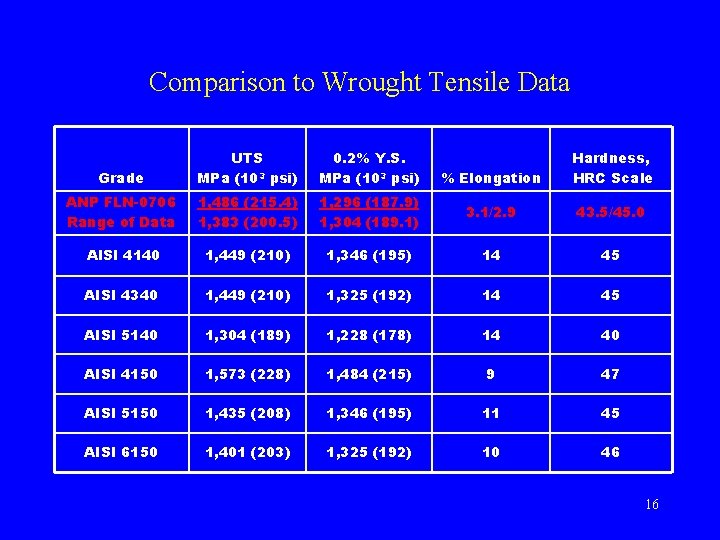
Comparison to Wrought Tensile Data Grade UTS MPa (103 psi) 0. 2% Y. S. MPa (103 psi) % Elongation Hardness, HRC Scale ANP FLN-0706 Range of Data 1, 486 (215. 4) 1, 383 (200. 5) 1, 296 (187. 9) 1, 304 (189. 1) 3. 1/2. 9 43. 5/45. 0 AISI 4140 1, 449 (210) 1, 346 (195) 14 45 AISI 4340 1, 449 (210) 1, 325 (192) 14 45 AISI 5140 1, 304 (189) 1, 228 (178) 14 40 AISI 4150 1, 573 (228) 1, 484 (215) 9 47 AISI 5150 1, 435 (208) 1, 346 (195) 11 45 AISI 6150 1, 401 (203) 1, 325 (192) 10 46 16
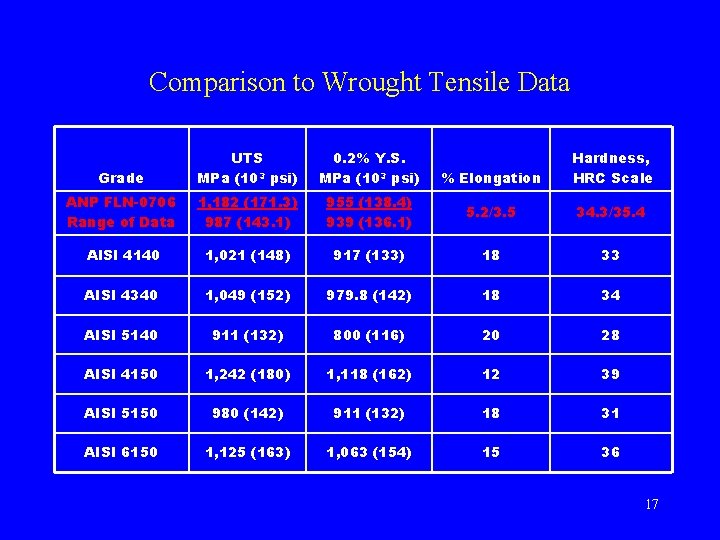
Comparison to Wrought Tensile Data Grade UTS MPa (103 psi) 0. 2% Y. S. MPa (103 psi) % Elongation Hardness, HRC Scale ANP FLN-0706 Range of Data 1, 182 (171. 3) 987 (143. 1) 955 (138. 4) 939 (136. 1) 5. 2/3. 5 34. 3/35. 4 AISI 4140 1, 021 (148) 917 (133) 18 33 AISI 4340 1, 049 (152) 979. 8 (142) 18 34 AISI 5140 911 (132) 800 (116) 20 28 AISI 4150 1, 242 (180) 1, 118 (162) 12 39 AISI 5150 980 (142) 911 (132) 18 31 AISI 6150 1, 125 (163) 1, 063 (154) 15 36 17
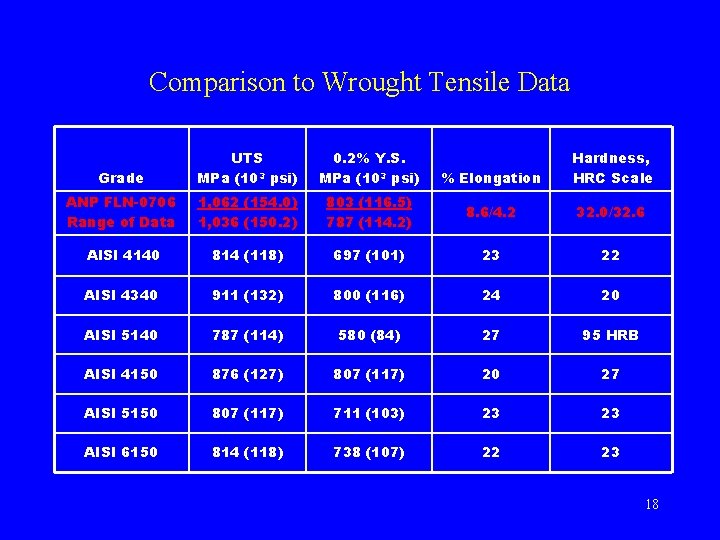
Comparison to Wrought Tensile Data Grade UTS MPa (103 psi) 0. 2% Y. S. MPa (103 psi) % Elongation Hardness, HRC Scale ANP FLN-0706 Range of Data 1, 062 (154. 0) 1, 036 (150. 2) 803 (116. 5) 787 (114. 2) 8. 6/4. 2 32. 0/32. 6 AISI 4140 814 (118) 697 (101) 23 22 AISI 4340 911 (132) 800 (116) 24 20 AISI 5140 787 (114) 580 (84) 27 95 HRB AISI 4150 876 (127) 807 (117) 20 27 AISI 5150 807 (117) 711 (103) 23 23 AISI 6150 814 (118) 738 (107) 22 23 18
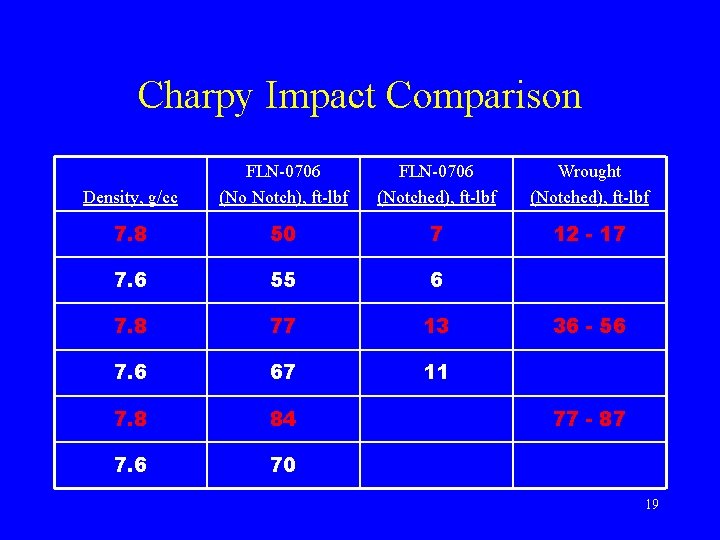
Charpy Impact Comparison Density, g/cc FLN-0706 (No Notch), ft-lbf FLN-0706 (Notched), ft-lbf Wrought (Notched), ft-lbf 7. 8 50 7 12 - 17 7. 6 55 6 7. 8 77 13 7. 6 67 11 7. 8 84 7. 6 70 36 - 56 77 - 87 19
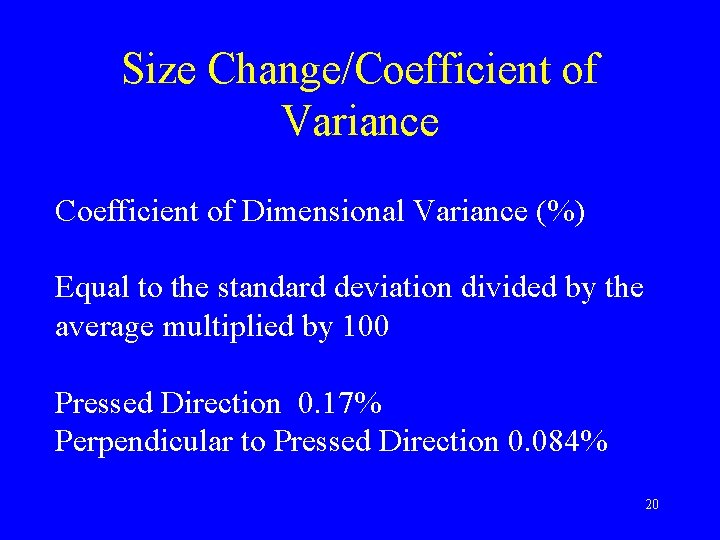
Size Change/Coefficient of Variance Coefficient of Dimensional Variance (%) Equal to the standard deviation divided by the average multiplied by 100 Pressed Direction 0. 17% Perpendicular to Pressed Direction 0. 084% 20
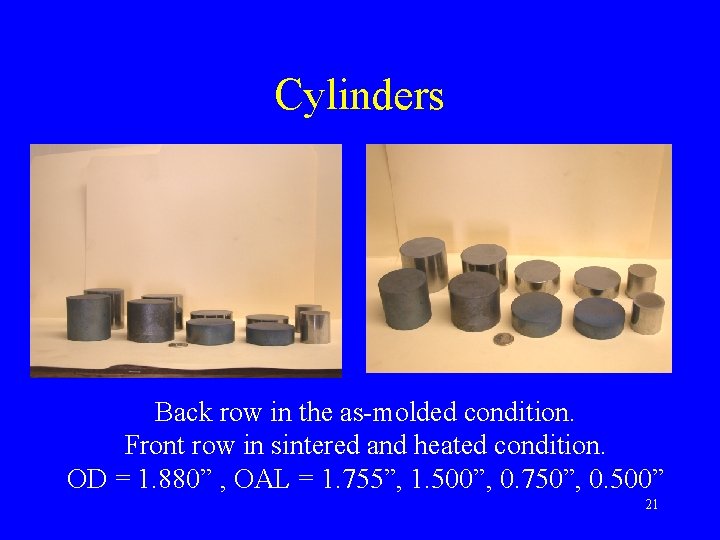
Cylinders Back row in the as-molded condition. Front row in sintered and heated condition. OD = 1. 880” , OAL = 1. 755”, 1. 500”, 0. 750”, 0. 500” 21
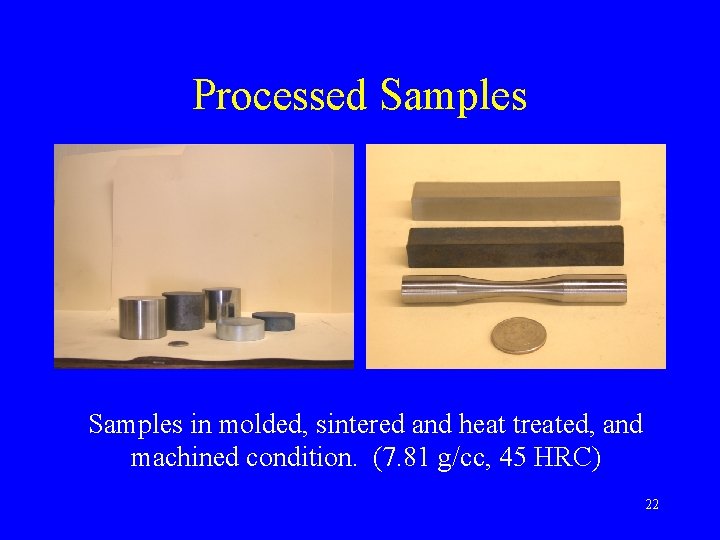
Processed Samples in molded, sintered and heat treated, and machined condition. (7. 81 g/cc, 45 HRC) 22
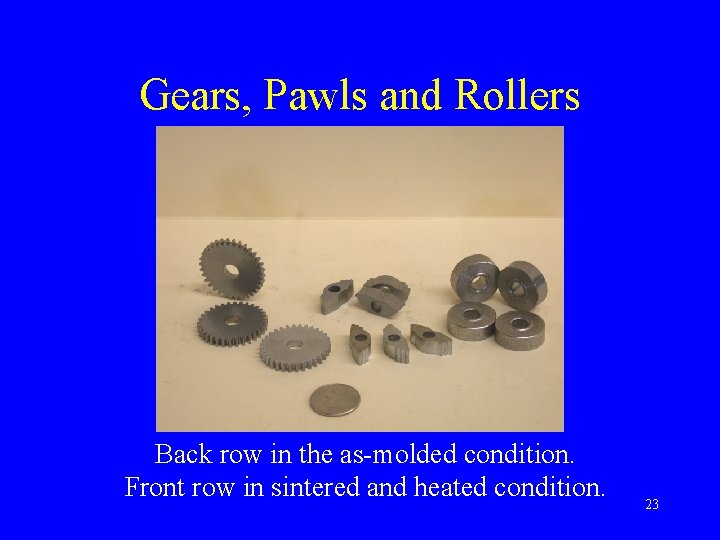
Gears, Pawls and Rollers Back row in the as-molded condition. Front row in sintered and heated condition. 23
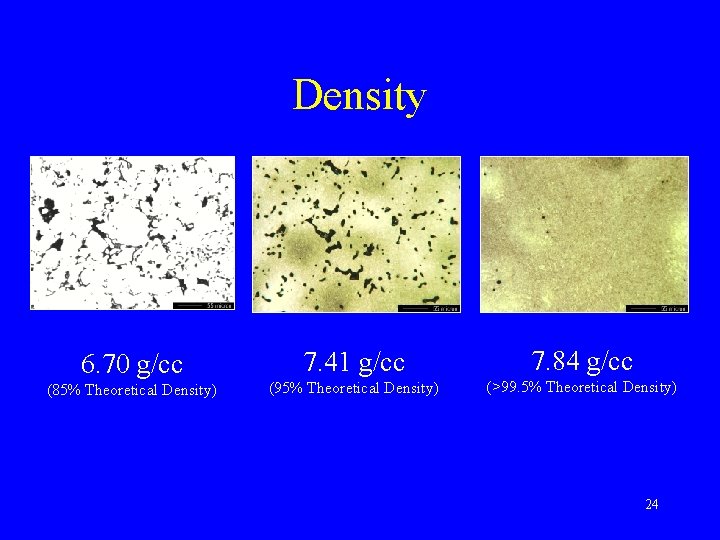
Density 6. 70 g/cc 7. 41 g/cc 7. 84 g/cc (85% Theoretical Density) (95% Theoretical Density) (>99. 5% Theoretical Density) 24
Future Analysis (Fatigue) Stress Endurance values for various sets of process conditions 25
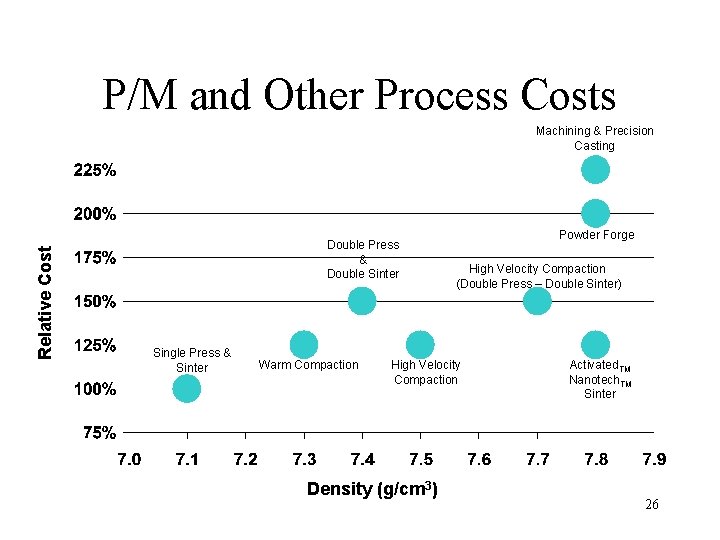
P/M and Other Process Costs Relative Cost Machining & Precision Casting Double Press & Double Sinter Single Press & Sinter Warm Compaction Powder Forge High Velocity Compaction (Double Press – Double Sinter) High Velocity Compaction Density (g/cm 3) Activated. TM Nanotech. TM Sinter 26
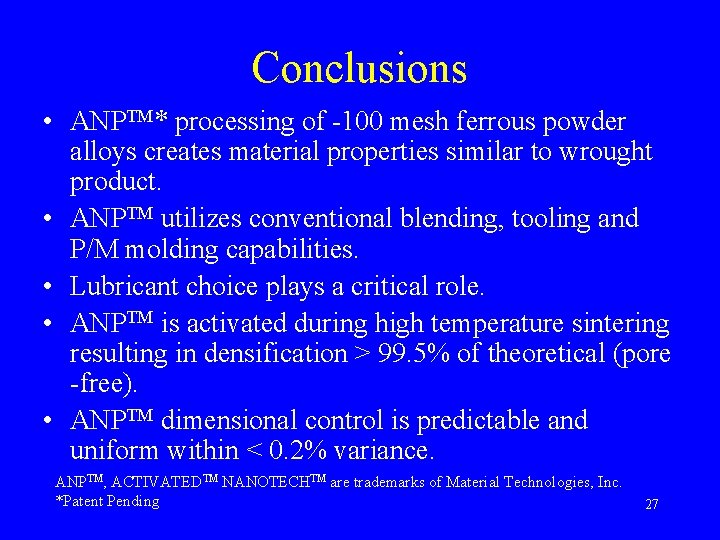
Conclusions • ANPTM* processing of -100 mesh ferrous powder alloys creates material properties similar to wrought product. • ANPTM utilizes conventional blending, tooling and P/M molding capabilities. • Lubricant choice plays a critical role. • ANPTM is activated during high temperature sintering resulting in densification > 99. 5% of theoretical (pore -free). • ANPTM dimensional control is predictable and uniform within < 0. 2% variance. ANPTM, ACTIVATEDTM NANOTECHTM are trademarks of Material Technologies, Inc. *Patent Pending 27
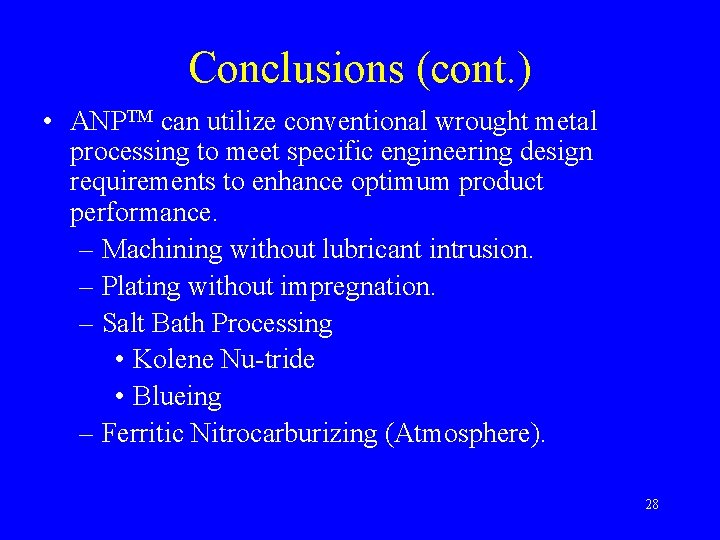
Conclusions (cont. ) • ANPTM can utilize conventional wrought metal processing to meet specific engineering design requirements to enhance optimum product performance. – Machining without lubricant intrusion. – Plating without impregnation. – Salt Bath Processing • Kolene Nu-tride • Blueing – Ferritic Nitrocarburizing (Atmosphere). 28
Conclusions (cont. ) • ANPTM parts can be pressed from 276 (20) to 828 (60) MPa (TSI) and still sinter to full density. • Further development work will result in even greater performance. • Work continuing on a broader selection of alloys. 29