
Near Earth Objects NearEarth Objects NEOs are comets

Near Earth Objects Near-Earth Objects (NEOs) are comets and asteroids that have been nudged by the gravitational attraction of nearby planets into orbits that allow them to enter the Earth's neighborhood. Composed mostly of water ice with embedded dust particles, comets originally formed in the cold outer planetary system while most of the rocky asteroids formed in the warmer inner solar system between the orbits of Mars and Jupiter. The scientific interest in comets and asteroids is due largely to their status as the relatively unchanged remnant debris from the solar system formation process some 4. 6 billion years ago. 37 Near Earth Object candidates are identified in Sloan Digital Sky Survey imaging data. The objects have apparent magnitudes r=19 – 21 and proper motions of 1. 3 to 18 degrees per day. The earth collision rate for this population (size greater than 20 m) is estimated to be one per century.

How To Find NEOs 5 Fields 1 2 Camcols 3 4 5 6 SDSS imaging data consist of 6 strips called “camcols”. The above image is a small portion of a “run” that extends for 800 fields. Near Earth Objects show up as streaks in 3 colors
Why OSG ? Experience tells us that Grid is more suitable for CPU Intensive Jobs. Neo Jobs are Data Intensive but also need fair amount of CPU time. Also, to achieve PARALLELISM … v More Jobs…finish sooner v Running locally would limit the number of jobs run simultaneously v On OSG, can run several run-rerun and camcols within a run-rerun in parallel Current Workflow also will facilitate further analysis
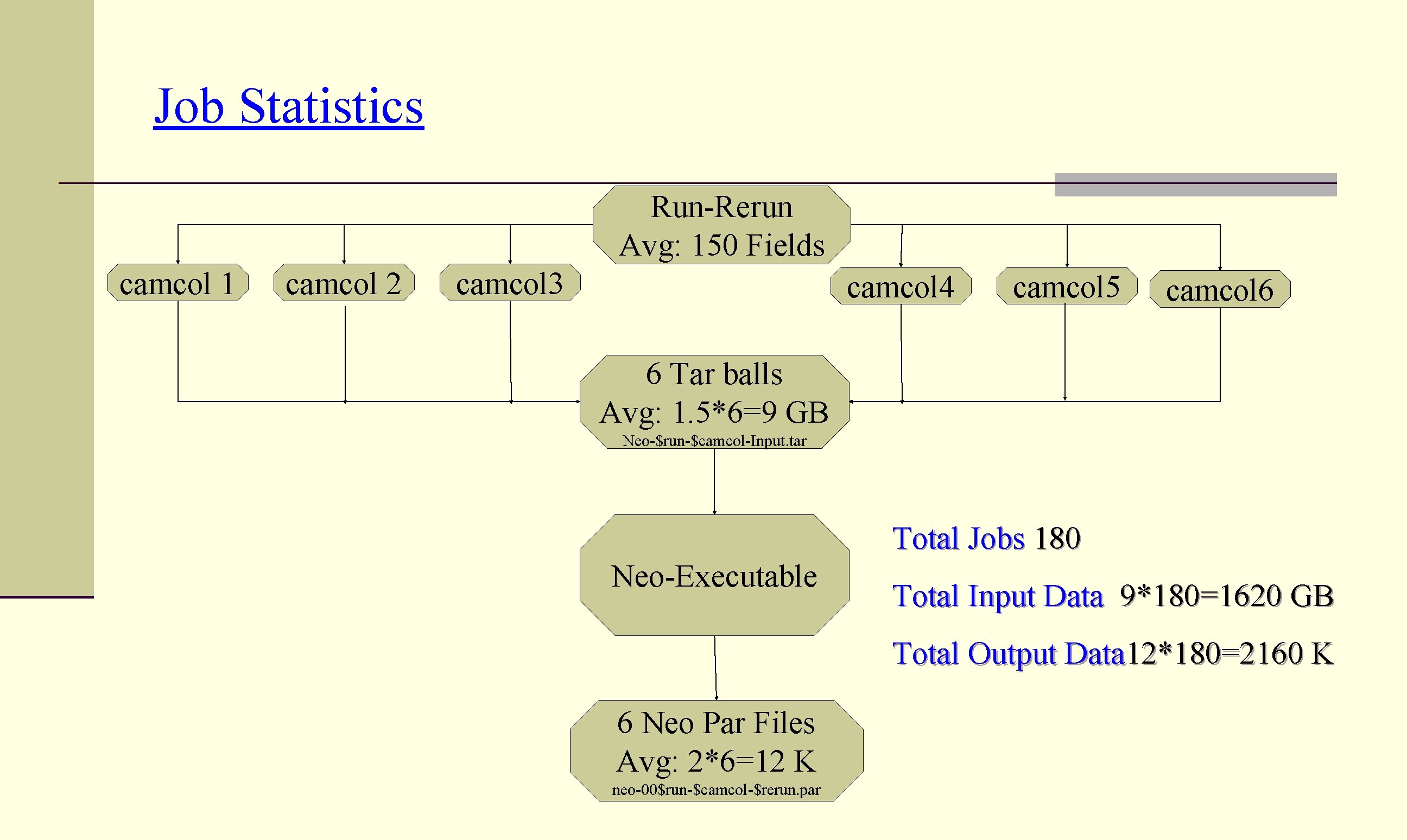
Job Statistics Run-Rerun Avg: 150 Fields camcol 1 camcol 2 camcol 3 camcol 4 camcol 5 camcol 6 6 Tar balls Avg: 1. 5*6=9 GB Neo-$run-$camcol-Input. tar Total Jobs 180 Neo-Executable Total Input Data 9*180=1620 GB Total Output Data 12*180=2160 K 6 Neo Par Files Avg: 2*6=12 K neo-00$run-$camcol-$rerun. par
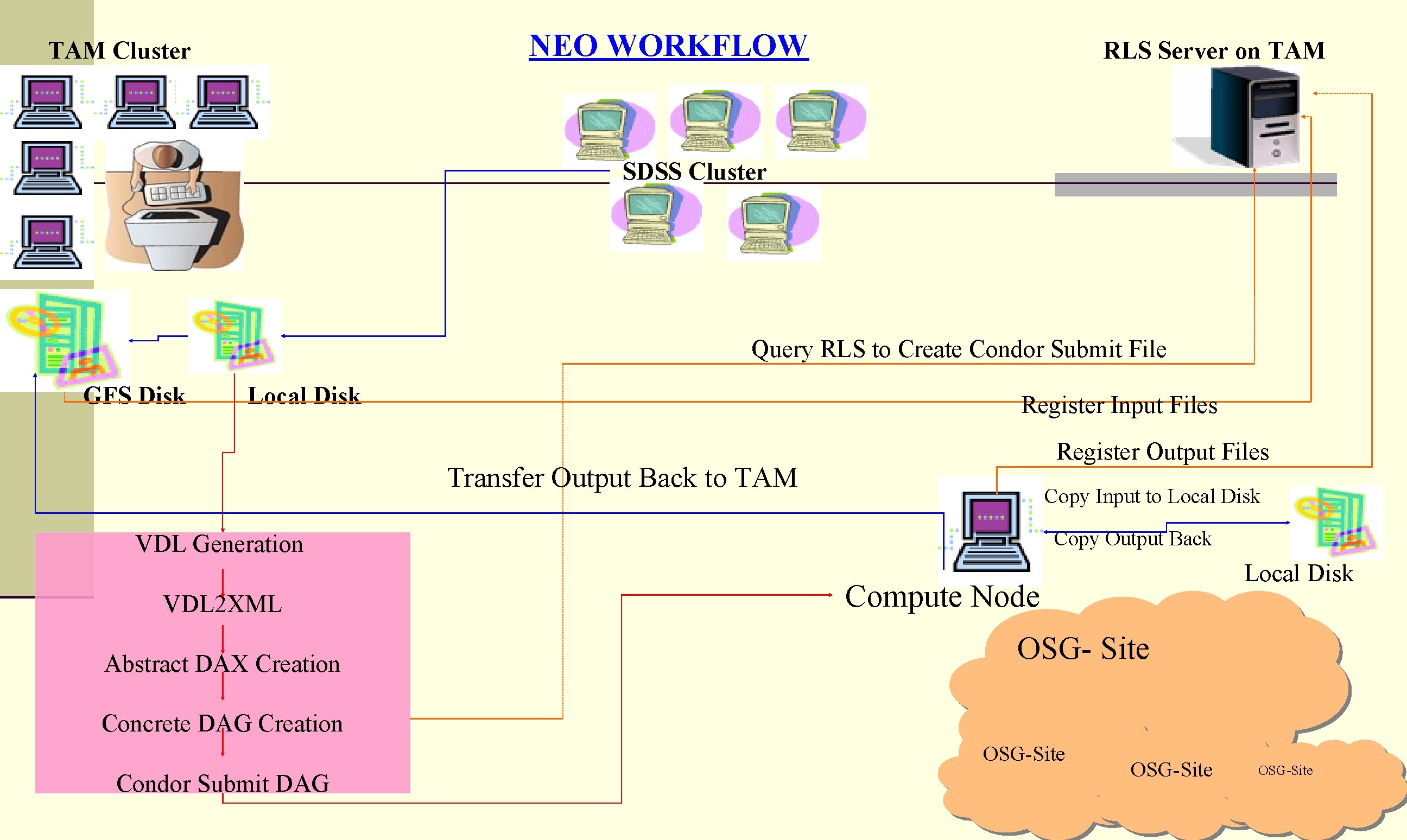
NEO WORKFLOW TAM Cluster RLS Server on TAM SDSS Cluster Query RLS to Create Condor Submit File GFS Disk Local Disk Register Input Files Register Output Files Transfer Output Back to TAM Copy Input to Local Disk Copy Output Back VDL Generation VDL 2 XML Abstract DAX Creation Local Disk Compute Node OSG- Site Concrete DAG Creation OSG-Site Condor Submit DAG OSG-Site
Future EAG Grid Projects… In the coming year 2005 -2006 Experimental Astrophysics Group ( EAG ) has 4 projects planned for the Open Science Grid v The simulation effort for the DES v Genetic algorithm fitting of SDSS quasar spectra v Search for near Earth asteroids in the SDSS imaging data v The coaddition of the SDSS southern stripe. v Thankyou
- Slides: 7