
NEA 1 Food Investigation Task Non Examined Assessment

- Slides: 14
NEA 1 Food Investigation Task Non Examined Assessment – this means an exam…. not coursework
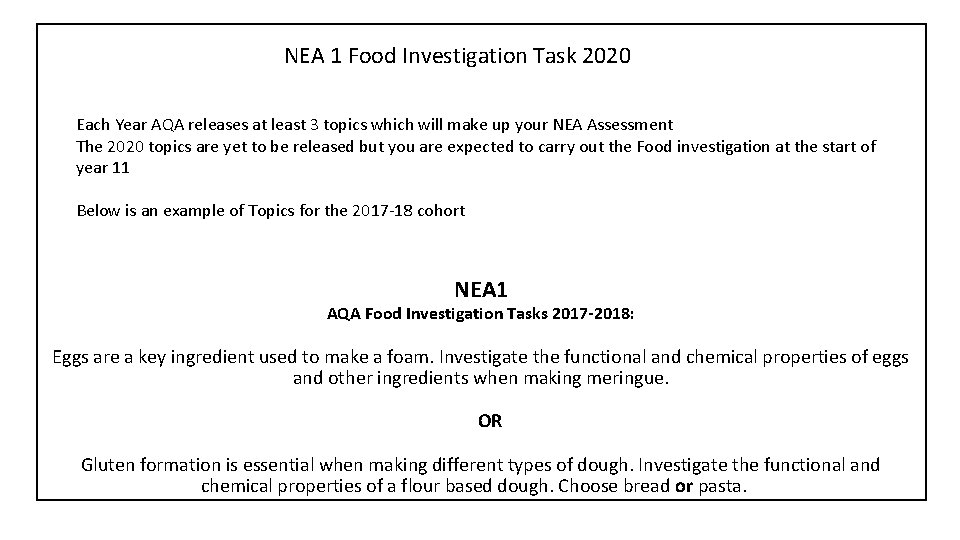
NEA 1 Food Investigation Task 2020 Each Year AQA releases at least 3 topics which will make up your NEA Assessment The 2020 topics are yet to be released but you are expected to carry out the Food investigation at the start of year 11 Below is an example of Topics for the 2017 -18 cohort NEA 1 AQA Food Investigation Tasks 2017 -2018: Eggs are a key ingredient used to make a foam. Investigate the functional and chemical properties of eggs and other ingredients when making meringue. OR Gluten formation is essential when making different types of dough. Investigate the functional and chemical properties of a flour based dough. Choose bread or pasta.
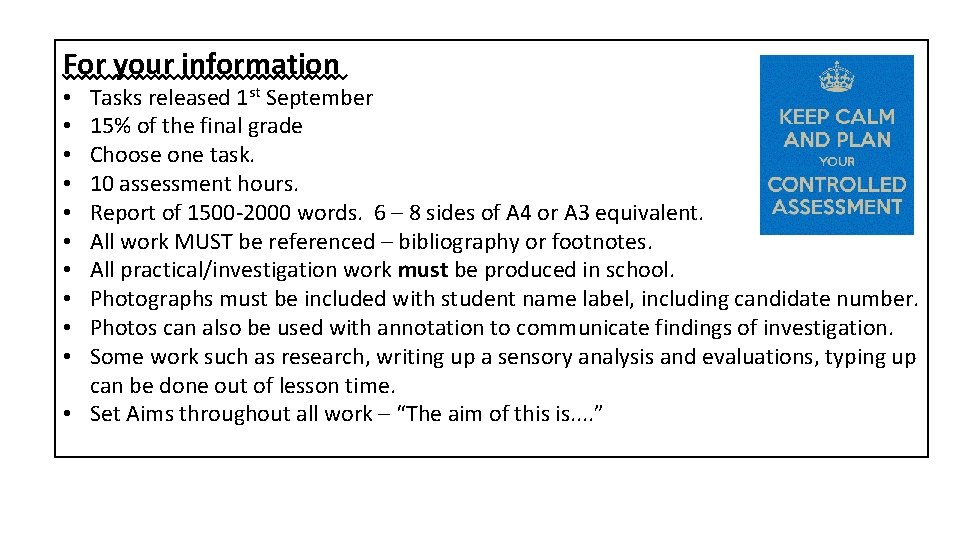
For your information Tasks released 1 st September 15% of the final grade Choose one task. 10 assessment hours. Report of 1500 -2000 words. 6 – 8 sides of A 4 or A 3 equivalent. All work MUST be referenced – bibliography or footnotes. All practical/investigation work must be produced in school. Photographs must be included with student name label, including candidate number. Photos can also be used with annotation to communicate findings of investigation. Some work such as research, writing up a sensory analysis and evaluations, typing up can be done out of lesson time. • Set Aims throughout all work – “The aim of this is. . ” • • •
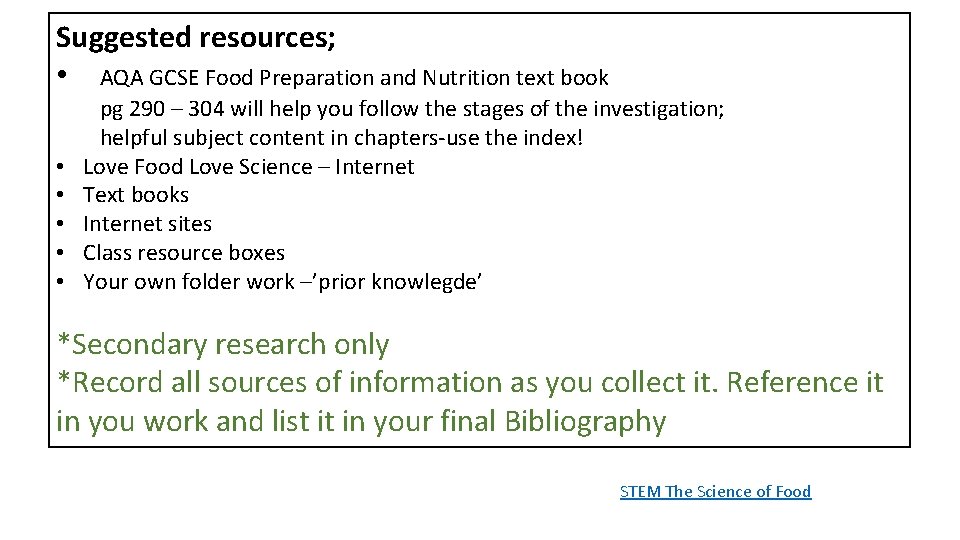
Suggested resources; • AQA GCSE Food Preparation and Nutrition text book • • • pg 290 – 304 will help you follow the stages of the investigation; helpful subject content in chapters-use the index! Love Food Love Science – Internet Text books Internet sites Class resource boxes Your own folder work –’prior knowlegde’ *Secondary research only *Record all sources of information as you collect it. Reference it in you work and list it in your final Bibliography STEM The Science of Food
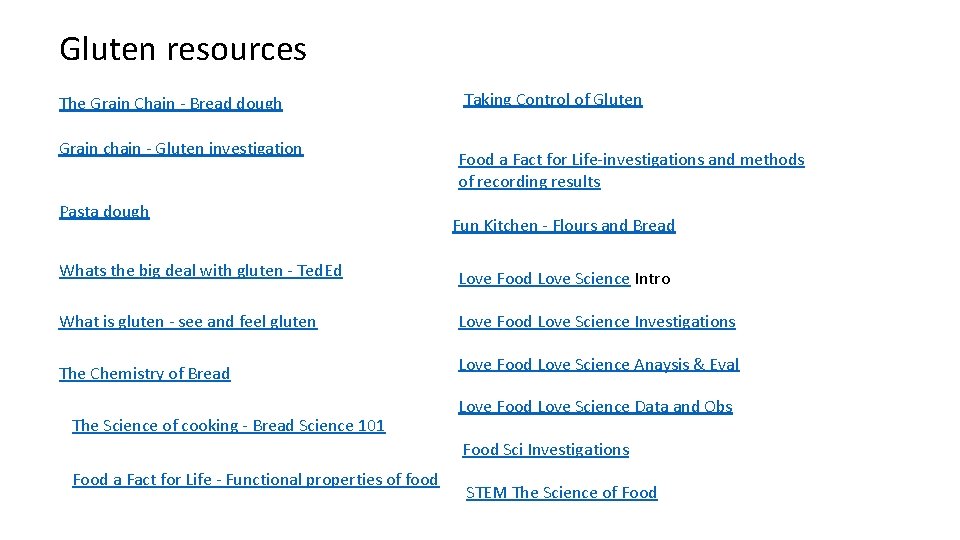
Gluten resources The Grain Chain - Bread dough Grain chain - Gluten investigation Pasta dough Taking Control of Gluten Food a Fact for Life-investigations and methods of recording results Fun Kitchen - Flours and Bread Whats the big deal with gluten - Ted. Ed Love Food Love Science Intro What is gluten - see and feel gluten Love Food Love Science Investigations The Chemistry of Bread The Science of cooking - Bread Science 101 Love Food Love Science Anaysis & Eval Love Food Love Science Data and Obs Food Sci Investigations Food a Fact for Life - Functional properties of food STEM The Science of Food
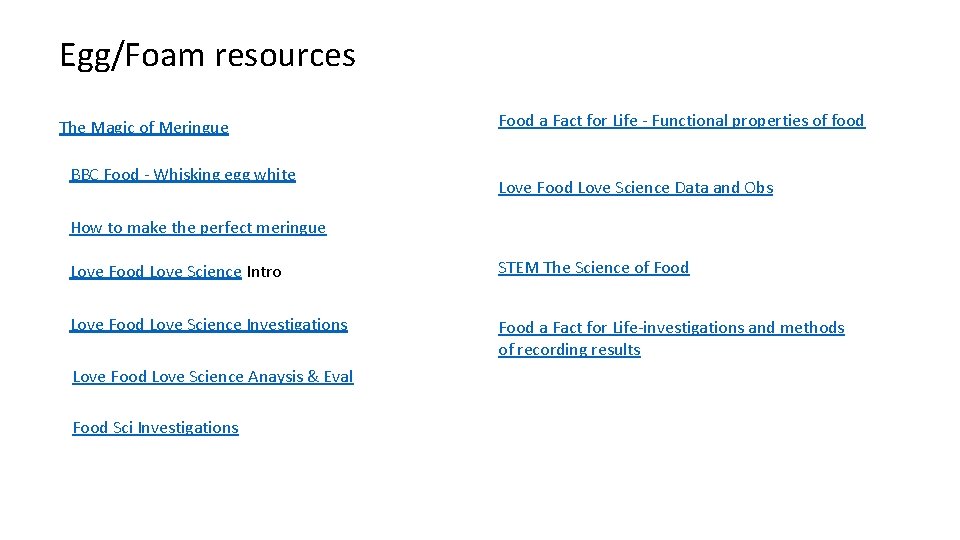
Egg/Foam resources The Magic of Meringue BBC Food - Whisking egg white Food a Fact for Life - Functional properties of food Love Food Love Science Data and Obs How to make the perfect meringue Love Food Love Science Intro STEM The Science of Food Love Science Investigations Food a Fact for Life-investigations and methods of recording results Love Food Love Science Anaysis & Eval Food Sci Investigations
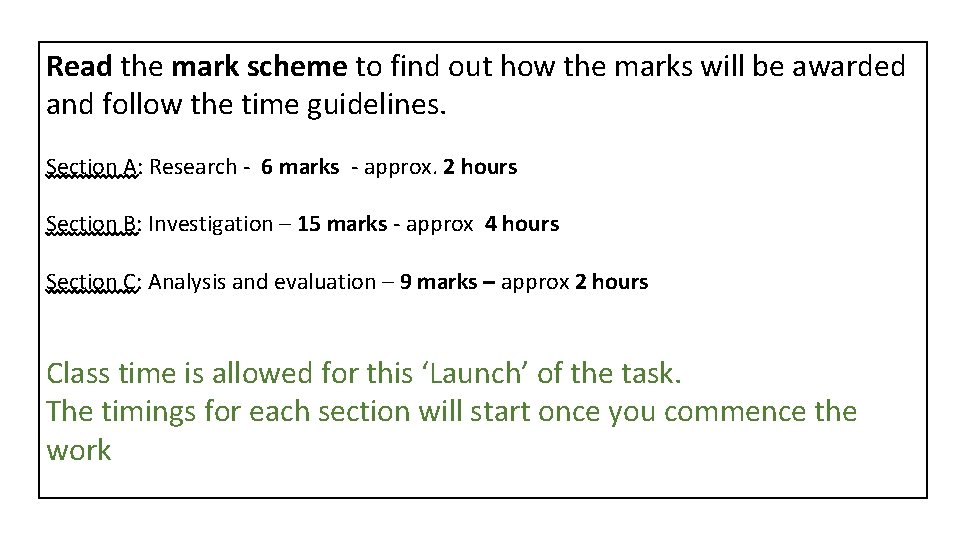
Read the mark scheme to find out how the marks will be awarded and follow the time guidelines. Section A: Research - 6 marks - approx. 2 hours Section B: Investigation – 15 marks - approx 4 hours Section C: Analysis and evaluation – 9 marks – approx 2 hours Class time is allowed for this ‘Launch’ of the task. The timings for each section will start once you commence the work
Possible layout of task ( 7 - 8 pages) Front cover- Task Page 1 – Research; aim, analysis of task and research Page 2 – Research; research, conclusions and hypothesis Page 3 - Investigation; aim of investigation, results and conclusion. Page 4 – Investigation; aim of investigation, results and conclusion. Page 5 – Investigation; aim of investigation, results and conclusion. Page 6 – Analysis and Evaluation. How the hypothesis is proved or disproved Page 7 - Analysis and evaluation. How the information will be used when preparing and cooking. Page 8 - Bibliography Your report of the investigation is to be 6 -8 sides of A 4. 1500 -2000 words. The report can be hand written or word processed. All class work will be hand written in a working notebook – type up in your own time
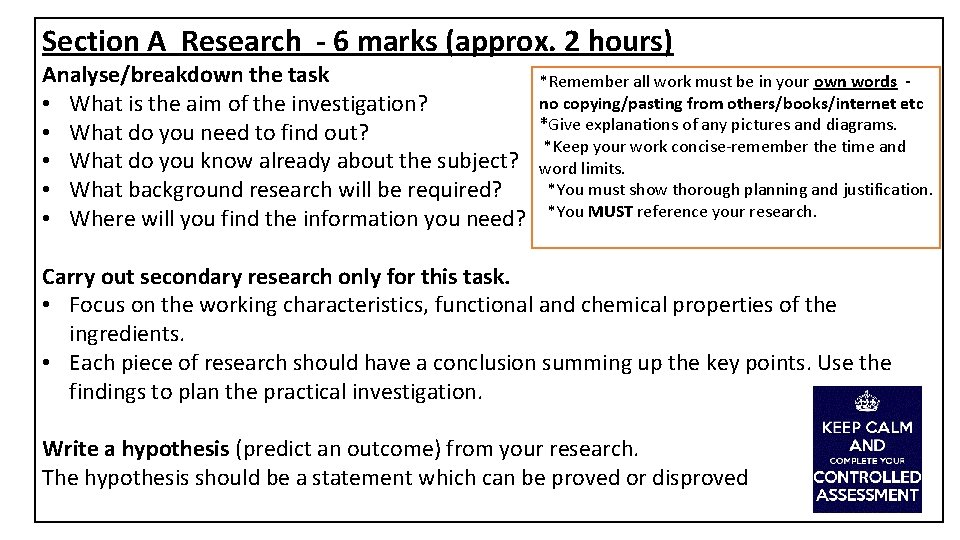
Section A Research - 6 marks (approx. 2 hours) Analyse/breakdown the task • What is the aim of the investigation? • What do you need to find out? • What do you know already about the subject? • What background research will be required? • Where will you find the information you need? *Remember all work must be in your own words no copying/pasting from others/books/internet etc *Give explanations of any pictures and diagrams. *Keep your work concise-remember the time and word limits. *You must show thorough planning and justification. *You MUST reference your research. Carry out secondary research only for this task. • Focus on the working characteristics, functional and chemical properties of the ingredients. • Each piece of research should have a conclusion summing up the key points. Use the findings to plan the practical investigation. Write a hypothesis (predict an outcome) from your research. The hypothesis should be a statement which can be proved or disproved
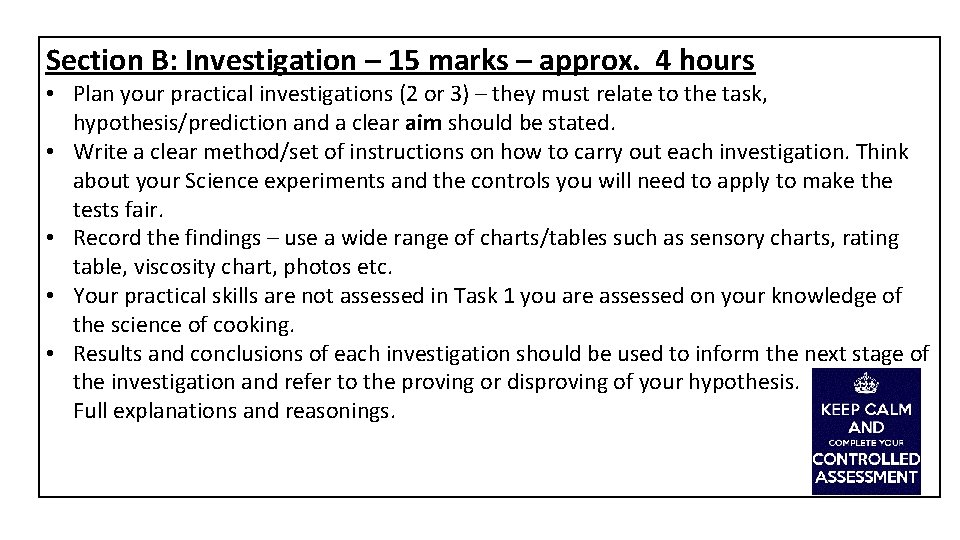
Section B: Investigation – 15 marks – approx. 4 hours • Plan your practical investigations (2 or 3) – they must relate to the task, hypothesis/prediction and a clear aim should be stated. • Write a clear method/set of instructions on how to carry out each investigation. Think about your Science experiments and the controls you will need to apply to make the tests fair. • Record the findings – use a wide range of charts/tables such as sensory charts, rating table, viscosity chart, photos etc. • Your practical skills are not assessed in Task 1 you are assessed on your knowledge of the science of cooking. • Results and conclusions of each investigation should be used to inform the next stage of the investigation and refer to the proving or disproving of your hypothesis. Full explanations and reasonings.
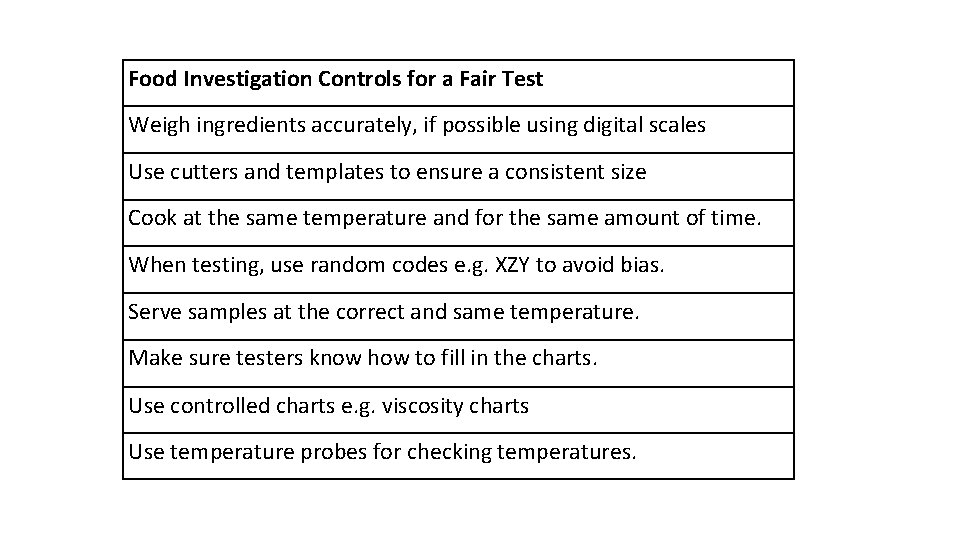
Food Investigation Controls for a Fair Test Weigh ingredients accurately, if possible using digital scales Use cutters and templates to ensure a consistent size Cook at the same temperature and for the same amount of time. When testing, use random codes e. g. XZY to avoid bias. Serve samples at the correct and same temperature. Make sure testers know how to fill in the charts. Use controlled charts e. g. viscosity charts Use temperature probes for checking temperatures.
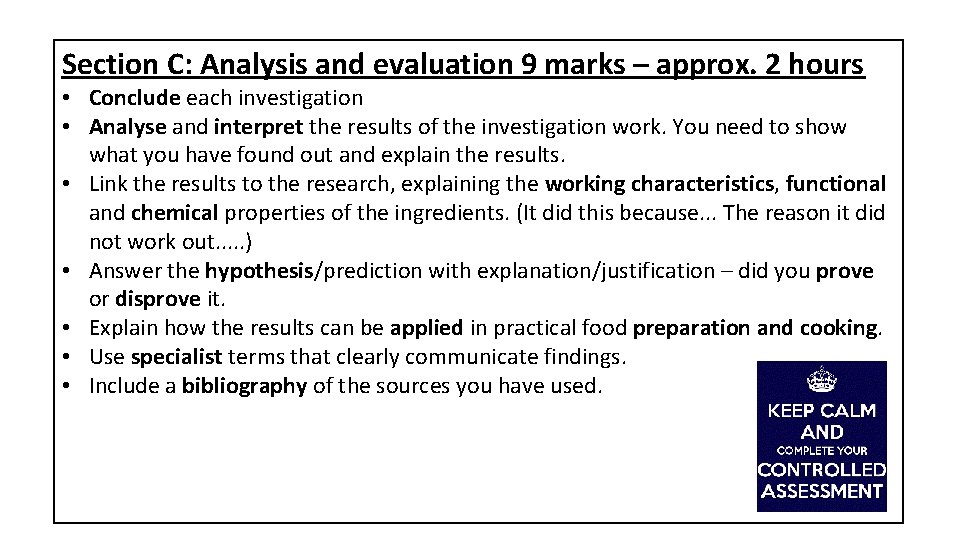
Section C: Analysis and evaluation 9 marks – approx. 2 hours • Conclude each investigation • Analyse and interpret the results of the investigation work. You need to show what you have found out and explain the results. • Link the results to the research, explaining the working characteristics, functional and chemical properties of the ingredients. (It did this because. . . The reason it did not work out. . . ) • Answer the hypothesis/prediction with explanation/justification – did you prove or disprove it. • Explain how the results can be applied in practical food preparation and cooking. • Use specialist terms that clearly communicate findings. • Include a bibliography of the sources you have used.
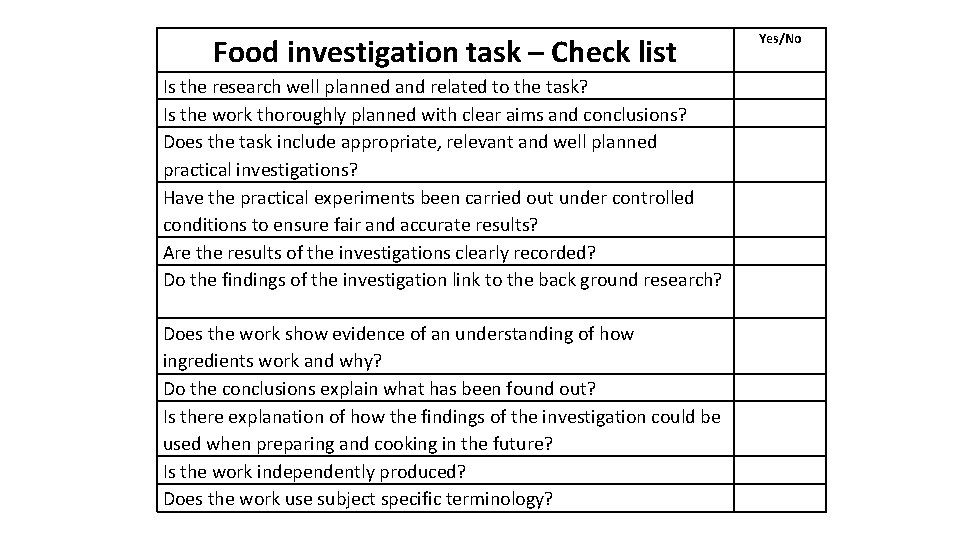
Food investigation task – Check list Is the research well planned and related to the task? Is the work thoroughly planned with clear aims and conclusions? Does the task include appropriate, relevant and well planned practical investigations? Have the practical experiments been carried out under controlled conditions to ensure fair and accurate results? Are the results of the investigations clearly recorded? Do the findings of the investigation link to the back ground research? Does the work show evidence of an understanding of how ingredients work and why? Do the conclusions explain what has been found out? Is there explanation of how the findings of the investigation could be used when preparing and cooking in the future? Is the work independently produced? Does the work use subject specific terminology? Yes/No