
NDIS Quality and Safeguards Commission A rightsbased approach
NDIS Quality and Safeguards Commission: A rights-based approach to the reduction and elimination of restrictive practices ACT Senior Practitioner Seminar Series 2 November 2018 – Canberra ACT Dr Jeffrey Chan, Senior Practitioner Donna White, Assistant Director NDIS Quality and Safeguards Commission – Behaviour Support Function
NDIS National Quality and Safeguarding Framework § All Australian Governments are committed to evidence-based behaviour support strategies to both improve the quality of life of people with disability and reduce and eliminate the use of Restrictive Practices § Consistent with Australia’s international human rights obligations and the National Framework for Reducing and Eliminating the Use of Restrictive Practices in the Disability Service Sector § Joint Commonwealth/State responsibility: Commonwealth leadership in behaviour support and monitoring of Restrictive Practices role; states remain responsible for legislation and policy on authorisation and consent arrangements for Restrictive Practices § Commonwealth’s leadership role will sit with the new NDIS Quality and Safeguards Commission
NDIS Quality and Safeguards Commission – Behaviour Support Function The NDIS Commission’s Senior Practitioner will provide leadership in relation to behaviour support and in the reduction and elimination of the use of restrictive practices by NDIS Providers • Building the capacity of behaviour support practitioners • Developing policy and guidance materials • Education, training and advice to implementing providers • Monitoring and analysing the use of Restrictive Practices • Assisting states and territories in the development of nationally consistent Restrictive Practice definitions and minimum standards for authorisation [Act – SE brief]

Regulated Restrictive Practices • ‘Restrictive Practice’ means any practice or intervention that has the effect of restricting the rights or freedom of movement of a person with disability: NDIS Act s 9 • ‘Regulated Restrictive Practices’ are: Ø Seclusion Ø Chemical restraint Ø Mechanical restraint Ø Physical restraint Ø Environmental restraint

Regulated Restrictive Practices an only be used in the context of: 1. Reducing the risk of harm to the self or others 2. Clearly being identified in a Behaviour Support Plan 3. Authorisation (however described) by the State/Territory where required 4. Only being used as a last resort 5. Being the least restrictive response available 6. Being proportionate to the potential harm of self or others 7. Being used for the shortest possible time 8. The NDIS participant being given opportunities to develop new skills that have the potential to avoid the need for a Restrictive Practice
Behaviour Support – Raising the Bar § Behaviour Support aimed at safeguarding the dignity of the person and improving their quality of life § Contemporary evidence-based practice § Constructively reducing behaviours that may lead to harm of self or others § Work towards the reduction and elimination of Restrictive Practices
Getting the Message Right What do we need to know about Restrictive Practices? Myths and Assumptions. .
Changing our thinking, attitude & behaviour towards the use of Restrictive Practices “JUSTICE WILL NOT BE SERVED UNTIL THOSE WHO ARE UNAFFECTED ARE AS OUTRAGED AS THOSE WHO ARE” - Benjamin Franklin
International Research Evidence Shows: ü Restraints and seclusion are not therapeutic, and have no scientific basis establishing their efficacy ü Restraint and seclusion do not effectively shape and change behaviour, and do not result in positive pro-social behaviour ü Restraint and seclusion are not used unless absolutely necessary, are often punitive and not for safety reasons
International Research Evidence Shows: ü Restraints and seclusion do not keep the people we serve safe ü Restraints and seclusion do not keep staff safe ü Restraints and seclusion are not used objectively and not without bias ü It costs more to apply restraints and seclusion
What do people feel when they are subjected to Restrictive Practices? ü They do not feel safe ü They recount their trauma and negative experience ü They feel violated and go through cycles of psychological distress ü They feel practices are unethical ü They feel helpless, hopeless and “spirit broken” ü They view their behaviours are in response to an offending or maladaptive environment Ramcharan et al. (2009) Strout (2010) Stubbs et al. (2009)
What do staff experience when they administer restraint and seclusion? ü They feel angry and distressed ü Re-traumatization of staff can occur ü They require stress leave after applying restraint and seclusion ü They experience one or more negative psychological experiences ü They found the experience demeaning ü They also feel anger when a colleague is injured during the process of restraint application
Evidence to reduce and eliminate restraints and seclusion: ü Uphold the dignity of the person across all settings, circumstances, and communities; and enliven the CRPD so the person can exercise his/her rights ü Set the right tone and direction in organisational culture - call out immediately when something is not right. Start with a “whole person within a large system” approach in service delivery and practice ü There are rights based treatment approaches – e. g. Positive Behaviour Support, Mindfulness ü Safeguarding system – legislation, policy and practice; culture change and improving the system
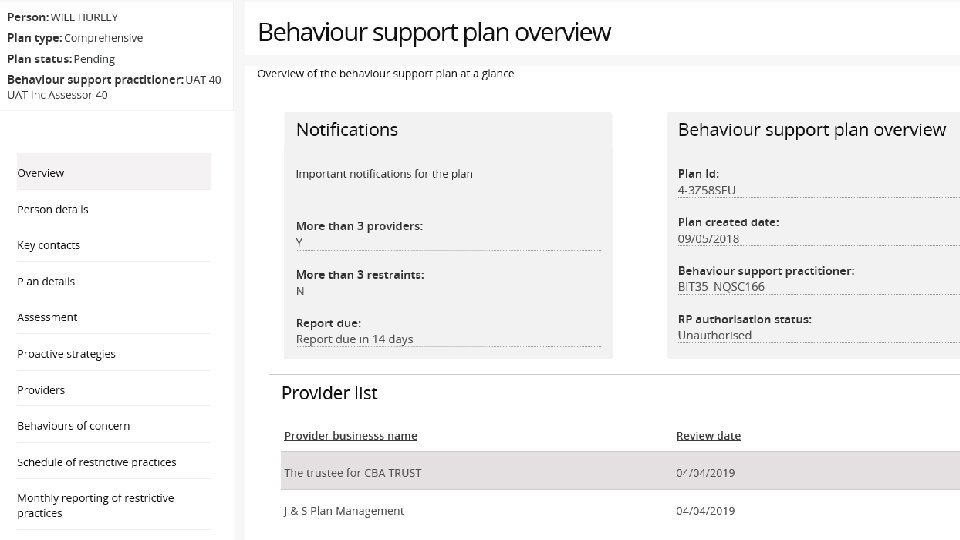
Specialist Behaviour Support Provider Requirements • Use Behaviour Support practitioners deemed suitable by the NDIS Commission • Timeframes – 1 month interim plan, 6 months comprehensive plan, review plan at least every 12 months • Develop plans that meet NDIS Commission requirements: Ø Developed in consultation with the person with a disability, their support network and implementing provider Ø Based on a comprehensive biopsychosocial assessment including a functional behavioural assessment Ø Contain contemporary evidence-based behavioural strategies including environmental adjustments to constructively reduce behaviours of concern Ø Work towards reducing and eliminating Restrictive Practices Ø Be developed in a form approved by the Commissioner and lodged with the Commission
Implementing Provider Requirements • Providers implementing behaviour support plans that may involve the use of Restrictive Practices must be registered • Any Restrictive Practices that may be used must be: Ø Implemented in accordance with a behaviour support plan Ø Authorised or consented in line with the state/territory requirements (including short-term approvals) • Keep records on the use of Restrictive Practices
Implementing Provider Requirements (continued. . ) • Providers must report regularly on the use of regulated Restrictive Practices Ø Monthly reporting of use of Restricted Practices in accordance with the behaviour support plan (note: for short-term approvals in SA, QLD and TAS this reporting is fortnightly) Ø Comply with reportable incident requirements (e. g. when a Restrictive Practice requires authorisation but this has not been obtained, if the practice is used it must be reported within 5 days) • Take all steps to facilitate the engagement of a behaviour support practitioner if a behaviour of concern arises or if a behaviour support plan needs to be reviewed • Support staff to receive appropriate training in implementing evidence-informed strategies • Work with the behaviour support practitioner to monitor outcomes for the person with disability and the progress of the behaviour support plan’s implementation
Reports - Record Keeping 1. Impact to the person with disability or another 2. Any injury 3. Whether the RP was a reportable incident 4. Behaviour of concern 5. Reason for use of RP 6. Time, date and place of RP 7. Names and contact details of those involved, including witnesses 8. Actions taken in response to RP 9. Less restrictive options considered 10. Actions and strategies used leading up to the use of RP
Role of the Authorising Reporting Officer • Responsible for reviewing and submitting monthly reports on the use of Restrictive Practices • Fields included are: o Restrictive Practice type and subtype o Duration o Where was it used o Behaviour of concern o Free text comments section • Monthly reports are to be submitted to the Commission no more than 5 business days after the end of the month.
Monthly Reporting of Restrictive Practices ROUTINE REPORTING: • Used for reporting against an agreed routine schedule e. g. , daily dose medication • Report on the monthly use of any regulated Restricted Practice that is described in the behaviour support plan.
Transition Arrangements For existing providers transitioning with existing participants: § If a behaviour support plan is in place and authorised – notify the Commission within 3 months, ensure arrangements are in place until plan review (12 months max) or Commissioner deems otherwise § If authorised but no behaviour support plan – facilitate the development of a plan within 6 months or Commissioner deems otherwise § If no authorisation or behaviour support plan – notify the Commission within 1 month, develop an interim plan within 3 months
Thankyou “JUSTICE WILL NOT BE SERVED UNTIL THOSE WHO ARE UNAFFECTED ARE AS OUTRAGED AS THOSE WHO ARE” - Benjamin Franklin
- Slides: 22