
NDIS Health Preplanning Practice NDIS and Hospital Discharge


- Slides: 54
NDIS & Health: Pre-planning Practice
NDIS and Hospital Discharge Discipline Specific Resources
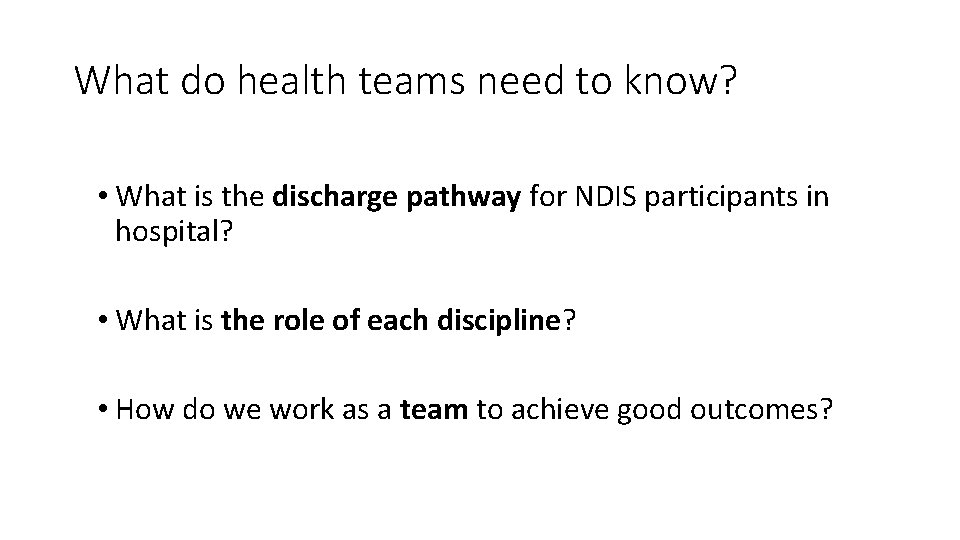
What do health teams need to know? • What is the discharge pathway for NDIS participants in hospital? • What is the role of each discipline? • How do we work as a team to achieve good outcomes?
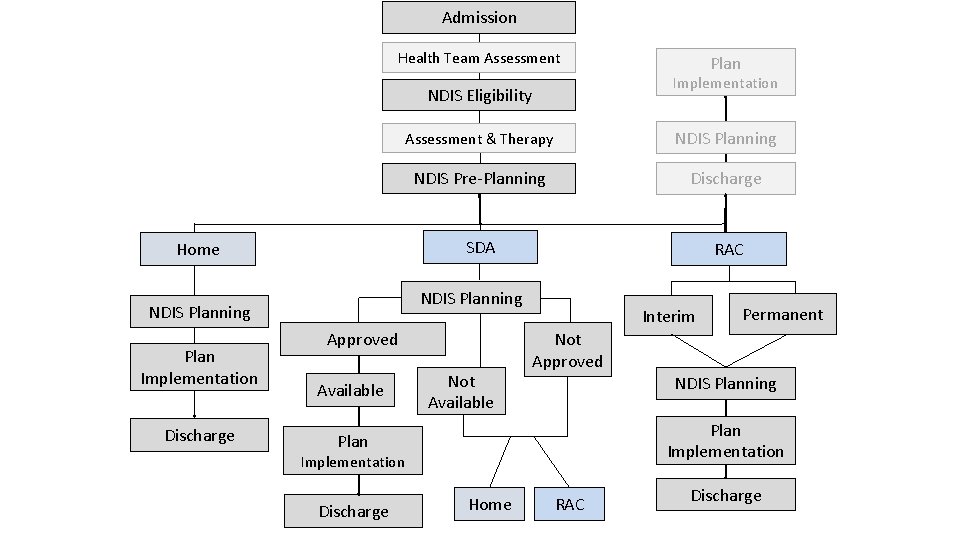
The Patient Pathway
Admission Health Team Assessment Implementation NDIS Eligibility Home Plan Implementation Discharge Assessment & Therapy NDIS Planning NDIS Pre-Planning Discharge SDA RAC NDIS Planning Approved Available Not Available Interim Permanent Not Approved NDIS Planning Plan Implementation Discharge Plan Home RAC Discharge
The Health Team Pathway
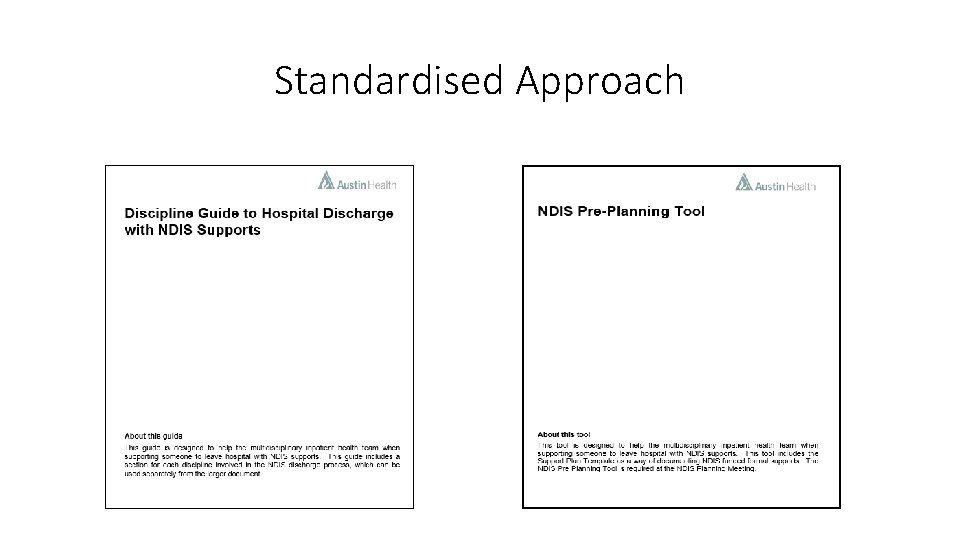
Standardised Approach
The NDIS Discharge Pathway Overview Using the Guide and the Tool.
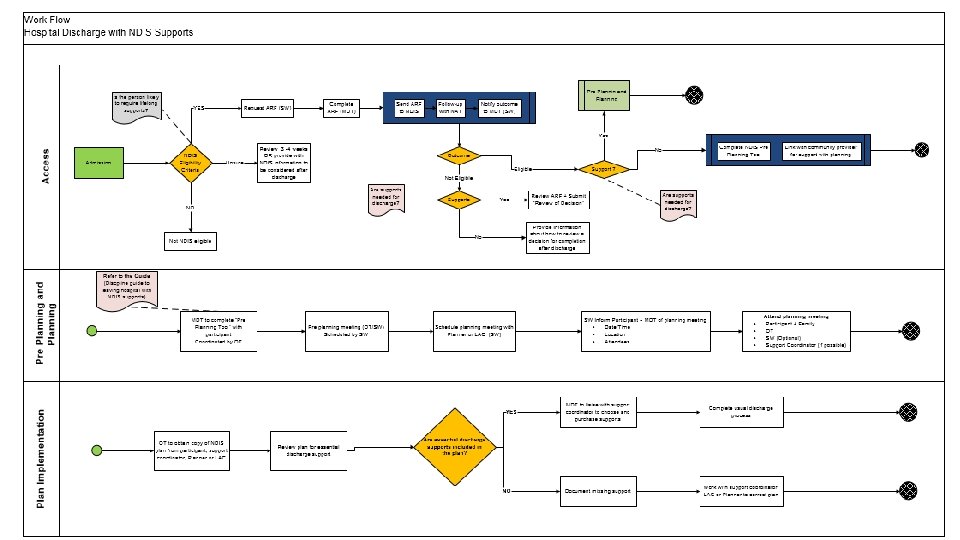
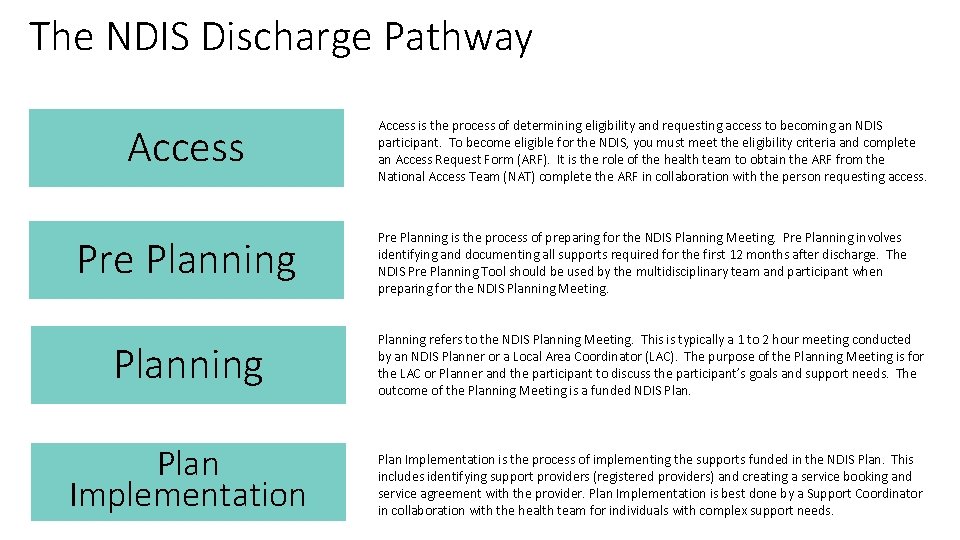
The NDIS Discharge Pathway Access Pre Planning Access is the process of determining eligibility and requesting access to becoming an NDIS participant. To become eligible for the NDIS, you must meet the eligibility criteria and complete an Access Request Form (ARF). It is the role of the health team to obtain the ARF from the National Access Team (NAT) complete the ARF in collaboration with the person requesting access. Pre Planning is the process of preparing for the NDIS Planning Meeting. Pre Planning involves identifying and documenting all supports required for the first 12 months after discharge. The NDIS Pre Planning Tool should be used by the multidisciplinary team and participant when preparing for the NDIS Planning Meeting. Planning refers to the NDIS Planning Meeting. This is typically a 1 to 2 hour meeting conducted by an NDIS Planner or a Local Area Coordinator (LAC). The purpose of the Planning Meeting is for the LAC or Planner and the participant to discuss the participant’s goals and support needs. The outcome of the Planning Meeting is a funded NDIS Plan Implementation is the process of implementing the supports funded in the NDIS Plan. This includes identifying support providers (registered providers) and creating a service booking and service agreement with the provider. Plan Implementation is best done by a Support Coordinator in collaboration with the health team for individuals with complex support needs.
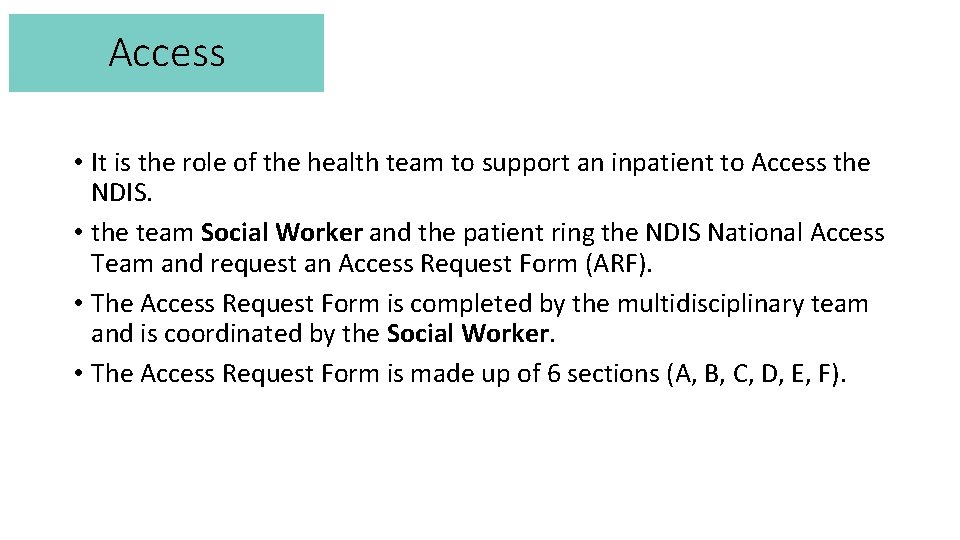
Access • It is the role of the health team to support an inpatient to Access the NDIS. • the team Social Worker and the patient ring the NDIS National Access Team and request an Access Request Form (ARF). • The Access Request Form is completed by the multidisciplinary team and is coordinated by the Social Worker. • The Access Request Form is made up of 6 sections (A, B, C, D, E, F).
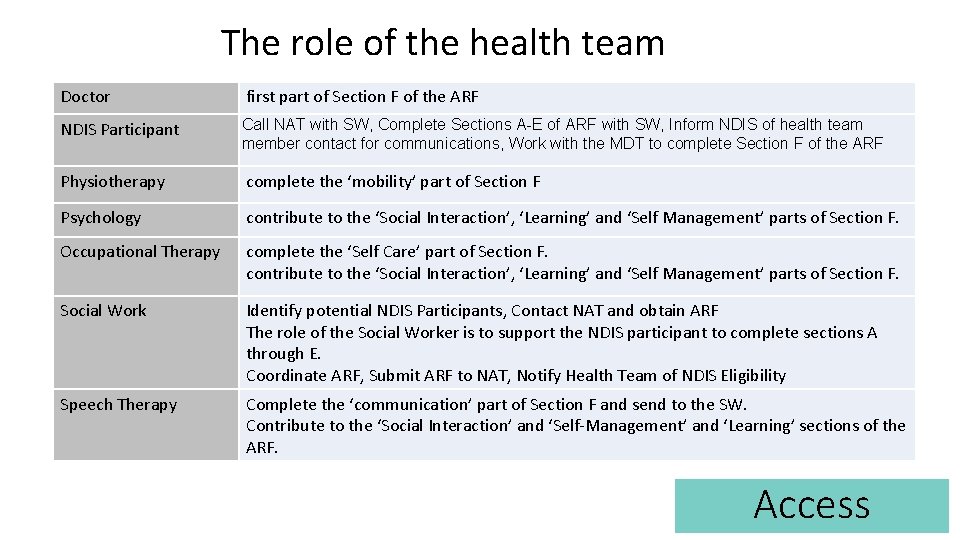
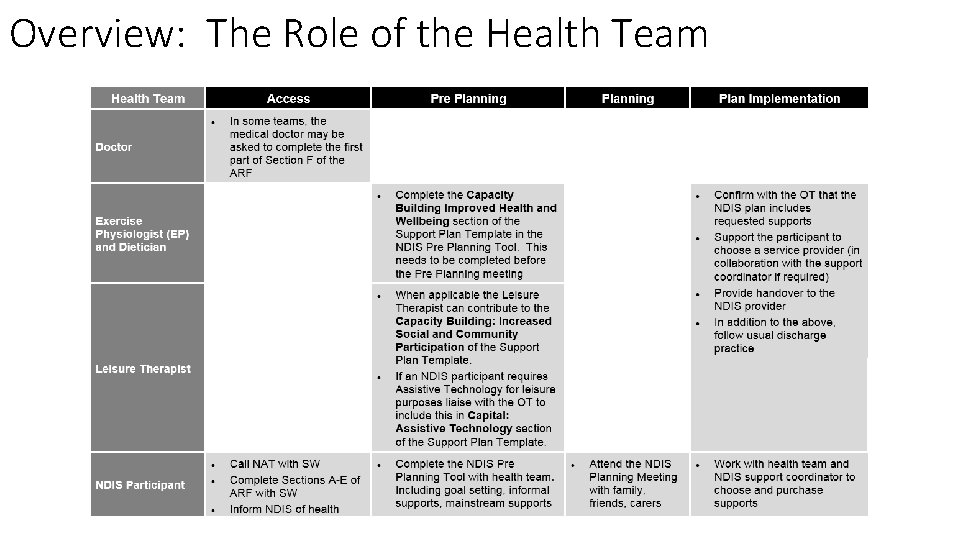
The role of the health team Doctor first part of Section F of the ARF NDIS Participant Call NAT with SW, Complete Sections A-E of ARF with SW, Inform NDIS of health team member contact for communications, Work with the MDT to complete Section F of the ARF Physiotherapy complete the ‘mobility’ part of Section F Psychology contribute to the ‘Social Interaction’, ‘Learning’ and ‘Self Management’ parts of Section F. Occupational Therapy complete the ‘Self Care’ part of Section F. contribute to the ‘Social Interaction’, ‘Learning’ and ‘Self Management’ parts of Section F. Social Work Identify potential NDIS Participants, Contact NAT and obtain ARF The role of the Social Worker is to support the NDIS participant to complete sections A through E. Coordinate ARF, Submit ARF to NAT, Notify Health Team of NDIS Eligibility Speech Therapy Complete the ‘communication’ part of Section F and send to the SW. Contribute to the ‘Social Interaction’ and ‘Self-Management’ and ‘Learning’ sections of the ARF. Access
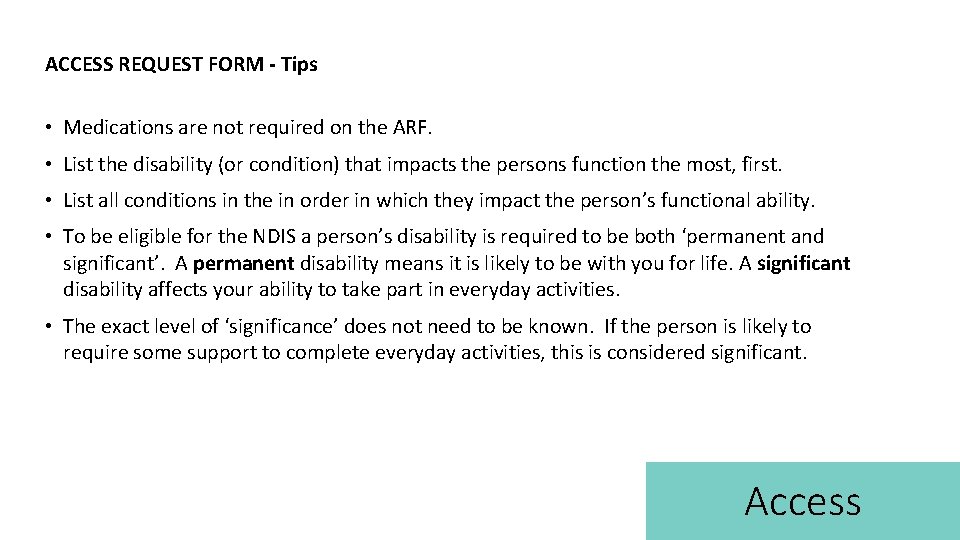
ACCESS REQUEST FORM - Tips • Medications are not required on the ARF. • List the disability (or condition) that impacts the persons function the most, first. • List all conditions in the in order in which they impact the person’s functional ability. • To be eligible for the NDIS a person’s disability is required to be both ‘permanent and significant’. A permanent disability means it is likely to be with you for life. A significant disability affects your ability to take part in everyday activities. • The exact level of ‘significance’ does not need to be known. If the person is likely to require some support to complete everyday activities, this is considered significant. Access
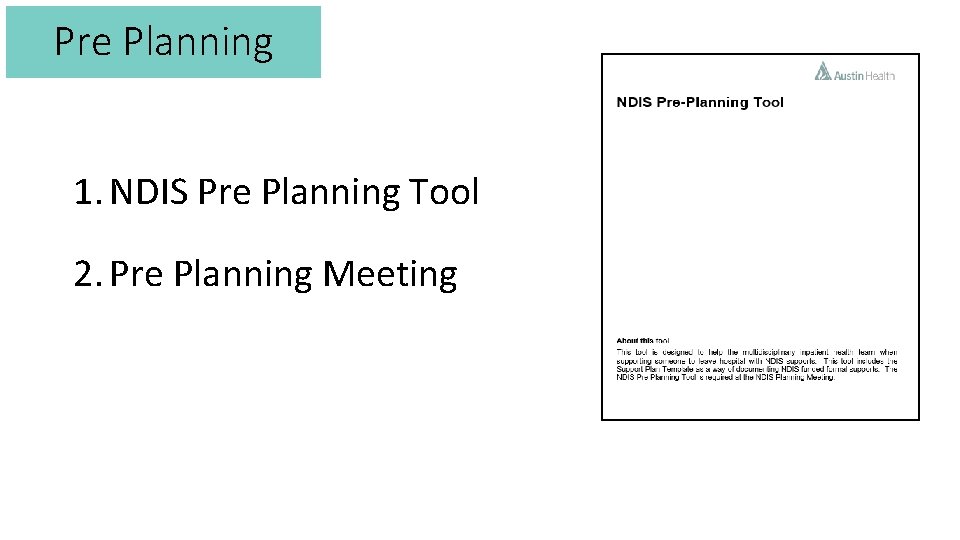
Pre Planning 1. NDIS Pre Planning Tool 2. Pre Planning Meeting
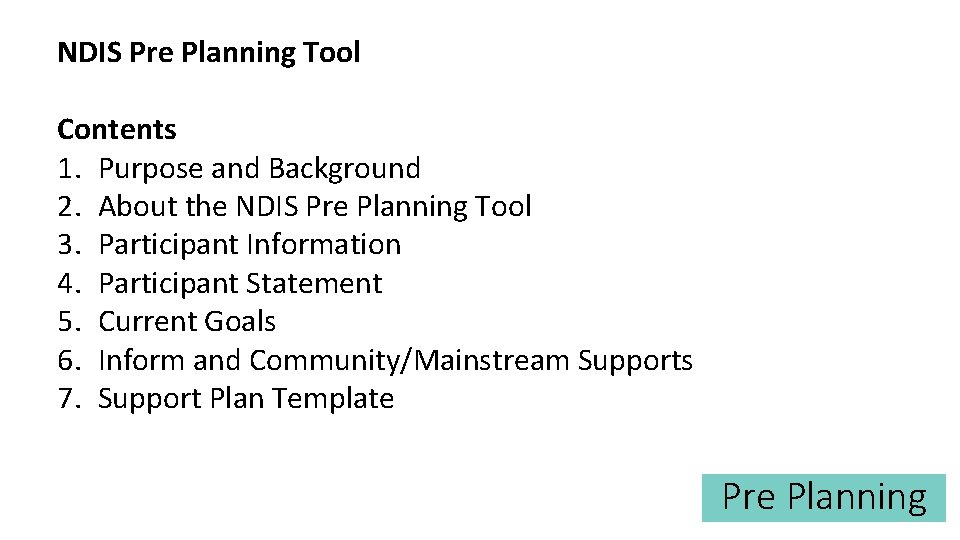
NDIS Pre Planning Tool Contents 1. Purpose and Background 2. About the NDIS Pre Planning Tool 3. Participant Information 4. Participant Statement 5. Current Goals 6. Inform and Community/Mainstream Supports 7. Support Plan Template Pre Planning
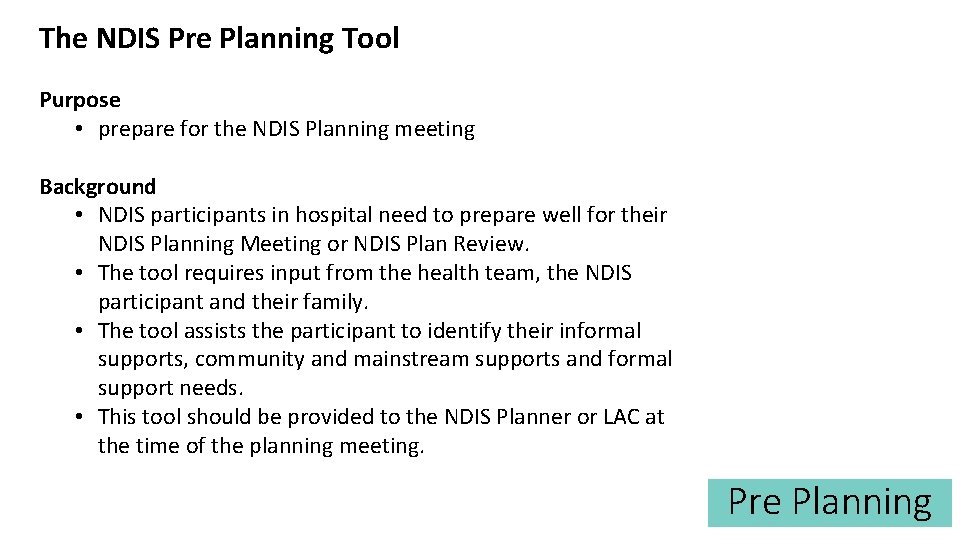
The NDIS Pre Planning Tool Purpose • prepare for the NDIS Planning meeting Background • NDIS participants in hospital need to prepare well for their NDIS Planning Meeting or NDIS Plan Review. • The tool requires input from the health team, the NDIS participant and their family. • The tool assists the participant to identify their informal supports, community and mainstream supports and formal support needs. • This tool should be provided to the NDIS Planner or LAC at the time of the planning meeting. Pre Planning
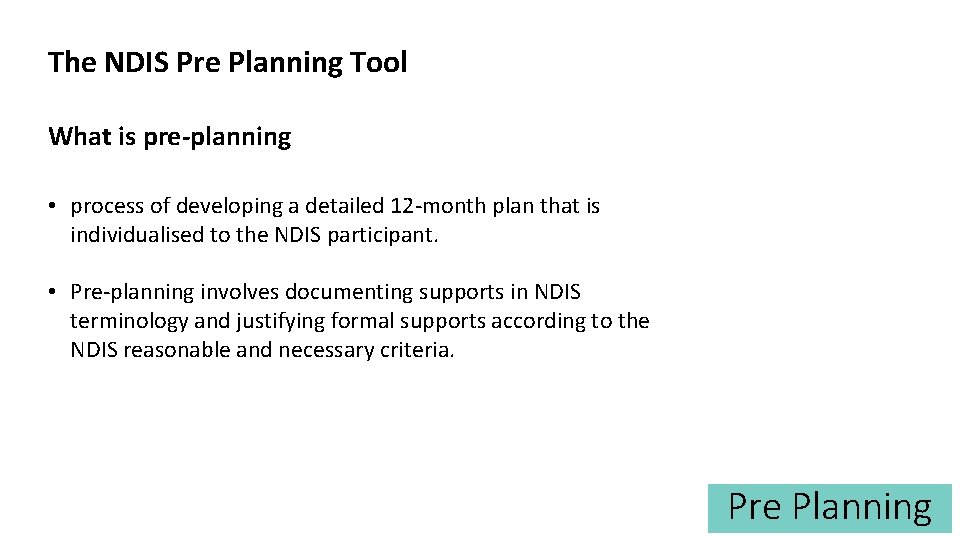
The NDIS Pre Planning Tool What is pre-planning • process of developing a detailed 12 -month plan that is individualised to the NDIS participant. • Pre-planning involves documenting supports in NDIS terminology and justifying formal supports according to the NDIS reasonable and necessary criteria. Pre Planning
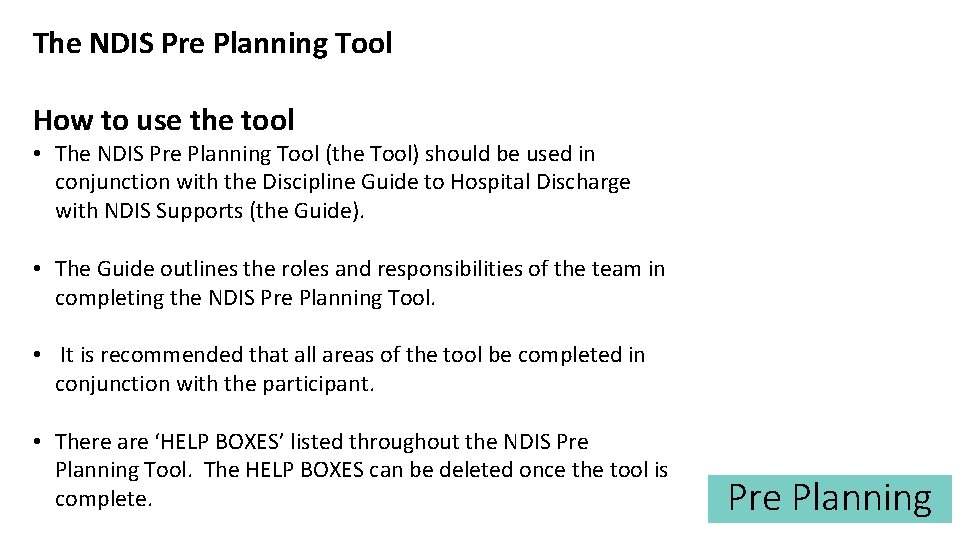
The NDIS Pre Planning Tool How to use the tool • The NDIS Pre Planning Tool (the Tool) should be used in conjunction with the Discipline Guide to Hospital Discharge with NDIS Supports (the Guide). • The Guide outlines the roles and responsibilities of the team in completing the NDIS Pre Planning Tool. • It is recommended that all areas of the tool be completed in conjunction with the participant. • There are ‘HELP BOXES’ listed throughout the NDIS Pre Planning Tool. The HELP BOXES can be deleted once the tool is complete. Pre Planning
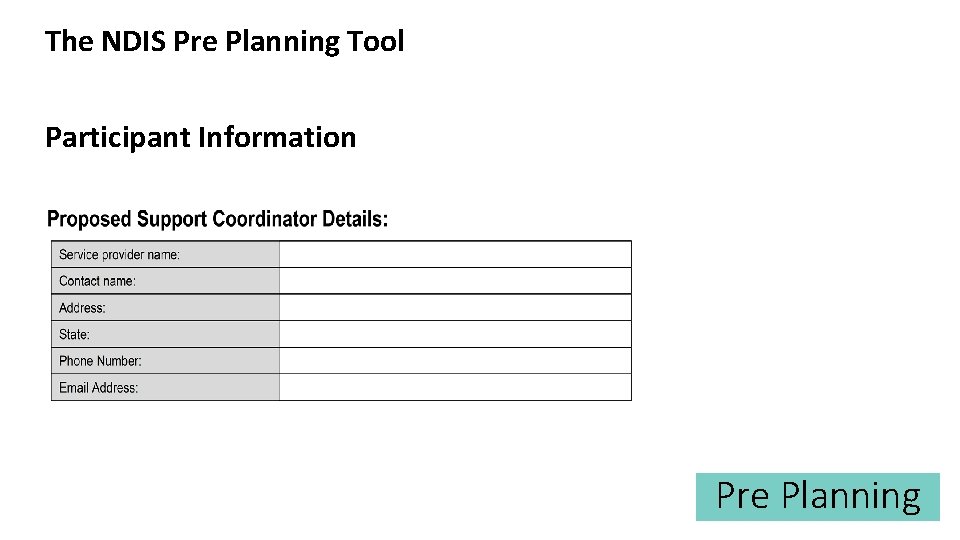
The NDIS Pre Planning Tool Participant Information Pre Planning
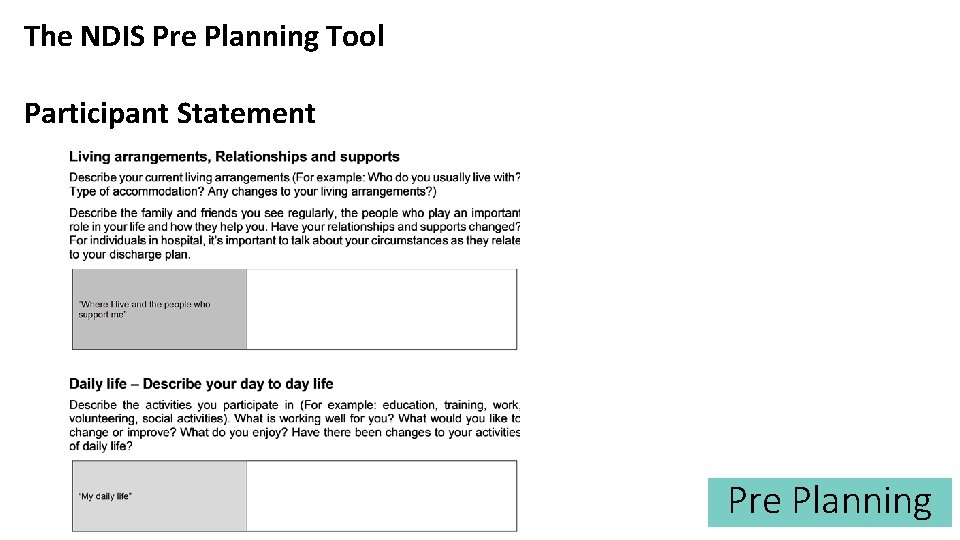
The NDIS Pre Planning Tool Participant Statement Pre Planning
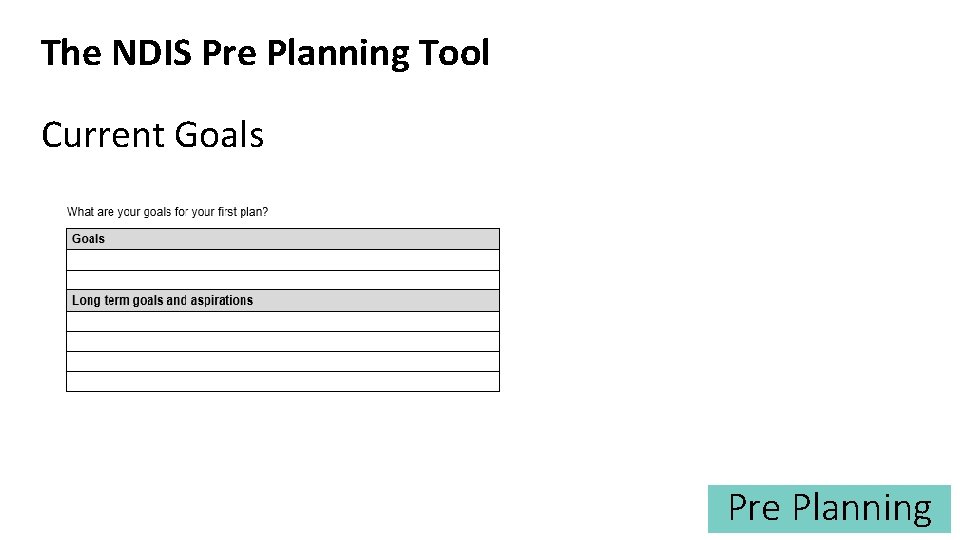
The NDIS Pre Planning Tool Current Goals Pre Planning
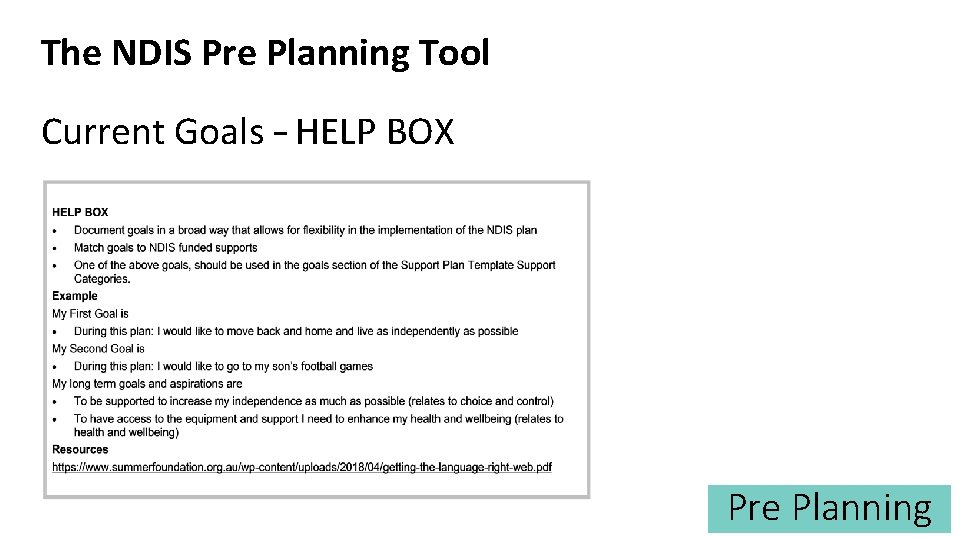
The NDIS Pre Planning Tool Current Goals – HELP BOX Pre Planning
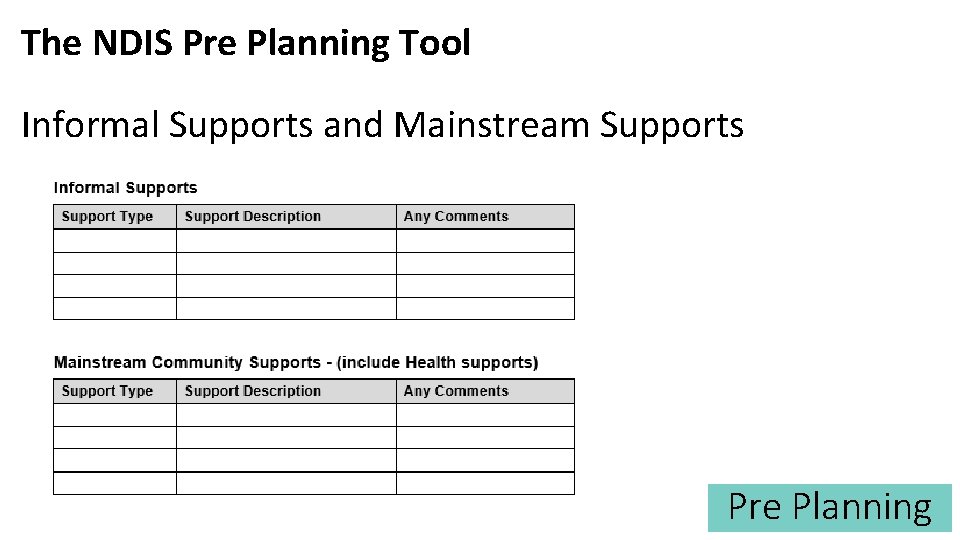
The NDIS Pre Planning Tool Informal Supports and Mainstream Supports Pre Planning
The NDIS Pre Planning Tool Informal Supports and Mainstream Supports Pre Planning
The NDIS Pre Planning Tool The Support Plan Template Pre Planning
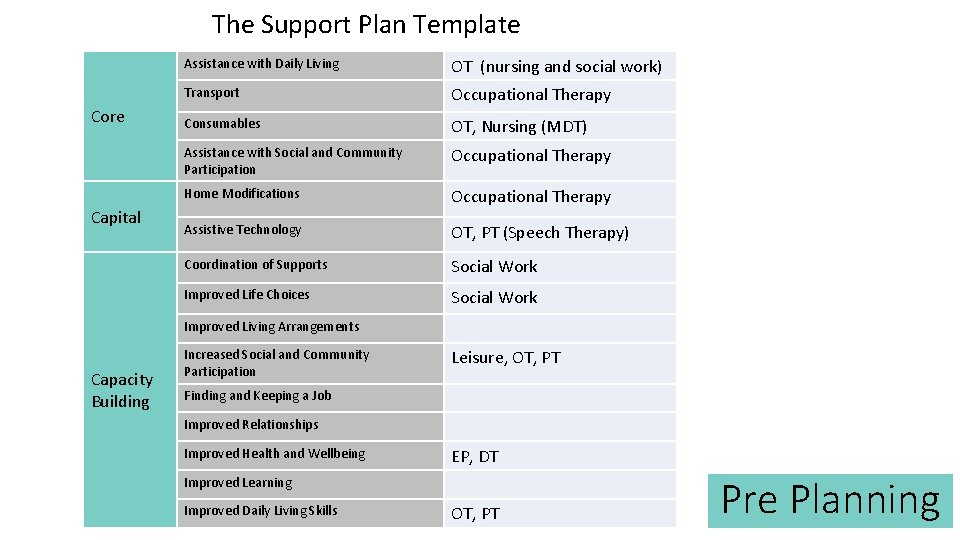
The Support Plan Template Core Capital Assistance with Daily Living OT (nursing and social work) Transport Occupational Therapy Consumables OT, Nursing (MDT) Assistance with Social and Community Participation Occupational Therapy Home Modifications Occupational Therapy Assistive Technology OT, PT (Speech Therapy) Coordination of Supports Social Work Improved Life Choices Social Work Improved Living Arrangements Capacity Building Increased Social and Community Participation Leisure, OT, PT Finding and Keeping a Job Improved Relationships Improved Health and Wellbeing EP, DT Improved Learning Improved Daily Living Skills OT, PT Pre Planning
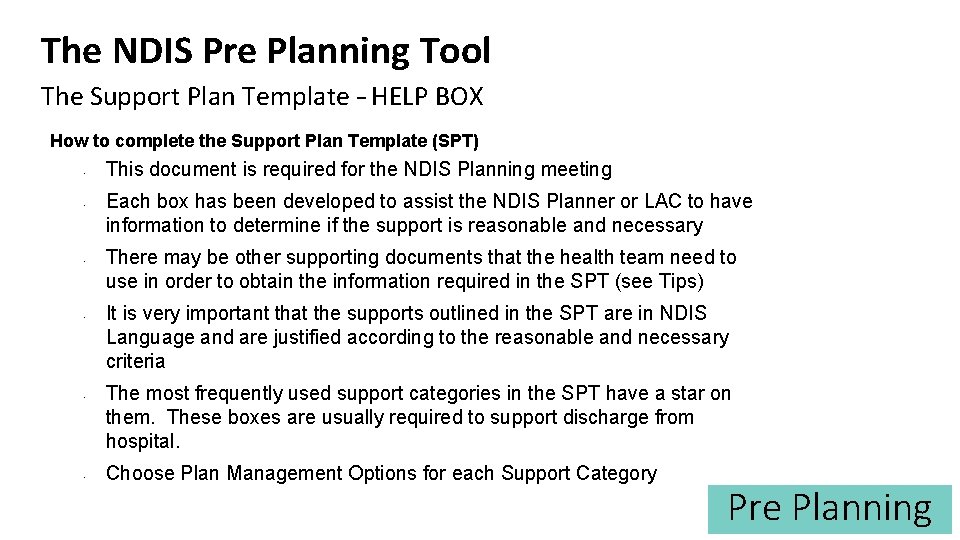
The NDIS Pre Planning Tool The Support Plan Template – HELP BOX How to complete the Support Plan Template (SPT) • • • This document is required for the NDIS Planning meeting Each box has been developed to assist the NDIS Planner or LAC to have information to determine if the support is reasonable and necessary There may be other supporting documents that the health team need to use in order to obtain the information required in the SPT (see Tips) It is very important that the supports outlined in the SPT are in NDIS Language and are justified according to the reasonable and necessary criteria The most frequently used support categories in the SPT have a star on them. These boxes are usually required to support discharge from hospital. Choose Plan Management Options for each Support Category Pre Planning
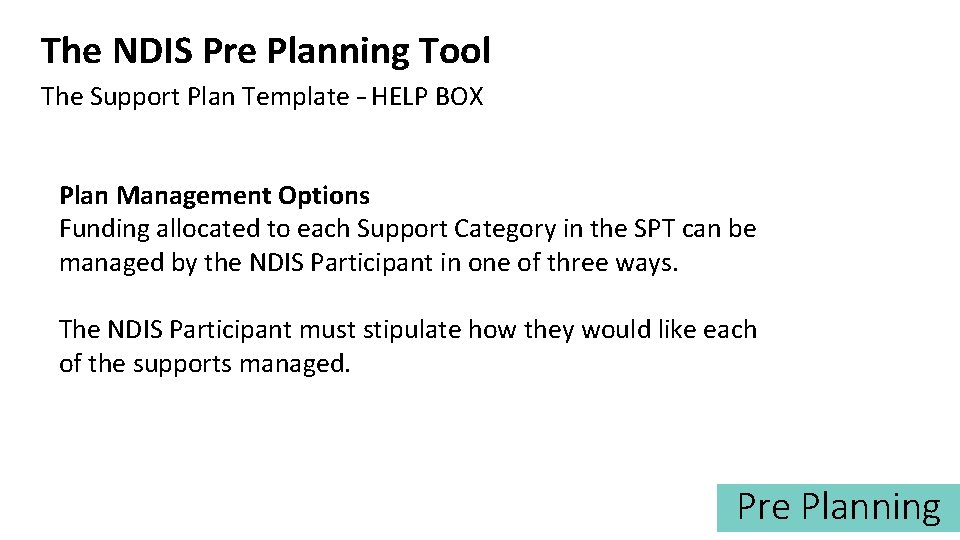
The NDIS Pre Planning Tool The Support Plan Template – HELP BOX Plan Management Options Funding allocated to each Support Category in the SPT can be managed by the NDIS Participant in one of three ways. The NDIS Participant must stipulate how they would like each of the supports managed. Pre Planning
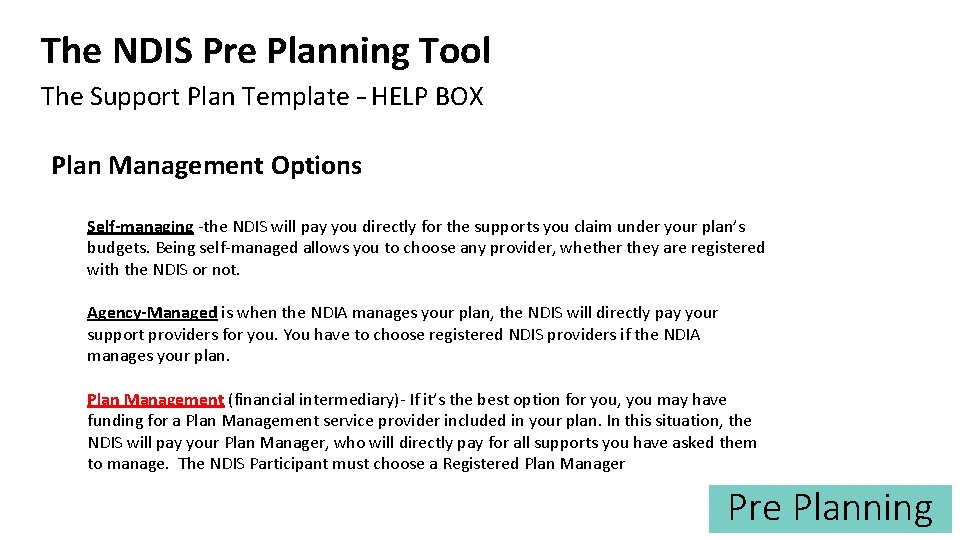
The NDIS Pre Planning Tool The Support Plan Template – HELP BOX Plan Management Options Self-managing -the NDIS will pay you directly for the supports you claim under your plan’s budgets. Being self-managed allows you to choose any provider, whether they are registered with the NDIS or not. Agency-Managed is when the NDIA manages your plan, the NDIS will directly pay your support providers for you. You have to choose registered NDIS providers if the NDIA manages your plan. Plan Management (financial intermediary)- If it’s the best option for you, you may have funding for a Plan Management service provider included in your plan. In this situation, the NDIS will pay your Plan Manager, who will directly pay for all supports you have asked them to manage. The NDIS Participant must choose a Registered Plan Manager Pre Planning
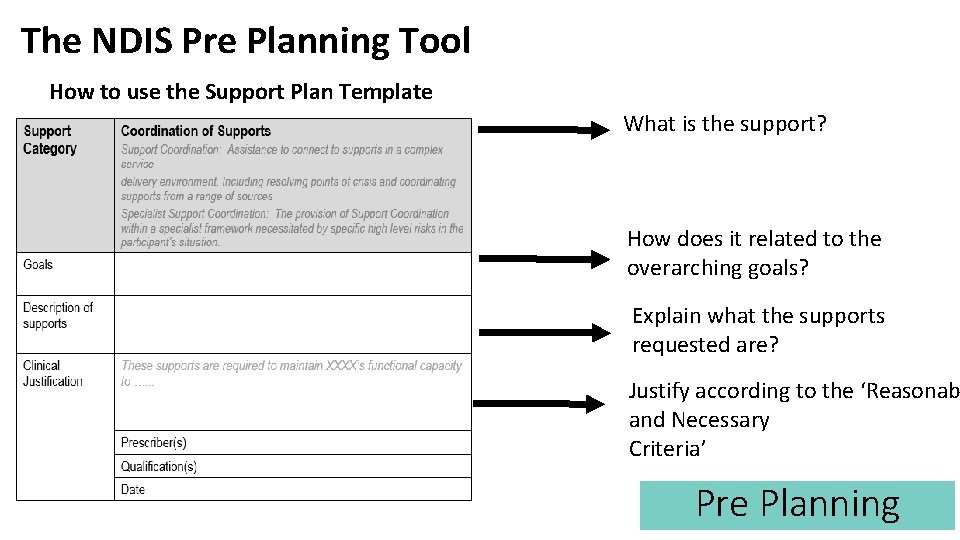
The NDIS Pre Planning Tool How to use the Support Plan Template What is the support? How does it related to the overarching goals? Explain what the supports requested are? Justify according to the ‘Reasonab and Necessary Criteria’ Pre Planning
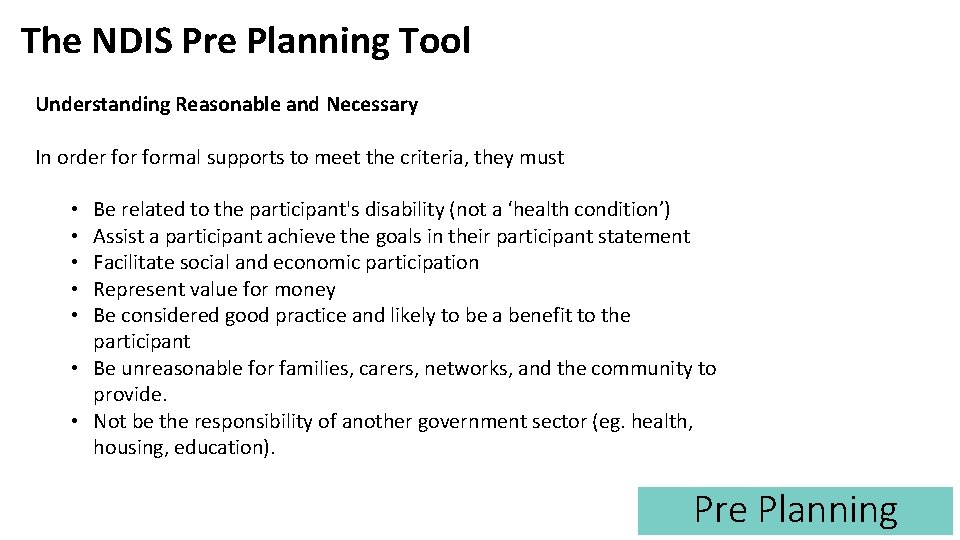
The NDIS Pre Planning Tool Understanding Reasonable and Necessary In order formal supports to meet the criteria, they must Be related to the participant's disability (not a ‘health condition’) Assist a participant achieve the goals in their participant statement Facilitate social and economic participation Represent value for money Be considered good practice and likely to be a benefit to the participant • Be unreasonable for families, carers, networks, and the community to provide. • Not be the responsibility of another government sector (eg. health, housing, education). • • • Pre Planning
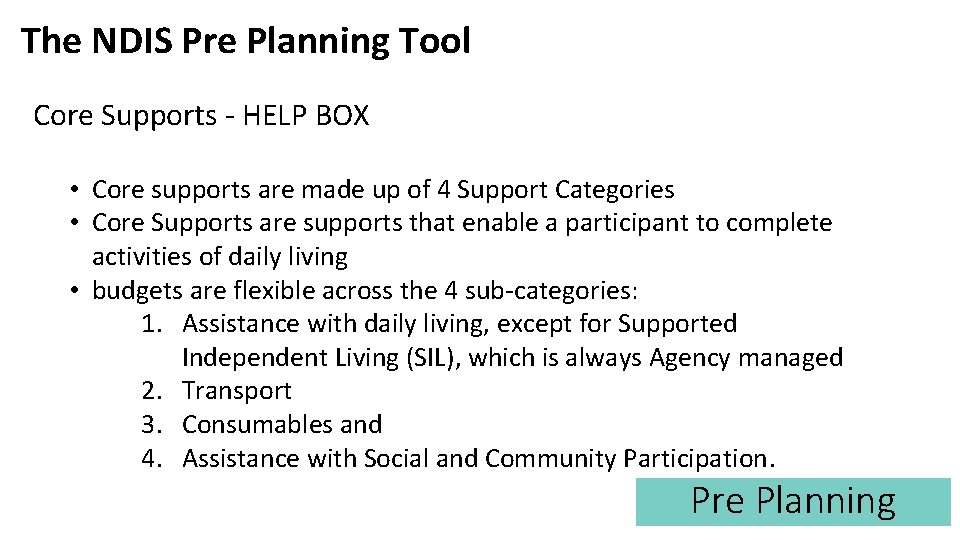
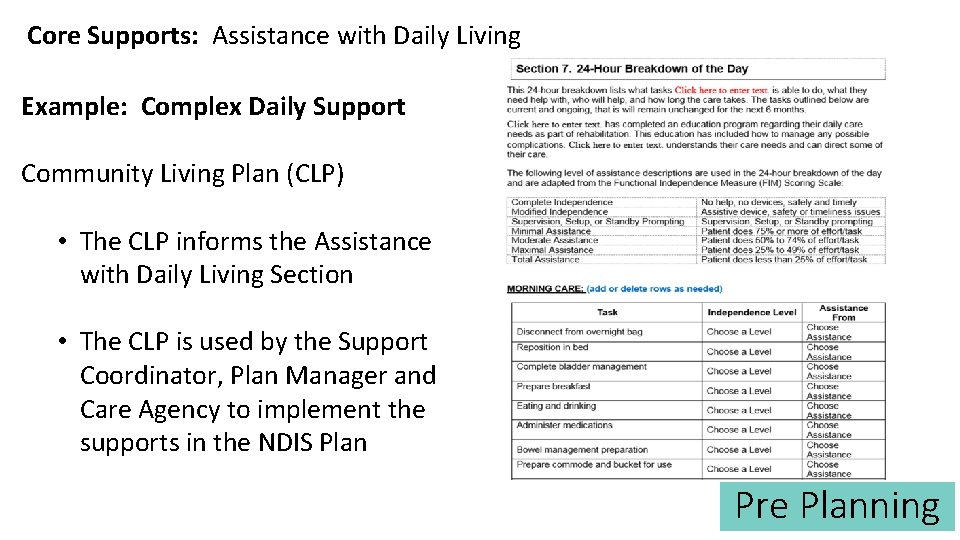
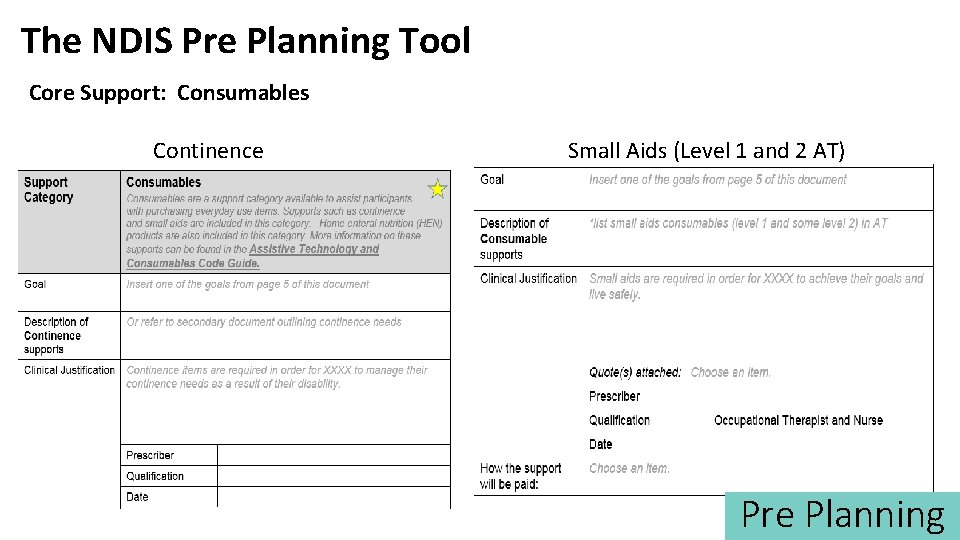
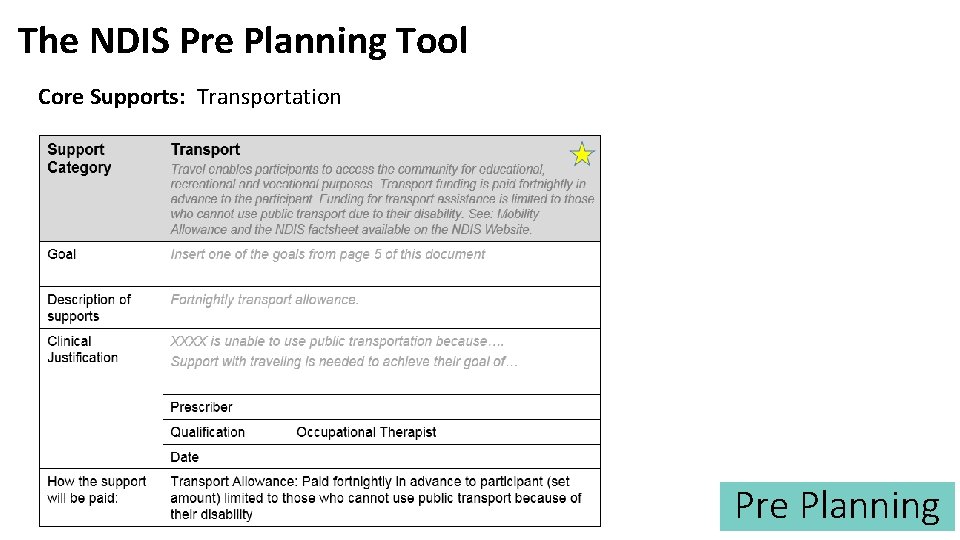
The NDIS Pre Planning Tool Core Supports - HELP BOX • Core supports are made up of 4 Support Categories • Core Supports are supports that enable a participant to complete activities of daily living • budgets are flexible across the 4 sub-categories: 1. Assistance with daily living, except for Supported Independent Living (SIL), which is always Agency managed 2. Transport 3. Consumables and 4. Assistance with Social and Community Participation. Pre Planning
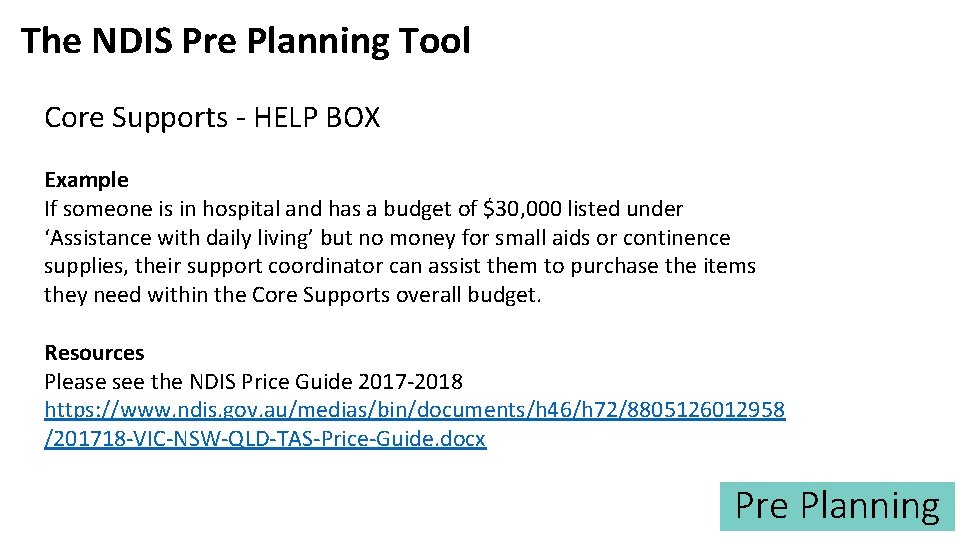
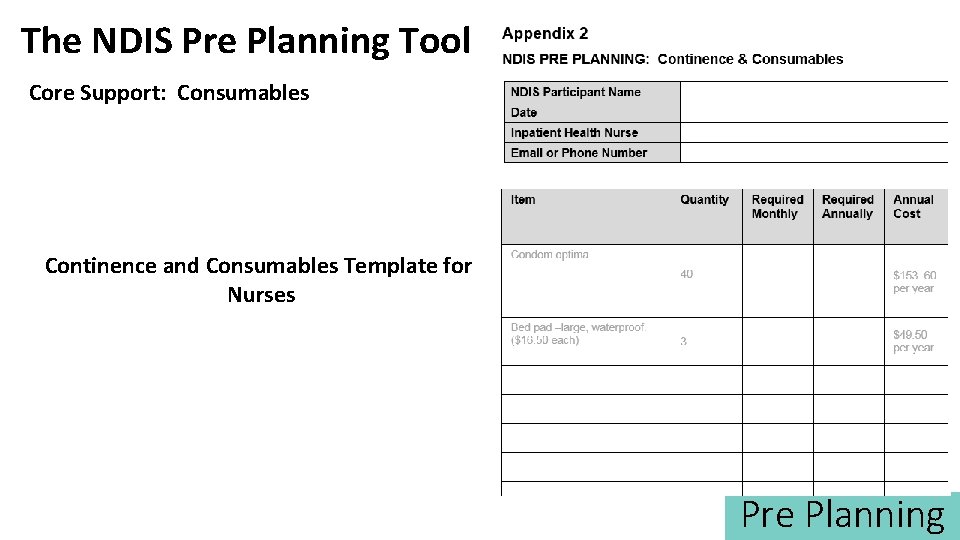
The NDIS Pre Planning Tool Core Supports - HELP BOX Example If someone is in hospital and has a budget of $30, 000 listed under ‘Assistance with daily living’ but no money for small aids or continence supplies, their support coordinator can assist them to purchase the items they need within the Core Supports overall budget. Resources Please see the NDIS Price Guide 2017 -2018 https: //www. ndis. gov. au/medias/bin/documents/h 46/h 72/8805126012958 /201718 -VIC-NSW-QLD-TAS-Price-Guide. docx Pre Planning
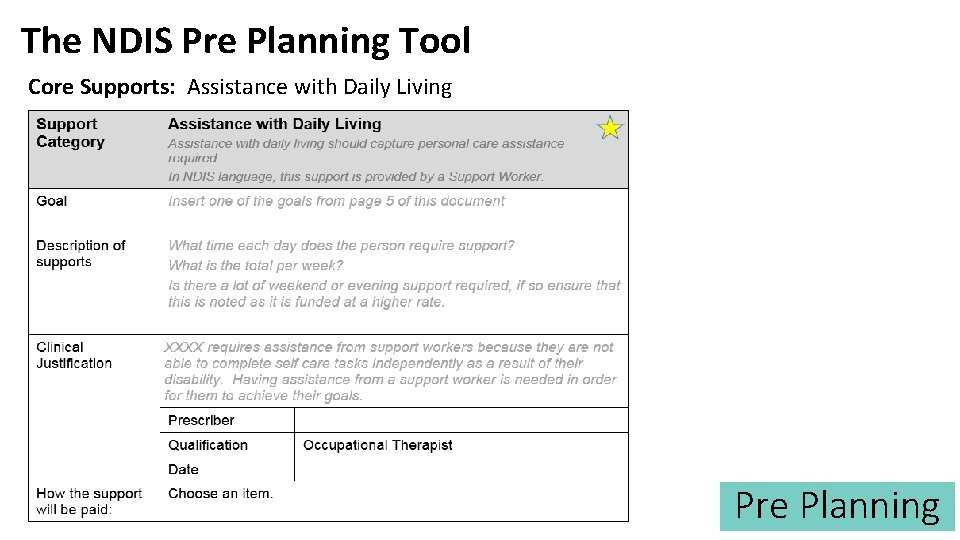
The NDIS Pre Planning Tool Core Supports: Assistance with Daily Living Pre Planning
Core Supports: Assistance with Daily Living Example: Complex Daily Support Community Living Plan (CLP) • The CLP informs the Assistance with Daily Living Section • The CLP is used by the Support Coordinator, Plan Manager and Care Agency to implement the supports in the NDIS Plan Pre Planning
The NDIS Pre Planning Tool Core Support: Consumables Continence Small Aids (Level 1 and 2 AT) Pre Planning
The NDIS Pre Planning Tool Core Support: Consumables Continence and Consumables Template for Nurses Pre Planning
The NDIS Pre Planning Tool Core Supports: Transportation Pre Planning
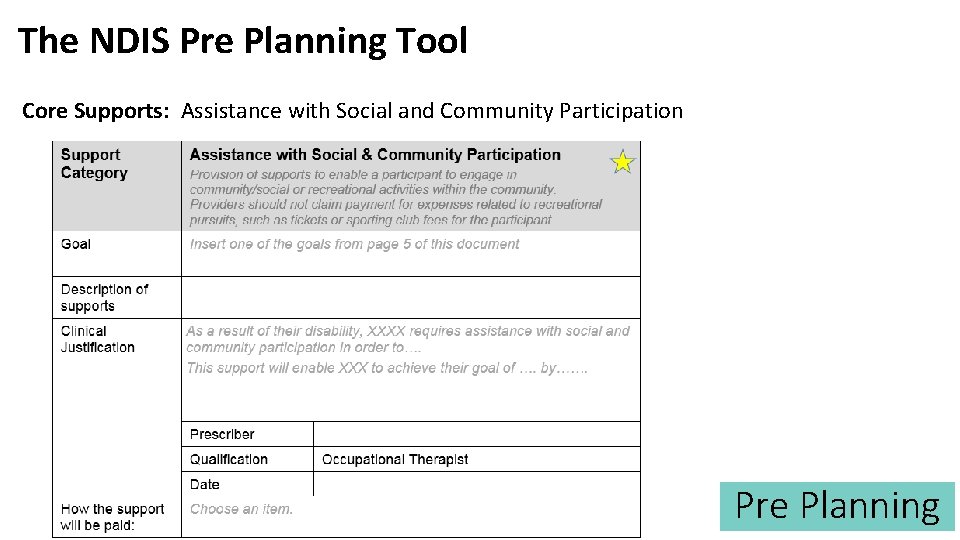
The NDIS Pre Planning Tool Core Supports: Assistance with Social and Community Participation Pre Planning
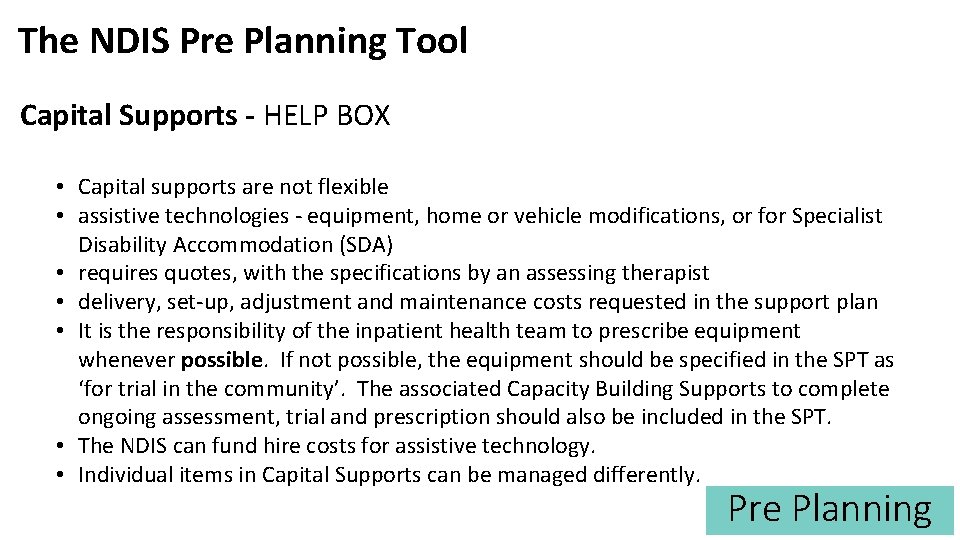
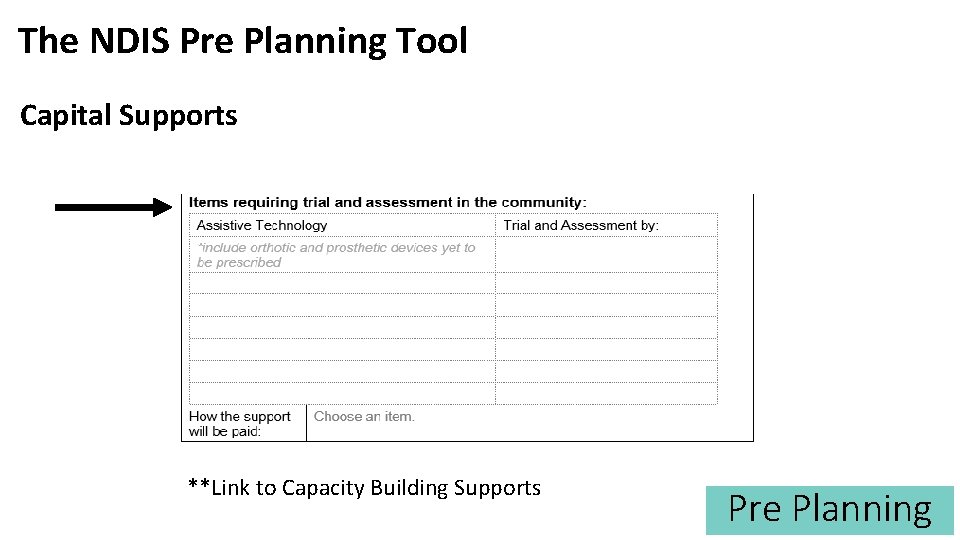
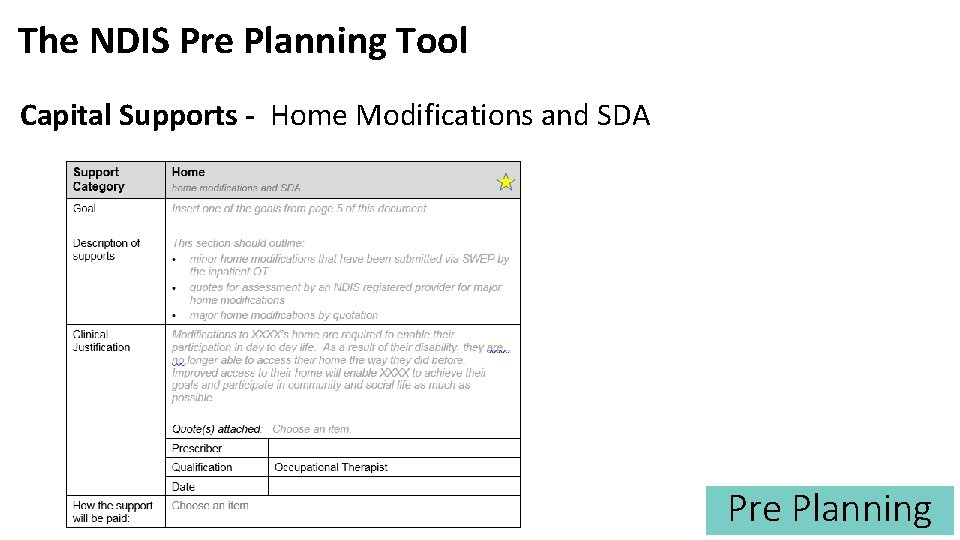
The NDIS Pre Planning Tool Capital Supports - HELP BOX • Capital supports are not flexible • assistive technologies - equipment, home or vehicle modifications, or for Specialist Disability Accommodation (SDA) • requires quotes, with the specifications by an assessing therapist • delivery, set-up, adjustment and maintenance costs requested in the support plan • It is the responsibility of the inpatient health team to prescribe equipment whenever possible. If not possible, the equipment should be specified in the SPT as ‘for trial in the community’. The associated Capacity Building Supports to complete ongoing assessment, trial and prescription should also be included in the SPT. • The NDIS can fund hire costs for assistive technology. • Individual items in Capital Supports can be managed differently. Pre Planning
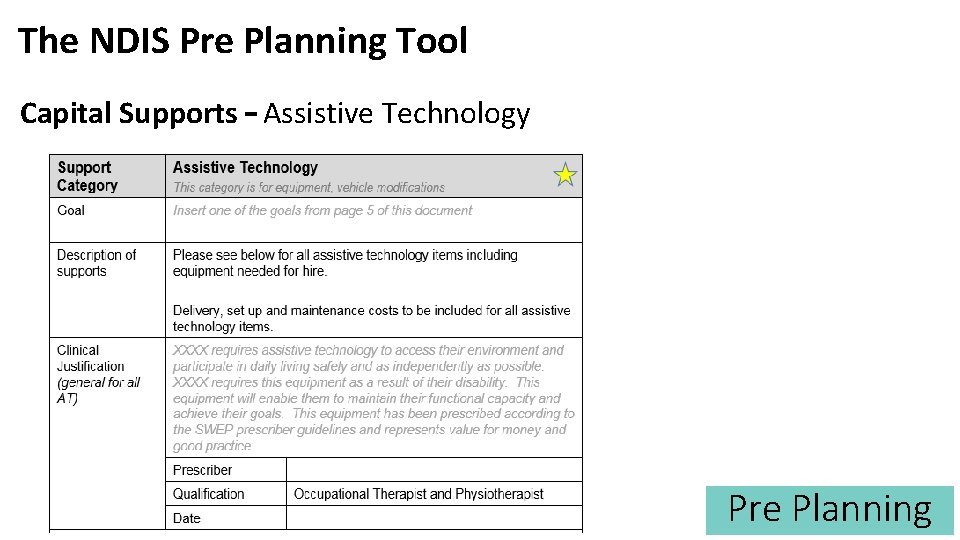
The NDIS Pre Planning Tool Capital Supports – Assistive Technology Pre Planning
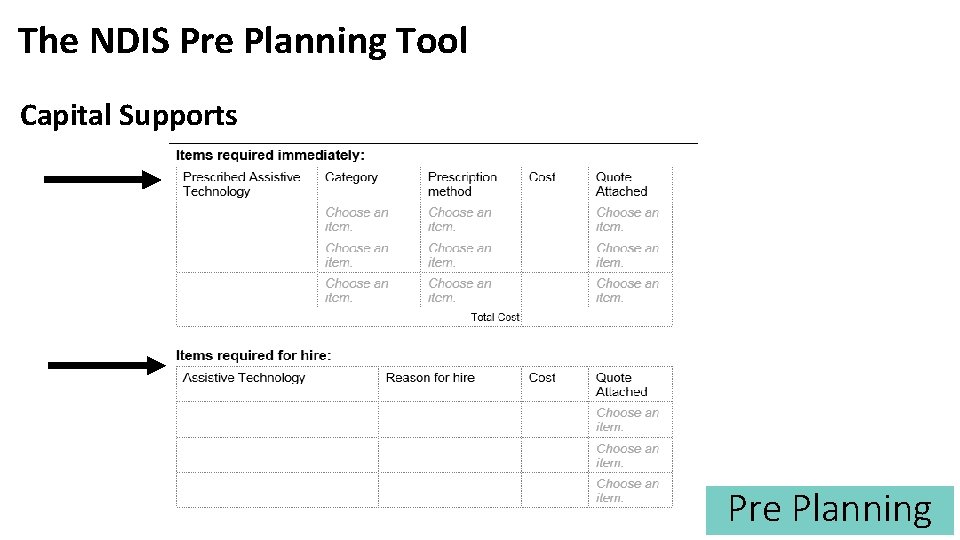
The NDIS Pre Planning Tool Capital Supports Pre Planning
The NDIS Pre Planning Tool Capital Supports **Link to Capacity Building Supports Pre Planning
The NDIS Pre Planning Tool Capital Supports - Home Modifications and SDA Pre Planning
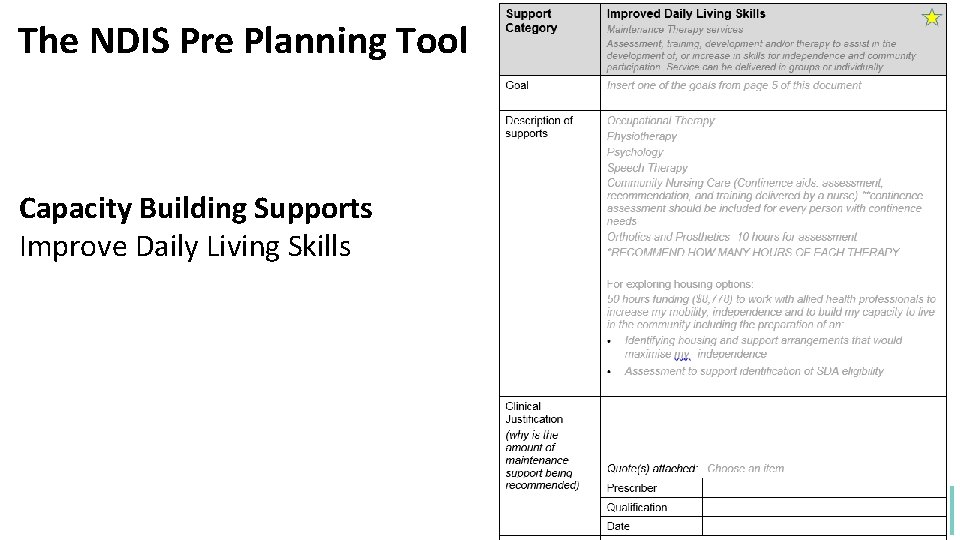
The NDIS Pre Planning Tool Capacity Building Supports - HELP BOX • Capacity Building supports are not flexible • Capacity Building supports enable a participant to build their independence and skills • Health services are responsible for rehabilitation after discharge from hospital • It may be appropriate to seek a quote from a community provider for services • Support Coordination is a vital role in plan implementation • If someone is being discharged to residential aged care, and they wish to explore other housing options, Capacity Building Improved Daily Living skills and Capacity Building Coordination of Supports should specify this goal and associated hours of support (see example) Pre Planning
The NDIS Pre Planning Tool Capacity Building Supports Improve Daily Living Skills Pre Planning
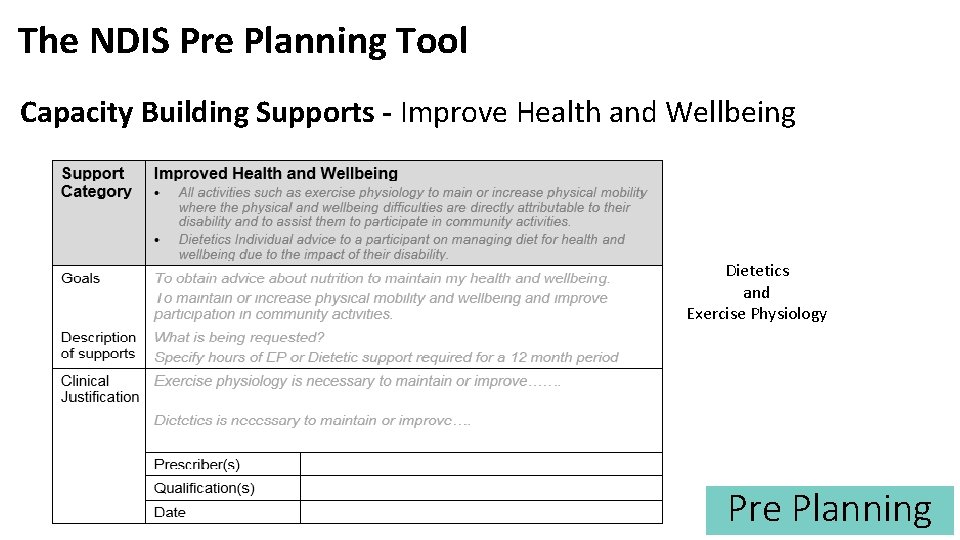
The NDIS Pre Planning Tool Capacity Building Supports - Improve Health and Wellbeing Dietetics and Exercise Physiology Pre Planning
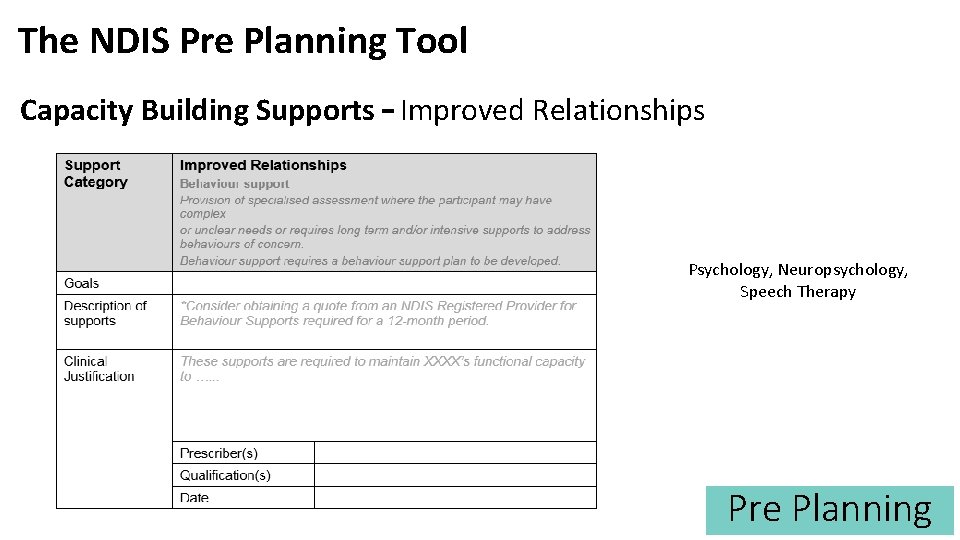
The NDIS Pre Planning Tool Capacity Building Supports – Improved Relationships Psychology, Neuropsychology, Speech Therapy Pre Planning
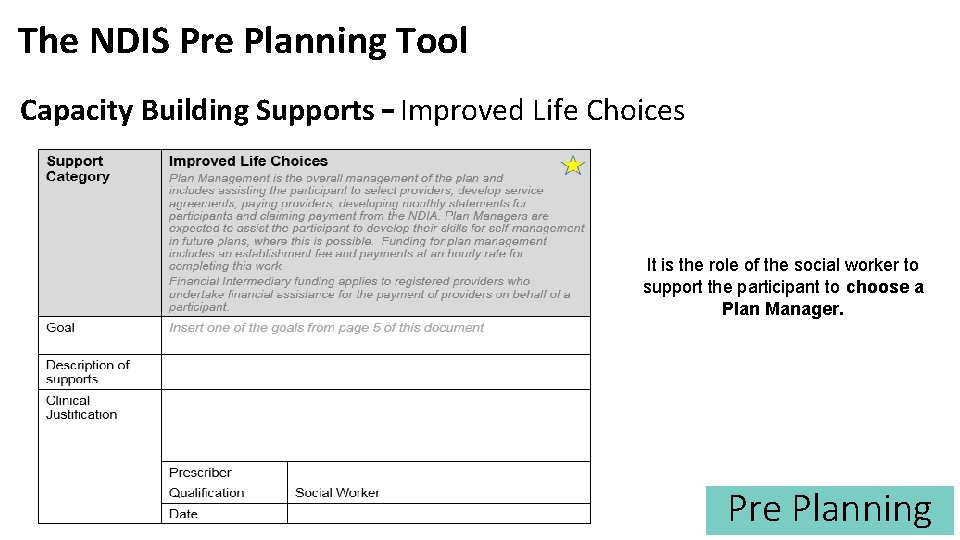
The NDIS Pre Planning Tool Capacity Building Supports – Improved Life Choices It is the role of the social worker to support the participant to choose a Plan Manager. Pre Planning
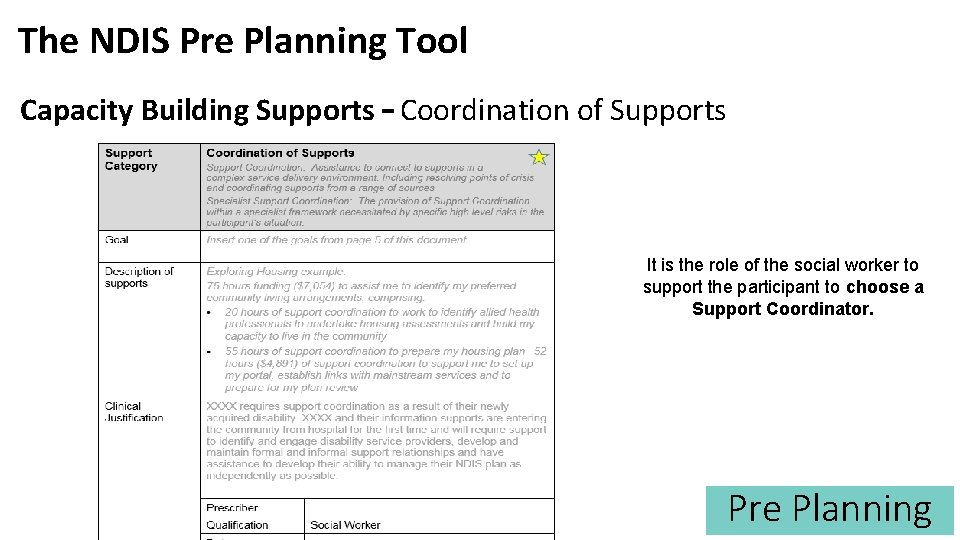
The NDIS Pre Planning Tool Capacity Building Supports – Coordination of Supports It is the role of the social worker to support the participant to choose a Support Coordinator. Pre Planning
Pre Planning The Pre Planning Meeting • The health team and the patient • Review the NDIS Pre Planning Tool • Discuss planning meeting (attendees, likely events, time, place, etc)
Planning NDIS Planning Meeting • 1 to 2 hour meeting conducted by an NDIS Planner or a Local Area Coordinator (LAC) • The purpose of the Planning Meeting is for the LAC or Planner and the participant to discuss the participant’s goals and support needs. • OT, Social Work, Speech (as needed)
Plan Implementation • Plan Implementation is best done by a Support Coordinator in collaboration with the health team for individuals with complex support needs.
Overview: The Role of the Health Team