
NCSX Operation of the C 1 Modular Coil
- Slides: 28
NCSX Operation of the C 1 Modular Coil in the Coil Test Facility Peer Review June 1, 2006
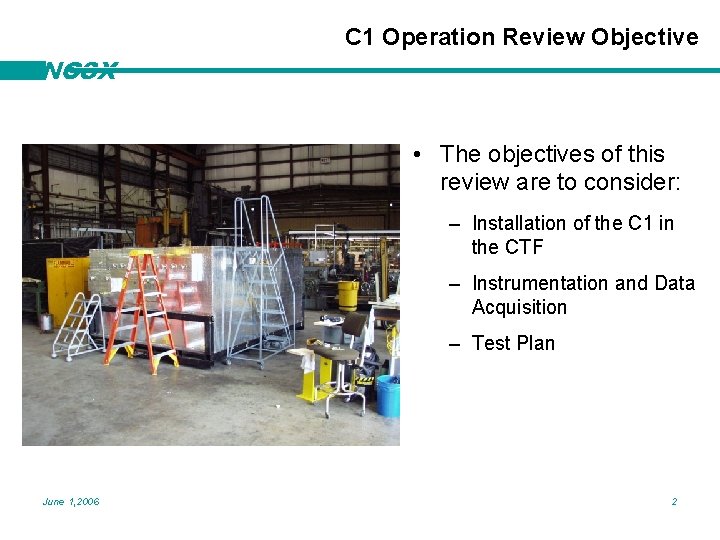
C 1 Operation Review Objective NCSX • The objectives of this review are to consider: – Installation of the C 1 in the CTF – Instrumentation and Data Acquisition – Test Plan June 1, 2006 2
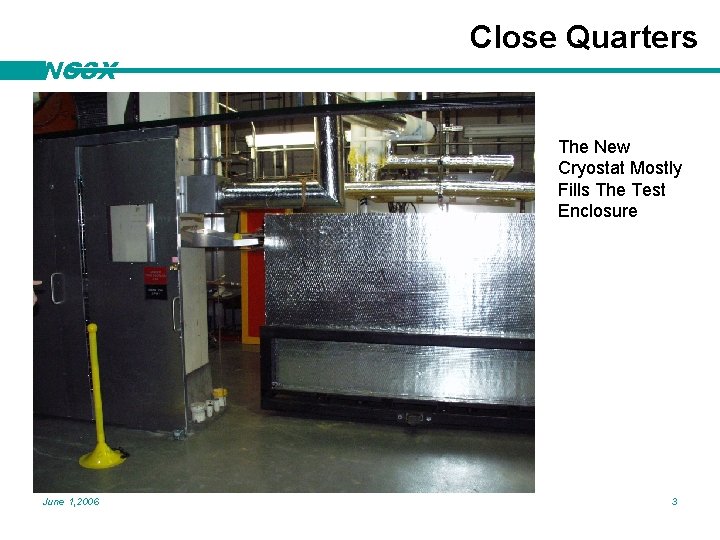
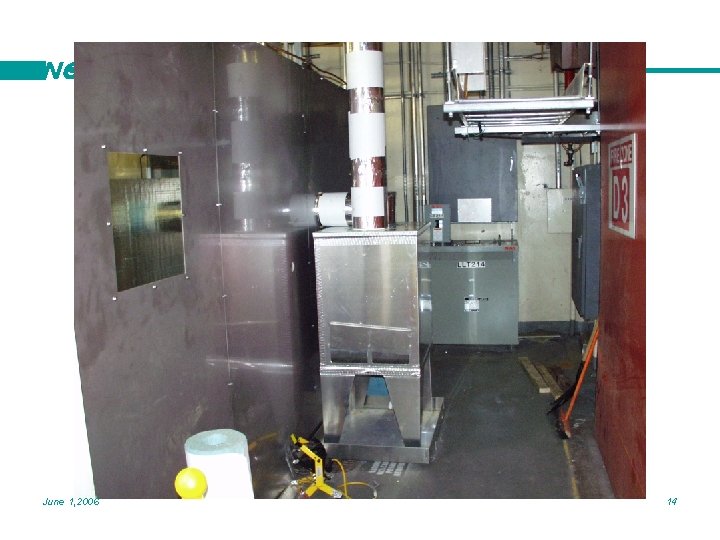
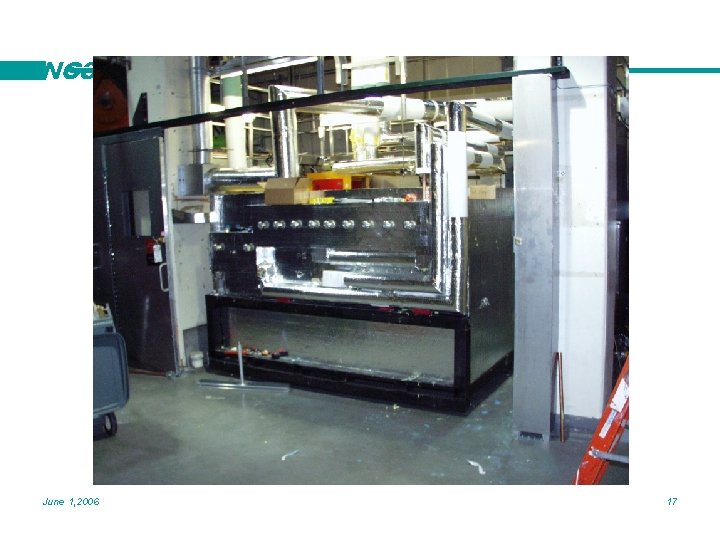
NCSX Close Quarters The New Cryostat Mostly Fills The Test Enclosure June 1, 2006 3
NCSX ES&H Changes • Magnetic field exposure for personnel is slightly higher for the C 1 test. The barrier distance increases from 15 feet to 23 feet. • The C 1 cryostat is large enough to impede access to and egress from the test enclosure. Three access doors allow entrance to the enclosure with necessary procedure changes (RLM: von Halle). – May become classified as a Confined Space June 1, 2006 4
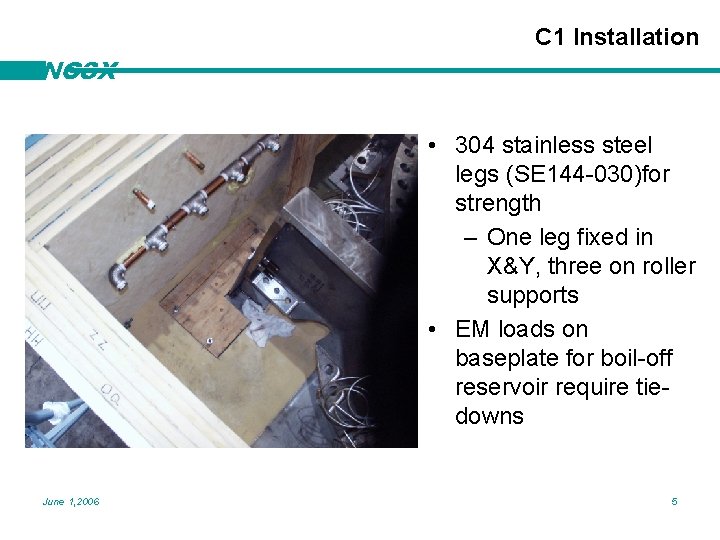
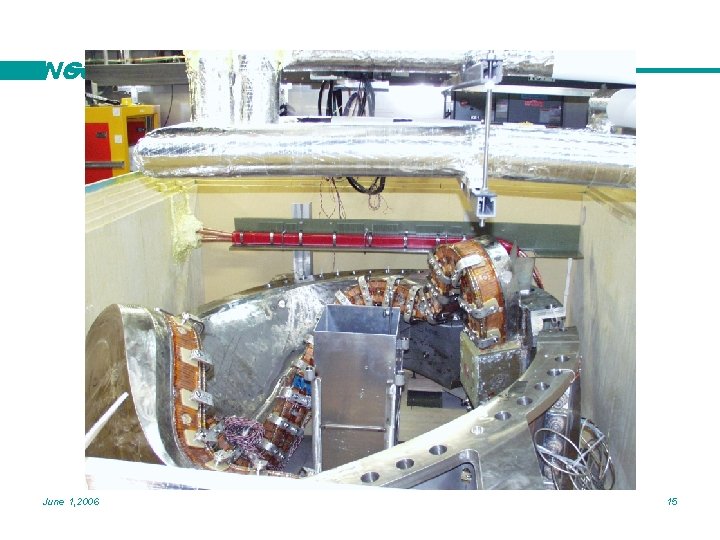
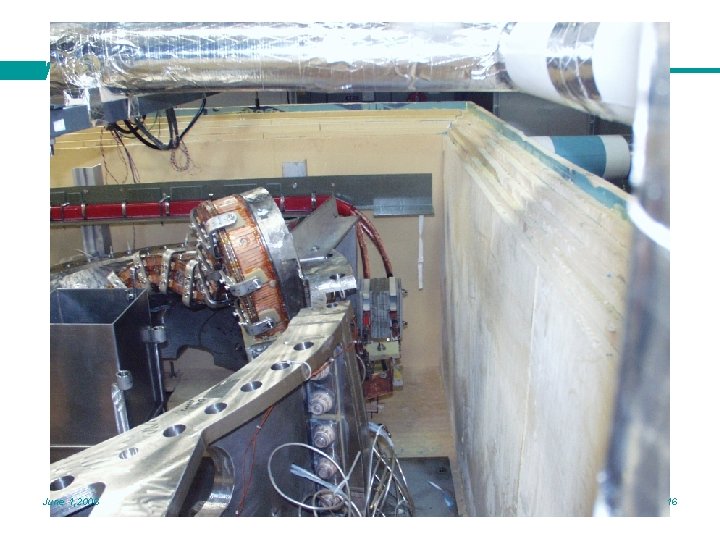
C 1 Installation NCSX • 304 stainless steel legs (SE 144 -030)for strength – One leg fixed in X&Y, three on roller supports • EM loads on baseplate for boil-off reservoir require tiedowns June 1, 2006 5
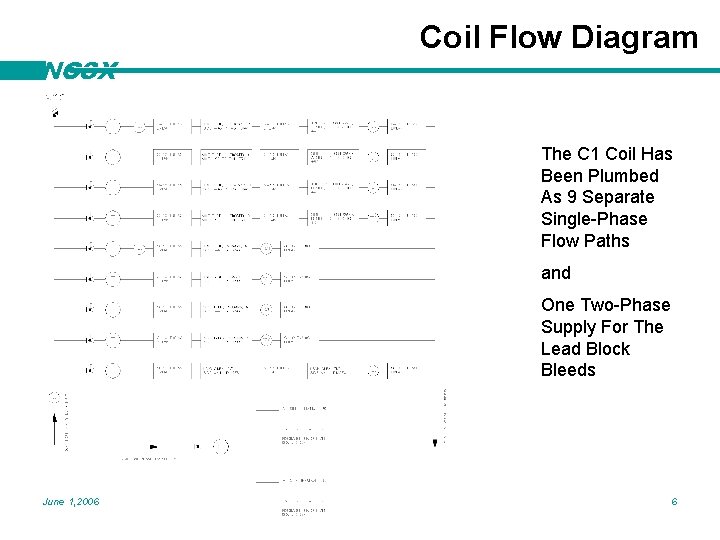
NCSX Coil Flow Diagram The C 1 Coil Has Been Plumbed As 9 Separate Single-Phase Flow Paths and One Two-Phase Supply For The Lead Block Bleeds June 1, 2006 6
NCSX The Plumbing B-Plan • Teflon tubing with Swagelok joints and custom backing inserts were not reliable – 40 psig was the best pressure achieved – The previous style of insulating G-10 pipe nipples will be used in the plumbing June 1, 2006 7
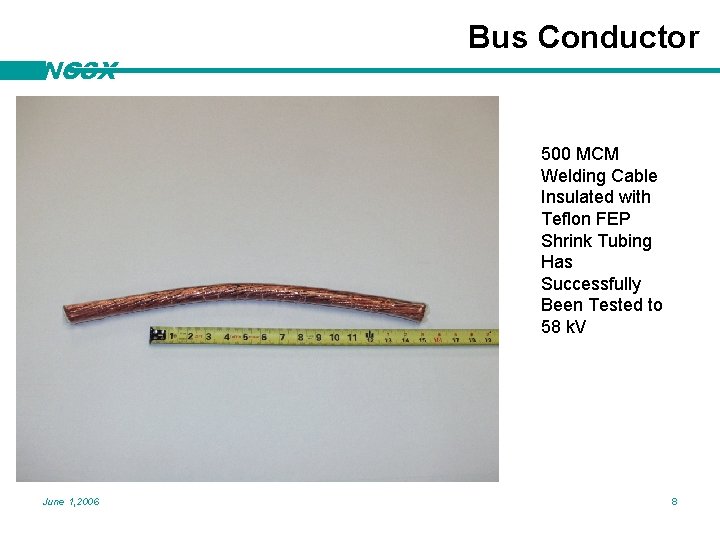
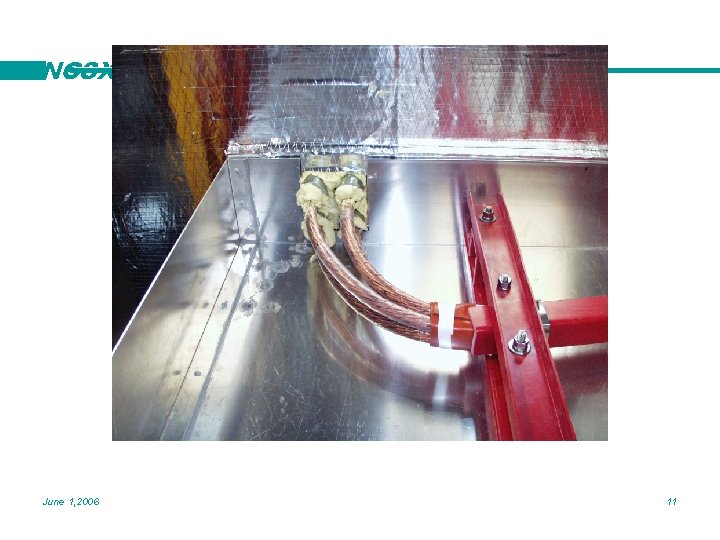
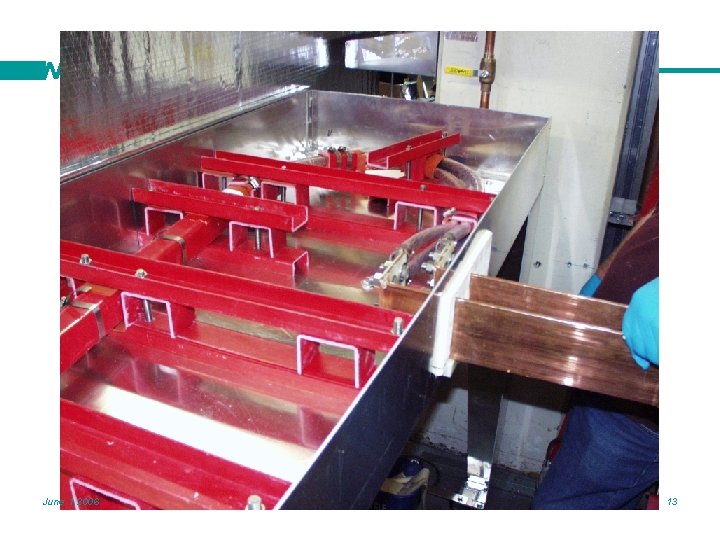
NCSX Bus Conductor 500 MCM Welding Cable Insulated with Teflon FEP Shrink Tubing Has Successfully Been Tested to 58 k. V June 1, 2006 8
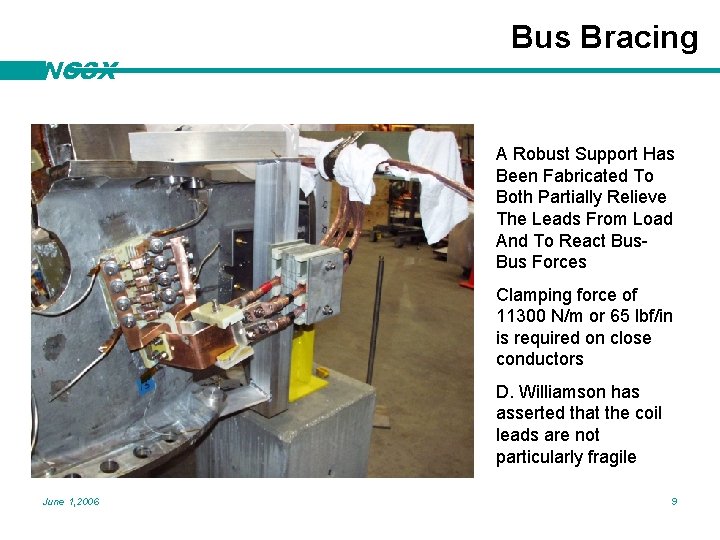
NCSX Bus Bracing A Robust Support Has Been Fabricated To Both Partially Relieve The Leads From Load And To React Bus Forces Clamping force of 11300 N/m or 65 lbf/in is required on close conductors D. Williamson has asserted that the coil leads are not particularly fragile June 1, 2006 9
NCSX Lead Insulation • Maximum voltage across coil is expected to be approximately 499 volts – The G 11 CR lead sleeves designed and machined for the production coils are being used for this test set-up June 1, 2006 10
NCSX June 1, 2006 11
NCSX June 1, 2006 12
NCSX June 1, 2006 13
NCSX June 1, 2006 14
NCSX June 1, 2006 15
NCSX June 1, 2006 16
NCSX June 1, 2006 17
NCSX Test Objectives • Main purpose – calibrate FE models with actual data – Improves confidence with which models can be used for future what-if inquiries. • Secondary purpose – assess cooldown/recovery performance from ambient temperature and after pulses June 1, 2006 18
NCSX Dimensional/Deflection Measurements • 3 measurement approaches – Extensive strain gauge array – Mechanical displacement measurement – Manual measurement of total width of both winding packs before and after June 1, 2006 19
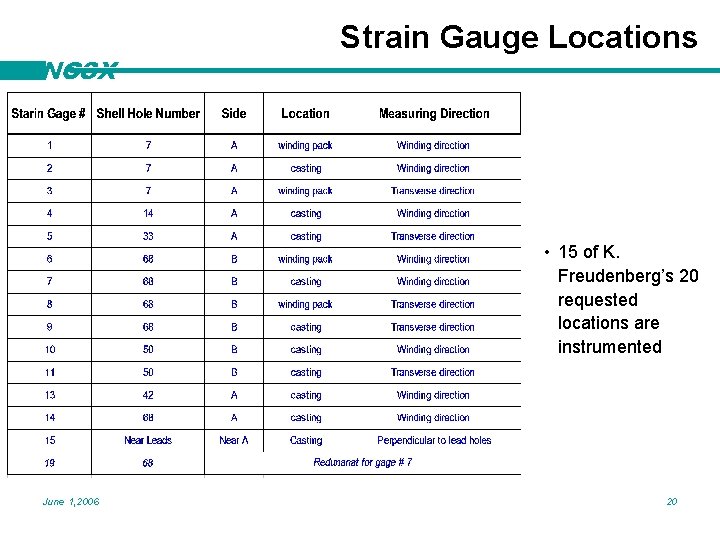
NCSX Strain Gauge Locations • 15 of K. Freudenberg’s 20 requested locations are instrumented June 1, 2006 20
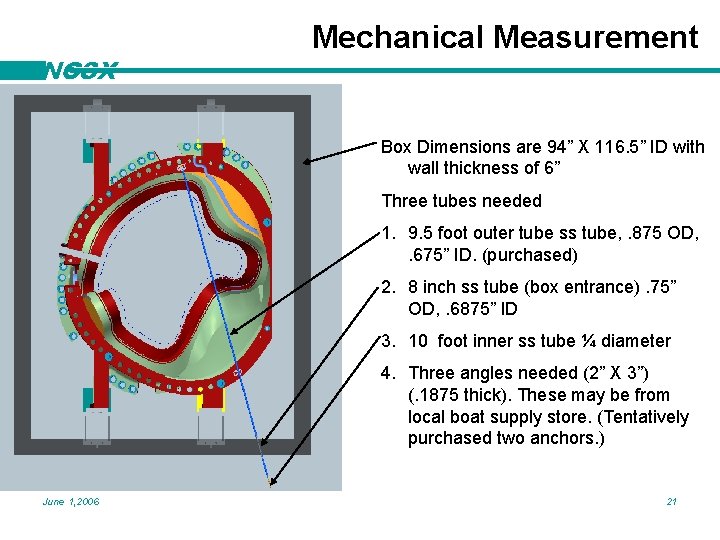
NCSX Mechanical Measurement Box Dimensions are 94” X 116. 5” ID with wall thickness of 6” Three tubes needed 1. 9. 5 foot outer tube ss tube, . 875 OD, . 675” ID. (purchased) 2. 8 inch ss tube (box entrance). 75” OD, . 6875” ID 3. 10 foot inner ss tube ¼ diameter 4. Three angles needed (2” X 3”) (. 1875 thick). These may be from local boat supply store. (Tentatively purchased two anchors. ) June 1, 2006 21
NCSX Thermal Measurements • Extensive strain gauge and t/c data collection system • V/I resistance inference – This is a key feature as it is prototypical of the first-plasma machine protection scheme – ADMINISTRATIVE control of coil temperature through resistance value (wait for next pulse until cool) June 1, 2006 22
NCSX Temperature Differentials • Fiberglass convection insulation will be installed on coil with fiberglass rope • Only outer aspect of coil will be exposed to cooling • Two T/C’s will be installed near the winding packs on coolant tubes. The resulting temperatures will be used to monitor the delta. T between the windings and the MCWF. • A 50 C difference has been recommended. June 1, 2006 23
NCSX Test Sequence – Lift the both ends of the cable bus assembly and megger pole-pole to 3 k. V – Restore the bus at the coil end and megger the warm coil to ground to 7. 5 k. V – Completely restore the bus and measure the warm circuit resistance from the rectifier room – Collect winding pack width data prior to cool-down – Cool the coil to ~80 K with proper data collection June 1, 2006 24
NCSX Test Sequence (cont. ) – Measure the cold circuit resistance from the rectifier room – Perform basic shot sequence with T/C, strain archival and V/I cooldown checks – Warm up to install mechanical measurement rig – 5 k. A room temperature pulse for K. F. – Cool down, repeat shot sequence, collect previous data plus displacements – Warm up facility – Measure final winding pack dimensions June 1, 2006 25
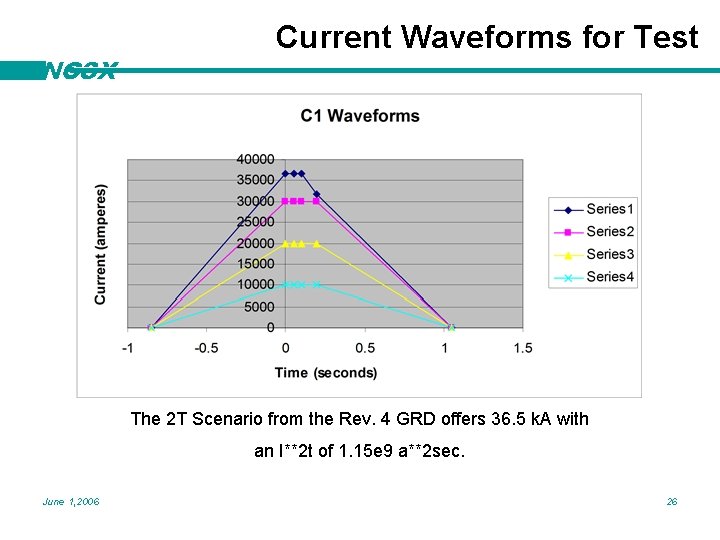
NCSX Current Waveforms for Test The 2 T Scenario from the Rev. 4 GRD offers 36. 5 k. A with an I**2 t of 1. 15 e 9 a**2 sec. June 1, 2006 26
NCSX Protective Circuitry • Protective Settings – Maximum “On” time – 2. 3 seconds - no change from TRC – Tau (thermal) – 200 seconds – no change – Minimum cycle time – 900 seconds – no change – I**2 t max – 1. 6 e 9 a**2 sec – no change – Imax – 38. 5 k. A up from 33 k. A June 1, 2006 27
NCSX June 1, 2006 28