
NCSX Keystoning and its Influence on Winding Pack
- Slides: 14
NCSX Keystoning and its Influence on Winding Pack Design Wayne Reiersen 30 July 2003 Reiersen - 1
NCSX Keystoning It has been recognized that when a conductor (solid or cabled) is bent around a small radius, the conductor cross-section will deform – this phenomenon is called keystoning Keystoning has two deleterious effects • Added difficulty in controlling the current center in the winding pack • Increased current density due to loss of copper area Minimizing keystoning is important to avoid these effects 30 July 2003 Reiersen - 2
NCSX Keystoning tests A test matrix has been structured based on the following parameters: • Insulation (none, 1 half-lapped layer, 2 half-lapped layers) • Winding direction (easy, hard) • Cabling law (inside 3 conductors twisted in the same direction, opposite direction, and straight relative to outer 9 conductors) • Winding form (disk, pipe) Today’s results based largely on winding trials with parameters highlighted in green – full set of raw data available Comparison made to earlier results with 2 half-lapped layers of insulation – reduced set of data available 30 July 2003 Reiersen - 3
NCSX Keystoning tests w/o insulation A model developed by Brooks suggested that keystoning of cabled conductor should scale with the ratio of the width to the bend radius • “Width” is defined as the conductor dimension in the direction of the bend radius • The dominant deformation should be in the “height” direction The latest round of keystoning tests were performed without insulation to separate out its effects • Nominal conductor dimensions were 0. 539” (+/-0. 010”) by 0. 660” (+/-0. 010”) 30 July 2003 Reiersen - 4
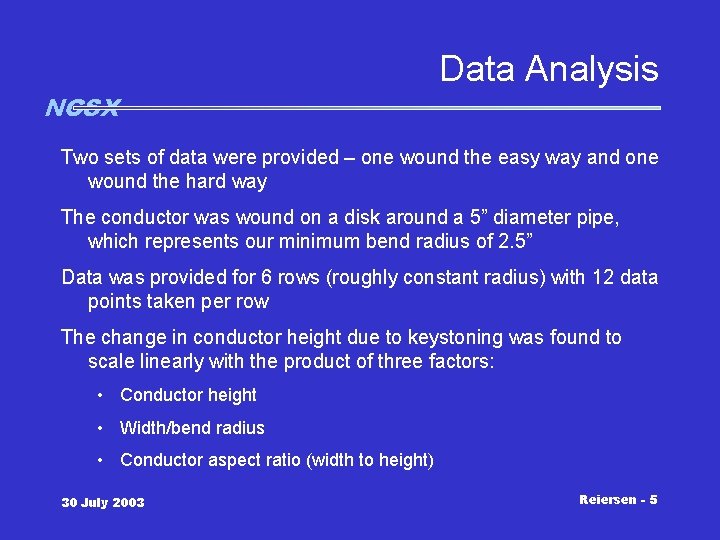
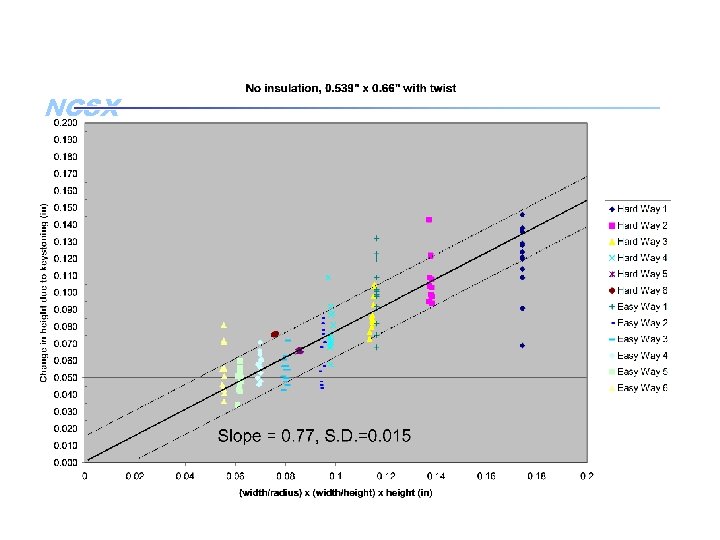
NCSX Data Analysis Two sets of data were provided – one wound the easy way and one wound the hard way The conductor was wound on a disk around a 5” diameter pipe, which represents our minimum bend radius of 2. 5” Data was provided for 6 rows (roughly constant radius) with 12 data points taken per row The change in conductor height due to keystoning was found to scale linearly with the product of three factors: • Conductor height • Width/bend radius • Conductor aspect ratio (width to height) 30 July 2003 Reiersen - 5
NCSX 30 July 2003 Reiersen - 6
NCSX 30 July 2003 Reiersen - 7
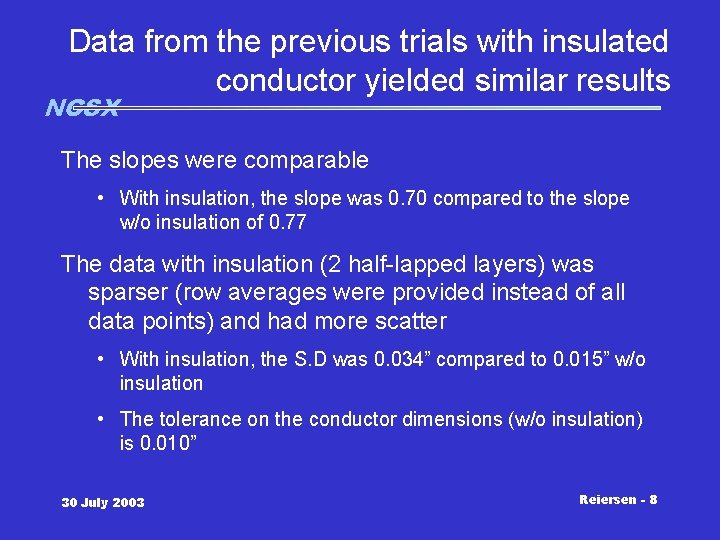
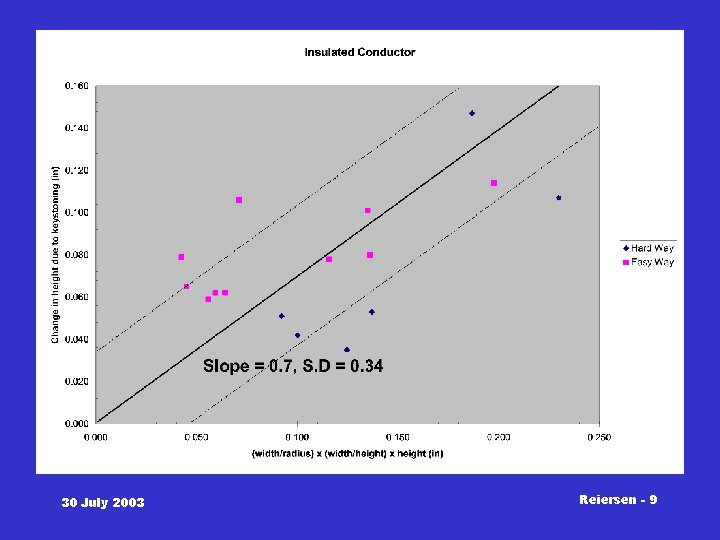
Data from the previous trials with insulated conductor yielded similar results NCSX The slopes were comparable • With insulation, the slope was 0. 70 compared to the slope w/o insulation of 0. 77 The data with insulation (2 half-lapped layers) was sparser (row averages were provided instead of all data points) and had more scatter • With insulation, the S. D was 0. 034” compared to 0. 015” w/o insulation • The tolerance on the conductor dimensions (w/o insulation) is 0. 010” 30 July 2003 Reiersen - 8
NCSX 30 July 2003 Reiersen - 9
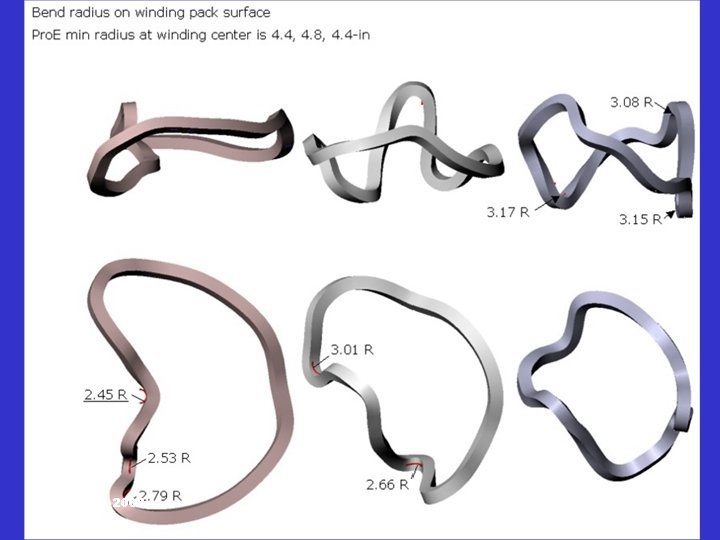
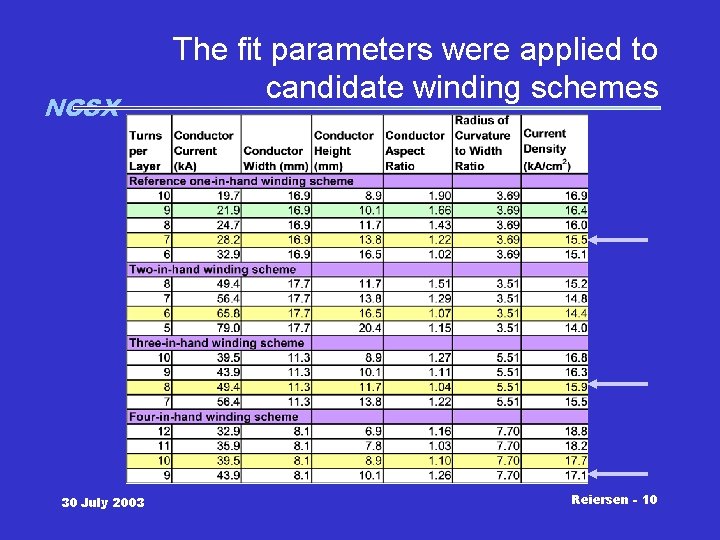
NCSX 30 July 2003 The fit parameters were applied to candidate winding schemes Reiersen - 10
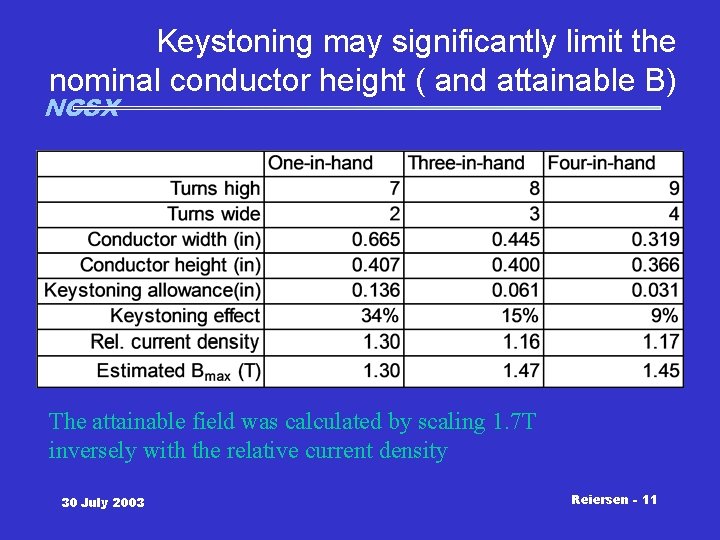
Keystoning may significantly limit the nominal conductor height ( and attainable B) NCSX The attainable field was calculated by scaling 1. 7 T inversely with the relative current density 30 July 2003 Reiersen - 11
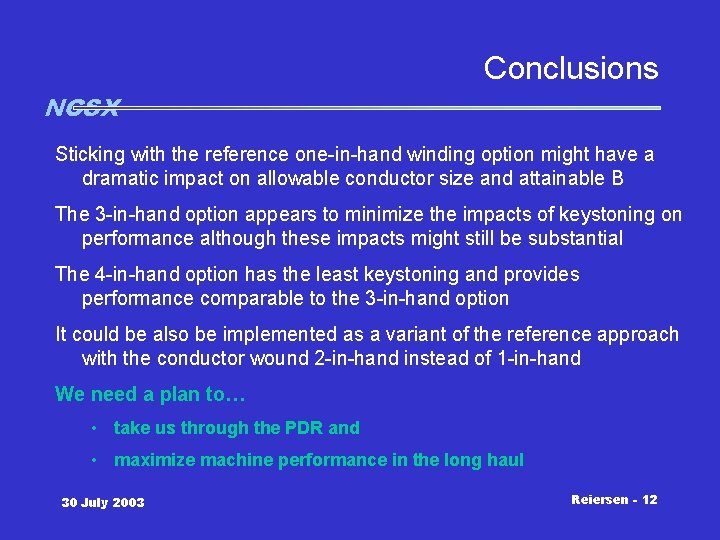
Conclusions NCSX Sticking with the reference one-in-hand winding option might have a dramatic impact on allowable conductor size and attainable B The 3 -in-hand option appears to minimize the impacts of keystoning on performance although these impacts might still be substantial The 4 -in-hand option has the least keystoning and provides performance comparable to the 3 -in-hand option It could be also be implemented as a variant of the reference approach with the conductor wound 2 -in-hand instead of 1 -in-hand We need a plan to… • take us through the PDR and • maximize machine performance in the long haul 30 July 2003 Reiersen - 12
NCSX Postscript New data arrived this morning for INSULATED conductor Dimensions were measured BEFORE winding • The average height was 0. 721” with a S. D. of 0. 0037” • The average width was 0. 620” with a S. D. of 0. 0049” • Nominal conductor dimensions are 0. 539” x 0. 660”. Nominal insulation thickness is 0. 035”. Insulation “fluffing” is very small. • Standard deviations are smaller than the conductor tol. of 0. 010” Keystoning tests were done winding the easy way only • Results were consistent (but more favorable) than previous results • The slope was 0. 54 (v. 0. 77) which indicates that the keystoning effect with the conductor/insulation scheme is more benign • The S. D. was about the same – 0. 134 (v. 0. 15) – indicating a comparable degree of consistency with the model 30 July 2003 Reiersen - 13
NCSX 30 July 2003 New conductor with reduced insulation thickness Reiersen - 14