
NCSX Cryostat and Cooling of Stellarator Core Steve



- Slides: 25
NCSX Cryostat and Cooling of Stellarator Core Steve Raftopoulos NCSX Cryostat WBS(171) Manager Peer Review, April 23, 2008
Table of Contents • Introduction • Requirements • Interfaces • Design plans Peer Review, April 23, 2008 S. Raftopoulos page 2
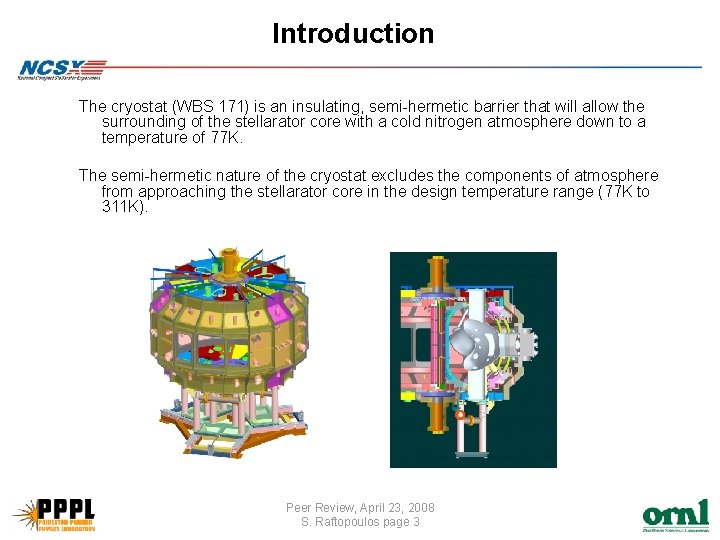
Introduction The cryostat (WBS 171) is an insulating, semi-hermetic barrier that will allow the surrounding of the stellarator core with a cold nitrogen atmosphere down to a temperature of 77 K. The semi-hermetic nature of the cryostat excludes the components of atmosphere from approaching the stellarator core in the design temperature range (77 K to 311 K). Peer Review, April 23, 2008 S. Raftopoulos page 3
Requirements WBS 171 (cryostat) 1. Must be gas-tight to internal positive pressure. – 2. Must provide penetrations for vessel extensions, electrical & hydraulic lines, stellerator supports, etc. – 3. 5. 6. In order to limit LN 2 usage to ~2 trailers per week. Cryostat panels shall contain a feature allowing the admission of ambient temperature nitrogen gas. – 8. Demountable design Removable panels. Shall withstand vacuum vessel displacements (~1/4” radial) due to thermal expansion/contraction. Shall withstand displacements (~1/4” radial) due to movement of the coil/coil support structure during magnet pulse and cooldown. The cryostat design, including penetrations and joint sealing, shall limit the influx of ambient heat to about 14 k. W. – 7. Shall be have provisions for custom configuration, i. e. future penetrations. Shall allow access to internal volume for stellerator maintenance – – 4. Small leaks are a nuisance, large leaks are expensive, very large leakage may risk ability to operate stellarator, in-leakage of air may damage components. Inhibits the oxygen enrichment of the panel system Shall be compatible with all indentified ES&H requirements and best practices. Peer Review, April 23, 2008 S. Raftopoulos page 4
Interfaces • MECHANICAL – EVERYTHING is either within or passes through the cryostat. A system interface document will address all interfaces, including planned (and unplanned) maintenance. • ELECTRICAL – Coil buss work – Signal and control cabling • ENVIRONMENTAL/SAFETY – Test cell (maintain environment safe for occupation) • Oxygen deficiency in Test Cell and Test Cell Basement must be addressed • Oxygen enrichment must be avoided. – HVAC (nitrogen gas must be vented outside via ducting. Peer Review, April 23, 2008 S. Raftopoulos page 5
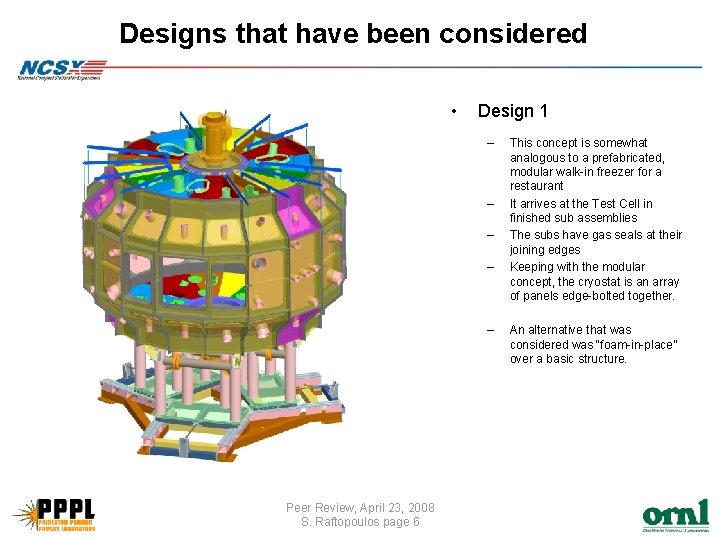
Designs that have been considered • Design 1 – – – Peer Review, April 23, 2008 S. Raftopoulos page 6 This concept is somewhat analogous to a prefabricated, modular walk-in freezer for a restaurant It arrives at the Test Cell in finished sub assemblies The subs have gas seals at their joining edges Keeping with the modular concept, the cryostat is an array of panels edge-bolted together. An alternative that was considered was “foam-in-place” over a basic structure.
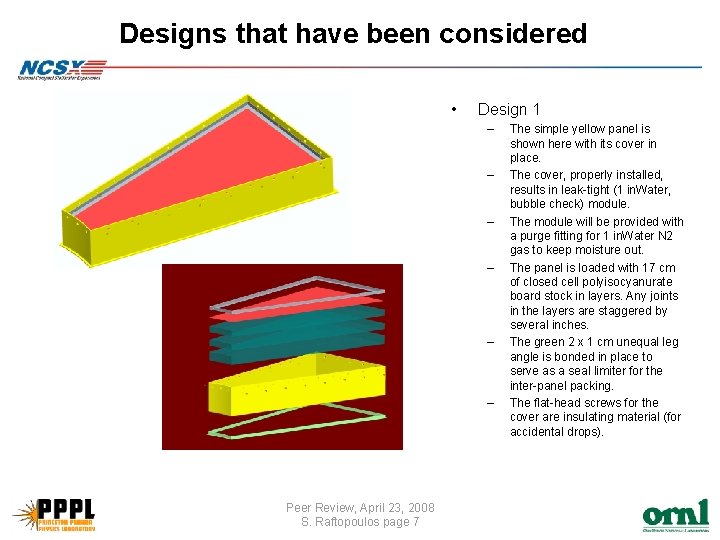
Designs that have been considered • Design 1 – – – Peer Review, April 23, 2008 S. Raftopoulos page 7 The simple yellow panel is shown here with its cover in place. The cover, properly installed, results in leak-tight (1 in. Water, bubble check) module. The module will be provided with a purge fitting for 1 in. Water N 2 gas to keep moisture out. The panel is loaded with 17 cm of closed cell polyisocyanurate board stock in layers. Any joints in the layers are staggered by several inches. The green 2 x 1 cm unequal leg angle is bonded in place to serve as a seal limiter for the inter-panel packing. The flat-head screws for the cover are insulating material (for accidental drops).
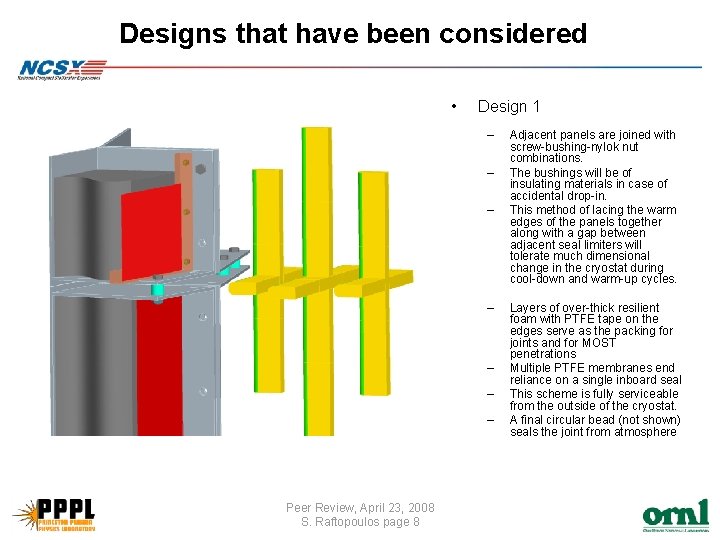
Designs that have been considered • Design 1 – – – – Peer Review, April 23, 2008 S. Raftopoulos page 8 Adjacent panels are joined with screw-bushing-nylok nut combinations. The bushings will be of insulating materials in case of accidental drop-in. This method of lacing the warm edges of the panels together along with a gap between adjacent seal limiters will tolerate much dimensional change in the cryostat during cool-down and warm-up cycles. Layers of over-thick resilient foam with PTFE tape on the edges serve as the packing for joints and for MOST penetrations Multiple PTFE membranes end reliance on a single inboard seal This scheme is fully serviceable from the outside of the cryostat. A final circular bead (not shown) seals the joint from atmosphere
Design Concept 1 • Pros – Modular panel design, allows access to stellarator as required. – Rigid panelized system, fabricated in relatively small sections that are easy to transport and handle. – Readily repairable in-situ if damaged. – Preliminary mechanical and thermal analysis already done for this design. • Cons – – Incorporates many linear feet of seals. Unproven sealing technique – needs prototyping/proof of principle. Cost is higher than alternative being explored. Panelized base of cryostat may not contain LN 2 if gas condenses and accumulates as liquid. Peer Review, April 23, 2008 S. Raftopoulos page 9
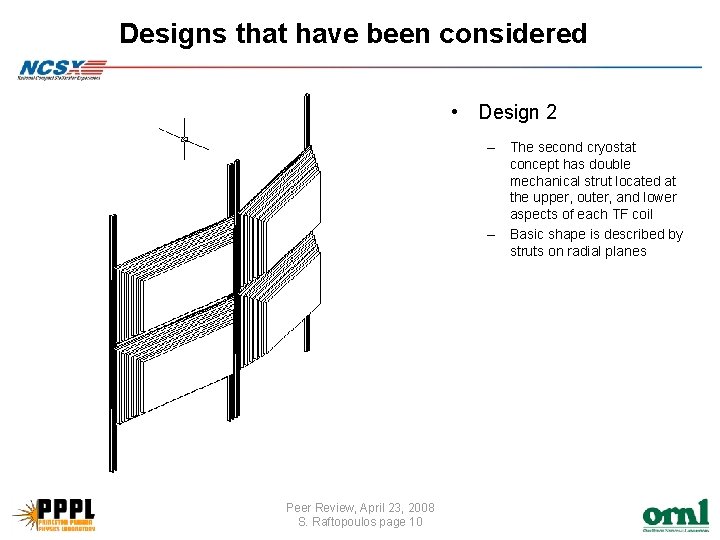
Designs that have been considered • Design 2 – The second cryostat concept has double mechanical strut located at the upper, outer, and lower aspects of each TF coil – Basic shape is described by struts on radial planes Peer Review, April 23, 2008 S. Raftopoulos page 10
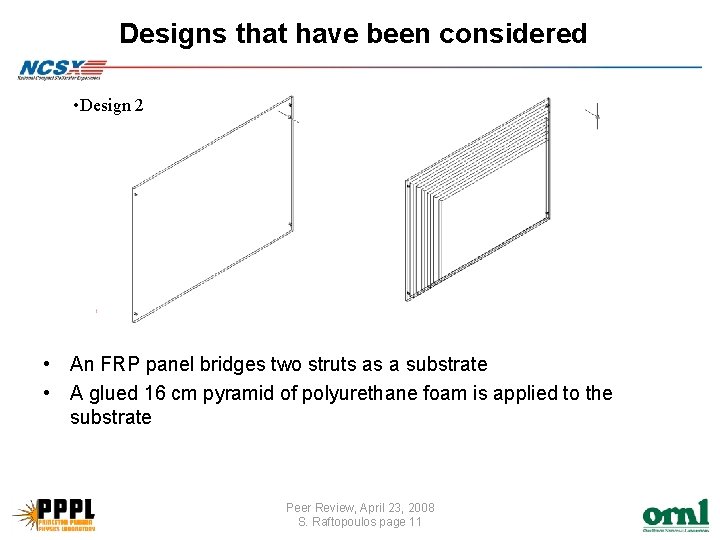
Designs that have been considered • Design 2 • An FRP panel bridges two struts as a substrate • A glued 16 cm pyramid of polyurethane foam is applied to the substrate Peer Review, April 23, 2008 S. Raftopoulos page 11
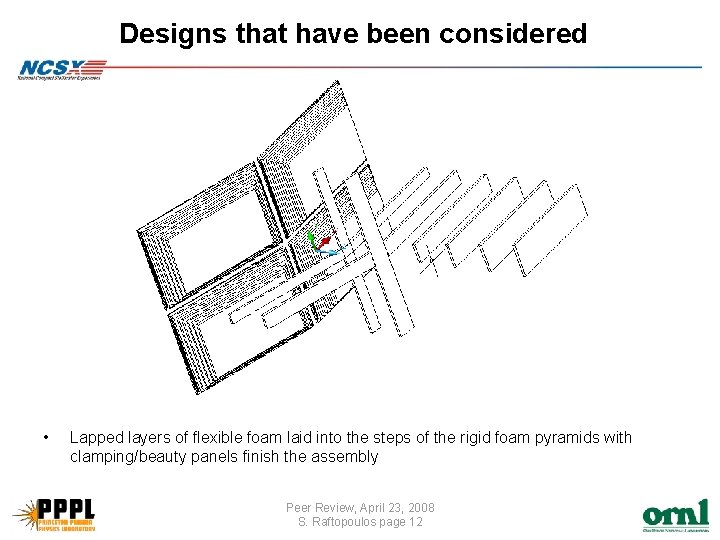
Designs that have been considered • Lapped layers of flexible foam laid into the steps of the rigid foam pyramids with clamping/beauty panels finish the assembly Peer Review, April 23, 2008 S. Raftopoulos page 12
Design Concept 2 • Pros – Modular panel design, components are common “off the shelf” items, readily available and inexpensive. – Design incorporates “loose” tolerances, intentionally chosen to keep fabrication costs down. “Woodworking” tolerances apply. – This design is cheap to manufacture and affords maximum access to NCSX device. • Cons – Incorporates many, many linear feet of seals. – Unproven sealing technique – needs prototyping/proof of principle. – Panelized base of cryostat may not contain LN 2 if gas condenses and accumulates as liquid. Peer Review, April 23, 2008 S. Raftopoulos page 13
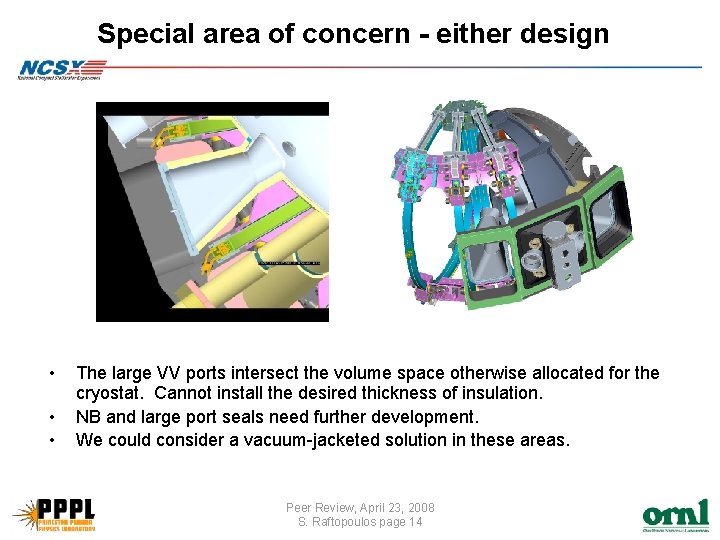
Special area of concern - either design • • • The large VV ports intersect the volume space otherwise allocated for the cryostat. Cannot install the desired thickness of insulation. NB and large port seals need further development. We could consider a vacuum-jacketed solution in these areas. Peer Review, April 23, 2008 S. Raftopoulos page 14
Design Alternatives • A simpler cryostat (like the Alcator C-Mod), that uses a upper/lower “dome” and minimally segmented cylinder. • One derivative of this approach would be to increase the diameter to allow access for an individual to maneuver within the cryostat, Pros • More easily sealable, reliable • Lower, one-piece dome would contain liquid. – Cons • Loose a large degree of accessibility • Adds length to the port tubes used by diagnostics (reduced aperture) • Instead of pliable foam seal, we could “foam-in” the joints and cut them out when access is needed. Peer Review, April 23, 2008 S. Raftopoulos page 15
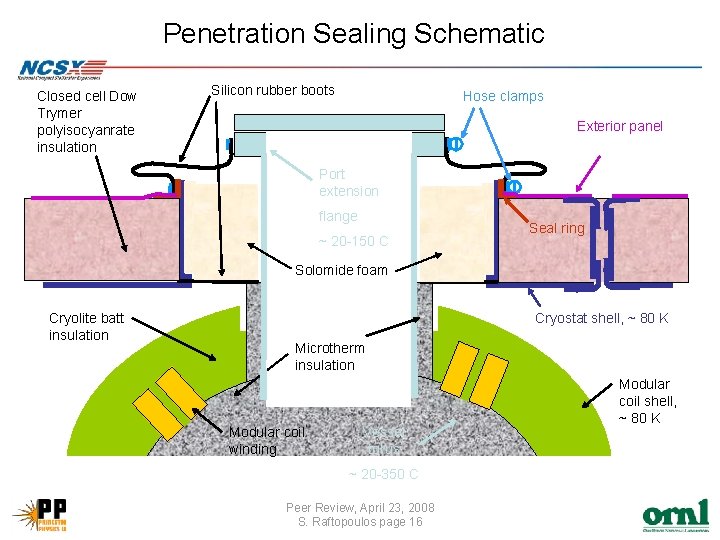
Penetration Sealing Schematic Closed cell Dow Trymer polyisocyanrate insulation Silicon rubber boots Hose clamps Exterior panel Port extension flange ~ 20 -150 C Seal ring Solomide foam Cryolite batt insulation Cryostat shell, ~ 80 K Microtherm insulation Modular coil winding Vessel torus ~ 20 -350 C Peer Review, April 23, 2008 S. Raftopoulos page 16 Modular coil shell, ~ 80 K
Penetration Basics • Inner boot is historically fiberglass cloth impregnated with Dow silicone compound • The penetrations be entirely serviceable from the exterior of the machine – Our ever-growing concern about confined spaces AND time-forrescue tends to call for exterior serviceability • Inboard travel limiter to prevent packed joint seals from falling in – Limiter included in basic tub would be expensive – A value-minded engineer might glue non-conductive angle on the tub Peer Review, April 23, 2008 S. Raftopoulos page 17
Cooling the Contents of the Cryostat Peer Review, April 23, 2008 S. Raftopoulos page 18
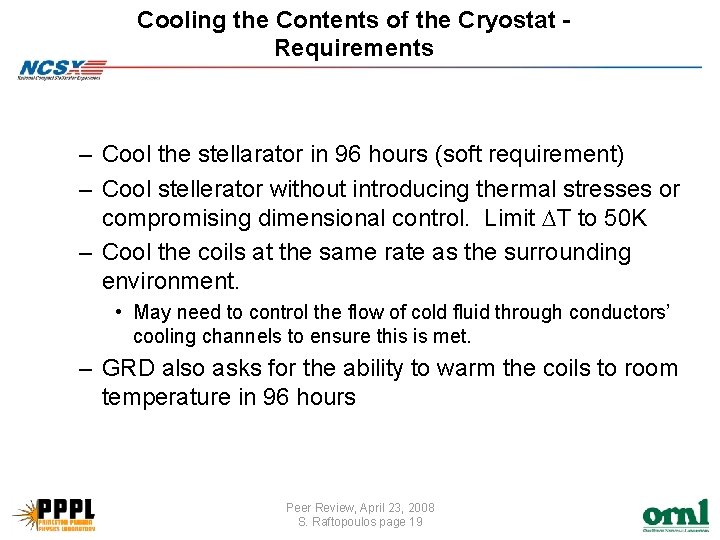
Cooling the Contents of the Cryostat Requirements – Cool the stellarator in 96 hours (soft requirement) – Cool stellerator without introducing thermal stresses or compromising dimensional control. Limit DT to 50 K – Cool the coils at the same rate as the surrounding environment. • May need to control the flow of cold fluid through conductors’ cooling channels to ensure this is met. – GRD also asks for the ability to warm the coils to room temperature in 96 hours Peer Review, April 23, 2008 S. Raftopoulos page 19
Peer Review, April 23, 2008 S. Raftopoulos page 20
Concerns • Fmea, etc. Peer Review, April 23, 2008 S. Raftopoulos page 21
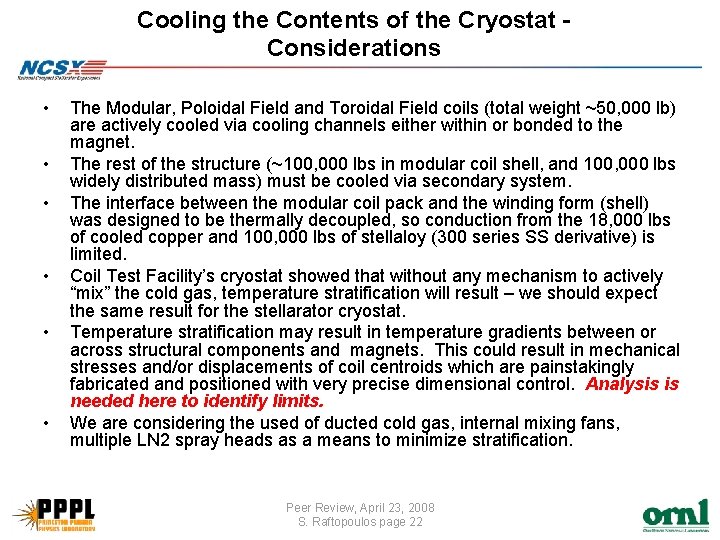
Cooling the Contents of the Cryostat Considerations • • • The Modular, Poloidal Field and Toroidal Field coils (total weight ~50, 000 lb) are actively cooled via cooling channels either within or bonded to the magnet. The rest of the structure (~100, 000 lbs in modular coil shell, and 100, 000 lbs widely distributed mass) must be cooled via secondary system. The interface between the modular coil pack and the winding form (shell) was designed to be thermally decoupled, so conduction from the 18, 000 lbs of cooled copper and 100, 000 lbs of stellaloy (300 series SS derivative) is limited. Coil Test Facility’s cryostat showed that without any mechanism to actively “mix” the cold gas, temperature stratification will result – we should expect the same result for the stellarator cryostat. Temperature stratification may result in temperature gradients between or across structural components and magnets. This could result in mechanical stresses and/or displacements of coil centroids which are painstakingly fabricated and positioned with very precise dimensional control. Analysis is needed here to identify limits. We are considering the used of ducted cold gas, internal mixing fans, multiple LN 2 spray heads as a means to minimize stratification. Peer Review, April 23, 2008 S. Raftopoulos page 22
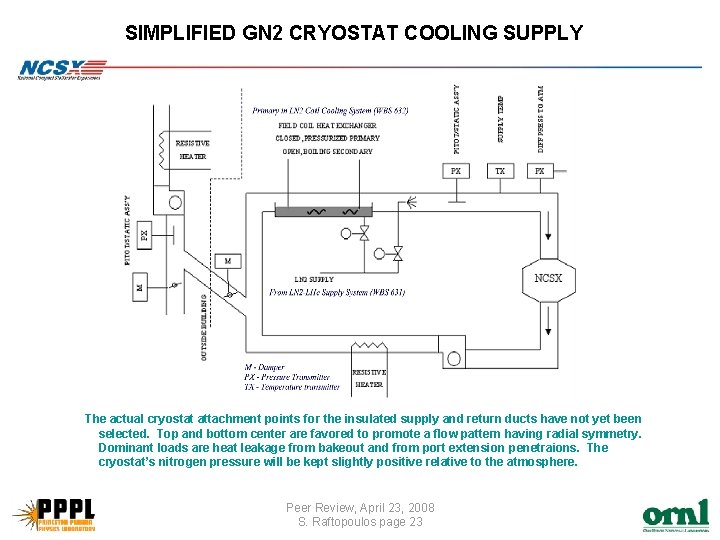
SIMPLIFIED GN 2 CRYOSTAT COOLING SUPPLY The actual cryostat attachment points for the insulated supply and return ducts have not yet been selected. Top and bottom center are favored to promote a flow pattern having radial symmetry. Dominant loads are heat leakage from bakeout and from port extension penetraions. The cryostat’s nitrogen pressure will be kept slightly positive relative to the atmosphere. Peer Review, April 23, 2008 S. Raftopoulos page 23
Possibilities? ? • Can we spray LN 2 directly onto structures. • Fans operating within the cryostat • Conduction cooling via plates or tubing will be considered (Alcator CMOD recommendation). – May be feasible for the modular coil mass, but the 100, 000 lbs of distributed mass will be difficult to cool this way Peer Review, April 23, 2008 S. Raftopoulos page 24
Risk Assessment • WBS-623 Cooling of structures • Heat loads (from hot vessel and conduction thru insulation) can be calculated, but imperfections in installation and the modular nature of the cryostat may negatively affect performance and reliability. • Condensation of liquid at bottom of cryostat may cause sealing issues resulting in LN 2 and cold gas leaks. • Stratification of GN 2 temperatures may result in uneven cooling of the structures. – Mitigation • Seeking experience of other facilities that employ cryostats. • Cooling structures via conduction (as opposed to liquid spray & evaporation) • Prototyping the LN 2/GN 2 cooling concepts will quantify risk and will lead to solutions. Peer Review, April 23, 2008 S. Raftopoulos page 25